
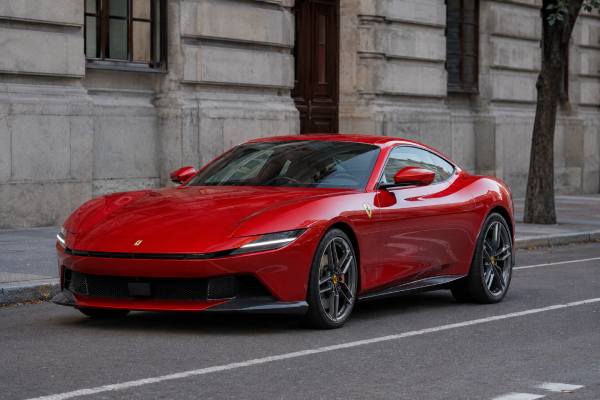
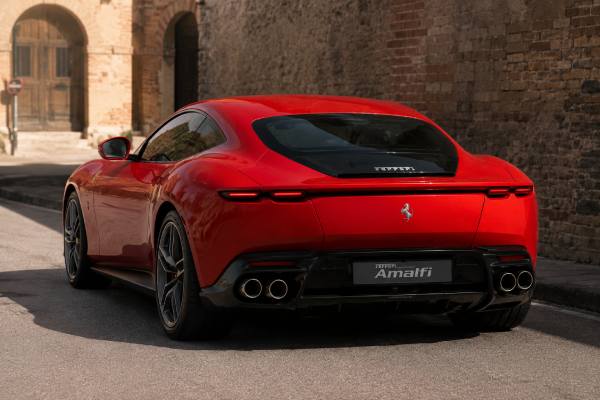
The Ferrari Amalfi is Ferrari’s modern front-mid-engine V8 grand tourer, introduced as the successor to the Roma and positioned as the elegant, usable gateway into Maranello’s two-seat-plus-two performance range. It keeps the classic Ferrari GT recipe: a long bonnet, rear-wheel drive, a compact cabin set back in the chassis, and a high-output twin-turbo V8 mounted behind the front axle.
For buyers and enthusiasts, the Amalfi matters because it is not just a lightly renamed Roma. It brings a sharper exterior identity, updated cabin controls, revised electronics, Ferrari’s latest brake and stability systems, and a more powerful version of the 3.9-litre F154-family V8. Ferrari quotes 640 cv, which is often described as 640 metric horsepower; in some markets this appears as about 631 mechanical hp.
Quick Take
The Ferrari Amalfi’s strongest appeal is its mix of clean grand-touring styling, serious V8 performance, and everyday usability without moving to hybrid assistance. Its main identity is as the F169M evolution of the Roma formula, using the F154 BH twin-turbo 3.9-litre V8, an 8-speed dual-clutch transmission, active aerodynamics, and modern Ferrari chassis electronics. The caution is that it remains an expensive, highly specified exotic car where options, warranty coverage, service history, carbon-ceramic brake condition, tire age, and software support will matter more than ordinary mileage alone.
Table of Contents
- Model History and Ferrari GT Significance
- Engine, Chassis, and Key Specifications
- Production, Variants, and Factory Options
- Design, Engineering, and Special Features
- Driving Experience and Real Performance
- Reliability, Maintenance, and Restoration Reality
- Market Value and Buying Guide
Model History and Ferrari GT Significance
The Amalfi is important because it continues Ferrari’s front-engine GT bloodline at a time when much of the supercar world is moving toward hybrid systems, extreme aero, and track-first positioning. It replaces the Roma coupe as Ferrari’s elegant V8 grand tourer, but it does so with enough mechanical, electronic, and ergonomic changes to feel like a meaningful update rather than a simple facelift.
Ferrari revealed the Amalfi in 2025 for the 2026 model cycle. The name follows Ferrari’s habit of using evocative Italian place names for its more lifestyle-focused GT models, as seen with the California, Portofino, Roma, and now Amalfi. The message is clear: this is not meant to be the most aggressive Ferrari in the showroom. It is intended to be fast, beautiful, usable, and approachable by Ferrari standards.
The model sits below Ferrari’s more extreme mid-engine and limited-production cars, but that does not make it a soft car. With 640 cv from a twin-turbo V8, rear-wheel drive, a dry weight quoted at 1,470 kg with lightweight content, and 0–100 km/h in 3.3 seconds, the Amalfi is far quicker than many older Ferrari supercars. Its role is different: it is a grand tourer with serious pace, not a stripped track special.
Successor to the Roma
The Roma brought back a smoother, more restrained Ferrari design language when it arrived in 2019. It was widely admired for its proportions and for reviving the spirit of classic front-engine Ferrari berlinettas, but some owners and reviewers criticized its touch-sensitive steering-wheel controls and cabin usability. The Amalfi directly addresses that criticism with a more intuitive interior layout and the return of more physical controls, including the important emotional detail of a proper start button.
The Amalfi also brings the Roma concept closer to Ferrari’s current electronics and vehicle-dynamics strategy. It uses updated Side Slip Control, ABS Evo, brake-by-wire hardware, active rear aerodynamics, and revised steering calibration. These systems are not decorative technology. They are central to how a modern Ferrari manages enormous turbocharged torque while still feeling precise and adjustable.
Why collectors and buyers pay attention
The Amalfi is a regular-production model, not a numbered limited edition. Even so, early cars can become interesting to collectors if they have rare color combinations, carefully chosen options, low mileage, complete Ferrari service records, and desirable market specifications.
Its long-term importance will likely come from four factors:
- It is one of Ferrari’s pure internal-combustion front-engine V8 GTs.
- It continues the Roma platform but improves key usability complaints.
- It uses the F154 engine family, one of Ferrari’s most successful modern turbo V8 lines.
- It may become a reference point for buyers who want modern Ferrari performance without hybrid complexity.
That does not mean every Amalfi will become collectible in the same way. Specification, originality, documentation, and condition will separate ordinary used examples from the cars future buyers actively chase.
Engine, Chassis, and Key Specifications
The heart of the Ferrari Amalfi is its 3,855 cc F154 BH twin-turbocharged V8, mounted in a front-mid position and driving the rear wheels through an 8-speed dual-clutch transmission. The key point is not just peak output; it is how Ferrari combines high torque, fast response, high revs for a turbo engine, and GT usability in one package.
The F154 family has powered several modern Ferraris, but the Amalfi’s version is tuned specifically for this car. Ferrari quotes 640 cv at 7,500 rpm and 760 Nm of torque from 3,000 to 5,750 rpm. The rev limit is raised to 7,600 rpm, which helps the engine feel more alive at the top end than many turbocharged V8s.
Core technical specifications
| Category | Specification |
|---|---|
| Model | Ferrari Amalfi |
| Internal code | F169M |
| Production period | 2026–present |
| Body style | 2+2 coupe, with Spider variant introduced later |
| Engine | F154 BH 90-degree twin-turbocharged V8 |
| Displacement | 3,855 cc |
| Bore x stroke | 86.5 mm x 82 mm |
| Maximum power | 640 cv at 7,500 rpm |
| Maximum torque | 760 Nm from 3,000–5,750 rpm |
| Rev limit | 7,600 rpm |
| Transmission | 8-speed F1 dual-clutch automatic |
| Drivetrain | Rear-wheel drive |
Dimensions and performance
The Amalfi is compact for a modern high-performance GT, but it is still wide and low. Its 2,670 mm wheelbase helps give it the long-bonnet stance expected of a front-engine Ferrari, while the 50:50 weight distribution supports balanced handling rather than pure straight-line traction.
| Measure | Figure |
|---|---|
| Length | 4,660 mm |
| Width | 1,974 mm |
| Height | 1,301 mm |
| Wheelbase | 2,670 mm |
| Dry weight | 1,470 kg with optional lightweight content |
| Weight distribution | 50% front / 50% rear |
| Fuel tank capacity | 80 litres |
| Boot capacity | 273 litres |
| 0–100 km/h | 3.3 seconds |
| 0–200 km/h | 9.0 seconds |
| Top speed | 320 km/h |
| 100–0 km/h braking | 30.8 metres |
The wheel and tire package is staggered, with 20-inch wheels and wider rear tires. The standard format uses 245/35 R20 front tires and 285/35 R20 rear tires. That setup gives the front axle enough precision without making the car nervous, while the rear tires have to manage the full load of 760 Nm going to the road.
Carbon-ceramic brakes are part of the modern Ferrari performance formula. The Amalfi uses large carbon-ceramic discs, with 390 mm front and 360 mm rear disc diameters. The more important ownership point is condition: replacement costs are high, and track use can accelerate pad and disc wear.
Production, Variants, and Factory Options
The Amalfi began as the coupe replacement for the Roma, and the Spider followed as the open-top companion. The coupe is the cleaner collector reference point for the F169M launch story, while the Spider appeals to buyers who want the same V8 GT character with a retractable soft top.
Ferrari has not positioned the Amalfi as a numbered limited-production model. That means rarity will come from specification, market allocation, color, interior choices, and options rather than a fixed build count. As with many modern Ferraris, two cars can have very different desirability depending on how they were ordered.
Coupe and Spider distinction
The coupe is the lighter, stiffer, purer version of the Amalfi concept. It has the cleanest roofline, the most cohesive side profile, and the most direct link to the Roma coupe it replaces.
The Spider adds open-air character and a more lifestyle-focused identity. It keeps the same basic V8 output and GT mission, but the roof mechanism adds weight and changes the ownership conversation. Buyers should pay closer attention to roof operation, seals, water management, noise, alignment, and the condition of roof fabric or special fabric options.
| Area | Coupe | Spider |
|---|---|---|
| Character | Cleaner, lighter GT coupe | Open-top grand tourer |
| Collector appeal | Often stronger for launch-spec purists | Strong for lifestyle buyers and warm-weather markets |
| Inspection focus | Paint, brakes, software, options, underside | All coupe checks plus roof operation and seals |
| Practicality | Best luggage use and cabin quietness | More emotional, less simple long-term ownership |
Factory options that matter
Modern Ferrari desirability is heavily shaped by configuration. The “right” specification depends on the buyer, but some options consistently affect market interest.
Important Amalfi option areas include:
- Exterior paint, especially historic, triple-layer, or Tailor Made colors.
- Carbon-fibre exterior details.
- Forged wheel designs and finish.
- Brake caliper color.
- Carbon-fibre interior trim.
- Daytona-style or racing-style seats, depending on availability by market.
- Seat ventilation, heating, massage, and comfort-oriented trim.
- Passenger display.
- Premium audio, including Burmester where offered.
- Driver-assistance and parking equipment.
- Lift system, where available and appropriate for local roads.
- Special stitching, leather, Alcantara, and contrast cabin details.
For resale, a restrained specification can be as desirable as a dramatic one. A clean exterior color, tasteful interior contrast, well-chosen wheels, and full documentation often age better than a heavily personalized car with unusual colors that suit only one owner.
Documentation and authenticity
Because the Amalfi is a current production-era Ferrari, buyers should expect a clean digital and paper trail. The minimum standard should include:
- Original order specification.
- Window sticker or market-equivalent build document.
- Warranty and service booklet or digital service record.
- Invoices for every dealer service.
- Tire and brake measurements.
- Battery and diagnostic reports.
- Recall and campaign completion records.
- Confirmation of original paint where relevant.
Originality matters even on a modern car. Paintwork from stone-chip correction, bumper refinishing, or minor cosmetic repairs is not always a problem, but it must be disclosed and measured properly. A high-value Ferrari with vague paint history is harder to sell later.
Design, Engineering, and Special Features
The Amalfi’s design works because it keeps the long, clean Ferrari GT proportions while giving the car a sharper and more modern front and rear identity. It is less retro-romantic than the Roma, but still avoids the visual aggression of a track-focused supercar.
Ferrari’s Styling Centre, led by Flavio Manzoni, shaped the Amalfi around a more sculpted, monolithic look. The front treatment is cleaner and more technical than the Roma’s, with a reduced traditional grille effect and a smoother horizontal emphasis. The body language is meant to look fast without relying on large fixed wings or heavy surface drama.
Aerodynamics without visual clutter
The active rear spoiler is one of the Amalfi’s most important functional design features. It can move through different positions depending on speed, braking, acceleration, and driving conditions. In its highest-downforce position, it helps generate meaningful rear stability at high speed.
This matters because the Amalfi’s mission is not simply to look elegant at a hotel entrance. It must also remain stable above 250 km/h, brake hard from high speed, and give the driver confidence on fast roads. Active aero allows Ferrari to keep the silhouette clean while still adding downforce when it is useful.
Powertrain packaging
The front-mid-engine layout places the V8 behind the front axle line as much as packaging allows. This improves weight balance and gives the car the classic Ferrari GT stance: long hood, short rear deck, cabin set back, and strong rear haunches.
The turbos sit within a tightly packaged engine bay, so heat management is central to ownership. Modern turbo Ferraris are built for this environment, but proper cool-down habits after hard driving, clean airflow paths, fresh fluids, and correct servicing matter. Heat is rarely kind to rubber, plastic, wiring insulation, seals, or electronic modules over the long term.
Cabin and control philosophy
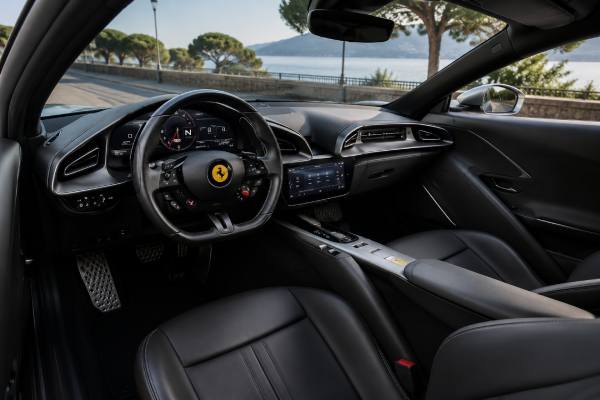
The Amalfi cabin is important because Ferrari responded to owner feedback. The Roma’s haptic-heavy interface looked futuristic but could be distracting in real use. The Amalfi restores more tactile controls, including the start button and revised steering-wheel inputs.
The digital layout still feels modern. The driver gets a wide digital instrument display, the center screen manages infotainment and vehicle functions, and a passenger display may be fitted depending on specification. This dual-cockpit idea remains a Ferrari GT signature: the driver is the focus, but the passenger is not ignored.
The cabin is technically a 2+2, but buyers should understand what that means. The rear seats are best for children, small adults on short trips, soft bags, or extra cabin storage. The Amalfi is more practical than a mid-engine two-seater, but it is not a true four-seat luxury coupe.
Driving Experience and Real Performance
The Amalfi should be understood as a very fast GT, not as a softened supercar or a track car with nicer leather. Its main dynamic appeal is the way it combines huge mid-range torque, quick shifts, strong braking, and Ferrari’s rear-drive balance in a car that can still be used for normal journeys.
Acceleration is effortless at ordinary road speeds. The torque plateau from 3,000 to 5,750 rpm means the car does not need to be worked hard to feel fast. Press the throttle in a higher gear and the engine delivers a thick, immediate shove. Keep it in the upper rev range and it becomes more urgent, using the raised rev limit to give the driver a more Ferrari-like finish to each gear.
Engine character
Turbocharging changes the sound and feel compared with older naturally aspirated Ferrari V8s. The Amalfi will not have the razor-edged scream of a 458 Italia or the mechanical delicacy of older atmospheric engines. Instead, it offers a denser, more muscular delivery with a broad torque band and sharper response than many turbo GT engines.
That distinction matters for buyers. Anyone expecting a classic high-pitched naturally aspirated Ferrari experience may prefer an older model. Anyone who wants modern speed, flexibility, and usability will likely appreciate the F154 BH setup.
Transmission and drive modes
The 8-speed dual-clutch transmission is central to the car’s dual character. Around town, it should behave smoothly enough for GT use. In sportier modes, it shifts with the speed and authority expected from a modern Ferrari. The extra ratios help keep the engine relaxed at cruising speeds while still allowing aggressive gearing when the car is driven hard.
Ferrari’s Manettino driving-mode system changes the car’s responses by altering throttle mapping, transmission behavior, stability-control thresholds, damping, and related chassis settings. The value is not just faster lap times. It lets the driver choose between relaxed touring, wet-road security, and more open rear-drive adjustability.
Steering, braking, and road feel
Modern Ferrari steering is quick, light, and highly responsive. The Amalfi’s revised electric power steering calibration is designed to work with the latest grip-estimation systems and chassis software. On the road, that should make the car feel alert without requiring heavy steering effort.
The brake-by-wire system and ABS Evo are especially important. Brake-by-wire means the pedal is connected to a control system rather than being purely hydraulic in feel. Some drivers need time to adjust, but Ferrari uses this technology to improve braking precision, stability, and stopping distances. For most road driving, the system should feel strong and consistent. On track, condition and temperature become more important.
Ride quality should be better than its performance figures suggest, especially with the adaptive magnetorheological damping system. The Amalfi is still wide, low, and tire-sensitive, so broken urban roads, steep ramps, and cold high-performance tires require care. It is usable, but it is not carefree.
Reliability, Maintenance, and Restoration Reality
The Amalfi is too new to have a long independent reliability record, so the best ownership view comes from its hardware, Ferrari’s modern service structure, and known stress points on high-performance turbocharged GTs. The car should be reliable when maintained correctly, but neglect, poor storage, wrong tires, weak batteries, and skipped dealer updates can quickly turn a modern Ferrari into an expensive problem.
Ferrari’s 7-Year Genuine Maintenance programme is a major advantage for early owners and used buyers. It generally supports scheduled maintenance during the first seven years of the car’s life and is valuable because it keeps service history within the official Ferrari network. That history is not just about maintenance cost. It helps protect future resale confidence.
Likely maintenance priorities
For the Amalfi, the most important ownership areas are:
- Annual servicing or mileage-based servicing according to Ferrari documentation.
- Engine oil, filters, brake fluid, and inspection items.
- Battery condition and correct battery tender use.
- Software updates and campaign completion.
- Tire age, specification, tread depth, and pressure monitoring.
- Carbon-ceramic brake pad and disc measurements.
- Cooling-system checks and hose condition.
- Turbocharger oil and heat-management health.
- Dual-clutch transmission operation and fluid-service compliance.
- Suspension, steering, lift system, and damper diagnostics.
A modern Ferrari that sits unused can still deteriorate. Low mileage is attractive, but ultra-low mileage without proper servicing is not automatically better. Batteries weaken, tires age, seals dry, fluids absorb moisture, and software campaigns may be missed.
Known risk areas to inspect
Because the Amalfi shares philosophy and some engineering background with the Roma, buyers should inspect it like a modern Ferrari GT rather than like a normal used coupe.
| Area | What to check | Why it matters |
|---|---|---|
| Carbon-ceramic brakes | Disc wear, pad life, cracks, edge condition, track use | Replacement costs are high and condition affects value |
| Tires | Date codes, correct sizes, matching brand and spec | Old or wrong tires change handling and reduce confidence |
| Battery and electronics | Charging history, warning lights, tender use, module faults | Weak voltage can trigger expensive diagnostic confusion |
| Transmission | Shift quality, hesitation, leaks, service record | DCT repairs are specialist work and costly |
| Paint and body | Paint-depth readings, panel gaps, underside scuffs | Accident history or poor repairs can damage resale |
| Interior controls | Screens, buttons, steering controls, passenger display | Electronic trim faults affect usability and warranty claims |
| Spider roof | Operation, seals, fabric, alignment, water leaks | Roof problems add complexity beyond coupe ownership |
Restoration is the wrong word—for now
The Amalfi is a modern car, so buyers should think in terms of preservation, not restoration. The best examples will be kept original, serviced by Ferrari, protected with quality paint protection film where appropriate, and stored correctly.
Heavy modifications can hurt future value. Exhaust changes, aftermarket wheels, ECU tuning, lowered suspension, non-factory carbon trim, or removed emissions equipment may appeal to one owner but narrow the buyer pool later. On a current Ferrari, factory correctness usually matters more than personalization after delivery.
For long-term ownership, keep every invoice and every diagnostic printout. A complete history file turns maintenance spending into value protection. Missing records turn even a beautiful car into a question mark.
Market Value and Buying Guide
The Amalfi’s market is still young, so buyers should treat early prices as launch-period data rather than a settled depreciation curve. In Europe, the launch price was reported around €240,000 before heavy personalization; in other markets, taxes, tariffs, delivery timing, and options can push transaction prices much higher.
The used market will take time to form. Early allocations, delivery timing, color choice, and specification will all affect premiums or discounts. A highly optioned early car in a desirable color may hold firm, while a strangely configured car with ordinary colors, missing options, or unclear history may soften more quickly once supply improves.
What drives value
The strongest Amalfi examples will usually have:
- Desirable exterior and interior color combination.
- Original paint or fully documented minor cosmetic work.
- Full Ferrari dealer service history.
- Warranty and 7-year maintenance coverage status.
- Clean diagnostic report.
- Correct tires with recent date codes.
- Healthy carbon-ceramic brakes.
- No accident history.
- No aftermarket tuning.
- Complete books, keys, tools, accessories, and charging equipment.
- Well-chosen factory options without excessive personalization.
Mileage matters, but it should not be viewed in isolation. A 7,000 km car with complete Ferrari history, fresh tires, clean paint, and documented brake measurements can be a better buy than a 1,000 km car that has sat unused with old tires and a weak battery.
Pre-purchase inspection checklist
Before buying a Ferrari Amalfi, arrange a specialist inspection through an official Ferrari dealer or a highly experienced Ferrari independent with proper diagnostic access. The inspection should include:
- Confirm VIN, market specification, and original build.
- Review full service and warranty history.
- Check open recalls, campaigns, and software updates.
- Perform a full diagnostic scan.
- Measure carbon-ceramic brake wear.
- Inspect tire age, tire type, and wheel condition.
- Check paint depth across all panels.
- Inspect underbody panels, front splitter area, suspension arms, and cooling openings.
- Test all displays, controls, cameras, sensors, and driver-assistance functions.
- Road-test for steering alignment, braking feel, shift quality, noises, and warning lights.
For Spider models, add a complete roof-cycle test and water-seal inspection. The roof should move smoothly, latch cleanly, and show no fabric damage or alignment issues.
Examples to seek and avoid
Seek a car with a coherent factory specification, official maintenance record, clean paint history, and evidence of careful storage. A well-used but properly maintained Amalfi can be a strong buy if priced honestly.
Avoid cars with vague import history, unexplained paintwork, mismatched tires, aftermarket engine tuning, missing documents, repeated electronic faults, or owners who cannot provide brake and service data. Also be cautious with cars advertised as “delivery mileage” if they have been sitting for long periods without annual service.
Long-term collectability
The Amalfi has a credible path to long-term interest because it combines a front-mid-engine layout, rear-wheel drive, a pure combustion V8, and improved usability over the Roma. It is also part of Ferrari’s transition period, when the brand is balancing combustion, hybrid, and future electric models.
That said, regular-production modern Ferraris do not all become blue-chip collectibles. The safest buying strategy is to choose a specification you genuinely like, maintain it perfectly, avoid modifications, and preserve the original documents. If collectability improves later, you benefit. If it does not, you still own one of Ferrari’s most polished modern V8 GTs.
References
- Ferrari Amalfi – Ferrari.com 2026 (Manufacturer Model Page)
- Ferrari Amalfi 2025 (Manufacturer Press Release)
- Ferrari Amalfi Spider 2026 (Manufacturer Press Release)
- Warranties And Official Ferrari Maintenance 2026 (Manufacturer Maintenance Information)
- NHTSA | National Highway Traffic Safety Administration 2026 (Recall Database)
Disclaimer
This article is for informational purposes only and is not a substitute for professional diagnosis, repair, inspection, or official Ferrari service advice. Specifications, torque values, service intervals, software procedures, campaign status, and equipment can vary by VIN, market, model year, and option package. Always verify details against the official service documentation for the specific car and consult a qualified Ferrari technician before making maintenance, repair, or purchase decisions.
If you found this guide useful, please share it on Facebook, X/Twitter, or your preferred car community to support our work.