
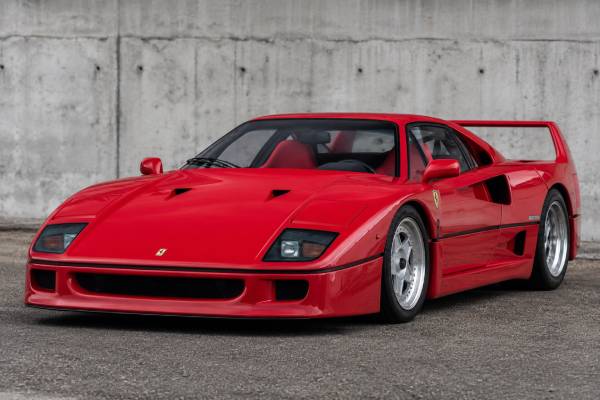
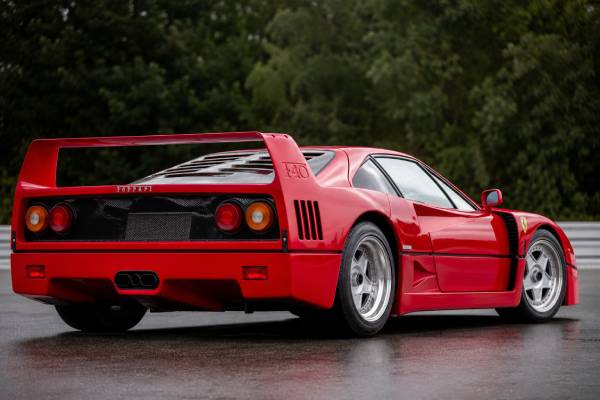
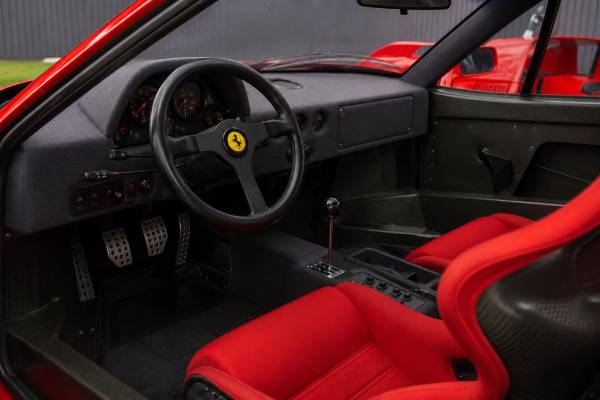
The Ferrari F40 is the car that turned Ferrari’s 40th anniversary into one of the clearest statements Maranello ever made. Built around the F120 platform and the F120A twin-turbo 2.9-liter V8, it was raw, light, fast, noisy, and intentionally short on comfort. It followed the 288 GTO, borrowed ideas from Ferrari’s cancelled Group B-era development work, and arrived as the last road car approved during Enzo Ferrari’s lifetime. For buyers and collectors, the F40 is not just another classic supercar. It is a benchmark for originality, documentation, mechanical condition, and provenance. For enthusiasts, it remains one of the purest ways to understand late-1980s Ferrari engineering: composite bodywork, manual gearbox, huge turbo boost, minimal driver aids, and a driving experience that still feels serious today.
Table of Contents
- Why the F40 Still Defines Ferrari
- F120A V8, Chassis, and Core Specs
- Production Changes and Desirable Versions
- Composite Body, Aero, and F40 Details
- Boost, Lag, Balance, and Road Feel
- Maintenance Risks and Restoration Realities
- Market Values and F40 Buying Checks
Why the F40 Still Defines Ferrari
The Ferrari F40 matters because it captured Ferrari at a rare moment: old-school racing instinct meeting modern supercar ambition. It was not designed as a luxury flagship. It was built as a light, uncompromising road car with racing materials, turbocharged power, and almost no softness between the driver and the machine.
Ferrari launched the F40 in 1987 to mark the company’s 40th anniversary. It replaced the 288 GTO as the most extreme Ferrari road car and became the direct ancestor of the F50, Enzo, LaFerrari, and later limited-production Ferrari halo cars. Yet it feels very different from those later cars. There is no hybrid system, no paddle-shift gearbox, no stability control, and no adaptive digital layer to tidy up mistakes. The F40 asks the driver to understand the engine, brakes, tires, steering, and weight transfer directly.
Its historical importance also comes from its timing. Enzo Ferrari died in August 1988, making the F40 the final road-going Ferrari released with his approval. That fact is often repeated because it is emotionally powerful, but the car’s collectability is not based on sentiment alone. The F40 also represented Ferrari’s fastest and most expensive road car at launch, and it showed how far the company was willing to go to make a production car feel close to a competition machine.
The F40’s shape came from Pininfarina, with Pietro Camardella working under Aldo Brovarone’s supervision. Its engineering direction is strongly associated with Nicola Materazzi, who had already been deeply involved with Ferrari’s turbocharged V8 program. The result was not elegant in the traditional 1960s Ferrari sense. It was low, wide, vented, winged, and purposeful. Every duct, NACA intake, louver, and opening had a job: cooling, reducing lift, feeding the intercoolers, or managing airflow.
The car’s reputation today is unusually broad. Collectors care about early “non-cat, non-adjust” cars, Classiche certification, mileage, original paint, matching numbers, and the quality of long-term storage or recommissioning. Drivers care about boost response, steering feel, brake confidence, and whether the car has been maintained well enough to be used properly. Fans care because the F40 looks like the poster version of a Ferrari supercar: red paint, pop-up lamps, a fixed rear wing, and a cockpit stripped down to the essentials.
Production continued into the early 1990s, with road-car sources commonly citing a total a little above 1,300 examples. Exact totals vary slightly depending on how sources count prototypes, market versions, and competition derivatives, so buyers should rely on chassis-specific records rather than broad production numbers alone. What matters most in the market is not simply that an F40 is rare. It is whether that specific car is original, documented, correctly maintained, and honestly represented.
F120A V8, Chassis, and Core Specs
The F40’s defining hardware is its 2,936 cc twin-turbocharged 90-degree V8, mounted longitudinally behind the cabin and driving the rear wheels through a five-speed manual gearbox. The headline output is 478 hp at 7,000 rpm, with strong mid-range torque once the turbos are fully awake.
| Category | Specification |
|---|---|
| Model | Ferrari F40, Type F120 |
| Production years | 1987–1992 road car production era |
| Engine | F120A 90-degree V8, twin turbocharged and intercooled |
| Displacement | 2,936.25 cc |
| Bore x stroke | 82.0 mm x 69.5 mm |
| Compression ratio | 7.7:1 |
| Maximum power | 478 hp at 7,000 rpm |
| Maximum torque | 577 Nm at about 4,000 rpm |
| Induction | Twin IHI turbochargers, twin intercoolers |
| Fuel system | Electronic fuel injection and engine management |
| Transmission | Five-speed manual transaxle |
| Drivetrain | Rear mid-engine, rear-wheel drive |
The engine was based on Ferrari’s turbo V8 knowledge from the 288 GTO, but enlarged and sharpened for the F40’s road-car mission. The relatively low compression ratio helped manage forced induction, while the twin-turbo layout gave the car its famous split personality: manageable below boost, then brutally quick when the turbos arrived.
The F40 did not use a full carbon monocoque like later supercars. Instead, it combined a tubular steel chassis with composite body and structural panels. Kevlar, carbon fiber, Nomex, resin, and lightweight aluminum were used to keep mass down. Ferrari quoted a very low dry weight for European-specification cars, but actual curb weight varies by market, fluids, emissions equipment, and later production changes.
| Item | Ferrari F40 data |
|---|---|
| Body style | Two-door Berlinetta |
| Chassis structure | Tubular steel frame with composite body panels |
| Suspension | Independent double wishbones with coil springs, dampers, and anti-roll bars |
| Steering | Unassisted rack-and-pinion |
| Brakes | Ventilated discs front and rear, no modern electronic brake assistance |
| Wheelbase | 2,450 mm |
| Length | 4,358 mm |
| Width | 1,970 mm |
| Height | 1,124 mm |
| Dry weight | About 1,100 kg in lightweight European specification |
| Top speed | 324 km/h, or about 201 mph |
| 0–100 km/h | About 4.1 seconds |
The tire package was also part of the F40’s personality. Wide rear tires gave the car traction when the turbos hit, while the unassisted steering and low nose gave the driver direct information at speed. Early cars are especially known for their lightness and simplicity, while later and U.S.-market cars can feel slightly more developed because of emissions, safety, and suspension differences.
The key point is that the F40’s specifications only tell part of the story. The numbers are still impressive, but the way they are delivered is what defines the car: a manual gearbox, a narrow power band by modern standards, large turbo boost, light weight, and very little insulation from heat, vibration, and noise.
Production Changes and Desirable Versions
F40 values are strongly affected by production specification, market version, originality, and documentation. The most discussed distinction is between early “non-cat, non-adjust” cars and later cars with catalytic converters, adjustable suspension, or market-specific equipment.
Ferrari originally planned the F40 as a limited-production flagship, but demand was far greater than expected. Production expanded through the early 1990s, and the car reached several markets with different regulatory requirements. That means not every F40 is mechanically or cosmetically identical.
The main road-car distinctions are:
- Early European non-cat cars: These are generally the purest specification, without catalytic converters and often without adjustable suspension. Collectors tend to value them highly when they remain original and well documented.
- Non-cat, non-adjust cars: This phrase is common in the market because it identifies the combination many collectors associate with the lightest and most direct F40 specification.
- Catalyst-equipped cars: Later cars and market-specific examples received emissions equipment. They are still real F40s and can be excellent to own, but they may be valued differently from the earliest specification.
- Adjustable-suspension cars: Some later cars used a hydraulic ride-height system to improve ground-clearance practicality. This can make road use easier, but it adds parts, inspection points, and originality questions.
- U.S.-market F40s: North American cars received federalized equipment and are a separate collecting category. They are desirable in the United States because they are easier to register and document, but their details differ from European cars.
The F40 also has competition-related variants, but these should not be confused with standard road cars. Michelotto-developed F40 LM, Competizione, and GTE cars were built for racing and evolved far beyond the road-car specification. They are far rarer, much more specialized, and valued through a different lens: race history, period documentation, event eligibility, and originality of competition components.
For road-car buyers, identification should start with the chassis number, engine number, gearbox number, body number, original market, and factory records. Ferrari Classiche certification is important because it can confirm that major components match the car’s original configuration. It does not remove the need for a specialist inspection, but it is a major confidence factor.
Factory colors and interiors require careful handling. The F40 is strongly associated with Rosso Corsa paint and red cloth racing seats, and most road cars are presented that way. Non-red cars, unusual trim claims, or special-order stories should be treated as “prove it with paperwork” items. A repaint may be acceptable on a driver-quality car, but on a collector-grade F40, original paint, factory markings, and untouched composite details can add major value.
A buyer should also understand the difference between originality and usability. Some low-mile F40s are museum-grade cars with original tires, original hoses, old fuel cells, and delicate paint. They may be historically important but not ready for hard driving. Other cars have been maintained and lightly updated for road use, with fresh fuel tanks, belts, hoses, tires, and suspension parts. Those cars may be less untouched but better to drive.
The best examples have both: strong originality and careful, documented mechanical care. The riskiest examples are cars with vague mileage, missing service books, undocumented engine or gearbox work, questionable paint history, import complications, or modified parts that are hard to reverse.
Composite Body, Aero, and F40 Details
The F40 looks dramatic because nearly every shape serves cooling, weight, or stability. Its design is not decoration first; it is a functional shell around a hot, turbocharged mid-engine car.
The body uses large lightweight panels made from composite materials rather than conventional pressed steel. This was advanced for a late-1980s production Ferrari and remains one reason restoration quality matters so much. Poor repairs, excessive filler, incorrect paint thickness, or hidden accident damage can change both the car’s value and its authenticity.
The front end is low and blunt, with pop-up headlights and wide intake openings. The side profile is defined by deep NACA ducts that help feed the engine bay and intercoolers. The rear bodywork is full of vents because the F40 produces enormous heat. Behind the cabin sit the twin-turbo V8, intercoolers, exhaust plumbing, and transaxle. Heat management is part of the car’s engineering and part of its ownership reality.
The fixed rear wing is one of the F40’s signature features. On many cars, large wings look like styling statements. On the F40, the wing belongs to the whole aero package. The car was built to remain stable at speeds above 300 km/h, and its bodywork works with the underbody, cooling exits, rear vents, and wide stance to manage airflow.
The cockpit is just as important as the exterior. The F40 was intentionally stripped back:
- no luxury sound insulation in the usual grand-touring sense
- no plush carpets on early lightweight examples
- simple pull cords instead of conventional interior door handles
- exposed materials and visible structure
- thin seats trimmed for support rather than comfort
- a gated manual shifter
- simple analog instruments
- limited storage space
Early cars with sliding side windows feel especially close to a racing car. Later cars with wind-up windows are more usable but slightly less stark. Air conditioning was fitted to many cars because cabin heat is a real issue, not a minor inconvenience. In traffic or hot climates, a properly working cooling and ventilation system matters.
The triple-exit exhaust layout is another defining detail. The outer pipes handle exhaust flow from the engine banks, while the center outlet is associated with the wastegate discharge. That helps create the F40’s hard-edged, mechanical sound. It is not a smooth, operatic naturally aspirated Ferrari note. It is a sharper turbocharged soundtrack: intake rush, wastegate noise, exhaust bark, and mechanical clatter.
The F40 also has a visible honesty that collectors like. On some cars, the weave and texture beneath the paint can be seen in certain light. That is part of the character, but it also means paintwork needs expert interpretation. A glassy over-restored finish can look attractive to casual viewers while making experts suspicious. Correct F40 restoration is not simply about making the car shiny. It is about preserving the way the materials, panel fit, finishes, and factory details should look.
Compared with later Ferrari halo cars, the F40 is simple in concept but demanding in execution. The F50 is naturally aspirated and more Formula 1-inspired. The Enzo is carbon-tub, paddle-shift, and electronically managed. LaFerrari brings hybrid assistance and advanced control systems. The F40 sits before all of that. Its specialness comes from lightness, boost, aerodynamics, and directness.
Boost, Lag, Balance, and Road Feel
Driving an F40 is dominated by turbo response, low weight, manual control, and the need to respect tire temperature and road conditions. It is fast by modern standards, but what makes it unforgettable is the way speed arrives.
Below the boost threshold, the F40 can feel lighter and less explosive than its image suggests. The engine is tractable enough when warm and correctly tuned, but it does not deliver the instant low-rpm torque of a modern turbocharged supercar. The driver needs to choose gears properly and understand that the car changes character as revs and boost build.
When the turbos come in, the car becomes much more serious. The acceleration is hard, the engine note sharpens, and the rear tires are asked to manage a sudden rise in torque. On a dry road with warm tires, the F40 can feel beautifully balanced. On cold tires, damp surfaces, old rubber, or uneven pavement, it demands patience.
The five-speed gated manual gearbox is central to the experience. It gives the driver time to think and makes every full-throttle run more deliberate. A good gearbox should feel mechanical and precise once warm, not vague or obstructive. A tired gearbox, worn linkage, or weak synchros can make the car far less enjoyable and very expensive to correct.
Steering is unassisted, so effort is high at parking speeds but rich in feedback once moving. This is one reason experienced drivers love the car. The steering tells you what the front tires are doing without filtering. Modern supercars may be faster, but few communicate road texture and front-end load as directly.
The brakes require period expectations. The F40 does not have modern carbon-ceramic brakes, brake-by-wire tuning, or electronic safety nets. Pedal feel should be firm and confidence-inspiring, but the system needs heat, condition, and correct pads to perform well. Old fluid, tired hoses, worn discs, or incorrect pads can quickly turn an expensive car into a frightening one.
Ride quality is firm, and the car is low. Road crown, steep driveways, speed bumps, and rough urban pavement all require care. Later adjustable-suspension cars can be more practical, but the system must work properly. A non-functioning lift or ride-height system is not just an inconvenience; it is a negotiation point and a sign that other maintenance may have been deferred.
Visibility is mixed. The forward view feels dramatic because the nose is low, but rear visibility is limited by the body shape, wing, and engine cover. The cabin is noisy, warm, and narrow by modern luxury-car standards. Longer drives are possible, but they are not relaxed. An F40 is more of an event than transportation.
The best driving examples usually share the same traits:
- recent tires in the correct sizes and speed rating
- fresh fluids and brake service
- properly set suspension geometry
- smooth boost control
- no fuel smells or hot-start issues
- clean clutch engagement
- stable coolant and oil temperatures
- no hesitation under load
- no smoke from turbo seals or worn engine components
A restored car is not automatically better than an original car on the road. Restoration quality varies. A properly recommissioned original car may drive better than a cosmetically restored example with poor mechanical setup. For anyone buying an F40 to drive, a road test by an experienced Ferrari specialist is essential.
Maintenance Risks and Restoration Realities
An F40 is not difficult because it is mysterious; it is difficult because age, heat, rarity, and originality all matter at the same time. The car needs specialist care from people who understand both Ferrari mechanical systems and F40-specific materials.
The engine is strong when maintained correctly, but neglect can be expensive. Timing belts, tensioners, fluids, ignition components, fuel delivery, turbo plumbing, and cooling parts must be kept current. A car that has covered very few miles may still need major work because seals, hoses, tanks, and rubber components age even when the car is stored.
Fuel tanks are one of the most important F40 ownership subjects. Many cars used flexible fuel cells or bladder-style tanks, and age-related deterioration is a known concern. Some cars have been converted to aluminum tanks for durability and usability. That can be sensible for a driver, but originality-focused buyers will want to know exactly what was changed, when, by whom, and whether original parts or documentation remain.
The cooling system also deserves serious attention. Turbocharged mid-engine cars generate high heat, and old hoses or weak fans can create expensive problems. A pre-purchase inspection should include pressure testing, checking radiators, inspecting coolant pipes, confirming fan operation, and looking for signs of overheating or poor past repairs.
Turbochargers, wastegates, intercooler hoses, and exhaust components need inspection. Smoke on boost, oil residue in the intake tract, boost-control problems, or unusual noises can point to costly work. Because access is labor-intensive and parts can be expensive, small symptoms should not be dismissed.
The gearbox and clutch should be assessed carefully. A worn clutch is expected on a car that has been driven, but abusive use, poor adjustment, or long storage can create additional issues. Gear selection should improve as the oil warms. Grinding, jumping out of gear, heavy baulking, or noisy bearings require expert diagnosis.
The chassis and body can be more worrying than the engine. Composite damage is not always obvious. Look for uneven panel gaps, incorrect fasteners, hidden cracks, mismatched paint texture, repairs around the nose, floor, sills, rear clamshell, suspension pickup areas, and underbody. Accident history is a major value issue, especially if repair documentation is weak.
For U.S.-market 1990–1992 cars, the NHTSA suspension fork recall must be checked by VIN. The recall concerned front and rear lower suspension fork components that could crack or break under extreme use. A buyer should not rely only on a seller’s verbal assurance. Completion should be documented through Ferrari, service records, or official recall history.
| Area | What to check | Why it matters |
|---|---|---|
| Engine | Belts, leaks, compression, boost behavior, smoke, service records | Major engine work is expensive and affects confidence |
| Fuel system | Tank age, hoses, pumps, fuel smell, conversion records | Old fuel components are a safety and usability risk |
| Cooling | Radiators, fans, hoses, coolant pipes, temperature stability | Heat damage can cascade into larger repairs |
| Gearbox and clutch | Shift quality, synchros, clutch take-up, records of work | Repairs require specialist labor and costly parts |
| Body and chassis | Composite repairs, paint thickness, panel fit, underbody damage | Authentic repair quality has a major effect on value |
| Suspension | Bushings, dampers, ride-height system, recall completion | Handling and safety depend on correct condition |
| Documentation | Books, tools, service history, Classiche file, ownership chain | Paperwork can separate a top-tier car from a risky one |
Restoration requires restraint. Over-restoring an F40 can remove factory character. Under-restoring one can leave hidden safety and reliability risks. The best approach depends on the car’s purpose. A preservation-grade car should be conserved with minimal intervention. A driver-quality car should be made mechanically safe and reliable while keeping reversible changes and detailed records.
Parts availability is possible but not simple. Some parts are available through Ferrari networks, specialists, or reproduction channels, but costs can be high and lead times long. Original wheels, correct interior materials, factory books, tool rolls, exhaust parts, and body components can be especially important to value.
A proper F40 inspection is not a normal used-car inspection. It should involve a Ferrari specialist familiar with the model, a lift inspection, paint assessment, documentation review, diagnostic checks where applicable, compression or leak-down testing when justified, and a controlled road test.
Market Values and F40 Buying Checks
The F40 sits near the top of the modern-classic Ferrari market, and the best cars now trade like blue-chip collectibles. As of 2026 public-market data, ordinary language such as “good condition” is not enough; value depends on specification, originality, mileage, documentation, and the credibility of recent maintenance.
Public auction and listing data show the F40 market ranging from the low-to-mid seven figures for usable examples to well above that for exceptional cars. Recent public sales have pushed the strongest low-mile, highly original, or unusually significant examples into the $5 million to $6 million-plus range. Average public-market figures are lower than the very top sales, but the trend is clear: the market pays heavily for quality, provenance, and confidence.
The main value drivers are:
- Original specification: Early non-cat, non-adjust cars are especially sought after, but top U.S.-spec cars also command strong money.
- Matching numbers: Chassis, engine, gearbox, and body authenticity are central to collector value.
- Ferrari Classiche certification: A Red Book is not a substitute for inspection, but it supports authenticity.
- Mileage quality: Low mileage helps only when the car has been stored and recommissioned correctly.
- Condition: Original paint, correct interior, clean underbody, and undamaged composite panels matter.
- Service history: Recent major service, fuel system work, belts, tires, and cooling-system care reduce risk.
- Provenance: Long-term ownership, famous first owners, concours history, or complete records can add value.
- Completeness: Books, tools, manuals, tire inflator, original parts, and service booklets can materially affect price.
- Market version: European early cars, U.S. cars, and later adjustable-suspension cars each have their own buyer base.
The best buying process is methodical:
- Confirm the exact chassis, engine, gearbox, and body numbers.
- Establish the original market, original specification, and production configuration.
- Review Ferrari Classiche documents, service books, invoices, and ownership records.
- Check for accident history, paintwork, composite repairs, and underbody damage.
- Verify timing-belt history, fuel-tank status, cooling-system work, and tire age.
- For U.S.-market cars, confirm completion of the suspension recall by VIN.
- Have the car inspected and road-tested by a known F40 specialist.
- Price the car according to risk, not just mileage and appearance.
Avoid cars with missing history, unclear import status, inconsistent mileage, undocumented color changes, non-original major components, vague “recent service” claims, or sellers who resist a proper inspection. Also be careful with static low-mile cars. They can be extremely valuable, but they may need extensive recommissioning before safe use. A 500-mile car with old fuel tanks, ancient tires, stale fluids, and deteriorated seals is not automatically easier to own than a 15,000-mile car with excellent care.
For investors, the F40 has strong long-term fundamentals: iconic status, analog driving experience, manual gearbox, Enzo-era connection, Pininfarina design, Ferrari halo-car lineage, and a global collector base. It is also not so rare that the market lacks comparable sales. That helps buyers understand relative value.
For drivers, the best F40 may not be the lowest-mile car. A carefully maintained, documented, mechanically fresh example can provide more enjoyment and less anxiety than a museum-grade car. For concours-focused collectors, originality and preservation may matter more than road readiness. The correct choice depends on whether the buyer wants to preserve, show, drive, or invest.
The F40 remains special because it resists simplification. It is not merely “the last Enzo Ferrari car,” not merely “the first 200 mph Ferrari,” and not merely “a turbocharged classic.” It is a demanding, lightweight, composite-bodied, manual Ferrari that rewards knowledge. Buy the right one, and it is one of the most important modern Ferraris ever made. Buy the wrong one, and the repair, documentation, and authenticity problems can be as dramatic as the car itself.
References
- Ferrari F40 (1987) – Ferrari.com 2026 (Manufacturer Specifications)
- Vehicle Detail Search – 1990 FERRARI F40 | NHTSA 2026 (Recall Database)
- RCQPR-05V169-6467 2006 (Recall Database)
- Ferrari F40 Market – CLASSIC.COM 2026 (Market Data)
- 1991 Ferrari F40 | Arizona 2026 | RM Sotheby’s 2026 (Auction Catalogue)
Disclaimer
This article is for informational purposes only and is not a substitute for professional diagnosis, repair, appraisal, or inspection. Specifications, torque values, service intervals, inspection procedures, emissions equipment, and parts can vary by VIN, market, production date, and individual vehicle history. Always verify details against official Ferrari service documentation and use a qualified Ferrari specialist before buying, repairing, restoring, or driving an F40.
If you found this guide useful, please consider sharing it on Facebook, X/Twitter, or your favorite car community to support our work.