
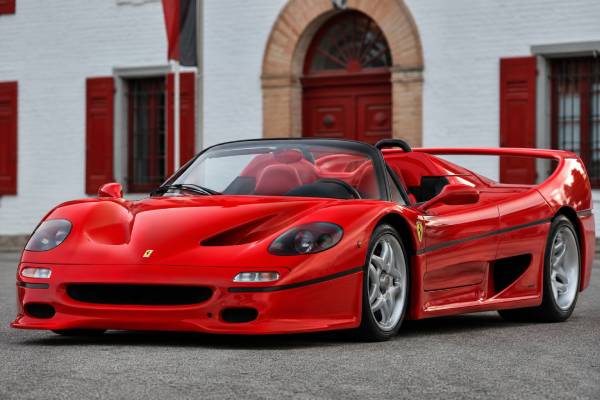
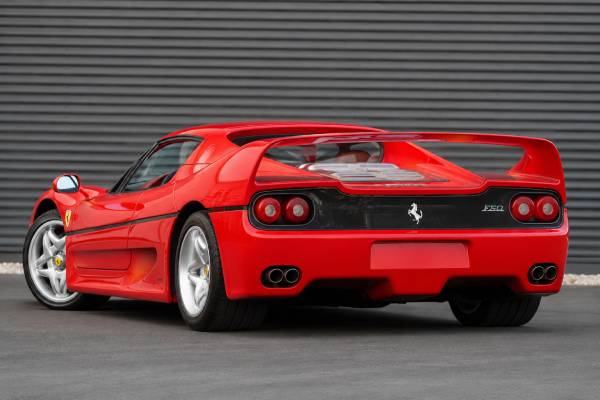
The Ferrari F50 is the rawest member of Ferrari’s modern halo-car bloodline: a limited-production, rear-mid-engined, V12 targa built from 1995 to 1997 to mark Ferrari’s 50th anniversary. Known internally as the Type F130, it replaced the turbocharged F40 with a very different idea of speed: a naturally aspirated Tipo F130B 4.7-litre V12 derived from Ferrari’s racing work, a carbon-fibre central tub, a six-speed gated manual, no ABS, no power steering, and no servo-assisted brakes. Only 349 production cars were built, which gives the F50 real scarcity even among collectible Ferraris. Today it matters because it sits at a rare crossroads: old enough to feel mechanical and demanding, modern enough to use composite construction and electronic damping, and special enough that originality, documentation, and service history can move value by millions.
Table of Contents
- Why the F50 Matters in Ferrari History
- Tipo F130B V12, Chassis, and Core Specs
- Production Numbers, Options, and Authenticity Clues
- Carbon Body, Aero, and Formula One Thinking
- How the F50 Feels on Road and Track
- Maintenance Risks, Restoration, and Specialist Care
- Market Values, Inspection, and Buying Strategy
Why the F50 Matters in Ferrari History
The F50 is important because it was Ferrari’s most direct 1990s attempt to put grand prix thinking into a road car. It followed the F40, but it did not copy the F40’s formula; instead of turbo boost, drama, and lightweight brutality, the F50 offered a high-revving V12, a carbon tub, a removable roof, and a chassis layout that made the engine a structural part of the car.
Ferrari launched the F50 in 1995, during a period when supercars were becoming more sophisticated and more expensive. The McLaren F1 had moved the goalposts for packaging, materials, and top-speed performance. The Bugatti EB110 showed how advanced all-wheel drive and quad-turbo power could be. Ferrari’s answer was not the fastest car in every test, but it was one of the most intense. It was built around connection rather than comfort.
The F50 also holds a special place because it sits between two different Ferrari eras. The F40 was Enzo Ferrari’s final approved road car and has always carried enormous emotional weight. The Enzo, launched later, brought the paddle-shift, carbon-brake, computer-managed hypercar age into Ferrari’s limited-series line. The F50 is the bridge: carbon structure and racing influence on one side, analogue controls and manual interaction on the other.
Pininfarina shaped the car, with design work associated with the studio’s 1990s Ferrari language and the earlier Mythos concept. The look was controversial when new. Compared with the F40’s clean wedge and fixed rear wing, the F50 seemed more complex, with soft curves, deep intakes, exposed buttresses, and a large rear wing integrated into the rear body. Time has been kind to it. Collectors now value the F50 precisely because it does not look or feel like any other Ferrari halo car.
The car’s anniversary purpose also matters. Ferrari did not build thousands. The commonly quoted figure of 349 production cars was deliberately below demand, helping protect exclusivity. That scarcity, plus the manual gearbox and naturally aspirated V12, has made the F50 one of the most desirable post-1980s Ferraris. It is not just a supercar; it is a factory-built statement about what Ferrari believed a road-going racing car could be in the mid-1990s.
For enthusiasts, the appeal is simple: the F50 is loud, physical, expensive, rare, and full of mechanical honesty. For buyers and collectors, the appeal is more detailed. The right car has matching identity, Classiche certification, complete accessories, known ownership, correct maintenance, original finishes, and a clear history. The wrong one can still be spectacular, but accident repair, expired fuel cells, missing roof equipment, weak documentation, or poor restoration work can heavily affect confidence.
Tipo F130B V12, Chassis, and Core Specs
The F50’s defining feature is its Tipo F130B V12, a 4.7-litre, naturally aspirated engine that makes its performance through revs rather than forced induction. The rest of the car is equally focused: rear-wheel drive, a gated six-speed manual, a carbon-fibre central tub, pushrod suspension, and very few driver aids.
| Item | Specification |
|---|---|
| Engine code | Tipo F130B |
| Configuration | 65-degree V12, rear-mid-mounted, longitudinal |
| Displacement | 4,698.50 cc |
| Bore x stroke | 85 mm x 69 mm |
| Valvetrain | DOHC, five valves per cylinder, 60 valves total |
| Induction | Naturally aspirated, variable-length intake |
| Fuel and ignition | Bosch Motronic M2.7 electronic management |
| Compression ratio | 11.3:1 |
| Maximum power | 382 kW / 520 hp at 8,500 rpm |
| Maximum torque | 471 Nm at 6,500 rpm |
| Lubrication | Dry sump |
| Transmission | Six-speed manual, limited-slip differential |
| Drivetrain | Rear-wheel drive |
The V12’s character is shaped by its short stroke, high compression, dry-sump lubrication, and high-rpm breathing. It is not a lazy large-capacity engine. Maximum torque arrives high in the rev range, and maximum power is near the top. That means the F50 rewards drivers who use the gearbox and let the engine work.
The chassis was advanced for a road car of the period. Ferrari used a carbon-fibre and composite central tub, with the engine and gearbox assembly contributing structurally. This approach gave the car a serious racing connection, but it also means inspection and repair are specialist matters. Damage to composite structure or mounting points is not the same as repairing a normal steel or aluminium road-car shell.
| Item | Specification |
|---|---|
| Body style | Two-seat targa with removable hard roof |
| Structure | Carbon-fibre composite central tub |
| Suspension | Double wishbones with pushrods and electronic adaptive dampers |
| Steering | Unassisted rack and pinion |
| Brakes | Brembo ventilated and cross-drilled cast-iron discs, no ABS |
| Front tyres | 245/35 ZR18 |
| Rear tyres | 335/30 ZR18 |
| Wheelbase | 2,580 mm |
| Length | 4,480 mm |
| Width | 1,986 mm |
| Height | 1,120 mm |
| Dry weight | 1,230 kg |
| Fuel capacity | 105 litres |
| Claimed top speed | 325 km/h / 202 mph |
| 0–100 km/h | About 3.8–3.9 seconds, depending on test source and conditions |
One detail buyers should not overlook is the absence of common driver aids. The F50 has no power steering, no ABS, and no brake servo. That is part of the car’s appeal, but it also changes how wear, tyres, brake setup, alignment, and suspension condition feel from the driver’s seat. A tired F50 can feel heavy and nervous. A properly set-up one feels demanding but alive.
Production Numbers, Options, and Authenticity Clues
The F50 was not a broad model range; it was essentially one limited-production targa, with market specification, colour, accessories, and documentation making the biggest differences between cars. For buyers, the most important question is not which trim to choose, but whether a specific car is complete, authentic, correctly maintained, and properly documented.
Ferrari built 349 production examples between 1995 and 1997. The cars were numbered, and serious buyers normally expect the serial identity, chassis number, engine number, gearbox number, and build details to be checked against factory records. Ferrari Classiche certification is especially important in this market because it gives buyers stronger confidence that major components and configuration match original Ferrari specifications.
There was no regular coupe, spider, automatic, or comfort version. The F50’s removable hard roof turns it from closed targa to open car, and correct roof equipment matters. A complete car should be checked for its roof panel, roof storage case, soft-top equipment where supplied, manuals, tools, books, keys, luggage or fitted accessories if originally delivered, service invoices, import paperwork, and certification documents.
Factory colours are a major value factor. Rosso Corsa is by far the colour most people associate with the F50, but non-red cars can be especially desirable when factory-original and well documented. Giallo Modena, Nero Daytona, Argento Nürburgring, and Rosso Barchetta are among the best-known alternatives. Rare colours do not automatically make a car better, but when a rare colour is original, attractive, and supported by strong provenance, it can change market behaviour dramatically.
Market and regional differences
U.S.-specification cars are especially notable because only a small portion of total production went to the United States. These cars can carry a premium when mileage, condition, colour, and history are strong. European and other-market cars can also be extremely desirable, but import compliance, lighting, emissions, seat-belt equipment, and federalization history require careful review when the car has moved between markets.
A buyer should confirm:
- The car’s market specification when new.
- Whether it has been imported, federalized, or converted.
- Whether all compliance work was documented.
- Whether any market-specific parts were changed.
- Whether paint, interior, glass, lighting, and emissions equipment still match the car’s history.
The F50 GT is often mentioned in the same conversation, but it is not a normal production variant. It was a racing derivative developed for GT competition, with a fixed roof, major aero changes, a more powerful version of the V12, and a completely different purpose. Only a tiny number were completed, and they belong in a separate category from the road-going F50. They are useful for understanding the F50 platform’s potential, but not for valuing ordinary road cars.
What counts as complete
On a car this valuable, completeness is not a small detail. Missing items may be possible to replace, but cost, originality, and correctness can become major issues. The best examples usually have:
- Ferrari Classiche certification or a clear path to certification.
- Original books, tools, manuals, keys, and delivery documents.
- Removable hardtop and proper storage case.
- Documented service history from Ferrari dealers or recognized specialists.
- Clear mileage trail.
- Known ownership chain.
- Original paint or carefully documented high-quality paintwork.
- Evidence of fuel-cell, belt, fluid, tyre, and suspension maintenance.
Collectors pay for certainty. A beautiful car with gaps in its history may still sell well, but it usually needs a discount or a stronger inspection result to compete with a fully documented example.
Carbon Body, Aero, and Formula One Thinking
The F50 looks unusual because its shape is driven by cooling, aero, packaging, and the need to turn a racing-influenced structure into a usable road car. It is not as visually simple as the F40, but nearly every opening, duct, surface, and rear-body feature has a job.
The front end is low and wide, with large openings feeding cooling systems. The body sides channel air toward the mid-mounted V12. The rear deck and integrated wing help stability at high speed. The buttress-like rear structure also works with the removable-roof concept, giving the car its distinctive open-and-closed personality.
Materials are central to the F50 story. The body uses composite construction, including carbon fibre and other lightweight materials. The central tub is the heart of the structure. This made the F50 exotic in the 1990s and still makes it complex today. A conventional inspection is not enough. A proper evaluation should include composite structure, mounting points, underbody condition, suspension pick-up areas, and evidence of repair.
The engine installation is one of the most important engineering features. Ferrari did not simply install the V12 in a normal subframe and isolate it for comfort. The engine and gearbox are part of the structural concept, which is one reason the F50 feels so intense. Noise, vibration, and mechanical texture reach the cabin in a way that later hypercars often filter out.
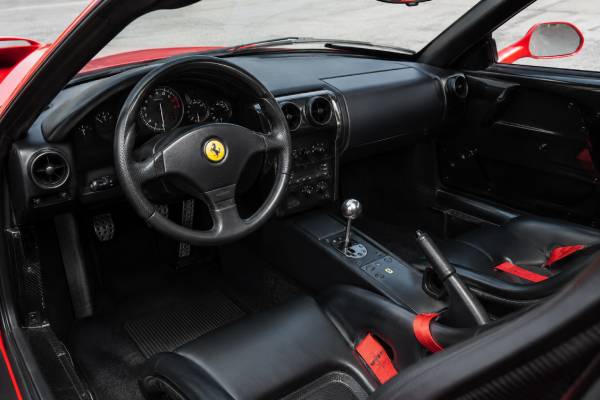
The cockpit is sparse but not crude. The driver sits low, with a clear focus on the steering wheel, pedals, shifter, and instruments. The gated manual shifter is one of the car’s great tactile features. The open metal gate, the long lever movement, and the need for deliberate shifts are central to the driving experience. This is not a car that hides the driver’s inputs.
Sound and sensory character
The F50’s sound is a large part of its identity. The V12 has a hard-edged, high-rpm voice that feels more mechanical than theatrical. Intake noise, exhaust resonance, gear whine, and structure-borne vibration all mix together. With the roof removed, the experience is even more direct.
That rawness is also why condition matters so much. Exhaust leaks, tired engine mounts, poor heat shielding, ageing rubber, worn dampers, and old tyres can turn excitement into harshness or instability. The best F50s feel sharp and demanding, not loose or abusive.
How the F50 Feels on Road and Track
The F50 feels special because it asks the driver to participate. It is fast by modern standards, but its real character comes from steering effort, brake feel, gearshift precision, high-rev throttle response, and the constant sense that the chassis is talking through the controls.
At low speeds, the unassisted steering can feel heavy. Parking and tight manoeuvres require care, and the wide body demands attention. Once moving, the steering becomes one of the car’s best features. It has a directness that later power-assisted and heavily filtered systems rarely match. The front end gives strong information, but the car needs warm tyres and a smooth driver.
The V12 is not a low-rpm torque engine in the style of a big modern turbocharged motor. It builds urgency as revs rise. The F50 is enjoyable at moderate speeds because the engine is responsive and musical, but the full experience happens higher in the rev range. Drivers used to instant turbo torque may initially find the delivery less explosive than expected. Keep the engine on cam, and the car becomes much more dramatic.
The six-speed manual is part of the event. It prefers deliberate timing and mechanical sympathy, especially when cold. Quick, careless shifts are not the point. The gearbox rewards rhythm: clutch, lever, throttle, and engine speed all need to work together.
Braking is another area where expectations must be period-correct. The F50 has powerful Brembo brakes, but no ABS and no servo assistance. Pedal effort is higher than in a modern supercar. The driver has to manage pressure and lock-up risk. On the road this gives excellent feel; on track it demands skill, especially on old tyres or uneven surfaces.
Road manners
The F50 is usable in the basic sense: it has a roof, lights, air conditioning, and enough road-car equipment to be driven. But it is not relaxed. It is wide, low, noisy, hot in some conditions, and expensive to expose to traffic, poor roads, or inattentive drivers. The suspension can cope with road use better than the car’s reputation suggests when everything is fresh and correctly set, but it remains a serious machine.
On a mountain road, the F50 is more about flow than brute force. It rewards clean corner entry, careful brake release, and progressive throttle. The rear tyres are huge, but the short, stiff, mid-engined layout still deserves respect. Tyre age and temperature make a major difference.
Track character
On track, the F50’s strengths are response, sound, and feedback. Its limitations are also clear by modern standards. It does not have modern stability control, modern carbon-ceramic brakes, dual-clutch shifts, or the huge downforce of later hypercars. The brakes and tyres must be monitored carefully, and the cost of a mistake is enormous.
Period tests put the F50 in the 3.8-second range for 0–60 mph, with the quarter mile around the low 12-second range in some independent testing. Ferrari’s claimed top speed is 325 km/h, or 202 mph, although test results vary with conditions, gearing, surface, and car setup. The important point is not whether it beats every rival on a stopwatch. The F50’s value is in the way it delivers speed.
Maintenance Risks, Restoration, and Specialist Care
F50 ownership is not normal supercar ownership; it is limited-production Ferrari stewardship. The major risks are age, parts scarcity, composite repair complexity, fuel-system service, deferred maintenance, and the cost of putting a poorly kept car back into correct condition.
The first issue is time. Every F50 is now old enough for rubber, seals, hoses, wiring insulation, fuel components, suspension parts, brake parts, and interior materials to need careful inspection. Low mileage does not remove this risk. In fact, cars that sit for long periods can develop their own problems: stale fuel, dried seals, sticky hydraulics, flat-spotted tyres, corrosion on brake surfaces, weak batteries, and electrical gremlins.
The fuel cell is a major service item. The F50 uses a racing-style fuel bladder, and age limits are important. A car with an expired or questionable fuel cell may require expensive work before it should be used seriously. Auction descriptions often highlight recent fuel-cell replacement because buyers understand how important and costly it can be.
The engine itself is strong when properly maintained, but it is not casual. Belt service, valve checks where required, oil leaks, coolant leaks, ignition issues, sensors, wiring, and dry-sump system health should all be assessed by specialists. The V12 sits in a tightly packaged, heat-heavy environment. Heat management, correct fluids, and careful warm-up matter.
The gearbox and clutch need inspection for wear, leaks, synchro behaviour, and service history. A gated manual is desirable, but it is still a mechanical system with expensive parts and labour. A poor shift when cold is not automatically a disaster, but grinding, jumping out of gear, dragging clutch behaviour, or vague linkage feel deserves attention.
Common inspection priorities
A proper pre-purchase inspection should focus on:
- Fuel-cell age and replacement documentation.
- Timing-belt and major-service history.
- Engine leaks, coolant condition, and dry-sump system condition.
- Clutch wear, gearbox operation, and differential noise.
- Suspension dampers, lift function, bushings, joints, and alignment.
- Brake disc condition, pad condition, caliper health, and brake-fluid history.
- Tyre age, tyre model, and correct sizing.
- Composite tub condition and repair evidence.
- Underbody damage from lifts, ramps, kerbs, or transport.
- Roof panel fit, seals, wind noise, and water leaks.
- Electrical operation, including dash, fans, lights, and warning systems.
- Interior shrinkage, sticky surfaces, leather condition, and originality.
Restoration and originality
Restoring an F50 is possible, but it should not be approached like restoring a common classic. The car’s value is tied to originality and correctness. Repainting, retrimming, replacing major components, or modifying exhaust and suspension can affect value unless documented and reversible.
Some upgrades may improve usability, but collectors usually prefer factory-correct presentation. A non-original exhaust may sound exciting, but it can reduce buyer confidence if the original parts are gone. A modern tyre solution may be necessary for safe use, but tyre choice should be documented. Carbon repairs require specialist evidence, not vague assurances.
Because values are high, maintenance records should be unusually detailed. A one-line invoice is not enough. Buyers want to see dates, mileage, parts, workshop names, technician notes, photos where relevant, and evidence that service was done correctly. Ferrari dealer history is valuable, but respected independent Ferrari specialists can also be highly credible if their documentation is strong.
Market Values, Inspection, and Buying Strategy
The F50 market has moved strongly upward, and top cars now trade in a range where provenance, colour, mileage, and documentation can create huge gaps between examples. As of 2026, ordinary language like “good condition” is not precise enough; buyers need to know exactly why a car is worth less, market-correct, or exceptional.
Public auction results in 2025 and 2026 show the top of the market pushing far beyond the older $4 million to $5 million range. Highly special examples have brought around $9 million or more, especially when they combine rare colour, U.S. specification, famous ownership, low mileage, long-term care, and Classiche certification. More typical cars can still sit lower, but the entire market has become more serious.
| Value factor | Why it matters |
|---|---|
| Originality | Factory paint, interior, engine, gearbox, and specification carry major weight. |
| Documentation | Complete records reduce uncertainty and support future resale. |
| Classiche certification | Factory authentication improves buyer confidence. |
| Colour | Rare original colours can create strong premiums. |
| Mileage | Low mileage helps, but only when service and condition are also strong. |
| Market specification | U.S.-specification and correctly documented import status can affect demand. |
| Service currency | Fresh major service, fuel-cell work, and correct tyres reduce immediate risk. |
| Accident history | Composite and structural repairs require expert proof and usually affect value. |
For buyers, the best strategy is to treat the inspection as a provenance audit and a mechanical evaluation at the same time. The car may look perfect in photos and still have issues that matter deeply. Ask for the documentation before travelling to see the car. Review ownership chain, service records, mileage progression, certification, import documents, and accessories. Then hire a specialist who knows F50s specifically.
Cars to seek
The strongest F50s usually have a combination of:
- Known ownership from new.
- Original factory colour and interior.
- Ferrari Classiche certification.
- Low or moderate mileage with regular exercise.
- Recent major service by a respected Ferrari facility.
- Current fuel cell or documented recent replacement.
- Complete roof equipment, books, tools, and accessories.
- No accident history.
- No unexplained gaps in records.
- Clear title, import, and tax status.
Cars to approach carefully
Not every F50 needs to be a museum piece, but some warning signs deserve caution:
- Missing service records.
- Expired fuel cell with no plan or estimate.
- Repaint without clear reason.
- Evidence of underbody impact.
- Non-original colour change.
- Missing roof case, tools, manuals, or keys.
- Unverified engine or gearbox identity.
- Poor panel fit around composite sections.
- Long storage without recommissioning.
- Seller reluctance to allow specialist inspection.
A driver-quality F50 can be a wonderful thing if priced correctly and mechanically sorted. In fact, a carefully maintained car with usable mileage may be more enjoyable than a delivery-mileage car that nobody wants to exercise. But buying a “cheap” F50 rarely works if it needs major sorting. At this level, deferred maintenance can easily erase the discount.
Long-term collectability looks strong because the F50 has the ingredients serious Ferrari collectors value: limited production, anniversary significance, manual gearbox, naturally aspirated V12, carbon construction, Pininfarina design, and a clear place in the 288 GTO–F40–F50–Enzo–LaFerrari lineage. Its reputation has improved as the market has come to appreciate analogue supercars. The F50 may once have lived in the F40’s shadow, but today it stands as one of Ferrari’s most fascinating and demanding road cars.
References
- Ferrari F50 (1995) – Ferrari.com 1995 (Manufacturer Specifications)
- Ferrari F50: Ferrari History 1995 (Manufacturer History)
- Ferrari Classiche: Certification – Ferrari.com 2026 (Factory Certification)
- Decision That Certain Nonconforming Model Year 1996 and 1997 Ferrari F50 Passenger Cars Are Eligible for Importation 2017 (Regulatory Import Decision)
- 1995 Ferrari F50 | Monterey 2025 2025 (Auction Record)
Disclaimer
This article is for informational purposes only and is not a substitute for professional diagnosis, inspection, repair, appraisal, or legal advice. Specifications, torque values, service intervals, procedures, compliance requirements, and correct parts can vary by VIN, market, equipment, and vehicle history. Always verify details against official Ferrari service documentation and have any Ferrari F50 inspected by a qualified specialist before purchase, repair, or restoration.
If you found this guide useful, please consider sharing it on Facebook, X/Twitter, or your preferred car community to support our work.