
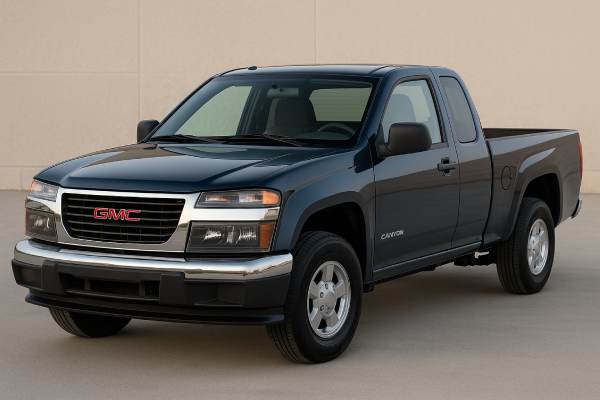
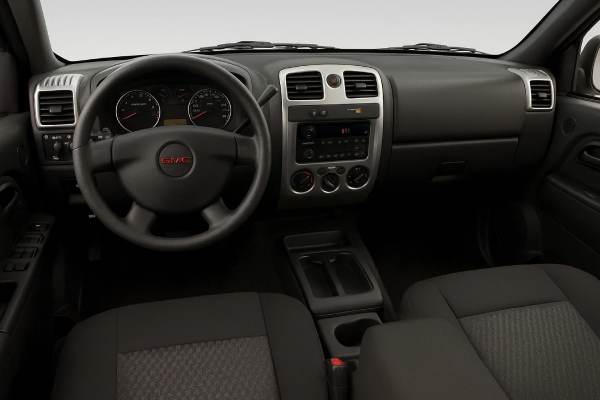
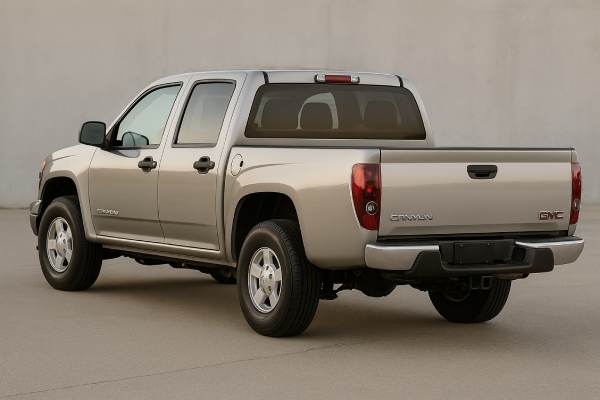
The 2004–2006 GMC Canyon 4WD with the 2.8 l LK5 inline-four is the most approachable way into a true body-on-frame 4×4 in GM’s midsize truck family. It combines compact exterior dimensions with a modern rack-and-pinion front end and the Atlas-series DOHC engine, plus a part-time four-wheel-drive system that gives extra traction when you actually leave pavement. Power is modest at 175 hp and 185 lb-ft, but the gearing and low range make the truck more capable off-road than its numbers might suggest.
In period, most 2.8 l 4WD Canyons were work-focused SL or SLE trims in regular or extended cab form, often with the Z71 off-road suspension package. That means you’ll see a mix of bare-bones work trucks and lightly optioned daily drivers on the used market. Choosing the right one comes down to understanding how the 4×4 hardware works, what the common problems are, and how the truck compares with rivals like the Tacoma, Frontier, and Ranger.
Owner Snapshot
- Compact 4×4 truck with 175 hp 2.8 l four-cylinder, low range, and up to roughly 4,000 lb (≈1,800 kg) tow capacity when properly equipped.
- Z71 4WD versions gain extra ground clearance, skid plates, and more aggressive tires, making them genuinely capable on rough tracks.
- Known weak spots include cylinder-head issues on early Atlas engines and electronic 4×4 components like encoder motors and axle actuators.
- A sensible baseline is engine oil and filter every 5,000 mi / 8,000 km or 12 months, plus 4WD system fluid services around 45,000–60,000 mi (72,000–96,000 km).
Navigate this guide
- GMC Canyon 2.8L 4WD basics
- 4WD Canyon technical details
- Trims, off-road gear, and safety
- Reliability, 4×4 issues, and fixes
- Maintenance and 4WD buyer guide
- Driving performance in 4WD use
- Canyon 4WD versus rivals
GMC Canyon 2.8L 4WD basics
For 2004–2006, the GMC Canyon 4WD with the 2.8 l LK5 engine sits at the intersection of affordability, capability, and relative simplicity. Built on the GMT355 platform shared with the Chevrolet Colorado and Isuzu i-280, it uses body-on-frame construction with an independent front suspension and leaf-spring rear axle.
The LK5 “Vortec 2800” is a 2.8 l inline-four, all-aluminum with dual overhead cams and four valves per cylinder, producing 175 hp at 5,600 rpm and 185 lb-ft (≈251 Nm) at 2,800 rpm. Those figures match the Colorado’s base engine ratings and carry over unchanged across 2004–2006.
On the 4WD side, the Canyon uses a part-time system with:
- 2HI (rear-wheel drive) for normal dry-road driving
- 4HI for low-traction surfaces like snow or gravel
- 4LO with a low-range reduction in the transfer case for off-road climbing or slow, heavy pulling
Engagement is via a dash switch commanding an electronic encoder motor on the transfer case and an actuator on the front differential, controlled by a 4×4 control module.
Typical configurations
Most 2.8 l 4WD Canyons you’ll encounter are:
- Regular cab 4WD with a 6-ft bed, aimed at trades and rural buyers
- Extended cab 4WD with jump seats or fold-down rear seating and the same bed length
- Crew cabs with the 2.8 l exist but are less common; many crew cabs use the 3.5 l five-cylinder instead.
Within these, you’ll see both the on-road-oriented Z85 suspension and the off-road Z71 package. Z71 adds more ground clearance, skid plates, and larger tires; when combined with 4WD, it significantly improves rough-road capability compared with a base 2WD truck.
Use cases where the 2.8L 4WD works well
- Daily commuting in mixed weather with occasional snow or dirt-road use
- Light to moderate off-roading, hunting, fishing, and trail access
- Towing small trailers (ATVs, small boats, lightweight campers) within the 4,000 lb neighborhood when properly equipped
- Rural owners who need 4×4 for access and a bed for materials but do not regularly tow near full midsize truck limits
Key strengths
- Smaller footprint than full-size trucks, but real low-range 4WD
- Smoother and more refined than older S-10/Sonoma trucks, thanks to the new chassis and engine family
- Strong aftermarket and parts support thanks to overlap with Colorado and long production run
Key limitations
- Power is just adequate; on long grades or when towing, the engine and transmission work hard
- No modern stability control or advanced active safety systems in these model years
- Early Atlas engines and some 4×4 components have well-documented failure modes that you need to check and budget for
4WD Canyon technical details
Engine and performance
| Item | Specification (2.8 l LK5 4WD)* |
|---|---|
| Engine code | LK5 Vortec 2800 (Atlas family) |
| Layout | Inline-4, aluminum block and head, DOHC, 4 valves/cyl |
| Displacement | 2.8 l (≈ 2,770 cm³) |
| Bore × stroke | ≈93 mm × 102 mm (3.66 in × 4.02 in) |
| Compression ratio | ~10.0:1 (varies slightly by calibration) |
| Induction | Naturally aspirated |
| Fuel system | Sequential multi-port fuel injection (MPFI) |
| Max power | 175 hp (130 kW) @ 5,600 rpm |
| Max torque | 185 lb-ft (≈251 Nm) @ 2,800 rpm |
| Timing drive | Chain (no fixed replacement interval) |
| Emissions standard | US Tier-2 era light-truck standards |
*Numbers consolidated from GM and independent spec databases for the 2004–2006 2.8 l I4.
Fuel economy
A typical 2004 4WD 2.8 l Canyon with manual transmission is rated around the high-teens mpg combined in US testing, with lower city and higher highway figures. Owner reports cluster in the high-teens to low-20s mpg, depending on cab style, gearing, and tire choice, translating to roughly 11–13 L/100 km.
Transmission and 4WD driveline
| Item | Specification |
|---|---|
| Drive type | Part-time 4×4 (2HI, 4HI, 4LO) |
| Manual transmission | 5-speed Aisin AR-5 (often labelled MA-5) |
| Automatic transmission | 4-speed Hydra-Matic 4L60-E |
| Rear differential | Open or optional G80 automatic locking differential |
| Typical axle ratios | 3.73 or 4.10, depending on trim/tow package |
| Transfer case | Electronically shifted, encoder-motor actuated part-time case |
The 4L60-E uses Dexron VI ATF, with a total capacity around 11.2 qt for a full refill, while the manual and transfer case use dedicated fluids or Synchromesh-type oil depending on the specific transfer case.
Chassis, dimensions, and weights (typical 4WD extended cab)
Auto-data and similar spec sources list the 2.8 l 4WD extended-cab Canyon with:
| Item | Approximate value |
|---|---|
| Wheelbase | ≈ 126 in (3,200 mm) for many 4WD extended cabs |
| Overall length | 5,260 mm (207.1 in) |
| Width | 1,717 mm (67.6 in) |
| Curb weight | ≈ 1,660+ kg (≈ 3,650–3,700 lb) depending on cab/trim |
| GVWR | ≈ 2,404 kg (≈ 5,300 lb) |
| Bed length | ~6 ft on regular/extended cab |
| Ground clearance | ≈ 6.4 in on basic 4WD; Z71 increases clearance by roughly 3.5 in over lower suspensions |
Z71 4WD trucks can have close to 9 in of ground clearance and noticeably higher step-in height, which matters off-road but makes loading and egress slightly more demanding.
Performance and capability
| Metric | Typical figure (2.8 l 4WD) |
|---|---|
| 0–60 mph (0–97 km/h) | ≈ 10–11 s (configuration-dependent estimate) |
| Top speed | Around 95–105 mph (153–169 km/h), limited |
| Braked towing | Often up to ~4,000 lb (≈1,800 kg) when properly equipped |
| Payload | Around 1,500–1,650 lb (≈680–750 kg), trim-dependent |
Real-world performance is more about gearing and traction than sprint numbers. Low range makes steep, slow off-road climbs practical despite the modest engine output.
Fluids and service capacities (typical 2.8L 4WD)
| System | Spec and capacity (approximate) |
|---|---|
| Engine oil | 5W-30 (GM6094M/Dexos1-type); ≈ 5.0 qt (4.7 l) with filter; drain plug ~19 lb-ft (26 Nm) |
| Engine coolant | Dex-Cool OAT; roughly 9–10 l total system capacity (varies by cab/engine) |
| Manual gearbox | GM-approved manual trans fluid; ≈ 2.3–2.5 qt |
| 4L60-E automatic | Dexron VI; ≈ 11.2 qt total fill, ≈ 5 qt pan service |
| Rear differential | 75W-90 GL-5 gear oil; ≈ 1.6–2.0 qt depending on axle |
| Front differential | 75W-90 GL-5; about 1–1.5 qt typical for this platform |
| Transfer case | GM transfer case fluid or Dexron VI; a little over 2 qt |
| Brake/clutch | DOT 3 fluid |
| A/C refrigerant | R-134a; capacity ~0.7–0.8 kg (verify under-hood label) |
Safety and driver assistance
The 2004–2006 Canyon platform scores:
- Extended cab: Good overall in moderate-overlap frontal crash tests
- Crew cab: Acceptable in moderate-overlap front; Poor in side impact without optional side airbags
- Regular cab: Marginal head-restraint rating; limited crash data otherwise
Safety equipment in these years includes dual front airbags, 4-wheel ABS on most models, and traction control on some trucks, but no stability control or modern ADAS (no AEB, lane keeping, or blind-spot systems).
Trims, off-road gear, and safety
Trim structure for 2.8L 4WD Canyon
Trim naming and details vary slightly by market and year, but in North America the 2.8 l 4WD Canyon generally appears in lower and mid trims:
- SL / base
- Cloth seats, manual windows and locks on early trucks
- 2.8 l engine and 5-speed manual commonly standard
- 4WD available mainly on regular/extended cab
- SLE and similar mid-level trims
- Power accessories, upgraded audio, alloy wheels
- 4-speed automatic more common
- Access to Z71 Off-Road package and locking differential
GM’s Z85 suspension is the “standard” setup, tuned for on-road ride and light hauling, while Z71 brings higher ride height, protective skid plates, and more aggressive tires. In 4WD form, Z71 plus the G80 locking rear axle make a meaningful difference in off-road traction.
Quick identifiers
- The glovebox RPO sticker lists LK5 (2.8 l), suspension codes (Z85, Z71), and G80 if fitted with the automatic locker.
- Many 2.8 l 4WD trucks lack the higher-end interior trim found on 3.5 l trucks, but the 4×4 hardware is similar across engines.
4WD hardware differences vs 2WD
Compared with a 2WD Canyon, the 4WD variant adds:
- Front differential and CV axles
- Electronic front-axle disconnect actuator
- Transfer case with 2HI/4HI/4LO and encoder motor
- Additional front-end components (such as different crossmembers and steering knuckles) to accommodate CV shafts
These components add weight and complexity but enable true off-road use, including deep snow and mud where a Z71 2WD will still struggle even with good tires.
Safety ratings by cab style
The 4WD system does not significantly change crash performance, so ratings follow body style:
- Extended cab 4WD
- Moderate-overlap front: Good overall
- Dummy kinematics well controlled; some upward steering-column movement noted
- Crew cab 4WD
- Moderate-overlap front: Acceptable
- Side impact (without side airbags): Poor, with high injury measures to the torso and pelvis
- Regular cab 4WD
- Head-restraint and seat rating: Marginal
These ratings come from tests of the Colorado/Canyon platform and are shared across driveline variants.
Passive safety and child-seat provisions
- Airbags: Dual front airbags are standard; some later years and higher trims offered side-curtain airbags, which improve side-impact protection considerably.
- Seatbelts: Three-point belts for outboard positions; some jump seats in extended cabs are less ideal for child restraints.
- Child seats:
- Crew cabs provide LATCH anchors and are the best choice if you need to regularly transport children.
- Extended cab jump seats are better viewed as occasional/emergency seating for adults or older kids.
Recalls and brake-lamp switch campaign
A key safety recall for 2004–2009 Colorado/Canyon trucks covers a brake-lamp switch defect that can cause brake lights to fail or cruise control to become inoperative. Owners should verify completion of recall work through official recall lookup tools or dealer records.
ADAS and calibration implications
Because there is no modern ADAS suite, “calibration” after repairs usually means:
- Reprogramming or updating the engine computer (ECM) or transmission (TCM) for drivability fixes
- Resetting or reinitializing the 4×4 control module after transfer-case or actuator work
- Clearing airbag codes and checking sensors after any collision or SRS repair
No camera or radar aiming procedures exist for these early trucks, which simplifies body-shop work compared with newer pickups.
Reliability, 4×4 issues, and fixes
The 2.8 l 4WD Canyon shares most engine and chassis issues with 2WD versions, plus an extra layer of 4×4-specific wear and electronics. Knowing where these trucks typically fail helps you avoid the worst examples and maintain a good one properly.
Engine and cooling system (ICE-specific)
1. Cylinder-head and valve-seat wear (common, high severity)
- Symptoms: Persistent misfire (often cylinder 4), rough idle, hard starting, loss of compression, sometimes unexplained coolant loss.
- Root cause: Early Atlas four- and five-cylinders are known for valve-seat and head-casting issues in certain build ranges.
- Fix: Perform compression and leak-down tests on suspect engines. If out of spec, plan on head replacement or a professionally rebuilt head. Some trucks had warranty head replacements, which is a plus if documented.
2. Timing-chain noise and stretch (occasional, medium severity)
- Symptoms: Rattle at cold start, cam/crank correlation codes, poor performance.
- Root cause: Chain stretch and guide/tensioner wear, typically aggravated by infrequent oil changes or dirty oil.
- Fix: Replace chain, guides, and tensioner as a set and reset cam timing. A healthy Atlas engine with regular oil service can run well beyond 200,000 mi without timing-chain failure.
3. Oil leaks and consumption (occasional, low–medium severity)
- Valve-cover and oil-pan gasket seepage, plus front/rear main seals, are normal aging issues.
- Excessive oil consumption points to ring or PCV problems and is a warning sign on higher-mileage trucks.
4×4 system and driveline
The 4×4 hardware adds several known trouble spots:
1. Encoder motor / transfer-case switch (common, medium severity)
- Symptoms: 4×4 lights blinking or stuck, failure to shift between 2HI/4HI/4LO, “Service 4WD” message.
- Root cause: Worn encoder motor, faulty dash switch, or position sensor inside the motor.
- Fix: Diagnose with a scan tool that can read the transfer-case control module (TCCM). Replacement encoder motor or dash switch often resolves it; in some cases the TCCM itself fails.
2. Front differential actuator faults (common in cold climates, medium severity)
- Symptoms: Transfer case engages (low gearing present) but front wheels do not pull; binding or delayed engagement; faults more frequent in cold, wet conditions.
- Root cause: Sticky or failing front-axle actuator and related wiring; occasionally internal diff issues.
- Fix: Verify power and ground to actuator, test actuator directly, inspect harness for corrosion, and replace actuator if nonfunctional.
3. Front differential wear and noise (occasional, potentially high severity)
- Symptoms: Growling or whining from the front axle, especially under load in 4WD, or during tight turns.
- Root cause: Low or contaminated gear oil, worn bearings, or gear damage from heavy use.
- Fix: Inspect and top off fluid, check for leaks, and rebuild or replace the diff if metal or heavy wear is found.
4. 4L60-E automatic issues (platform-wide)
- Common concerns include harsh or flared shifts, torque-converter shudder, and 3–4 clutch wear on heavily used trucks.
- Regular ATF changes and avoiding excessive towing help extend life; a pre-purchase road test and scan for transmission codes is essential.
Chassis, steering, and corrosion
- Front suspension wear (common, low–medium severity): Ball joints, tie-rod ends, and control-arm bushings wear faster on lifted and off-roaded trucks. Expect to replace components on older or high-mileage examples.
- Rear leaf-spring and shackle rust: In salt-belt regions, spring hangers, shackles, and frame sections around them can rust badly.
- Brake-line corrosion: Steel lines along the frame rails can corrode and leak, especially near clips and unions.
Recalls, TSBs, and extended coverage
Beyond the brake-lamp recall, GM and regulators list various service bulletins and campaigns for:
- Cluster and gauge issues
- Transmission shift concerns
- HVAC blend-door and blower-motor faults
- Electrical glitches in lighting and accessories
Always run the VIN through official GM and NHTSA recall tools and ask a dealer to print the campaign/TSB history. A truck that has had recall and TSB work completed is usually a safer bet than one with an unknown or incomplete history.
Pre-purchase reliability checklist (4WD-focused)
- Confirm 4HI and 4LO engagement on a low-traction surface and ensure the truck shifts cleanly back to 2HI.
- Listen for front-axle and transfer-case noises under load and at full steering lock in 4WD.
- Check for leaks at the front diff, transfer case, and rear axle.
- Scan all modules (ECM, TCM, TCCM) for stored codes, not just current faults.
Maintenance and 4WD buyer guide
A 2.8 l 4WD Canyon can be a long-lived truck if you stay ahead on fluids and inspection. Given the age of these vehicles, it makes sense to be more conservative than the original long-interval maintenance guidance.
Practical maintenance schedule (time/distance)
| Item | Interval (max) | Notes |
|---|---|---|
| Engine oil and filter | 5,000 mi / 8,000 km or 12 months | Use quality synthetic 5W-30; more often for heavy towing/short trips. |
| Engine air filter | Inspect every 15,000 mi / 24,000 km; replace by 30,000 mi / 48,000 km | Sooner in dusty conditions. |
| Cabin air filter | 15,000–20,000 mi (if equipped) | Not all early trucks have a separate cabin filter. |
| Spark plugs | Up to 100,000 mi / 160,000 km; consider 60,000–80,000 mi | Long-life plugs but age and deposits justify earlier replacement. |
| Coolant | 5 years or 100,000 mi (160,000 km) initial, then every 3–5 years | Always refill with compatible Dex-Cool OAT coolant. |
| Brake fluid | Every 2–3 years | Prevents internal corrosion and maintains pedal feel. |
| Manual-trans fluid | 45,000–60,000 mi (72,000–96,000 km) | Shorter if towing or off-road frequently. |
| ATF (4L60-E) | 30,000–50,000 mi (50,000–80,000 km) | Pan drop and filter; add auxiliary cooler for frequent towing. |
| Front and rear diff oil | 45,000 mi (72,000 km) severe; ≤60,000–75,000 mi otherwise | Use correct 75W-90 GL-5 gear oil; change sooner after water crossings. |
| Transfer case fluid | 45,000–60,000 mi | Dexron VI or GM transfer-case fluid; critical for encoder-motor life. |
| Serpentine belt and tensioner | Inspect annually; replace around 60,000–90,000 mi | Listen for chirps and check for cracks. |
| Suspension and steering | Inspect at every oil change | Check ball joints, tie-rods, bushings, and shocks. |
| Tire rotation and alignment | Rotate every 5,000–7,500 mi | Keep fronts from cupping; align after front-end work. |
| 12 V battery | Test yearly after 4–5 years | Replace proactively in harsh climates. |
Fluid specs and key torques (decision-level)
- Engine oil: 5W-30 meeting GM6094M/Dexos1, ≈5 qt capacity.
- Coolant: Dex-Cool OAT, typically 50/50 mix.
- ATF: Dexron VI (4L60-E).
- Diffs: 75W-90 GL-5 gear oil (check for limited-slip additive requirements if not using locker-compatible gear oil).
- Transfer case: GM transfer-case fluid or Dexron VI (per GM guidance and TSBs).
Key torque examples (verify for your VIN):
- Wheel lug nuts: ≈100 lb-ft (135 Nm)
- Oil drain plug: ≈19 lb-ft (26 Nm)
Buyer’s inspection checklist (4WD-specific emphasis)
When shopping for a used 2.8 l 4WD Canyon:
- Engine health
- Cold start: listen for timing-chain rattle and misfires.
- Warm idle: ensure smooth running and no check-engine light.
- Inspect oil, coolant, and ATF for cross-contamination or metal.
- 4×4 system
- In a safe, loose-surface area, confirm that 4HI and 4LO engage and disengage.
- Watch for “Service 4WD” warnings, blinking 4×4 lights, or grinding/binding.
- Driveline and chassis
- Check U-joints for play, listen for clunks when shifting from D to R and on throttle transitions.
- Inspect CV boots, front diff, and transfer-case seals for leaks.
- Corrosion and structure
- Frame rails, crossmembers, spring hangers, and brake lines in rust-belt trucks.
- Paper trail
- Look for consistent oil-change records and evidence of diff/transfer-case services.
- Confirm recall completion via a dealer printout or NHTSA lookup.
Recommended vs risky combinations
- Good value sweet spot:
- Extended-cab 4WD, 2.8 l, Z71, manual transmission, G80 locker, with documented maintenance and no 4×4 warning lights.
- Proceed with caution:
- Trucks with chronic misfire history, “Service 4WD” messages, obvious front-diff or transfer-case noise, or serious frame rust.
- If you tow heavy often:
- You may be better served by the 3.5 l I-5 or a different midsize truck entirely, as the 2.8 l is happiest below its maximum tow rating.
Driving performance in 4WD use
On-road behavior
In daily driving, a 2.8 l 4WD Canyon feels very similar to its 2WD sibling, just heavier and slightly more deliberate in acceleration:
- Ride: The independent front suspension and coil-over shocks provide decent compliance, though unladen rear axle hop is noticeable over sharp bumps. Z71 trucks sit higher and feel firmer.
- Steering: Rack-and-pinion steering offers predictable if somewhat light feedback; the truck is easy to place in traffic and parking lots.
- Noise: The inline-four has a smooth, slightly buzzy note when revved; with stock exhaust and tires, wind and road noise are moderate by early-2000s pickup standards.
The 2.8 l pairs especially well with the 5-speed manual; with the 4L60-E automatic, passing at highway speeds often triggers a kickdown and a noticeable rise in engine noise.
Off-road and poor-weather performance
This is where 4WD meaningfully separates the Canyon from 2WD trucks and crossovers:
- Traction: 4HI with decent all-terrain or winter tires is effective on snow, ice, and muddy tracks. A G80 locking rear differential adds security climbing out of ruts or pulling a trailer up a wet ramp.
- Ground clearance:
- Standard 4WD trucks have around 6.4 in of clearance, which is adequate for mild trails and rutted gravel roads.
- Z71 4WD versions approach 9 in of clearance plus underbody skid protection, allowing you to tackle more serious obstacles and deeper snow.
- Low range: 4LO allows careful crawling over rocks, through deep ruts, or when backing trailers on steep grades, compensating somewhat for the modest power output.
Real-world fuel economy and range
4WD hardware and higher ride height cost you some fuel economy compared with 2WD:
- City: Many owners see 16–18 mpg US (13–15 L/100 km) in mixed urban driving.
- Highway (100–115 km/h / 60–70 mph): About 20–24 mpg US (9.8–11.8 L/100 km) depending on cab, gearing, and tires.
- Mixed use: 17–20 mpg US (12–14 L/100 km) is typical.
Expect a further 15–30 % increase in fuel consumption when:
- Driving in 4HI on high-drag surfaces (mud, deep snow)
- Towing near the 4,000 lb mark, especially into headwinds or over mountains
With the roughly 19-gal (72 l) tank, realistic mixed-use range is around 320–380 mi (515–610 km) between fill-ups.
Towing and load behavior
A properly equipped 2.8 l 4WD Canyon can tow in the 3,500–4,000 lb range, but you should manage expectations:
- Powertrain: On grades, the engine needs revs and the automatic will downshift often; manual trucks offer better control but demand more driver involvement.
- Stability: Wheelbase and chassis tuning are adequate for light travel trailers and utility loads if you respect tongue-weight guidelines, use a brake controller, and keep speeds sensible.
- Braking: The front-disc/rear-drum setup is fine when in good condition but can feel marginal with a full load and no trailer brakes.
Traction and control nuances
Because early Canyon 4WD trucks lack stability control, you rely on:
- Proper tires for weather and terrain
- Appropriate 2HI/4HI/4LO selection for conditions
- Sensible speeds and smooth inputs, especially on mixed-friction surfaces where part-time 4WD is not ideal
In snow-belt regions, a 4WD Canyon with good winter tires, some weight in the bed, and a locking rear diff is far more confidence-inspiring than a comparable 2WD pickup.
Canyon 4WD versus rivals
When new, the 2004–2006 Canyon 4WD 2.8 l competed directly with 4×4 versions of the Toyota Tacoma, Nissan Frontier, and Ford Ranger. Each truck approaches the small-4×4 brief differently.
Versus Toyota Tacoma 2.7 4WD
- Reliability and resale: Tacoma usually wins on long-term reliability perception and resale value, with fewer major engine issues reported.
- Power and refinement: The Tacoma 2.7 l four has similar output but a reputation for durability under heavy use; its interior and ride quality are often viewed as more polished.
- Value: Used prices for Tacomas are significantly higher; budget-minded buyers can often get a newer or better-equipped Canyon for the same money.
Versus Nissan Frontier 2.4/2.5/4.0 4WD
- Performance: Frontier V6 models out-torque the 2.8 l Canyon by a wide margin; four-cylinder Frontiers are closer in capability.
- Chassis: Both trucks use independent front suspension and leaf-spring rears; ride quality and handling are broadly similar, with trim-dependent differences.
- Issues: Frontiers of this era have their own concerns, so neither platform is trouble-free as it ages.
Versus Ford Ranger 4×4
- The Ranger’s older design is simpler and robust, but cabin packaging and refinement trail the Canyon.
- The Canyon’s Atlas engine family and more modern chassis deliver a smoother, more “car-like” feel, though some Ranger engines are well-proven workhorses.
When a 2.8L 4WD Canyon makes sense
Choose a 2004–2006 Canyon 2.8 l 4WD if:
- You want true low-range 4×4 in a compact package at lower purchase prices than a comparable Tacoma.
- You’re comfortable maintaining fluids and monitoring known weak points, or you have a trusted shop.
- You mostly tow and haul within the truck’s comfort zone, not at the limit.
Look instead at a different truck (or the 3.5 l I-5 Canyon/Colorado) if you:
- Tow heavy or frequently in mountainous areas
- Need the highest possible safety ratings and modern ADAS
- Prefer to avoid platforms with any significant engine-family “stories,” even if issues are manageable with careful selection and maintenance
For the right buyer—someone who values a compact footprint, real off-road capability, and reasonable running costs—the 2.8 l 4WD Canyon can still be a smart, usable truck decades after it left the showroom.
References
- Manuals and Guides | Vehicle Support – Experience GM 2024 (Owner’s Manual Portal)
- GMC Canyon Info, Specs, Pictures, Wiki & More 2023 (Model Overview and Powertrain Specs)
- GMC Canyon I Extended cab 2.8 (175 Hp) 4WD 2020 (Technical Specifications)
- Used 2004 GMC Canyon Specs & Features 2024 (4WD Specifications and Capacities)
- 2004 GMC Canyon Crew cab pickup 2004 (Safety Rating)
Disclaimer
This article is for informational purposes only and is not a substitute for professional diagnosis, repair, or official service literature. Specifications, fluid types, torque values, and maintenance intervals can vary by VIN, model year, market, and installed equipment. Always confirm data against the official owner’s manual, factory service information, and current technical bulletins for your specific vehicle, and follow appropriate safety procedures when working on any vehicle.
If you found this guide helpful, you are welcome to share it with other owners or shoppers via Facebook, X/Twitter, or enthusiast forums to help support accurate, independent technical information.