
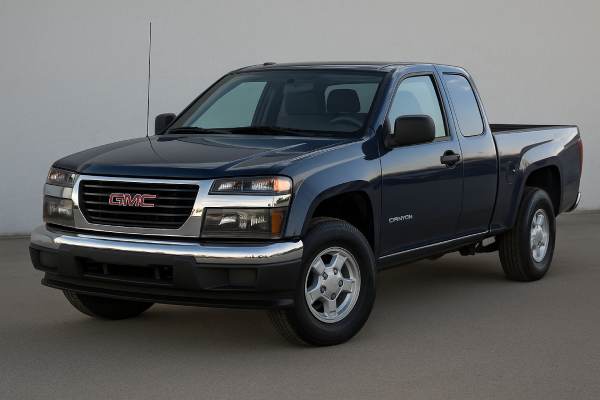
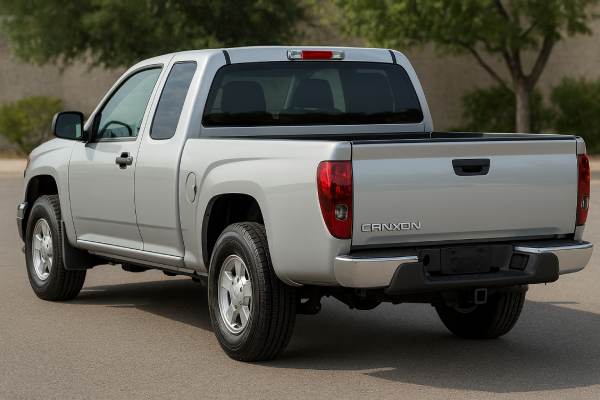
The 2009 GMC Canyon 4WD with the LH8 5.3-litre V8 is one of the most unusual configurations in the midsize pickup world. It combines the compact GMT355 chassis with a full-size LS-family V8 and a proper two-speed transfer case, giving you a truck that feels much stronger than its size suggests.
For owners and shoppers, this version of the Canyon sits at the intersection of practicality and enthusiasm: it tows more than the four- and five-cylinder models, climbs grades with ease, and still fits in normal parking spaces and garages. At the same time, it uses straightforward body-on-frame construction and a very well-understood small-block V8, which helps with long-term serviceability.
This guide walks through the key technical data, common issues, typical maintenance needs, and how the 4WD V8 Canyon compares to other midsize trucks. The goal is to help you decide whether this specific spec is right for your use case and what it will take to keep it reliable over the long term.
Top Highlights
- Strong 300 hp 5.3 l LH8 V8 gives full-size truck thrust in a smaller footprint.
- 4WD with low range and available locking rear differential makes it genuinely capable off-road.
- Robust LS-family engine and simple hydraulically assisted steering keep long-term service practical.
- Watch for 4L60E transmission wear and frame corrosion in salted climates as mileage and age increase.
- Plan on engine oil and filter every 5,000–7,500 miles (8,000–12,000 km) or 12 months, whichever comes first.
What’s inside
- GMC Canyon LH8 4WD profile
- 4WD Canyon LH8 specs and data
- 4WD V8 trims and safety
- Reliability issues and service actions
- Maintenance planning and buyer guide
- On-road and off-road performance
- Canyon LH8 4WD versus rivals
GMC Canyon LH8 4WD profile
The 2009 facelift GMC Canyon 4WD with the LH8 V8 was a short-run configuration aimed at buyers who wanted full-size power in a smaller package. Built on the GMT355 platform shared with the Chevrolet Colorado and Hummer H3, it retains the basic ladder frame, double-wishbone front suspension, and leaf-spring rear axle, but adds the 5.3-litre all-aluminium V8 under the hood.
Compared with four- and five-cylinder Canyons, the V8 4WD model stands out in three areas: towing capacity, passing performance, and effortless highway cruising. The 300 hp output and broad torque curve make it feel relaxed at 70–75 mph (110–120 km/h), even with passengers, tools, or light trailers. For many owners, that relaxed feel is the main reason to choose this variant over a four-cylinder commuter truck or a larger half-ton pickup.
The 4WD models typically use GM’s shift-on-the-fly two-speed transfer case with 2HI, 4HI, and 4LO modes, controlled by a rotary or push-button selector on the dashboard. Many trucks were optioned with an automatic locking rear differential, which helps significantly in mud, snow, and low-speed off-road use. Ground clearance is moderate rather than extreme, so it is better described as a strong light-duty trail truck than a rock crawler.
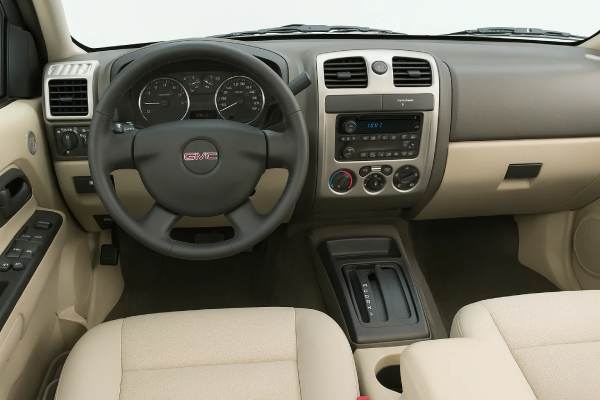
Inside, the Canyon is functional and straightforward. Most V8 4WD models are extended-cab or crew-cab trucks with SLE or SLT trim, so you will typically see power accessories, air conditioning, and an upgraded audio system. Materials are work-oriented plastic and cloth or leatherette, which wear acceptably if kept clean but will not feel as plush as newer midsize trucks.
The LH8 itself is a member of GM’s Generation IV small-block family, closely related to engines used in full-size trucks and SUVs. That means a huge aftermarket, widespread parts availability, and a large knowledge base among independent shops. For an older truck, that combination is a major advantage: the more common the engine family, the easier it is to keep it going without excessive cost or downtime.
4WD Canyon LH8 specs and data
Engine and performance
| Item | Value |
|---|---|
| Engine code | LH8 |
| Configuration | 90° V8, cam-in-block (OHV), 2 valves/cyl, 16 valves total |
| Block / heads | Aluminium block and heads (LS-family) |
| Displacement | 5.3 l (≈ 5,328 cc) |
| Bore × stroke | ≈ 96.0 × 92.0 mm (3.78 × 3.62 in) |
| Induction | Naturally aspirated |
| Fuel system | Sequential multiport fuel injection |
| Compression ratio | Around 9.9:1 |
| Max power | 300 hp (≈ 224 kW) @ ~5,300 rpm |
| Max torque | 320 lb-ft (≈ 433 Nm) @ ~4,000 rpm |
| Firing order | 1-8-7-2-6-5-4-3 (typical LS-family) |
| Timing drive | Chain |
| Emissions standard (US) | Tier 2 / Bin-level light-duty truck compliance for 2009 model year |
Fuel economy and efficiency (typical real-world range)
| Scenario | L/100 km (approx.) | mpg US (approx.) | mpg UK (approx.) |
|---|---|---|---|
| City driving | 15–17 | 14–16 | 17–19 |
| Highway (65–70 mph / 105–115 km/h) | 11–13 | 18–21 | 22–25 |
| Mixed use | 13–14.5 | 16–18 | 19–22 |
Actual consumption will depend strongly on axle ratio, tire size, lift kits, load, and driving style. Trucks with aggressive all-terrain tires or roof racks often sit at the higher end of these ranges.
Transmission and driveline
| Item | Value |
|---|---|
| Transmission | 4-speed automatic, GM 4L60E (electronically controlled) |
| Gear ratios (1st / 2nd / 3rd / 4th / Reverse) | 3.06 / 1.63 / 1.00 / 0.70 / 2.29 |
| Transfer case | Electronic shift-on-the-fly, 2-speed, 2HI / 4HI / 4LO |
| Typical transfer case low ratio | Around 2.6–2.7:1 |
| Drive type | Part-time 4WD (rear-drive on dry pavement) |
| Rear differential | Open, with optional automatic locking differential (G80 code) |
| Typical final drive ratio | Around 3.73:1 (varies by axle option) |
Chassis, dimensions, and weights (typical crew/extended cab 4WD V8)
Values can vary slightly by cab style and bed length, but the ranges below are representative:
| Item | Value (approx.) |
|---|---|
| Front suspension | Independent double wishbone, torsion bar or coil spring, stabilizer bar |
| Rear suspension | Solid axle with semi-elliptic leaf springs |
| Steering | Power-assisted rack-and-pinion or recirculating ball (depending on configuration) |
| Front brakes | Ventilated disc |
| Rear brakes | Drum (most models) |
| Wheelbase | ≈ 2,827–3,200 mm (111.3–126.0 in) depending on cab/bed |
| Length | ≈ 4,980–5,260 mm (196–207 in) |
| Width | ≈ 1,740–1,740+ mm (around 69–70 in excluding mirrors) |
| Height | ≈ 1,650–1,700 mm (65–67 in) |
| Ground clearance | ≈ 200–220 mm (7.9–8.7 in), slightly lower with side steps |
| Curb weight | ≈ 1,850–2,000 kg (4,080–4,410 lb) |
| GVWR | ≈ 2,540–2,700 kg (5,600–5,950 lb) |
| Fuel tank | ≈ 79–81 l (≈ 21 US gal / 17.5 UK gal) |
Cargo volume depends on bed length; the standard bed offers ample space for typical homeowner and light-trade use, while the long bed extends that capacity at the cost of maneuverability.
Performance and capability
| Metric | Typical value (V8 4WD automatic) |
|---|---|
| 0–60 mph (0–97 km/h) | Around 7.0–7.5 s (unloaded, on road tires) |
| 0–100 km/h (0–62 mph) | Around 7.5–8.0 s |
| Top speed | Electronically limited; generally in the 95–110 mph (153–177 km/h) range |
| Braking 100–0 km/h | Roughly 42–46 m (138–151 ft) depending on tires and load |
| Towing capacity (properly equipped) | Up to around 6,000 lb (≈ 2,720 kg) |
| Payload | Typically 1,000–1,400 lb (≈ 450–635 kg) |
| Roof load | Usually around 150–200 lb (≈ 70–90 kg) with appropriate rack system |
For exact capacities on a specific truck, always check the VIN label and door-jamb tire-loading sticker, as equipment, axle ratios, and GVWR packages change the numbers.
Fluids and service capacities (typical values)
These are typical for the LH8 V8 4WD Canyon; always verify against the under-hood label and service manual for your exact VIN.
| System | Specification (typical) | Approx. capacity |
|---|---|---|
| Engine oil | 5W-30 meeting GM oil specification for the era (e.g., GM6094M / later dexos equivalents) | ≈ 5.7 l (6.0 US qt) with filter |
| Engine coolant | Long-life OAT coolant compatible with GM requirements (e.g., Dex-Cool type) | ≈ 11–12 l (≈ 11.5–12.7 US qt) including block |
| Automatic transmission | Dexron-VI ATF | ≈ 9–10 l (≈ 9.5–10.5 US qt) for full overhaul; less for drain and fill |
| Transfer case | GM-approved transfer case fluid (often Dexron-VI–based or specific auto-track fluid) | ≈ 1.5–2.0 l (≈ 1.6–2.1 US qt) |
| Front differential | 75W-90 GL-5 gear oil (synthetic preferred in cold climates) | ≈ 1.2–1.5 l (≈ 1.3–1.6 US qt) |
| Rear differential | 75W-90 GL-5 (plus friction modifier if specified for locking diff) | ≈ 2.0–2.5 l (≈ 2.1–2.6 US qt) |
| A/C refrigerant | R-134a | Typically around 650–800 g (23–28 oz); check label |
| A/C compressor oil | PAG oil of specified viscosity | Quantity per service manual |
Torque values for critical fasteners, such as wheel lug nuts, crank pulley bolts, and suspension components, vary by configuration. As a rough guide, wheel lug nuts are often in the 135–150 Nm (100–110 lb-ft) range, but you must confirm in the service data for your specific truck.
Electrical
| Item | Value (typical) |
|---|---|
| Alternator output | Around 125–145 A depending on option package |
| 12 V battery | Group-size truck battery, typically 600–700+ CCA |
| Spark plugs | Long-life platinum or iridium plugs, heat range to GM spec |
| Spark plug gap | Typically around 1.0–1.1 mm (0.040–0.044 in); confirm on under-hood label |
Safety and driver assistance equipment
For a 2009 truck, the Canyon relies mainly on passive safety and basic electronic aids rather than modern ADAS:
- Dual front airbags.
- Optional head-curtain side airbags on many crew-cab and higher trims.
- Four-wheel antilock brakes (ABS) as standard.
- Traction control and basic stability control on later models and higher trims.
- OnStar telematics and crash notification where subscribed.
Advanced driver-assistance systems such as autonomous emergency braking, adaptive cruise control, and lane-keeping assistance were not fitted to this generation. Any such features on a used truck will come from aftermarket accessories rather than factory equipment.
4WD V8 trims and safety
On the 2009 facelift, the LH8 V8 was positioned as the top engine option and was usually paired with better-equipped trims. In the GMC Canyon lineup, that most often meant SLE and SLT models, available in extended cab and crew cab forms, combined with 4WD and the automatic transmission.
Trims and equipment patterns
Common patterns you will see on V8 4WD trucks include:
- Work Truck (if ordered with V8 and 4WD, relatively rare):
- Steel wheels, vinyl or basic cloth interior, minimal chrome.
- Manual-adjust mirrors, basic audio, little sound insulation.
- Still gets the same powertrain and frame, so capability remains high.
- SLE (volume trim for V8 4WD):
- Alloy wheels, body-colour or chrome bumpers.
- Power windows and locks, keyless entry.
- Upgraded cloth seating, often with split-fold rear benches.
- Optional locking rear differential, towing package, and off-road suspension package.
- SLT (upper trim):
- Leather-appointed seats, often heated in front.
- More comprehensive audio system, sometimes with steering-wheel controls.
- Additional interior trim accents, fog lights, and more chrome.
- Frequently paired with crew-cab body and towing package.
Mechanical differences by trim are modest, but off-road or towing packages can add slightly different shock tuning, skid plates, and the all-important locking differential. When shopping, decoding the RPO (Regular Production Option) codes on the glove-box sticker or service printout is one of the best ways to verify what a specific truck actually has.
Safety ratings and crash performance
Safety performance for this generation Canyon depends on body style and the presence of optional curtain airbags. Government frontal crash tests generally show good driver and passenger protection. Side-impact results vary more, with crew-cab models and trucks without side curtains tending to score lower.
Extended-cab versions often fare better in certain frontal tests, while crew cabs may score higher in rear-seat side-impact protection when equipped with curtains. Because the V8 4WD option is confined to these larger cabs, most examples will fall into the better-equipped categories, but you should still confirm which airbags a specific truck has.
From a structural standpoint, the ladder frame is robust, and the cabin maintains survival space well in frontal offset impacts. However, this is still an older design by modern standards. Later midsize trucks with newer crash structures and more airbags will typically outperform it in comprehensive test programs.
Safety systems and child-seat practicality
Key points for family use and daily driving:
- Airbags: Dual frontal airbags as standard; many V8 4WD trucks have optional curtain airbags that cover front and rear rows.
- Brakes: ABS is standard. Some owners upgrade pads and rotors to higher-friction or heavy-duty aftermarket components to improve pedal feel under heavy towing.
- Stability and traction: Later 2000s trucks increasingly received electronic stability control alongside traction control, particularly on higher trims and 4WD models. It is worth verifying whether your truck has these features active via the instrument cluster indicators and owner’s manual.
- Child seats: Crew-cab Canyons can accommodate child seats more easily than extended-cab models. Lower anchor points and tether anchors are present but may be less convenient than in a modern SUV, so plan extra time for installation and check your seat’s compatibility.
Because there is almost no factory ADAS content, collision avoidance still depends mainly on driver attention, tire condition, and conservative driving habits. When evaluating a used truck, ensure that ABS warning lights are off, that no airbag or stability control fault lamps are illuminated, and that all seatbelts retract and latch properly.
Reliability issues and service actions
The good news for the Canyon LH8 4WD is that the core engine is very robust when serviced regularly. Most long-term reliability concerns centre on supporting components: the 4L60E automatic transmission, 4WD hardware, front suspension, and corrosion on older frames.
Engine and ancillaries
Common / low-to-medium cost issues:
- Oil leaks:
- Symptoms: Oil spots under the truck, smell of burning oil on hot shutdown.
- Likely causes: Valve-cover gaskets, oil pan gasket seepage, rear main seal on higher-mileage trucks.
- Remedy: Replace gaskets and seals, inspect crankshaft surfaces and PCV system; catch small leaks early to avoid softening rubber bushings.
- Ignition components:
- Symptoms: Misfires under load, rough idle, check-engine light with misfire codes.
- Likely causes: Worn spark plugs, ageing ignition coils, wiring issues.
- Remedy: Replace spark plugs at the recommended interval, swap coils as needed, and inspect harness routing.
- Cooling system aging:
- Symptoms: Coolant smell, low coolant warning, overheating in traffic.
- Likely causes: Radiator end-tank seepage, degraded hoses, water pump wear.
- Remedy: Pressure-test the system, replace suspect components, and flush coolant if it is discoloured or contaminated.
Major internal engine failures are relatively rare if oil and coolant are maintained, which is one of the main reasons owners value the LS-family design.
Transmission and driveline
The 4L60E automatic is well known and reasonably durable, but it does have distinctive failure modes:
- Shift flare or slipping in 3rd/4th:
- Prevalence: Common at high mileage, especially with heavy towing and infrequent fluid changes.
- Cause: 3–4 clutch pack wear, valve-body issues, or line-pressure problems.
- Remedy: Rebuild or replace the transmission; a fluid and filter change can sometimes improve marginal behaviour but will not fix worn clutches.
- Harsh or delayed engagement (Drive or Reverse):
- Cause: Valve-body wear, solenoid sticking, or internal seal leakage.
- Remedy: Diagnosis with a transmission specialist; may require valve-body repair or complete rebuild.
- Transfer case and front differential issues:
- Symptoms: Failure to engage 4HI/4LO, grinding or clicking noises, 4WD warning lights.
- Causes: Faulty encoder motor, worn internal gears, or low/contaminated fluid.
- Remedy: Verify electrical operation, check fluids, and replace the encoder motor or rebuild the unit as needed.
Routine fluid changes in the transmission, transfer case, and differentials significantly improve long-term durability.
Suspension, steering, and brakes
On older GMT355 trucks, you should expect some wear in the front suspension and steering:
- Front ball joints and control-arm bushings:
- Symptoms: Clunks over bumps, vague steering, uneven tire wear.
- Remedy: Replace ball joints and bushings in pairs, and follow up with an alignment.
- Wheel bearings:
- Symptoms: Growling or humming noise that changes with speed and cornering load.
- Remedy: Replace the affected hub assembly.
- Brake system:
- Issues: Rusty backing plates and caliper brackets in salted climates, soft pedal feel when fluid is old.
- Remedy: Replace corroded hardware and flush brake fluid every few years.
Corrosion and body
In regions that use road salt, frame and underbody corrosion can be significant:
- Inspect frame rails near the rear spring hangers, cab mounts, and crossmembers for scaling or perforation.
- Check brake and fuel lines along the chassis for corrosion.
- Look at the bed seams and lower door edges for bubbling or rust blisters.
Addressing corrosion early with cleaning, rust treatment, and undercoating can extend the truck’s useful life considerably.
Recalls, TSBs, and software updates
Across the GMT355 family, there have been recalls and technical service bulletins for items such as brake-lamp function, tailgate hardware, and certain safety-related components. For the V8 4WD trucks, some software updates may also refine shift calibration or address drivability quirks.
For any specific Canyon:
- Run the VIN through the official recall database for open safety recalls.
- Ask a GMC dealer to print the warranty and campaign history, confirming which campaigns have been completed.
- If you experience recurring drivability or electrical issues, ask a dealer or specialist if any updated calibrations are available for the engine or transmission control modules.
When buying used, proof of regular fluid services, documentation of any transmission work, and evidence of completed recalls are all strong positives.
Maintenance planning and buyer guide
A well-maintained Canyon LH8 4WD can be a long-term truck. The key is sticking to a sensible maintenance schedule and being realistic about age-related items on a vehicle that is now well over a decade old.
Practical maintenance schedule (typical guidance)
Always cross-check with the owner’s manual and service data, but a conservative schedule for mixed use looks like this:
- Engine oil and filter:
- Every 5,000–7,500 miles (8,000–12,000 km) or 12 months, whichever comes first.
- Short-trip or heavy-towing trucks benefit from the shorter interval.
- Engine air filter:
- Inspect annually, replace every 30,000–45,000 miles (50,000–70,000 km) or sooner in dusty conditions.
- Cabin air filter (if equipped):
- Replace every 15,000–25,000 miles (25,000–40,000 km) or 2 years.
- Spark plugs:
- Long-life plugs often spec’d around 100,000 miles (160,000 km).
- On older trucks, many owners choose to replace slightly earlier (80,000–100,000 miles) to avoid seized plugs.
- Fuel filter:
- If an external serviceable filter is fitted, replace around every 60,000 miles (100,000 km).
- Many later systems use a “lifetime” in-tank filter; replace only when servicing the pump, following service information.
- Coolant:
- Replace roughly every 5 years or 100,000 miles (160,000 km) under normal use; more often if tests show degradation or if there has been contamination.
- Automatic transmission fluid and filter:
- Change every 50,000–60,000 miles (80,000–100,000 km) for mixed driving, sooner for frequent towing or heavy loads.
- Transfer case and differential fluids:
- Replace every 50,000–60,000 miles (80,000–100,000 km), more frequently for regular off-road or towing use.
- Brake fluid:
- Flush every 2–3 years regardless of mileage.
- Brake pads and rotors:
- Inspect at least annually; replace when worn close to minimum thickness or when pulsation or cracks appear.
- Serpentine/auxiliary belt and hoses:
- Inspect yearly and replace the belt around 90,000–100,000 miles (145,000–160,000 km) or at any sign of cracking; replace hoses proactively if they are original on an older truck.
- Alignment and tire rotation:
- Rotate tires every 5,000–7,500 miles (8,000–12,000 km).
- Check alignment whenever new tires are fitted or if uneven wear appears.
- 12 V battery:
- Test annually after 4–5 years of age and replace at the first consistent signs of weakness.
Because the LH8 uses a timing chain rather than a belt, there is no scheduled belt replacement, but chain noise, stretch, or timing-correlation codes at high mileage should be investigated promptly.
Buyer’s checklist for a used Canyon LH8 4WD
When evaluating a used 2009 Canyon 4WD V8, focus on:
- Frame and underbody:
- Look for heavy scaling, deep pitting, or structural rust, especially in the rear frame.
- Check crossmembers and spring mounts carefully.
- Transmission behaviour:
- Shifts should be clean and decisive, without flares, bangs, or long delays when engaging Drive or Reverse.
- Test both cold and hot; marginal transmissions often behave better when cold.
- 4WD operation:
- Confirm that 2HI, 4HI, and 4LO engage and disengage smoothly on loose surfaces.
- Listen for binding, grinding, or unusual noises from the transfer case or front axle.
- Engine condition:
- Check for excessive oil consumption, visible leaks, or coolant/oil cross-contamination.
- Listen for ticking or knocking noises that persist when warm.
- Suspension and steering:
- Drive over rough roads and listen for clunks; inspect ball joints, tie-rod ends, and control-arm bushings.
- Check for uneven tire wear suggesting alignment or suspension issues.
- Brakes and lines:
- Inspect lines along the frame for rust.
- Evaluate pedal feel and stopping performance during a controlled test drive.
- Electrical and interior:
- Test power windows, locks, mirrors, and seat adjustments.
- Confirm that no warning lights (ABS, airbag, check engine, stability control) remain illuminated.
Well-documented trucks with regular fluid changes, evidence of transmission servicing, and minimal corrosion are the best candidates. Hard-used fleet or plow trucks without service history are best avoided unless priced accordingly and you are prepared for major reconditioning.
Long-term durability outlook
If you choose a solid example and keep up with fluids, suspension maintenance, and rust prevention, the LH8 V8 and 4WD hardware can support high mileages. Many LS-family engines run beyond 200,000 miles (320,000 km) with only routine service. The limiting factors are usually body/frame rust and the cost of transmission rebuilds relative to the truck’s market value.
On-road and off-road performance
The 4WD LH8 Canyon feels very different from four- and five-cylinder versions on the road. The extra mass of the V8 over the front axle is noticeable, but the torque and acceleration make the truck feel much more effortless in daily use.
Powertrain character
Throttle response from the 5.3 l V8 is smooth and predictable, with a broad torque band that makes it easy to keep the engine between 2,000 and 4,000 rpm in normal driving. Passing at highway speeds is straightforward: a downshift or two from the 4L60E drops the engine into the heart of its torque curve and produces decisive acceleration.
There is no turbo lag to manage, and the simple intake and exhaust routing keeps response linear. The factory calibration favours smoothness and reliability over sharp performance, so pedal mapping is progressive rather than aggressive. Many owners choose mild tuning or exhaust changes for a little more character, but even stock, the truck feels strong.
The 4L60E transmission is geared for a balance between towing and cruising. With a typical 3.73 final drive, first gear is short enough to move off confidently with trailers or in steep terrain, while fourth gear and the torque converter lock-up keep cruise rpm reasonable. Kickdown is not instantaneous by modern standards, but the truck rarely feels strained.
Ride, handling, and NVH
On pavement, the Canyon 4WD V8 rides like a compact body-on-frame truck: firm but not punishing when unladen, and more settled with some weight in the bed. The front independent suspension and relatively narrow width make it easy to place on tight roads or in city traffic.
- Straight-line stability: Acceptable at highway speeds, especially with good tires and fresh alignment.
- Cornering: Predictably front-heavy, with moderate body roll. It is happiest at a measured pace rather than being hustled.
- Steering: Light to moderate effort with limited road feel, typical of trucks of its era.
- Noise levels: V8 induction and exhaust note are noticeable under heavy throttle but subdued at a cruise. Wind and tire noise are more dominant on coarse pavement.
A well-maintained suspension with quality shocks can make a noticeable difference in both ride and control. Worn dampers and bushings tend to exaggerate float and body motions.
Off-road and low-traction behaviour
The combination of part-time 4WD, low range, and available locking rear differential makes the Canyon 4WD with the LH8 genuinely capable on moderate trails:
- 4HI: Suitable for snow, gravel, and light off-road use where extra traction is needed at higher speeds.
- 4LO: Useful for slow technical sections, steep climbs, boat ramps, and controlled descents.
- Locking rear differential (if fitted): Helps maintain progress when one rear wheel loses traction.
Ground clearance and approach/departure angles are adequate for rutted tracks, forest roads, and construction sites but not in the same league as purpose-built off-roaders. Skid plates, careful line choice, and sensible speeds are still essential.
Load and towing performance
With the V8 and proper tow package, the Canyon 4WD is comfortable with medium trailers such as small travel trailers, car haulers with light cars, or loaded utility trailers:
- The V8’s torque helps keep transmission temperatures manageable when combined with a working auxiliary cooler.
- Stability is reasonable for a midsize truck, but heavier trailers and high crosswinds will still demand careful driving and proper weight distribution.
- Expect a noticeable fuel-economy penalty when towing: it is normal to see consumption worsen by 25–40% compared with solo highway running.
Under heavy load, downshifts on long grades are normal. If the truck repeatedly hunts between gears, consider using lower manual ranges or tow/haul mode if available.
Canyon LH8 4WD versus rivals
When new, the 2009 GMC Canyon 4WD V8 occupied a niche corner of the midsize truck segment. Today, that uniqueness is still one of its main selling points.
Powertrain and capability versus rivals
- Toyota Tacoma (same era):
- Typically offered four- and six-cylinder engines but no V8.
- Known for strong reliability and resale value, but often more expensive on the used market.
- Off-road-focused models (like TRD Off-Road) offer robust capability but less outright towing power than a properly equipped V8 Canyon.
- Nissan Frontier:
- V6 power is competitive but again lacks the V8 punch, especially at higher altitudes or when towing.
- Chassis and interior are similar in age and feel, but parts and service availability are somewhat different region by region.
- Ford Ranger (pre-2011 North American generation):
- Smaller and generally less powerful, often better suited as a light-duty utility truck than a tow or highway rig.
- Simpler, but less refined, with fewer comfort and convenience features in many trims.
- Dodge Dakota (with V8):
- Offers V8 power, often with slightly more space and towing capacity.
- However, some Dakota powertrain combinations have a more mixed long-term reliability reputation.
Within this context, the Canyon 4WD LH8 trades some perceived brand bulletproofness (compared with a Tacoma) for stronger straight-line performance and a compact footprint. For buyers who specifically want a V8 in a smaller truck, the shortlist is very short, which is why these trucks attract enthusiasts.
Ownership and running costs
Compared with rivals:
- Fuel economy:
- The V8 Canyon will typically consume more fuel than a four-cylinder or V6 midsize competitor and similar or slightly less than an older half-ton truck, depending on gearing and weight.
- Maintenance and repair:
- The LS-family V8 and 4L60E transmission are widely understood by independent shops, which can keep costs reasonable.
- Parts availability is good for engine and chassis; body and trim pieces may require more searching as the trucks age.
- Resale value:
- Values depend heavily on condition, rust, and documentation. Well-kept V8 4WD examples often hold value better than base engines because of their rarity and desirability among enthusiasts.
Who the Canyon LH8 4WD suits best
This specific configuration makes most sense if:
- You want a smaller truck footprint but need genuine towing capability and highway performance.
- You value a conventional hydraulic steering and non-turbocharged V8 for long-term serviceability.
- You are comfortable budgeting for higher fuel use and possible transmission or rust repairs over time.
If your daily drive is mostly short city trips and light errands, a four-cylinder or newer midsize truck may be more sensible. If you tow heavy trailers regularly or want maximum safety and comfort features, a newer full-size half-ton might be a better long-term match. For the right owner, though, the 2009 GMC Canyon 4WD with the LH8 5.3 l V8 remains a very compelling blend of size, power, and character.
References
- Manuals and Guides | Vehicle Support 2024 (Owner’s Manual)
- GM Recall Information | GM 2024 (Recall Database)
- 2009 GMC CANYON | NHTSA 2024 (Recall and Safety Data)
- Chevrolet Colorado crew cab pickup 2009 crash test ratings 2010 (Safety Rating)
- Fuel Economy of 2009 GMC Canyon 2009 (Official Fuel Economy Data)
Disclaimer
This article is for informational purposes only and is not a substitute for professional diagnosis, repair, or safety advice. Specifications, torque values, fluid types, and maintenance intervals can vary by VIN, market, production date, and installed equipment. Always confirm critical data against your vehicle’s owner’s manual, factory service information, and under-hood labels before performing any work.
If you found this guide useful, please consider sharing it with other owners and enthusiasts on platforms like Facebook or X/Twitter. Your support helps keep detailed, independent technical content available to more readers.