
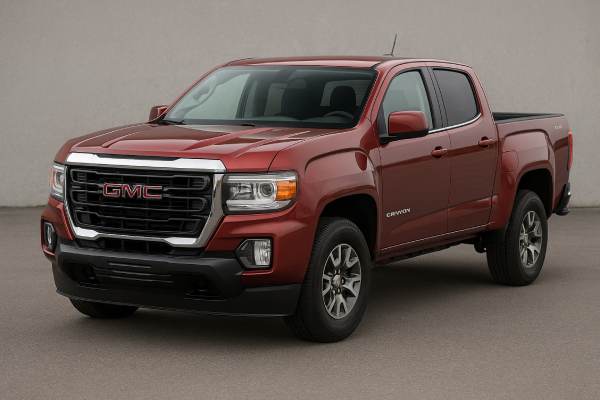
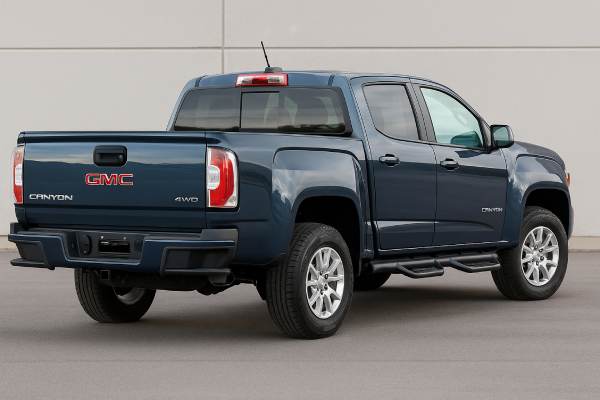
The 2021–2022 GMC Canyon 4WD with the 2.8 litre Duramax LWN diesel is a specialist’s truck: compact enough for daily use, but engineered to tow, haul, and handle poor conditions with confidence. Built on the GMT31XX platform, it combines a robust ladder frame, a part-time four-wheel-drive system with a two-speed transfer case, and a high-torque turbo-diesel tuned for low-rpm pulling power rather than headline acceleration.
In its final pre-redesign years, the Canyon diesel stands out in a market that has moved back toward petrol engines and downsized turbo units. The 181 hp diesel delivers a strong 369 lb-ft of torque, paired with a 6-speed automatic that keeps revs low on the highway. Owners value its long range, relaxed cruising, and strong tow ratings in a package that is easier to park than a full-size pickup.
There are trade-offs: added drivetrain complexity, more maintenance discipline, and safety technology that feels a generation behind newer rivals. This guide focuses on the 4WD diesel Canyon, looking at what it is like to own, maintain, and drive, and whether it still makes sense as a new or used buy.
Key Takeaways
- 2.8 L Duramax 4WD Canyon combines midsize footprint with serious torque and around 7,550 lb (3,425 kg) max towing when properly equipped.
- Four-wheel drive with a two-speed Autotrac transfer case adds traction for snow, gravel, and light off-road use compared with the RWD version.
- Ownership caveat: emissions hardware and diesel fuel-system components are costly if neglected or exposed to contaminated fuel.
- Typical diesel timing belt interval is around 150,000 mi / 240,000 km, with water pump and tensioners done at the same time.
- Fuel filter changes roughly every 37,500 mi / 60,000 km or 2 years are important for injector and pump longevity.
Guide contents
- GMC Canyon 4WD Diesel Profile
- Technical Details for Canyon 4WD Diesel
- Canyon 4WD Trims and Safety
- Canyon 4WD Diesel Reliability Notes
- Ownership Maintenance and Buying Guide
- On-Road Performance and 4WD Use
- Canyon 4WD Diesel Against Competitors
GMC Canyon 4WD Diesel Profile
The four-wheel-drive 2.8 Duramax Canyon is the “do-most-things” version of this generation truck. Where the rear-drive diesel caters to highway towing and open-road efficiency, the 4WD variant adds all-weather usability and light off-road capability without stepping up to a full-size pickup. It uses a selectable 4×4 system with a two-speed transfer case: high range for wet or loose surfaces and low range for controlled crawling, backing trailers on steep ramps, or climbing rough tracks.
GMC positioned the diesel engine as an upgrade across several trims rather than a separate model. In 2021–2022 it appears most often in Elevation, AT4, and Denali 4WD crew cabs. The facelift brought a more upright nose, trim-specific grilles, and some feature reshuffling, but underneath you are still dealing with the 2015-onward GMT31XX platform and the same basic Duramax driveline used since 2016.
The engine itself is a 2.8 litre inline-four, single turbo, with common-rail direct injection and a relatively high 16.5:1 compression ratio. The headline numbers—181 hp and 369 lb-ft—do not look dramatic next to some petrol rivals, but they do not tell the full story. The torque arrives early, at about 2,000 rpm, and stays strong across the mid-range, which is exactly where you spend your time towing, climbing grades, or merging with traffic in a loaded truck.
Pairing this engine with 4WD and the 6-speed automatic adds weight and friction compared with the RWD diesel. That costs a little acceleration and fuel economy, but gives the Canyon a much larger operating window. Snowy mountain passes, gravel job sites, muddy boat ramps, or rutted access roads are all more manageable with the extra driven axle and low range.
From an ownership perspective, the 4WD diesel sits at the intersection of three complexity layers: modern diesel emissions hardware, a timing-belt-driven interference engine, and a multi-piece driveline with transfer case and front differential. When maintained on schedule, it can deliver long life and impressive real-world efficiency. When neglected, repairs can be expensive. Understanding those trade-offs is the key to deciding whether a 4WD Duramax Canyon is the right fit.
Technical Details for Canyon 4WD Diesel
This section focuses on a typical configuration: 2021–2022 GMC Canyon Elevation or AT4, Crew Cab, Short Box, 4WD, with 2.8 L Duramax LWN and 6-speed automatic. Values can vary slightly with trim and options.
Engine and Performance (2.8 L Duramax LWN)
| Item | Value | Notes |
|---|---|---|
| Engine code | LWN | 2.8 L Duramax turbo-diesel |
| Layout and valvetrain | Inline-4, DOHC, 4 valves/cyl | Cast-iron block, aluminium head |
| Displacement | 2.8 L (2,776 cc) | Bore × stroke ≈ 94 mm × 100 mm |
| Induction | Variable-geometry turbo, intercooler | Tuned for low-rpm torque |
| Fuel system | High-pressure common-rail direct injection | Electronically controlled |
| Compression ratio | ~16.5:1 | High for efficiency and torque |
| Max power | 181 hp (135 kW) @ 3,400 rpm | Factory rating |
| Max torque | 369 lb-ft (500 Nm) @ 2,000 rpm | Broad mid-range plateau |
| Timing drive | Gear-driven cams, toothed timing belt from crank | Belt service interval about 150,000 mi / 240,000 km |
| Emissions system | Cooled EGR, DOC, DPF, SCR with DEF | Designed to meet modern light-duty diesel limits |
| Rated economy (4WD diesel) | Roughly 18–19 mpg city / 28 mpg highway (US) | Slightly lower than equivalent 2WD |
| Real-world mixed | Often 21–24 mpg US (25–29 mpg UK) | Driver, load, and climate dependent |
| 120 km/h (75 mph) cruise | Typically 8.8–9.5 L/100 km (25–27 mpg US) | On stock tyres with moderate load |
| Aerodynamics (est.) | Cd ≈ 0.42, frontal area ≈ 2.8 m² | Typical midsize crew-cab pickup values |
Transmission and Driveline
| Item | Value | Notes |
|---|---|---|
| Transmission | Hydra-Matic 6L50, 6-speed automatic | Only transmission paired with the diesel |
| Gear ratios | 1st 4.06, 2nd 2.37, 3rd 1.55, 4th 1.16, 5th 0.85, 6th 0.67, Rev 3.20 | Wide-ratio spread for towing and economy |
| Final drive ratio | Commonly 3.42:1 with diesel 4WD | Confirm via axle RPO code |
| Drive type | Part-time 4WD | Rear-drive default, selectable 4HI and 4LO |
| Transfer case | Electric-actuated, 2-speed Autotrac | 4HI for slippery roads, 4LO for off-road/steep work |
| Differententials | Rear automatic locking (G80) on most tow/off-road packages | Open front differential |
| Low-range ratio | Approx. 2.7:1 | Multiplies wheel torque for slow-speed control |
Chassis and Dimensions (4WD Crew Cab Short Box)
| Item | Value | Notes |
|---|---|---|
| Platform | GMT31XX | Shared with Chevrolet Colorado |
| Front suspension | Independent coil-over with twin-tube dampers | Control-arm layout |
| Rear suspension | Solid axle, leaf springs, twin-tube dampers | Tuned for payload and towing |
| Steering | Electric rack-and-pinion | Light effort, relatively tight turning for class |
| Brakes | 4-wheel discs; front ~12.2 in, rear ~12.75 in | ABS and stability control standard |
| Wheels / tyres (typical) | 17–18 in alloys, 255/65R17 or 265/60R18 | AT4 trims often use all-terrain patterns |
| Ground clearance | Around 8.4–8.6 in (213–218 mm) | AT4 slightly higher due to suspension and tyres |
| Length | ≈ 212–213 in (5,385–5,410 mm) | Crew-cab short box |
| Width (w/o mirrors) | ≈ 74.3 in (1,887 mm) | Body width |
| Height | ≈ 70–71 in (1,780–1,800 mm) | Varies with tyres and trim |
| Wheelbase | 128.3 in (3,259 mm) | Short-box crew configuration |
| Curb weight | Roughly 3,950–4,050 lb (1,790–1,835 kg) | 4WD diesel is among the heaviest combinations |
| GVWR | Around 6,000 lb (≈2,720 kg) depending on trim | Check door-jamb label |
| Fuel tank | 21 gal (79 L) | Shared across many configurations |
| Bed volume | ≈ 41 ft³ (≈1,160 L) short box | Measured to top of bed sides |
Performance and Capability (4WD Diesel)
| Metric | Value | Notes |
|---|---|---|
| 0–60 mph (0–97 km/h) | Roughly 9.5–10.0 s | 4WD and diesel weight slow it slightly vs RWD |
| 0–100 km/h | Around 10.0–10.5 s | Approximate |
| Top speed | About 110 mph (177 km/h) | Speed-limited |
| Braking 100–0 km/h | Around 40–43 m (131–141 ft) | Depends on tyres and load |
| Max towing (4WD diesel) | Up to about 7,550 lb (≈3,425 kg) | Requires properly equipped 4WD crew-cab with tow package |
| Payload | Typically 1,400–1,550 lb (635–700 kg) | Slightly reduced by 4WD and diesel hardware |
| Roof load | Commonly 165–220 lb (75–100 kg) | Check rating of rack or crossbars used |
Fluids and Service Capacities (Key Items)
| System | Spec and Capacity | Notes |
|---|---|---|
| Engine oil | About 5.6 L / 6.0 qt with filter; dexos2-approved 5W-30 diesel oil | Low-ash oil for DPF protection |
| Coolant | GM-approved Dex-Cool; ~10–11 L system capacity | Typical 50/50 mix |
| ATF (6L50) | Dexron-VI; ~9–10 L for complete service | Follow temperature-based level check |
| Transfer case | Appropriate GM transfer-case fluid; ≈1–2 L | Shorter interval with frequent 4WD use |
| Front and rear axles | 75W-90 synthetic gear oil; roughly 1.3–2.0 L per axle | Change more often if towing |
| DEF tank | Typically 4–5 gal | Consumption roughly 2–3% of fuel volume |
| A/C refrigerant | R-134a; charge and oil per under-hood label | Use certified equipment |
Electrical and Safety Hardware Snapshot
| Item | Value / Description | Notes |
|---|---|---|
| Alternator | Typically around 150 A | Higher output with some tow packages |
| 12 V battery | 70–80 Ah range, AGM or flooded | Diesel glow cycles demand a healthy battery |
| Airbags | Front, side, and side-curtain bags | Crew-cab coverage for both rows |
| ABS / ESC / traction control | Standard | Foundation safety systems |
| Headlights | Halogen projector on most trims | Performance below newer LED rivals |
| Driver-assist systems | Forward collision alert, lane departure warning (optional); rear parking sensors on some trims | Warning-only systems, no automatic braking |
Canyon 4WD Trims and Safety
The 4WD diesel Canyon was not a separate model line; instead, it was an engine option on several trims. The way those trims are equipped changes how the truck behaves and how easy it is to identify.
Elevation (and Elevation Standard) 4WD diesel
- Often the “work and play” choice: cloth seats, simpler trim, and 17- or 18-inch wheels.
- Diesel upgrade focuses on towing and range, while keeping suspension and brakes close to the mainstream gas versions.
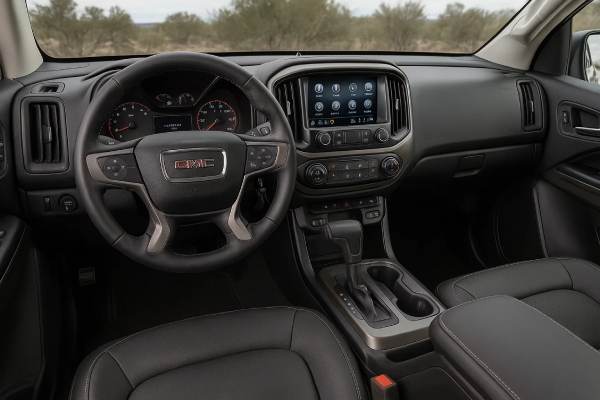
- Visual cues include a more understated grille and limited chrome, with a traditional analogue gauge cluster and mid-sized infotainment screen.
AT4 4WD diesel
- Off-road-oriented, pairing the 4WD system with all-terrain tyres, an off-road-tuned suspension, and underbody skid plates.
- Typically includes recovery hooks, hill-descent control, and the locking rear differential, making better use of low range for technical terrain.
- Easy to recognise by AT4 badging, darker exterior accents, red tow hooks, and an interior with sportier colour accents.
Denali 4WD diesel
- The luxury-leaning specification, combining the diesel 4WD hardware with larger wheels, chrome exterior pieces, leather upholstery, and premium audio.
- Denali trims prioritise comfort and appearance over maximum off-road clearance, but still retain the capability of the underlying 4WD system.
- Denali-specific grille patterns, bright window surrounds, and interior wood-effect trim make it the easiest to spot in a car park.
Option packages add further layers: trailering packages bring an integrated trailer brake controller and hitch guidance features; protection packages add floor liners and bed protection; appearance packages change wheels and exterior details. For the diesel, verifying the presence of the full trailering package is crucial if you want to access the highest tow ratings.
VIN information and RPO codes (printed on labels such as the glovebox sticker in many GM vehicles) are very useful. Codes like LWN confirm the diesel engine; GU6 indicates a 3.42 axle ratio; G80 denotes the automatic locking rear differential; Z71 or specific off-road packages affect suspension and tyre choice.
Safety ratings in brief
Crash-test data for the Canyon largely comes from the crew-cab Colorado/Canyon platform rather than each engine or trim combination. In general:
- The structure performs well in most traditional crash tests, with strong scores for moderate-overlap front impacts, side impacts, roof strength, and head restraints.
- Some small-overlap tests, particularly on the passenger side, score lower, reflecting an older cab design compared with the very latest midsize trucks.
- Headlight performance on most trims is rated below average, with limited reach and contrast in dark rural driving. Aftermarket upgrades must be chosen and aimed carefully to avoid glare.
NHTSA testing typically shows a 4-star overall rating, with good frontal and side performance but the expected rollover sensitivity inherent to taller, body-on-frame pickups with higher centres of gravity.
Safety systems and ADAS in the 4WD diesel
Standard safety hardware is solid but conventional:
- Multiple airbags, including head-curtain coverage for both rows in crew-cab models.
- Four-wheel ABS, electronic stability control, and traction control.
- Tyre-pressure monitoring and a rear-view camera.
Available driver-assistance features include:
- Forward collision alert (warning only, no automatic braking).
- Lane departure warning (audible/visual alerts, but no active steering).
- Rear parking sensors, particularly helpful with tall bed sides and a loaded cargo area.
Advanced systems that are common on newer rivals—such as adaptive cruise control, lane-keeping assist, and automatic emergency braking with pedestrian detection—are not available on this generation of Canyon. If those technologies are priorities, that becomes an important factor in cross-shopping.
After repairs involving the front bumper, grille, or windscreen, any forward-facing sensors or cameras used for collision and lane-departure warnings should be checked and calibrated. This is simpler than on heavily sensor-laden modern trucks, but still essential for proper system performance. For families, the crew-cab’s rear seats provide ISOFIX/LATCH anchors on the outer positions, with top tethers; some owners find the lower anchors slightly buried in the seat cushions, so trial-fitting child seats is recommended.
Canyon 4WD Diesel Reliability Notes
From a reliability standpoint, the 4WD diesel Canyon inherits the strengths and weaknesses of the 2.8 Duramax, then adds the potential wear points of a part-time four-wheel-drive system. Many owners report reliable high-mileage use, but the trucks that have problems can generate large repair bills, especially when maintenance has been skipped.
Common and occasional issues
- Emissions-system faults (common, medium to high cost)
- Symptoms: Check-engine light, limp-mode behaviour, increased fuel consumption, frequent DPF regenerations, or dashboard messages about exhaust or DEF systems.
- Likely causes: Soot and ash buildup in the DPF, sticking or clogged EGR valves, failing NOx or differential-pressure sensors, or issues with the DEF injector.
- Remedy: Proper diagnostics with a scan tool, forced regeneration or cleaning of the DPF, and replacement of faulty sensors or EGR components. Regular highway driving, correct oil, and clean fuel help keep the system healthy.
- Fuel-system sensitivity (occasional, high cost if severe)
- Symptoms: Hard starting, rough idle, misfires, rail-pressure faults, or excessive injector correction values.
- Root causes: Water or particulates in fuel, overdue fuel-filter changes, or use of sub-standard diesel.
- Remedy: Prompt filter replacement, draining any water separator, and, where needed, injector testing or replacement. The high-pressure pump and injectors are precision components that do poorly with contaminated fuel.
- Timing belt overdue (risk rises after 150,000 mi / 240,000 km)
- Symptoms: Belt noise, visible cracking when inspected, or, in worst cases, sudden engine failure with internal damage after belt breakage.
- Root cause: Running far past the recommended interval or age limit. The engine is interference-design, so belt failure can bend valves.
- Remedy: Preventive timing belt service with new tensioners, idlers, and usually the water pump, using correct locking tools and procedures.
- Turbocharger wear (occasional, high cost)
- Symptoms: Increasing whistle, siren-like noises, reduced boost, smoke, or frequent overboost/underboost codes.
- Root causes: Oil contamination or starvation, very long oil intervals, or foreign object damage.
- Remedy: Thorough inspection of intake, intercooler, and oil feed/return paths; replacement of the turbocharger when needed, combined with strict oil-change discipline afterwards.
- 4WD system and driveline wear (occasional, usually medium cost)
- Symptoms: Clicking or clunking when engaging 4WD, vibration at speed in 4HI, binding in tight turns if 4WD is used on dry pavement, or leaks at transfer case and axle seals.
- Root causes: Lack of fluid changes, misuse of 4HI on high-grip surfaces, or heavy off-road use without inspections.
- Remedy: Fluid services for transfer case and axles, replacement of worn U-joints or CV joints, and, in some cases, transfer-case repair.
- Chassis corrosion (common in salted climates, low to medium cost)
- Symptoms: Rust on frame rails, crossmembers, rear leaf-spring mounts, brake lines, and bed seams.
- Remedy: Regular underbody washes, rustproofing, and inspection. Advanced rust may require line replacement, bracket repair, or frame attention before it becomes a safety issue.
Mileage bands and typical patterns
- Up to 60,000 mi (100,000 km): Most trucks experience minor issues—occasional sensor faults or software updates—especially if used for mixed highway and city driving and serviced on time.
- 60,000–120,000 mi: More reports of EGR/DPF-related issues appear, particularly in trucks that do many short trips or idle extensively. Suspension wear (shocks, bushings) and driveline noises (U-joints, wheel bearings) begin to show in hard-worked examples.
- 120,000+ mi: The maintenance story becomes critical. Well-maintained trucks can continue to run reliably, but overdue timing belts, neglected fluids, and untreated rust all come to a head. Failures of injectors, high-pressure pumps, or turbochargers typically show up in this band when maintenance has not kept pace.
Recalls, TSBs, and extended coverage
A key recall for 2022 Canyon and Colorado models concerns the front passenger seat frame hook attachment, which may not be properly welded and can separate from the inboard track of the seat frame. The remedy is dealer inspection and, if required, seat-frame replacement at no cost. Checking that this recall has been completed is important for both safety and resale confidence.
Various technical service bulletins (TSBs) and software updates address:
- Driveability concerns such as hesitation or unusual shifting patterns.
- Emissions-related diagnostic improvements.
- Sensor-calibration updates for driver-assistance features.
A dealer can check recall and campaign completion via the vehicle’s VIN. Prospective buyers should obtain a print-out or screenshot showing all campaigns closed.
Pre-purchase checks specific to the 4WD diesel
When shopping used:
- Confirm service history for engine oil, fuel filters, coolant, ATF, transfer case, and axle oils. Missing records at higher mileage should be treated as a reason to budget for a full fluid refresh.
- Ask specifically about timing belt replacement; if there is no clear evidence it has been done, treat it as due.
- Inspect the 4WD engagement on a test drive, moving between 2HI, 4HI, and 4LO on appropriate surfaces, listening for unusual noises and checking for binding.
- Look for signs of emissions tampering (removed DPF, EGR block-off plates, altered exhaust). These can make the truck illegal on public roads and complicate future repairs.
- Have a diesel-competent workshop run a scan, checking for stored codes and examining injector balance and rail-pressure behaviour under load.
Ownership Maintenance and Buying Guide
Because the 4WD Duramax Canyon combines a modern diesel with a multi-piece driveline, a structured maintenance plan pays off. The onboard oil-life monitor is useful, but owners who tow, off-road, or operate in very cold climates may choose more conservative intervals.
Practical maintenance schedule (typical use)
| Item | Interval (distance / time) | Notes |
|---|---|---|
| Engine oil and filter | Oil-life monitor or ~7,500 mi / 12,000 km or 1 year | Use dexos2 5W-30 or equivalent low-ash diesel oil |
| Fuel filter | 37,500 mi / 60,000 km or 2 years | Shorten if poor fuel quality is a concern |
| Engine air filter | 45,000 mi / 72,000 km or 4 years; sooner in dust | Inspect annually |
| Cabin air filter | 22,500–30,000 mi / 36,000–50,000 km or 2 years | More frequent in polluted or dusty areas |
| Coolant (Dex-Cool) | 150,000 mi / 240,000 km or 5 years | Replace hoses as needed |
| Timing belt kit and water pump | 150,000 mi / 240,000 km or around 10 years | Treat as critical, interference engine |
| Serpentine/aux belt | 150,000 mi / 240,000 km or on condition | Often done with timing belt |
| ATF (6L50) | 45,000–60,000 mi / 72,000–100,000 km | Shorter interval if towing or in hot climates |
| Transfer-case fluid | 45,000 mi / 72,000 km (severe) or 90,000 mi normal | More often with frequent 4WD use |
| Front and rear axle oil | 45,000 mi severe; up to 90,000 mi normal | Essential for trucks that tow or off-road |
| Brake fluid | Every 3 years | Moisture control and ABS performance |
| Brake pads and rotors | Inspect yearly or every 12,000 mi / 20,000 km | Watch for rust scaling on inner rotor faces |
| Tyre rotation and alignment | 6,000–7,500 mi / 10,000–12,000 km | Helps even wear, especially on aggressive tyres |
| 12 V battery | Test annually after 4 years; replace around 6–7 years | Diesel starting and glow plugs demand a strong battery |
| 4WD system inspection | At each oil change | Check CV boots, U-joints, seals, and lines |
Owners who tow near the truck’s limits, run heavy accessories, or drive mainly short trips in cold weather should move toward the shorter end of these intervals, especially for engine oil, fuel filters, ATF, transfer-case fluid, and axle oils.
Fluid specifications and key torque values
- Choose dexos2-approved low-SAPS oils to protect the DPF and other emissions equipment. Avoid generic “diesel” oils that do not meet this specification.
- Use the correct coolant and protect it from contamination with tap water that can change its chemistry; distilled or deionised water is best for mixing.
- When working on the engine yourself, an important torque to note is the oil-drain-plug torque (around 24 Nm / 18 lb-ft). Over-tightening can strip the pan threads.
- Follow official procedures and torque values for timing-belt replacement; cam and crank locking is critical to avoid mis-timing.
Buyer’s guide: what to look for and what to avoid
Preferred configurations
- For a balance of value, capability, and comfort, many buyers target a crew-cab short-box 4WD diesel Elevation or AT4 with the trailering package.
- AT4 brings useful off-road and winter hardware without excessive luxury extras. Denali appeals if you prioritise comfort and appearance over rough-road use.
Desirable traits in used trucks
- Documented timing-belt and fuel-filter services, plus regular oil changes with the correct specification.
- Clean underbody with limited corrosion, especially around frame rails, fuel and brake lines, and rear-spring mounts.
- 4WD system that engages smoothly, with no grinding or clunking noises and no binding in appropriate conditions.
- Emissions system in original, unmodified condition, with no warning lights and normal DEF consumption.
Common reconditioning items
Expect to budget for some wear-and-tear work on higher-mileage trucks:
- Tyres, especially on AT4 models where all-terrain patterns may have worn or aged.
- Shocks and struts, particularly at 80,000–100,000 mi and beyond.
- Brake rotors and pads, which may show rust lips or pulsation.
- Suspension bushings and ball joints if the truck has seen heavy loads or rough roads.
Long-term durability outlook
With proper maintenance and sympathetic use, the 4WD Duramax Canyon can be a long-lasting tool. The engine is designed to handle high mileages, and the 4WD hardware is conventional and well understood. The main long-term risks are skipped timing-belt services, neglected diesel-emissions systems, and corrosion in harsh climates.
For buyers who want to keep a truck for a decade or more, prioritising a well-maintained example—and setting aside a realistic annual maintenance budget—is more important than chasing the lowest purchase price.
On-Road Performance and 4WD Use
Out on the road, the 4WD diesel Canyon feels noticeably different from a petrol V6 version and subtly different from the RWD diesel. The added front driveline hardware makes the truck feel a little more substantial, and the low-rpm torque of the diesel sets the character.
In everyday driving, throttle response is measured but strong. The turbo takes a brief moment to build boost from very low revs, but once you are rolling, the engine pulls with a steady push rather than a high-rev rush. The 6-speed automatic generally shifts early to keep revs low, taking advantage of the torque. When you select tow/haul mode, it holds gears longer, downshifts earlier on grades, and makes more use of engine braking—very helpful when towing or descending steep hills.
Ride quality is firm but controlled. Unladen, the rear end can hop slightly over sharp bumps and broken surfaces, as is typical for leaf-spring pickups. With some weight in the bed or a trailer attached, the truck settles and feels more planted. The 4WD hardware does not radically change the ride, but AT4 and similar off-road-oriented trims with all-terrain tyres can feel a little busier and noisier than road-biased setups.
Wind and road noise are modest at highway speeds, and the diesel’s clatter softens to a background hum once you are in top gear. Around town and at idle, there is no hiding that it is a diesel, but the sound is well managed for a midsize pickup.
Steering is light and consistent, more tuned for ease of use than sharp feedback. Straight-line stability is good, and the relatively compact footprint makes the Canyon easy to thread through city streets or multi-storey car parks compared to full-size trucks.
Braking performance is adequate for the segment. The pedal can feel slightly soft, and repeated hard stops when towing will benefit from using lower gears or tow/haul mode to keep speeds in check and share some of the work with engine braking.
Real-world efficiency and range
Compared with the RWD diesel, the 4WD version typically sacrifices a small amount of fuel economy due to extra weight and driveline losses. In practice, many owners see:
- City: roughly 17–20 mpg US (13.8–11.8 L/100 km), depending on trip length and traffic.
- Highway (100–120 km/h / 60–75 mph): often 24–28 mpg US (9.8–8.4 L/100 km), with best results at moderate speeds and smooth driving.
- Mixed driving: commonly around 21–24 mpg US (11.2–9.8 L/100 km).
Towing a 3,500–5,000 lb trailer usually increases fuel use by about 20–35%, putting highway figures into the mid- to high-teens mpg (US). Cold weather, short trips, and frequent DPF regenerations can push consumption higher; planning occasional longer runs and using the block heater where available can help.
4WD engagement and traction
The part-time system means you normally drive in 2HI (rear-wheel drive). You select 4HI on loose or slippery surfaces—snow, gravel, wet grass—and 4LO when you need more control at low speeds: steep tracks, rocky sections, or tight manoeuvres with heavy trailers. Using 4HI on dry, high-grip pavement can cause driveline binding and should be avoided.
With good all-terrain or winter tyres, the 4WD Canyon feels secure in snow and on muddy tracks, especially when you combine 4HI with the locking rear differential. Low range and hill-descent control are valuable for descending steep, loose surfaces or easing heavy loads down ramps. For many owners, these capabilities are why the 4WD diesel makes more sense than the RWD version despite the slight efficiency penalty.
Canyon 4WD Diesel Against Competitors
In the 2021–2022 timeframe, the 4WD Duramax Canyon sits in a competitive midsize-pickup class that includes:
- Toyota Tacoma 4×4 (3.5 L V6).
- Ford Ranger 4×4 (2.3-litre turbo petrol).
- Nissan Frontier 4×4 (3.8 L V6).
- Honda Ridgeline (AWD, 3.5 L V6, unibody).
Each has its own character, and the Canyon diesel appeals to a fairly specific use case.
Strengths of the Canyon 4WD diesel
- Towing and loaded stability
The 4WD diesel Canyon’s tow ratings are among the highest in the class once properly equipped, and the diesel’s torque delivery at low rpm makes it feel relaxed under load. Coupled with the relatively long wheelbase for a midsize truck and the selectable 4WD system, it feels confident towing campers, boats, or equipment trailers in varied conditions. - Highway efficiency with 4WD capability
Few 4WD midsize pickups of this era can match the Canyon diesel’s combination of real-world highway economy and range. For drivers who cover serious distances and still need 4WD for winter or rough access roads, that blend is a strong selling point. - Traditional truck construction in a manageable size
Like the Tacoma, Ranger, and Frontier, the Canyon uses body-on-frame construction. Compared with full-size diesels, however, it is easier to park, lighter, and generally cheaper to operate, while still offering enough capability for many owners’ usage patterns.
Where rivals often win
- Modern driver assistance and infotainment
Newer designs—particularly recent versions of the Ranger, Tacoma, and Ridgeline—offer more comprehensive suites of driver-assistance tech, including automatic emergency braking, adaptive cruise control, and more advanced lane-keeping functions. Their infotainment and digital instrument clusters also feel more modern than the pre-2023 Canyon. - Perceived long-term simplicity
Petrol V6 trucks such as the Tacoma and Frontier avoid the complexity of modern light-duty diesel emissions systems. For some owners, especially those doing many short trips, that simpler setup is attractive even if fuel consumption is higher. - Ride comfort and refinement
The Honda Ridgeline, though not a direct work-truck rival due to its unibody construction, delivers significantly better ride comfort, cabin quietness, and car-like handling. Some later petrol rivals have also edged ahead in NVH and interior materials versus the outgoing Canyon.
Who the 4WD diesel Canyon suits best
The GMC Canyon 4WD with the 2.8 L Duramax diesel is a strong candidate if you:
- Frequently tow or haul moderate loads but do not need the size or running costs of a full-size diesel pickup.
- Live in a region with real winters, unpaved access roads, or steep terrain where 4WD and low range are genuinely useful.
- Are willing to follow a diesel-specific maintenance plan and either do the work yourself carefully or use a workshop familiar with modern diesel pickups.
If your usage is mostly short city trips, if you are sensitive to potential big-ticket repair risks, or if you strongly value the very latest safety and driver-assistance features, a newer petrol midsize pickup—or even a crossover-based alternative—may be a better, lower-stress ownership experience.
References
- 2022 GMC Canyon Features, Specs and Options 2022 (Brochure)
- 2020 Chevrolet and GMC Duramax Diesel 2.8L Owner Manual Supplement 2020 (Owner’s Manual)
- Owner’s Manuals and Guides 2022 (Owner’s Manual Portal)
- 2022 GMC Canyon Crew Cab Pickup 2022 (Safety Rating)
- Part 573 Safety Recall Report 22V-375 2022 (Recall Report)
Disclaimer
This article is for informational purposes only and is not a substitute for professional diagnosis, repair, or official service information. Specifications, torque values, fluid types, and maintenance intervals can vary by VIN, model year, market, and installed equipment. Always confirm details against the official owner’s manual, factory service information, and current technical bulletins for your specific vehicle.
If this guide helped you understand the GMC Canyon 4WD diesel better, please consider sharing it with other owners or shoppers via social media or forums to support our work and help more people make informed decisions.