
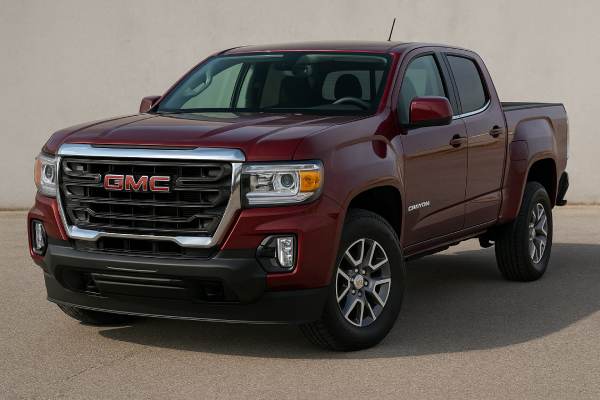
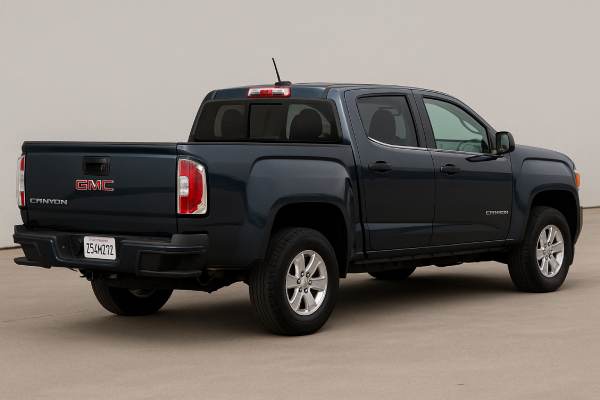
The 2021 facelift GMC Canyon 4WD with the 2.5 litre LCV four-cylinder sits in an unusual place in the midsize pickup world. It shares the same basic chassis and cabin as the more popular 3.6 V6 and Duramax diesel, but it uses a simpler, lighter engine with lower purchase cost and more modest performance. For buyers who spend more time commuting, running light loads, or accessing trailheads than towing at maximum capacity, this configuration can make a lot of sense.
The facelift brought a cleaner front end, revised trims, and some feature reshuffling without changing the fundamentals: body-on-frame construction, available extended or crew cabs, and a selectable 4WD system that remains straightforward to service. This guide focuses specifically on the 4WD 2.5 LCV model for 2021, breaking down its technical data, real-world behaviour, common issues, and what to look for when buying used so you can decide whether this is the right Canyon for your needs.
Fast Facts
- 2.5 litre LCV inline-four with direct injection, 200 hp and about 191 lb-ft, favouring simplicity and lighter front-end weight over outright speed.
- Selectable 4WD with low range and a robust frame gives credible off-road traction and winter confidence, even with the base engine.
- Official ratings place fuel economy around 22 mpg combined (19 city / 25 highway) for comparable 2.5-litre Canyon trims, so running costs stay reasonable if driven sensibly.
- Canyon earns strong crash scores from major agencies when properly equipped, but availability of advanced driver-assistance features is limited compared to newer rivals.
- Plan engine oil and filter changes at roughly 7,500 miles / 12,000 km or 12 months, whichever comes first, and shorten intervals if you tow, idle, or off-road frequently.
What’s inside
- Canyon 2.5 4WD facelift overview
- Canyon 2.5 4WD specifications
- 2021 Canyon grades and safety tech
- Reliability patterns and common faults
- Maintenance schedule and buying advice
- Driving feel, handling and towing
- Canyon 2.5 4WD against rivals
Canyon 2.5 4WD facelift overview
The facelifted 2021 GMC Canyon 4WD with the 2.5 litre LCV engine targets buyers who want a midsize truck footprint with approachable running costs and straightforward hardware. While many shoppers gravitate to the 3.6 V6 or Duramax diesel, the naturally aspirated 2.5 is still enough for light-duty work, site access, and recreational use when paired with low-range four-wheel drive.
The LCV four-cylinder is an all-aluminium, direct-injection, DOHC design from GM’s modern four-cylinder family. It balances durability and efficiency with chain-driven camshafts and variable valve timing. In Canyon tune it produces 200 hp and roughly 191 lb-ft, with the torque peak in the mid-range where daily driving happens rather than at high rpm.
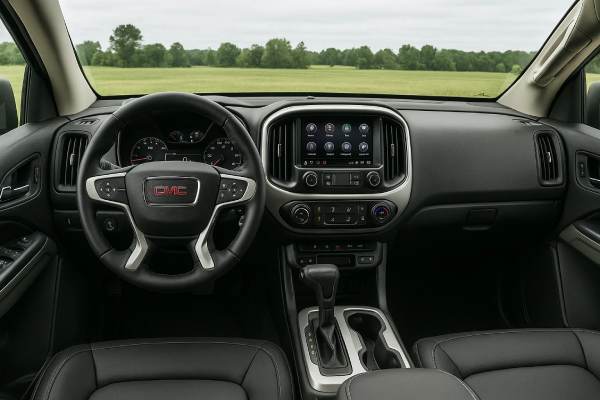
In 2021 the Canyon line gained a cleaner front fascia, trim-specific grilles and bumpers, and minor interior updates. The 2.5 4WD combo is mainly found in work-oriented Elevation Standard and some fleet-spec configurations rather than luxury Denali or off-road-oriented AT4 models. That means cloth seating, simpler infotainment, and fewer chrome details, but also fewer complicated systems to age or fail.
Chassis fundamentals are shared across the range: a fully boxed ladder frame, independent front suspension with coil-over shocks, and a solid rear axle on leaf springs. The 4WD system is a part-time, driver-selected setup with 2-High, 4-High, and 4-Low, plus an automatic locking rear differential on many builds. This gives good traction in loose terrain while avoiding the extra wear and complexity of full-time all-wheel drive.
For owners, the appeal of this exact configuration lies in its balance. It is not the quickest Canyon, nor the strongest tower, but it combines acceptable performance with lower initial cost, simpler maintenance, and a curb weight that is modest for a body-on-frame pickup. If you mostly commute, carry tools, and occasionally tow a small trailer or boat, the 2.5 4WD facelift truck can be a pragmatic, long-term choice.
Canyon 2.5 4WD specifications
Below are typical specifications for a 2021 GMC Canyon 4WD with the 2.5 LCV engine (extended or crew cab, short box). Exact numbers can vary slightly by cab, box, and equipment; always cross-check by VIN.
Engine and performance
| Item | Value |
|---|---|
| Engine code | LCV (Ecotec 2.5) |
| Layout and cylinders | Inline-4, aluminium block and head, DOHC, 4 valves per cylinder |
| Displacement | 2.5 L (2,457 cc) |
| Bore × stroke | About 88 mm × 100 mm (3.46 × 3.94 in) |
| Induction | Naturally aspirated |
| Fuel system | Direct injection, electronically controlled |
| Compression ratio | Around 11.3:1 |
| Max power | 200 hp (about 149 kW) @ ~6,300 rpm |
| Max torque | ~191 lb-ft (259 Nm) @ ~4,400 rpm |
| Timing drive | Chain-driven camshafts |
| Emissions standard | U.S. Tier 3 / LEV III equivalent (gasoline) |
Fuel economy and efficiency (typical U.S. figures)
| Item | Value |
|---|---|
| Combined rating | About 22 mpg (US) combined, depending on cab/trim |
| City / highway | Roughly 19 / 25 mpg (US) for comparable 2.5-litre Canyon trims |
| Approx. metric | About 10.7 L/100 km combined (city/highway mix) |
| Real-world highway @ 120 km/h | Commonly in the 9–10 L/100 km range when lightly loaded |
Transmission and driveline
| Item | Value |
|---|---|
| Transmission | 6-speed automatic (Hydra-Matic 6L50) |
| Drive type | Part-time 4WD with 2H / 4H / 4L |
| Transfer case | Electronically shifted, low-range about 2.7:1 (typical GM mid-size) |
| Rear differential | Open with automatic locking feature on many trims |
| Final drive ratios | Typically mid-3s (varies with axle option and cab style) |
Chassis and dimensions (typical crew cab short box)
| Item | Value |
|---|---|
| Frame | Fully boxed ladder frame |
| Front suspension | Independent, coil-over shock, twin-wishbone |
| Rear suspension | Solid axle, semi-elliptic leaf springs |
| Steering | Electric power-assisted rack-and-pinion |
| Front brakes | Ventilated discs (approx. 300+ mm diameter) |
| Rear brakes | Solid discs (varies slightly by trim) |
| Length | Around 5,395 mm (212.5 in) |
| Width (without mirrors) | About 1,880–1,890 mm (~74–74.5 in) |
| Height | Around 1,790–1,795 mm (~70.5–70.7 in) |
| Wheelbase (crew cab short box) | ~3,259 mm (~128.3 in) |
| Ground clearance | Roughly 210–215 mm (~8.3–8.5 in), depending on tyres and skid plates |
| Fuel tank | Approx. 79 L (21 US gal) |
| Curb weight range | Roughly 1,900–2,000 kg (4,200–4,400 lb), depending on cab and options |
Capability
| Item | Value |
|---|---|
| Towing capacity (braked) | Typically up to about 3,500 lb (≈1,588 kg) with proper equipment |
| Payload | Commonly in the 1,400–1,500 lb range (≈635–680 kg), depending on configuration |
| Roof load | Modest; roof racks are mainly for light gear, not heavy loads |
Fluids and service capacities (approximate)
These values are representative for the 2.5-litre 4WD powertrain; always confirm against the service information for your VIN.
| System | Specification and capacity (approx.) |
|---|---|
| Engine oil | Dexos1-approved 5W-30 or 0W-20; around 5.0–5.2 US qt (4.7–4.9 L) with filter |
| Engine coolant | Long-life OAT coolant; roughly 9–10 US qt (8.5–9.5 L) total capacity |
| Automatic transmission | Dexron-VI or later equivalent; roughly 8–9 L total fill (less for drain-and-fill) |
| Transfer case | GM-specified transfer case fluid; typically around 1.9 L (2.0 US qt) |
| Front differential | 75W-90 synthetic gear oil; around 1.3–1.5 L depending on axle |
| Rear differential | 75W-90 (with additive if locking diff); around 1.5–1.8 L typical |
| A/C refrigerant | R-134a; charge amount near 600–700 g depending on system variant |
| Brake fluid | DOT 3 or DOT 4, as specified in the owner’s manual |
Electrical
| Item | Value |
|---|---|
| Alternator output | Typically 150–170 A depending on equipment package |
| 12 V battery | Flooded or AGM, around 70–80 Ah with ample cold-cranking capacity |
| Spark plugs | Long-life iridium, change interval typically around 97,500 mi / 160,000 km in normal service |
Safety and driver assistance
| Item | Value |
|---|---|
| Crash ratings | Good structural performance in most major tests for recent Canyon models, especially crew-cab 4WD with side airbags |
| Airbags | Front, side, and curtain coverage for front seats and often the rear outboard seats |
| ABS and stability | Four-wheel ABS, stability control, traction control standard |
| ADAS availability | Lane departure warning and forward collision alert on certain trims; no full adaptive cruise or lane-centering in most 2021 configurations |
2021 Canyon grades and safety tech
On the facelift 2021 Canyon, the 2.5-litre 4WD combination is primarily tied to more work-focused grades rather than the fully optioned Denali or AT4. In many markets, the 2.5 engine is offered on Elevation Standard or fleet-orientated trims, sometimes with extended cab and occasionally with crew cab short box.
Trim and equipment character
Typical 2.5 4WD trucks lean toward:
- Cloth upholstery, manually adjustable seats, and a straightforward cabin layout.
- Small to mid-size infotainment screens with Apple CarPlay and Android Auto but fewer premium audio upgrades.
- Simpler wheel and tyre packages, often 17-inch alloys or steels with all-season tyres rather than aggressive off-road rubber.
- Limited appearance packages compared with Denali’s chrome or AT4’s off-road styling.
Mechanically, most 2.5 4WD trims share the same basic suspension tune as mid-level 3.6 trucks rather than the more specialised off-road dampers and skid plates found on AT4. That means a comfort-oriented ride and good body control for daily use, though less wheel travel and underbody protection for serious off-roading.
Year-specific facelift details
For 2021, GMC updated the Canyon with:
- A revised front fascia, grille designs, and fog-lamp surrounds that visually separate trims.
- Minor updates to option availability, including expanded availability of safety alerts on some builds.
- Some interior trim tweaks and colour/trim package reshuffling.
For the 2.5 4WD buyer, this facelift mostly affects appearance and feature bundling rather than core mechanicals; engine, gearbox, frame, and 4WD system remain essentially unchanged.
Safety equipment and ADAS
All 2021 Canyon models include a safety baseline:
- Multiple airbags including front, side thorax, and curtain bags.
- Four-wheel ABS, traction control, and stability control.
- Tyre pressure monitoring and rear-view camera.
On certain trims, the Driver Alert Package adds:
- Lane departure warning (audible and visual).
- Forward collision alert with adjustable sensitivity.
However, features like automatic emergency braking, adaptive cruise control, blind-spot monitoring, and rear cross-traffic alert are either not available or limited to specific trims with more powerful engines. That means a 2.5 4WD Canyon may have fewer active safety systems than a similarly priced rival from later model years.
When shopping, check the build sheet or RPO codes for driver-assistance packages, and verify that camera and sensor systems function correctly. After repairs that affect the front bumper, windscreen, or alignment, some systems may require calibration using factory procedures and scan tools.
Reliability patterns and common faults
The LCV 2.5 and the Canyon chassis are generally well-proven, especially by 2021 when early-run issues had been addressed. Still, there are patterns to be aware of if you plan to keep the truck long-term.
Engine and fuel system
The LCV 2.5 uses direct injection, which can lead to intake-valve carbon build-up over high mileage, especially with lots of short trips. Symptoms include rough idle, hesitation, and reduced performance. Walnut blasting or chemical cleaning of the intake ports and valves restores airflow.
Oil consumption is usually modest, but extended change intervals, heavy towing, or poor-quality oil can accelerate wear on timing chains and tensioners. Listen for cold-start rattles and check for cam/crank correlation faults with a scan tool. Persistent timing-related codes, noisy chains, or metal in the oil suggest it is time for a timing kit and closer inspection.
High-pressure fuel pumps and injectors can suffer from contamination or poor fuel quality. Misfires under load or hard starting may be traced to a weak pump, leaking injector, or sensor faults (such as rail-pressure sensors). A proper diagnosis with fuel-pressure readings and scan data is important before replacing expensive components.
Cooling and HVAC
Plastic coolant fittings, hoses, and radiator end tanks are potential leak points once the truck passes the mid-life mark. Regularly inspect for crusted coolant, a sweet smell after shutdown, or slow coolant loss. Replacing ageing hoses and clamps proactively can prevent overheating.
A/C systems can develop minor leaks at O-rings or condenser joints; reduced cooling performance, oily residue on lines, or visible dye traces are clues. Recharging without leak repair is only a temporary fix.
Driveline and chassis
The 6L50 automatic is generally robust if serviced with clean fluid. Harsh or delayed shifts can come from contaminated fluid, valve-body wear, torque-converter issues, or software that needs updating. A pan drop, filter change, and software check are good first steps before assuming internal damage.
Front suspension components—ball joints, control-arm bushings, and tie-rod ends—see high loads on rough roads. Clunks over bumps, wandering steering, and uneven tyre wear point to wear in these parts. The solid rear axle is tough but can develop leaks at pinion or axle seals; gear-oil seepage on the inside of rear wheels is a warning sign.
Rust is less extreme than on older trucks but still a concern in salt-belt regions. Pay attention to:
- Frame rails and crossmembers.
- Rear spring hangers and shackles.
- Cab corners, door bottoms, and bed seams.
Electrical and electronics
Minor electrical issues typically involve:
- Failing wheel-speed sensors causing ABS/traction lights.
- Door latch and window-regulator wear on high-use work trucks.
- Occasional infotainment glitches that respond to software updates or module resets.
GM often addresses software-related driveability or infotainment complaints through service bulletins and ECU reflashes, so check with a dealer for outstanding updates or campaigns based on your VIN.
Recalls and field actions
Use the official recall databases and GMC’s own tools to check for open recalls or customer satisfaction programmes on air bags, seat-belt pretensioners, brake components, or electronic modules. You will need the VIN to see the full picture for a specific truck.
Maintenance schedule and buying advice
Because the 2.5-litre Canyon is often used as a work truck, a structured maintenance plan is key to long life. Below is a practical schedule for mixed normal/severe use; always adjust to your environment and usage.
Core service intervals (approximate)
- Engine oil and filter – Every 7,500 miles / 12,000 km or 12 months; consider 5,000 miles / 8,000 km if you tow, idle, or drive in dusty conditions.
- Engine air filter – Inspect annually; replace around 30,000–45,000 miles (48,000–72,000 km), sooner in dusty use.
- Cabin air filter – Replace every 2 years or 20,000–25,000 miles (32,000–40,000 km).
- Spark plugs – Typically every 97,500 miles / 160,000 km in normal service; sooner if misfires appear.
- Coolant – First change around 5 years / 150,000 miles (240,000 km), then shorter intervals.
- Automatic transmission fluid – For mixed duty, plan a drain-and-fill around 45,000–60,000 miles (72,000–96,000 km).
- Transfer case and differentials – Replace fluid every 45,000 miles (72,000 km) for frequent towing, off-roading, or heavy loads; every 60,000–75,000 miles (96,000–120,000 km) otherwise.
- Brake fluid – Flush every 3 years regardless of mileage.
- Serpentine belt and hoses – Inspect yearly; plan replacement around 90,000–120,000 miles (145,000–190,000 km) or at first signs of cracking or glazing.
- Alignment, tyres, and rotation – Rotate tyres every 6,000–7,500 miles (10,000–12,000 km); align whenever you notice pull, uneven wear, or after suspension work.
- 12 V battery – Test annually after year three; many last 4–6 years depending on climate and usage.
Because this truck is 4WD, it is especially important to keep tyre sizes matched and tyre wear even. Mismatched rolling diameters stress the transfer case and differentials when 4WD is engaged.
Fluids and torque considerations
Use fluids that explicitly meet GM’s current specifications (such as Dexos1 for engine oil and Dexron-VI or subsequent approved ATF for the transmission). For critical fasteners—wheel nuts, suspension components, and driveshaft flanges—follow the torque values in the service manual. Over-tightening can distort hubs and rotors; under-tightening risks loosening hardware.
Buyer’s checklist for a used 2021 Canyon 2.5 4WD
When inspecting a used truck:
- Service records – Look for evidence of regular oil changes, coolant and brake-fluid renewal, and at least one driveline fluid service if mileage is high.
- Rust check – Inspect frame, bed supports, spring hangers, and cab corners, especially in cold-climate trucks.
- 4WD system – Engage 4H and 4L on a loose surface, listening for abnormal noises and ensuring smooth engagement and disengagement.
- Transmission behaviour – On a test drive, make sure shifts are smooth, with no flares, bangs, or delayed engagement when shifting into Drive or Reverse.
- Cooling and leaks – Check for coolant on the undertray, oil seepage at the front and rear of the engine, and gear-oil seepage at differential seals.
- Tyres and suspension – Uneven wear suggests alignment or suspension wear; knocking over bumps can hint at worn control-arm bushes or ball joints.
- Electrical – Verify all windows, locks, infotainment functions, and lighting, including high-mount stop lights and number-plate lights.
Which 2.5 4WD Canyon to seek
If possible, look for:
- A one-owner or fleet-maintained truck with documented services.
- Factory towing package if you pull a trailer, as it includes wiring, hitch, and often cooling improvements.
- Crew-cab configuration if you regularly carry people; extended cab is fine for tools and occasional passengers but less comfortable.
Overall, a well-maintained 2.5 4WD facelift Canyon should deliver long service with predictable costs, especially if you are disciplined with fluids and inspections.
Driving feel, handling and towing
On the road, the 2.5-litre 4WD Canyon feels different from its V6 and diesel siblings, but not necessarily worse—just tuned to a different use case.
Powertrain character
Off the line, the 2.5 lacks the punch of the 3.6 V6, especially when heavily loaded or climbing steep grades. Acceleration is adequate rather than quick, with 0–60 mph times in the ten-second range depending on configuration and load. The engine is happiest in the mid-range, where its torque peak lives, and the 6-speed automatic does a decent job of keeping it there.
Throttle response is linear and predictable. Around town, the combination suits relaxed driving, with the gearbox shifting early for economy. On the highway, downshifts for passes are more frequent than in the V6, so expect a bit more engine noise when overtaking or climbing hills. This is normal, but if shifts are harsh or delayed, a fluid change and software check are worthwhile.
Ride, handling, and NVH
The fully boxed frame and independent front suspension give the Canyon a secure, planted feel on paved roads. Steering weight is light to moderate, with reasonable accuracy and feedback for a truck. Body roll is present but controlled; it feels like a traditional pickup rather than a crossover, but it is not unruly.
Ride quality depends heavily on whether the bed is loaded. Unladen, the rear leaf springs can feel firm over sharp bumps and expansion joints. With some weight in the bed—tools, gear, or a light load—the rear end settles and the ride improves. Cabin noise is moderate: you will hear tyre and wind noise at motorway speeds and more engine sound during climbs, but the truck is acceptable for long trips.
4WD traction and light off-roading
The selectable 4WD system and decent ground clearance give the 2.5 Canyon genuine capability on gravel roads, forest tracks, and light off-road trails. In 2H, it behaves like a rear-drive truck; engaging 4H on loose surfaces adds stability and traction in rain, snow, or dirt. 4L is for slow, technical sections or steep climbs and descents.
Remember that the transfer case is not meant for extended use of 4H on dry, high-grip pavement; doing so can cause driveline binding. For frequent off-roading, consider all-terrain tyres, skid-plate upgrades, and more aggressive suspension setup.
Towing and load behaviour
With a maximum tow rating in the 3,500-lb (≈1,588-kg) range, the 2.5 4WD Canyon is ideal for small campers, boats, and utility trailers rather than heavy car haulers. Within that range, it tows steadily if you:
- Use the correct hitch setup and trailer brakes where required.
- Drive conservatively and allow more distance for merging and braking.
- Downshift on long climbs to keep transmission temperatures in check.
Expect fuel economy to drop significantly under tow—losses of 25–40% are common depending on trailer profile and speed. The chassis itself feels stable under load, particularly in crew-cab short-box form with a relatively long wheelbase, but soft rear springs can sag with heavy tongue weight. Weight-distributing hitches and rear-spring aids are options if you tow at the upper limit frequently.
In daily use, the 2021 2.5 4WD Canyon feels like a compact, manageable truck rather than a full-size behemoth. It fits into tighter spaces, threads through city streets more easily, and consumes less fuel than many larger pickups while still covering most light-duty tasks.
Canyon 2.5 4WD against rivals
When you compare the 2021 GMC Canyon 2.5 4WD to other midsize trucks, its strengths and compromises become clearer.
Versus Chevrolet Colorado 2.5 4WD
Mechanically, the Canyon and Colorado are siblings. A 2.5-litre 4WD Colorado shares the same engine, transmission, and frame. The differences are mainly:
- Styling and interior design, with GMC positioned a bit more “premium” in some trims.
- Feature packaging and pricing, which can favour one brand depending on market deals.
From a technical and reliability perspective, they are near-identical. Choosing between them comes down to appearance, equipment, and local availability.
Versus Toyota Tacoma
The Tacoma enjoys a reputation for long-term durability and resale value. However, it also carries:
- Higher used prices.
- A somewhat harsher ride and less comfortable seating for some drivers.
- Engines that are reliable but not especially fuel-efficient.
The Canyon’s 2.5 offers comparable real-world economy and a more car-like driving position, with better on-road manners and cabin refinement in many trims. The Tacoma counters with a broader aftermarket, strong perceived reputation, and more off-road-focused variants.
Versus Ford Ranger
The contemporary Ford Ranger uses a turbocharged 2.3 petrol engine with more torque and a modern 10-speed automatic. It is generally quicker and more capable at towing than the Canyon 2.5, but with greater mechanical complexity: a turbocharger, higher operating pressures, and more intricate emissions systems.
For buyers who value straightforward naturally aspirated hardware and fewer complex components, the Canyon’s 2.5 can look attractive. Those who prioritise strong acceleration or maximum tow ratings may prefer the Ranger or a Canyon with the 3.6 or diesel.
Versus Nissan Frontier (previous generation)
Older Frontiers are simple and robust but feel dated inside, with older safety tech and rougher ride quality. The 2021 Canyon, even in work-oriented form, generally offers:
- A more modern cabin.
- Better crash-safety structure.
- A broader mix of infotainment options.
Who the Canyon 2.5 4WD suits best
This facelifted 2021 truck is a smart choice if you:
- Need a reliable 4WD pickup for light towing and off-pavement access.
- Value a manageable size and relatively good fuel economy for a body-on-frame truck.
- Prefer simpler mechanicals over turbocharged engines, complex electronics, and niche off-road packages.
If you regularly tow near maximum capacity, demand the quickest acceleration, or want a full suite of modern ADAS, you may be better served by a V6 Canyon, a diesel, or a newer rival. But for many owners, the 2.5 4WD Canyon hits a sweet spot of capability, cost, and long-term serviceability.
References
<a href="https://gmauthority.com/blog/gm/gm-engines/lcv/">2.5L I4 LCV Engine Info, Power, Specs, Wiki</a> 2024 (Engine Specs)<a href="https://www.edmunds.com/gmc/canyon/2021/mpg/">Used 2021 GMC Canyon MPG & Gas Mileage Data | Edmunds</a> 2024 (Fuel Economy Data)<a href="https://www.iihs.org/ratings/vehicle/gmc/canyon-crew-cab-pickup/2021">2021 GMC Canyon</a> 2021 (Safety Rating)<a href="https://www.nhtsa.gov/vehicle/2021/GMC/CANYON%252520CREW%252520CAB%2525204WD">2021 GMC CANYON CREW CAB 4WD</a> 2021 (Safety Rating and Recalls)<a href="https://www.gmc.com/support/vehicle/manuals-guides">Manuals and Guides | Vehicle Support | GMC</a> 2021 (Owner’s Manual Portal)
Disclaimer
This article is for informational purposes only and is not a substitute for professional diagnosis, repair, or official service information. Specifications, torque values, fluid capacities, and maintenance intervals can vary by VIN, market, build date, and installed equipment. Always confirm procedures and values against the official service manual, owner’s manual, and technical bulletins for your specific vehicle, and consult a qualified technician when in doubt.
If you found this guide useful, please consider sharing it with other owners or shoppers on social media platforms such as Facebook or X/Twitter. Your support helps keep detailed, independent technical content like this sustainable.