
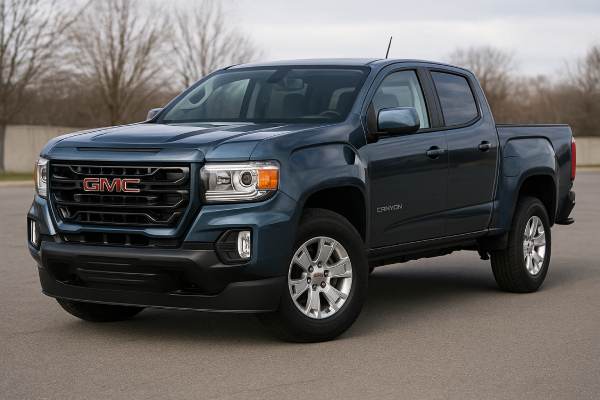
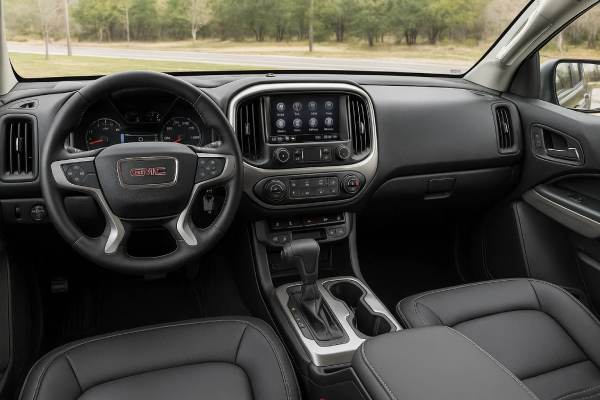
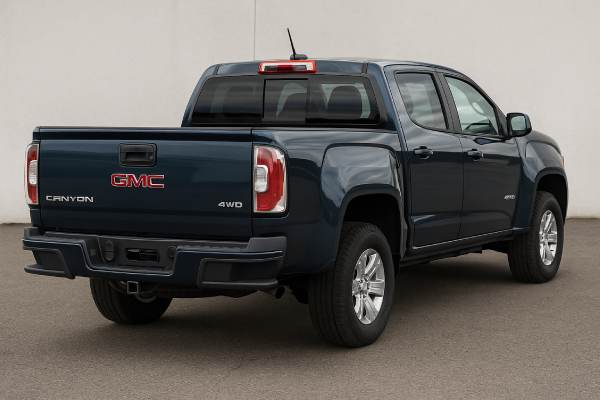
The 2021–2022 GMC Canyon 4WD with the LGZ 3.6 litre V6 sits at the top of the pre-redesign Canyon range. It combines a naturally aspirated high-feature V6, an 8-speed automatic, and a proper two-speed transfer case, giving you a midsize truck that is easy to daily yet serious enough for towing and back-road use. With 308 hp and a reasonably light chassis, it feels more responsive than many rivals, while still returning acceptable fuel economy for a 4WD gas pickup.
This guide focuses specifically on the 4WD V6 facelift models in the GMT31XX generation, built for the 2021 and 2022 model years. You will find hard specs, real-world performance notes, known issues, maintenance strategies, and how the Canyon 4WD compares to key rivals. If you are considering buying one used, or simply want to understand the mechanical package you already own, the aim is to give you clear, workshop-grade information in plain language.
Top Highlights
- Strong 308 hp LGZ V6 with 275 lb-ft, smooth revs, and good highway passing power.
- Proven Autotrac 4WD system with low range, automatic rear locker, and up to around 7,000 lb towing when properly equipped.
- Comfortable crew-cab packaging with decent ride quality for a body-on-frame truck.
- Watch for 8-speed automatic (8L45) fluid quality and transfer case/axle services if used for heavy towing or off-road work.
- Plan engine oil and filter changes every 7,500–8,000 km (5,000 mi) under mixed or severe use to protect the high-compression V6.
What’s inside
- GMC Canyon 4WD V6 Profile
- LGZ 3.6 4WD Specifications
- Canyon 4WD V6 Equipment and Safety
- 4WD V6 Reliability and Fixes
- Service Plan and Buying Tips
- On-Road and 4WD Driving Impressions
- How Canyon 4WD V6 Stacks Up
GMC Canyon 4WD V6 Profile
The 2021–2022 GMC Canyon 4WD with the LGZ 3.6 litre V6 is the “all-rounder” of the GMT31XX generation. It sits above the four-cylinder gas base engine and alongside the 2.8 Duramax diesel, offering more power and smoother response than the diesel, with simpler after-treatment and lower fuel costs in many markets.
The LGZ is a modern aluminium 60-degree V6 with dual overhead cams, four valves per cylinder, direct injection, variable valve timing, cylinder deactivation, and a relatively high compression ratio. It is paired with the 8L45 eight-speed automatic and a two-speed Autotrac transfer case. This gives the truck true 4WD low, an automatic locking rear differential on many trims, and an electronically controlled front axle engagement. Crew cab 4WD models are the most common, with either a short or long box.
From an ownership standpoint, the 4WD V6 Canyon strikes a balance between capability and livability:
- It tows a mid-size travel trailer or car hauler with less strain than the I-4.
- It is less complex and generally cheaper to service than the diesel.
- It is small enough to park in most urban spaces, yet still offers a usable bed and respectable payload.
The 2021–2022 facelift brought a sharpened front-end appearance, updated graphics and trim packages (especially for AT4 and Denali), and some equipment reshuffling. Underneath, though, the core mechanical package remained stable, which is good news for parts availability and workshop familiarity.
If you mainly drive unloaded and value refinement, the V6 is more responsive and quieter than the diesel. If you tow frequently at the upper end of the rating or cover huge highway distances, the diesel still wins on torque and economy. The 4WD V6 is the “middle lane” option: confident, versatile, and relatively straightforward to keep in good shape if you follow fluids and inspections closely.
LGZ 3.6 4WD Specifications
This section covers the typical configuration for a 2021–2022 GMC Canyon 4WD crew cab with the LGZ 3.6 V6 and 8-speed automatic. Always verify exact specs by VIN, trim, and market.
Engine and performance (LGZ 3.6 V6)
| Item | Value |
|---|---|
| Engine code | LGZ |
| Type | 60° V6, aluminium block and heads |
| Valvetrain | DOHC, 4 valves per cylinder, continuously variable valve timing |
| Displacement | 3.6 L (3,649 cc) |
| Bore × stroke | ~95.0 × 85.8 mm (3.74 × 3.38 in) |
| Induction | Naturally aspirated |
| Fuel system | Direct injection (SIDI) |
| Compression ratio | ~11.5:1 |
| Max power | 308 hp (230 kW) @ 6,800 rpm |
| Max torque | 275 lb-ft (373 Nm) @ 4,000 rpm |
| Recommended fuel | Regular unleaded (check market manual for octane) |
| Emissions standard (NA) | U.S. EPA Tier 3 / LEV III equivalent |
Efficiency (4WD V6, typical crew cab)
| Cycle | L/100 km | mpg (US) | mpg (UK) |
|---|---|---|---|
| City | ~13.8 | 17 | 20.4 |
| Highway | ~9.8 | 24 | 28.8 |
| Combined | ~12.4 | 19 | 22.8 |
These figures correspond to a 4WD V6 automatic crew cab on the U.S. EPA cycle. Real-world mixed use commonly falls in the 12–13 L/100 km (18–20 mpg US) range if you keep speeds reasonable.
At a steady 120 km/h (75 mph), owners often report high-9 to low-10 L/100 km (23–25 mpg US) in calm conditions, with 4–5 L/100 km penalties when towing at or near max ratings.
Transmission and driveline
| Item | Value |
|---|---|
| Transmission | 8-speed automatic, GM 8L45 |
| Drive type | Part-time 4WD with 2-speed Autotrac transfer case |
| Transfer case | Electronically controlled, 2-speed, with 2H / 4H / 4Lo and Auto modes (depending on trim) |
| Rear axle | 3.42 final drive ratio typical on V6 4WD |
| Differential | Automatic locking rear differential (G80) on many 4WD trims |
| 4WD engagement | Dash-mounted rotary selector; low-range for off-road and heavy pulling |
Chassis, dimensions, and capacities
Values vary slightly by bed length and trim; below is typical for a 4WD crew cab.
| Item | Value (approximate) |
|---|---|
| Overall length | ~5,395 mm (212.5 in) |
| Width (without mirrors) | ~1,885 mm (74.2 in) |
| Height | ~1,790 mm (70.5 in) |
| Wheelbase (crew cab, short box) | 3,258 mm (128.3 in) |
| Curb weight | ~2,045–2,050 kg (≈4,500–4,520 lb) for 4WD V6 crew cab |
| GVWR | Around 2,722–2,880 kg (6,000–6,350 lb) depending on configuration |
| Suspension front | Independent, coil-over shock, twin-wishbone |
| Suspension rear | Solid axle with leaf springs |
| Brakes | 4-wheel discs with ABS; front vented, rear solid |
| Typical wheel/tyre | 17–20 in rims; 255/65 R17 to 265/60 R18 all-terrain or highway tyres |
| Fuel tank | ~79 L (21 gal US) |
| Ground clearance | Roughly 211–220 mm (8.3–8.7 in) depending on trim |
Performance and capability (typical V6 4WD)
| Metric | Value (approximate) |
|---|---|
| 0–100 km/h (0–62 mph) | Mid-7 to low-8 s, depending on trim and tyres |
| 0–60 mph | Around 6.9–7.3 s with the V6 4WD |
| Top speed (governed) | ~185 km/h (115 mph) |
| Max towing (V6 4WD, properly equipped) | Typically up to ~3,175 kg (around 7,000 lb) with correct axle, cooling, and tow package |
| Typical payload | Roughly 650–750 kg (1,400–1,650 lb), depending on GVWR and curb weight |
Fluids and electrical (summary)
Exact fluid specs vary by market; always confirm by VIN:
- Engine oil: Dexos-approved 5W-30 synthetic, capacity around 5.5–6.0 L with filter.
- Coolant: Long-life OAT (orange Dex-Cool type), premix around 50:50.
- Transmission: Dexron ULV fluid for 8L45, capacity ~9–10 L including converter.
- Transfer case & differentials: GM-spec gear oil (often 75W-90 for diffs, special Autotrac fluid for transfer case).
- Electrical: Alternator output typically 150+ A on V6 4WD; 12 V battery ~70–80 Ah with good cold-cranking rating for winter starts.
Canyon 4WD V6 Equipment and Safety
For 2021–2022, the Canyon 4WD V6 was offered mainly in Elevation, AT4, and Denali trims (depending on market). The V6 and 4WD combination is common on:
- Elevation / Elevation Standard – “core” work and daily-use truck.
- AT4 – off-road-oriented model with skid plates and all-terrain tyres.
- Denali – premium trim with more chrome, luxury interior, and extra features.
Some trims offer 4WD as an option; AT4 is 4WD-only.
Trims and functional differences
Key mechanical and functional distinctions for the 4WD V6:
- Elevation 4WD V6
- 8L45 automatic, Autotrac 2-speed transfer case.
- Automatic locking rear differential on many packages.
- 17- or 18-inch wheels with all-season or mild all-terrain tyres.
- Available trailering package with hitch, wiring, and guidance features.
- AT4 4WD V6
- Off-road suspension tuning and all-terrain tyres.
- Skid plates, recovery hooks, and usually a slightly higher ride height.
- Hill-descent control and off-road-oriented traction calibration.
- Unique trim cues: AT4 badging, darker grille, interior details.
- Denali 4WD V6
- Similar core mechanicals to Elevation, but with more equipment.
- Larger wheels, more chrome, multi-way power seats, upgraded audio.
- Many driver-assist features standard or bundled in packages.
For quick identification, look for:
- Trim badges on doors and tailgate (AT4, Denali).
- Wheel design and tyre type (Denali often has larger, more road-biased tyres; AT4 has beefier A/T rubber).
- Interior trim: Denali uses more leather, wood-style trim, and embroidered headrests; AT4 has darker, rugged-themed finishes.
Safety ratings
The Canyon shares its structure with the Chevrolet Colorado. Most published ratings for the 2015–2022 crew-cab models apply across both.
- IIHS:
- Good overall rating in moderate overlap front and original side tests.
- Good driver-side small overlap protection; passenger-side small overlap test has a Marginal overall rating for this generation, mainly due to structural performance.
- Child-seat anchor usability generally rated in the Acceptable/Good range.
- Headlight ratings vary by trim; some halogen units are only Marginal or Poor.
- NHTSA (U.S.):
- Many crew-cab 4WD models achieve 4- or 5-star overall ratings, with strong side-impact scores and slightly lower frontal ratings; always check specific VIN.
The 2022 model year is also subject to a passenger-seat frame recall (N222368320) for potential welding issues on the front passenger seat cushion frame. The remedy is inspection and, if required, frame replacement at no charge.
Airbags and driver-assistance systems
Typical 2021–2022 Canyon 4WD V6 crew cabs offer:
- Airbags:
- Front airbags for driver and passenger.
- Side-impact airbags for front seats.
- Side-curtain airbags covering both rows.
- Active safety & stability systems (varies by trim and package):
- ABS and electronic stability control with traction control.
- Trailer sway control integrated into stability programming.
- Tyre-pressure monitoring system (TPMS).
- Available ADAS (often via Driver Alert or similar package):
- Forward collision alert.
- Lane departure warning.
- Rear park assist.
- Rear-vision camera (standard by this time).
These systems generally rely on front camera and ultrasonic sensors rather than complex radar/LiDAR setups. After body repairs or windshield replacement, calibration procedures may be required; this is especially true for forward collision alert and lane departure warning.
4WD V6 Reliability and Fixes
Overall, the LGZ 3.6 V6 and 4WD driveline are reasonably robust when serviced on time, but there are patterns worth knowing, particularly for buyers of high-mileage or heavily used trucks.
Engine-related themes (LGZ 3.6)
Common / moderate severity
- Timing chain stretch and noise (higher mileage or poor oil history)
- Symptoms: Rattling on cold start, timing-correlation fault codes (e.g., cam/crank), rough idle.
- Likely cause: Chain wear from extended oil change intervals or low oil.
- Remedy: Inspect with scan data and, if out of spec, replace chains, guides, and tensioners. Prevent with conservative oil changes and correct oil weight.
- Direct-injection carbon build-up (long-term)
- Symptoms: Gradual loss of low-rpm torque, misfires under load, rough idle.
- Cause: DI engines do not wash intake valves with fuel; vapour and oil mist bake onto valves over time.
- Remedy: Walnut blasting or similar intake-valve cleaning procedures when symptoms appear, typically beyond 100,000–130,000 km (60,000–80,000 mi).
- PCV and oil consumption issues
- Symptoms: Higher than expected oil use, oily intake tract.
- Remedy: Check PCV circuits and update parts if superseded; monitor oil carefully and keep at the correct level.
8L45 automatic and 4WD system
Occasional / can be moderate cost
- Torque-converter shudder or harsh shifts
- Symptoms: Shudder at light throttle in top gears, harsh downshifts, especially when warm.
- Cause: Fluid breakdown and contamination; early versions of this 8-speed family were known for torque-converter clutch shudder.
- Remedy: Proper fluid exchange with the latest approved fluid and, if needed, torque-converter replacement. Many owners see improvements after a thorough fluid service.
- Transfer case and diff wear from neglected services
- Symptoms: Groaning or binding in tight turns, clunks engaging 4WD, metallic fluid on inspection.
- Remedy: Follow transfer case and axle fluid change intervals, especially if you tow or use 4WD often. Use the correct Autotrac and gear oils.
Chassis, suspension, and corrosion
Common / usually low to medium cost
- Front suspension wear
- Symptoms: Clunks over bumps, looseness in steering, uneven tyre wear.
- Cause: Worn ball joints, control-arm bushings, or sway-bar links, especially on AT4 trucks used off-road.
- Remedy: Inspect joints and bushings during alignment or tyre service; replace worn parts with quality components.
- Rust at frame and bed junctions in road-salt regions
- Symptoms: Flaking undercoating, bubbling at seams, rust at leaf-spring shackles and crossmembers.
- Remedy: Annual under-body washing, targeted rustproofing, and early treatment of any surface rust. Inspect frame rails, rear crossmembers, and bed supports closely when buying used.
Recalls, TSBs, and service actions
Key items to be aware of for 2022-model trucks include:
- Front passenger seat hook separation (N222368320)
- Issue: Passenger seat cushion frame hook may not be properly welded; in certain crashes this could compromise occupant load management.
- Fix: Dealer inspection and replacement of seat cushion frame if it falls within specified build periods, performed at no charge.
- General 8-speed shift quality updates
- Various technical bulletins and software updates exist for shift feel improvements and shudder concerns. The official remedy is usually an updated fluid spec, proper flush procedure, and a TCM calibration update when needed.
When considering a used Canyon 4WD V6, ask for:
- Dealer-printout of recall status (VIN check).
- Proof of automatic transmission and transfer case services.
- Evidence of regular engine oil changes with quality Dexos-approved oil.
Service Plan and Buying Tips
A clear service plan is the best way to make a 2021–2022 Canyon 4WD V6 a long-term partner rather than a problem. The intervals below are practical rather than strictly “maximum permitted”, and assume mixed or light-severe use (towing, short trips, some off-road).
Practical maintenance schedule (approximate)
Always adjust for your market and official service guidance.
- Engine oil and filter – Every 7,500–8,000 km or 12 months (≈5,000 mi) if you tow, idle in traffic, or run short trips. Stretching to the longest oil-life monitor intervals is not ideal for this engine.
- Engine air filter – Inspect every 15,000 km (10,000 mi), replace 30,000–40,000 km, sooner in dusty conditions.
- Cabin air filter – Replace every 24,000–30,000 km (15,000–20,000 mi) or 2 years.
- Spark plugs – Iridium plugs typically around 150,000 km (90,000–100,000 mi), but inspect earlier if misfires occur.
- Coolant – Long-life coolant often has a ~5-year / 160,000 km initial interval, then shorter; consider 4–5 years regardless of mileage for peace of mind.
- Automatic transmission (8L45) – Fluid exchange roughly every 60,000–80,000 km (40,000–50,000 mi) is sensible, especially if you tow.
- Transfer case – Replace fluid around every 50,000–75,000 km (30,000–45,000 mi), sooner with frequent 4WD use.
- Front and rear differentials – 60,000–80,000 km (40,000–50,000 mi) intervals with proper gear oil; more often if towing or in off-road mud/water.
- Brake fluid – Flush every 2–3 years regardless of mileage.
- Brake pads and rotors – Inspect at each tyre rotation; typical life 40,000–80,000 km depending on use.
- Tyre rotation and alignment – Rotate every 10,000–12,000 km (6,000–7,500 mi); align whenever tyres are replaced or abnormal wear appears.
- Serpentine/aux belts and hoses – Inspect every service; replace belts around 100,000–120,000 km or when cracked/glazed.
- 12 V battery – Load-test annually from year 3 onward; many OE batteries last about 4–6 years in mixed climates.
Timing on the LGZ is chain-driven, so there is no regular belt replacement, but you should treat any chain noise or timing-correlation codes as a “do not ignore” situation.
Fluid and torque notes (high-level)
- Use Dexos-approved synthetic oil of the recommended viscosity (commonly 5W-30 in North America).
- Use Dexron ULV or the current recommended fluid for the 8L45; mixing older Dexron fluids is not advised.
- Axle and suspension fasteners that are removed during service (e.g., control arms, leaf-spring hardware) must be torqued to spec with the vehicle at normal ride height to avoid bushing pre-load.
For precise fill capacities and torque values (drain plugs, wheel lugs, suspension, and seat bolts), always refer to the official service literature for your VIN.
Buyer’s guide: what to check
When inspecting a used Canyon 4WD V6:
- Paperwork and history
- Evidence of regular oil changes, not just long-interval servicing.
- Transmission and 4WD fluid services done on time.
- Recall and TSB status documented.
- Underbody and frame
- Check frame rails, crossmembers, leaf-spring mounts, and bed supports for rust.
- Look for off-road damage: bent skid plates, scraped crossmembers, dented fuel tank.
- 4WD operation
- Engage 4H and 4Lo on a loose surface; listen for binding or abnormal noises.
- Ensure the automatic locker behaves as expected (no constant banging or harsh clunks on gentle turns).
- Road test
- Feel for torque-converter shudder at light throttle in 7th–8th gears.
- Check for steering wander, vibrations, or brake pulsation at highway speeds.
- Verify that all driver-assistance features (camera, sensors) function and no warning lights remain.
- Interior and electronics
- Test seat adjustments, especially on powered Denali seats.
- Confirm infotainment responsiveness and Bluetooth/CarPlay/Android Auto operation.
- Inspect passenger seat for any signs of recall work; ask the seller to confirm recall completion in writing.
Durability outlook: With regular fluids and a bit of mechanical sympathy, the 4WD V6 Canyon can easily reach 200,000–250,000 km (125,000–155,000 mi) without major powertrain overhaul. The main long-term enemies are neglected transmission and 4WD fluids, salt-related frame corrosion, and ignored timing-chain warnings.
On-Road and 4WD Driving Impressions
Ride, handling, and noise
The Canyon 4WD V6 feels more refined than older compact pickups but is still a body-on-frame truck:
- Ride: Unladen, it can be slightly firm and bouncy on broken pavement, especially on AT4 all-terrain tyres. With a bit of load in the bed, it settles and feels more composed. Denali and some Elevation trucks on road tyres ride a bit smoother.
- Handling: Steering is light and predictable, though not especially talkative. The truck tracks straight at motorway speeds and feels stable in crosswinds. Body roll is present but well-controlled; quick lane changes do not feel nervous.
- NVH: The V6 is quiet at cruise and only really announces itself when pushed past 4,000 rpm. Road and tyre noise vary by wheel/tyre package—AT4’s aggressive tread will be louder than Elevation’s highway tyres.
Powertrain character
The LGZ 3.6 is happiest when revved a little:
- Low-rpm behaviour: Adequate torque off idle, but not diesel-like; you sometimes need a downshift for brisk acceleration or steep grades.
- Mid-range and top-end: Strong pull from about 3,000 rpm to redline; passing power on two-lane roads is a strong point.
- Transmission logic: The 8L45 tends to shift up early for economy and may hunt between gears on rolling terrain. Tow/Haul mode sharpens response and holds gears longer, which is worth using with trailers or in hills.
When cold or with older fluid, some trucks display slightly hesitant or jerky shifts. A proper fluid service and any applicable software updates usually improve this.
Real-world fuel consumption
While the EPA combined figure is about 19 mpg US (12.4 L/100 km) for many 4WD V6 configurations, actual numbers vary:
- City driving: 14–16 L/100 km (15–17 mpg US) is typical in mixed urban use.
- Highway at 100–110 km/h (60–70 mph): 10–11 L/100 km (21–24 mpg US) in calm conditions.
- At 120 km/h (75 mph): 11–12 L/100 km (19–21 mpg US) is realistic.
With a mid-size travel trailer or car hauler, expect a 30–45% increase in fuel consumption, depending on weight and aerodynamics. Short-range off-road work in low range can push figures well above 20 L/100 km (≈12 mpg US).
4WD traction and off-road behaviour
The Canyon’s 4WD system is simple and effective:
- Autotrac allows an “Auto” mode on some trims, which behaves like an on-demand 4WD system for variable conditions.
- 4H locks the front and rear axles together via the transfer case for slippery surfaces.
- 4Lo provides significant torque multiplication for steep climbs, descents, and heavy pulling at low speeds.
- The automatic rear locker improves traction in mud, snow, and loose gravel when one rear wheel breaks traction.
The AT4 trim, with its off-road suspension tuning, skid plates, and A/T tyres, handles rough forest roads and moderate trails confidently. Approach and departure angles are decent for a midsize truck, though the front air dam on non-AT4 models can limit clearance and may need trimming or removal for serious off-roading.
Under load—such as towing a 2,500–3,000 kg trailer—the V6 and 4WD system feel sure-footed, particularly on long highway grades. Keep an eye on transmission temperatures and use Tow/Haul mode; if you frequently tow near the limit in hot conditions, consider adding an auxiliary transmission cooler and shorten fluid intervals.
How Canyon 4WD V6 Stacks Up
In the 2021–2022 midsize pickup segment, the Canyon 4WD V6 competes primarily with the Toyota Tacoma V6, Ford Ranger 2.3 EcoBoost, Nissan Frontier 3.8 V6, and Honda Ridgeline V6.
Versus Toyota Tacoma V6 4×4
- Powertrain: The Canyon’s 308 hp V6 offers more top-end power than the Tacoma’s V6, and its 8-speed auto typically feels less busy than Tacoma’s 6-speed at highway speeds.
- Off-road: TRD Off-Road and TRD Pro versions remain very strong off-road, but AT4 is a credible alternative, especially if you prefer a more car-like driving position.
- Reliability: Tacoma retains an edge in long-term reputation, but the Canyon V6 is competitive if serviced on time and kept away from excessive corrosion.
Versus Ford Ranger 2.3 EcoBoost 4×4
- Torque and drivability: The Ranger’s turbo four delivers strong low-rpm torque and easy tuning potential. The Canyon V6 feels more linear, with a naturally aspirated character and fewer turbo-related concerns.
- Economy: The Ranger tends to be slightly more efficient, particularly unloaded.
- Ride and refinement: Both are comfortable; the Canyon V6 sounds more “traditional truck” due to the six-cylinder exhaust note.
Versus Nissan Frontier 3.8 V6 4×4
- Performance: Both use high-revving V6s with similar power outputs. The Frontier’s 9-speed automatic can be smoother in some scenarios, though calibration varies by year.
- Interior and tech: The Frontier’s newer cabin and infotainment may feel more modern than the outgoing Canyon’s, but the Canyon still has a straightforward, easy-to-use interior with good ergonomics.
- Aftermarket: Both have decent aftermarket support; the Colorado/Canyon twins arguably enjoy a broader ecosystem for suspension and armour parts.
Versus Honda Ridgeline AWD
- Construction: The Ridgeline is unibody with independent rear suspension, tuned more like an SUV. It rides and handles better on-road but cannot match the Canyon’s low-range 4WD, frame strength, and payload robustness for heavy work or serious off-road use.
- Use case: If you mostly commute and occasionally haul light loads, the Ridgeline is quieter and more comfortable. If you tow, off-road, or plan to keep the truck in rougher service, the Canyon 4WD V6 is better suited.
Overall position
The 2021–2022 GMC Canyon 4WD LGZ 3.6 V6 is a well-rounded midsize truck:
- Strong, naturally aspirated V6 with good reliability when maintained.
- Capable 4WD system with a genuine low range and useful rear locker.
- Competitive towing and payload figures in its class.
- Interior and infotainment that are not the newest but are proven and functional.
For buyers who want a traditional ladder-frame truck with modern safety, acceptable comfort, and a strong non-turbo petrol engine, this Canyon variant remains a very rational choice—especially if you find a truck with clean history, corrosion-free frame, and documented fluid services.
References
- 2022 FEATURES, SPECS AND OPTIONS 2022 (Manufacturer Brochure)
- Gas Mileage of 2022 GMC Canyon 2022 (Fuel Economy Data)
- 2022 GMC Canyon 2022 (Safety Rating)
- Product Safety Recall N222368320 Front Seat Hook Separation 2022 (Recall Bulletin)
- 2022 GMC Canyon Mobile Interactive Brochure 2022 (Manufacturer Brochure)
Disclaimer
This article is for informational purposes only and is not a substitute for professional diagnosis, repair, or official service information. Specifications, torque values, maintenance intervals, and procedures can vary by VIN, market, build date, and installed equipment. Always confirm all data against the official owner’s manual, workshop manual, and technical bulletins for your specific vehicle.
If you found this guide useful, please consider sharing it with other owners or shoppers on social platforms such as Facebook or X/Twitter. It helps more people make informed decisions and supports the effort that goes into producing detailed technical content like this.