
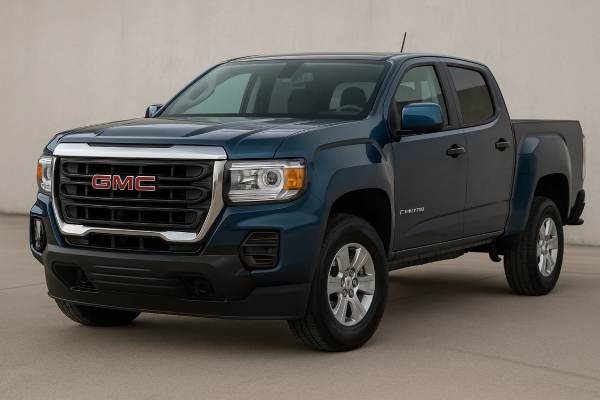
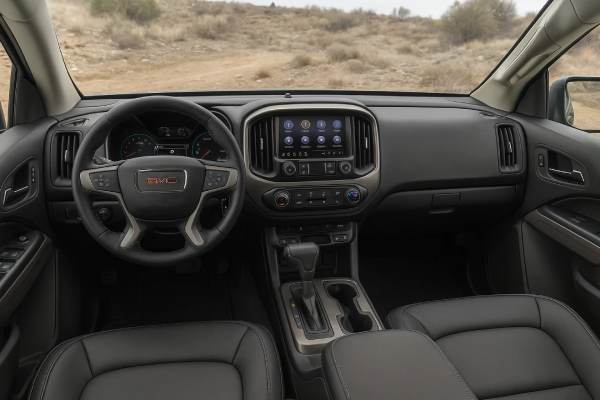
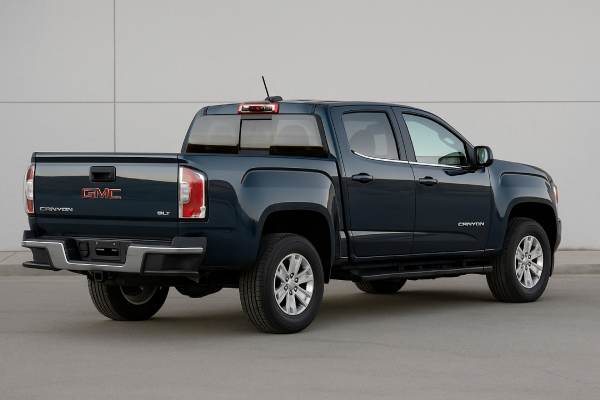
For the 2021 facelift, the GMC Canyon with the 2.5-liter LCV four-cylinder and rear-wheel drive sits at the practical end of the lineup. It is usually found on Elevation Standard and similar work-oriented trims, aimed at owners who value a manageable footprint and predictable running costs more than maximum towing numbers or luxury features. The naturally aspirated 2.5 engine paired with the 6-speed automatic keeps the powertrain simple, with proven hardware and a relatively light nose for balanced steering and ride.
This article focuses on the facelifted 2021 model year only, where styling, equipment packaging, and active-safety availability changed compared with earlier GMT31XX trucks. We will walk through technical specs, capability, reliability patterns for the LCV engine, and what to look for when buying or maintaining one. If you are choosing between the 2.5 and the 3.6 V6 or a rival midsize truck, the goal here is to show when the 2.5 RWD Canyon makes sense—and when it may not.
Essential Insights
- Efficient 2.5-liter LCV four-cylinder with simple, chain-driven timing and good reliability when serviced on time.
- Rear-wheel-drive chassis, light front end, and compact footprint make it easy to maneuver in tight urban and job-site spaces.
- Payload is solid for a midsize truck, but 2.5-liter towing capacity and acceleration lag behind the 3.6 V6 and some competitors.
- Direct-injection four-cylinder benefits from high-quality oil and fuel; watch for injector and carbon build-up issues on higher-mileage trucks.
- Oil and filter changes are best done every 7,500–8,000 miles (12,000–13,000 km) or 12 months, even if the Oil Life Monitor allows longer.
Start here
- Facelift Canyon 2.5 basics
- GMC Canyon 2.5 key specs
- 2021 Canyon trims and safety
- Reliability and common 2.5 issues
- Ownership, maintenance and buying tips
- On-road performance and towing feel
- Canyon 2.5 versus rivals
Facelift Canyon 2.5 basics
For 2021, the GMT31XX-based GMC Canyon received a notable facelift with a bolder grille, revised front bumper designs, and clearer trim separation between Elevation, AT4, and Denali models. The 2.5-liter LCV four-cylinder with rear-wheel drive is mainly paired with the work-oriented Elevation Standard trim in extended-cab form, targeting fleet buyers and private owners who want a straightforward, mid-size pickup that is easy to park and inexpensive to run.
The LCV engine is a 2.5-liter Ecotec inline-four with direct fuel injection, variable valve timing, and a chain-driven double-overhead-cam valvetrain. It produces about 200 hp and 191 lb-ft of torque in Canyon tune, backed by a 6-speed automatic transmission and a relatively short final drive. Rather than chasing high-end performance, this setup focuses on decent low-end and mid-range torque for commuting, light payload work, and occasional towing.
Being rear-wheel drive only, this configuration suits warmer climates and mostly paved use. Compared with the 4WD versions, you save weight, complexity, and some fuel. The chassis remains fully boxed and body-on-frame, with independent front suspension and leaf springs in the rear—familiar pickup architecture that shops know how to service.
In the facelift year, GMC also tightened the active-safety story. Some driver-assistance features such as forward collision alert and lane departure warning became more widely available as packages, though they were still not standard on every 2.5-liter truck. Cosmetic updates like new wheel designs and revised badging help distinguish the 2021 trucks from earlier models, which matters if you are comparing used examples on a lot.
If you want a mid-size truck that feels modern inside but not overloaded with tech, the 2.5 RWD Canyon sits in a sweet spot. The cabin is quieter and more refined than many full-size work trucks, yet the mechanical package remains simple: no turbocharger, no 8-speed transmission, and no transfer case to maintain. The trade-off is modest straight-line performance and more careful planning when towing or climbing steep grades with heavy loads.
GMC Canyon 2.5 key specs
Engine and performance
| Item | Specification (LCV 2.5L I4) |
|---|---|
| Engine code | LCV Ecotec Gen III |
| Configuration | Inline-4, DOHC, direct injection |
| Valves per cylinder | 4 |
| Bore × stroke | 88.0 mm × 100.8 mm (3.46 in × 3.97 in) |
| Displacement | 2.5 L (2,457 cc) |
| Compression ratio | ~11.3:1 |
| Induction | Naturally aspirated |
| Max power | 200 hp @ ~6,300 rpm |
| Max torque | 259 Nm (191 lb-ft) @ ~4,400 rpm |
| Timing drive | Chain (no belt) |
| Fuel type | Regular unleaded gasoline |
| Fuel system | High-pressure direct injection |
| Emissions / efficiency standard | U.S. EPA / Tier 3 |
| EPA fuel economy (RWD 2.5) | 19 mpg city / 25 mpg highway / 22 mpg combined |
| Approx. L/100 km (city / hwy) | 12.4 / 9.4 L/100 km (approximate) |
| Real-world highway @ 120 km/h | Typically 9–10 L/100 km (23–26 mpg US), light load |
Transmission and driveline
| Item | Specification |
|---|---|
| Transmission | 6-speed automatic, 6L50 |
| Drive type | Rear-wheel drive (RWD) |
| Typical axle ratio | Around 4.10:1 on 2.5L RWD trucks |
| Differential | Open rear differential (locker optional in some packs) |
| Manual transmission | Not typically paired with 2.5 in 2021 Canyon (North America) |
Chassis and dimensions (typical 2WD Ext Cab 128″)
| Item | Specification |
|---|---|
| Platform | GMT31XX body-on-frame mid-size pickup |
| Front suspension | Independent, coil-over shocks |
| Rear suspension | Solid axle with leaf springs |
| Steering | Electric power rack-and-pinion |
| Front brakes | Ventilated discs |
| Rear brakes | Discs (on most 2021 trims) |
| Wheelbase | ~3,251 mm (128.0 in) |
| Overall length | ~5,395 mm (212.5 in), depending on body style |
| Width (excluding mirrors) | ~1,884 mm (74.2 in) |
| Height | ~1,785 mm (70.3 in), trim-dependent |
| Ground clearance | Around 211 mm (8.3 in), wheel/tire dependent |
| Turning circle (curb-to-curb) | ~12.6 m (41–42 ft) |
| Curb weight (2.5 RWD Ext Cab) | Roughly 1,750–1,830 kg (3,850–4,050 lb) |
| GVWR | Around 2,495 kg (5,500 lb), trim-dependent |
| Fuel tank capacity | Approx. 79 L (21.0 US gal) |
Performance and capability
| Item | Approximate value (2.5 RWD) |
|---|---|
| 0–60 mph (0–97 km/h) | Around 9.5–10.5 seconds, unladen |
| Top speed (governed) | About 175 km/h (109 mph), region-dependent |
| Braked towing capacity | Typically up to 1,588–1,814 kg (3,500–4,000 lb) with proper equipment |
| Unbraked towing | Often limited to ~680 kg (1,500 lb) |
| Payload | Commonly in the 650–730 kg (1,400–1,600 lb) range, by configuration |
| Roof load | Modest; check roof-rack and manual limits (often 68–75 kg / 150–165 lb) |
Fluids and service basics (approximate)
| System | Type / spec (always verify by VIN) |
|---|---|
| Engine oil | Dexos-approved 5W-20 or 0W-20; ~5.0–5.5 L (5.3–5.8 qt) with filter |
| Engine coolant | Dex-Cool OAT; premix 50/50; capacity ~9–10 L |
| Transmission fluid | Dexron-VI for 6L50; ~8–9 L (partial fills much less) |
| Rear axle | 75W-90 synthetic gear oil (spec varies) |
| A/C refrigerant | R-134a; charge and oil amounts by label |
| Spark plugs | Iridium; change interval commonly 97,000–160,000 km (60,000–100,000 mi) |
Electrical and safety
| Item | Specification / note |
|---|---|
| Alternator | Typically 150+ A, trim-dependent |
| 12 V battery | Group 48/94R-type in many trucks, ~70+ Ah |
| Airbags | Front, side-impact, and side-curtain for cab |
| NHTSA overall rating | Around 4-star overall for 2021 Canyon range |
| IIHS moderate overlap front | Good (crew cab tested; applies to 2015–2022) |
| Key ADAS availability | Forward collision alert, lane departure warning on some 2021 trims |
Values above are typical for a 2021 2.5-liter RWD Canyon, but specific numbers can vary by body style, options, and market.
2021 Canyon trims and safety
On the facelifted 2021 Canyon, the 2.5-liter LCV engine is usually tied to the more basic trim levels, most commonly Elevation Standard with an extended cab and 2WD. In some markets, fleet-spec or base “Work Truck” style trims may also use this engine. Higher trims like AT4 and Denali are generally paired with the 3.6-liter V6 or diesel, so if you see leather seats and extensive chrome on a 2021 Canyon, it is unlikely to be a 2.5-liter.
Trim and option patterns
- Elevation Standard / base work-oriented trims
- 2.5-liter engine, 6-speed automatic, RWD or 4WD (RWD for the configuration in this article).
- Cloth seats, simpler infotainment, smaller wheel sizes.
- Manual-air conditioning and basic gauge cluster, but still with smartphone connectivity in many markets.
- Elevation / mid-level
- Often moves to the 3.6 V6, but some fleet orders may still specify the 2.5 in 2WD.
- Larger wheels, more chrome or black-accent appearance packs.
- AT4 / Denali
- Typically V6 or diesel, 4WD, and more advanced safety/comfort equipment.
Quick visual tells for a 2.5 RWD truck include: lack of “V6” badging, more basic wheel designs, and lower tow-rating stickers on the door jamb or hitch. VIN-decoding and the under-hood emission label are the best final checks.
Safety ratings
For 2021, the Canyon range generally holds a four-star overall rating in U.S. NHTSA testing, with strong frontal and side performance but rollover risk typical of taller body-on-frame pickups. IIHS testing primarily covers the crew-cab configuration; there it scores well in moderate overlap frontal and several other categories, giving a reasonable proxy for structural behavior. Extended-cab 2.5-liter trucks share the same basic frame and cab structure but may differ in weight and equipment.
Safety systems and ADAS
Standard safety equipment on 2.5-liter RWD models usually includes:
- Multiple airbags (front, side, and curtain)
- Electronic stability control and traction control
- Four-wheel disc brakes with ABS and brake assist
- Tire-pressure monitoring
Depending on trim and packages, the following may be available, but not always standard, on 2021 2.5-liter trucks:
- Forward collision alert
- Lane departure warning
- Rear park assist
- Rear camera with guidelines
- Teen Driver configurable key and monitoring features
On a used or fleet truck, it is important not to assume ADAS presence just from seeing a facelift front end. Check for the correct steering-wheel buttons, menu options in the cluster and infotainment screen, and the build sheet or window sticker. Calibration of any forward-looking sensors may be required after windscreen replacement, major front-end collision repair, or suspension alterations.
Child-seat installation is helped by rear jump seats with top-tether anchors in extended-cab models, but legroom is limited, so most families will be more comfortable in a crew-cab Canyon even if the engine is the same.
Reliability and common 2.5 issues
The LCV 2.5-liter Ecotec engine has a generally solid reputation in Colorado/Canyon applications, especially compared with some of the issues seen on the 3.6 V6 and certain 8-speed automatics. It uses a timing chain, so there is no scheduled belt change, and many engines run high mileages with routine maintenance. However, like any modern direct-injection four-cylinder, it has a few known weak points worth understanding.
Common/occasional issues and what they look like
- Oil consumption and extended intervals – Some LCV engines show modest oil usage as mileage accumulates. Symptoms are low dipstick readings between changes and oil-level warnings. Root causes include ring and valve-stem wear and long oil-change intervals. The remedy is primarily preventive: use the correct Dexos-approved oil, avoid stretching service intervals, and monitor oil level every 1,000–1,500 miles.
- Cam phaser solenoids / valve timing control – Owners and technicians report frequent check-engine lights related to variable valve timing solenoids or the oil distribution manifold on the valve cover. Symptoms include rough idle, hesitation, and stored timing-related fault codes. Replacement of the affected solenoids or the oil manifold and an oil-system check are standard repairs.
- Secondary air injection port clogging (some markets) – On engines with secondary air injection, carbon can clog the head’s air passages, causing emission-system fault codes. The fix can be labor-intensive, involving removal of the exhaust manifold and mechanical cleaning. Trucks used on many short trips are more susceptible.
- Cooling-system concerns – Like other aluminum-block engines, the 2.5 does not tolerate overheating. Thermostat or water-pump faults, or neglected coolant, can lead to hot-running conditions. Watch for coolant loss, temperature-gauge fluctuations, and heater performance changes. Prompt repair of leaks and replacement of faulty components are crucial.
- Fuel injector and intake deposit issues – Direct injection means fuel does not wash intake valves. Over time, carbon build-up and injector deposits may cause misfires, poor throttle response, or reduced fuel economy. Periodic use of approved fuel-system cleaners and, when needed, professional intake cleaning can address this.
Driveline and chassis
The 6L50 6-speed automatic is much simpler than GM’s later 8-speed units and tends to be less problematic, though fluid neglect can still cause harsh shifts or premature wear. Occasional complaints include torque-converter shudder and rough downshifts, often improved with a fluid exchange using the correct Dexron-VI fluid and a software update where applicable.
Chassis-wise, the mid-size Canyon commonly sees:
- Front suspension bushing and ball-joint wear on high-mileage or heavily loaded trucks.
- Rear leaf-spring squeaks or corrosion in harsh climates.
- Frame and underbody corrosion around cross-members and bed mounts if the truck sees road salt and is not regularly washed.
Recalls, TSBs, and extended coverage
Specific recall and service-campaign coverage varies by VIN and market. For a 2021 Canyon, it is essential to:
- Run a VIN search on the official manufacturer support site and NHTSA (for U.S. trucks) to confirm recall status.
- Ask a dealer to print any completed or outstanding campaigns, such as software updates for powertrain or airbag systems.
- Verify that any open TSB-related concerns (for example, drivability or shift-quality updates) have been addressed with the latest calibrations.
Pre-purchase reliability checks
When inspecting a used 2.5 RWD Canyon:
- Look for a complete maintenance history, particularly regular oil changes using the correct spec.
- Check for stored diagnostic codes (even if the lamp is off) using a scan tool.
- Inspect the underbody and frame for corrosion, especially in rust-belt regions.
- Listen for cold-start rattles that persist, which could point to chain, tensioner, or valvetrain issues rather than brief normal noise.
- Confirm smooth operation of the transmission in all gears and under light and moderate throttle.
Overall, the LCV engine and 6-speed automatic combination tends to be durable when maintained, with most issues being manageable rather than catastrophic—an attractive trait for owners planning to keep the truck long-term.
Ownership, maintenance and buying tips
Keeping a 2021 Canyon 2.5 RWD healthy is mostly about disciplined, correct maintenance rather than exotic procedures. The truck is built on familiar hardware, and most independent shops comfortable with modern GM vehicles can look after it.
Suggested maintenance intervals (general guidance)
Always verify with the official owner’s and service manuals, but as a practical schedule:
- Engine oil and filter – Every 7,500–8,000 miles (12,000–13,000 km) or 12 months, whichever comes first; sooner for heavy towing, dusty conditions, or lots of idling.
- Engine air filter – Inspect at 15,000 miles (24,000 km); replace by 30,000 miles (48,000 km) or sooner if dirty.
- Cabin air filter – Replace every 24,000–30,000 miles (40,000–48,000 km) or 2 years.
- Spark plugs (iridium) – Typically around 97,000–120,000 miles (160,000–190,000 km), but worthwhile earlier if misfires appear.
- Fuel filter – In many modern systems, the filter is integrated with the pump module. Follow official guidance; focus on using quality fuel and periodic injector cleanings.
- Coolant – Dex-Cool is often rated for long life, but a drain-and-fill around 5 years or 100,000 miles (160,000 km) is a sensible baseline on a work truck.
- Transmission fluid (6L50) – Consider a fluid service in the 50,000–60,000-mile (80,000–100,000-km) range, especially for towing or hot climates.
- Differential fluid – Check at similar intervals; change more often for regular towing.
- Brake fluid – Flush about every 3 years regardless of mileage.
- Serpentine belt and hoses – Inspect annually; replacement typically between 90,000 and 120,000 miles depending on condition.
- Alignment and tire rotation – Rotate every 5,000–7,500 miles (8,000–12,000 km) with oil changes, and check alignment annually or after impacts.
- 12 V battery – Test yearly after the third year; many last 4–6 years depending on climate.
For torque values and capacities that matter—such as wheel-lug torque, drain-plug torque, and suspension fasteners—always consult the service manual or a trusted professional resource. Under-torque can lead to loosening, and over-torque risks damaged threads or warped components.
Buyer’s guide: what to inspect
When evaluating a used 2021 Canyon 2.5 RWD:
- Body and frame – Look for rust at frame rails, around rear spring hangers, bed mounts, and cab-to-frame points. Check the bed floor, tailgate, and rocker panels for corrosion or repairs.
- Accident and repair history – Panel gaps, overspray, and mismatched paint can signal prior damage. Inspect the front crash structure behind the bumper if possible.
- Suspension and steering – Drive over rough surfaces and listen for clunks or rattles. Excess play in the steering or significant wandering at highway speeds suggests front-end wear or poor alignment.
- Electrical and infotainment – Test all windows, locks, lighting, and connectivity features. On a work truck, hard use can shorten the life of switches and door harnesses.
- Engine behavior – Cold-start, warm idle, and full-throttle pulls should all be smooth. Any misfire, hesitation, or persistent ticking calls for further diagnosis.
Which configurations to favor
For buyers mainly running light loads, commuting, or using the truck as a daily driver, a 2.5 RWD Elevation Standard extended cab can make sense thanks to lower purchase cost and decent fuel economy. For frequent towing near the rated limit, steep grades, or heavy payloads, the V6 or diesel versions are better suited.
Long-term, a well-maintained LCV 2.5 RWD Canyon can deliver a decade or more of service with fewer complexity-related surprises than higher-spec variants. The key is simple: keep fluids fresh, deal with small issues quickly, and avoid prolonged operation at or beyond its towing and payload limits.
On-road performance and towing feel
The 2.5-liter RWD Canyon drives differently from the more common V6 or diesel versions. Around town, it feels light on its feet, with a front end that turns in quickly and a generally tidy footprint that makes city driving and parking straightforward. The steering effort is moderate, and the truck tracks well at highway speeds when the alignment and tires are in good condition.
Ride quality is firmly sprung, as expected from a mid-size pickup, but the rear leaf springs cope better with moderate loads than many compact crossovers. Unladen, the rear can feel slightly busy over rough pavement, particularly with higher-pressure all-season or light-truck tires. Adding a few hundred pounds in the bed calms things down and helps the suspension work in its intended range. Cabin noise is acceptable for the class, with wind and road noise more prominent than engine noise at cruise.
From a powertrain perspective, the 2.5 LCV has adequate torque when unladen but will not feel quick, especially compared with the 3.6 V6. Throttle response is linear, and the 6-speed automatic’s gearing keeps the engine in its torque band reasonably well, but you can expect downshifts and higher revs when merging, passing, or climbing hills. The engine is smoother and quieter at steady speeds than under full load, where it becomes more vocal.
Real-world efficiency
Drivers typically report fuel economy close to EPA ratings when driven sensibly:
- City driving – Often in the mid-teens to low-20s mpg (around 12–14 L/100 km), depending on traffic and load.
- Highway at 60–70 mph (100–115 km/h) – Commonly 23–26 mpg (9–10 L/100 km) with light loads.
- Mixed use – Around 21–23 mpg (10–11 L/100 km) for many owners.
Cold climates, short trips, and heavy loads will push these numbers downward, while gentle highway cruising can slightly exceed them.
Towing and load behavior
With correct equipment and within its rated limits, the 2.5 RWD Canyon can tow small utility trailers, light boats, or compact campers. However, acceleration and hill-climbing performance are noticeably more modest than with the V6. Expect:
- Longer merge and passing distances when towing.
- Frequent downshifts and higher revs on grades.
- A noticeable fuel-economy penalty—often 25–40% worse consumption with a moderate trailer.
Braking performance is adequate, especially when combined with properly adjusted trailer brakes, but as with any mid-size pickup, long descents call for engine braking and conservative speeds. It is wise to avoid running constantly at maximum tow rating; if your use case frequently approaches those limits, a V6 Canyon or a rival with higher torque is a safer and less stressful choice.
Traction in wet or light snow is acceptable with quality tires and an empty bed, but this RWD configuration does not have the all-weather confidence of a 4WD truck. Owners in snowy climates often add weight over the rear axle and fit proper winter tires to compensate. For mostly dry, warm-weather regions, the RWD layout is simpler and more efficient.
Canyon 2.5 versus rivals
When cross-shopping the facelift 2021 Canyon 2.5 RWD, the natural rivals are other mid-size pickups with base gas engines and two-wheel drive—such as the Chevrolet Colorado 2.5, Toyota Tacoma four-cylinder 2WD, Ford Ranger 2WD with its turbo four, and Nissan Frontier’s V6-only approach. Each has a different balance of performance, efficiency, and complexity.
Where the 2.5 RWD Canyon stands out
- Simple powertrain – Naturally aspirated engine, chain timing, and a 6-speed automatic are familiar to most technicians and lack turbo plumbing or high-gear-count transmissions.
- Refined cabin for a work truck – Compared with some older rivals, the 2021 interior offers good seat comfort, straightforward controls, and useful connectivity, even in basic trims.
- Manageable size – Easier to park and thread through city streets than many full-size trucks, while still offering a true pickup bed and respectable payload.
- Shared hardware with Colorado – Broad parts availability and a large support community across two brands.
Where it lags behind
- Power and torque – Rivals with turbocharged four-cylinders or standard V6 powertrains will out-accelerate the 2.5 Canyon, especially when loaded or towing.
- Maximum tow ratings – If you routinely tow near 5,000–7,500 lb, other configurations—both within the Canyon line and among competitors—are better suited.
- Standard active-safety content – Some rivals offer more active-safety features standard on base trims, whereas the Canyon often requires option packages for similar coverage.
Ideal buyer profile
The 2021 Canyon RWD 2.5 suits owners who:
- Value a straightforward, durable powertrain over outright performance.
- Mostly drive without a trailer or with only light, occasional towing.
- Need a real pickup bed but do not want the bulk, fuel use, or parking challenges of a full-size truck.
- Plan to keep the truck long enough that lower complexity and modest repair costs matter more than maximum resale value.
For buyers focused on towing larger campers or boats, frequent mountain driving with heavy payloads, or all-weather off-road ability, a V6 or diesel Canyon—or a similarly specified rival—will be a better long-term match. But for light-duty work, commuting, and general use in moderate climates, the facelifted 2021 Canyon RWD 2.5 can be a sensible, economical choice.
References
- GM 2.5 Liter I4 Ecotec LCV Engine Info, Power, Specs, Wiki 2024 (Technical Overview)
- 2021 GMC Canyon Fuel Economy 2021 (Fuel Economy Data)
- 2021 GMC Canyon Specifications 2023 (Specifications Summary)
- 2021 GMC Canyon Crew cab pickup 2021 (Safety Rating)
- Vehicle Detail Search – 2021 GMC CANYON 2021 (NHTSA Ratings Database)
Disclaimer
This article is for informational purposes only and is not a substitute for professional diagnosis, repair, or official service information. Specifications, torque values, fluid types, and maintenance intervals can vary by VIN, market, model year, build date, and installed equipment. Always confirm details against the official owner’s manual, factory service documentation, and technical bulletins for your specific vehicle, and consult a qualified technician when in doubt.
If you found this guide useful, please consider sharing it with other owners or enthusiasts on social platforms such as Facebook or X/Twitter to help support high-quality, independent technical content.