
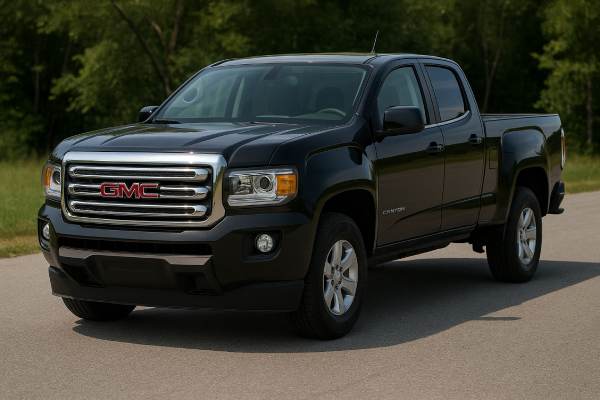
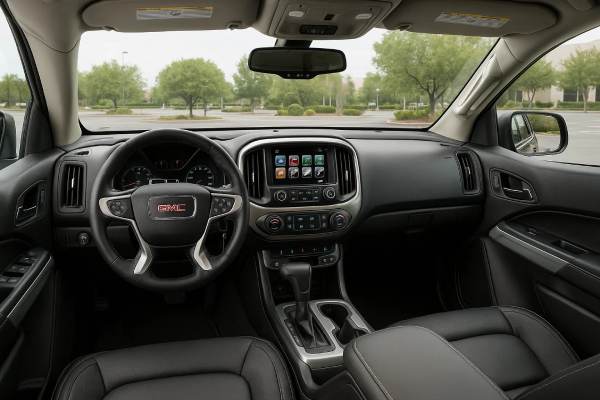
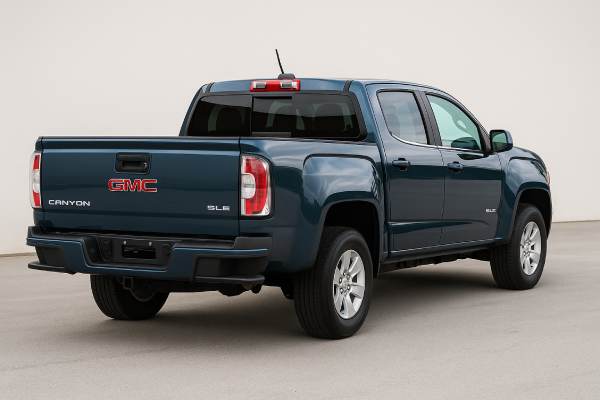
The 2015–2016 GMC Canyon RWD with the LFX 3.6 litre V6 sits in a sweet spot between full-size capability and everyday usability. It shares its bones with the Chevrolet Colorado but leans slightly more upscale, with a quieter cabin and extra equipment in higher trims. Under the hood, the direct-injection V6 delivers 305 hp and competitive torque, backed by a 6-speed automatic and rear-wheel drive that keeps weight and running costs down compared to 4WD versions.
For owners, the draw is a truck that can tow a decent trailer, commute comfortably, and still fit in normal parking spaces. The GMT31XX platform brought a big leap in refinement over the older GMT355 trucks, especially in ride quality and noise control. At the same time, it remains a body-on-frame pickup with proper payload and a robust ladder frame. This guide walks through specs, real-world performance, reliability patterns, maintenance planning, and how this Canyon stacks up against rival midsize trucks.
Fast Facts
- 3.6 litre LFX V6 with 305 hp and 269 lb-ft gives strong acceleration for highway merging and towing.
- RWD layout, well-weighted steering, and compact dimensions make it easy to live with in tight city streets and parking garages.
- Properly equipped V6 Canyons can tow up to about 7,000 lb, enough for a mid-size camper or car trailer.
- Watch for transmission shift quality and occasional power-steering and infotainment issues on early trucks.
- Aim for engine oil and filter changes roughly every 5,000–7,500 miles (8,000–12,000 km) or 12 months, adjusting for heavy use or towing.
Navigate this guide
- GMC Canyon 3.6 RWD in depth
- LFX engine and chassis data
- Canyon 3.6 trims and safety systems
- Reliability trends, failures and remedies
- Maintenance roadmap and buyer guide
- Driving dynamics and fuel use
- How this Canyon stacks up
GMC Canyon 3.6 RWD in depth
The 2015–2016 GMC Canyon RWD with the 3.6 litre LFX V6 is part of the first “modern” generation of Canyon after a production gap. The GMT31XX platform was designed to move GM’s midsize trucks upmarket: better crash performance, a stiffer frame, and interiors that feel closer to crossovers than work trucks. The RWD V6 configuration is popular with buyers who want capability but do not need 4×4 complexity or the fuel penalty that comes with it.
The LFX engine was already proven in GM cars and crossovers before being used in the Canyon. It is an all-aluminium, DOHC V6 with direct injection and variable valve timing. In this application it is tuned for 305 hp and strong mid-range torque rather than just a high-rpm peak, giving performance that rivals older full-size V6 pickups without their size and weight.
In daily use, the RWD Canyon feels closer to a big sedan than to older compact trucks. The cab is quieter, the suspension is more controlled over broken pavement, and the electric power steering keeps effort light at parking speeds. Yet you still get a traditional body-on-frame structure, a separate cargo bed, and a robust rear axle with leaf springs for load carrying.
For many owners, the key advantage of a RWD LFX Canyon versus the 4WD version is simplicity. There is no transfer case to service, fewer driveline joints, and slightly better fuel consumption. If you tow mostly on paved roads, live in a warm climate, or only occasionally deal with winter weather, RWD is usually sufficient when paired with good tyres and modern stability and traction control.
Compared with the 2.5 litre four-cylinder models, the 3.6 V6 transforms the Canyon from “adequate” to “effortless” under load. It accelerates confidently with passengers and cargo, and it feels less strained climbing grades or merging at highway speeds. On the used market, the V6 RWD combination is often the sweet spot in the range: more desirable than low-spec four-cylinder trucks, but cheaper and lighter than high-spec 4WD trim levels.
LFX engine and chassis data
Engine and performance
| Item | Specification |
|---|---|
| Engine code | LFX |
| Configuration | 60° V6, aluminium block and heads |
| Valvetrain | DOHC, 4 valves per cylinder, variable valve timing |
| Displacement | 3.6 L (3,564 cc) |
| Bore × stroke | ~94.0 mm × 85.6 mm (3.70 in × 3.37 in) |
| Induction | Naturally aspirated |
| Fuel system | Direct fuel injection |
| Compression ratio | About 11.5 : 1 |
| Max power | 305 hp (approx. 224 kW) @ 6,800 rpm |
| Max torque | 269 lb-ft (365 Nm) @ about 4,000 rpm |
| Timing drive | Chain (no scheduled replacement) |
| Recommended fuel | Regular unleaded, with premium advisable under heavy load or high ambient temperatures |
Official economy for the 3.6 V6 RWD automatic is around 18 mpg city, 26 mpg highway and 21 mpg combined (about 13.1 / 9.0 / 11.2 L/100 km). Real-world owners often report low-20s mpg (US) on open highway at moderate speeds, dropping into the high-teens when heavily loaded or driven quickly.
At a steady 120 km/h (75 mph), a realistic highway figure for a stock RWD V6 Canyon is roughly 10.5–11.5 L/100 km (20–22 mpg US), assuming no lift kit and sensible tyres. Aerodynamics are typical for a midsize pickup: upright cab and open bed mean drag increases rapidly with speed.
Transmission and driveline
| Item | Specification |
|---|---|
| Gearbox | 6-speed automatic (Hydra-Matic 6L50) |
| 1st / 2nd / 3rd | 4.06 / 2.37 / 1.55 |
| 4th / 5th / 6th | 1.16 / 0.85 / 0.67 |
| Reverse | 3.20 |
| Final drive ratio | Commonly 3.42:1 on V6 RWD models |
| Drive type | Rear-wheel drive |
| Differential | Open rear differential; automatic locking rear (G80) often available or included with towing/off-road packages |
| Tow/Haul mode | Standard on V6 auto; alters shift points and provides grade braking when towing |
Properly equipped RWD V6 Canyons with the trailering package and correct axle can tow up to around 7,000 lb (approx. 3,175 kg), with standard configurations closer to 3,500 lb (1,588 kg). Payload varies with cab and trim but typically ranges from about 1,400–1,600 lb (635–725 kg).
Chassis and dimensions
Figures below are representative for 2015–2016 V6 RWD crew-cab short-bed models; extended-cab and long-bed trucks differ slightly.
| Item | Specification (approximate) |
|---|---|
| Platform | GMT31XX body-on-frame |
| Front suspension | Independent, coil-over shock, twin-tube dampers |
| Rear suspension | Solid axle with leaf springs |
| Steering | Electric power-assisted rack-and-pinion |
| Brakes (front/rear) | Ventilated discs front, solid discs rear, ABS |
| Wheelbase | ~3,259 mm (128.3 in) crew cab; ~3,340 mm (131.5 in) long-wheelbase |
| Length | ~5,395–5,715 mm (212.5–225 in) depending on bed |
| Width (excluding mirrors) | ~1,885 mm (74.2 in) |
| Height | ~1,785 mm (70.3 in) |
| Turning circle | About 12.6 m (41.3 ft) |
| Ground clearance | Around 213 mm (8.4 in) |
| Curb weight | Roughly 3,980–4,200 lb (1,805–1,905 kg) depending on cab and equipment |
| GVWR | Typically around 5,500–6,000 lb (2,495–2,722 kg) |
| Fuel tank | About 79–80 L (21.0 US gal) |
Fluids, electrical and key service data
Values are typical for the LFX V6; always confirm against the exact manual for your VIN.
- Engine oil: Dexos1-approved 5W-30 or 0W-20; capacity roughly 5.5–6.0 L (5.8–6.3 US qt) including filter
- Coolant: Long-life OAT coolant (GM Dex-Cool type); mix near 50:50; capacity roughly 10–11 L including heater circuit
- Automatic transmission: Dexron VI ATF; capacity for a full overhaul is much higher than a simple pan drain
- Rear axle: Synthetic gear oil (e.g., 75W-90); capacity a little over 1.5–2.0 L depending on axle
- A/C refrigerant: R-134a with a small PAG compressor oil charge
- Alternator: Typically in the 150–160 A range on V6 trucks
- 12 V battery: Group 48/49-type in many markets, around 60–70 Ah with a high cold-cranking rating
Typical torque values for planning (always verify against official data):
- Wheel lugs: roughly 140 Nm (103 lb-ft)
- Spark plugs: around 20 Nm (15 lb-ft) where specified
- Drain plugs (engine/axle): usually 25–35 Nm range
Canyon 3.6 trims and safety systems
Trims and equipment basics
In 2015–2016, the V6 RWD Canyon was offered mainly in mid to upper trims, while base models often used the 2.5 litre four-cylinder. Trim names include SL, base Canyon, SLE and SLT, with the V6 showing up most frequently on SLE and SLT trucks, plus special appearance packages.
Typical trim distinctions:
- SL / Base Canyon
- Simpler interiors, cloth seats, manual-adjust seats
- Smaller wheel options, fewer chrome details
- Often four-cylinder only; V6 RWD more likely as an upgrade on base or SLE
- SLE
- The volume trim for V6 RWD trucks
- 17-inch alloy wheels, colour-matched bumpers and grille details
- Touchscreen infotainment, Bluetooth, rearview camera, keyless entry
- Available in extended-cab and crew-cab forms
- SLT
- More luxury-oriented: leather-trimmed seats, power driver’s seat, automatic climate control on some spec levels
- Additional chrome and wheel upgrades, plus more advanced audio options
- Often where you see optional safety tech bundles and the best trailer/tow packages
Packages such as All-Terrain are more common on 4WD trucks but some features, like unique wheels or interior trim, can appear in RWD configurations as well.
Quick identifiers and build clues
- V6 Canyons usually wear “V6” fender or tailgate badging in North American markets.
- The VIN engine code and RPO label (often in the glovebox or on the Service Parts Identification sticker) confirm LFX, axle ratio (e.g., GU6 for 3.42), and presence of locking differential (G80).
- SLT trucks often show leather, contrast stitching and more chrome; SLE models tend to have cloth and more subdued finishes.
Safety equipment and ratings
All 2015–2016 Canyons, including the RWD 3.6 V6, come with:
- Front, side-impact and side-curtain airbags
- Electronic stability control and traction control
- Four-wheel disc brakes with ABS and brake assist
- Rearview camera (important given the tall tailgate)
Crew-cab models perform well in most independent crash tests, with strong ratings in moderate overlap front, side and roof-strength tests, and good head restraint performance. Passenger-side small-overlap protection is weaker, as it is for many pickups of this era, but still within acceptable bounds for a midsize truck.
On the active safety front, the Canyon offered lane departure warning and forward collision alert on higher trims. These are warning-only systems; there is no automatic emergency braking or adaptive cruise control on 2015–2016 models. That means the truck relies primarily on its basic structure, airbags and electronic stability control, rather than a full modern ADAS suite.
For child seats, the rear seats in crew-cab models include lower anchors and top tether points that make installing child restraints straightforward. Extended-cab rear jump seats are less suitable for regular child-seat use, both in space and access, and are better kept for occasional passengers.
Reliability trends, failures and remedies
Overall, the 2015–2016 Canyon 3.6 RWD shows average-to-good reliability, but like most modern trucks it has a few recurring issues you should understand before buying or planning repairs.
Common and occasional issues
- 6L50 transmission behaviour
- Symptoms: Harsh or delayed shifts, occasional flare between gears, shudder at light throttle around 40–60 mph.
- Likely causes: Ageing fluid, torque converter clutch behaviour, or, less commonly, internal wear.
- Remedy: Fresh Dexron VI fluid and an adaptive relearn often improve behaviour; in more severe cases, updated software or a torque converter replacement may be required. Staying ahead on fluid changes helps a great deal.
- Electric power steering assist loss (select trucks)
- Symptoms: Sudden loss of power steering assist with warning messages, steering becomes heavy but remains mechanically connected.
- Likely causes: Fault in the electric power-assist motor or control module, sometimes addressed by recall or special coverage programs.
- Remedy: Dealer diagnosis with scan tools, module or motor replacement when required, and recall completion for affected VINs.
- Infotainment and connectivity glitches
- Symptoms: Screen freezing or rebooting, Bluetooth dropping connections, steering-wheel controls occasionally unresponsive.
- Likely causes: Early software versions or intermittent head-unit faults.
- Remedy: Head-unit software update at a dealership; replacement module in stubborn cases, often handled under warranty on younger trucks.
- LFX-specific concerns
- Timing chain stretch: Less common than on some earlier GM V6 families, but can appear at high mileage with poor oil-change history. Symptoms include rattling at start-up, timing correlation codes, or rough running.
- Carbon build-up: As with many direct-injection engines, intake valve deposits may accumulate, causing misfires or rough idle in severe cases. Walnut-shell blasting or intake cleaning can restore performance.
- Brake and suspension wear
- Heavy towing or frequent city driving accelerates wear on front pads and rotors, and can age shocks and rear leaf-spring bushings early.
- Clunks over bumps, vague steering or uneven tyre wear suggest that a full front-end and alignment check is due.
Recalls, bulletins and coverage
Across the 2015–2016 model years, official recall programs have addressed items such as:
- Power steering assist failures on certain VIN ranges
- Seat frame or seatbelt issues
- Airbag or sensing-module calibrations
Each recall has a defined VIN range and remedy, usually inspection and component replacement or software reprogramming.
To verify completion on a truck you are considering:
- Use official recall lookup tools with the VIN.
- Ask the seller for service records or printouts showing recall and bulletin completion.
- Confirm that steering, airbag warning lights, and seat adjustments behave normally on a test drive.
Pre-purchase reliability checklist
When inspecting a used Canyon 3.6 RWD:
- Confirm a solid service history, especially regular oil changes using the correct specification.
- Evaluate the transmission for any shudder, flare or harshness. A single firm shift is less worrying than a consistent pattern of issues.
- Turn the steering wheel lock-to-lock at low speed and watch for warning messages or intermittent loss of assist.
- Inspect frame and underbody for rust, particularly crossmembers, fuel and brake lines, and rear spring perches on trucks from snowy regions.
- Check all electronics: infotainment system, reversing camera, steering-wheel controls, windows, locks, and mirrors.
Trucks that pass these checks and show no signs of neglect can usually be relied upon for long service life, provided you maintain them thoughtfully.
Maintenance roadmap and buyer guide
Practical maintenance schedule (typical use)
Use this as a planning guide alongside the official schedule for your specific truck.
- Engine oil and filter – Every 5,000–7,500 miles (8,000–12,000 km) or 12 months; shorten intervals for heavy towing, idling or dusty conditions.
- Engine air filter – Inspect annually; replace roughly every 30,000 miles (48,000 km) or sooner in dusty environments.
- Cabin air filter – Replace every 20,000–25,000 miles (32,000–40,000 km) or every 2 years.
- Coolant – First change around 5 years/100,000 miles (160,000 km), then every 3–5 years depending on condition.
- Spark plugs – Replace around 97,500–100,000 miles (160,000 km), earlier if you notice misfires or rough running.
- Fuel system care – Periodic injector cleaning and throttle-body service, especially after 60,000 miles (96,000 km) or if idle quality drops.
- Timing chain – No fixed interval; investigate promptly if start-up rattle, timing codes or persistent noise appear.
- Serpentine belt and hoses – Inspect at each service; typically replace around 90,000–120,000 miles (145,000–190,000 km) or when cracking or noise appears.
- Automatic transmission fluid – Change roughly every 45,000–60,000 miles (72,000–96,000 km), more often with frequent towing or extreme heat.
- Rear axle oil – Refresh around 50,000–60,000 miles (80,000–96,000 km); sooner under severe service.
- Brake fluid – Flush every 3 years regardless of mileage.
- Brake pads and rotors – Inspect at least yearly; replace when below minimum thickness or if vibrations and noise develop.
- Alignment and tyre rotation – Rotate tyres every 6,000–8,000 miles (10,000–13,000 km); align whenever tyres show uneven wear or after suspension repairs.
- 12 V battery – Load-test yearly after 4 years; expect replacement every 4–6 years depending on climate and usage.
Fluid choices and planning
- Use Dexos1-approved synthetic oil for the LFX to help control deposits and support timing-chain life.
- Stick with a proper Dex-Cool-type coolant; avoid mixing coolant types.
- If you tow regularly, tighten your ATF and axle-oil change intervals and consider additional cooling where appropriate.
Buyer’s checklist
When evaluating a used Canyon RWD 3.6:
- Body and frame
- Check for overspray, misaligned panels or inconsistent gaps that hint at accident repairs.
- Inspect the underside carefully for rust, especially in high-salt regions.
- Engine bay
- Listen for abnormal engine noises at cold start and when warm.
- Look for oil seepage around cam covers and the front or rear crank seals, and for dried coolant stains near the water pump and hoses.
- Road test
- Confirm smooth, consistent shifts in all gears and under various loads.
- Verify straight tracking, stable braking and absence of steering vibration.
- Listen for driveline noises that change with speed or throttle.
- Interior and equipment
- Test every switch and feature, including infotainment, camera, steering-wheel controls, air conditioning and heater.
- Check seat-adjustment mechanisms, especially power seats in SLT models.
Which trucks to favour
Within the 2015–2016 range:
- Look for:
- SLE or SLT trims with documented maintenance and completed recalls.
- Trucks with tow package and locking differential if you plan to haul frequently.
- Be more cautious with:
- Heavily modified trucks with large lifts or tyres without supporting upgrades.
- Vehicles showing transmission complaints, no fluid-change history or significant rust.
With sensible care, the Canyon 3.6 RWD is capable of exceeding 200,000 miles (320,000 km) while remaining a comfortable and useful daily driver.
Driving dynamics and fuel use
Ride, handling and refinement
On the road, the Canyon RWD feels composed and refined for a midsize truck. The frame is stiff, and squeaks and rattles are minimal on healthy examples. The suspension tuning balances load-carrying with comfort: unladen, you can still feel the firm rear leaf springs over sharp bumps, but the truck is less jittery than many older competitors.
Electric power steering keeps low-speed manoeuvres easy while providing reasonable weight at highway speeds. The Canyon holds its line well around long bends and in crosswinds, with stability control ready to step in if you overstep grip.
Noise levels are good: wind noise is modest at typical motorway speeds, tyre noise depends on tread choice, and the V6 remains smooth and quiet at cruise, only raising its voice when you call for full power. Compared with full-size trucks, the Canyon feels easier to place in tight spaces while still feeling substantial on the open road.
Powertrain character
The LFX V6 is responsive and likes to rev. It pulls cleanly from low rpm but really comes alive in the mid and upper ranges, which suits overtaking and highway on-ramps. The 6L50 automatic keeps the engine in its power band, downshifting quickly when you press the accelerator.
In Tow/Haul mode, the transmission holds lower gears longer, shifts more firmly and uses engine braking more aggressively when descending hills. This makes the truck feel more controlled with a trailer and reduces stress on the friction brakes.
At part throttle, shifts are usually smooth and unobtrusive. Some owners notice occasional hesitation or hunting between gears on rolling terrain; a software update and fresh fluid can often improve this behaviour.
Real-world efficiency
For a typical RWD V6 crew-cab:
- City: 13–15 L/100 km (15–18 mpg US) depending on traffic and driving style
- Highway (100–110 km/h / 60–70 mph): Around 9–11 L/100 km (21–26 mpg US) in calm conditions
- Mixed use: Commonly 11–12 L/100 km (19–21 mpg US)
Lift kits, aggressive all-terrain tyres, roof racks, and constant heavy loads can easily add 1–2 L/100 km (2–3 mpg US penalty). Keeping speeds moderate, anticipating traffic and avoiding long periods of idling all help control fuel use.
Load, towing and stability
When properly equipped, the Canyon 3.6 RWD tows confidently:
- The long wheelbase and relatively wide track help stability with medium-length trailers.
- Trailer-sway control and ABS contribute to confidence when braking hard or dealing with crosswinds.
- A weight-distributing hitch is recommended for heavier tongue weights to maintain level ride and steering feel.
Expect fuel consumption to worsen by 20–30 percent or more at the upper end of the rated tow capacity. Engine and transmission temperatures remain well-managed when the truck is serviced correctly and driven with some mechanical sympathy (using Tow/Haul mode, downshifting early on grades, giving cool-down time after long pulls).
How this Canyon stacks up
In the 2015–2016 midsize pickup field, the Canyon RWD 3.6 competes most directly with the Toyota Tacoma V6, Nissan Frontier V6, and its Chevrolet Colorado twin. Each has distinct strengths; the Canyon’s appeal lies in its refinement and powertrain.
Versus Toyota Tacoma (second generation)
- The Tacoma is widely praised for long-term durability and resale value, and it has deep aftermarket support.
- Its 4.0 V6 and 5-speed automatic are tough but less efficient and less refined than the Canyon’s LFX V6 and 6-speed automatic.
- The Canyon’s interior, ride quality and noise levels feel more modern and car-like, which many daily drivers prefer.
Versus Nissan Frontier (D40)
- The Frontier shares a reputation for robustness, but its technology and cabin feel a generation older.
- Canyon offers better fuel economy, more current safety features, and a more up-to-date infotainment experience.
- Frontier values can be attractive, but you trade refinement and some safety performance for the lower entry cost.
Versus Chevrolet Colorado
- Mechanically almost identical; differences are mainly styling, trim mixes and brand image.
- GMC positions the Canyon slightly more upscale, with subtle styling changes and some unique interior touches in higher trims.
- If you prefer a slightly more premium feel and badge, the Canyon is the better fit; the Colorado may be easier to find in work-truck configurations in some regions.
Ideal buyer profile
The 2015–2016 GMC Canyon RWD with the LFX 3.6 suits:
- Drivers who spend most of their time on paved roads but still want real towing and hauling ability.
- Owners who want a truck that is easier to park and manoeuvre than a full-size, without giving up a comfortable cabin.
- Buyers who prioritise modern refinement and strong V6 performance over extreme off-road capability or the latest driver-assistance gadgets.
If you need regular deep-snow or off-road use, you might favour a 4WD version or a different platform. For everyone else, this Canyon spec is a well-balanced, efficient and capable midsize truck that still feels thoroughly modern years after launch.
References
- Manuals and Guides | Vehicle Support | GMC 2024 (Owner’s Manual)
- 2015 GMC Canyon 2015 (Safety Rating)
- Vehicle Detail Search – 2015 GMC CANYON PU EC | NHTSA 2015 (Recall Database)
- 2015 GMC Canyon Specs & Features 2015 (Specifications)
- 2015 GMC Canyon Trims Comparison [+ Chart] 2015 (Trim and Equipment Data)
Disclaimer
This article is for informational purposes only and is not a substitute for professional diagnosis, repair, or safety advice. Specifications, torque values, fluid types, service intervals and repair procedures can vary by VIN, market, model year and equipment level. Always confirm critical details using the official service documentation, owner’s manual and technical bulletins for your specific vehicle, and consult a qualified technician before carrying out maintenance or repairs.
If you found this guide useful, please consider sharing it on social platforms such as Facebook or X/Twitter to help other GMC Canyon owners and support our work.