
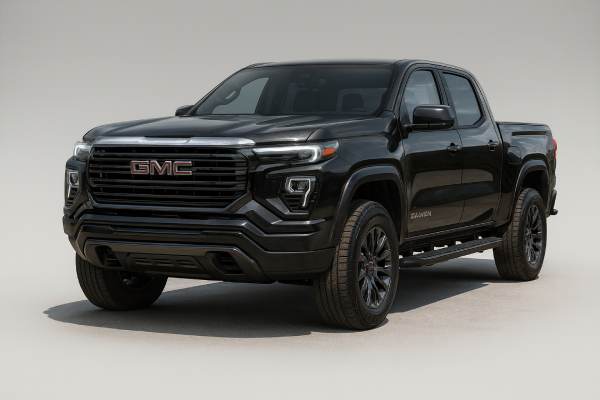
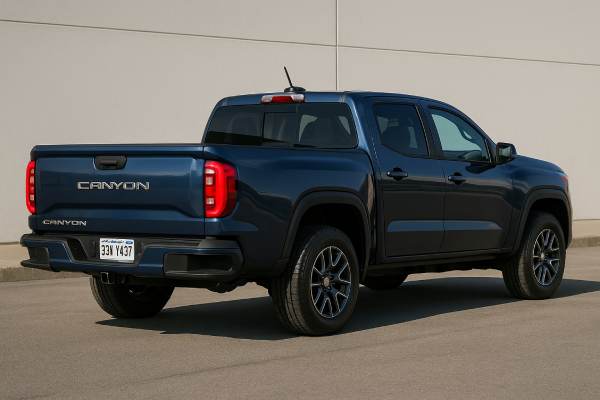
The 2023–present GMC Canyon with the 2.7-litre L3B turbo engine marks a clear shift in how midsize trucks balance power, tech, and daily usability. Instead of a V6, GMC uses a high-output four-cylinder that delivers 310 hp and strong low-rpm torque, paired with an 8-speed automatic and rear-wheel drive. That combination makes this Canyon feel quick and confident on the road while still aimed at towing, hauling, and long-term work use.
The new GMT31XX-2 platform also brings a stiffer structure, more advanced safety engineering, and a cabin that feels closer to a modern SUV than an old-school pickup. For owners, that means better refinement, more connectivity, and improved driver assistance, but also a greater need to understand software updates, calibration requirements, and proper maintenance. This guide walks through specs, real-world performance, reliability patterns, service guidance, and how the Canyon RWD compares with key rivals in the segment.
Fast Facts
- Strong 310 hp 2.7L TurboMax four-cylinder with stout torque gives V6-like performance with better low-rpm pull.
- RWD Elevation models can tow up to 7,700 lb when properly equipped, matching many larger trucks for trailer capacity.
- EPA combined fuel economy is about 20 mpg (18 city / 23 highway) for 2WD Elevation, so budgeting for fuel is still important on long commutes.
- Expect engine oil and filter changes roughly every 7,500–10,000 miles (12,000–16,000 km) or annually, with more frequent service under heavy use.
- IIHS crash testing shows strong performance in key crashworthiness areas thanks to the updated structure and airbag system.
Section overview
- Canyon 2.7 Turbo RWD Insight
- L3B 2.7 RWD Specs Summary
- Trims, Options and Safety Tech
- Reliability Patterns and Fix Actions
- Maintenance Plan and Buying Guide
- Driving Experience and Efficiency
- Canyon 2.7 RWD Versus Rivals
Canyon 2.7 Turbo RWD Insight
The 2023-on GMC Canyon RWD with the L3B 2.7-litre turbocharged four-cylinder is the “new normal” for midsize GMC trucks. Instead of offering multiple engines, GMC simplifies the range with a single high-output powertrain and tunes the chassis around it. In rear-wheel-drive Elevation trim, the Canyon targets buyers who mostly stay on road, tow moderate loads, and want a more agile alternative to a full-size pickup.
The L3B itself is a modern aluminium inline-four with dual overhead cams, four valves per cylinder, direct injection, variable valve timing, and a dual-volute turbo. It is designed for strong low- and mid-range torque, making the truck feel muscular at everyday revs rather than only near redline. For owners, that means brisk acceleration onto highways and confident passing even with passengers or a light trailer on the hitch.
The GMT31XX-2 frame is significantly updated versus the previous Canyon generation. It uses a boxed-rail design and revised suspension geometry, improving both ride comfort and steering precision. You only get a crew-cab short-bed configuration, which simplifies body choices but also focuses the truck on lifestyle and light commercial users rather than fleets needing multiple cab/bed combinations.
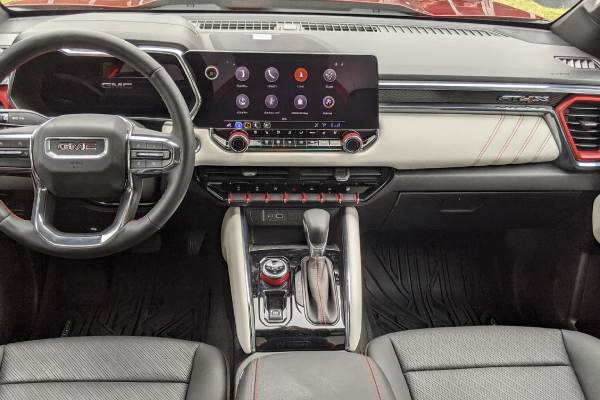
Inside, the Canyon’s cabin moves toward the premium end of the midsize class. A standard digital gauge cluster, large central touchscreen, and a more horizontal dashboard layout make the interior feel wider and more modern. RWD versions benefit from slightly lower mass and reduced driveline complexity compared to 4WD, which helps both efficiency and ride smoothness on paved roads.
For buyers cross-shopping larger trucks, the key appeal of this Canyon specification is its balance: easier to park, quick in traffic, able to tow 7,700 lb when appropriately specified, and significantly more refined than many older midsize pickups. The trade-offs are a single engine choice, a higher feature load (and therefore more electronics to maintain), and fuel economy that is good for the power but not compact-car frugal.
L3B 2.7 RWD Specs Summary
This section focuses on a typical configuration: 2023–present GMC Canyon Elevation, crew cab, short box, rear-wheel drive, with the 2.7L Turbo High-Output (L3B) engine and 8-speed automatic.
Engine and Performance
| Item | Specification |
|---|---|
| Engine code | L3B Turbo High-Output inline-4 |
| Displacement | 2.7 L (about 2,727 cc) |
| Layout and valvetrain | DOHC, 4 valves per cylinder, variable valve timing and valve lift |
| Induction | Single dual-volute turbocharger |
| Fuel system | Gasoline direct injection |
| Compression ratio | Around 10:1 (market-dependent) |
| Max power | 310 hp @ 5,600 rpm |
| Max torque | 430 lb-ft @ roughly 3,000 rpm (around 580+ Nm) |
| Redline | About 6,100 rpm |
| Emissions standard | Typically U.S. Tier 3 / LEV III equivalent |
Factory fuel economy for 2WD Elevation is roughly 18 mpg city, 23 mpg highway, and 20 mpg combined (about 13.1/10.2/11.8 L/100 km). Real-world figures vary with tyre choice, load, and driving style; owners who tow frequently or drive at high highway speeds can expect numbers in the mid-teens mpg.
Transmission and Driveline
| Item | Specification |
|---|---|
| Transmission | 8-speed automatic (8-speed torque-converter unit) |
| Drive type | Rear-wheel drive |
| Final drive ratio | Around 3.42:1 (varies slightly by axle/tow package) |
| Differential | Open rear differential (electronic traction control via brakes) |
| Tow rating (max, properly equipped) | Up to 7,700 lb (approx. 3,493 kg) conventional tow |
| Payload (approx RWD Elevation) | Around 1,600–1,700 lb depending on options |
Chassis and Dimensions
| Item | Specification |
|---|---|
| Platform | GMT31XX-2 boxed-rail ladder frame |
| Front suspension | Independent double-wishbone with coil-over dampers |
| Rear suspension | Solid axle with leaf springs |
| Steering | Electric power rack-and-pinion |
| Brakes | 4-wheel discs with ABS and stability control |
| Wheelbase | ~131.4 in (3,337 mm) |
| Overall length | ~213.2 in (5,415 mm) for short box |
| Width (without mirrors) | Mid-70s inches, trim-dependent |
| Fuel tank | About 21.4 US gal (81 L) |
| Typical curb weight (RWD Elevation) | Around 4,400–4,600 lb depending on equipment |
Performance and Capability
With 310 hp and 430 lb-ft, the Canyon RWD is one of the stronger midsize trucks in its class. Independent testing and estimates place 0–60 mph times in the low-6-second range for comparable 2.7L turbo trucks, which translates to brisk acceleration for merging and passing.
Braked trailer ratings of 7,700 lb are realistic when using a weight-distributing hitch, trailer brake controller, and appropriate cooling. Payload capacity around 1,600–1,700 lb allows for passengers plus a reasonable bed load, but owners should always check the tyre-and-loading label on the door jamb for the exact number for their VIN.
Trims, Options and Safety Tech
Although this article focuses on the RWD configuration, understanding the broader Canyon range helps you identify equipment and safety differences.
For 2023–present, the Canyon lineup is built around the Elevation, AT4, AT4X, and Denali trims. In most markets, rear-wheel drive is primarily offered with the Elevation trim, while AT4, AT4X, and Denali are four-wheel-drive only. All share the same 2.7L Turbo High-Output engine and 8-speed automatic; unlike some Colorado variants, Canyon keeps the high-output specification standard.
Key trim differences that matter to owners:
- Elevation (RWD focus here)
- Road-oriented suspension tuning and tyres.
- Standard ride height, simpler off-road hardware.
- Cloth seats standard, with available comfort and technology packages.
- AT4 / AT4X (4WD only)
- Raised suspension, off-road shocks, and underbody protection.
- More aggressive all-terrain tyres.
- Additional terrain drive modes and, on AT4X, front and rear lockers.
- Denali (mostly 4WD)
- Premium interior materials, larger wheels, and distinctive exterior trim.
- More advanced audio and comfort features as standard.
For RWD Elevation buyers, the main option packages to watch are:
- Convenience and comfort packs (heated seats, remote start, dual-zone climate, power driver’s seat).
- Technology packages (larger digital instrument cluster, extra cameras, upgraded infotainment).
- Trailering packages (integrated brake controller, hitch guidance, additional cooling).
Safety Ratings
The 2023 redesign brought the Canyon structure and safety systems up to modern standards for crash performance. The crew-cab body style has been evaluated in multiple crash scenarios with good occupant protection. Side-impact and small-overlap frontal tests show strong cabin integrity and controlled dummy readings.
Because the RWD and 4WD crew-cab models share the same basic structure and body shell, these ratings generally apply across driveline variants. Still, it is wise to confirm details for your specific year and configuration through official safety-rating databases.
Airbags and Passive Safety
Standard passive safety equipment typically includes:
- Dual front airbags.
- Front seat-mounted side-impact airbags.
- Side-curtain airbags extending over both rows.
- Three-point seatbelts with pretensioners and load limiters in front.
- LATCH/ISOFIX anchor points on the rear outboard seats.
ADAS and Driver Assistance
Depending on trim and package content, the Canyon RWD can be equipped with:
- Automatic emergency braking with forward collision alert.
- Lane keep assist with lane departure warning.
- Following distance indicator and forward collision warning.
- Blind-zone monitoring and rear cross-traffic alert.
- Rear park assist and high-definition rear camera.
- Optional surround-view camera system.
- Adaptive cruise control in higher equipment levels.
Some early trucks were subject to a recall related to unexpected automatic emergency braking activations due to camera-module software. The remedy involves updated calibrations and, if needed, hardware checks. Owners should always verify recall status with an official VIN look-up and ask for written confirmation of completion.
ADAS features may require calibration after windscreen replacement, front-end crash repairs, or suspension changes that alter ride height. Any body-shop work on the front end should include an ADAS calibration plan.
Reliability Patterns and Fix Actions
Because this Canyon generation is still relatively new, long-term data is developing, but we can already outline early patterns and areas to watch based on the L3B’s history in other GM trucks and emerging feedback from owners.
Engine and Powertrain
The L3B 2.7L turbo has several design goals: quick response, robust mid-range torque, and improved efficiency over a comparable V6. For reliability:
- Oil quality is critical. The turbocharger, timing system, and direct-injection hardware all depend on clean, high-quality oil. Long intervals or poor oil can accelerate deposits and wear.
- Direct injection and intake deposits. As with most DI engines, there is a long-term risk of carbon build-up on intake valves, especially with short-trip and low-load usage. Symptoms may include rough idle, hesitation, or misfires. Walnut blasting or other valve-cleaning methods are typical remedies when required.
- Turbocharger plumbing. Oil feed and return passages must remain clean. Sludge or neglect can impact turbo life, though this is rarely an issue if oil changes are timely.
- Timing chain wear. Stretch and guide wear are more likely when service intervals are extended, or the engine is run low on oil. Rattling at cold start or timing-correlation codes require immediate attention.
Overall, the engine appears robust when maintained conservatively. Preventive care focuses on oil, intake cleanliness, and avoiding heat-soak conditions with hard shut-downs after sustained high load (for example, letting the engine idle briefly after heavy towing before switching off).
The 8-speed automatic benefits from fluid that is not overheated or oxidized. Trucks that tow frequently, operate in hot climates, or see a lot of stop-start driving may justify transmission fluid changes earlier than the maximum intervals in the handbook.
Chassis, Suspension, and Body
For RWD Elevation models:
- Front suspension wear typically shows up as clunks over sharp bumps, vague steering, or uneven tyre wear and is usually related to control-arm bushings or ball joints. Regular alignments and inspections keep this under control.
- Rear leaf-spring and shackle wear is more of a concern on trucks run near maximum payload over rough roads. Listen for squeaks, knocks, or axle tramp during test drives.
- Corrosion risk is concentrated in salt-belt regions. Check frame rails, crossmembers, and the junctions between cab, bed, and frame for rust; early treatment preserves long-term value.
Body panels and trim are more complex than on earlier Canyons, with more camera lenses and sensors embedded. Any collision repair should be inspected for correct panel gaps, sealant, and sensor operation.
Electronics and Infotainment
The fully digital cabin brings with it more controllers and software dependencies:
- Infotainment system freezes or reboots may occur occasionally; many can be resolved with software updates.
- Camera or sensor faults after bumper work or hitch installations usually trace back to damaged wiring or poor connector seating.
- ADAS warnings and limited-function messages may point to calibration needs or the camera-module recall; they should not be ignored.
Recalls, TSBs, and Service Campaigns
Key owner actions:
- Run an official VIN recall search and print the results.
- Ask the dealer to confirm all service campaigns and software updates have been applied, especially for the ADAS and powertrain systems.
- For any drivability issues (harsh shifts, surging, laggy throttle), request checks for relevant Technical Service Bulletins and updated calibrations.
When buying used, proof of recall completion and a clear service record are as important as the physical condition of the truck.
Maintenance Plan and Buying Guide
A disciplined maintenance plan keeps the L3B and the rest of the Canyon platform delivering their best performance over the long term.
Practical Maintenance Schedule (General Guidance)
Intervals below are general recommendations; always follow the official schedule for your market and adjust for your usage.
- Engine oil and filter
- Every 7,500 miles / 12,000 km or 12 months for mixed use.
- Consider every 5,000 miles / 8,000 km if towing heavily, idling frequently, or driving mostly short trips.
- Use dexos-approved full-synthetic oil in the specified viscosity (often 5W-30) and OEM-quality filters.
- Engine air filter
- Inspect at 15,000 miles / 24,000 km.
- Replace by 30,000–45,000 miles, earlier in dusty areas.
- Cabin air filter
- Replace every 20,000–30,000 miles, or every 2 years, to maintain HVAC efficiency.
- Spark plugs
- Typically iridium plugs; replacement interval is often 60,000–100,000 miles depending on market guidance.
- Replace sooner if misfire codes or rough running appear.
- Coolant
- Long-life coolant often first replaced around 5 years/100,000 miles (160,000 km), then at shorter intervals.
- Use the specified long-life coolant and correct dilution (often 50:50).
- Automatic transmission fluid
- Inspect condition around 45,000–60,000 miles.
- Replace by 60,000–75,000 miles for conservative care, especially if towing or in hot climate operation.
- Rear differential fluid
- Replace around 60,000–75,000 miles; more often if towing or carrying heavy loads frequently.
- Brake fluid
- Change every 3 years regardless of mileage.
- Brake pads and rotors
- Inspect at every tyre rotation; typical pad life depends heavily on driving style and load but often falls between 30,000–70,000 miles.
- Tyres, rotation and alignment
- Rotate every 7,500 miles / 12,000 km.
- Align whenever you notice uneven wear, steering pull, or after suspension work.
- Aux belts and hoses
- Inspect at each service; replace belts with visible cracking or glazing, and hoses showing swelling or soft spots.
- 12 V battery
- Test annually from year three onwards.
- Expect operational life of roughly 4–6 years in typical conditions.
Fluid Specs and Torque Values (Planning-Level)
Exact values depend on model year and market, but typical figures include:
- Engine oil drain plug torque in the 25–35 Nm (18–26 lb-ft) range.
- Wheel lug torque around 140 Nm (100–105 lb-ft).
- Differential and transmission pan fasteners at modest torque to avoid stripping; always follow workshop manual values.
These numbers are only for planning; never rely on them instead of official documentation.
Buyer’s Guide: What to Look For
When evaluating a new or used Canyon RWD 2.7:
- Documentation and history
- Confirm regular oil changes with invoices showing correct spec.
- If mileage exceeds 40,000–50,000 miles, look for transmission and differential fluid service.
- Ask for recall and campaign printouts stamped or signed by a dealer.
- Physical inspection
- Check the frame, suspension mounts, and brake lines for corrosion or impact damage.
- Inspect tyres for even wear; cupping or inside-edge wear may indicate alignment issues.
- Look for water ingress in lights and camera lenses, which can affect ADAS functions.
- Tech and ADAS function
- Test every camera view and parking sensor.
- Verify AEB, lane-keeping, and adaptive cruise (if fitted) activate smoothly and without false alarms.
- Confirm infotainment stability: no repeated reboots, lag, or Bluetooth dropouts during a longer test.
- Road test behaviour
- Listen for clunks from the rear when shifting between drive and reverse.
- Check for harsh or erratic shifts in the 2–3 and 3–4 ranges, which could suggest the need for software or fluid attention.
- Assess steering feel around center, and ensure the truck tracks straight on a flat road.
Long-Term Outlook
Assuming timely fluids, completed software updates, and sensible usage, the Canyon RWD 2.7 should be capable of 150,000–200,000+ miles of service without major powertrain overhaul. Long-term value will hinge on rust prevention, proper tow practices, and how well its electronics are cared for and kept current.
Driving Experience and Efficiency
On the road, the Canyon RWD with the L3B engine feels more like a strong midsize SUV than a traditional small pickup, while still carrying the robustness of a ladder-frame truck.
Ride, Handling, and NVH
The boxed-rail frame and independent front suspension provide good straight-line stability and fairly tight body control. Compared with the previous generation, steering is more precise, and the truck feels planted at motorway speeds. Unladen, you will still notice some firmness in the rear over sharp expansion joints due to the leaf-spring axle, but overall comfort is good for a midsize pickup.
Cabin noise at highway speeds is well managed. Engine noise is subdued once in top gears, with a restrained growl when you ask for full power. Tyre and wind noise are more apparent than engine sound, especially on coarse asphalt, but remain within a comfortable range for long journeys.
Braking performance is predictable, with a firm pedal and good modulation. As with any truck, stopping distances lengthen under heavy payloads or towing; using a properly adjusted trailer braking system is crucial when near the top of the tow rating.
Powertrain Character
The 2.7 Turbo High-Output four-cylinder is tuned for torque. In daily use:
- The truck steps away smartly from a stop with minimal lag.
- Mid-range response when merging or overtaking is strong, often needing only a single downshift.
- The engine is happy to work between 1,500–4,000 rpm for most tasks, with higher revs reserved for hard acceleration.
The 8-speed automatic is calibrated to balance performance and efficiency. In normal mode, it tends to upshift early and sometimes shuffles between gears on gentle grades. Switching to tow/haul or a sportier setting holds gears longer, sharpens throttle response, and generally makes the truck feel more decisive, particularly when carrying a load or towing.
Real-World Efficiency
For mixed use, many owners see results close to the official combined figure of about 20 mpg (roughly 11.8 L/100 km), with city-heavy driving dipping into the high-teens and relaxed highway cruising occasionally exceeding 23 mpg (about 10 L/100 km). Key factors that influence results:
- Average speed and traffic density.
- Tyre type (all-terrains usually cost a bit of efficiency).
- Towing and payload usage.
- Climate and use of remote start or extended idling.
Short trips in cold weather are particularly hard on fuel consumption, as the engine spends more time in warm-up enrichment and the cabin heater adds load.
Load and Towing Behaviour
With rear-wheel drive, weight distribution matters:
- Unladen, traction can be limited on wet or icy roads; quality tyres and, if needed, some weight over the rear axle improve stability.
- With a modest load in the bed, the truck feels more planted and rides more smoothly.
- When towing near 7,700 lb, the powertrain has reserve torque, but you will feel the mass of the trailer in braking and crosswind behavior. A weight-distributing hitch, correctly set trailer brakes, and conservative speed on long descents are essential.
Temperature monitoring (via the onboard gauges where available) is useful on extended grades. If you regularly tow in hot climates, consider shorter ATF intervals and discuss auxiliary cooling options with a knowledgeable shop.
Canyon 2.7 RWD Versus Rivals
In the midsize truck space, the Canyon RWD 2.7 competes primarily with its Chevrolet Colorado sibling, Toyota Tacoma, Ford Ranger, Nissan Frontier, and in some cases well-priced full-size pickups.
Versus Chevrolet Colorado
The Colorado shares platform, engine, and transmission with the Canyon. Differences are mainly in styling, interior trim themes, and option packaging.
- The Canyon often positions itself slightly more upscale, with distinctive front-end styling and interior trim.
- Colorado may offer different equipment bundles that appeal to fleet buyers or those prioritizing value over design.
From a reliability and service perspective, they are effectively the same truck; choice comes down to taste, available deals, and trim combinations.
Versus Toyota Tacoma
Tacoma is known for long-term durability and strong resale values, particularly in off-road-oriented trims. Compared with a current Canyon RWD 2.7:
- The Canyon’s turbo four delivers stronger low-end and mid-range torque than the older Tacoma V6 and feels quicker in everyday driving.
- The Tacoma has a more off-road-biased reputation and a massive aftermarket, though its cabin and driving position can feel more dated.
- For buyers focused on modern tech, cabin refinement, and on-road comfort, the Canyon has a notable edge; for those prioritizing long-term resale and trail-proven hardware, Tacoma remains a benchmark.
Versus Ford Ranger
The Ranger’s 2.3L EcoBoost four-cylinder offers similar turbocharged character:
- The Canyon 2.7 generally provides more power and torque, translating into stronger towing and passing ability.
- Fuel economy is broadly comparable; exact results depend heavily on configuration and driving style.
- Interiors differ in layout and feel; some drivers prefer the Canyon’s newer screen integration and gauges, while others like the Ranger’s approach.
Ownership considerations such as dealer support, local parts availability, and personal comfort in the cabin should weigh as heavily as the spec sheet.
Versus Nissan Frontier
Nissan’s Frontier uses a 3.8L naturally aspirated V6:
- The Frontier offers a linear, rev-happy V6, while the Canyon focuses on turbocharged torque at lower rpm.
- Frontier’s latest redesign improved interior quality, but the Canyon still feels more tech-forward, particularly in RWD Elevation with option packs.
- For buyers who prefer a simpler non-turbo powertrain, the Frontier can be appealing; for those who want strong torque and modern electronics, the Canyon stands out.
Versus Full-Size Trucks
A well-equipped Canyon can overlap in price with entry and mid-level full-size pickups:
- Full-size trucks deliver more cabin and bed volume and, in many cases, higher maximum tow ratings.
- The Canyon is easier to park, lighter to maneuver, and often more pleasant in tight urban or suburban environments.
- Fuel economy is sometimes surprisingly similar; the Canyon’s advantages show up most clearly in day-to-day ease of use.
For many owners who do not need a full-size’s bed volume or cabin width, the Canyon RWD 2.7 offers a balanced, modern package with strong performance and a manageable footprint.
References
<a href="https://www.gmc.com/content/dam/gmc/na/us/english/index/about/download-brochures/2023-models/02-pdf/GMTC23CT000_MY23_GMC_CANYON_DESKTOP_103023_INTERACTIVE.pdf">2023 GMC Canyon Brochure</a> 2023 (Specifications Overview)<a href="https://www.fueleconomy.gov/feg/PowerSearch.do?action=noform&baseModel=Canyon&make=GMC&pageno=1&rowLimit=50&srchtyp=ymm&year1=2023&year2=2023">2023 GMC Canyon Fuel Economy</a> 2023 (EPA Fuel Economy Database)<a href="https://www.iihs.org/ratings/vehicle/gmc/canyon-crew-cab-pickup/2023">2023 GMC Canyon Crew Cab Pickup</a> 2024 (Safety Rating)<a href="https://static.nhtsa.gov/odi/rcl/2024/RCORRD-24V133-9988.pdf">2023 MY Chevrolet Colorado and GMC Canyon – Unwarranted Automatic Emergency Braking Events</a> 2024 (Recall Notice)<a href="https://www.gmc.com/support/vehicle/manuals-guides">Manuals and Guides | Vehicle Support</a> 2024 (Owner’s Manual Portal)
Disclaimer
This article is for informational purposes only and is not a substitute for professional diagnosis, repair, or official service information. Specifications, torque values, maintenance intervals, and procedures can vary by VIN, market, model year, and installed equipment. Always verify all technical data and service steps against the official Owner’s Manual, workshop literature, and technical bulletins for your specific vehicle, and consult a qualified technician when in doubt.
If you found this guide helpful, please consider sharing it with other owners or shoppers on Facebook, X/Twitter, or your preferred automotive forums. Sharing supports high-quality technical content and helps more people make informed decisions about their trucks.