
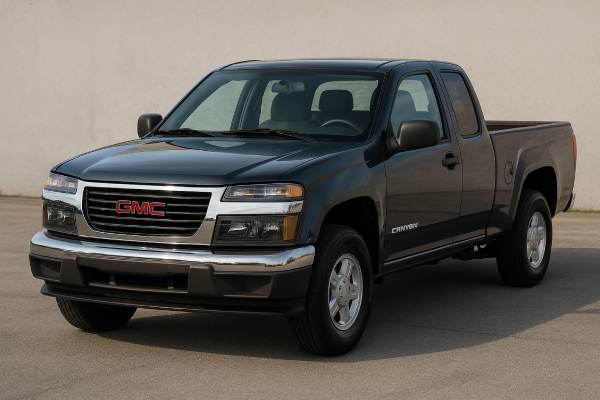
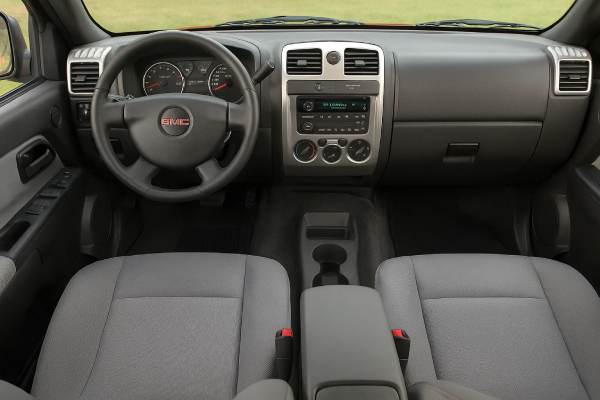
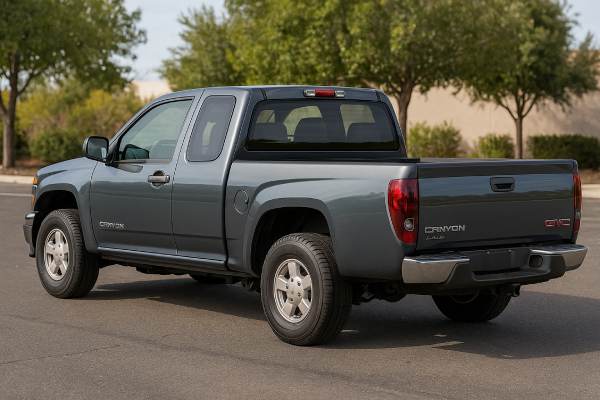
The first-generation GMC Canyon with the 2.8 l LK5 inline-four sits in a sweet spot for owners who want a compact pickup that is easy to park, reasonably efficient, and still capable of real work. Built on GM’s GMT355 platform alongside the Chevrolet Colorado, this truck replaced the S-10/Sonoma with a more modern chassis, rack-and-pinion steering, and a pair of Atlas-family inline engines.
In 2WD form (often described as “FWD/2WD” in listings but actually rear-wheel drive), the 2.8 l Canyon was typically sold as a budget-friendly work or commuter truck in regular and extended cab bodies, paired with a 5-speed manual or 4-speed automatic. Owners like its compact dimensions, smooth-running DOHC engine, and decent ride quality for a body-on-frame pickup. At the same time, there are well-known weak points—especially cylinder-head issues on early Atlas engines and mixed crash-test results—that buyers need to understand.
This guide walks through the key specs, reliability patterns, maintenance needs, and how the 2.8 l Canyon compares with rivals so you can decide whether it fits your use case and budget.
Fast Facts
- 2.8 l LK5 inline-four makes 175 hp and 185 lb-ft, enough for light towing and daily driving but not effortless highway passing when loaded.
- Real-world fuel economy typically lands around 18–21 mpg combined (about 13–11 L/100 km), with the manual gearbox slightly more efficient than the automatic.
- Known issues include cylinder-head valve-seat problems, electrical quirks, and front suspension wear, especially on higher-mileage or poorly maintained trucks.
- Plan engine oil and filter changes every 5,000 mi / 8,000 km or 12 months (shorter than GM’s original maximums) to protect the aging Atlas engine.
Guide contents
- GMC Canyon 2.8L LK5 Overview
- Canyon 2.8L Specs and Data
- Trims, Safety and Driver Aids
- Reliability and Common Issues
- Maintenance and Buying Advice
- Driving Experience and Performance
- How Canyon 2.8L Compares
GMC Canyon 2.8L LK5 Overview
The 2004–2006 GMC Canyon 2.8 l is the entry-level configuration of GM’s mid-2000s compact pickup line, sharing its bones with the Chevrolet Colorado and Isuzu i-280. It uses the GMT355 platform with body-on-frame construction, rack-and-pinion steering, and independent front suspension, replacing the older S-10 architecture with a more refined and spacious truck.
Despite some listings using “FWD,” all 2WD Canyons of this era are actually rear-wheel drive; 4WD variants add a transfer case and front differential. The 2.8 l four-cylinder was usually paired with 2WD in regular and extended cab trucks, while crew cabs more often received the 3.5 l inline-five.
Engine and intent
The LK5 Vortec 2800 is an all-aluminum, DOHC, 16-valve inline-four with variable exhaust cam phasing. Output is 175 hp at 5,600 rpm and 185 lb-ft (about 251 Nm) at 2,800 rpm, giving a torque curve that feels stronger than older pushrod fours in compact trucks of the 1990s.
This engine is best suited for:
- Light-duty hauling and commuting
- Occasional towing of small trailers, ATVs, or a lightweight pop-up camper
- Owners who prioritize lower purchase price and fuel use over maximum towing
Cab and chassis mix
Across 2004–2006, the 2.8 l was available mainly in:
- Regular cab 2WD – shorter wheelbase, lighter curb weight, best fuel economy
- Extended cab 2WD – extra interior storage and occasional rear seating
- Some 4WD variants – especially extended cab, but most four-cylinders remain 2WD
Ride quality is relatively compliant for a small truck, especially with the on-road-oriented Z85 suspension; off-road Z71 packages are firmer but more capable on rough roads.
Strengths
- Compact size makes it easier to maneuver and park than full-size pickups
- Inline-four is smoother than many comparable four-cylinder truck engines
- Reasonable fuel economy for the era, especially with the 5-speed manual
- Parts availability is excellent thanks to mechanical overlap with Colorado and Isuzu i-series
Key drawbacks
- Performance is adequate but not brisk, especially with the automatic and a full load
- Early Atlas engines have known cylinder-head and valve-seat issues if neglected
- Safety performance is mixed: some crash tests are strong, but crew-cab side-impact ratings are poor without side airbags
If your use case is mainly city/highway commuting, home-center runs, and occasional light towing, the 2.8 l Canyon can work well, provided you buy a well-maintained example and respect its limits.
Canyon 2.8L Specs and Data
Engine and performance
| Item | Specification* |
|---|---|
| Engine code | LK5 Vortec 2800 (Atlas family) |
| Layout | Inline-4, aluminum block and head, DOHC, 4 valves/cyl |
| Displacement | 2.8 l (≈ 2,770–2,800 cc) |
| Bore × stroke | ~93 mm × 102 mm (3.66 in × 4.02 in) |
| Compression ratio | ~10.0:1 (market and calibration dependent) |
| Induction | Naturally aspirated |
| Fuel system | Sequential multi-port fuel injection (MPFI) |
| Max power | 175 hp (130 kW) @ 5,600 rpm |
| Max torque | 185 lb-ft (≈ 251 Nm) @ 2,800 rpm |
| Timing drive | Chain (no scheduled replacement; monitor for noise/stretch) |
| Emissions standard | US Tier 2-era light-truck standards (varies by state and GVWR) |
*Exact values can vary slightly by model year, calibration, and market; always verify by VIN.
Efficiency
EPA-style ratings for a 2.8 l 2WD Canyon are around the low 20s mpg city and mid-to-high 20s mpg highway with the manual, and slightly lower with the automatic; owner-reported averages cluster around 18–21 mpg combined.
Converted:
- Combined: ~11–13 L/100 km
- Highway: ~8.7–10.2 L/100 km
Real-world highway use at 120 km/h (75 mph) often adds 0.5–1.0 L/100 km over the official highway figure due to aerodynamic drag.
Transmission and driveline
Most 2.8 l Canyons pair with either a 5-speed manual (Aisin AR-5/MA-5) or a 4-speed automatic (Hydra-Matic 4L60-E).
| Item | Specification |
|---|---|
| Drive type | 2WD: rear-wheel drive; some 4WD models with part-time transfer case |
| Manual transmission | 5-speed Aisin AR-5 (MA-5) |
| Automatic transmission | 4-speed 4L60-E |
| Final drive ratios | Commonly 3.73 or 4.10 (varies with trim and tow package) |
| Rear differential | Open; optional locking rear differential (G80) on some trims |
| 4WD system (if equipped) | Part-time, two-speed transfer case, dash-selectable 2HI / 4HI / 4LO |
Chassis and dimensions (typical 2WD regular/extended cab)
Dimensions vary with cab and bed, but for a 2004 regular-cab 2WD truck:
| Item | Approx. value |
|---|---|
| Wheelbase | 111.2 in (2,825 mm) |
| Overall length | ~192.8 in (4,897 mm) |
| Width (excluding mirrors) | ~67.6–68.6 in (≈ 1,720–1,740 mm) |
| Height | ~65–67 in (varies with suspension and tires) |
| Curb weight | ~3,200–3,600 lb (cab, bed, and driveline dependent) |
| Front suspension | Independent SLA (short-long arm) with coil-over shock (2WD) |
| Rear suspension | Solid axle with leaf springs |
| Steering | Rack-and-pinion, power-assisted |
| Brakes | Front discs, rear drums with ABS widely available |
| Fuel tank | ~19 US gal (72 l) typical |
Performance and capability
Published performance for the 2.8 l is sparse, but period tests and aggregated data for the base I4 Colorado/Canyon put 0–60 mph in roughly 9.8–10.7 seconds with 2WD and the manual gearbox.
| Metric | Typical figure (2WD 2.8 l) |
|---|---|
| 0–60 mph (0–97 km/h) | ≈ 10–11 s (configuration dependent) |
| Top speed | Electronically limited; typically in 95–105 mph (153–169 km/h) range |
| Braked towing capacity | Around 2,000–3,500 lb depending on cab, axle ratio, and cooling package |
| Payload | Often 1,300–1,700 lb, again dependent on GVWR and configuration |
Always check the specific truck’s door-jamb tire/loads sticker for exact tow and payload ratings.
Fluids and service capacities (2.8 l, typical values)
| System | Spec and capacity* |
|---|---|
| Engine oil | 5W-30; capacity ≈ 4.7 l (5.0 US qt) with filter; drain-plug torque ≈ 26 Nm (19 lb-ft) |
| Engine coolant | Dex-Cool–type long-life coolant; capacity ≈ 9.8 l (10.4 US qt) |
| Manual gearbox (AR-5) | GM manual transmission fluid; ≈ 2.2–2.4 l (2.3–2.5 qt) |
| Automatic (4L60-E) | Dexron VI ATF; ~11.2 US qt total fill, ~5 qt for pan-drop service |
| Rear differential | 75W-90 GL-5 gear oil; ≈ 1.6 l (1.7 qt) |
| Front differential (4WD) | 75W-90 GL-5; ≈ 1.5 l (1.6 qt) |
| Power steering | GM-approved power-steering fluid; capacity controlled by dipstick |
| Brake/clutch fluid | DOT 3 |
| A/C refrigerant | R-134a, roughly 1.6 lb (0.73 kg) system capacity (verify under-hood label) |
*Capacities are approximate; always fill to dipstick/level plug and verify.
Electrical and ignition
| Item | Typical spec |
|---|---|
| Alternator output | ~100 A stock on many configurations |
| 12 V battery | Group 86 case; ~520–690 CCA depending on replacement part choice |
| Spark plugs | Long-life platinum/iridium; gap ≈ 0.042–0.044 in (1.07–1.12 mm) |
| Wheel lug nuts | ≈ 100 lb-ft (135 Nm) torque for OEM wheels |
Safety and driver assistance equipment
For 2004–2006, the Canyon offers:
- Front airbags
- Optional side-curtain airbags on some cab styles and trims
- Four-wheel ABS on most models
- Traction control on some 2WD trucks; no stability control on early years
Crash-test results vary by cab:
- Extended cab: Good overall in moderate overlap front crash tests
- Crew cab: Acceptable in moderate front; Poor in original-series side impact without side airbags
- Head restraints/seats: Often rated Marginal across several cab styles
There are no modern ADAS features like automatic emergency braking or lane-keeping on these years.
Trims, Safety and Driver Aids
Trims and equipment basics
For 2004–2006 in North America, the 2.8 l Canyon usually appears in lower and mid-level trims, with the 3.5 l five-cylinder reserved more for higher trims and heavy-duty towing packages.
Typical trim structure:
- SL (base)
- Steel wheels, basic cloth interior
- Manual windows/locks in early years
- 2.8 l engine standard, 5-speed manual commonly fitted
- SLE / LS-equivalent
- Alloy wheels, upgraded cloth and interior trims
- Optional 4-speed automatic
- Available Z85 (on-road) or Z71 (off-road) suspension packages
- Z85 vs Z71 suspensions
- Z85: Street-oriented, slightly softer ride, all-season tires
- Z71: Taller stance, firmer tuning, off-road-biased tires and skid plates
The 2.8 l engine appears in regular and extended cabs, in both Z85 and Z71 packages. Most crew cabs, especially in SLE form, use the 3.5 l, so a crew-cab 2.8 l is relatively unusual.
Quick identifiers
- Engine code sticker (under hood, RPO sticker in glovebox) will list LK5
- Trim and suspension codes such as Z85, Z71, and G80 appear on the same RPO label
- 2.8 l trucks may have fewer chrome and comfort options; Denali-style luxury trim was not offered on this generation
Functional differences by trim
Trim can influence:
- Rear axle ratio – Lower trims often use 3.73, some tow-oriented packages may use 4.10, improving pull but hurting highway fuel use.
- Tow package – Additional engine/transmission cooling and hitch equipment
- Locker availability – The G80 automatic locking differential is more often found on Z71 and/or tow-package trucks
For a buyer who wants maximum traction from a 2WD 2.8 l, a Z71 with the G80 locker is ideal, as it helps compensate for the limited power when towing or on loose surfaces.
Safety ratings by body style
Safety performance for this generation is mixed and very cab-dependent:
- Extended cab
- Moderate overlap front: good overall structure and occupant protection
- Head restraints and seats: marginal
- Crew cab
- Moderate overlap front: acceptable overall, marginal structure
- Side impact (without side airbags): poor overall with high risk of torso and pelvic injury
- Regular cab
- Limited crash data; head-restraint performance rated marginal
Official star ratings can be checked by VIN, but broadly, these trucks perform acceptably in frontal impacts for their era and less well in side impacts without side-curtain airbags.
Safety systems and child-seat provisions
- Airbags – Dual front airbags; optional side-curtain airbags in later years and higher trims
- Braking and stability
- Four-wheel ABS standard or widely available
- Electronic stability control not fitted in early 2004–2006 models
- Traction control offered on some rear-drive trucks
- Child seats
- LATCH/ISOFIX-equivalent lower anchors in crew-cab rear seats
- Extended-cab jump seats are less suitable for full-size child seats; top-tether anchorage may be present but access is tight
ADAS and calibration considerations
These trucks do not have advanced driver-assistance systems such as:
- Automatic emergency braking
- Adaptive cruise control
- Lane departure or lane-keeping
- Blind-spot or rear cross-traffic alerts
The main electronic calibration considerations after repairs relate to:
- Airbag module resets after deployment or component replacement
- Engine and transmission ECM/TCM software updates to address driveability or shift concerns
Reliability and Common Issues
The 2.8 l Canyon can be durable with proper care, but certain problems recur often enough that a buyer or owner should plan around them.
Engine and powertrain issues
1. Cylinder head and valve-seat problems (common, high severity)
- Symptoms: Misfires (often cylinder 4), rough idle, loss of compression, hard starting, sometimes coolant loss without obvious leaks.
- Likely cause: Valve-seat recession or cracking in the aluminum cylinder head, a known issue on early Atlas four- and five-cylinder engines.
- Remedy: Compression and leak-down tests, followed by cylinder-head replacement or rebuild if out of spec. In some markets, GM supported specific head casting ranges with extended coverage; always check history and ask a dealer to run the VIN.
2. Timing-chain wear and noise (occasional, medium severity)
- Symptoms: Rattle on cold start, cam/crank correlation codes, poor running.
- Cause: Chain stretch and/or guide/tensioner wear, often accelerated by long oil-change intervals or low-quality oil.
- Remedy: Inspect with valve cover off if codes or noise appear; replace chain, guides, and tensioner together and reset cam timing.
3. Oil consumption and leaks (occasional, low–medium severity)
- Valve-cover gasket seepage and oil-pan gasket leaks are typical on higher-mileage engines.
- PCV system issues or stuck oil-control rings can increase consumption, especially if oil has been changed infrequently.
Check for blue smoke on startup and during deceleration, and monitor dipstick levels between changes.
4. Transmission and driveline
- 4L60-E automatic
- Issues: shift flare, harsh 1–2 shift, torque-converter shudder, and on heavily used trucks, sun-gear and 3–4 clutch failures.
- Mitigation: regular ATF changes (every 30,000–50,000 mi / 50,000–80,000 km), correct cooler-line routing, and avoiding overloading.
- AR-5 manual
- Generally robust; problems usually involve clutch wear, hydraulic release issues, or owner abuse rather than design flaws.
Driveshaft U-joints and rear-axle bearings can wear with heavy towing or neglected fluid changes; listen for clunks or droning noises on test drives.
Chassis, suspension, and corrosion
Front suspension wear (common, low–medium cost)
- Worn ball joints, control-arm bushings, and tie-rod ends are common on older Canyon/Colorado trucks, especially with lifts or larger wheels.
- Symptoms include front-end clunks, uneven tire wear, and loose steering feel.
Frame and body corrosion (climate-dependent)
In rust-belt regions, inspect carefully:
- Rear frame rails near the shackles
- Crossmembers around the fuel tank and spare tire
- Cab mounts and seams
Surface rust is normal; heavy scaling, flakes, or perforation is a red flag.
Electrical and interior issues
Instrument cluster and gauge faults (occasional, low–medium cost)
- Erratic fuel or temperature gauges, intermittent cluster power, or dead stepper motors.
- Often resolved by cluster repair/rebuild or replacement; some markets had TSBs and campaigns addressing cluster behavior.
Passlock / anti-theft no-start (occasional)
- The GM Passlock system can prevent starting if it detects a fault in the ignition lock cylinder or key signal.
- Owners report intermittent crank-no-start that resets after waiting or a battery disconnect; the cure can be reprogramming, new ignition parts, or wiring repair.
Blower motor and HVAC controls
- Blower resistors and motors can fail, leaving only high speed or no airflow.
- Check all fan speeds and HVAC mode changes during inspection.
Recalls, TSBs, and software
There is a long list of technical service bulletins (TSBs) for the early Canyon/Colorado platform, covering:
- Instrument-panel indicators and oil-life monitor behavior
- Automatic-transmission shift concerns
- HVAC blend-door and controls
- Corrosion and fluid-contamination issues in the transmission cooler circuit
Before purchasing:
- Use the official GM or NHTSA recall lookup to ensure all recalls are completed.
- Ask the seller for documentation of any head replacement, transmission rebuilds, or major electrical repairs. These can be positives if done correctly.
Pre-purchase reliability checklist
Focus on:
- Cold start – Listen for chain rattle; note idle smoothness and misfires.
- Warm idle and rev – Watch for misfire, check-engine light, and exhaust smoke.
- Road test –
- Smooth, timely shifts (auto or manual)
- No driveline clunks on throttle on/off
- Straight braking with no vibration
- Fluids – Check engine oil, ATF, and coolant for contamination or metallic sheen.
- Service records – Regular oil changes, coolant replacement, and transmission/differential services are strong positive signs.
Maintenance and Buying Advice
A structured maintenance plan is critical to keeping a 2.8 l Canyon healthy, especially given its age.
Practical maintenance schedule (time/distance)
This table blends GM’s published intervals with conservative adjustments for age:
| Item | Interval (whichever comes first) | Notes |
|---|---|---|
| Engine oil and filter | 5,000 mi / 8,000 km or 12 months | Use quality 5W-30; follow oil-life monitor if it calls for earlier changes. |
| Engine air filter | Inspect every 15,000 mi / 24,000 km; replace by 30,000 mi / 48,000 km | Shorten in dusty use. |
| Cabin filter (if fitted) | 15,000–20,000 mi / 24,000–32,000 km | Some early trucks may not have a separate cabin filter. |
| Spark plugs | Up to 100,000 mi / 160,000 km; many owners replace around 60,000–80,000 mi as preventative. | |
| Coolant | Every 5 years or 100,000 mi (160,000 km) initially, then every 3–5 years | Use Dex-Cool or equivalent OAT coolant. |
| Brake fluid | Every 2–3 years | Helps prevent internal corrosion and sticking calipers. |
| Manual-trans fluid | 45,000 mi / 72,000 km in severe use; 60,000–75,000 mi otherwise | Use the correct GM fluid. |
| ATF (4L60-E) | 30,000–50,000 mi / 50,000–80,000 km, pan-drop and filter | More frequent if towing or in hot climates. |
| Differential oil | 45,000 mi / 72,000 km (severe); 60,000–90,000 mi general | Replace sooner if towing or off-road. |
| Serpentine belt | Inspect annually; replace ~60,000–90,000 mi or if cracked/noisy | Replace tensioner if noisy. |
| Timing chain | No fixed interval; inspect and listen | Replace only with noise, stretch, or correlation faults. |
| Suspension and steering | Visual and physical check at every tire rotation | Look for play in joints and bushings. |
| Tire rotation and alignment | Rotate every 5,000–7,500 mi | Align when uneven wear appears or after front-end repairs. |
| 12 V battery | Test annually after 4–5 years | Typical life 4–7 years depending on climate and quality. |
Fluid specs and key torque values
- Engine oil: Quality synthetic 5W-30, modern API rating; capacity about 4.7 l (5 qt).
- Coolant: Dex-Cool OAT, 50/50 mix; total capacity about 9.8 l (10.4 qt).
- Drain-plug torque: ~26 Nm (19 lb-ft).
- Wheel lug nuts: ~135 Nm (100 lb-ft).
Always confirm torque specs against a service manual for your exact year and wheel type.
Buyer’s guide: what to look for
1. History and paperwork
- Prefer trucks with documented oil changes and coolant service.
- Evidence of head replacement or major engine work can be positive if done at a reputable shop.
- Confirm recall and TSB completion through official lookups.
2. Engine health
- Warm compression test and leak-down on high-mileage trucks or any with misfire history.
- Check for oil in coolant or coolant in oil (suggesting head or gasket issues).
- Look for coolant stains around the thermostat housing, radiator, and heater hoses.
3. Driveline and chassis
- Listen for driveline clunks when shifting from D to R and when pulsing the throttle.
- Check front suspension for play: pry on ball joints and bushings; inspect tie-rod ends.
- Inspect frame for corrosion, especially in salty regions.
4. Electronics and interior
- Verify all gauges, warning lights, and the odometer behave correctly.
- Test HVAC in all modes, including A/C; note blower speeds.
- Check for working remote locks if fitted, and make sure the Passlock security light behaves normally at startup.
Recommended and avoid-if-possible combinations
- Great all-rounder:
- 2.8 l 2WD extended cab, Z85 suspension, 5-speed manual, with G80 locking differential and documented maintenance.
- For heavier towing:
- Consider the 3.5 l I-5 instead; the 2.8 l can tow but feels strained near its upper rating.
- Be cautious with:
- Neglected trucks showing misfire codes, low compression, or heavy oil sludge
- Rust-belt examples with significant frame and brake-line corrosion
- Trucks with mixed or missing VIN labels suggesting accident repairs
Long-term durability outlook
A well-maintained 2.8 l Canyon can comfortably exceed 200,000 mi (320,000 km), but the condition of the cylinder head, cooling system, and transmission is critical. Trucks that followed long oil-change intervals with budget oil or ran hot repeatedly are much more likely to develop major engine issues.
Driving Experience and Performance
Powertrain character
The 2.8 l LK5 feels different from older GM four-cylinder truck engines. It revs more freely and is smoother thanks to its DOHC layout and modern design, but it still makes its best torque low in the rev range. Peak torque arrives around 2,800 rpm, and everyday driving usually keeps the engine between 2,000 and 3,500 rpm.
- With the 5-speed manual, the truck feels reasonably lively at city speeds. Gear ratios are spaced to keep the engine in its torque band, and downshifts for highway passing feel natural.
- With the 4-speed automatic, performance is softer. Kickdown from 4th to 2nd can be a bit slow, and the engine can sound busy during extended climbs, especially when loaded or towing.
Expect 0–60 mph in roughly 10–11 seconds for a 2WD manual truck in good health; automatics and heavier cabs will trend to the slower end.
Ride, handling, and NVH
On the road, the 2.8 l Canyon behaves like a light-duty pickup:
- Ride quality –
- Unladen rear end can hop over sharp bumps and expansion joints.
- With 200–400 lb in the bed, the truck feels noticeably more settled.
- Steering –
- Rack-and-pinion gives predictable response, though steering feel is filtered.
- Parking-lot maneuvering is easy thanks to compact dimensions.
- Noise levels –
- Engine is audible under load but not coarse; Atlas engines have a characteristic “humming” note.
- Wind noise is moderate on the highway; tire noise depends heavily on tire choice.
Braking performance is acceptable but not sports-car sharp, given front discs and rear drums. Regular brake-fluid changes and quality pads/rotors help maintain a firm pedal.
Real-world efficiency and range
Owner-reported and aggregated data generally show:
- City driving: ~17–19 mpg US (13–14 L/100 km)
- Highway (100–115 km/h / 60–70 mph): ~23–27 mpg US (8.7–10.5 L/100 km) in ideal conditions
- Mixed: ~18–21 mpg US (11–13 L/100 km)
Factors that reduce economy:
- Oversize off-road tires and lift kits
- Roof racks, bed racks, and heavy accessories
- Short trips with cold starts
- Towing at highway speeds (expect 20–40 % higher fuel use)
With a ~19-gal tank, a realistic mixed-driving range is about 350–400 mi (560–640 km) between fill-ups.
Load and towing behavior
Within its rated limits, the 2.8 l Canyon can tow small utility trailers, jet skis, or a lightweight camper:
- Towing up to ~2,000 lb – Generally comfortable if you allow time for acceleration and keep speeds modest.
- Near maximum ratings (~3,000–3,500 lb depending on configuration) –
- Expect frequent downshifts on grades, especially with the automatic.
- Transmission and coolant temperatures can climb; an auxiliary cooler is wise if you tow often.
With heavy payloads in the bed, rear-spring squat can be noticeable; airbags or helper springs are common upgrades for owners who regularly haul close to payload limits.
Traction and control
On 2WD trucks:
- Traction is largely tire-dependent; a locking G80 rear differential helps significantly in snow, mud, or gravel.
- Without electronic stability control on early models, the driver’s inputs and tire choice matter more in low-grip conditions.
For owners in snowy climates who don’t want 4WD complexity, a 2WD Canyon with winter tires, a locking differential, and some weight in the bed can be surprisingly capable.
How Canyon 2.8L Compares
When new, the 2004–2006 GMC Canyon 2.8 l competed with:
- Toyota Tacoma 2.4/2.7 l
- Nissan Frontier 2.4 l
- Ford Ranger 2.3/3.0 l
- Mazda B-Series equivalents
Performance and efficiency
Compared with rivals:
- Power and torque –
- The 175 hp/185 lb-ft 2.8 l compares well to most four-cylinder competitors of the time, offering similar or better torque.
- However, Toyota’s 2.7 l four and Nissan’s later engines often feel less stressed when loaded.
- Efficiency –
- Real-world fuel economy is broadly similar to Tacoma and Frontier, slightly better than some V6 or 3.0-liter Ranger configurations.
If you want the absolute best blend of power and economy, a Tacoma 2.7 or a later diesel midsize pickup will beat the Canyon. But for its generation, the 2.8 l Canyon is competitive.
Ride, comfort, and features
- Ride and handling –
- Canyon’s rack-and-pinion steering and coil-over IFS give it a more modern, car-like feel than some older rivals.
- Tacoma’s suspension tuning is often praised as more refined on broken pavement, while the Frontier can feel stiffer.
- Interior quality –
- Cabin materials in the Canyon are functional but basic, with hard plastics and straightforward controls.
- Tacoma interiors of the era feel slightly more solid and better finished; Frontier is roughly comparable.
Feature content (audio options, power conveniences) depends heavily on trim; higher-end SLE trucks are reasonably equipped for the mid-2000s but lack modern infotainment and safety tech.
Reliability and ownership costs
In broad strokes:
- Toyota Tacoma (2nd gen) – Usually rated higher for long-term reliability and resale value, but used prices are also significantly higher.
- Nissan Frontier – Mixed reliability; some powertrain issues on certain engines, rust concerns similar to GM in some regions.
- Ford Ranger – Older chassis and packaging, but very simple and robust when lightly optioned; ride and refinement trail the Canyon.
The Canyon’s 2.8 l engine is more complex than some older pushrod fours, and its cylinder-head issues can be expensive if they appear out of warranty. However, parts sharing with Colorado and Isuzu i-series trucks keeps component costs reasonable, and independent shops are familiar with the platform.
Who the 2.8L Canyon suits best
The 2004–2006 GMC Canyon 2.8 l is a good fit if you:
- Want a compact, easy-to-park truck with honest pickup capability
- Value reasonable fuel use over maximum towing power
- Are comfortable doing (or paying for) proactive maintenance and inspections
- Can find a well-maintained example with good compression, clean fluids, and limited corrosion
If you prioritize minimal risk and plan to keep the truck for a decade or more, a well-chosen Tacoma may be safer but pricier. If you are value-focused, mechanically engaged, and willing to be selective, a good Canyon 2.8 l can offer a lot of truck for relatively little money.
References
<a href="https://experience.gm.com/support/vehicle/manuals-guides">Manuals and Guides | Vehicle Support - Experience GM</a> 2024 (Owner’s Manual Portal)<a href="https://www.conceptcarz.com/s6103/gmc-canyon.aspx">2004 GMC Canyon Specifications & Dimensions</a> 2004 (Specifications)<a href="https://www.thecarconnection.com/specifications/gmc_canyon_2004">2004 GMC Canyon Specifications</a> 2004 (Specifications)<a href="https://www.iihs.org/ratings/vehicle/gmc/canyon-extended-cab-pickup/2004">2004 GMC Canyon Extended cab pickup</a> 2004 (Safety Rating)<a href="https://www.nhtsa.gov/ratings">Car Safety Ratings | Vehicles, Car Seats, Tires</a> 2024 (Recall and Safety Ratings Database)
Disclaimer
This article is for informational purposes only and is not a substitute for professional diagnosis, repair, or manufacturer service information. Specifications, torque values, capacities, and maintenance intervals can vary by VIN, model year, market, emission package, and installed equipment. Always confirm data against the official owner’s manual, factory service manual, and current technical bulletins for your specific vehicle, and follow all safety procedures when working on a vehicle.
If you found this guide useful, feel free to share it with other owners or shoppers via Facebook, X/Twitter, or your favorite forum to help support accurate, independent automotive information.