
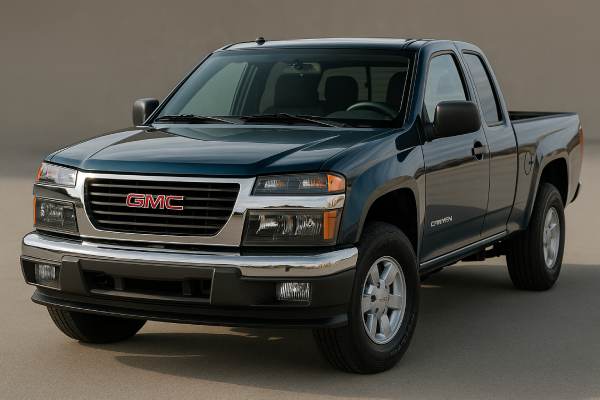
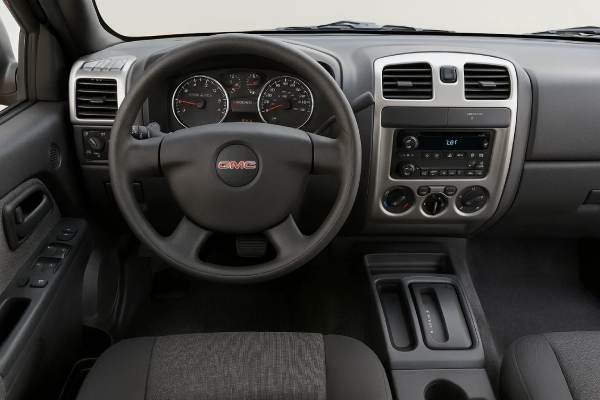
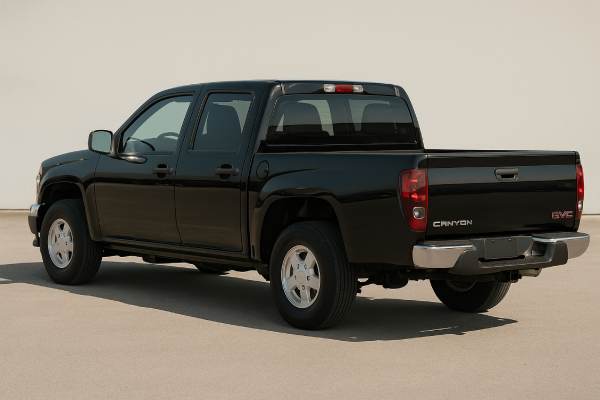
The facelifted 2009 GMC Canyon RWD with the LH8 5.3-liter V8 is one of the most interesting versions of the first-generation Canyon. It takes the compact GMT355 chassis and pairs it with a full LS-family V8, giving you big-truck power in a smaller footprint. With about 300 hp and strong mid-range torque, this rear-wheel-drive Canyon feels noticeably quicker than the four- and five-cylinder variants, yet it remains easy to park, maneuver, and live with every day.
Compared with 4WD models, the RWD V8 Canyon is lighter, simpler, and more efficient, with fewer driveline components to maintain. It suits drivers who spend most of their time on pavement, tow moderate loads, and appreciate the sound and pull of a traditional pushrod V8. This guide walks through the technical data, ownership experience, common issues, maintenance strategy, and how the V8 RWD Canyon stacks up against midsize rivals and full-size alternatives.
Fast Facts
- 5.3 l LH8 all-aluminum V8 delivers around 300 hp and strong torque in a compact truck package.
- RWD layout reduces weight and complexity compared with 4WD, helping ride comfort and running costs.
- Known concerns include typical LS-family issues (manifold bolts, sensors) and 4L60E transmission wear at high mileage.
- Oil and filter changes every 5,000–7,500 miles (8,000–12,000 km) are a smart baseline for long-term durability.
Navigate this guide
- LH8 V8 Canyon summary
- Canyon V8 specifications and data
- V8 trims, features and safety
- Reliability, faults and service actions
- Maintenance plan and buyer guide
- Driving impressions and performance
- How the V8 Canyon compares
LH8 V8 Canyon summary
For 2009, the GMC Canyon received a facelift that sharpened the front-end styling and refined the interior, but the headline mechanical change for enthusiasts was the availability of the LH8 5.3-liter V8 in the GMT355 platform. This brought the proven LS-family architecture, traditionally reserved for larger trucks and SUVs, into a compact pickup. The result is a Canyon that accelerates like a small full-size truck while still fitting into urban parking spaces and tight garages.
The LH8 is an aluminum-block V8 with aluminum heads, sequential fuel injection, and coil-on-plug ignition. In the Canyon, it is tuned to around 300 hp with a broad, flat torque curve designed more for towing and everyday drivability than peak power. Many examples do not use cylinder deactivation, which means you avoid some of the lifter issues seen in later AFM-equipped engines and keep a clean V8 exhaust note.
Being rear-wheel drive only, this version of the Canyon is mechanically simpler than 4WD variants. There is no front differential, front driveshaft, or transfer case to service, and the truck weighs less over the front axle. That makes the steering lighter, improves ride quality on broken pavement, and slightly improves fuel economy compared with a V8 4WD counterpart.
Typical buyers of the 2009 V8 RWD Canyon include:
- Drivers who want a compact truck that can genuinely tow and merge briskly.
- Enthusiasts who appreciate LS-family tuning potential in a smaller chassis.
- Owners coming from full-size pickups who now want something easier to park but do not want to give up V8 torque.
As a one-year facelifted configuration, the 2009 LH8 RWD Canyon is relatively rare, which can be a plus for uniqueness but means you should shop carefully for a well-kept example.
Canyon V8 specifications and data
This section focuses on the 2009 facelift GMC Canyon RWD (GMT355) equipped with the LH8 5.3-liter V8 and automatic transmission, in typical extended- and crew-cab configurations.
Engine and performance
| Item | Specification |
|---|---|
| Engine code | LH8 (Vortec 5300) |
| Family | LS-based, Gen IV small-block V8 |
| Block / heads | Aluminum block, aluminum heads |
| Layout, valvetrain | 90° V8, cam-in-block (OHV), 2 valves per cylinder |
| Displacement | 5.3 l (5,328 cc) |
| Bore × stroke | approx. 96.0 mm × 92.0 mm (3.78 in × 3.62 in) |
| Compression ratio | around 9.9–10.0:1 (application-dependent) |
| Induction | Naturally aspirated |
| Fuel system | Sequential multi-port fuel injection |
| Max power | ~300 hp @ ~5,200 rpm |
| Max torque | ~320 lb-ft (around 430 Nm) @ ~4,000 rpm |
| Redline | ~6,000 rpm |
| Timing drive | Chain (no fixed replacement interval; condition-based) |
| Recommended fuel | Regular unleaded (consult owner’s manual for local rating) |
The LH8’s character in this truck is all about accessible torque. It pulls strongly from low revs, making the Canyon feel relaxed with a load in the bed or when towing. Unlike high-revving performance variants of the LS family, this calibration prioritises smoothness and durability.
Transmission and driveline
The V8 Canyon is paired exclusively with an automatic gearbox in most markets.
| Item | Specification |
|---|---|
| Transmission | 4L60-E 4-speed automatic |
| Gearbox type | Longitudinal, electronically controlled |
| Drive type | Rear-wheel drive (RWD) |
| Typical axle ratios | Commonly 3.73 or similar (varies with tow and trim packages) |
| Rear differential | Open differential or automatic locking diff (option-dependent) |
The 4L60-E is well known across GM’s truck and SUV range. It is reasonably robust when serviced, but sensitive to heat and neglected fluid. In a V8 Canyon driven enthusiastically or used for towing, fluid quality matters more than in the lighter four-cylinder versions.
Chassis and dimensions
Representative values for the 2009 facelift (exact figures vary slightly by cab and bed):
| Item | Typical value (RWD V8) |
|---|---|
| Platform | GMT355 body-on-frame |
| Body styles | Extended cab and crew cab |
| Overall length | ~5,260 mm (around 207 in) |
| Width (excluding mirrors) | ~1,740–1,780 mm (68–70 in) |
| Wheelbase | ~3,200 mm (approx. 126 in) |
| Curb weight | ~1,800–1,900 kg (3,970–4,200 lb) |
| GVWR | ~2,400–2,540 kg (5,300–5,600 lb) |
| Suspension (front) | Independent, torsion bar or coil (market/trim dependent) |
| Suspension (rear) | Solid rear axle with leaf springs |
| Steering | Rack-and-pinion, power assisted |
| Brakes | Front ventilated discs, rear drums, ABS |
| Fuel tank | ~76 l (around 20 US gal) |
Performance and towing
| Metric | Typical value (V8 RWD) |
|---|---|
| 0–60 mph (0–97 km/h) | High 7s to low 8s (unladen) |
| Top speed (governed) | Around 100–110 mph (160–177 km/h) |
| Maximum tow rating | Often around 5,500–6,000 lb when properly equipped |
| Typical payload | In the 1,300–1,500 lb range (configuration-dependent) |
Exact tow and payload ratings depend on cab style, bed length, axle ratio, suspension package, and equipment. Always confirm the numbers on the particular truck’s door label and in the owner’s manual.
Fluids, capacities and electrical (typical)
| System | Specification and notes |
|---|---|
| Engine oil | 5W-30 meeting GM specifications; capacity usually around 5.7–6.0 l (6 qt) |
| Coolant | Long-life OAT coolant (Dex-Cool type); capacity depends on engine and HVAC configuration |
| Transmission | Dexron VI ATF; full overhaul fill around 11–12 qt |
| Rear differential | 75W-90 GL-5 gear oil; add friction modifier if limited-slip specified |
| Power steering | GM-approved power steering fluid |
| A/C refrigerant | R-134a; charge mass from under-hood label |
| Alternator | Typically in the ~100–140 A range depending on trim |
| 12 V battery | Group size suited to truck application, often ~600–700 CCA |
These values are guides only; final confirmation should always come from the official service documentation for the exact VIN.
V8 trims, features and safety
The LH8 V8 was typically offered on better-equipped trims of the facelifted 2009 Canyon rather than the base models. Exact trim names and standard kit vary by region, but several themes are consistent.
Trims and options for the V8 RWD
Common configurations for the RWD V8 include:
- Extended cab V8
- Rear-hinged half-doors and a longer bed.
- Suitable if you prioritise cargo length and occasional rear seating.
- Crew cab V8
- Four full-size doors and a shorter bed.
- Best for families or those regularly carrying passengers.
Features often found or available with the V8 package:
- Power windows, locks, and mirrors.
- Air conditioning and upgraded audio (CD/MP3, later with auxiliary input).
- Alloy wheels with wider tires than base models.
- Appearance or sport packages with body-colour bumpers and unique trim.
- Tow package including hitch receiver, wiring, and often a different axle ratio.
Look for the glovebox RPO label, which lists engine code, axle ratio, differential type, and suspension and appearance packages. This is the quickest way to confirm that a truck genuinely left the factory as a V8 model and not a converted example.
Functional differences between trims
Mechanically, key differences can include:
- Axle ratios: Tow-oriented trims are more likely to have a shorter ratio (higher numerical value), giving better pull at the expense of cruise rpm.
- Differentials: Some packages include an automatic locking differential, which improves traction on wet or loose surfaces.
- Suspension tuning: Sport or off-road packages may have firmer shocks and slightly different ride height.
- Brakes and cooling: V8-equipped trucks are often specified with slightly heavier-duty cooling and possibly different brake hardware.
These differences matter if you plan to tow near rated capacity or drive frequently on rough roads.
Safety ratings
As a facelift of the original GMT355 platform, the 2009 Canyon’s crash performance is largely aligned with similarly aged Colorado/Canyon models:
- Frontal crash performance is generally comparable to other compact/midsize pickups of the era, with acceptable structural integrity in moderate-overlap tests.
- Side-impact and rear-impact protection is strongly influenced by whether the truck has side curtain airbags and reinforced structures; crew cabs usually fare better for rear occupants than extended cabs.
- Roof strength and whiplash protection are adequate by mid-2000s standards but not at the level of more modern platforms.
Electronic stability control became more common around this period, but coverage varies by trim and market. If you value active safety, look specifically for a truck with stability control and side airbags listed among its equipment.
Safety equipment and child-seat usability
Typical safety hardware on a 2009 V8 Canyon includes:
- Dual front airbags.
- Available side curtain airbags, especially on higher trims.
- Four-wheel ABS with electronic brake-force distribution.
- Three-point belts at all outboard seating positions.
Crew-cab models often provide LATCH / ISOFIX-compatible anchors in the rear, making it much easier to mount child seats securely. Extended-cab rear jump seats are not ideal for regular child-seat use and may have limitations for certain restraint types, so always confirm in the owner’s manual.
For maximum safety, seek:
- A crew-cab V8 with side curtain airbags and stability control.
- Evidence that any airbag or seat-belt recalls have been performed.
- Properly fitted tires of the correct load and speed rating, as these have a direct impact on braking and handling.
Reliability, faults and service actions
The 2009 LH8 V8 Canyon benefits from the LS-family’s strong reputation for durability, but it also inherits some typical issues of that engine line, as well as chassis- and transmission-related concerns common to the GMT355 platform.
Engine-related issues
1. Exhaust manifold bolt failures (common, low-to-medium cost)
The small-block V8 family is known for broken exhaust manifold bolts, particularly at the rear cylinders. Symptoms include a ticking noise on cold start that quietens as the engine warms up, sometimes accompanied by visible sooting around the manifold flange. Repair involves removing the broken bolts and fitting new hardware and gaskets; labour can be significant depending on access.
2. Oil leaks (common with age, low-to-medium cost)
Valve-cover gaskets, oil-pan gaskets, and rear main seals can leak over time. Minor seepage is often manageable, but heavier leaks can contaminate mounts and bushings or cause low oil levels. Careful inspection from underneath and along the bellhousing is important before purchase.
3. Sensor and auxiliary component faults (occasional, low cost)
Mass airflow sensors, oxygen sensors, and throttle-body-related issues can trigger check-engine lights and drivability complaints. These are usually straightforward fixes with quality replacement parts and do not reflect core engine weakness.
Transmission and driveline
4. 4L60-E wear and failure (common at higher mileage, medium-to-high cost)
The 4L60-E is durable when maintained, but in a V8 truck used for towing or driven hard, it is not bulletproof. Warning signs include:
- Delay when shifting into drive or reverse.
- Flare or slip during the 2–3 upshift.
- Shudder or harsh engagement under load.
Regular fluid and filter changes and maintaining correct transmission temperature are crucial. Once significant slipping is present, a full rebuild or replacement is usually required.
5. Differential wear and noise (occasional, medium cost)
If differential oil is not changed periodically, bearings can wear and gears can develop whine at cruise speeds. While some noise is tolerable in older trucks, loud whining or clunking under load changes is a red flag.
Chassis, suspension and rust
The GMT355 platform, like many trucks of its era, is vulnerable to corrosion in harsh climates:
- Frame rails, crossmembers and leaf-spring mounts can rust significantly.
- Brake lines running along the frame can corrode and eventually leak.
- Body seams and cab mounts may show surface corrosion in neglected vehicles.
Suspension wear is also expected with age:
- Front ball joints, tie rods, and control-arm bushings can develop play and noise.
- Rear leaf-spring bushings and shackles can squeak or shift.
A thorough inspection on a lift is essential to assess whether the frame is solid and the suspension is in good shape.
Electrical and body
Common age-related issues include:
- Instrument cluster faults such as erratic gauges or dead stepper motors.
- Power-window switches and lock actuators that fail or work intermittently.
- Blower-motor resistor pack failures leading to loss of certain fan speeds.
These problems are usually fixable with replacement modules or components and are well-known among GM truck specialists.
Recalls, technical bulletins and extended coverage
Over the life of the GMT355 trucks, various recalls and technical service bulletins (TSBs) have addressed issues ranging from seat-belt anchorage to wiring and control modules.
Best practice is to:
- Run a VIN check through official recall databases.
- Ask the seller for proof that recall and campaign work has been completed.
- Keep all dealer and shop invoices to document the truck’s history.
This not only improves safety but can also protect resale value and simplify future diagnostic work.
Maintenance plan and buyer guide
A V8 Canyon is relatively simple to maintain for anyone familiar with GM trucks, but staying ahead of fluids, belts, and inspections is key to long life, especially if the truck tows or carries heavy loads in hot conditions.
Practical maintenance schedule
Use the following as a general guide (adjust for severe service and always verify against the official maintenance schedule for your VIN):
| Item | Typical interval (time/distance) |
|---|---|
| Engine oil and filter | 5,000–7,500 miles / 8,000–12,000 km or annually |
| Engine air filter | 30,000 miles / 50,000 km; inspect yearly |
| Cabin filter (if fitted) | 15,000–20,000 miles / 25,000–30,000 km |
| Spark plugs | 100,000 miles / 160,000 km or as specified |
| Coolant (Dex-Cool type) | 5 years or 100,000 miles; then every 3 years / 50,000 miles |
| Automatic-transmission fluid and filter | 30,000–50,000 miles / 50,000–80,000 km (more often for heavy towing) |
| Rear differential oil | 50,000–60,000 miles / 80,000–100,000 km |
| Power-steering fluid | Inspect yearly; refresh around 100,000 miles or as needed |
| Brake fluid | Every 2–3 years |
| Serpentine belt | Inspect yearly; replace at 90,000–120,000 miles |
| Hoses and cooling lines | Inspect yearly; replace at signs of swelling, cracking, or leaks |
| 12 V battery | Test yearly after year 4; expect 5–7-year lifespan |
| Wheel alignment and rotation | Rotate tires every 5,000–7,500 miles; align annually or as needed |
Timing chains on the LH8 are run-to-condition components: listen for unusual noise, watch for timing-related codes, and inspect for sludge. When evidence of significant wear appears, plan for a timing-set replacement.
Fluid selection and torque considerations
- Use high-quality 5W-30 engine oil that meets GM specifications for gasoline V8s.
- Stick with long-life OAT coolant compatible with Dex-Cool systems and avoid mixing with conventional green coolant.
- Only use Dexron VI ATF in the 4L60-E to maintain shift quality and longevity.
Critical fasteners, such as wheel nuts, suspension bolts, and drivetrain drain plugs, should always be tightened to the torque values in the official service manual. Over- or under-torquing can lead to failures, leaks, or distorted components.
Buyer’s checklist for a 2009 V8 RWD Canyon
When inspecting a used truck:
- Confirm it is an original V8
- Check the VIN and RPO label for the LH8 engine code.
- Look for evidence of modifications or engine swaps that could complicate future service.
- Inspect the frame and underside
- Look for heavy rust, scaling, or previous repairs on frame rails, crossmembers, and spring mounts.
- Check brake lines, fuel lines, and transmission cooler lines for corrosion.
- Evaluate the engine
- Start cold and listen for exhaust manifold leaks, knocks, or chain noise.
- Confirm smooth idle, no misfires, and no warning lights.
- Test the transmission and driveline
- Drive at city and highway speeds and under moderate acceleration.
- Watch for delayed engagement, flaring shifts, or shudder.
- Check suspension and steering
- Listen for clunks over bumps and note any wandering or vibration at speed.
- Look for uneven tire wear that could indicate alignment or worn components.
- Review documentation
- Ask for records of oil changes, transmission services, coolant changes, and any major repairs.
- Confirm recall completion via official channels.
A well-documented, solid-frame truck with a healthy powertrain is worth more than a cheaper example needing rust repair or major mechanical work.
Driving impressions and performance
On the road, the 2009 LH8 V8 Canyon RWD feels very different from its four- and five-cylinder siblings. It has the easy power and relaxed character more commonly associated with full-size pickups, but in a smaller, lighter package.
Everyday driving
With around 300 hp and a broad torque curve, the V8 Canyon accelerates briskly from a stop and has ample passing power at highway speeds. The 4L60-E’s four gears are widely spaced by modern standards, but in normal driving the transmission keeps revs low and unobtrusive. Kickdown for passing is quick enough, and the engine’s torque makes short work of on-ramps and hills.
Noise, vibration and harshness (NVH) are acceptable for a body-on-frame truck. At idle and cruise, the V8 is subdued; under load it produces a traditional small-block rumble many owners enjoy. Road and wind noise become more noticeable above typical highway speeds, especially with aggressive tires or aftermarket exhaust systems.
Handling and ride
The RWD-only layout and reduced front-end weight versus a 4WD version help steering feel and turn-in. Key traits:
- Predictable, slightly slow steering typical of trucks, but with decent accuracy.
- Noticeable body roll in quick transitions, though manageable given the truck’s purpose.
- Ride that is firm when unladen, with some choppiness on broken pavement, but more compliant with modest cargo in the bed.
Good-quality tires and fresh shocks significantly improve both comfort and control. An alignment to factory or slightly more front-caster-biased specs can help high-speed stability.
Fuel economy and range
Real-world fuel economy varies with driving style and load, but broad expectations for a RWD V8 Canyon are:
- City: Roughly 13–15 mpg (15.7–18.1 L/100 km).
- Highway: Around 18–21 mpg (11.2–13.1 L/100 km) at moderate speeds.
- Mixed: Mid-teens mpg for most drivers.
With a tank of about 20 gallons, practical range often falls between 280 and 360 miles (450–580 km) depending on use and conditions.
Towing and hauling
The V8 transforms the Canyon’s towing and load capabilities:
- Towing small to medium travel trailers, boats, or multi-axle utility trailers feels well within the truck’s comfort zone when properly equipped.
- Acceleration with a trailer is confident, and the truck can maintain highway speeds on moderate grades.
- Transmission temperature and brake performance must still be monitored; use tow/haul mode if provided, fit a brake controller where required, and respect the truck’s ratings.
Under heavy towing, expect fuel economy to drop into the low teens or single-digit mpg. Stopping distances increase noticeably, so conservative driving style and high-quality trailer brakes are important.
Overall, the LH8 V8 RWD Canyon offers a satisfying blend of performance and practicality for drivers who spend most of their time on-road but still need to tow and haul regularly.
How the V8 Canyon compares
The 2009 V8 RWD Canyon occupies an unusual niche: a compact/midsize pickup with a full LS-family V8. That makes its competitive set slightly different from typical four- or six-cylinder rivals.
Compared with four- and five-cylinder Canyons
- Power and performance: The V8 is significantly stronger, especially when loaded or towing. Acceleration and highway passing are in a different league.
- Complexity and maintenance: Engine bay access is tighter and some components are more expensive, but the basic LS architecture is well understood and widely supported.
- Fuel economy: Expect a measurable drop in mpg compared with four-cylinder trucks and a modest drop versus five-cylinder versions, especially in city driving.
If you value effortless performance and towing over maximum economy, the V8 is the clear choice.
Compared with 4WD Canyon and Colorado V8s
- Simplicity: RWD omits front driveline components and transfer case, reducing weight, cost, and maintenance.
- Capability: For serious off-road use or very slippery climates, 4WD V8 models are more versatile. RWD with a locking rear diff and good tires can manage many conditions but not all.
- Efficiency: RWD generally delivers slightly better fuel economy and a smoother ride on-road.
Choose the RWD V8 if your driving is predominantly paved and you tow more often than you tackle deep mud or snow.
Compared with other midsize trucks (Tacoma, Frontier, Ranger)
Most rival midsize pickups of this era rely on V6 engines or high-output four-cylinders:
- Power: The LH8 V8 matches or exceeds their performance, especially in mid-range torque.
- Towing: Properly equipped, the Canyon’s tow rating is competitive, though some V6 rivals offer similar numbers with different gearing and chassis tuning.
- Reliability: Toyota Tacoma and some Nissan Frontier generations have very strong reputations, but each has its own known issues (for example, frame rust on certain Tacomas). The Canyon’s V8 powertrain is robust, but the platform’s rust and 4L60-E vulnerabilities require the same due diligence.
Because the V8 Canyon is relatively rare, prices on the used market can vary widely. You may find under-valued examples from sellers who see it as “just another old compact truck,” but some enthusiasts seek them out, pushing up prices for low-mileage, rust-free, well-optioned trucks.
Compared with full-size pickups
Full-size trucks from the same era offer:
- More interior space and higher tow and payload ratings.
- The same or similar V8 engines in a heavier chassis.
However, they are:
- Larger to park and maneuver in tight urban spaces.
- Often more expensive to buy and run (tires, brakes, fuel).
The 2009 LH8 V8 Canyon RWD is a compelling middle ground if you want real V8 capability in a smaller footprint, provided you find a solid, well-maintained truck.
References
- Manuals and Guides | Vehicle Support – Experience GM 2024 (Owner’s Manual Portal)
- Owner’s Manuals, Warranties, and Radio Codes | Chevrolet Support 2024 (Service Information Access)
- Recalls | NHTSA 2024 (Recall Database)
- Vehicle ratings | Insurance Institute for Highway Safety 2024 (Safety Ratings)
- GM Genuine Parts | ACDelco and GM Original Equipment 2024 (Parts and TSB Reference)
Disclaimer
This article is for informational purposes only and does not replace professional diagnosis, repair, or official service information. Specifications, torque values, fluid types, and maintenance intervals can vary by VIN, model year, market, and equipment level. Always verify critical data against your own vehicle’s owner’s manual, factory service documentation, and applicable technical bulletins before performing any work.
If you found this guide helpful, please consider sharing it with other owners and enthusiasts on platforms such as Facebook, X/Twitter, or relevant forums. Your support helps encourage the creation of detailed, independent resources for older vehicles like the GMT355 Canyon.