
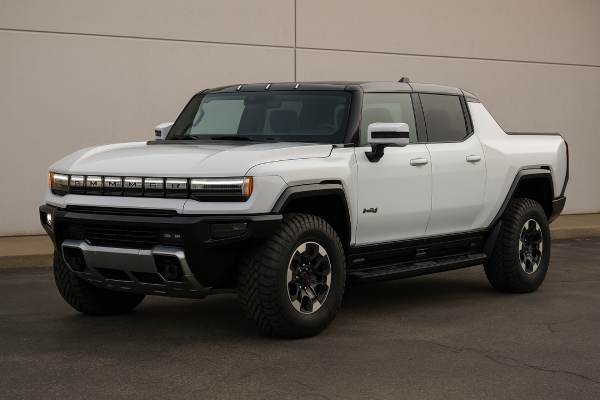
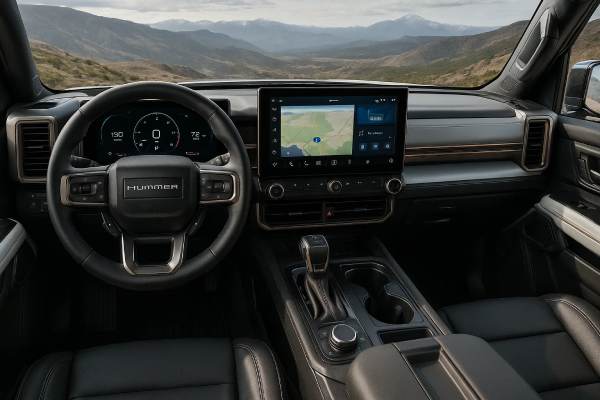
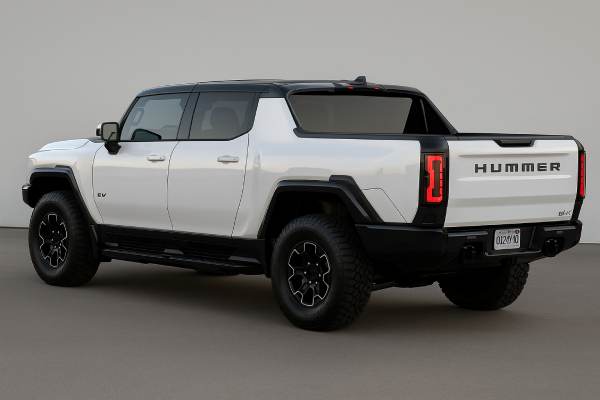
The dual-motor GMC Hummer EV Pickup takes the wild character of the 1000-hp Edition 1 and reshapes it into a slightly more efficient, more attainable truck. Using GM’s Ultium platform with one motor on each axle and a 20-module battery pack of roughly 170 kWh, the dual-motor models deliver up to 570 hp, strong towing capability, and standard e4WD with four-wheel steering and CrabWalk.
Compared with the tri-motor 3X and Edition 1, the dual-motor Hummer EV trades maximum headline acceleration for better range per kWh, a lower entry price, and a little less mass up front. It is still a huge electric pickup with curb weights well over 8,000 lb and tow ratings up to the 5-ton neighborhood in some configurations. That means heavy-duty brakes, serious tires, and maintenance expectations more like a ¾-ton truck than a midsize SUV.
This guide focuses on the dual-motor e4WD pickup from 2023 onward, with a practical look at specs, charging, trims, reliability, maintenance, and how it compares with rival electric trucks.
Key Takeaways
- Dual-motor Ultium e4WD delivers up to 570 hp, four-wheel steering, and CrabWalk while improving efficiency versus the 1000-hp tri-motor models.
- A 20-module pack of about 170 kWh supports roughly 300+ miles of rated range in suitable configurations, depending on wheels, tires, and options.
- Battery-pack sealing and high-voltage connection recalls affect some Hummer EVs, so VIN-based recall checks are critical when buying used.
- Plan on tire rotation, brake and suspension checks about every 7,500 miles or 12 months, especially if you tow or use off-road modes frequently.
Navigate this guide
- GMC Hummer EV 2X Dual-Motor Profile
- Dual-Motor Hummer EV Pickup Specs
- Hummer EV Dual-Motor Trims and Safety
- Reliability and Service Actions Hummer EV
- Maintenance and Buying Guide Hummer EV
- Driving Impressions Hummer EV Dual-Motor
- Hummer EV Dual-Motor Versus Rivals
GMC Hummer EV 2X Dual-Motor Profile
The dual-motor Hummer EV Pickup, commonly associated with the 2X trim, targets buyers who want the Hummer EV experience without the cost and complexity of the tri-motor flagship. It uses two Ultium Drive permanent-magnet motors—one driving the front axle, one the rear—for e4WD, with system output up to 570 hp and a very high at-the-wheels torque figure once gearing is included.
Where the tri-motor trucks pair with a 24-module pack of around 246 kWh gross, the dual-motor pickup uses a 20-module Ultium pack of roughly 170 kWh gross. That smaller pack reduces cost and mass while still delivering EPA-style range figures around the low-300-mile mark in some 2X configurations on road-oriented tires. It remains a substantial battery by any passenger-vehicle standard.
The truck rides on GM’s BT1 skateboard platform with a crew-cab body, five-foot bed, MultiPro tailgate, and removable Infinity Roof panels. Length, width, and height—about 216.8 in, 86.7 in and 79.1 in—match the tri-motor versions, as do the ~135-inch wheelbase and enormous footprint. Curb weight generally falls just over 8,400–9,000 lb depending on options, with gross vehicle weight ratings around or above 10,000 lb.
Functionally, the dual-motor Hummer EV retains signature features: four-wheel steering, CrabWalk diagonal driving, adaptive air suspension with a high-lift mode, and extensive off-road camera views, especially when specified with an Extreme Off-Road package. Super Cruise hands-free highway driving is available on many builds, alongside a large central touchscreen and a premium-leaning cabin.
In short, the dual-motor pickup is the “everyday” Hummer EV: still outrageous by normal truck standards, but somewhat more livable. Power is easily sufficient for quick highway merges and overtakes, range is competitive with or better than many smaller-battery rivals, and tow ratings up to around 12,000 lb can be achieved in specific 20-module, road-oriented configurations.
Dual-Motor Hummer EV Pickup Specs
This section focuses on the dual-motor Ultium-drive pickup with the 20-module pack (typically 2X dual-motor trucks from 2023 onward).
Powertrain, Battery, and Efficiency
| Parameter | Value | Notes |
|---|---|---|
| Motor layout | 2 × permanent-magnet synchronous (1 front, 1 rear) | Ultium Drive e4WD |
| Nominal architecture | ~400 V pack, reconfigurable for 800 V DC charging | Split-pack Ultium architecture |
| Battery chemistry | Ultium lithium-ion NMC large-format cells | Shared with other Ultium vehicles |
| Traction battery | ≈170 kWh gross (20 modules); usable likely in mid-150 kWh range | 24-module trucks use a larger pack |
| Max system power | Up to 570 hp (~425 kW) | Dual-motor e4WD trims |
| Max torque | GM quotes around 7,400 lb-ft at the wheels | Marketing figure at the wheels, not crank |
| Thermal management | Liquid-cooled pack, motors, and power electronics; integrated HVAC that can support battery conditioning | Important for fast charging and cold weather |
| Efficiency test | Certified under standard EPA light-duty procedures where applicable | Exact label values vary by wheel and tire |
| EPA-style efficiency | Roughly equivalent to high-30s kWh/100 km combined | Reflects heavy mass and aero drag |
| Rated range | Around 300–310 miles for some 2X dual-motor pickups | Depends strongly on wheels, tires and options |
| Real-world highway (75 mph) | About 40–45 kWh/100 km and 260–290 miles per charge in good conditions | Highway speed, mild weather, road-oriented tires |
| Aerodynamics | Boxy design with high frontal area | Much less aero-efficient than EV crossovers or sedans |
Driveline and Charging
| Parameter | Value | Notes |
|---|---|---|
| Drive units | Single-speed reduction gear front and rear | No multi-speed gearbox |
| Drive type | e4WD (electric all-wheel drive) | Torque distribution controlled electronically |
| Charging connector | CCS1 for AC and DC (North America) | Other regions may use CCS2 |
| Onboard AC charger | Up to 19.2 kW with 240 V / 80 A | Lower rates on smaller home circuits |
| DC fast-charge peak | Up to roughly 300–350 kW on suitable 800 V DC hardware | Highest rates in low-to-mid SOC window |
| Typical DC curve | High power from about 10–55% SOC, tapering above ~70% | Plan 10–80% fast-charge stops for efficiency |
| DC 10–80% time | Roughly 30–40 minutes in favorable conditions | Depends on charger and temperature |
| AC 0–100% time | Approximately 10–12 hours at 19.2 kW; 15–20+ hours at 11 kW or 7 kW | From low SOC to full charge |
| Battery preconditioning | Navigation-triggered preconditioning for DC fast charging | Warms or cools pack ahead of arrival |
| Bidirectional capability | Limited vehicle-to-load style export in some configurations; full home-backup functions are not yet core to the Hummer marketing | Check region-specific documentation |
Performance and Capability
| Parameter | Value | Notes |
|---|---|---|
| 0–60 mph | Around mid-4 seconds with launch mode on dual-motor trucks | Still very quick for a full-size pickup |
| Top speed | About 106 mph (170 km/h) | Software-limited |
| Braking distance | Long compared with lighter EVs due to mass, even with large brakes | Plan for generous following distances |
| Towing capacity | Approximately 7,500–12,000 lb (3,400–5,400 kg) | Higher numbers tied to specific 20-module, tow-package trucks |
| Payload | Roughly 1,300–1,500 lb (590–680 kg) | Limited by heavy curb weight and GVWR |
| Roof load | Restricted; removable roof panels constrain rack systems | Always check the owner’s manual |
Under heavy towing near the upper rating, expect usable range to drop by roughly 40–60%, especially at highway speeds.
Chassis and Dimensions
| Parameter | Value | Notes |
|---|---|---|
| Platform | GM BT1 skateboard | Shared with Hummer EV SUV and Ultium pickups |
| Suspension | Independent front and rear with adaptive air suspension and available high-lift mode | Multiple height settings |
| Steering | Electric power steering with standard rear-wheel steering and CrabWalk | Tight turning circle for size |
| Brakes | Four-wheel discs with ABS and regenerative blending | Sized for >8,000 lb curb weight |
| Wheels/tires | 22″ all-terrain or 18″ mud-terrain in Extreme Off-Road package | Tire choice strongly affects range and noise |
| Ground clearance | Around 10 in in standard mode; more in raised modes | Exact figure varies with tire and setting |
| Length / width / height | ≈216.8 in / 86.7 in / 79.1 in | Massive footprint |
| Wheelbase | ≈135–136 in | Crew-cab short-bed proportions |
| Curb weight | Roughly 8,400–9,100 lb | Depends on pack, wheels and options |
| GVWR | About 10,000–10,550 lb | Borderline heavy-duty classification |
| Bed length | About 60 in | Five-foot box with MultiPro tailgate |
Safety and Driver Assistance
| Parameter | Value | Notes |
|---|---|---|
| Crash ratings | Limited public data; many configurations fall outside typical NHTSA/IIHS test classes due to weight | Do not assume standardized ratings |
| Airbags | Front and side-impact airbags plus seat-mounted units; no traditional full-length side curtains due to removable roof design | Seat belts and roof-panel fit are critical |
| ADAS suite | AEB with pedestrian detection, lane-keep assist, blind-spot monitoring, rear cross-traffic alert, surround-view cameras; Super Cruise on selected trims | Content varies by year and option packages |
Electrical and Service Fluids (Highlights)
- Traction battery: around 170 kWh gross, ~400 V architecture with 800 V fast-charging behavior.
- 12 V system: conventional 12 V battery supporting body and safety electronics; weak 12 V voltage can cause confusing warning messages.
- Coolant loops: separate or semi-separate loops for battery and power electronics; only GM-approved coolant should be used.
- Brake fluid: DOT-type fluid with multi-year change interval (exact timing in owner’s manual).
- Drive-unit fluids and torque specs: detailed capacities and torque values appear only in GM Service Information and should be followed precisely.
Hummer EV Dual-Motor Trims and Safety
For dual-motor pickups, the primary trim to focus on is the Hummer EV 2X, although availability and naming can vary slightly by model year and market.
2X dual-motor pickup
- Two-motor e4WD (one front, one rear), with system output up to about 570 hp.
- Standard 20-module Ultium battery pack, giving an estimated 300-plus-mile range in its most efficient configurations.
- Four-wheel steering and CrabWalk are typically standard, along with adaptive air suspension and the option of Super Cruise.
- Commonly equipped with 22″ wheels and all-terrain tires; an Extreme Off-Road package adds 18″ wheels, 35-inch mud-terrain tires, underbody armor, and extra trail-focused hardware.
On-road-oriented 2X
- Places emphasis on range and towing.
- 22″ wheels and more road-biased tires improve range and braking performance versus the off-road setup.
- Highest tow ratings are usually available on this configuration, assuming correct tow package and cooling equipment.
2X with Extreme Off-Road package
- Prioritizes rock-crawling and trail work over range and pure tow capacity.
- Mud-terrain tires, skid plates, and different gearing reduce range and may lower tow ratings but significantly increase off-road confidence.
- Extra underbody cameras and off-road data displays make it easier to place the truck in technical terrain.
How to identify dual-motor trucks
- Look for “2X” badging on the exterior and in digital cluster menus.
- Use the VIN and build sheet to confirm two-motor e4WD as well as 20-module pack configuration.
- Check the window sticker or online spec sheet for power, tow rating, wheel size, and range numbers that align with dual-motor 2X equipment.
Safety structure and ratings
Because many Hummer EV pickups sit near or above 10,000 lb GVWR, they do not always fall neatly into typical light-duty crash-test programs. Where ratings exist, they can be partial or specific to certain configurations. Regardless, the Hummer EV’s structure relies heavily on the strong, low-mounted Ultium battery pack, with substantial side rails and cross-members.
The removable Infinity Roof and open-air design limit the use of conventional side-curtain airbags. Side-impact and seat-mounted airbags still provide important protection, but rollover containment is more dependent on seat belts, seat geometry, and whether roof panels are properly latched.
ADAS and calibration notes
Most dual-motor Hummer EV 2X trucks can be equipped with:
- Forward collision alert with automatic emergency braking.
- Lane-keep assist with lane-departure warning.
- Blind-spot monitoring and rear cross-traffic alert.
- 360-degree camera systems with off-road views.
- Super Cruise hands-free driving on mapped highways on certain option packages.
After any windshield replacement, front- or rear-bumper work, major suspension repair, or wheel/tire size change, sensor and camera calibration should be rechecked. Because Super Cruise depends on precise lane-tracking and positioning, using calibration procedures from GM Service Information is especially important.
Reliability and Service Actions Hummer EV
The dual-motor Hummer EV shares its core Ultium hardware with the tri-motor trucks, which means many of the same campaigns and technical bulletins apply. While long-term data is still emerging, several key areas deserve attention.
High-voltage battery sealing (common / high severity)
A major battery recall addresses packs whose enclosures were not sealed correctly, allowing potential water ingress. If moisture enters the pack, the vehicle may display high-voltage system warnings, fail to start, or lose propulsion while driving.
- Symptoms: “Service High Voltage System” or similar warnings, refusal to start, sudden entry into reduced-power or limp modes.
- Likely cause: Incomplete or defective urethane sealing around pack joints or flanges.
- Remedy: Full high-voltage battery-pack replacement with updated components and improved sealing.
Although this issue first appeared on early tri-motor builds, some 2022–2023 trucks overlapping with dual-motor production are also included. Always run a VIN check through an official recall database or dealer.
Internal HV connections and welds (rare / high severity)
Another recall covers a smaller number of packs with potential internal connection or weld issues. In affected cases, high-resistance joints inside the pack can trigger HV faults or power loss.
- Symptoms: High-voltage warnings, “Charging Disabled,” or loss of propulsion that does not resolve with a key cycle.
- Remedy: Inspection using specialized procedures, followed by pack replacement if the suspect condition is found.
Because the risk involves loss of propulsion, any truck flagged by this recall should not be driven until the remedy is complete.
Charge-port and connector moisture (occasional / medium severity)
Customer-satisfaction programs and technical bulletins address moisture or corrosion in high-voltage connectors around the charge port and pack inlets.
- Symptoms: Intermittent DC fast-charge failures, repeated charge-fault messages, or HV isolation faults.
- Remedy: Inspection and replacement of affected connectors, sealing improvements, and sometimes software updates to improve detection and fault-handling logic.
Software, BMS and drive-unit updates (common / low–medium severity)
Being a first-wave Ultium product, the Hummer EV has received a number of software refinements. These may:
- Improve battery-management diagnostics and balancing logic.
- Adjust DC fast-charging curves, especially at higher SOCs or in cold weather.
- Tweak traction and torque-vectoring behavior for smoother responses.
- Refine ADAS performance and Super Cruise behavior.
Some of these updates arrive over the air; others require a dealer visit. A used truck with all outstanding updates applied is generally preferable.
Driveline, chassis and corrosion
Even with two motors instead of three, the dual-motor Hummer EV is extremely heavy. That has implications:
- Wheel bearings and suspension joints work hard, especially with off-road tires. Listen for clunks or looseness and watch for inner-edge tire wear.
- Steering components see large loads from big tires and off-road use; test on rough roads and at highway speed for wander.
- Brakes handle intense thermal loads when towing or descending long grades, even with regenerative braking doing some of the work. Long braking distances are a fact of physics.
- Corrosion can start around fasteners that secure skid plates, underbody panels, and the battery enclosure, especially in regions that use road salt. Regular underbody washes and inspections help.
HV isolation and water ingress diagnostics
If the truck shows repeated high-voltage isolation warnings or unexplained charge faults, the standard diagnostic path is:
- Pulling diagnostic trouble codes and checking isolation readings.
- Inspecting external HV connectors, seals, and pack surfaces.
- Using pack inspection procedures through dedicated service ports.
- If necessary, quarantining and replacing the pack according to recall or service guidelines.
These are not DIY operations; they require an EV-certified facility with the proper protective gear, tools, and training.
Pre-purchase reliability checks (dual-motor focus)
For a used dual-motor Hummer EV, request:
- A full recall and field-action report by VIN, including proof of completion.
- Service records showing any battery-pack or HV connector replacements.
- A battery state-of-health or capacity report from a GMC dealer.
- Evidence of regular tire rotations, brake inspections, and suspension work.
- Notes on charging habits (home AC vs frequent DC fast charging) and how often the truck has towed heavy loads or off-roaded.
Maintenance and Buying Guide Hummer EV
The dual-motor Hummer EV avoids engine-oil changes, but its size and performance mean it still demands structured maintenance. Think of it as a high-end heavy-duty truck with EV-specific systems layered on top.
Practical maintenance schedule (typical use)
Always confirm details in the official owner’s and warranty manuals for your specific VIN.
Every 7,500 miles or 12 months
- Rotate tires; check tread depth and look for inner-edge wear or cupping.
- Inspect brake pads, rotors and calipers; verify parking-brake operation.
- Inspect suspension arms, bushings, ball joints and steering links for play.
- Check underbody armor and skid plates for damage or packed-in debris.
Every 15,000 miles or about 12–24 months
- Replace cabin air filter.
- Inspect cooling systems for the battery, drive units and power electronics: coolant level, hose condition, and radiator cleanliness.
- Perform a detailed alignment and steering check if the truck sees off-road use or frequent pothole impacts.
Every 30,000 miles or 2–3 years
- Replace brake fluid (or follow the time-based interval in the manual if more conservative).
- Inspect drive-unit fluids; replace if GM schedules it or if severe-use conditions warrant.
- Inspect charge port, cables and visible high-voltage connectors for signs of corrosion or overheating.
Around 5 years or 100,000–150,000 miles (if specified)
- Replace coolant in battery and power-electronics loops according to GM’s EV coolant guidelines, especially in harsh climates.
- Re-check drive-unit fluid condition and consider replacement if towing or off-road use has been heavy.
Annually
- Test the 12 V battery, particularly in hot or very cold regions.
- Confirm all ADAS features (including Super Cruise where equipped) still function as intended and that no warning messages persist.
Critical torque values (for wheel nuts, suspension fasteners, and high-voltage service points) are not generic; they must come from GM Service Information. Over- or under-torquing these fasteners can cause serious safety issues.
Buyer’s guide: what to check
1. Traction battery health
- Ask for a state-of-health or capacity report from an official GMC tool.
- Compare expected range for that trim and tire package with what the current owner sees in regular driving. Large gaps may indicate degradation or underlying issues.
2. Charging hardware
- Test AC charging on a home-style Level 2 charger to confirm stable current and proper charge completion.
- Test DC fast charging if possible, making sure the truck reaches the expected peak power and doesn’t immediately taper at low SOC.
- Inspect the charge port for damage, discoloration or corrosion on the contacts and seals.
3. Cooling and thermal management
- Look for coolant residue around front radiators, pumps, and visible hoses.
- In cold weather, verify that the truck still accepts fast charging after a highway drive and that preconditioning works via the navigation system.
4. Chassis and body
- Inspect the underbody and skid plates for dents, deep gouges, or rust, especially on trucks with off-road packages.
- Check for play in suspension and steering components by driving over uneven surfaces and listening for knocks.
- Examine the bed, hitch and tailgate for signs of heavy towing or impact damage.
5. Electronics and OTA updates
- Ensure that instrument-cluster and infotainment software feel responsive and that basic functions (Bluetooth, navigation, camera views) work cleanly.
- Check that Super Cruise (if fitted) engages reliably on mapped highways without frequent dropouts.
- Ask the dealer to confirm that all software updates and recalls have been completed.
Recommended configurations and long-term outlook
For most owners who mix commuting, road trips, and occasional towing or off-roading, a 2X dual-motor truck with the 20-module pack, 22″ wheels, and tow package is a solid balance of range and utility. The Extreme Off-Road package makes sense if you genuinely use the truck on trails but does add noise, wear, and energy consumption.
With proper recall completion, sane charging habits, and regular heavy-duty maintenance, the long-term outlook is one of gradual battery-capacity loss and normal wear items rather than catastrophic failures. That said, the cost of big tires, brakes, and potential suspension work should be part of any long-term budget.
Driving Impressions Hummer EV Dual-Motor
The dual-motor Hummer EV still feels like a showpiece, but it brings a slightly calmer personality than the 1000-hp models.
Ride, handling and NVH
Thanks to the low-mounted battery, the truck’s center of gravity is reasonable for its height. Adaptive air suspension smooths out many road defects, though the combination of large wheels and heavy components means you still feel sharp impacts. On 22″ all-terrain tires, the ride is relatively composed and highway stability is strong.
Rear-wheel steering is transformative. At low speeds, the truck pivots in and out of parking spaces or tight trailheads like something much smaller. CrabWalk mode, which turns front and rear wheels in phase, is more than a gimmick when lining up to obstacles or maneuvering a trailer into tight spots. At highway speeds, rear steer works subtly to enhance stability rather than create twitchiness.
Cabin noise is dominated by wind over the windshield and mirrors and, on aggressive tires, some road roar. The dual-motor powertrain itself is quiet, with just a faint electric whine under hard acceleration.
Powertrain character and regenerative braking
With up to 570 hp and strong torque, the dual-motor truck launches briskly without feeling as violent as the tri-motor models. Torque comes in smoothly and makes passing at 50–80 mph easy even with passengers and cargo. Launch modes can still give mid-4-second 0–60 mph times in favorable conditions.
Regenerative braking offers multiple levels, from mild coast-like behavior to strong deceleration suitable for near one-pedal driving around town. The transition from regeneration to friction braking is generally well managed. Emergency-stop distances are long mainly because of mass, not a lack of brake hardware, so it pays to leave extra following distance and to keep rotors clean with occasional firm stops.
Real-world efficiency and range
Expectations matter. This is not a hyper-efficient EV:
- City and suburban driving: With gentle inputs, energy use in the mid-30s kWh/100 km is realistic, making official range figures achievable in mild weather.
- Highway driving (100–120 km/h / 60–75 mph): Energy use tends to climb into the low-40s kWh/100 km, yielding practical ranges around 260–290 miles for a full charge on road-oriented tires.
- Cold weather: Short trips and heavy heater use can cut usable range by 25–35%, especially if the truck frequently starts from a cold soak.
Frequent DC fast charging at high SOC accelerates battery wear on any EV, so planning trips around 10–80% fast-charge windows and using AC charging for daily use is a more battery-friendly strategy.
Charging in everyday life
At home, a 19.2 kW Level 2 setup can add roughly 45–50 miles of mixed driving range per hour in good conditions. That means an overnight session comfortably covers deep discharges. On more typical 11 kW or 7 kW home chargers, charging from low SOC to full will take the better part of a day, though in practice most owners rarely need 0–100% in one shot.
On the road, when the pack is preconditioned and SOC is in the 10–50% window, high-power DC fast chargers can restore a large chunk of range in well under an hour. Battery preconditioning through navigation is especially important in winter or before key fast-charge stops on long routes.
Traction, control and towing behavior
Off-road, the dual-motor e4WD system, rear steering, air suspension and optional Extreme Off-Road package combine to deliver impressive capability. The truck can pick its way through rocky sections with good low-speed control, while CrabWalk helps sidestep obstacles and tight trees.
When towing, the Hummer EV feels stable and confident, though the already high mass means you notice the additional load mostly in braking distances and energy consumption. A moderate trailer at highway speeds can cut range by roughly half, so serious tow users must plan routes around DC fast-charging opportunities and accept slower progress.
Hummer EV Dual-Motor Versus Rivals
Buyers considering the dual-motor Hummer EV typically also look at the Ford F-150 Lightning, Rivian R1T, Tesla Cybertruck, and GM’s own Silverado EV and Sierra EV.
Versus Ford F-150 Lightning
The Lightning is essentially an electric version of a mainstream work truck. Its strengths include:
- Familiar F-150 packaging with excellent bed and cab practicality.
- Strong home-backup power integration on some trims.
- Generally better efficiency per kWh than the Hummer, with similar headline tow ratings on the right model.
The Hummer EV, in contrast, offers:
- Much more dramatic styling and a more “event” feel.
- Four-wheel steering, CrabWalk and a stronger bias toward off-road adventure.
- An open-roof experience with the Infinity Roof panels.
Versus Rivian R1T
The Rivian R1T is smaller and lighter, with dual- and quad-motor versions offering strong on-road performance and impressive off-road capability. It typically delivers better efficiency and similar or better range from a smaller battery pack.
Rivian advantages:
- Tighter dimensions and more urban-friendly footprint.
- Clever storage, including the gear tunnel and integrated accessories.
- Strong software ecosystem and frequent OTA updates.
Hummer EV advantages:
- Larger pack available, which helps maintain range even with big tires or towing.
- Iconic styling and a more imposing stance.
- Roof-off driving and a more traditional “big truck” feeling.
Versus Tesla Cybertruck
The Cybertruck emphasizes unconventional design, stainless-steel construction and aggressive aero. It aims for strong range and performance, especially when combined with the Supercharger network.
Cybertruck strengths include:
- High efficiency for a large truck and strong DC fast-charging infrastructure.
- Integrated Tesla software and ecosystem.
The Hummer EV counters with:
- A more conventional interior layout and bed/tailgate system.
- Richer cabin materials and a more traditional truck ambiance.
- Unique off-road features like CrabWalk and adaptive air suspension tuned for trail work.
Versus Silverado EV and Sierra EV
GM’s Silverado EV and Sierra EV Denali share Ultium underpinnings but are designed for broader truck use:
- Longer wheelbase options and midgates for extended cargo length.
- Some trims offering significantly longer range than the Hummer EV.
- Bed and cabin layouts better optimized for work and family duties.
Against them, the dual-motor Hummer EV stands out as the halo lifestyle product: less rational as a work tool, but more memorable to own and drive.
Who is the dual-motor Hummer EV for?
If your priorities are efficiency, low operating cost and maximum bed practicality, a Rivian, Lightning, Cybertruck or Silverado EV is likely a better match. But if you want an electric truck that looks and feels like nothing else on the road, with serious off-road hardware and enough power and range for big-trip adventures, the dual-motor Hummer EV delivers that experience without quite the excess of the 1000-hp models. The key is to treat it as the heavy, high-performance machine that it is and maintain it accordingly.
References
<a href="https://www.gmc.com/electric/hummer-ev/pickup-truck">2026 HUMMER EV Truck | Electric Pickup Truck | GMC</a> 2024 (Model overview)<a href="https://www.gmc.com/content/dam/gmc/na/us/english/index/about/download-brochures/2024-models/GMTH23CT100-2024-HUMMER-EV-PICKUP-FO-031924.pdf">HUMMER EV PICKUP 2024 FEATURES, SPECS AND OPTIONS</a> 2024 (Features, specs and options brochure)<a href="https://contentdelivery.ext.gm.com/content/dam/cope/en_us/public/pdf_assets/active/warranty_manuals_browse/22_GMC_Hummer_EV_WM_en_US_U_15835627B_2024DEC17_2P.pdf">HUMMER EV LIMITED WARRANTY AND OWNER ASSISTANCE INFORMATION 2022</a> 2024 (Warranty Manual)<a href="https://static.nhtsa.gov/odi/rcl/2022/RCRIT-22V771-9162.pdf">Product Safety Recall N222380031 Improper Urethane Sealing - High Voltage Battery Pack</a> 2023 (Safety Recall)<a href="https://static.nhtsa.gov/odi/rcl/2023/RCRIT-23V367-3362.pdf">Safety Recall N232404441 HV Battery Loss of Propulsion</a> 2023 (Safety Recall)
Disclaimer
This article is for informational purposes only and does not replace professional diagnosis, repair, or official service procedures. Specifications, torque values, maintenance intervals, and technical instructions can vary by VIN, market, model year, and installed equipment. Always confirm critical information against your vehicle’s official owner’s manual, warranty booklet, and GM Service Information, and have high-voltage work or safety-system calibrations performed only by qualified technicians at an EV-certified facility.
If this guide helped you understand the dual-motor GMC Hummer EV Pickup, you are welcome to share it on platforms such as Facebook or X/Twitter to support our work and help other owners and shoppers.