
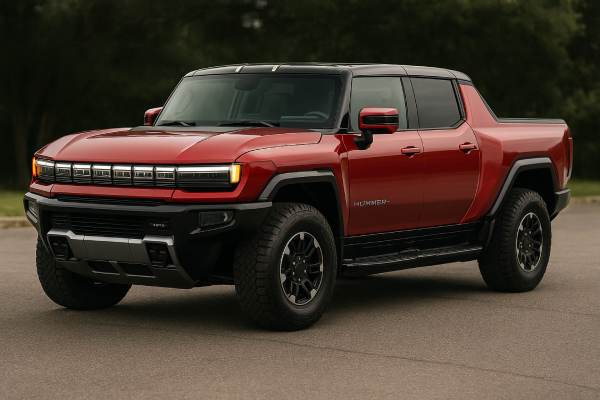
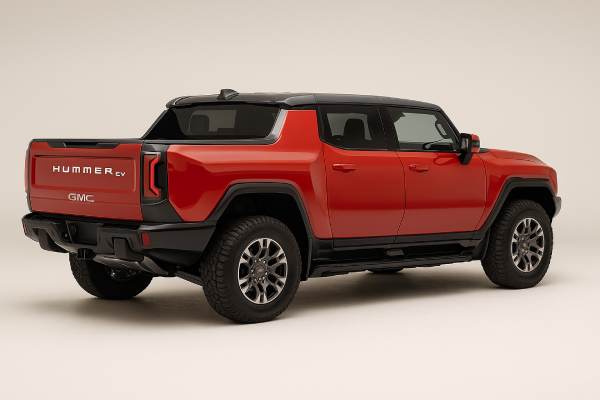
The 625 hp GMC HUMMER EV Pickup 2X with the Extreme Off-Road Package sits in a unique spot: it is both a serious off-road tool and a high-tech electric flagship. Based on GM’s BT1 platform and Ultium drive system, this dual-motor configuration combines a 20-module battery pack, sophisticated air suspension, and four-wheel steering with headline features like CrabWalk and Watts to Freedom launch mode.
Compared with the standard 570 hp 2X tune, the 625 hp configuration trades a little range for extra performance and more aggressive hardware, including 18-inch wheels with 35-inch mud-terrain tyres and enhanced underbody protection. Ownership, however, still feels recognisably GMC: familiar controls, strong towing capability, and a dealer network used to heavy trucks, overlaid with EV-specific features such as 19.2 kW AC charging, 300 kW DC fast charging, and over-the-air software updates. This guide walks through the specs, running costs, reliability picture, and how this 625 hp HUMMER EV compares if you are cross-shopping other electric pickups.
Fast Facts
- Dual-motor Ultium e4WD with 20-module pack, 625 hp and 7,400 lb-ft (GM-estimated) in 2X Extreme Off-Road configuration.
- EPA range around 279 miles for the 625 hp off-road setup, with strong DC fast-charging capability up to about 300 kW under ideal conditions.
- Extreme Off-Road Package adds 18″ wheels with 35″ off-road tyres, full underbody skid plates, front and rear lockers by brake control, and upgraded cameras.
- High-voltage battery has been subject to sealing and internal-fault recalls; buyers should confirm recall completion and updated battery modules.
- Typical service touchpoint: tyre rotation, brake inspection, and general EV health check every 12,000 km or 12 months (7,500 miles or 12 months), sooner with heavy off-road use or frequent towing.
What’s inside
- GMC Hummer EV 625 hp Package
- Hummer EV 625 hp Technical Specs
- 625 hp Hummer EV Models and Safety
- Reliability and Field Fixes for Hummer EV
- Ownership Maintenance and Buying Advice
- On-Road and Off-Road Driving Experience
- How the 625 hp Hummer EV Stacks Up
GMC Hummer EV 625 hp Package
The 625 hp version of the GMC HUMMER EV Pickup is built around the 2X dual-motor model, combined with the Extreme Off-Road Package. Under the skin, it uses GM’s BT1 truck platform and Ultium battery system, with a 20-module lithium-ion pack arranged in the floor between the axles. In this tune, the pack is roughly 170 kWh gross, feeding two permanent-magnet Ultium drive units (one at each axle) for full-time electronic four-wheel drive.
Where the standard 2X is rated at up to 570 hp with 22-inch all-terrain tyres, the off-road-focused configuration uses more aggressive 35-inch mud-terrain tyres on 18-inch wheels, revised calibration, and off-road hardware. In this setup, GM quotes about 625 hp and the same 7,400 lb-ft “shaft torque” figure used across the HUMMER EV range. The trade-off is slightly reduced highway efficiency and an EPA range in the high-200-mile bracket instead of the low-300s.
The hardware package is extensive. Air Ride Adaptive Suspension provides multiple ride heights plus Extract Mode, which can temporarily lift the truck roughly 6 inches to clear obstacles. Four-wheel steer with CrabWalk lets the truck move diagonally at low speeds, easing tight manoeuvres on the trail or in tight car parks. Beneath the body, the Extreme Off-Road Package adds full underbody skid plates, rocker protection with integrated steps, and additional underbody cameras for obstacle spotting.
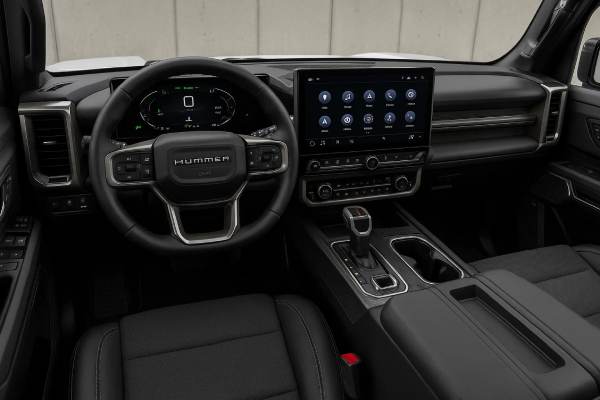
Inside, the 625 hp HUMMER EV remains a luxury truck. All 2X pickups get the Infinity Roof with removable Sky Panels, a 12.3-inch digital instrument cluster, a large central infotainment display, Bose 14-speaker audio, and extensive LED lighting and camera coverage. Super Cruise hands-free driver assistance is available, and the 2X 625 hp model retains the 19.2 kW onboard AC charger and up to roughly 300 kW DC fast-charging capability through an 800-volt charging architecture that can reconfigure the pack for rapid charging.
From an ownership point of view, this specific variant appeals to buyers who want maximum off-road hardware and presence without stepping up to the tri-motor 3X or Edition 1 models. It is still a huge, heavy truck, but the dual-motor layout keeps complexity a notch lower and may prove easier to live with in the long term, especially if you value range consistency, simpler driveline hardware, and slightly lower purchase cost than the three-motor flagship.
Hummer EV 625 hp Technical Specs
Powertrain, Battery, and Efficiency
| Item | Specification (625 hp 2X Extreme Off-Road) |
|---|---|
| Code | Ultium BT1, HUMMER EV Pickup 2X |
| Motor | Dual Ultium permanent-magnet motors, 1 front / 1 rear, e4WD |
| System voltage | Nominal 400 V drive, reconfigurable to ~800 V for DC fast charging |
| Battery chemistry | Ultium lithium-ion (nickel-rich NMC-type) modules |
| Traction battery | 20-module pack, approx. 170 kWh gross; usable capacity slightly lower (not officially quoted) |
| Max power | 625 hp (GM-estimated, combined) |
| Max torque | 7,400 lb-ft “shaft torque” (marketing figure; actual wheel torque lower but substantial) |
| Thermal management | Liquid-cooled battery and drive units, integrated HV coolant loop; heat pump for cabin and battery pre-conditioning on most builds |
| Test standard | EPA combined for U.S. trucks |
| Rated efficiency | Roughly mid-40s kWh/100 km equivalent (varies with wheel/tire and conditions) |
| Rated range | About 279 miles EPA with 20-module pack and Extreme Off-Road tyres |
| Real-world highway @ 120 km/h | Often 30–40% higher consumption than city; expect roughly 210–230 miles usable on a full charge in calm conditions |
| Aerodynamics | Approx. Cd ~0.45 with large frontal area (~5.0 m²); strongly affects high-speed efficiency |
Driveline and Charging
| Item | Specification |
|---|---|
| Transmission / drive unit | Single-speed reduction gear integrated into each e-axle |
| Overall reduction | Not publicly detailed; geared for strong low-speed torque and ~170 km/h (105 mph) top speed |
| Final drive | Integrated into e-axle assemblies |
| Drive type | e4WD all-wheel drive (front and rear e-axles) |
| Differentials / torque distribution | Software-controlled; brake-based torque vectoring and motor control simulate locking behaviour |
| AC connector | SAE J1772 / Type 1 inlet via CCS1 combination port, up to 19.2 kW with suitable 240 V 80 A supply |
| DC connector | CCS1, up to about 300 kW with compatible 800 V charger (higher peaks on some tri-motor/24-module packs) |
| Charging port location | Left rear quarter, behind flap integrated in rear fender |
| Onboard AC charger | 19.2 kW (80 A) |
| DC fast-charge peak | Up to ~300 kW in ideal conditions, tapering as state of charge rises |
| Typical DC curve | High power from roughly 10–50% SOC, then gradual taper; winter conditions reduce both power and window significantly |
| Replenishment time | Roughly 10–80% in 40–50 minutes on a strong DC charger; 0–100% in about 9–10 hours on a 19.2 kW AC supply |
| Battery preconditioning | Triggered when a DC fast charger is set as destination in navigation; pre-heats or cools pack as needed |
| Bidirectional capability | 120 V / 240 V export via onboard outlets and bed power points; full V2H/V2G not widely marketed but limited vehicle-to-load is supported |
Performance and Capability
| Item | Specification (approximate for 625 hp Off-Road) |
|---|---|
| 0–60 mph | Around mid-4-second range with Watts to Freedom and favourable conditions |
| 0–100 km/h | Approximately 4.5–4.7 seconds |
| Top speed | About 170 km/h (105 mph) |
| Braking distance | Expect 100–0 km/h in roughly 40–45 m depending on tyres and surface; heavy mass is the limiting factor |
| Towing capacity | Up to around 7,500–8,000 lb in 2X configuration (check exact rating for your VIN and equipment) |
| Payload | Typically 650–800 kg (1,400–1,750 lb) depending on options; heavier options reduce payload |
| Roof load | Generally modest rated roof load due to removable roof panels; use manufacturer rack kits and limits |
Chassis and Dimensions
Most dimensions are shared across 2X and 3X pickups.
| Item | Specification |
|---|---|
| Suspension (front) | Independent front suspension with air springs and adaptive dampers |
| Suspension (rear) | Independent rear suspension with air springs and adaptive dampers |
| Steering | Electric power steering with four-wheel steer; tight turning circle for size |
| Brakes | Large ventilated discs front and rear with electronic parking brake |
| Wheels / Tyres | 18″ alloy wheels with LT305/70R18 (35″) mud-terrain tyres in Extreme Off-Road Package |
| Ground clearance | Over 300 mm (12+ in) in normal off-road height; significantly more in Extract Mode |
| Approach / departure / breakover | Off-road-optimised; approach and departure angles are competitive with full-size off-road pickups |
| Length / Width / Height | About 216.8 in (5,507 mm) long, ~86.7 in (2,201 mm) wide without mirrors, ~79 in (2,009 mm) tall |
| Wheelbase | 135.6 in (3,445 mm) |
| Turning circle | Greatly reduced versus a conventional truck thanks to four-wheel steer, aiding parking and tight off-road turns |
| Curb weight | Typically above 8,600 lb for 2X dual-motor; exact figure varies with options |
| GVWR | Around 9,900–10,000 lb (Heavy-Duty class) |
| Cargo volume | Bed plus ~36–37 ft³ rear cargo and about 11 ft³ front “eTrunk” storage, depending on configuration |
Safety and Driver Assistance
| Item | Specification |
|---|---|
| Crash ratings | No full Euro NCAP or IIHS crash program at time of writing; basic U.S. regulatory testing applies |
| Headlight performance | LED headlights with signature lighting; detailed lab ratings vary by test body |
| Airbags | Multi-stage front airbags, side-impact airbags, and curtain airbags front and rear |
| ABS / stability | Four-wheel ABS, stability control, traction control, hill-descent and hill-start assist |
| ADAS suite | Automatic emergency braking, forward collision alert, lane-keep assist and lane-departure warning, blind-spot monitoring, rear cross-traffic alert, rear camera mirror, surround-view cameras, traffic sign features depending on market |
| Super Cruise | Available hands-free highway assist with lane-centering and automatic lane-change on compatible roads and active subscription |
Electrical
| Item | Specification |
|---|---|
| Traction battery | 20-module Ultium pack, c. 170 kWh gross, nominal 400 V |
| High-voltage layout | Pack split into sections with contactor boxes enabling 400/800 V operation for charging |
| DC–DC converter | High-capacity DC–DC to support 12 V systems from HV pack (exact output not widely published) |
| Inverters | Integrated in drive units; rated to deliver full combined 625 hp in this tune |
| 12 V battery | Conventional 12 V battery supporting accessories and control modules; located under hood or protected compartment |
| OTA updates | Over-the-air updates available for infotainment and some vehicle systems; powertrain and ADAS updates delivered through dealer or OTA depending on campaign |
Fluids and Service Capacities (high-level)
GM does not publish all service capacities publicly; exact values should always be confirmed in service information.
| Item | Notes |
|---|---|
| Drive unit / reduction gear oil | Long-life synthetic gear oil; generally “lifetime fill” unless contamination or leak is present |
| Battery and power electronics coolant | Dedicated EV coolant meeting GM specifications, changed only per official campaigns or high-mileage service guidance |
| Separate gearbox / e-axle fluid | Integrated in drive units; no routine service interval published |
| Brake fluid | DOT 3 or DOT 4 type; advisable to replace roughly every 3 years under normal use |
| A/C refrigerant | R-1234yf with model-specific charge quantity in grams noted on under-hood label |
| Washer fluid | Large reservoir suitable for extended highway use; capacity not critical but useful for long trips |
| Key torque specs | Wheel nuts, suspension fasteners, and HV-service fasteners require precise torque; always follow workshop manual data by VIN |
625 hp Hummer EV Models and Safety
Within the HUMMER EV Pickup range, the 625 hp number belongs specifically to certain dual-motor 2X configurations. In practice, that means a 2X pickup fitted with the 20-module Ultium battery and Extreme Off-Road Package, which includes the mud-terrain tyres and full underbody protection. Without that package, the same 2X dual-motor hardware is rated at up to 570 hp with 22-inch wheels and all-terrain tyres.
From a trim perspective, the 2X sits below the 3X and Edition 1 tri-motor trucks. All share the same basic cab, bed, and BT1 architecture, but differ in number of motors, available 24-module pack option, and some capability metrics. The 2X dual-motor 625 hp build is aimed at buyers who prioritise slow-speed off-road control and hardware but do not require the extra rear motor of the 3X. It can be identified by its 2X badging, wheel and tyre combination, and options such as underbody cameras and skid plates.
Equipment levels are generous. Standard or available features typically include the Infinity Roof with removable Sky Panels, tri-zone climate control, heated and ventilated front seats, heated rear outboard seats, a heated steering wheel, and extensive storage. The cabin blends rugged design cues with premium materials, with rubberised floor covering and removable inserts that can be pulled out for cleaning after muddy off-road trips.
On the safety side, every HUMMER EV Pickup includes a comprehensive suite of airbags, stability systems, and crash-energy-management structures tuned for the vehicle’s very high mass. Driver-assistance equipment covers forward collision warning, automatic emergency braking, lane-keep assist, blind-spot monitoring, and rear cross-traffic alert. A particularly important piece of the puzzle is the camera system, with multiple underbody and surround-view cameras that are especially useful in off-road scenarios where the high hood and boxy body can otherwise limit visibility.
Super Cruise is a major selling point. On compatible divided highways, and with an active subscription, it allows hands-free driving with automatic lane-keeping and lane changes. For buyers who plan to tow or regularly cover long highway distances, Super Cruise can significantly reduce fatigue. It does, however, require a well-maintained sensor suite and software that is up to date, so post-repair calibrations after windscreen or camera replacement must be carried out carefully.
Although there is no complete, independent crash-test portfolio for the HUMMER EV Pickup from bodies such as IIHS or Euro NCAP at the time of writing, the vehicle is engineered to meet U.S. Federal Motor Vehicle Safety Standards and leverages GM’s experience with heavy-duty truck crash structures. The flip side of the massive curb weight is that braking distances and crash energy management must work harder; good tyres and a careful driving style remain critical, especially when sharing the road with smaller passenger cars.
Reliability and Field Fixes for Hummer EV
The HUMMER EV family is still relatively new, so long-term reliability data is limited. However, several themes have already emerged, particularly around the high-voltage battery pack and related hardware. Early trucks were subject to a recall related to improper urethane sealing of the battery pack enclosure. In affected vehicles, water could enter the pack if the seal was not correctly applied, leading to warning messages, no-start conditions, or loss of propulsion. The official repair involves replacing the high-voltage battery pack with a properly sealed unit and is carried out only by EV-certified GMC dealers under a safety recall.
Another campaign addresses internal high-voltage battery issues that could also lead to loss of propulsion. In this field action, GM again requires work to be done by specially trained technicians, and in some cases individual modules or entire packs are replaced. For a potential buyer of a 625 hp 2X truck, confirming that all battery-related recalls and service bulletins have been completed is one of the most important reliability checks. A dealer can print a service history showing completed recall work, and buyers can cross-check VINs in official databases before purchase.
Beyond the battery, the usual EV-specific components have their own failure modes. Onboard chargers (OBCs) can suffer from internal faults or cooling problems, often presenting as an inability to charge at full AC power or failed charging sessions on home wallboxes. DC–DC converters, which step pack voltage down to 12 V, may occasionally fail or exhibit intermittent behaviour; symptoms include low-voltage warnings, repeated 12 V battery drain, or random electrical gremlins. Charge port hardware and seals are another area to inspect carefully, especially on trucks that have seen heavy DC fast-charging use or frequent off-road mud and water exposure.
The dual-motor drive units themselves are generally robust but carry the usual risks of high-torque EV gearboxes: bearing wear, gear whine, and seal leaks. Owners should listen for low-speed whines or rumbles that change with throttle or load, and inspect for oil seepage around drive-unit housings and half-shafts. Because the HUMMER EV is very heavy, suspension components such as control arm bushings, ball joints, and steering racks also see high loads. Regular off-road use accelerates wear, so pre-purchase inspections should include play checks at each corner and a close look at the adaptive air suspension system for leaks or asymmetrical ride height.
Corrosion is a concern on any off-road-oriented truck. The HUMMER EV’s battery enclosure, underbody skid plates, and mounting hardware are exposed to road salt and debris. While the pack itself is designed to be robust, any signs of underbody damage, missing skid plates, or bent mounting points should be investigated, as they can potentially affect pack sealing and long-term durability.
From a software standpoint, multiple updates and technical bulletins cover battery management, charging behaviour, driver-assistance performance, and infotainment stability. Some campaigns are software-only and delivered over the air or during regular service visits. Others require control unit replacement or reprogramming after hardware changes. For example, camera or radar module replacement often demands calibration steps that must be performed with factory tools. Owners should ensure their truck is running the latest calibrations, especially before long trips or heavy towing.
In summary, the key reliability themes for the 625 hp HUMMER EV are: proper battery pack sealing and internal integrity, healthy charging hardware, intact underbody and suspension components, and fully updated software. Trucks with complete recall histories, documented high-voltage work, and clean underbodies are more reassuring prospects than those with gaps in paperwork or visible off-road damage.
Ownership Maintenance and Buying Advice
Day-to-day maintenance for the 625 hp HUMMER EV Pickup is lighter than for a combustion truck, but the stakes are higher when service is required because of the complexity and cost of high-voltage components. A practical maintenance schedule for mixed on-road and moderate off-road use might look like this, always cross-checked with the official service schedule for your VIN and market:
- Every 12,000 km or 12 months (7,500 miles or 12 months)
- Rotate tyres front-to-rear and inspect for uneven wear; mud-terrain tyres used in the Extreme Off-Road Package can wear quickly and noisily if neglected.
- Inspect brakes, including rotor condition and caliper slide freedom; regen reduces pad wear but heavy mass still stresses friction brakes.
- Check steering and suspension joints for play, especially after hard off-road use.
- General EV health check: ensure no HV warnings, diagnostic trouble codes, or coolant level issues.
- Every 24,000–30,000 km or 2 years (15,000–18,000 miles or 2 years)
- Check alignment, particularly if you frequently use off-road modes, Extract Mode, or tow. Misalignment accelerates tyre wear and reduces range.
- Inspect underbody skid plates and mounting points for damage or corrosion; repair or replace bent components.
- Inspect charge port seals, inlet pins, and bed-mounted power outlets.
- Every 3 years
- Replace brake fluid to maintain boiling point and corrosion protection. EVs still need fresh brake fluid even if pads last a long time.
- Test 12 V battery; heavy accessory use and frequent short trips can stress it. Proactively replacing a weak 12 V battery is cheap insurance against no-start situations.
- Every 5–6 years (or as specified)
- Coolant service for the HV battery and power electronics may be recommended at longer intervals or during specific campaigns; follow official documentation rather than guessing.
The drive units and reduction gears are typically “lifetime fill” unless damage or leaks occur; however, some owners and independent EV specialists prefer preventive fluid replacement around 150,000–200,000 km, especially on heavy trucks like the HUMMER EV. Any such work must follow GM fluid specifications and torque values for drain/fill plugs and subframe fasteners. Wheel nut torque and suspension fastener torque are critical due to the vehicle’s mass; these must always be set to the exact workshop-manual figures.
For buyers considering a used 625 hp HUMMER EV 2X with the Extreme Off-Road Package, a structured inspection checklist is essential:
- Battery health: Request a battery state-of-health report or at least a range check at a known state of charge. Observe charging behaviour on both AC and DC: unstable charging, repeated aborts, or unusually low charging power may hint at pack or OBC issues.
- Recall completion: Confirm completion of all battery-related and HV safety recalls using official VIN-lookup tools and dealer service records.
- Charging hardware: Inspect the CCS inlet for damage, burns, or loose feel; ensure the supplied portable charge cable, any wallbox, and bed outlets function correctly.
- Cooling and HVAC: Verify that cabin heating and cooling work in normal and preconditioning modes and that no coolant leaks or abnormal pump noises are present.
- Chassis and body: Inspect frame rails, subframes, and the battery enclosure for rust, damage, or poorly repaired off-road impacts. Look at skid plates and rock rails for major hits that could have stressed mounting points.
- Electronics and ADAS: Test Super Cruise (where legal), adaptive cruise control, lane-keep functions, parking cameras, and parking sensors. Confirm that OTA updates and connected services operate as expected.
As for what to seek or avoid: trucks with documented dealer maintenance, fully completed battery recalls, and moderate mileage are ideal. Heavily modified trucks (aftermarket lifts, oversized tyres, or non-standard electrical accessories) can be riskier, as they may stress the driveline and charging systems. Extremely hard-used off-road trucks or heavily towed trucks are not automatic write-offs, but they demand closer inspection of suspension, cooling, and pack protection.
In terms of long-term durability, the sheer battery capacity and robust cooling system suggest that, under normal use, degradation should be modest over the first 8–10 years, especially if DC fast charging is used sensibly and the truck is not stored at very high state of charge for long periods in hot climates. The most likely high-cost items over the life of the truck are tyres, brake hardware, suspension joints, and, in rare cases, high-voltage components such as drive units or the pack itself—which is why staying inside warranty where possible, or ensuring recall work has provided updated pack hardware, is especially valuable on the 625 hp HUMMER EV.
On-Road and Off-Road Driving Experience
From behind the wheel, the dual-motor 625 hp HUMMER EV feels every bit as dramatic as its styling suggests. Step-off torque is immediate, and even without the tri-motor drivetrain of the 3X, the truck launches strongly in normal modes. Engage Watts to Freedom and it delivers a hard, sustained shove, with 0–60 mph times in the mid-4-second range when conditions allow. Mid-range passing power is similarly abundant; the dual motors pull hard from highway speeds without the downshift lag of a conventional automatic transmission.
Steering feel is better than you might expect for something this large, thanks partly to four-wheel steer. At low speeds, the rear wheels turn opposite the fronts, dramatically tightening the turning circle and making parking-lot manoeuvres surprisingly manageable. At higher speeds, the rear wheels turn in phase to aid lane-change stability. The steering itself remains light and somewhat insulated rather than richly communicative, but it suits the truck’s luxury-off-roader brief.
Ride quality depends heavily on mode and tyres. With the Extreme Off-Road Package, the 35-inch mud-terrain tyres introduce more tread noise and a slightly busier feel on sharp-edged bumps than the 22-inch all-terrains. Air Ride Adaptive Suspension helps by smoothing large undulations and allowing the truck to crouch on the highway or lift for trails. Body control is impressive considering the mass; the low, heavy battery does a good job of keeping roll and pitch in check, though you always feel the truck’s weight when changing direction quickly or braking hard.
Braking feel in EVs can be tricky due to the blend of regenerative and friction braking. In the HUMMER EV, the pedal is tuned to be predictable, with strong regenerative deceleration in one-pedal mode and a natural transition to friction braking near a stop or during high-demand events. Nevertheless, the combination of high curb weight and off-road tyres makes absolute stopping distances longer than many lighter EVs and traditional half-ton pickups. Leaving extra following distance is prudent.
Off-road, the 625 hp 2X with Extreme Off-Road Package comes into its own. The combination of high ground clearance, Extract Mode, strong torque at zero rpm, and precise throttle control makes slow-speed rock crawling feel secure. CrabWalk can angle the truck around obstacles or ease manoeuvres on narrow switchbacks. Underbody cameras help place tyres accurately, reducing the risk of unseen rocks damaging the battery enclosure or suspension. The dual-motor system cannot torque-vector the rear axle as aggressively as the tri-motor setup, but for most users it will feel extremely capable and easier to modulate.
Efficiency and range vary widely with conditions. In city driving at moderate speeds, consumption can sit in the mid-30s kWh/100 km range, giving comfortably over 300 km of usable range per charge. At 100–120 km/h on the highway, the combination of blunt aerodynamics, wide tyres, and high ride height pushes consumption up, and in winter with heating running, effective range can drop to near 200 miles (320 km) or less. Towing a medium-size trailer or driving long, steep grades can further cut range by 40–50%, so planning charging stops with a buffer is wise.
Charging performance is strong, especially when the pack is preconditioned by setting a DC fast charger as the navigation destination. On a capable 800 V DC charger, the HUMMER EV can accept near-peak power from roughly 10% to about 50% SOC before tapering. For daily use, most owners will rely on a 240 V home charger; at the full 19.2 kW capability, a typical overnight session will comfortably refill a daily commuting allowance or even a substantial weekend trip. For buyers who anticipate frequent long-distance towing, the combination of large battery and high DC rate makes the 625 hp HUMMER EV more practical than many smaller-battery rivals, provided you are comfortable with its physical size and weight.
How the 625 hp Hummer EV Stacks Up
Against its rivals, the 625 hp HUMMER EV Pickup 2X with the Extreme Off-Road Package competes more on capability and theatre than on pure efficiency or value. The most obvious alternative is the Rivian R1T, which offers dual- and quad-motor configurations, strong off-road hardware, and clever packaging in a smaller footprint. The Rivian is generally more efficient, lighter, and easier to park, with a more car-like driving position. However, it cannot match the HUMMER’s sheer size, presence, or the headline features like CrabWalk and Extract Mode. For buyers who need to fit in tighter urban spaces, Rivian or similar mid-size EV pickups may be more practical.
Ford’s F-150 Lightning is another natural comparison. It leans more toward work-truck duties and conventional pickup packaging, with generous front cargo space and strong towing numbers but a more traditional look and a narrower range of off-road-specific hardware. The Lightning’s top trims provide brisk acceleration and competitive towing but do not reach the HUMMER’s combination of aggressive approach/departure angles, air suspension travel, and four-wheel steering. On the other hand, the Ford can be easier to live with as a single do-everything truck, particularly if you need to fit in standard parking spaces or deal with height-restricted car parks.
Within GM’s own line-up, the Silverado EV and Sierra EV share Ultium technology in a more conventional pickup form factor. They offer large packs, high towing ratings, and familiar full-size-truck proportions, usually with better bed usability and slightly lower curb weights than the HUMMER. For owners who want Ultium capability without the HUMMER’s extreme styling and off-road emphasis, a Silverado EV or Sierra EV may be the more rational choice.
Where the HUMMER EV 625 hp dual-motor truck really stands out is in the combination of off-road hardware, design drama, and high-speed charging. If you picture frequent trail use, overlanding, or regular driving in challenging conditions where underbody protection, Extract Mode, and four-wheel steering provide real benefits, the 625 hp 2X Extreme Off-Road configuration is a compelling solution. It lets you access much of the 3X’s off-road recipe with simpler dual-motor hardware and a price point below the tri-motor flagship.
The downsides are predictable. Efficiency is modest by EV standards, especially at high speed or with aggressive tyres. Tyres themselves are expensive consumables, particularly mud-terrains that see mixed on-road use. The truck’s immense size can make daily urban driving, tight parking, and narrow garages stressful, and there are still open questions about how gracefully such a heavy EV will age over 10–15 years in terms of suspension, brake, and pack durability.
For the right owner—someone who wants a statement vehicle, genuinely uses off-road capabilities, and is comfortable planning charging stops—the 625 hp HUMMER EV is a remarkable, if specialised, tool. For others, more modestly sized and more efficient electric trucks may deliver 80–90% of the capability with lower running costs and an easier ownership experience.
References
- 2026 HUMMER EV Truck | Electric Pickup Truck | GMC 2025 (Model overview)
- HUMMER EV PICKUP 2024 FEATURES, SPECS AND OPTIONS 2024 (Brochure)
- GMC Hummer EV 2025 (Technical summary)
- Product Safety Recall N222380031 Improper Urethane Sealing – High Voltage Battery Pack 2023 (Recall Bulletin)
- Safety Recall N232404441 HV Battery Loss of Propulsion 2023 (Recall Bulletin)
Disclaimer
This article is for informational purposes only and is not a substitute for professional diagnosis, repair advice, or official service documentation. Specifications, torque values, service intervals, and procedures can vary by model year, VIN, market, options, and running production changes. Always verify figures and procedures against the official owner’s manual, workshop manual, and current service bulletins for your specific vehicle, and have high-voltage work carried out only by properly trained and equipped technicians.
If you found this guide useful, please consider sharing it with other enthusiasts and owners on social platforms such as Facebook or X (Twitter). Your support helps more drivers make informed decisions about complex EV trucks like the HUMMER EV.