
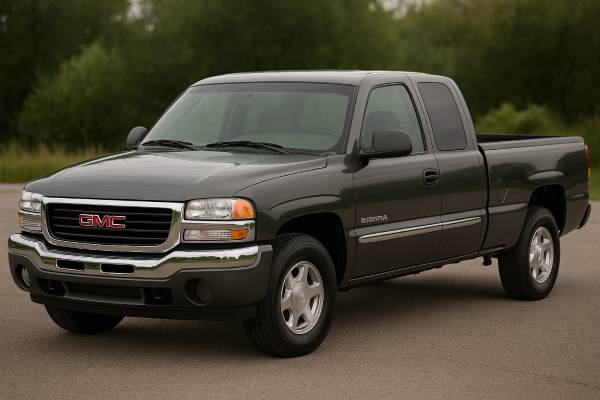
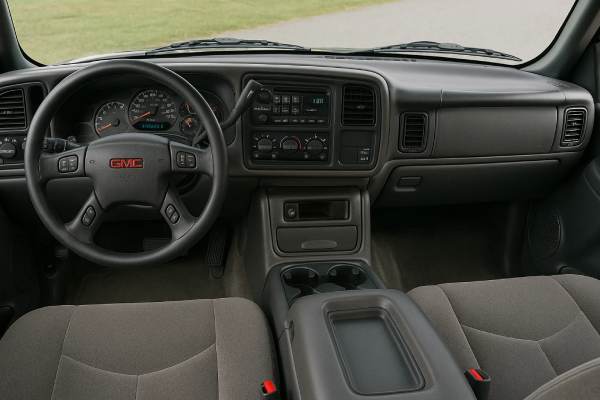
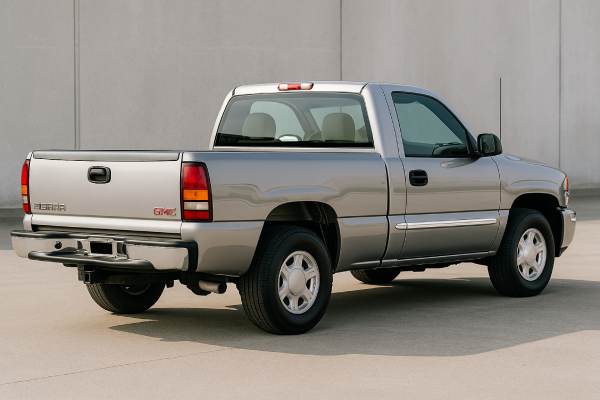
The GMT800-generation GMC Sierra 1500 with the LU3 4.3 litre V6 is the work-truck side of this platform: simple, durable and inexpensive to run, but not fast. As the base engine for many 2WD 1500 models from 2000–2006, it gives you full-size pickup capability with lower purchase and operating costs than the V8s.
The 4.3 Vortec LU3 is a 90° pushrod V6 related to the small-block V8 family. In this application it produces about 200 hp and 260 lb-ft of torque, enough for moderate towing and payloads if you are realistic about speed and gearing. Regular-cab 2WD trucks stay relatively light and efficient for a full-size, with typical EPA ratings around the mid-teens mpg combined for an automatic.
This guide focuses on the 2WD 1500 with the 4.3 V6: what it can tow, how it drives, where it tends to fail as it ages, and the maintenance choices that make the difference between a tired old beater and a trustworthy, long-lived truck.
Owner Snapshot
- Proven 4.3 V6 shares architecture with GM small-block V8s, giving robust internals and cheap, widely available parts.
- 2WD Sierra 1500 4.3 offers relatively low curb weight and decent fuel economy for a full-size truck, with common EPA figures around 14 mpg city / 19 mpg highway for 2WD automatics.
- Performance is adequate rather than strong; towing and steep grades demand planning, proper gearing and patience.
- Age-related issues include injector “spider” problems on early trucks, front-end wear, rust and neglected transmission fluid on hard-worked examples.
- A sensible severe-service interval is engine oil and filter every 5,000–8,000 km (3,000–5,000 miles) or 3–6 months, whichever comes first.
What’s inside
- Sierra 4.3 basics and role
- Engineering details for Sierra 4.3
- Sierra 1500 trims and safety
- Long-term reliability and weak points
- Maintenance planning and buyer guide
- Real-world driving and performance
- How Sierra 4.3 compares
Sierra 4.3 basics and role
The GMT800 platform arrived for 1999 and underpinned Chevrolet Silverado and GMC Sierra pickups through 2006 (plus 2007 “Classic” models). It brought hydroformed front frame sections, improved crash structures and a broad range of cabs, beds and engines.
Within that range, the LU3 4.3-litre V6 served as the base engine for many GMC Sierra 1500 2WD configurations. In 2-door regular-cab, short-wheelbase form with rear-wheel drive, it gives you a relatively compact full-size truck: around 5.16 m long and 1.99 m wide, with a wheelbase close to 3.02 m in typical C1500 short-bed spec.
Output is about 200 hp at roughly 4,400–4,600 rpm and 353 Nm (260 lb-ft) around 2,800 rpm, depending on year and calibration. That torque peak at relatively low rpm suits light towing, city usage and moderate loads. It will not keep up with later V8s when you are fully loaded, but it is much more capable than compact-truck engines of the 1990s.
Most 2WD 4.3 Sierras use:
- A 5-speed manual or 4-speed 4L60E automatic
- Rear-wheel drive with an open differential (G80 locking diff optional)
- A coil-spring independent front suspension with leaf-spring live rear axle
On the weight side, a typical regular-cab 4.3 2WD short-bed truck has curb weight in the low 1,800 kg range (around 4,050–4,250 lb) and a GVWR of about 2,770–2,900 kg (≈6,100–6,400 lb). Payloads around 880–950 kg (1,900–2,100 lb) are common.
Towing capacity depends heavily on rear-axle ratio, transmission and equipment. A representative early-2000s regular-cab 2WD 4.3 automatic can be rated up to roughly 3,900–4,000 kg (8,300 lb) maximum trailer weight in some configurations, though many trucks are equipped for closer to 2,000–2,500 kg (4,400–5,500 lb). Realistically, if you tow near the upper end, you will be slow on hills and should obsess over cooling and braking.
In the used market, the 4.3 Sierra 1500 2WD typically appeals to:
- Tradespeople who need a cheap, easy-to-fix work truck
- Homeowners wanting a weekend hauler and light tow rig
- Enthusiasts who prefer a lighter nose and simpler engine than the V8s
Its main compromise is power. If you expect to tow heavy trailers frequently or drive in high mountains, a 5.3 or 6.0 V8 is more appropriate. But if your use is mostly empty or lightly loaded commuting, the V6 can make good sense.
Engineering details for Sierra 4.3
This section uses a representative configuration: GMC Sierra 1500 II (GMT800) 4.3i V6 C1500 Regular Cab short bed 2WD (200 hp). Exact values vary slightly by model year and market, so always check your VIN sticker and owner’s manual.
Engine and performance
| Item | Specification |
|---|---|
| Engine code | LU3 “Vortec 4300” V6 |
| Layout | 90° V6, OHV, 2 valves per cylinder |
| Displacement | 4.3 l (4,300 cc) |
| Bore × stroke | ~101.6 × 88.4 mm (4.00 × 3.48 in) |
| Induction | Naturally aspirated |
| Fuel system | Multi-point fuel injection (MPFI) |
| Compression ratio | Around 9.2:1–9.4:1, depending on year |
| Max power | 200 hp @ ~4,400–4,600 rpm |
| Max torque | 353 Nm (260 lb-ft) @ ~2,800 rpm |
| Timing drive | Chain |
| Recommended fuel | Regular 87 AKI unleaded |
The LU3 V6 is essentially a shortened small-block V8, sharing bore, architecture and many design concepts. It uses a robust cast-iron block and heads and a simple cam-in-block valvetrain. This gives it a reputation for long life if oil changes are not neglected.
Fuel economy and real-world use
EPA ratings for a typical 2WD Sierra 1500 4.3 automatic in the early 2000s are around:
- 16 mpg combined
- 14 mpg city
- 19 mpg highway
That corresponds roughly to:
- 14.7 L/100 km combined
- 16.8 L/100 km city
- 12.4 L/100 km highway
Real-world reports usually show:
- 13–15 mpg US (15.7–18 L/100 km) mixed
- 11–13 mpg US (18–21 L/100 km) with heavier loads or lots of city driving
- 16–18 mpg US (13–15 L/100 km) at moderate highway speeds with a light load
At 120 km/h (75 mph), expect closer to the low end of the highway rating.
Transmission and driveline
| Item | Specification |
|---|---|
| Transmissions | 5-speed manual or 4L60E 4-speed automatic |
| 4L60E ratios | 1st 3.06, 2nd 1.63, 3rd 1.00, 4th 0.70, Rev 2.29 |
| Typical final drive | 3.08, 3.23 or 3.42 on many 2WD 4.3 trucks |
| Drive type | Rear-wheel drive (C1500) |
| Differential | Open; G80 locking differential optional on many trims |
Shorter (numerically higher) axle ratios give noticeably better launch and towing performance at the cost of higher cruise rpm and fuel consumption.
Chassis and dimensions
(Representative C1500 Regular Cab short bed 2WD 4.3 V6.)
| Item | Specification |
|---|---|
| Platform | GMT800 full-size pickup frame |
| Suspension (front) | Independent, coil springs (2WD 1500) |
| Suspension (rear) | Solid axle, semi-elliptic leaf springs |
| Steering | Power-assisted recirculating ball |
| Brakes | Front discs, rear drums with ABS |
| Wheelbase | ~3,023 mm (119.0 in) |
| Length | ≈5,161 mm (203.2 in) |
| Width | ≈1,994 mm (78.5 in) |
| Height | ~1,808–1,812 mm (≈71–71.3 in) |
| Ground clearance | About 206 mm (8.1 in) |
| Turning circle | ≈12.2 m (40.1 ft) |
| Curb weight | ~1,840–1,900 kg (4,050–4,200 lb) for 4.3 regular-cab SWB 2WD |
| GVWR | Around 2,770–2,900 kg (6,100–6,400 lb) |
| Payload | Roughly 880–950 kg (1,900–2,100 lb) |
| Fuel tank | ≈98–102 l (26–27 US gal) depending on configuration |
Fluids, capacities and key torques (typical)
Always confirm for your year and VIN in the official manual.
| System | Typical specification |
|---|---|
| Engine oil | 5W-30 meeting GM specs; about 4.7–4.9 l (5.0–5.2 qt) with filter |
| Coolant | Dex-Cool OAT coolant, 50/50 mix; capacity roughly 11–13 l |
| Transmission | 4L60E: Dexron-III (superseded by Dexron VI); total capacity ≈9–10 l, pan drop ≈4–5 l |
| Rear axle | 75W-90 GL-5 gear oil, capacity ≈1.6–2.0 l depending on axle |
| Spark plugs | AC Delco long-life plugs, gap around 1.52 mm (0.060 in) |
| Oil drain plug torque | About 25–30 Nm (18–22 lb-ft) |
| Wheel lug nuts | Typically around 190–210 Nm (140–155 lb-ft) |
Sierra 1500 trims and safety
The LU3 4.3 V6 appears primarily as the base engine across several trims and body styles in the 2000–2006 GMC Sierra 1500 2WD lineup. Understanding the trim structure helps you decode features and equipment on a used truck.
Trims and options
Common trims for 2WD regular-cab and extended-cab 1500s in this era include:
- Base / Work Truck (WT) – vinyl bench seat, manual windows and locks, basic audio, steel wheels. Often fleet white and heavily used.
- SL / SLE – cloth seats, power windows and locks, upgraded audio, optional split bench, nicer trim.
- Special editions / value packages – appearance packages, convenience groups, and towing or “Heavy-Duty Trailering” groups with hitch, wiring and coolers.
Key mechanical or functional differences that matter for a 4.3 truck:
- Axle ratio – check the glovebox RPO label for codes such as GU6 (3.42), GT4 (3.73) or GT5 (4.10). Taller 3.08 gears were also common.
- Locking differential (G80) – a big advantage for traction in wet, snow or loose surfaces.
- Brake and suspension packages – some trims add heavier rear springs, larger rear drums and different shocks that marginally raise tow or payload ratings.
- Wheel and tyre packages – 16-inch alloys vs steel, and P-metric vs LT tyres, change ride and load capacity.
The 4.3 engine is most common in regular cabs and some lower-trim extended cabs. Many higher trims and crew cabs were V8-only.
Safety ratings
The GMT800 trucks were tested by NHTSA and IIHS across several configurations. Ratings vary by cab style, year and the presence of optional side airbags. In general:
- Frontal crash performance for 1500 pickups of this era is acceptable to good for the time, with many tests scoring four or five stars.
- Side-impact and rollover performance is more mixed, particularly on extended-cab and 4WD trucks. Load, tyres and driver behaviour play big roles in real-world outcomes.
Because 2WD 4.3 trucks often lack side airbags and electronic stability control (ESC became more common later), they do not match modern safety standards. When evaluating one:
- Check for at least dual front airbags and pretensioner seatbelts.
- Look up official ratings for the specific year and cab configuration.
- Avoid grossly overloading the truck or using oversized, low-quality tyres that worsen stability.
Safety systems and ADAS
On a 2000–2006 Sierra 1500 4.3, safety equipment is comparatively simple:
- Passive safety: dual front airbags; optional side airbags in later years on some trims; 3-point belts for front occupants; adjustable head restraints.
- Braking and stability: front disc/rear drum brakes with ABS; no ESC or traction control on most early GMT800 trucks, though some later models added basic traction systems on certain trims.
- Child-seat provisions: LATCH lower anchors became more common in rear seats of extended and crew cabs during this period. Regular-cab trucks rely mainly on seatbelts and top tether anchors for child seats.
There is no factory lane-keeping, adaptive cruise, automatic emergency braking or blind-spot monitoring. Any cameras or parking sensors you encounter will be aftermarket and may require specific checking after repairs.
For collision repairs or alignment work, the main concerns are:
- ABS sensors and tone rings (ensure correct gap and cleanliness)
- Steering angle (must be centred after alignment on some later trucks)
- Proper routing and mounting of brake lines and fuel lines along the frame
Long-term reliability and weak points
The LU3 4.3 V6 in a GMT800 Sierra has a strong reputation for longevity, but age, mileage and poor maintenance can still cause expensive problems. Below are the patterns most owners and mechanics see.
Common, moderate-to-high impact issues
- Fuel injector “spider” and intake deposits (common, medium cost)
- Symptoms: Hard starts, rough idle, misfire codes, fuel smell, poor economy.
- Cause: Earlier central-port injection systems suffered from sticking poppets and fuel distribution issues; later LU3 multipoint systems are better but can still suffer from varnish and deposits.
- Remedy: Replace the injector assembly with the updated MPFI “spider”, clean the intake and verify fuel pressure and regulator function.
- Distributor cap, rotor and ignition components (common, low cost)
- Symptoms: Intermittent misfires, especially in damp weather; hesitation and rough running.
- Cause: Moisture intrusion and corrosion inside the distributor cap, ageing plug wires and worn plugs.
- Remedy: Replace cap, rotor, plugs and wires at recommended intervals or when misfire codes appear. Use quality parts and ensure proper wire routing.
- 4L60E transmission wear (common on tow/haul trucks, high cost)
- Symptoms: Flare on 1–2 or 2–3 shifts, slipping, delayed engagement, metallic debris in pan.
- Cause: Heat, fluid neglect and heavy towing beyond ratings. The 4L60E is durable if maintained but not happy with constant overload.
- Remedy: Strict fluid and filter changes, auxiliary cooler if towing, and rebuild or replacement when significant slip or shudder appears.
- Front-end wear (common, medium cost)
- Symptoms: Wandering, clunks over bumps, uneven tyre wear, vague steering.
- Cause: Worn ball joints, tie-rod ends, idler and pitman arms, and bushings after years of rough roads and loads.
- Remedy: Full front-end inspection, replacing multiple components where needed, followed by alignment.
- Rust and structural corrosion (common in salted climates, potentially high cost)
- Hotspots: Rocker panels, cab corners, wheel arches, frame near rear spring hangers and under bed mounts.
- Remedy: Early detection, rust treatment, cavity wax and, if advanced, welding or frame repair. Rust-free shells from dry climates are often worth a premium.
Occasional or age-driven problems
- Oil cooler line leaks – flexible sections of crimped steel/rubber lines can seep; look for oily drips near filter and crossmember.
- Power steering leaks and box wear – heavy steering use and towing strain the box; excessive play and leaks are common as trucks age.
- HVAC blend door or fan resistor failures – stuck on hot or cold, or certain blower speeds not working.
Engine bottom end and internals
The bottom end of the LU3 is generally very durable. Spun bearings, broken rods and catastrophic failures are rare when:
- Oil is changed regularly
- Cooling system is healthy
- The engine is not consistently overheated
More common engine-internal concerns are:
- Mild oil consumption at high mileage
- Valve cover and oil pan gasket seepage
- Occasional lifter noise on cold start, often benign if it quiets quickly
Recalls, TSBs and extended coverage
Over its production run, the Sierra 1500 saw various recalls and TSBs related to:
- Brake line corrosion and hoses in certain regions
- ABS system behaviour at low speeds on rust-belt trucks
- Seat and seatbelt anchorage issues
- Instrument cluster stepper motor failures in some years
Because campaign lists change by market, always:
- Run the VIN through an official recall database or with a GM dealer.
- Ask for printed history of recall and warranty actions.
- Check invoices for completed TSB-related work if a seller claims “all updates done.”
Missing critical recall work should be factored into price and used as a negotiation point.
Maintenance planning and buyer guide
A clear maintenance plan is the best way to extend the life of a 4.3 Sierra. The owner’s manuals for 2000–2006 Sierra models set out normal and severe schedules; most real-world use (short trips, towing, heavy city driving, dirt roads) falls under the severe category.
Practical maintenance schedule (typical severe-service)
Approximate intervals; always overlay with the official schedule.
- Engine oil and filter – every 5,000–8,000 km (3,000–5,000 miles) or 3–6 months.
- Engine air filter – inspect every 15,000 km (10,000 miles); replace around 30,000–40,000 km (20,000–25,000 miles) or sooner in dusty use.
- Cabin air filter – on trucks equipped with one: check yearly; replace every 24,000–30,000 km (15,000–20,000 miles).
- Fuel filter – about every 50,000 km (30,000 miles).
- Spark plugs – long-life plugs typically at 160,000 km (100,000 miles); many owners choose 100,000–120,000 km (60,000–75,000 miles) for older trucks.
- Coolant (Dex-Cool) – initially 5 years or 240,000 km (150,000 miles), but for older vehicles a 4–5 year interval regardless of mileage is safer.
- Automatic transmission (4L60E) – fluid and filter every 80,000–100,000 km (50,000–60,000 miles) in severe use.
- Manual gearbox – gear oil change roughly every 80,000–100,000 km (50,000–60,000 miles).
- Rear axle oil – change every 80,000–100,000 km (50,000–60,000 miles), sooner if towing often.
- Brake fluid – flush every 2–3 years.
- Serpentine/auxiliary belt and hoses – inspect at every service; replace belt around 100,000 km (60,000 miles) or if cracked/noisy.
- Steering and suspension – inspect annually; grease serviceable joints at each oil change.
- 12 V battery – test annually from the 4-year mark; typical life 5–7 years.
- Timing chain – no fixed interval; monitor for timing correlation codes, metallic noise and slack. Replace chain, gears and tensioners when symptoms appear.
Fluid specs and capacities (guideline figures)
- Engine oil: 5W-30, API and GM-approved; around 4.7–4.9 l with filter.
- Transmission: Dexron VI service fill in place of Dexron III; check dipstick hot and idling in Park.
- Differential: 75W-90 GL-5; add limited-slip friction modifier only if specified.
- Power steering: GM power steering fluid or Dexron III/VI per manual.
Buyer’s guide: what to inspect
If you are shopping for a Sierra 1500 4.3 2WD:
- Rust and structure
- Check frame rails, rear spring perches, crossmembers and brake lines along the frame.
- Inspect rocker panels, cab corners and bed seams; surface rust is manageable, perforation is costly.
- Engine and drivetrain
- Listen for cold-start misfires or ticking; smell exhaust for rich running.
- Check for coolant residue near intake manifold edges and radiator tanks.
- Test-drive until warm: look for smooth shifts (autos) and good clutch take-up (manuals).
- Front-end and tyres
- Feel for steering play; note any pulls or vibrations at highway speed.
- Examine tyre wear patterns for inside/outside edge wear indicating alignment issues.
- Brakes
- Confirm firm pedal feel and straight stops. Pulsation suggests warped rotors; long pedal may indicate rear drum or hydraulic issues.
- Electrical and interior
- Verify gauges, warning lights, A/C, heater, blower speeds and any power accessories.
- On higher trims, check for cluster gauge anomalies that might point to stepper motor issues.
- History and documentation
- Prefer trucks with detailed service histories, especially for oil and transmission services.
- Confirm recall completion through official channels.
Which years and specs to favour
- Mid-cycle trucks (roughly 2003–2005) often benefit from incremental tweaks and more widespread use of refined LU3 MPFI injection.
- Trucks with moderate gearing (3.23 or 3.42) are a solid compromise between performance and economy for mixed use.
- For light-duty daily driving, 2WD regular cabs with simpler trims are cheaper to maintain than loaded 4WD models.
Real-world driving and performance
On the road, a Sierra 1500 4.3 2WD feels like a traditional full-size truck, but lighter on its feet than V8 or 4WD versions.
Ride, handling and NVH
Unloaded, the rear leaf springs can be bouncy over rough pavement, especially with high-pressure light-truck tyres. With 200–300 kg in the bed, ride quality improves as the springs work in their designed range. The independent front suspension helps with turn-in and front-end compliance compared with older straight-axle trucks.
Steering effort is light thanks to power assistance, but there is some on-centre free play typical for recirculating-ball systems. Once aligned and fitted with good tyres, the truck tracks well at highway speeds. Crosswinds and ruts can move it around more than a modern, heavier-duty pickup, but it remains predictable if the suspension is in good condition.
Cabin noise is moderate: tyre roar from the rear, some wind noise around the mirrors and pillars and engine sound when accelerating. Regular-cab trucks with basic insulation are noisier than extended/crew cabs with more trim and sound-deadening.
Powertrain character
The 4.3 V6 is smooth enough for an old-school pushrod design, with a characteristic V6 growl under load. Below 2,000 rpm it feels modest but tractable; from about 2,200 to 4,000 rpm it pulls steadily. Passing at highway speeds requires a kickdown and some patience, especially with tall gearing.
With the 4L60E automatic, shift logic favours low-rpm upshifts for economy. On inclines, it may hunt between 3rd and 4th if you hover around the torque peak; using tow/haul mode (where fitted) and locking out overdrive under heavy load can help. The 5-speed manual feels more responsive but requires a driver comfortable with clutch work in traffic.
Performance metrics (approximate)
Published instrumented tests for this exact configuration are limited, but based on similar 4.3 GM trucks you can expect:
- 0–60 mph (0–97 km/h): roughly 10–12 seconds for a regular-cab 2WD automatic, slightly quicker with manual and shorter gears
- 100–0 km/h braking: depends heavily on tyre and brake condition; assume average full-size pickup distances, not modern SUV performance
- Top speed: electronically limited in many trucks by tyre rating, often near 170 km/h (105 mph)
The truck feels strongest in first and second gear around town. Once loaded or towing, acceleration becomes leisurely but adequate within legal limits.
Real-world efficiency and range
Using a 16 mpg combined figure as a baseline for a 4.3 2WD auto:
- With a 98–102 l tank (26–27 gal), realistic range is 480–640 km (300–400 miles) per fill under typical mixed driving.
- At steady 100–110 km/h (62–68 mph) without cargo, many owners report high-teens mpg (around 13–15 L/100 km).
- Heavy city use or short trips can drop economy into the low teens mpg (20+ L/100 km).
Add a moderate trailer (1,800–2,200 kg / 4,000–5,000 lb) and you can expect a 20–30 percent increase in fuel consumption.
Load and towing behaviour
Within its ratings, the 4.3 Sierra 2WD is a competent light tow vehicle:
- Stability: The long wheelbase and low hitch height help stability, but soft rear springs mean you should respect tongue-weight limits and consider weight-distribution hitches near the upper towing range.
- Braking: Truck brakes are adequate if maintained; always use trailer brakes for trailers above roughly 750–900 kg (1,650–2,000 lb), and keep brake fluid fresh.
- Temperatures: Watch coolant and transmission temperatures on long grades; downshift early and avoid full-throttle lugging.
For regular towing near 3,000 kg (≈6,600 lb), a 5.3 or 6.0 V8 is more relaxed. For occasional boat, small camper or equipment towing below 2,500 kg (5,500 lb), the 4.3 can perform well if you drive within its limits.
How Sierra 4.3 compares
The 4.3 V6 Sierra 1500 2WD sits at the intersection of three choices: other GMT800 powertrains, rival full-size pickups and smaller trucks/SUVs.
Versus V8 GMT800 Sierras
- Power: The 4.8 and 5.3 V8s offer noticeably quicker acceleration, especially with a load. You feel the difference most on highway on-ramps and steep grades.
- Economy: In many real-world cases, the 4.3’s fuel economy advantage over a 4.8 or 5.3 is modest—often 1–2 mpg at best—because the V8s can run in higher gears with less throttle.
- Towing: V8 trucks almost always have higher tow ratings; if you tow frequently, a V8 is safer and less stressful.
- Weight and steering feel: The V6 is slightly lighter over the nose, which some drivers prefer; steering effort is a bit lighter and turn-in marginally more responsive.
If you need maximum versatility and often carry heavy loads, a 5.3 V8 is usually the better choice. If you mostly drive empty and value simplicity and lower purchase cost, the 4.3 remains appealing.
Versus Ford F-150 and Dodge/Ram 1500 of the era
Compared with period Ford and Dodge base-engine trucks:
- Engines: Ford’s 4.2 V6 and Dodge’s 3.7/3.9 V6s compete in output but often feel less torquey or less refined. The GM 4.3’s 200 hp and 260 lb-ft place it near the top of the V6 group.
- Chassis: All three brands use body-on-frame layouts with independent front suspensions and leaf-spring rears; differences come down to tuning and options rather than fundamental architecture.
- Parts and support: GM’s 4.3 and GMT800 trucks share many parts with other GM vehicles, making long-term support a strong point.
In safety and refinement, all early-2000s half-tons lag modern trucks, but the GMT800 platform is competitive for its era.
Who should choose the 4.3 Sierra?
This truck still makes sense if:
- You want a simple, proven full-size pickup for commuting, light hauling and occasional towing.
- You value lower up-front cost and can accept modest performance.
- You prefer an engine with long production history and strong parts support, and you are comfortable doing basic maintenance yourself.
If your use case involves:
- Frequent heavy towing over 2,700–3,000 kg (6,000–6,500 lb), or
- Regular high-speed, high-load highway driving, or
- Demanding off-road work where low-end torque and gearing are critical,
then a V8 Sierra, HD truck or modern diesel will serve you better. For everyone else, a well-maintained 4.3 Sierra 1500 2WD remains a practical, budget-friendly way to own a full-size pickup.
References
<a href="https://www.auto-data.net/en/gmc-sierra-1500-ii-gmt800-generation-2099">GMC Sierra 1500 II (GMT800) | Technical Specs, Fuel consumption, Dimensions</a> 2025 (Specifications)<a href="https://www.auto-data.net/en/gmc-sierra-1500-ii-gmt800-4.3i-v6-c1500-regular-cab-swb-2wd-200hp-10197">GMC Sierra 1500 II (GMT800) 4.3i V6 C1500 Regular Cab SWB 2WD (200 Hp)</a> 2025 (Technical Data)<a href="https://www.fueleconomy.gov/feg/bymodel/2003_GMC_Sierra.shtml">Gas Mileage of 2003 GMC Sierra</a> 2003 (Fuel Economy Data)<a href="https://manual-directory.com/cars/gmc/sierra/">GMC Sierra Owner's Manual PDF [1993-2025]</a> 2024 (Owner’s Manuals Index)<a href="https://en.wikipedia.org/wiki/GMT800">GMT800 - Wikipedia</a> 2024 (Platform Overview)
Disclaimer
This article is for informational purposes only and is not a substitute for professional diagnosis, repair or safety advice. Specifications, torque values, towing limits, maintenance intervals and procedures can vary by VIN, model year, market, axle ratio, body style and installed equipment. Always confirm critical data against your official owner’s manual, factory service or upfitter documentation and under-hood labels, and consult a qualified technician before carrying out repairs, modifications or towing near rated limits.
If you found this guide helpful, please consider sharing it with other owners and enthusiasts on social platforms such as Facebook, X/Twitter and relevant forums. It helps more people make informed decisions and supports the effort that goes into creating detailed technical content like this.