

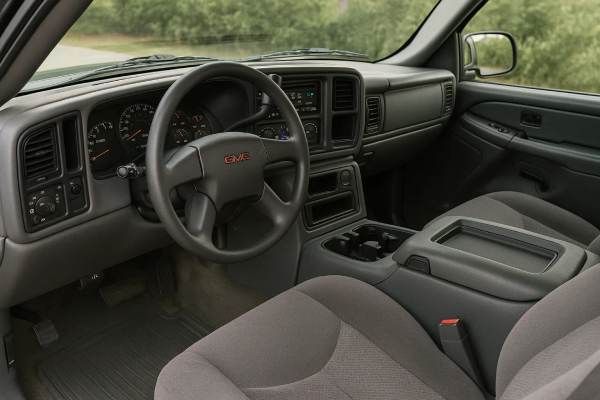

The 2000–2006 GMC Sierra 1500 4WD with the LU3 4.3 litre V6 is the “base” four-wheel-drive GMT800, but many owners discover it is anything but basic. It pairs a simple pushrod V6 with a stout ladder frame, independent front suspension, and a proven part-time 4WD system. In an age of complex turbocharged engines and multilink electronics, the Sierra 4.3 4WD stands out for durability, ease of service, and parts availability.
This configuration appeals to buyers who need a full-size pickup with real 4×4 capability and a manageable purchase and running cost. It is common in fleet work, light contracting, rural use, and as a second truck for towing small trailers, boats, or ATVs. In this guide, we will walk through its specs, capabilities, reliability patterns, and what to watch for if you are maintaining or buying one today, so you can decide whether the 4.3-powered Sierra fits your needs.
Owner Snapshot
- Strong, understressed 4.3 V6 and 4L60E combination with excellent parts support and simple layout.
- Robust GMT800 frame and 4×4 hardware make it suitable for snow, gravel, and job-site use.
- Interior is roomy and comfortable for the era, especially in extended and crew cab versions.
- Age-related rust, intake gasket leaks, and brake line corrosion need proactive inspection.
- Plan engine oil and filter changes every 5,000–6,000 miles (8,000–10,000 km) or 6 months under mixed use.
Explore the sections
- GMC Sierra 4.3 4WD basics
- Sierra 4.3 4WD specs
- Trims, options and safety
- Reliability and common issues
- Maintenance and buying guide
- Driving and performance feel
- How this Sierra compares
GMC Sierra 4.3 4WD basics
The GMT800 Sierra 1500 4WD with the LU3 4.3 litre V6 sits at the entry point of the four-wheel-drive lineup from 2000–2006. Under the hood is the Vortec 4300, a 90-degree pushrod V6 descended from GM’s small-block V8 family. It uses a cast-iron block and heads, two valves per cylinder, and multi-port fuel injection. Output for this period is 200 hp at 4,600 rpm and roughly 260 lb-ft of torque around 2,800 rpm, tuned for low-end pull rather than high-rev power.
In 4WD form, the 4.3 was most commonly paired with the 4L60E four-speed automatic, though a five-speed manual transmission was offered in some work-truck configurations. The transfer case is a two-speed unit (typically NP261 or NP263), with 2HI, 4HI, and 4LO, engaged by either a floor lever or dash-mounted push-button controls depending on trim. There is no full-time AWD mode, which keeps the system simple and durable.
Chassis-wise, all 1500 4×4 trucks use a torsion-bar independent front suspension and a solid rear axle on leaf springs. This layout balances ride comfort with the ability to handle payload and moderate off-road use. Brake hardware is disc front and drum rear on early trucks, with improvements to front brake sizing and pads over the run.
Configuration options mirror the broader Sierra range:
- Regular cab with short or long box
- Extended cab with third (and later rear-hinged fourth) door
- Crew cab late in the generation
Most 4.3 4WD trucks were built as work or value-trim vehicles, so you will commonly see vinyl floors, manual 4×4 selectors, and simpler cloth interiors. However, options such as alloy wheels, upgraded audio, and power accessories were still available, and fleets often chose them.
For today’s buyer or owner, the appeal lies in a combination of full-size capability and straightforward mechanicals. The 4.3 does not make the Sierra fast, especially compared to V8 models, but it is adequate for everyday driving, light towing, and winter use, provided you stay realistic about its limits.
Sierra 4.3 4WD specs
This section focuses on representative specifications for a 2003 Sierra 1500 4WD with the 4.3 V6 and automatic transmission. Numbers vary slightly by year, cab, and axle ratio, but these figures give a solid baseline.
Engine and performance
| Item | Value |
|---|---|
| Engine code | LU3 (Vortec 4300 V6) |
| Layout and cylinders | 90° V6, OHV, 2 valves per cylinder (12 valves) |
| Bore × stroke | 101.6 × 88.4 mm (4.00 × 3.48 in) |
| Displacement | 4.3 L (4,300 cc) |
| Induction | Naturally aspirated |
| Fuel system | Sequential multi-port fuel injection |
| Compression ratio | ~9.2:1 |
| Max power | 200 hp @ 4,600 rpm |
| Max torque | ~260 lb-ft (≈ 353 Nm) @ ~2,800 rpm |
| EPA combined (4WD auto) | 15 mpg (≈ 15.7 L/100 km) |
| EPA city / highway | 13 / 17 mpg |
| Recommended fuel | Regular unleaded (87 AKI) |
Transmission and driveline
| Item | Value |
|---|---|
| Automatic transmission | 4L60E 4-speed automatic |
| Manual transmission | NV3500 5-speed (limited availability) |
| Drive type | Part-time 4×4, 2HI / 4HI / 4LO |
| Transfer case | NP261 or NP263 (lever or push-button) |
| Front differential | Open; optional G80 locking rear differential |
| Typical axle ratios | 3.42, 3.73 (fleet/work trucks may have 4.10) |
Chassis and dimensions (typical 4WD extended cab, 6.5-ft box)
| Item | Value |
|---|---|
| Frame type | Fully boxed front, C-channel rear |
| Front suspension | Torsion-bar independent |
| Rear suspension | Solid axle, leaf springs |
| Steering | Power recirculating ball |
| Front brakes | Ventilated discs |
| Rear brakes | Drums |
| Wheelbase | ~3,645 mm (143.5 in) |
| Length | ~5,785 mm (≈ 228 in) |
| Width (without mirrors) | ~2,025 mm (≈ 79.7 in) |
| Height | ~1,870 mm (≈ 73–74 in) |
| Ground clearance | Around 200 mm (≈ 8 in) |
| Curb weight | ~2,050–2,150 kg (4,500–4,740 lb) |
| GVWR | ~2,770–2,900 kg (6,100–6,400 lb) |
| Fuel tank | ~98 L (26 US gal) |
| Bed length (short box) | ~1,981 mm (78 in / 6.5 ft) |
Performance and capability (typical)
| Item | Value |
|---|---|
| 0–100 km/h (0–62 mph) | ~10.5–11.5 s (lightly loaded, automatic) |
| Top speed (electronically) | ≈ 150–160 km/h (≈ 93–99 mph) |
| Braking 100–0 km/h | Typically ~43–47 m (140–155 ft), condition-dependent |
| Conventional tow rating | ≈ 2,000–2,700 kg (4,400–6,000 lb) depending on spec |
| Payload | Roughly 650–800 kg (1,400–1,750 lb) |
| Roof load | Usually limited; treat ~75–100 kg (165–220 lb) as safe working range with quality rack |
Fluids and service capacities (typical)
| System | Specification (check manual by VIN) | Approx. capacity |
|---|---|---|
| Engine oil | API SL/SJ, 5W-30 (commonly used) | ≈ 4.7 L (5.0 US qt) |
| Engine coolant | Long-life Dex-Cool, ~50/50 mix | ≈ 11–13 L (11.5–13.7 US qt) |
| Automatic transmission | Dexron III / Dexron VI replacement | ≈ 4–5 L (pan); 9–10 L total |
| Front differential | 75W-90 synthetic gear oil | ≈ 1.2–1.5 L |
| Rear differential | 75W-90 synthetic; add friction modifier if required | ≈ 2.0–2.5 L |
| Transfer case | Auto-Trak II or Dexron (per tag) | ≈ 1.9–2.5 L |
| A/C refrigerant | R-134a | ≈ 0.8–1.0 kg (28–35 oz) |
Electrical
| Item | Value / Notes |
|---|---|
| Alternator | Typically 105–145 A depending on equipment |
| 12V battery | Group 78/34, ~600–800 CCA |
| Spark plugs | Platinum/iridium, ~1.5 mm gap (0.060 in) |
Safety and driver assistance
Active safety on these trucks is simple by modern standards: four-wheel ABS, optional traction assist on some models, and basic cruise control. There is no factory lane-keeping, blind-spot monitoring, or autonomous emergency braking in this era. Crash-test performance in the IIHS moderate overlap test is mixed, with generally good injury measures but concerns about structure and head-restraint geometry. Proper head-restraint adjustment and seat maintenance are important on older examples.
Trims, options and safety
In 4WD form with the 4.3 V6, the Sierra 1500 was primarily sold in value-oriented trims, but there are still important differences to understand.
Typical trim walk in North America looked like this:
- Base / Work Truck (WT): Vinyl flooring, cloth or vinyl bench seat, manual-shift transfer case, steel wheels, and minimal chrome. Many fleet 4.3 4×4 trucks were ordered this way.
- SLE: More sound insulation, upgraded cloth seats, power windows and locks, alloy wheels, optional keyless entry, and more available comfort options. 4.3 4WD is less common here but does exist in some fleets and rural dealers.
- SLT / higher trims: Usually paired with V8 engines; a 4.3 4WD in SLT trim is rare.
Functional options to watch for:
- G80 locking rear differential: A big plus for traction in mud, snow, and on job sites. You can usually spot it from the RPO code sticker in the glovebox.
- Axle ratio: 3.42 gearing offers slightly better fuel economy; 3.73 is preferable if you tow or drive in hilly terrain.
- Transfer-case control: Floor-shift NP261 is simple and robust; push-button NP263 (Autotrac) adds convenience but brings an encoder motor that can fail with age.
Interior options include split-bench or bucket front seats, rear jump seats in extended cabs, and, on later crew cabs, a more habitable rear bench. Factory radios range from simple cassette/CD units to systems with steering-wheel audio controls; the 4.3 4WD could be ordered with most of these, especially in SLE trim.
On the safety side, equipment is consistent across the engine range:
- Dual front airbags
- Front seat-belt pretensioners
- Four-wheel ABS
- Child-seat provisions with LATCH in applicable rear seating positions
Side airbags and advanced driver-assist systems were not offered. Head-restraint and seat design are a known weak point, especially for taller occupants, so correct head-restraint adjustment and ensuring the seat tracks are in good condition matter more here than on newer trucks.
Year-to-year, changes for the LU3/4WD combination are modest: minor updates to trim, audio systems, and sometimes to brake components and calibration. The engine and major driveline components remain essentially the same through 2006, which helps with cross-year parts sourcing.
Quick identifiers for a 4.3 4WD truck:
- V6 badge is often absent, but the eighth digit of the VIN is usually “X” for the LU3.
- Under the hood, the V6 has three cylinders per bank and a more compact intake than the V8s.
- RPO lists in the glove box will show LU3 and GT4/GT5 (gear ratios), plus NP8 or similar for AutoTrac transfer cases.
Reliability and common issues
The GMT800 Sierra 1500 4WD with the 4.3 V6 enjoys a generally strong reputation for longevity, especially when maintained and kept away from severe rust. However, these trucks are now two decades old, so pattern failures are well established.
Engine and fuel system
The LU3 itself is robust. Common issues are usually age-related:
- Intake manifold gasket leaks (common, medium cost):
Symptoms: Coolant loss with no obvious external leak, rough cold starts, or sweet smell from engine bay.
Cause: Aging plastic/composite gaskets shrinking and hardening.
Remedy: Replace upper and lower intake gaskets, inspect mating surfaces, and refill with correct Dex-Cool coolant and proper bleed procedure. - Distributor cap and ignition components (common, low cost):
Symptoms: Misfires in damp weather, hard starting, hesitation under load.
Cause: Moisture intrusion and corrosion in cap/rotor, plus worn plug wires and old plugs.
Remedy: Replace cap, rotor, plug wires, and plugs as a set. - Fuel pump and sender (common with mileage, medium cost):
Symptoms: Long cranking, intermittent stall, fuel gauge inaccuracy.
Cause: In-tank pump wear and corroded sender contacts.
Remedy: Replace pump module with quality part, inspect wiring and tank.
Timing chains on the 4.3 rarely require scheduled replacement, but stretch and guide wear can appear at very high mileage or in neglected engines. Rattling at startup or timing correlation codes should trigger a deeper inspection.
Transmission, transfer case, and axles
- 4L60E wear (occasional to common, medium–high cost):
Symptoms: Flare on 1–2 shifts, slipping in overdrive, or harsh engagement.
Causes include fluid neglect, heavy towing, and aggressive driving.
Remedy: Fluid and filter service may help early; otherwise rebuild or quality remanufactured unit. - Transfer-case “pump rub” (GMT800-wide issue):
On some cases, an internal pump can wear through the magnesium housing, causing fluid loss and eventual failure. Aftermarket “pump rub” plates or updated parts are standard in quality rebuilds. - Encoder motor and 4×4 switch faults (for push-button systems):
Symptoms: Service 4WD light, failure to engage 4HI/4LO, or stuck mode.
Remedy: Diagnose power, grounds, and module; often resolved with new encoder motor or switch panel.
Front hubs and wheel bearings on 4×4 trucks see more stress than 2WD versions. Growling noises during turns or loose feeling in the steering over bumps warrant inspection.
Chassis, brakes, and body
- Brake line corrosion (common in salt states, medium cost):
Steel lines along the frame can rust and burst. Many owners pre-emptively replace the full set with coated or stainless lines. - Frame, brake-component, and fuel-line rust (region-dependent):
Focus on rear frame sections, shock mounts, spare-tire area, and bed crossmembers. Severe rust can be a safety issue, not just cosmetic. - Rocker panels and cab corners (very common cosmetic/structural issue):
Expect rust in wet or salty climates. Proper repairs often involve cutting and welding in patch panels. - Instrument cluster stepper motors (common, low–medium cost):
Erratic speedometer, tachometer, or fuel gauge readings are typically due to failing stepper motors. The fix is a cluster rebuild or replacement.
Recalls and Technical Service Bulletins (TSBs) over this era address items such as seat-belt components, ABS performance in low-speed stops on slippery surfaces, and occasional steering-shaft clunk. Any truck you are evaluating should be checked by VIN against the official recall database, and dealer records or invoices should confirm completion.
Maintenance and buying guide
A 4.3-powered Sierra 1500 4WD can deliver very long service life if cared for systematically. Below is a practical maintenance outline; always confirm exact intervals and fluids in the manual for your year and market.
Core service intervals (typical guidance for mixed use)
- Engine oil and filter: Every 5,000–6,000 miles (8,000–10,000 km) or 6 months; shorten to 3,000–4,000 miles (5,000–6,500 km) for heavy towing or short-trip use.
- Engine air filter: Inspect yearly; replace every 30,000–40,000 miles (50,000–65,000 km) or sooner in dusty service.
- Cabin air filter: Many GMT800 pickups lack one from the factory; if retrofitted, inspect annually.
- Spark plugs: Platinum/iridium plugs can go 80,000–100,000 miles (130,000–160,000 km), but replacing around 60,000 miles can improve drivability on older trucks.
- Coolant (Dex-Cool): Typically 5 years or 150,000 miles (240,000 km) from new, then every 3–5 years depending on condition.
- Automatic transmission fluid and filter: 50,000–60,000 miles (80,000–100,000 km) in mixed or severe use is a sensible target, especially if towing.
- Differentials and transfer case: 50,000 miles (80,000 km) as a practical interval; more frequent for deep-water crossings or hard off-road use.
- Brake fluid: Flush every 2–3 years.
- Serpentine belt and hoses: Inspect at each oil change; typically replace belts around 60,000–90,000 miles (100,000–150,000 km) or sooner if cracked.
- 12 V battery: Test yearly after year three; typical life is 4–6 years.
- Alignment and tyre rotation: Rotate every 6,000–8,000 miles (10,000–13,000 km); align whenever you see uneven wear or steering changes.
The 4.3 uses a timing chain with no fixed replacement interval; treat timing parts as “inspect and replace on symptoms” (noise, codes, or major front-end service).
Buying checklist for a used Sierra 4.3 4WD
When evaluating a truck:
- Rust and structure
- Inspect frame rails, transmission crossmember, rear spring hangers, and bed supports.
- Check rocker panels, cab corners, and floor pans from underneath.
- Driveline and 4×4 operation
- Confirm smooth engagement of 4HI and 4LO on a loose surface.
- Listen for clunks, grinding, or binding during tight turns.
- Check for leaks at differentials, transfer case, and transmission.
- Engine health
- Cold start should be clean with minimal valvetrain noise.
- Look for coolant residue around the intake manifold, radiator, and heater hoses.
- Scan for stored codes, even if the MIL is off.
- Brakes and steering
- Perform several firm stops and feel for pulsation.
- Listen for front-end clunks over bumps; inspect ball joints, tie-rods, and idler arms.
- Electrical and interior
- Test all gauges, especially speedometer and fuel level.
- Verify 4×4 indicator lights, ABS, and airbag warning lamps operate correctly at startup.
Which years and specs to target
- Later years (2003–2006) benefit from incremental refinements and may have less cumulative rust, but condition and maintenance history are more important than year alone.
- Trucks with documented fluid services, recent brake lines, and new front hubs are worth a premium in rust-prone areas.
- If you tow often and near the limit, a V8 Sierra may be a better fit; the 4.3 4WD shines for lighter duties where operating cost and simplicity matter most.
Long-term, a well-maintained 4.3 Sierra 4×4 can realistically exceed 250,000–300,000 miles (400,000–480,000 km) with major components original, making it an appealing choice for owners who value durability over outright speed.
Driving and performance feel
On the road, the Sierra 1500 4WD with the 4.3 V6 feels very much like what it is: a honest full-size truck tuned for work and all-weather use rather than speed. The V6’s character is defined by low-rpm torque and a relatively smooth, even pull up to around 3,500 rpm. Above that, the engine becomes more vocal without adding much extra thrust, so the truck is happiest driven with moderate throttle and timely upshifts.
With the 4L60E automatic, throttle response is relaxed but predictable. The transmission typically starts in a soft first gear, shifts into second early, and then short-shifts into overdrive to save fuel. Kickdown response for passing is adequate, especially with 3.73 gearing, but the truck will feel slower than V8 versions, particularly when loaded or climbing grades. Expect roughly mid-10-second 0–60 mph times in stock, healthy condition.
Ride quality on the GMT800 4×4 is surprisingly good for a body-on-frame pickup of this era. The torsion-bar front suspension and long rear leaf springs soak up highway undulations reasonably well, though small, sharp bumps can still produce some jiggle when the bed is empty. Steering is light with modest feedback; on-centre feel is secure but not sports-car precise, which suits the truck’s mission.
Noise, vibration, and harshness are acceptable for a two-decade-old pickup. Wind noise at highway speeds is noticeable but not overwhelming. The 4.3’s exhaust note is a subdued growl; at 65–70 mph (105–115 km/h) in top gear the engine hums along at moderate revs, making long distances manageable.
In real-world fuel use, most owners of 4.3 4WD trucks see high-teens mpg on steady highway runs and low-teens in city or mixed driving, aligning roughly with the 13/17/15 mpg city/highway/combined ratings for automatic models. Cold weather, short trips, oversized tyres, lift kits, and heavy accessories (bumpers, winches) can pull consumption down into the 11–13 mpg range.
Off-road and in poor weather, the part-time 4×4 system is straightforward and effective when used correctly:
- 4HI: For snow-covered roads, gravel, and mild off-road trails at moderate speeds.
- 4LO: For steep climbs/descents, deep mud or sand, and controlled maneuvering.
Ground clearance and approach/departure angles are adequate for forest roads, field access, and light trails, but this is not a rock-crawler. The front air dam and side steps are typically the first contact points off-road; owners who wheel regularly often remove or trim them and fit slightly taller all-terrain tyres.
When towing within its rated range, the 4.3 4WD maintains composure with good stability, provided the trailer is correctly loaded and the truck is in sound mechanical condition. Expect a significant fuel-economy penalty (25–40 percent) when pulling a medium trailer, and be prepared to manually downshift on longer grades to keep transmission temperatures reasonable.
How this Sierra compares
When new, the Sierra 1500 4WD with the 4.3 V6 competed against other base-engine 4×4 full-size trucks such as the Ford F-150 4.2 V6, Dodge Ram 1500 3.7/4.7, and first-generation Toyota Tundra V6. Today, buyers cross-shop it not only with those same models but also with mid-size 4×4 pickups that promise similar power with smaller footprints.
Against other domestic full-size V6 trucks of the era
- Power and torque: The 4.3 is generally comparable to Ford’s 4.2 V6 in output, though both are overshadowed by their respective small-block V8 options. In practice, the Sierra’s low-rpm torque and gearing make it feel more capable than the numbers suggest for light work.
- Driveline robustness: The Sierra’s 4L60E/NP261/NP263 combination is well-understood and widely supported by rebuilders. Ford and Dodge drivetrains from the same years are similarly capable but may not match the parts availability and community knowledge built up around the GM small-block-based platforms.
- Rust and aging: All early-2000s trucks can suffer from corrosion, but GMT800s are particularly known for rocker, cab-corner, and brake-line rust in harsh climates. F-150s of this era have their own frame and body rust concerns, while Rams often show front-end and paint issues.
Compared with V8 GMT800 Sierras
Within the Sierra family, the 4.3 4WD is best viewed as a lighter-duty, simpler alternative to 4.8 and 5.3 V8 models:
- Advantages: Slightly lower purchase price, marginally better fuel economy when empty, simpler packaging under the hood, and often lower insurance and tax costs.
- Trade-offs: Less performance when loaded or towing, more frequent downshifts on hills, and, in some cases, lower tow ratings. If you routinely pull heavy trailers, a V8 variant is usually a better choice.
Versus modern mid-size 4×4 pickups
Compared to newer mid-size trucks, the Sierra 4.3 4WD offers:
- More physical size and payload than most mid-sizes, useful for bulk cargo and larger cabins.
- Lower purchase price on the used market for similar capability.
- Higher running costs in fuel and, often, rust remediation versus a newer vehicle.
Where the Sierra stands out is for buyers who:
- Want a simple, proven, body-on-frame 4×4 for work, winter, or recreational use.
- Prefer an engine and drivetrain that any truck shop can diagnose and repair.
- Are comfortable trading some fuel efficiency and refinement for durability and low entry cost.
If you value modern driver aids, excellent crash-test performance, and lower emissions, a much newer truck—even a smaller one—will be more suitable. If you care most about ruggedness, parts availability, and the ability to do your own maintenance with basic tools, a well-kept Sierra 1500 4WD 4.3 remains a compelling option.
References
<a href="https://www.fueleconomy.gov/feg/bymodel/2003_GMC_Sierra.shtml">Gas Mileage of 2003 GMC Sierra</a> 2024 (Fuel Economy Data)<a href="https://www.iihs.org/ratings/vehicle/gmc/sierra-1500-extended-cab-pickup/2003">2003 GMC Sierra 1500</a> 2024 (Safety Rating)<a href="https://d3959jhrahzb4k.cloudfront.net/wp-content/uploads/2020/12/29175646/2003-GM-Trailering-Guide.pdf">2003 GM Trailering Guide</a> 2003 (Towing Guide)<a href="https://www.manual.nz/gmc/sierra-2003/manual">GMC Sierra (2003) manual (English - 571 pages)</a> 2003 (Owner’s Manual)<a href="https://experience.gm.com/support/vehicle/manuals-guides">Manuals and Guides | Vehicle Support - Experience GM</a> 2024 (Manuals Portal)
Disclaimer
This article is for informational purposes only and is not a substitute for professional diagnosis, repair, or safety advice. Specifications, torque values, capacities, and service intervals can vary by VIN, model year, market, and installed equipment. Always confirm procedures and data against the official service information and owner’s manual for your specific vehicle, and consult a qualified technician when in doubt.
If you found this guide helpful, please consider sharing it with other enthusiasts and owners on Facebook, X/Twitter, or your favourite truck forum. It helps support the effort that goes into creating and maintaining in-depth resources like this one.