
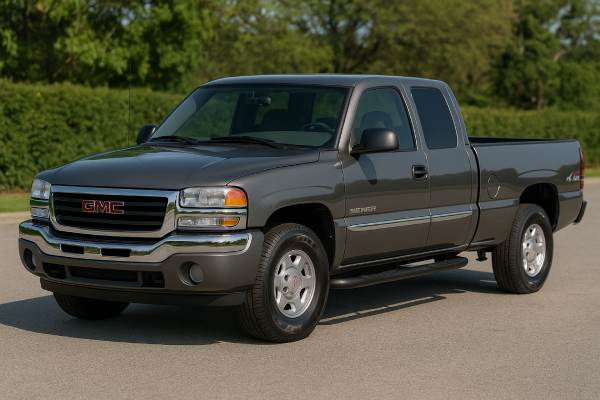
The GMT800-generation GMC Sierra 1500 4WD with the LM7 5.3 litre V8 sits in a sweet spot for many truck owners. It offers a strong, relatively simple pushrod V8, a proven part-time or AutoTrac four-wheel-drive system, and a chassis that can take years of work, towing, and winter use if it is maintained and protected from rust.
For buyers today, this truck is less about fancy technology and more about durability and parts availability. The LM7 shares much with later LS-based engines, making upgrades and repairs straightforward. At the same time, you get classic full-size truck traits: a separate frame, leaf-spring rear axle, and straightforward hydraulics and electrics.
This guide walks through what you need to know as an owner or shopper: key specifications, typical performance, real-world reliability patterns, maintenance priorities, and how the 5.3 4WD Sierra compares to rival half-ton pickups from the same era.
Owner Snapshot
- 5.3 litre LM7 V8 and 4WD drivetrain deliver strong low-end torque and confident towing for light to moderate trailers.
- Simple, well-understood mechanicals with excellent parts availability keep repair costs reasonable in most markets.
- Comfortable ride and refined V8 make it a pleasant long-distance or daily-use truck when maintained and shod with good tyres.
- Watch for frame and brake-line rust, front suspension wear, and aging fuel and EVAP components on higher-mileage trucks.
- Plan on engine oil and filter changes every 5,000 miles / 8,000 km or 6 months, whichever comes first, with severe-use service done more frequently.
Section overview
- GMC Sierra 5.3 4WD in detail
- Sierra 1500 5.3 4WD specs
- Trims, 4WD system, and safety
- Long-term reliability and known faults
- Maintenance schedule and buying guide
- Driving feel and off-road behaviour
- Sierra 5.3 4WD versus rivals
GMC Sierra 5.3 4WD in detail
The 2000–2006 GMC Sierra 1500 4WD with the LM7 5.3 litre V8 represents the core of the GMT800 truck line. Compared with the base 4.3 V6 and mid-level 4.8 V8, the 5.3 adds noticeably more torque and power without a huge penalty in fuel use. With 285 hp and a broad torque curve, it feels relaxed at highway speeds and confident with a trailer or full bed.
This generation kept a traditional full-frame layout with a solid rear axle and leaf springs, tuned to balance work capability with everyday comfort. In 4WD form, most trucks use a two-speed transfer case and independent front suspension. Many are equipped with GM’s AutoTrac system, which adds an automatic 4WD mode for slippery roads without the binding that can happen in part-time 4×4 on dry pavement.
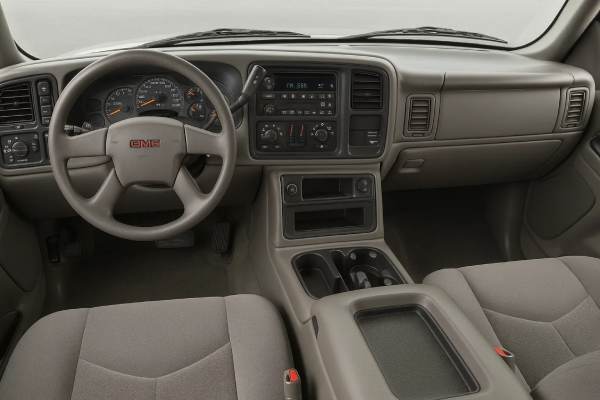
Inside, the Sierra 1500 5.3 4WD ranges from bare-bones work truck to leather-trimmed SLT. Three cab styles (regular, extended, and crew) and multiple bed lengths mean you can prioritise parking and manoeuvrability or maximum cargo floor. While the interior plastics are simple by modern standards, the controls are large, clear, and easy to use with gloves.
For owners today, the appeal lies in a combination of mechanical honesty and upgrade potential. The LM7 responds well to basic intake and exhaust improvements, and shares architecture with many performance LS engines, making swaps and tuning well documented. At the same time, the 4WD Sierra can serve as a reliable utility vehicle, winter truck, or tow rig, provided corrosion is managed and fluids are kept fresh.
Sierra 1500 5.3 4WD specs
This section focuses on a typical half-ton GMT800 Sierra 1500 4WD with the LM7 5.3 V8 and 4-speed automatic (4L60-E), in extended cab, short-box configuration. Exact figures vary slightly with year, cab, and axle ratios, but these numbers are representative.
Engine and performance
| Item | Value |
|---|---|
| Engine code | LM7 |
| Displacement | 5.3 l (5,328 cc) |
| Layout | 90° V8, iron block, aluminium heads |
| Valvetrain | OHV (pushrod), 2 valves per cylinder |
| Induction | Naturally aspirated |
| Fuel system | Sequential multi-port fuel injection |
| Compression ratio | ~9.5 : 1 |
| Max power | 285 hp (213 kW) @ ~5,200 rpm |
| Max torque | ~325 lb-ft (441 Nm) @ ~4,000 rpm |
| Rated fuel economy (4WD) | Typically mid-teens mpg US combined |
| Real-world highway (empty) | ~17–18 mpg US (13–14 l/100 km) |
Transmission and driveline
| Item | Value |
|---|---|
| Transmission | 4L60-E 4-speed automatic |
| Drive type | Part-time or AutoTrac 4WD |
| Transfer case (common) | NV246 (AutoTrac) 2HI / Auto 4WD / 4HI / 4LO |
| Typical axle ratios | 3.42 / 3.73 (varies by tow package) |
| Front differential | Independent, open |
| Rear differential | Solid axle; open or G80 automatic locking diff |
Chassis and dimensions
| Item | Value (typical ext. cab short box 4×4) |
|---|---|
| Front suspension | Independent torsion bar |
| Rear suspension | Solid axle, leaf springs |
| Brakes | Front disc, rear drum (most years) |
| Length | ~5,780 mm (227.6 in) |
| Width | ~2,000 mm (78–79 in) |
| Height | ~1,880 mm (74 in) |
| Wheelbase | ~3,645 mm (143.5 in) |
| Ground clearance | ~210 mm (8.3 in), trim-dependent |
| Turning circle (kerb-to-kerb) | ~13.4 m (44 ft) |
| Curb weight | ~2,150–2,250 kg (4,740–4,960 lb) |
| GVWR | ~2,900 kg (6,400 lb) |
| Fuel tank capacity | ~98 l (26 US gal) |
Performance and capability
| Item | Value (approximate) |
|---|---|
| 0–60 mph (0–97 km/h) | ~8.5–9.0 s (empty truck) |
| Top speed (limited) | ~160 km/h (around 99 mph) |
| Braked towing capacity | Up to ~3,800–4,000 kg (8,400–8,800 lb), spec-dependent |
| Payload | Typically ~600–750 kg (1,300–1,650 lb) |
| Roof load | Generally limited; follow rack rating |
Fluids and service capacities (typical)
Always confirm for your exact VIN and market.
| System | Specification / Capacity (approx.) |
|---|---|
| Engine oil | 5W-30 meeting GM spec; ~5.7 l (6.0 US qt) |
| Engine coolant | Dex-Cool, 50/50 mix; ~14–16 l (15–17 qt) |
| Transmission (4L60-E) | Dexron III/VI ATF; pan drop ~5–6 l, overhaul ~10–12 l |
| Transfer case (NV246) | AutoTrak II or specified fluid; ~1.9 l (2.0 qt) |
| Front differential | 75W-90 gear oil; ~1.4–1.6 l (1.5–1.7 qt) |
| Rear differential | 75W-90 gear oil; ~2.0–2.5 l (2.1–2.6 qt) |
| A/C refrigerant | R-134a, charge level model-year specific |
Electrical and safety tech (period-typical)
| Item | Value / Notes |
|---|---|
| Alternator output | ~105–145 A depending on options |
| 12V battery | ~600–650 CCA, group 78/34 or similar |
| Spark plug gap (typical) | ~1.5 mm (0.060 in), iridium plugs |
| Airbags | Dual front; later years add options |
| ABS | 4-wheel ABS standard |
| Stability control | Phased in on later model years/trims |
| Advanced ADAS | Not present (no AEB, ACC, lane assist) |
Trims, 4WD system, and safety
Across 2000–2006, the Sierra 1500 5.3 4WD was offered in several trims. Exact equipment varies by year and market, but you will usually see three core levels: a basic work-style trim, mid-level SLE, and higher-spec SLT.
Work Truck or base models are easy to spot by their simpler interior, bench seats, vinyl or cloth upholstery, and often a column shifter with fewer steering wheel buttons. Wheels are typically steel with hubcaps, and exterior trim is minimal. These trucks still commonly carried the 5.3 V8 in 4WD form when ordered for towing or fleet use, but may lack power accessories and upgraded audio.
SLE trucks add more convenience features: power windows and locks, better sound systems, and more brightwork outside. The dashboard and door panels get nicer materials, and you will often see alloy wheels and body-colour bumpers. SLT sits at the top, with leather seating, many power adjustments, automatic climate control on some years, and more sound insulation. SLT trucks are the easiest to identify inside thanks to their leather trim and often full-length centre console.
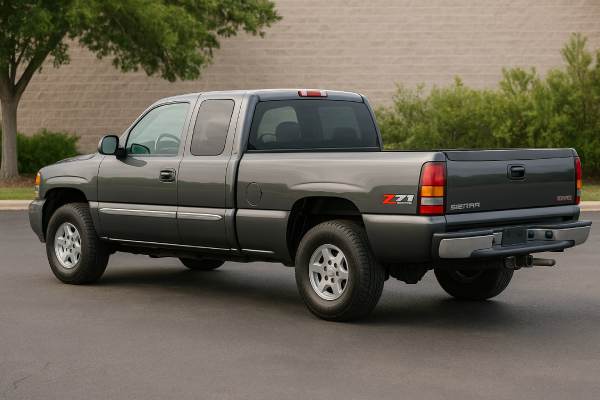
Key option packages shape how the truck drives and what it can tow. The Z71 Off-Road package adds tuned shocks, skid plates, and usually all-terrain tyres, making the 4WD system more effective off pavement. Tow packages (often linked to axle ratios like 3.73) add transmission coolers, wiring harnesses, and sometimes helper springs. If you plan to tow regularly, identifying these option codes on the SPID (Service Parts Identification) label in the glovebox is worthwhile.
Safety is typical of early-2000s pickups. Dual front airbags and 4-wheel ABS are standard, but side airbags and curtain airbags are rare. Stability control appears towards the later years and may not be present on all trims. Crash test ratings from that era tended to be mixed, especially for extended cab and older structure designs, so if safety is a priority, focus on trucks with the best available configuration and ensure belts, airbags, and seat mounts are in good condition. There is no native lane-keeping, automatic braking, or blind spot monitoring, so driver awareness and tyre/brake maintenance matter more than in newer vehicles.
Long-term reliability and known faults
The LM7 5.3 V8 is widely regarded as one of the most durable engines in this class when serviced correctly. Many Sierra 1500 4WD trucks have exceeded 200,000 miles (320,000 km) with their original engine and transmission. Even so, age and mileage bring predictable issues.
Common, usually moderate-cost issues include:
- Intake manifold and coolant leaks: Symptoms are gradual coolant loss, sweet smell, or dampness at the intake area. The cause is aging gaskets and plastics. The remedy is replacement of intake gaskets and careful inspection of coolant passages and hoses at the same time.
- Knock sensor and harness corrosion: Water intrusion under the intake can corrode knock sensors, leading to codes and reduced timing. The fix is to remove the intake, replace sensors and harness, and ensure proper sealing and drain paths.
- Fuel pump wear: Hard starting, low fuel pressure, or stalling under load often trace back to the in-tank pump. Replacement with a quality unit and verifying filter and wiring condition is the usual repair.
Driveline concerns centre on the 4L60-E automatic and front end components:
- 4L60-E wear: Harsh shifts, slipping in 3rd/4th, or no reverse frequently indicate worn clutches, a failed sun shell, or valve body problems. Fluid and filter changes can prolong life, but once symptoms are advanced, a rebuild or quality remanufactured unit is the realistic solution.
- Front suspension and steering: Idler arms, pitman arms, ball joints, and tie rod ends wear with time, especially on trucks that saw heavy loads or rough roads. Symptoms include wandering, uneven tyre wear, and clunks. A full front-end inspection and replacement with quality components, followed by alignment, restores stability.
Corrosion is one of the most serious long-term threats. On 4WD GMT800 trucks, watch for:
- Frame rust, especially near the rear spring hangers and cab mounts.
- Rusted brake and fuel lines along the frame rails.
- Rocker panels and cab corners rotting from the inside out.
These can range from cosmetic to structurally significant. A truck with severe frame corrosion can be uneconomical to repair even if the powertrain is sound.
Electrical issues are usually nuisance-level: instrument cluster stepper motors that cause erratic gauges, failing power window regulators, or aging ignition switch contacts. Many of these have well-understood fixes and, in some markets, were subject to extended warranties or service campaigns when the trucks were newer.
Before purchase, ask for recall and campaign history, and use official VIN lookup tools to confirm completion of any outstanding safety or corrosion-related actions.
Maintenance schedule and buying guide
A disciplined maintenance schedule is key to keeping a Sierra 1500 5.3 4WD reliable as it ages. Below is a practical baseline; always adjust for severe use such as frequent towing, off-road driving, and short-trip cold-weather operation.
Core service intervals (typical guidance)
- Engine oil and filter: Every 5,000 miles / 8,000 km or 6 months; 3,000 miles / 5,000 km if you tow often or idle extensively.
- Engine air filter: Inspect every 15,000 miles / 24,000 km; replace around 30,000 miles / 48,000 km or when dirty.
- Cabin air filter (if fitted): Every 2 years or 20,000–25,000 miles.
- Spark plugs: Iridium plugs often last close to 100,000 miles / 160,000 km; check earlier on high-mileage or rough-running engines.
- Coolant (Dex-Cool): Change around 5 years or 100,000–150,000 miles, then every 3–5 years, watching for contamination.
- Automatic transmission fluid: Drain and refill with filter every 50,000–60,000 miles if you plan to keep the truck; shorter if it tows frequently.
- Transfer case, front and rear differentials: 50,000 miles under heavy use; 80,000–100,000 miles under light duty.
- Brake fluid: Flush every 2–3 years to reduce corrosion and maintain pedal feel.
- Serpentine belt and hoses: Inspect at every oil change; plan on replacement by 90,000–100,000 miles or 6–8 years.
- Alignment and tyre rotation: Rotate tyres every 6,000–8,000 miles; align whenever components are replaced or uneven wear appears.
- 12V battery: Test yearly after 4–5 years; replace preventively around 6–7 years in harsh climates.
When evaluating a used Sierra 1500 5.3 4WD, bring a checklist:
- Frame and body: Inspect frame rails, crossmembers, rear spring hangers, steering box area, and cab mounts for rust or repairs. Check rocker panels and cab corners closely.
- Driveline: Engage 4HI and 4LO on a test drive to verify transfer case operation and listen for binding or grinding. Check for driveline vibrations under acceleration that can indicate worn U-joints or out-of-balance shafts.
- Engine and cooling: Look for coolant stains, oil leaks around the rear main and oil pan, and signs of overheating. A stable temperature gauge and clean coolant are good signs.
- Transmission: Shifts should be smooth, with no flares or harsh engagements. Delayed reverse or slipping in higher gears suggests future rebuild costs.
- Brakes and lines: On older 4WD trucks, closely inspect steel brake lines for rust, especially along the frame and near the rear axle.
As a buyer, prioritise trucks with:
- Documented fluid changes (especially transmission and diffs).
- Minimal rust, even if cosmetics are imperfect.
- Smooth, quiet driveline behaviour in all 4WD modes.
Avoid or price aggressively:
- Trucks with severe frame or brake-line corrosion.
- Units with obvious transmission issues or neglected fluids.
- Heavily modified trucks with unknown-quality lift kits or tuning unless you can verify the work.
With smart selection and baseline maintenance, the Sierra 1500 5.3 4WD can still offer many years of dependable service.
Driving feel and off-road behaviour
On the road, the Sierra 1500 5.3 4WD feels very much like a classic full-size truck, but a well-sorted example is comfortable and confidence-inspiring. The LM7 V8 delivers a smooth, relaxed idle and strong low- to mid-range torque. Around town, the engine rarely needs to spin above the mid-range to keep up with traffic. The 4L60-E transmission tends to upshift early under light throttle, which helps fuel use but can feel lazy; firmer throttle or tow/haul mode sharpens responses.
At highway speeds, the steering is light but stable. The truck tracks well if the front end is tight and aligned; wandering usually points to worn steering components or tired tyres. Wind and road noise are noticeable by modern standards, yet well-maintained door seals and good tyres make long trips easy enough. With the bed empty, the rear can feel bouncy over sharp bumps, which is normal for a leaf-sprung pickup. Adding a moderate load calms the ride.
Fuel economy is not the Sierra’s strongest suit, especially in 4WD form. Many owners see low- to mid-teens mpg US in mixed driving, with highway figures in the high teens at steady speeds. Short trips, big tyres, roof racks, and aggressive driving can push consumption higher.
Off-road and in poor weather, the 4WD system is the main differentiator from RWD versions. In 2HI, the truck behaves like a normal rear-drive pickup. Switching into Auto 4WD (on AutoTrac trucks) engages the front axle when slip is detected, which is useful on patchy snow or wet highways. 4HI locks front and rear together for snowy roads, gravel, and light trails, while 4LO provides the gearing for steeper climbs, descents, or extracting a trailer from a muddy site.
With stock suspension and tyres, the Sierra 1500 4WD is well suited to farm tracks, forest roads, and winter roads rather than extreme rock crawling. Ground clearance is moderate, and the front valance and steps are usually the limiting factors. An upgraded tyre package and mild levelling kit can improve breakover and approach angles without hurting road manners too much.
When towing, the 5.3 4WD combination feels secure up to its rated limits if the trailer is properly set up with trailer brakes and weight distribution where needed. Long mountain grades will raise coolant and transmission temperatures; a clean cooling system, functioning fan clutch, and auxiliary transmission cooler are essential. Expect a noticeable fuel consumption penalty when towing, often 30–50% higher than unloaded driving.
Sierra 5.3 4WD versus rivals
When you compare the 2000–2006 Sierra 1500 5.3 4WD with its main competitors, its strengths and weaknesses become clearer.
The obvious rivals are the Ford F-150 of the same era, the Dodge (Ram) 1500, and the first-generation Toyota Tundra. Ford offered a wide engine range, including the 5.4 Triton V8. Those trucks often ride slightly softer and may have more creature comforts in some trims, but the 5.4’s reputation for issues such as spark plug and timing-related concerns makes the LM7-powered Sierra attractive to buyers who prioritise long-term engine durability.
The Dodge Ram 1500 of this period, particularly with the 5.7 Hemi, can feel stronger off the line and has a distinctive styling and interior. However, some owners report front suspension and steering wear, and rust can be an issue depending on climate, much like the Sierra. Parts availability is good for both, but the LS-based GM engines enjoy a particularly rich aftermarket for tuning, swapping, and performance upgrades.
The Toyota Tundra is often praised for reliability and build quality, but it is smaller in its first generation and can command higher prices on the used market. If you need the combination of full-size interior space, strong towing, and lower purchase cost, the Sierra 1500 5.3 4WD can be the better value, especially if you are willing to address rust prevention and periodic front-end refreshes.
Where the Sierra 5.3 4WD clearly trails modern trucks is in safety tech and fuel economy. If you want native stability control on all trims, multiple airbags, or advanced driver assists, a newer generation truck may be a better choice. Yet for buyers focused on a mechanically straightforward, V8-powered 4WD with excellent parts support and the ability to tow and haul without complaint, the GMT800 Sierra remains a compelling option.
In practical terms, a well-maintained Sierra 1500 5.3 4WD can stand shoulder to shoulder with its period rivals in capability, and often surpass them in long-term ownership costs when you take into account the strength of the LM7 engine family and the availability of used and aftermarket components.
References
- GMC Sierra 1500 Crew Cab (2004) manual 2004 (Owner’s Manual)
- 2004 GMC SIERRA ➜ Owner’s Manual in PDF free download ➜ 2004 (Owner’s Manual)
- Car Safety Ratings | Vehicles, Car Seats, Tires 2023 (Safety Rating)
- 2003 GMC Sierra 1500 Review & Ratings 2003 (Review)
Disclaimer
This article is intended for general informational purposes only and is not a substitute for professional diagnosis, repair, or safety advice. Specifications, torque values, fluid capacities, and service intervals can vary by VIN, model year, market, and installed equipment. Always verify procedures and values against your official owner’s manual, factory service information, and the guidance of a qualified technician before performing any work on your vehicle.
If you found this guide useful, please consider sharing it with other owners or enthusiasts on platforms such as Facebook or X/Twitter. Your support helps make it possible to keep producing detailed, independent technical content.