
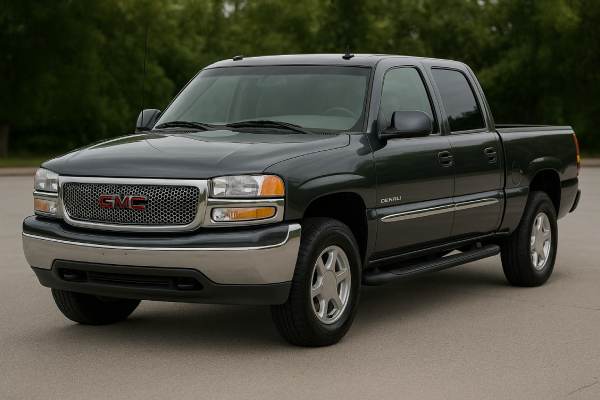
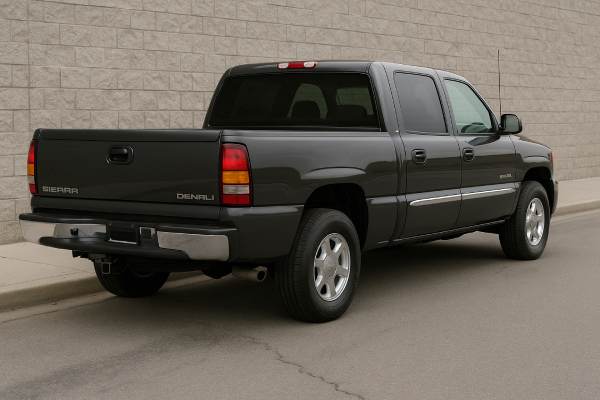
The GMT800-generation GMC Sierra 1500 Denali AWD sits at the upscale end of GM’s early-2000s full-size trucks. It pairs the stout LQ4 6.0-litre V8 with a full-time all-wheel-drive system, a more refined interior, and extra comfort equipment compared with the standard Sierra 1500. For many owners it is a do-it-all vehicle: it tows, hauls, and cruises long distances while still feeling special enough to use as a daily driver or family vehicle.
This guide focuses specifically on the 2001–2006 Sierra 1500 Denali with the 6.0-litre LQ4 and factory AWD. We will walk through key specs, common problems, service details, real-world performance, and how it stacks up against rival trucks of the same era. Whether you are evaluating a used example, planning upgrades, or simply want to understand your truck better, the sections below will give you a clear, practical picture of what to expect in ownership.
Top Highlights
- Strong LQ4 6.0 V8 and full-time AWD give confident acceleration and all-weather traction.
- Denali trim adds upscale interior, better sound insulation, and a more “SUV-like” feel than work-grade Sierras.
- Proven GMT800 chassis with excellent parts availability and strong aftermarket support.
- Watch for rust on frame and brake lines in road-salt regions, plus wear in front hubs and steering components.
- Plan on engine oil and filter changes every 5,000–8,000 km (3,000–5,000 miles) or 6 months on a mixed-use truck.
Navigate this guide
- Denali 6.0 AWD overview
- Technical data for Denali 6.0
- Denali equipment, AWD system, safety
- Reliability patterns and issue list
- Service schedule and buying tips
- On-road performance and comfort
- Denali 1500 versus competitors
Denali 6.0 AWD overview
The GMC Sierra 1500 Denali AWD occupies a niche between a luxury SUV and a traditional half-ton pickup. Built on the GMT800 platform from 2001 through 2006, it uses the LQ4 6.0-litre V8, a robust iron-block engine also found in heavy-duty GM trucks of the era. In the Denali, it is tuned for smoothness and mid-range torque rather than outright top-end power, with a rated output of around 325 hp and roughly 370 lb-ft of torque.
Unlike most Sierra 1500 models, the Denali uses a full-time AWD system instead of a selectable 4×4 transfer case. There is no 2WD mode; power is always routed through a centre differential to both axles. That gives a very secure feel in rain, snow, or on mixed-grip surfaces, and removes the need to decide when to engage four-wheel drive. The trade-off is slightly higher fuel consumption and more complexity in the driveline.
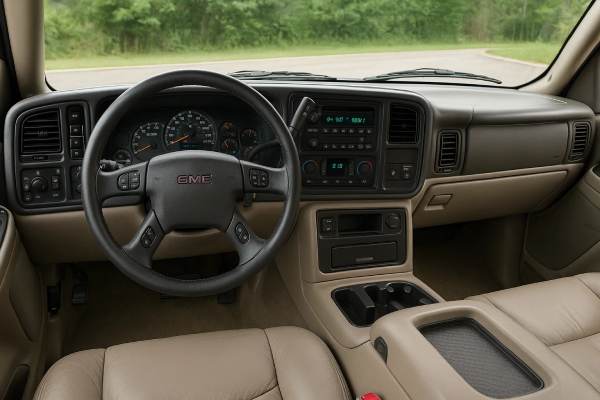
Inside, the Denali is closer to a premium SUV than a basic work truck. You typically get leather upholstery, heated front seats, a higher-end audio system, and more sound insulation. Many trucks also feature steering-wheel controls, memory driver’s seat, automatic climate control, and other comfort touches that were optional or unavailable on lower trims.
While the LQ4/AWD combination gives the Denali solid towing and hauling capability, payload ratings are still in the half-ton range. It is not a three-quarter-ton HD truck and should not be treated as one. When used within its design limits and maintained correctly, however, the Denali 1500 AWD can deliver long service lives, especially in milder climates where corrosion is less aggressive.
For shoppers, the main appeal is a blend of classic V8 truck character, everyday usability, and upscale equipment—without the complexity of later direct-injection or cylinder-deactivation engines. The rest of this guide explores the technical details, known weak points, and ownership realities in more depth.
Technical data for Denali 6.0
This section summarises the key mechanical and dimensional specifications for the GMT800 Sierra 1500 Denali AWD with the LQ4 6.0-litre V8. Figures can vary slightly by year, cab style, and equipment; treat numbers as typical values rather than VIN-exact data.
Engine and performance (LQ4 6.0 V8)
| Item | Specification (approximate) |
|---|---|
| Engine code | LQ4 |
| Layout and cylinders | V8, 90°, pushrod (OHV) |
| Valvetrain | 2 valves per cylinder, hydraulic roller lifters |
| Displacement | 6.0 L (5,967 cc) |
| Bore × stroke | 101.6 mm × 92.0 mm (4.00 in × 3.62 in) |
| Induction | Naturally aspirated |
| Fuel system | Sequential multi-port fuel injection |
| Compression ratio | ~9.4 : 1 |
| Max power | ~325 hp @ 5,000 rpm |
| Max torque | ~502 Nm (370 lb-ft) @ 4,000 rpm |
| Timing drive | Chain |
| Recommended fuel | Unleaded regular (octane as per local spec) |
| Typical combined economy | Roughly 15–17 L/100 km (14–17 mpg US) depending on use |
Transmission and AWD driveline
| Item | Specification (typical) |
|---|---|
| Transmission | 4-speed automatic, 4L65-E (later years) / 4L60-E (early) |
| Gear ratios (1st–4th) | 3.06 / 1.63 / 1.00 / 0.70 |
| Reverse | 2.29 |
| Final drive ratio | Commonly 3.73 : 1 |
| Drive type | Full-time AWD (no 2WD mode) |
| Centre differential | Planetary with viscous coupling (AutoTrac-based system) |
| Rear differential | Open or automatic locking (G80), depending on build |
Chassis, dimensions, and capacities
Values below assume a typical crew-cab Denali; extended-cab trucks differ slightly.
| Item | Specification (approximate) |
|---|---|
| Front suspension | Independent, torsion-bar, double wishbone |
| Rear suspension | Solid axle, leaf springs |
| Steering | Recirculating ball, power-assisted |
| Front brakes | Disc, approx. 305–325 mm (12–12.8 in) |
| Rear brakes | Disc on most Denali models |
| Wheelbase | ~3,645 mm (143.5 in) |
| Overall length | ~5,780 mm (227–228 in) |
| Overall width | ~2,000 mm (79 in) |
| Height | ~1,890–1,930 mm (74–76 in) |
| Ground clearance | Around 200–230 mm (8–9 in), depending on tyres |
| Curb weight | Roughly 2,450–2,650 kg (5,400–5,850 lb) |
| GVWR | Typically 3,130–3,220 kg (6,900–7,100 lb) |
| Fuel tank capacity | About 98 L (26 US gal) |
| Typical towing capacity | ~3,600–3,900 kg (8,000–8,600 lb), depending on year |
| Typical payload | ~600–750 kg (1,300–1,650 lb), depending on options |
Performance and capability
| Item | Typical figure (unladen, stock) |
|---|---|
| 0–100 km/h (0–62 mph) | Approx. 8–9 s |
| Top speed (governed) | Around 170–180 km/h (105–112 mph) |
| 100–0 km/h braking | In line with other full-size trucks of the era |
| Roof load | Consult roof-rack rating, often ~75–100 kg (165–220 lb) |
Fluids and service capacities (typical)
Always confirm exact specifications for the model year and market:
- Engine oil: 5W-30 meeting GM’s spec of the era; capacity roughly 5.7–6.6 L (6–7 US qt).
- Coolant: Long-life OAT (commonly Dex-Cool type); capacity around 15–16 L including heater circuit.
- Transmission fluid: Dexron III or successor; total system capacity roughly 11–12 L, pan refill less.
- Transfer case fluid (AWD): GM Auto-Trak II (blue fluid), a few litres depending on case.
- Differential oil: 75W-90 GL-5, add friction modifier if required for certain limited-slip units.
- A/C refrigerant: R-134a, with charge amount varying by year and system configuration.
Electrical highlights:
- Alternator outputs are typically in the 130–145 A range.
- 12 V battery is generally a Group 78 or similar size, with cold-cranking ratings suited to starting a large V8 in cold climates.
- Spark plugs are long-life types with fine-wire electrodes and a small, specified gap; replacement intervals are usually around 160,000 km (100,000 miles) under normal use.
Denali equipment, AWD system, safety
The Denali badge signifies a more luxurious and better-equipped Sierra 1500. While exact features vary year to year, you can expect most trucks to include leather seating, power-adjustable and heated front seats, upgraded audio, and body-colour or chrome exterior trim that distinguishes them from work-grade Sierras. Many trucks also received unique wheel designs and, in some years, optional Quadrasteer four-wheel steering on short-bed models.
From a mechanical point of view, the most notable difference is the full-time AWD system. Instead of the typical 2HI/4HI/4LO transfer case found in many GMT800 trucks, the Denali uses a transfer case with an integrated centre differential. Power is continuously split between the front and rear axles, often in a rear-biased ratio that shifts torque forwards as slip is detected. The system is designed to be transparent in normal driving: there is no lever to pull or knob to turn for everyday conditions.
In snow or rain, this gives the Denali a very sure-footed feel, especially when paired with all-season or dedicated winter tyres. On dry pavement, the AWD system helps prevent wheelspin when pulling away from junctions or when the truck is lightly loaded. The downsides are higher parasitic losses in the driveline, extra wear items (front diff, CV shafts, transfer-case internals), and a bit more complexity to service. Regular fluid changes in the transfer case and differentials are essential for long life.
Trim-level identifiers include:
- Denali badging on the doors or tailgate.
- Specific interior trim patterns, including wood-effect panels in many years.
- A distinctive instrument cluster and steering wheel on some models.
- Often, projector-style or upgraded headlamp and fog-lamp arrangements, depending on year and market.
Safety equipment reflects early-2000s design. You usually get dual front airbags and three-point belts for most seating positions. Side airbags were not universally fitted, and stability control was either unavailable or only introduced late in the run. Anti-lock braking (ABS) and traction control are generally standard on the Denali. Child-seat compatibility is provided by LATCH/ISOFIX-type anchors on the rear bench in crew-cab models.
Crash ratings from this era typically place the Sierra 1500 in the middle of the pack: acceptable for its time but not comparable to more modern full-size trucks with advanced crash structures and comprehensive airbag coverage. The key takeaway is that a well-maintained Denali with good tyres and working ABS/AWD can be very stable and predictable, but it still reflects the safety technology of its design period.
Reliability patterns and issue list
Overall, the LQ4-powered Denali has a good reputation for durability, especially in the engine department. Many trucks exceed 300,000 km (200,000 miles) with original long blocks if serviced properly. However, age, mileage, and corrosion now play a large role in reliability. The issues below are common patterns rather than guaranteed failures.
Engine and ancillaries
- Knock sensor and harness corrosion (common, medium cost): On these V8s, water can pool in the valley under the intake manifold, corroding knock sensors and their wiring. Symptoms include stored knock-sensor codes and retarded ignition timing. The fix is to remove the intake, replace sensors and harness, and improve sealing around the sensor wells.
- Exhaust manifold bolts (common, low–medium cost): Broken or rusted manifold bolts can cause ticking noises on cold start and minor exhaust leaks. Repair ranges from straightforward to challenging depending on how many bolts have snapped and where.
- Oil leaks (occasional, low–medium cost): Common sources include valve-cover gaskets, rear main seal area, and oil-pan gaskets. Most leaks are slow and manageable but should be monitored.
Cooling and fuel systems
- Radiator and heater-hose leaks (occasional, low cost): Age-related plastic and rubber degradation can cause small leaks. Replacing hoses, clamps, and sometimes the radiator itself is typical high-mileage maintenance.
- Fuel pump module failure (common, medium cost): In-tank electric fuel pumps can fail after many years, especially in hot climates or when frequently run low on fuel. Symptoms include long cranking, hesitation, or no-start. Replacement requires dropping the tank or lifting the bed.
Transmission and AWD
- 4L60-E / 4L65-E wear (occasional–common, medium–high cost): As mileage and towing hours build, you can see worn clutch packs, harsh shifts, or slipping in one or more gears. Trucks used within their tow ratings and serviced regularly tend to fare better.
- Transfer case “pump rub” (occasional–common, medium cost): Some GM transfer cases from this era can develop a wear hole in the rear housing due to internal pump movement, leading to fluid loss. Early detection and fitting of an updated pump-retainer kit can prevent major damage.
- Front differential and CV joint wear (occasional, medium cost): Full-time AWD means the front end is always engaged. Worn bearings or CV joints show up as humming, vibration, or clicking on turns.
Steering, suspension, and brakes
- Intermediate steering-shaft clunk (common, low cost): A light knock or clunk in the steering column over bumps is often due to the intermediate shaft. Lubrication kits or replacement shafts are standard fixes.
- Front hub bearings (common, medium cost): Heavy trucks, big wheels, and AWD load the front hubs. Failed units cause humming that changes with speed and steering input.
- Ball joints and control-arm bushings (occasional–common, medium cost): Wear shows as looseness in the front end and uneven tyre wear. On high-mileage trucks, a full front-end refresh can dramatically improve feel.
- Brake line corrosion (common in salt regions, medium–high cost): Steel brake lines along the frame can corrode and burst, often during hard stops. Many owners opt for replacement with coated or stainless lines.
Body and electrical
- Frame and body rust (region-dependent, high severity if advanced): In road-salt climates, check frame rails, crossmembers, cab corners, rockers, and bed supports. Severely rusted frames can be uneconomical to repair.
- Instrument-cluster stepper motors (common, low–medium cost): Erratic speedometer, tachometer, or fuel gauge readings are often due to failing stepper motors in the instrument cluster. Rebuild or replacement is the typical remedy.
- Door-lock actuators and window regulators (occasional, low–medium cost): Age and use take their toll on power accessories; fortunately, parts are widely available.
Many issues have been addressed by technical service bulletins over the years. When considering a truck, ask for documentation of transmission services, transfer-case fluid changes, and any work on steering, hubs, or brake lines. These items give a good sense of how seriously previous owners took maintenance.
Service schedule and buying tips
Because these trucks are now two decades old, a “by the book” schedule is only part of the picture. Age-related wear, prior use, and climate matter as much as mileage. The intervals below are sensible for a used Denali in mixed daily use and occasional towing; always adapt to your conditions.
Baseline maintenance (if service history is unknown)
When you first acquire the truck, it is wise to:
- Change engine oil and filter immediately, then set your own interval.
- Replace air filter and cabin filter (if fitted).
- Refresh coolant, brake fluid, and power steering fluid.
- Service transmission, transfer case, and differentials (new fluid, inspect magnets).
- Fit new spark plugs if mileage or age is uncertain.
- Inspect and, if needed, replace serpentine belts, tensioners, and critical hoses.
Ongoing maintenance (typical intervals)
- Engine oil and filter:
- Every 5,000–8,000 km (3,000–5,000 miles) or 6 months for mixed/short-trip or towing use.
- Up to 10,000–12,000 km (6,000–7,500 miles) for light-duty, mostly highway use using quality oil.
- Engine air filter:
- Inspect annually; replace every 30,000–40,000 km (20,000–25,000 miles) or sooner in dusty conditions.
- Cabin filter (if equipped):
- Replace every 24 months or 30,000 km (around 20,000 miles).
- Coolant (Dex-Cool type):
- If original or unknown, replace immediately. Afterwards, every 5 years or 160,000 km (100,000 miles) is typical, but shorter intervals are cheap insurance in older systems.
- Spark plugs:
- Long-life plugs often have a 160,000 km (100,000-mile) nominal life. For a high-mileage truck, replacing at 120,000–160,000 km (75,000–100,000 miles) helps maintain smooth running.
- Fuel filter:
- On trucks with a serviceable frame-rail filter, replace every 40,000–50,000 km (25,000–30,000 miles). Some later systems integrate the filter with the pump module.
- Automatic transmission fluid and filter:
- Every 50,000–60,000 km (30,000–40,000 miles) for trucks that tow, idle a lot, or work hard; up to 80,000–100,000 km (50,000–60,000 miles) for gentle use.
- Transfer case and differential fluids:
- Every 50,000–80,000 km (30,000–50,000 miles), especially on full-time AWD systems.
- Brake fluid:
- Flush every 2–3 years to prevent internal corrosion.
- Brake inspection (pads, rotors, lines):
- At least annually, or every 12,000–15,000 km (7,500–9,000 miles).
- Tyre rotation and alignment check:
- Rotate every 10,000–12,000 km (6,000–7,500 miles) to even out wear.
- Inspect alignment if you notice pulling, uneven wear, or after suspension work.
- 12 V battery:
- Test annually after the third year; many last 4–6 years in typical climates.
There is no timing belt to replace on the LQ4; it uses a timing chain. Inspection focuses on listening for abnormal noises, monitoring for timing-correlation codes, and responding to symptoms rather than preventive replacement on a schedule.
Buyer’s checklist
When evaluating a used Sierra 1500 Denali AWD:
- Frame and body: Check frame rails, rear spring mounts, cab corners, rockers, bed crossmembers, and brake-line routing for rust or repairs. Avoid trucks with deep structural corrosion.
- Driveline: On a test drive, listen for humming or grinding from the front hubs and differentials. Feel for shudder or slipping in the transmission under moderate throttle.
- AWD system: Perform tight circles in a parking lot; listen for binding, clunks, or CV-joint clicking. Check for fluid leaks at the transfer case and diffs.
- Steering and suspension: Look for play in the steering wheel, clunks over bumps, and uneven tyre wear. A vague or wandering feel suggests worn front-end components or alignment issues.
- Brakes: Check pedal firmness, look for rusted steel lines along the frame, and inspect rotors and pads.
- Interior and electronics: Test all windows, locks, HVAC modes, heated seats, and cluster gauges. A malfunctioning gauge cluster is common but fixable.
Well-maintained Denalis tend to feel tight, quiet, and strong even at higher mileages. Trucks that have towed within ratings, stored indoors, and seen regular fluid changes are often the best long-term bets.
On-road performance and comfort
The Sierra 1500 Denali AWD aims to deliver a more refined driving experience than a basic work truck while retaining core utility. The LQ4 6.0-litre V8 is the centrepiece: it offers a broad torque curve that makes the truck feel relaxed in everyday driving. Throttle response is strong but progressive; when you press deeper, the engine pulls hard through the mid-range with a classic V8 sound that is present but not overwhelming in the cabin.
With the 4-speed automatic, acceleration is brisk rather than outright quick. The transmission’s wide first gear helps the truck launch confidently, and the torque-converter characteristics make it easy to pull away smoothly with a trailer or full load. The downside is that only having four ratios means the engine revs higher at highway speeds than in modern 6-, 8-, or 10-speed trucks, which hurts fuel economy.
Ride quality benefits from the Denali’s weight, longer wheelbase, and more comfort-oriented suspension tuning. It still feels like a body-on-frame truck over sharp bumps, but the suspension does a decent job of smoothing out patched roads and freeway expansion joints. The cabin is generally quieter than lower trims thanks to extra sound insulation and more upscale interior materials. At motorway speeds, wind and tyre noise dominate more than engine noise, especially once in top gear.
Steering is light with a slow ratio, typical of full-size trucks from this era. Straight-line stability is good, and the truck tracks confidently at speed when the front-end components are in good condition. Cornering is predictable, with gentle understeer and noticeable body roll if you push it; this is a comfortable cruiser, not a sports truck.
The full-time AWD system shines in low-grip conditions. Pulling away on wet roads or packed snow feels drama-free, especially with appropriate tyres. On dry pavement, you rarely notice the system working unless you are watching driveline behaviour closely. Off-road, the Denali is limited more by tyre choice, ground clearance, and lack of low range than by the AWD system itself. It handles muddy tracks, snowy lanes, and light trails well, but it is not the best choice for serious rock crawling or deep sand.
Fuel consumption is the main compromise. In typical mixed driving, many owners see low- to mid-teens mpg (US), roughly mid-teens L/100 km. Highway figures can climb into the 12–14 L/100 km (17–20 mpg US) range with gentle driving and no trailer, but heavy towing or short-trip city use can pull the numbers down into the high-teens or low-20s L/100 km. If your priority is maximum efficiency, a smaller-engine 2WD truck or a newer platform will do better.
Under load, the Denali’s extra power and AWD traction help maintain speed on grades, but you must respect cooling limits and tow ratings. With sensible driving, appropriate trailer brakes, and fresh fluids, it can tow a medium-size camper or boat confidently, though its suspension and brakes are tuned more for comfort than for constant maximum-load work.
Denali 1500 versus competitors
When new, the Sierra 1500 Denali AWD competed with higher-end versions of other full-size trucks: upscale Ford F-150 trims, Dodge Ram 1500 models with the 5.7-litre Hemi, and well-equipped Toyota Tundras of the era. Today, used-market shoppers often cross-shop the Denali with those same trucks as well as early Nissan Titans.
Against Ford F-150 (early-2000s)
Well-optioned F-150s offer comfortable interiors and a broad engine range, including 5.4-litre V8s. Ford’s ride quality is generally comparable, and some owners prefer the feel of Ford’s steering and braking. However, the Denali’s 6.0-litre V8 is particularly strong, and the full-time AWD system gives it an advantage in mixed-traction everyday driving. Ford’s selectable 4×4 systems, by contrast, require driver input and are not meant for use on dry pavement in 4×4 high.
Against Dodge Ram 1500 (5.7 Hemi)
The Hemi-equipped Ram 1500 is known for its punchy acceleration and distinctive styling. Ride quality, especially in later years, is good. However, some owners report more issues with front-end components and rust than with comparable Sierras, depending on climate. The Denali counters with a smoother, more understated power delivery and a more SUV-like interior feel.
Against Toyota Tundra (first generation)
The first-generation Tundra is smaller than the domestic full-size trucks and has an excellent reputation for long-term reliability. It often wins on durability of small components and resistance to certain drivetrain issues. Where the Denali leads is in cabin size, towing capacity, and the availability of a powerful 6.0-litre V8 with full-time AWD. If you want the most trouble-free light-duty truck, a Tundra may have the edge; if you want more space and power, the Denali is attractive.
Against Nissan Titan (first generation)
The early Titan offers strong performance and decent tow ratings, but many examples suffer from rust and various drivetrain or differential issues. Parts availability is good but generally not as extensive as for GM trucks. The Denali benefits from the vast GMT800 parts ecosystem and a long history of aftermarket support, making it easier to keep on the road and to customise.
Overall, the Sierra 1500 Denali AWD is a compelling choice if you value:
- A strong, simple pushrod V8 with good aftermarket support.
- A comfortable, well-equipped interior with an SUV-like feel.
- All-weather traction without manual 4×4 engagement.
Its downsides include relatively poor fuel economy, aging safety design compared with modern trucks, and the need to stay ahead of rust and wear in the steering, suspension, and brake systems. For buyers who accept those trade-offs, a well-maintained Denali can still be a satisfying and capable full-size truck.
References
<a href="https://www.iihs.org/ratings/vehicle/gmc/sierra-1500-extended-cab-pickup/2003">GMC Sierra 1500 extended cab pickup 2003 ratings</a> 2003 (Safety Rating)<a href="https://www.gmc.com/">GMC Official Site</a> 2024 (Manufacturer Information)<a href="https://www.chevrolet.com/support/vehicle/manuals-guides">GM Owner’s Manuals and Guides</a> 2024 (Owner’s Manual)<a href="https://www.nhtsa.gov/recalls">NHTSA Recalls Lookup</a> 2024 (Recall Database)<a href="https://www.nhtsa.gov/vehicle">NHTSA Vehicle Safety Ratings</a> 2024 (Safety Rating)
Disclaimer
This article is intended for informational purposes only and is not a substitute for professional diagnosis, repair, or official service literature. Specifications, torque values, fluid types, and maintenance intervals can vary by VIN, model year, market, and installed equipment. Always confirm procedures and values with the official service manual, current technical bulletins, and qualified technicians before performing any work on your vehicle.
If you found this guide useful, please consider sharing it with other owners or enthusiasts on platforms like Facebook or X/Twitter. It helps support the effort required to create and maintain detailed, model-specific resources like this one.