
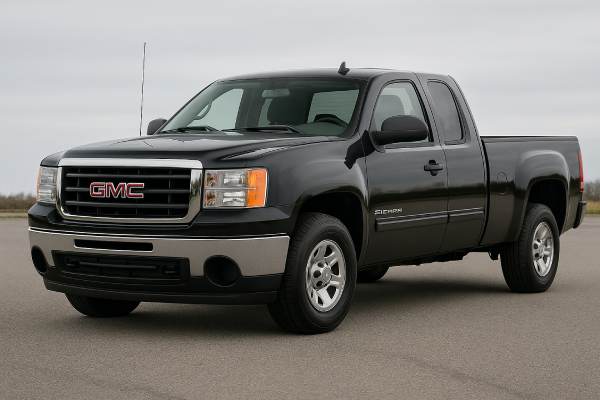
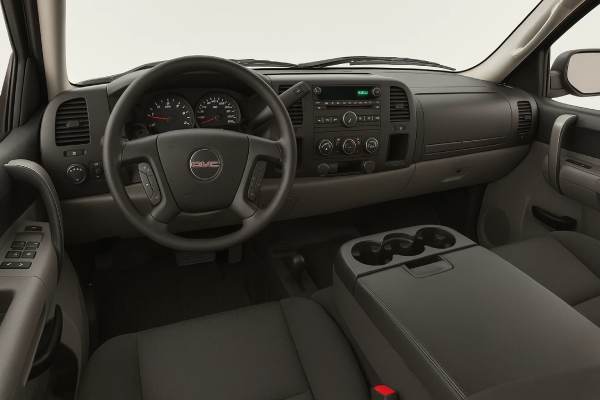
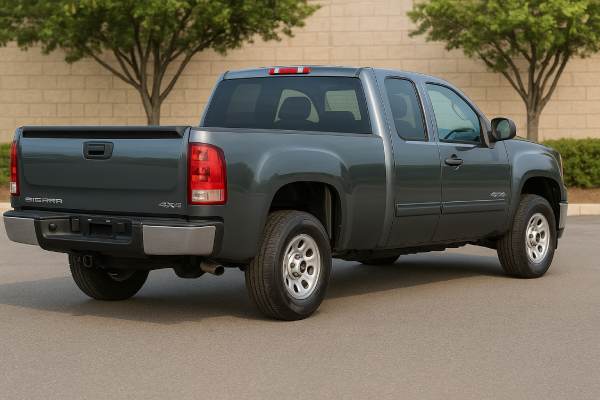
The GMT900-generation GMC Sierra 1500 with the LU3 4.3 litre V6 and part-time 4WD is one of the simplest full-size trucks you can buy from this era. It combines an old-school pushrod V6, a proven four-speed automatic, and a traditional 4×4 system with a two-speed transfer case. Power is modest at 195 hp, but torque comes in low, making it usable for light towing, plowing, and job-site work rather than high-speed hauling. Compared with V8 Sierras, the 4.3 4WD is lighter on upfront cost, easier to service, and mechanically less complex, though you still add the maintenance needs of the front differential and transfer case. Owners value these trucks for their rugged frames, straightforward interiors and wide availability of parts. If you need a basic 4×4 work truck for snowy climates or rough access roads, this configuration offers a practical balance of capability, durability, and running costs.
Owner Snapshot
- Simple LU3 4.3 V6 and 4×4 driveline are durable and well understood by independent shops.
- Regular cab 4WD layout gives a tight 39–40 ft turning circle yet good ground clearance and approach/departure angles.
- Fuel economy is notably worse than 2WD V6 trucks; 4WD adds weight, drag, and extra rotating mass.
- Transfer case and differentials benefit from fluid changes about every 80,000–100,000 km (50,000–60,000 miles), sooner with heavy towing.
Guide contents
- GMC Sierra 4.3 4WD summary
- 4.3 4WD specs and data
- 4WD trims, options and safety
- Reliability issues on 4WD models
- Maintenance planning and buyer guide
- Driving feel and off road use
- 4.3 4WD Sierra versus rivals
GMC Sierra 4.3 4WD summary
The 2007–2013 GMC Sierra 1500 4WD with the LU3 4.3 litre V6 sits at the bottom of the powertrain range but still delivers genuine pickup capability. It is most commonly found as a Work Truck (WT) regular cab with the standard bed and part-time 4×4; extended cab versions exist but are less common with the V6. The heart of the package is the 90° pushrod V6, a derivative of GM’s long-running small-block architecture, rated at 195 hp and around 353 Nm (260 lb-ft) of torque at just 2,800 rpm.
In this configuration the Sierra uses a traditional ladder frame, independent front suspension with torsion bars on 4WD models, and a solid rear axle with leaf springs. The 4×4 system is generally a two-speed transfer case with 2HI, 4HI, and 4LO, plus an optional Auto 4WD mode on trucks with the NP8 automatic transfer case. This layout gives you good all-weather traction and low-range gearing for slow off-road work or backing trailers on steep ramps.
Compared with V8 Sierras, the 4.3 4WD variant trades acceleration and high towing ratings for lower purchase cost, simpler emissions hardware, and slightly better fuel economy when unloaded. In real use, though, adding 4WD means city and highway consumption is still firmly in “full-size truck” territory.
This truck is best suited to owners who:
- Need reliable 4×4 traction for winter, job sites, or rural access roads.
- Tow moderate trailers rather than max-weight loads.
- Prefer a simple, serviceable powertrain over the latest technology.
Overall, the 4.3 4WD Sierra is a straightforward, no-frills work tool rather than a luxury tow rig, and that simplicity is a large part of its appeal.
4.3 4WD specs and data
Engine and performance (LU3 4.3 V6)
| Item | Specification |
|---|---|
| Engine code | LU3 Vortec 4300 V6 |
| Configuration | 90° V6, iron block, iron heads, OHV, 2 valves/cyl |
| Displacement | 4.3 l (4,300 cc) |
| Bore × stroke | 101.6 mm × 88.4 mm (4.00 in × 3.48 in) |
| Compression ratio | 9.2:1 |
| Induction | Naturally aspirated |
| Fuel system | Multi-point fuel injection (MFI) |
| Max power | 195 hp (145 kW) @ 4,600 rpm |
| Max torque | 353 Nm (260 lb-ft) @ 2,800 rpm |
| Timing drive | Chain |
| Emissions standard | US EPA / CARB light-duty truck regulations for the period |
Factory ratings and independent data put city fuel consumption around 16.8 l/100 km (14 mpg US) and extra-urban about 13.1 l/100 km (18 mpg US) for the regular cab 4WD V6. Real-world owners typically see mid-teens l/100 km combined (14–16 mpg US), with winter and 4WD use pushing numbers higher.
Transmission and driveline
Most LU3 4.3 4WD Sierras use:
- Transmission: 4L60E/4L60 automatic, 4-speed, electronically controlled.
- Drive type: Part-time 4×4 with rear-wheel drive in 2HI and selectable 4HI/4LO.
- Transfer case: Electronically shifted two-speed case (often NP246/NP261 variants on trucks with AutoTrac/NP8).
- Final drive ratios: Common axle ratios include 3.23 and 3.42; some fleet trucks have 3.73 for better towing.
A limited-slip rear differential is optional on many trims and worth seeking if you regularly drive in snow or on loose surfaces.
Chassis, dimensions and capacities
(Data below refers mainly to a Regular Cab, Standard Box 4.3 4WD automatic.)
| Item | Specification |
|---|---|
| Body style | Regular Cab, Standard Box, 2 doors, 3 seats |
| Length | 5,222 mm (205.6 in) |
| Width (without mirrors) | ~2,031 mm (80.0 in) |
| Height | ~1,875 mm (73.8 in) |
| Wheelbase | 3,023 mm (119.0 in) |
| Ground clearance | ~231 mm (9.1 in) |
| Approach / departure angle | ~16.2° / 24.2° |
| Curb weight (approx.) | 2,000–2,250 kg (4,400–4,950 lb) depending on bed/wheelbase |
| GVWR | ~2,900–3,000 kg (≈6,400–6,600 lb) |
| Fuel tank | 98 l (26 US gal) on standard box trucks |
| Bed volume (standard box) | ~1,718 l (60.7 cu ft) |
Suspension and brakes:
- Front suspension: Independent, torsion-bar on 4WD with stabiliser bar.
- Rear suspension: Solid axle with semi-elliptic leaf springs.
- Steering: Power-assisted rack-and-pinion.
- Brakes: Front ventilated discs, rear drums on most V6 work trucks; 4-wheel ABS standard.
Performance, towing and payload
Official acceleration figures for the 4.3 4WD are modest; think roughly 0–100 km/h in the mid- to high-10 second range when empty. This truck is tuned more for low-speed pulling than sprints.
Typical capacities (vary with axle ratio and equipment):
- Max towing (bumper-pull): Around 8,900–9,800 lb (≈4,000–4,450 kg) for 4WD regular cab V6 trucks with the right axle and cooling package.
- Payload: Roughly 1,565–1,705 lb (710–775 kg) for 4WD regular cabs.
If you routinely tow near the upper end of this range, a V8 Sierra will feel less strained; however, for medium-duty trailers, the 4.3 4WD is usable if you are patient and keep speeds reasonable.
Fluids, electrical and key specs
Approximate service capacities for a V6 4WD regular cab:
- Engine oil: 4.5 qt / 4.3 l of 5W-30 oil meeting GM 6094M / later dexos1 specs.
- Coolant: ~11.9 l of DEX-COOL extended-life coolant.
- Automatic transmission (4L60E): Roughly 11–12 qt for a full refill; 4–6 qt on a typical pan drop and filter change.
- Transfer case: Around 2 qt (≈1.9 l) of GM Auto-Trak II fluid on NP246-type cases.
- Front/rear axles: Commonly 75W-90 synthetic gear oil (GL-5), ~1.6–2.0 l per axle depending on housing.
- Alternator: Many V6 WTs use a 145 A alternator; towing packages may add higher-output units.
Critical torque examples (always verify per VIN):
- Wheel lug nuts: around 190 Nm (140 lb-ft).
- Spark plugs: roughly 25 Nm (18 lb-ft).
- Oil drain plug: around 25–30 Nm (18–22 lb-ft).
4WD trims, options and safety
Trims and configurations
For this specific LU3 4.3 4WD setup, the most common trim is the Work Truck (WT):
- WT 4WD Regular Cab, Standard Box: Vinyl or basic cloth seats, rubber floors, manual or simple power windows/locks, and a basic audio head unit.
- Some extended cab WTs and low-spec SL or SLE trucks also carried the 4.3, but most higher trims paired 4WD with a V8 instead.
Key mechanical and functional differences by configuration:
- Axle ratios: Many WT V6 trucks use 3.23 gears for economy; fleet and snowplow packages may have 3.42 or 3.73. Shorter gearing helps towing and off-road control.
- Suspension codes: Options like Z71 (off-road) or Z85 (handling/trailering) alter shock valving, stabiliser bars and sometimes tire packages.
- Tow packages: Add a hitch receiver, 7-pin wiring, transmission cooler and, sometimes, upgraded alternator.
Quick identifiers:
- Badging: “4×4” bed-side decals on many trucks, plus “Work Truck” or “SLE” tailgate emblems.
- Interior clues: Rubber floors and a simple radio unit usually mean WT; SLE adds carpet, more sound insulation, and upgraded audio.
- RPO codes: The glovebox option label (SPID sticker) lists codes like LU3 (engine), NP8 (AutoTrac 4WD), GT4/GT5 (axle ratios).
Safety ratings
Crash-test data for GMT900 Sierra covers the line as a whole rather than every engine/trim variation:
- IIHS: 2007–2013 Sierra 1500 crew cab (structurally similar) scores Good in moderate overlap front and Acceptable in side-impact tests, with Acceptable head restraint ratings.
- NHTSA (earlier protocol): Sierra 1500 regular and extended cab trucks received five stars for driver protection and four–five stars for passenger and side impacts in many model years.
Your specific truck’s rating can depend on cab style and the presence of side airbags; by 2010, head curtain and torso airbags became more widely standard, improving side-impact performance.
Safety equipment and driver assistance
Typical safety and assistance features on 2007–2013 Sierra 1500 4WD with the 4.3 include:
- Airbags: Dual front airbags across all years; head curtain side airbags and front seat torso airbags phased in and became more common from 2010 onward.
- Braking and stability: 4-wheel ABS and StabiliTrak stability control available or standard on most 4WD trucks in this era.
- Traction control: Often included with StabiliTrak; helps limit wheelspin in 2HI but does not replace 4×4 use.
- Child-seat provisions: Rear seat LATCH anchors on extended cab versions; regular cab trucks require careful placement and often are not ideal for rear-facing seats.
Advanced driver-assistance systems (AEB, lane-keeping, adaptive cruise) were not offered on this generation; driver awareness and good tires matter more than electronics here.
Reliability issues on 4WD models
The LU3 4.3 V6 has a reputation for robustness when maintained, but the 4WD system adds a few extra wear points to monitor. Issues are best thought of by system and likelihood.
Engine (LU3 4.3 V6)
Common to occasional issues:
- Intake manifold and gasket leaks (occasional, medium cost): Coolant or vacuum leaks at the intake manifold can cause rough running, coolant loss or external seepage. Remedy is gasket replacement; many shops update to improved gasket materials.
- Distributor cap/rotor and ignition components (common, low cost): Moisture and corrosion inside the cap can cause misfires. Fresh cap, rotor, plugs and leads often restore smooth running.
- Oil leaks: Valve cover gaskets and rear main seals can seep with age. Most are annoyances rather than emergencies if caught early.
The 4.3’s simple cam-in-block valvetrain means no timing belt and relatively rare chain issues at normal mileages if oil changes are kept up.
4WD system: transfer case and axles
Key 4WD-specific watch points:
- Transfer case “pump rub” (occasional, high cost if ignored): Many GM magnesium transfer cases (including NP246/NP263 units used on full-size 4×4 trucks) can suffer internal oil pump wear-through of the rear case half, known as “pump rub”. When it occurs, it can leak fluid while driving and destroy the transfer case if not repaired. Aftermarket pump upgrade plates and revised parts are widely available and considered a near-permanent fix.
- 4×4 engagement issues: Faulty shift motors, position sensors, or worn encoder rings can lead to no 4HI/4LO engagement or erratic Auto 4WD behaviour. Diagnosis with a capable scan tool is recommended.
- Front CV axles and hub bearings: Lifted trucks or ones with heavy plow use can wear these components; listen for humming or clicking while turning.
Transmission and driveline
The 4L60E is reasonably durable behind the 4.3 but not indestructible:
- Heat and fluid breakdown: Frequent towing, plowing or off-road use without extra cooling can shorten transmission life. Regular fluid and filter services (every 50,000–80,000 km / 30,000–50,000 miles in hard use) greatly improve longevity.
- Driveline vibrations or clunks: Worn universal joints, slip yokes, or differential backlash may show up as clunks when shifting from drive to reverse or under throttle transitions.
Suspension, brakes and body
- Front suspension wear: Ball joints, tie-rod ends and idler/pitman arms can wear on trucks that live on rough roads or run heavy front loads (plows, winches).
- Rust and corrosion: Frame rails, rear spring hangers, brake lines and rocker panels are known corrosion areas in road-salt regions. Inspect the rear frame kick-up over the axle and the cab corners closely.
- Brake lines: On older northern trucks, steel brake lines can rust and burst; many owners proactively replace with coated or stainless lines.
Recalls, TSBs and software
Across the GMT900 range, GM issued various recalls and service bulletins covering:
- Airbag and safety belt components.
- Steering intermediate shaft noises.
- Instrument cluster and electrical issues on certain years.
For any specific truck, run the VIN through the official recall database and ask a dealer to print a complete campaign and service history.
Pre-purchase, ask for:
- Full maintenance records (especially transmission, transfer case and axle fluid services).
- Proof that any open recalls have been completed.
- A professional inspection focusing on frame rust, 4×4 operation and transmission shifts.
Maintenance planning and buyer guide
Practical maintenance schedule (typical guidance)
Always check the owner’s manual and adjust for severe service, but the following is a sensible baseline for a 4.3 4WD Sierra:
- Engine oil and filter: Follow the Oil Life Monitor but no longer than 12 months; many owners choose 7,500–10,000 km (5,000–6,000 miles) intervals, especially with towing or short-trip use. Use quality 5W-30 meeting GM’s spec.
- Engine air filter: Inspect yearly; replace every 30,000–45,000 km (20,000–30,000 miles) or sooner in dusty conditions.
- Cabin air filter: If fitted, replace roughly every 24 months or 30,000 km.
- Spark plugs: Iridium plugs typically last 160,000 km (100,000 miles), but older, high-mileage trucks may benefit from earlier replacement.
- Fuel filter: On external-filter trucks, service around 80,000–100,000 km; many late models have in-tank filters not serviced separately.
- Coolant: DEX-COOL is often rated to 5 years/240,000 km (150,000 miles) from new; on older trucks, 5-year or 100,000 km refresh intervals are a sensible target.
- Automatic transmission fluid and filter: 50,000–80,000 km (30,000–50,000 miles) if you tow, plow or off-road regularly; up to ~100,000 km for light use.
- Transfer case fluid: GM manuals list around 97,500 miles under certain conditions; many enthusiasts change Auto-Trak II fluid every 60,000–80,000 km for peace of mind.
- Front and rear differential oil: 80,000–100,000 km in normal use; more often with heavy towing.
- Brake fluid: Flush every 3 years regardless of mileage.
- Serpentine belt and hoses: Inspect annually; replace at first sign of cracking, glazing or swelling (often around 150,000 km / 10+ years).
- Alignment and tyre rotations: Rotate tyres every 10,000–12,000 km (6,000–7,500 miles); align after suspension work or if you notice uneven wear or pull.
- 12 V battery: Load-test annually after year 4–5; expect replacement roughly every 5–7 years in typical climates.
Fluid specs (typical)
- Engine oil: 5W-30, API SN or later, meeting GM 6094M / dexos1 equivalent.
- Coolant: DEX-COOL OAT coolant; do not mix with conventional green coolants.
- Automatic transmission: Dexron-VI ATF.
- Transfer case: GM Auto-Trak II fluid on NP246/NP263-type automatic transfer cases.
- Differentials: 75W-90 synthetic gear oil; limited-slip rear differentials may require friction modifier per GM spec.
Buyer’s checklist for the 4.3 4WD Sierra
When inspecting a used truck:
- Frame and rust:
- Look closely at the frame around the rear axle, spring perches, and behind the cab.
- Check brake and fuel lines along the frame rails.
- 4×4 system:
- Verify smooth engagement of 2HI → 4HI → 4LO on a loose surface.
- Listen for grinding, binding or harsh clunks from the transfer case or axles.
- Transmission and driveline:
- Test for smooth shifts at light and medium throttle.
- Check for shudder in overdrive and clunks when shifting between drive and reverse.
- Engine health:
- Look for coolant leaks around the intake manifold.
- Confirm cold-start behaviour, idle quality, and absence of misfire under load.
- Service and recall history:
- Ask for documentation of fluid changes (transmission, transfer case, differentials).
- Run a VIN check for recalls and verify completion.
Which years and trims to target
Because this engine and platform changed little over 2007–2013, condition matters more than model year. That said:
- Pros for later trucks (2010+): More standard side airbags and refinements in safety systems.
- Pros for earlier trucks: Often cheaper to buy; still robust if rust is controlled.
For a working 4×4, a regular cab WT or low-spec SL with documented servicing and a clean frame often represents the best value.
Driving feel and off road use
Ride, handling and comfort
On the road, the 4.3 4WD Sierra feels like a traditional full-size pickup:
- Ride quality: Unloaded, the rear leaf springs can feel firm and a bit busy over broken pavement. With 200–400 kg in the bed, the truck settles nicely.
- Steering and stability: Steering is light and reasonably accurate. The wheelbase and weight provide good straight-line stability, though body roll is noticeable in tighter turns.
- Noise levels: Wind and tyre noise are moderate at highway speeds; the V6 is relatively quiet at cruise but can sound coarse at high rpm compared with a V8.
Cabin comfort depends heavily on trim. Work Truck models are basic, but seats are generally supportive enough for long days if you take breaks.
Powertrain character
The LU3 4.3 is tuned for torque at low and mid rpm:
- Throttle response: Crisp at low speeds; the truck pulls off the line competently in 2HI.
- Highway passing: Requires planning, especially with a load or trailer. Expect frequent downshifts from the 4-speed automatic on grades.
- Transmission behaviour: The 4L60E shifts smoothly when healthy; you may notice hunting between 3rd and 4th when towing or in hilly terrain.
In practice, the 4.3 4WD combination feels adequate for:
- Commuting and light highway use.
- Towing small to medium trailers (boats, utility, small campers).
- Snow, gravel and light off-road work at sensible speeds.
If you expect to climb long grades with heavy trailers at high speeds, a V8 configuration is better matched.
Real-world economy and range
EPA-style figures and European data suggest:
- City: Around 16–17 l/100 km (13–14 mpg US).
- Highway: Around 13–14 l/100 km (17–18 mpg US) for a regular cab 4WD at moderate speeds.
Real-world combined numbers in mixed driving tend to land in the mid-teens l/100 km (about 14–16 mpg US). Add:
- 10–20% higher consumption in winter with frequent 4WD use.
- 20–40% higher consumption when towing substantial loads.
With the 98 l tank, realistic highway range is often 550–650 km (340–400 miles) between fills when lightly loaded.
Off-road and winter performance
The 4WD Sierra is built more for rough roads and worksites than hardcore rock-crawling, but it is very capable in everyday tough conditions:
- Ground clearance and angles are good enough for rutted lanes and job sites.
- 4HI handles snow, mud and wet grass well with the right tyres.
- 4LO gives control when manoeuvring trailers on steep or slippery surfaces.
Key factors:
- Tyre choice matters more than anything. All-terrain tyres dramatically improve snow and dirt performance.
- Auto 4WD (if equipped) is convenient in mixed conditions but still benefits from manual 4HI selection when things get properly slippery.
- Stability control can cut power on loose climbs; some drivers prefer to disable it off-road when conditions permit.
Under full load or when towing, the truck remains stable if speed is kept sensible and brake condition is good; however, 4.3-powered trucks will slow significantly on long grades compared with V8 counterparts.
4.3 4WD Sierra versus rivals
When new, the 4.3 4WD Sierra 1500 competed with:
- Ford F-150 regular cab 4×4 with 4.2/4.6 engines.
- Ram 1500 regular cab 4×4 with 3.7/4.7 engines.
- Toyota Tundra regular cab 4×4 with 4.0 V6.
Strengths versus competitors
- Mechanical simplicity: The LU3 4.3 with a 4-speed automatic and part-time 4×4 is one of the simplest combinations of its era. That appeals to buyers who plan to keep the truck for many years and do their own maintenance.
- Chassis and frame robustness: The GMT900 frame and running gear are well proven and widely supported in the aftermarket.
- Parts availability: Sierra and Silverado trucks share many components, making parts plentiful and often inexpensive.
Trade-offs and weaknesses
- Power and refinement: The 4.3 V6 is outgunned by most rival V8s and even some V6s from this era. If you’re used to a modern 6- or 8-speed automatic, the 4-speed feels dated.
- Efficiency: While the 4.3 can be slightly more frugal than a 5.3 V8 when empty, the gap shrinks once you add load or increase speed. The Ford and Toyota V6 trucks of the time can equal or better its economy in some conditions.
- Cab and features: Work Truck interiors are durable but basic compared with higher-trim rivals that may offer more comfort and convenience.
Who should choose the 4.3 4WD Sierra?
This truck compares best if you:
- Prioritise reliability, serviceability and cost of ownership over raw performance.
- Need a tool-first 4×4: plowing, farm and forestry work, light contracting, or rural commuting.
- Are comfortable staying below maximum tow ratings and driving at measured speeds.
If you want brisk acceleration, frequent high-speed towing, or a more refined ride and interior, a V8 Sierra, F-150, or Tundra from the same era may suit you better. For buyers who want a durable, honest, and fixable 4×4 workhorse, the 4.3 4WD Sierra remains a solid choice.
References
- GMC Sierra 1500 III (GMT900) Regular Cab Standard Box 4.3 Vortec V6 (195 Hp) 4WD Automatic – Full specifications 2023 (Specifications)
- GMC Sierra 1500 III (GMT900) Regular Cab Standard Box 4.3 Vortec V6 (195 Hp) 4WD Automatic 2023 (Specifications)
- 2010 GMC Sierra 1500 Regular Cab – Tech Specs 2010 (Technical Data)
- 2010 GMC Sierra 1500 crew cab pickup 2010 (Safety Rating)
- 2010 GMC Sierra 1500 – Specs, Prices, MPG, Reviews & Ratings 2010 (Specifications)
Disclaimer
This article is for informational purposes only and is not a substitute for professional diagnosis, repair, or safety advice. Specifications, torque values, service intervals and procedures can vary by VIN, model year, market and installed equipment. Always confirm critical information against your official owner’s manual, factory service documentation, and current manufacturer or regulatory guidance before performing any work or making purchasing decisions.
If you found this guide useful, you are welcome to share it on social platforms such as Facebook or X/Twitter to help other Sierra owners and support our work.