
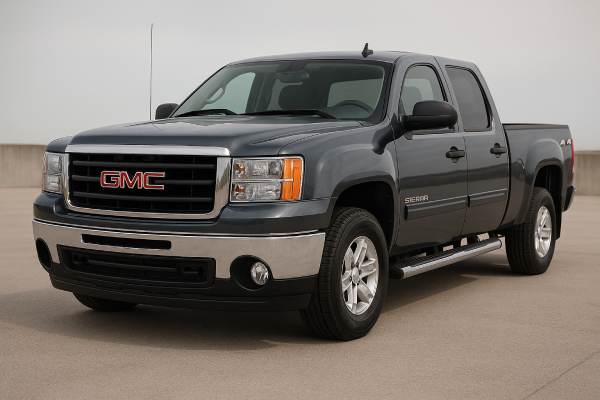
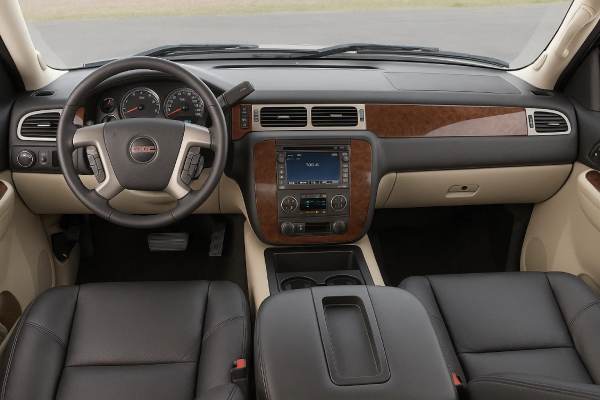
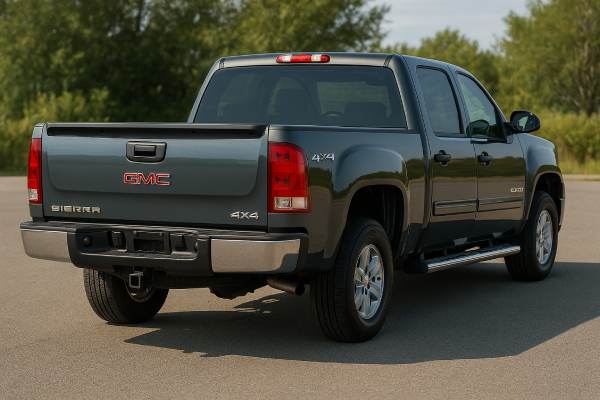
The GMT900-generation GMC Sierra 1500 with the LMG 5.3 litre V8 and four wheel drive is one of the most common light-duty trucks on North American roads. For many buyers, this is the “default” Sierra: crew cab or extended cab, 5.3 V8, 4×4, and a tow package. It combines a flexible small-block V8, a simple part-time four wheel drive system, and a frame and suspension tuned for work as well as daily use.
The iron-block LMG engine offers around 315–320 hp and roughly 335–340 lb-ft of torque, depending on year and calibration. Paired with 4×4 and the right axle ratio, it can pull mid-size campers, car trailers or boats with confidence while still fitting in suburban driveways and multi-storey car parks. At the same time, it is old enough that rust, transmission wear and active fuel management (AFM) issues can matter more than mileage alone. This guide focuses specifically on the 2007–2013 Sierra 1500 4WD with the LMG 5.3 V8, and what owners and buyers should know about living with one today.
Top Highlights
- LMG 5.3 V8 and part-time 4×4 give a strong mix of power, traction and everyday usability for work, towing and winter use.
- Four wheel drive adds weight and complexity versus RWD but significantly improves confidence on gravel, mud and snow with good tyres.
- AFM lifters, 4L60E/4L70E or 6L80 transmissions, and frame and brake-line rust are the main long-term watch points.
- Expect engine oil and filter changes every 5,000–7,500 miles (8,000–12,000 km) or 6–12 months, with shorter intervals if you tow or run E85 often.
Section overview
- GMC Sierra 5.3 4WD in focus
- LMG 5.3 4WD specs and data
- 4WD trims, equipment and safety
- Reliability trends and typical faults
- Service planning and buyer guidance
- Driving feel, traction and performance
- How this 5.3 4WD compares
GMC Sierra 5.3 4WD in focus
In the GMT900 generation (2007–2013), the LMG 5.3 litre V8 with four wheel drive is the heart of the Sierra 1500 range. It sits above the 4.3 V6 and 4.8 V8 but below the 6.0 and 6.2 heavy-duty oriented engines. For many retail buyers, especially in snowbelt regions, the combination of 5.3 power and part-time 4×4 hit the sweet spot between capability, cost and comfort.
The LMG is part of the Vortec 5300 small-block family. It uses an iron block with aluminium heads, a single in-block camshaft with pushrods, and two valves per cylinder. Most versions are flex-fuel capable and feature active fuel management (AFM), which can switch the engine into four-cylinder mode at light loads to save fuel. In practice, this means the truck can cruise quietly and reasonably efficiently, while still offering the traditional V8 surge when you ask for it.
The 4WD system on these trucks is a straightforward, mechanically robust setup. A two-speed transfer case sends power to the front differential when 4×4 is selected, usually via a dash switch with 2HI, 4HI, 4LO and sometimes Auto 4WD modes. In normal dry-road use you leave it in 2HI, sending power only to the rear axle. When conditions get slippery, you select 4HI (or Auto 4WD where fitted) and the truck can use all four tyres to move and steer.
Compared with an equivalent 5.3 RWD Sierra, the 4×4 version offers several key advantages:
- Better traction when starting on icy or muddy surfaces.
- More stability on gravel roads and in light off-road use.
- Higher resale value in many markets where winter conditions are common.
The trade-offs are predictable: higher purchase cost, additional complexity (front differential, transfer case, front driveshafts) and slightly worse fuel economy due to extra mass and rotating components. For owners who rarely see snow or dirt and mainly tow on dry highways, RWD may be a better fit. But for everyone else, the 5.3 4WD is the more versatile tool, as long as you are prepared to budget a little more for maintenance.
LMG 5.3 4WD specs and data
This section summarises typical specifications for the GMC Sierra 1500 4WD with the LMG 5.3 V8 in the 2007–2013 model years. Exact numbers vary by cab style, bed length, axle ratio and equipment, so always verify data against the door label and official documentation for a specific truck.
Engine and performance (LMG Vortec 5300)
| Item | Specification |
|---|---|
| Engine code | LMG Vortec 5300 V8 |
| Displacement | 5.3 l (5,328 cc), approx. 323 cu in |
| Layout | 90° V8, iron block, aluminium heads, OHV, 2 valves per cylinder |
| Bore × stroke | ~96.0 mm × 92.0 mm (3.78 in × 3.62 in) |
| Compression ratio | Typically around 9.6–9.9:1 |
| Induction | Naturally aspirated |
| Fuel system | Sequential multi-port fuel injection |
| Valvetrain | Hydraulic roller lifters, single in-block camshaft |
| Cylinder deactivation | Active Fuel Management (AFM) on most applications |
| Max power | Around 315–320 hp (235–239 kW) @ ~5,200–5,400 rpm |
| Max torque | Around 335–340 lb-ft (454–461 Nm) @ ~4,000–4,400 rpm |
| Recommended fuel | Regular unleaded (87 AKI); E85-compatible on flex-fuel versions |
Typical fuel economy for 5.3 4WD automatic trucks (gasoline):
| Usage | Typical consumption |
|---|---|
| City | ~13–15 mpg US (15.7–18.0 l/100 km) |
| Highway | ~18–20 mpg US (11.8–13.1 l/100 km) |
| Combined | ~15–17 mpg US (13.8–15.7 l/100 km) |
Running E85 usually increases consumption by roughly 25–30% under similar conditions.
Transmission, transfer case and driveline
Depending on year and trim, Sierra 1500 5.3 4WD models use:
| Item | Specification |
|---|---|
| Transmission (early years) | 4L60E or 4L70E 4-speed automatic, electronically controlled |
| Transmission (later years) | 6L80 6-speed automatic on many mid and upper trims |
| Gear ratios 4-speed | 1st 3.06 / 2nd 1.63 / 3rd 1.00 / 4th 0.70 / Rev 2.29 |
| Gear ratios 6-speed | 1st 4.03 / 2nd 2.36 / 3rd 1.53 / 4th 1.15 / 5th 0.85 / 6th 0.67 / Rev 3.06 |
| Transfer case | Two-speed, part-time 4×4 with 2HI/4HI/4LO and, on some models, Auto 4WD |
| Drive type | Rear wheel drive in 2HI; four wheel drive when 4HI/4LO/Auto 4WD is selected |
| Front differential | Independent front differential with CV half-shafts |
| Rear axle | Solid rear axle with leaf springs |
| Common axle ratios | 3.08, 3.23, 3.42; 3.73 often with tow/off-road packages |
| Differential options | Open as standard; automatic locking (G80 Eaton locker) optional |
Chassis, dimensions and capability (typical 4WD crew or extended cab)
Figures below are representative of popular 4WD 5.3 configurations; they vary slightly by cab and bed:
| Item | Specification |
|---|---|
| Overall length | ~5,700–5,850 mm (224–230 in) |
| Width (without mirrors) | ~2,030 mm (80 in) |
| Height | ~1,880–1,930 mm (74–76 in), slightly higher than RWD |
| Wheelbase | ~3,020–3,380 mm (119–133 in) |
| Ground clearance | Typically ~230–250 mm (9–10 in) for 4×4 models |
| Turning circle | Around 14–15.5 m (46–51 ft), depending on wheelbase |
| Curb weight | Roughly 2,150–2,450 kg (4,740–5,400 lb) |
| GVWR | Around 2,950–3,300 kg (6,500–7,250 lb), depending on spec |
| Fuel tank | About 98–128 l (26–34 US gal), depending on tank option |
Suspension and brakes (typical half-ton 4×4):
- Front: Independent suspension with coil-over shocks or torsion bars (depending on year and package), anti-roll bar.
- Rear: Solid axle with semi-elliptic leaf springs.
- Brakes: Front ventilated discs; rear drums on many work-focused trims, rear discs on some higher trims; ABS standard.
Performance and towing (typical 5.3 4WD with tow package):
- 0–60 mph (unloaded): generally mid-to-high 8-second range.
- Top speed: electronically limited, often in the 95–105 mph (153–170 km/h) range.
- Braked trailer rating: commonly around 8,000–9,600 lb (3,630–4,350 kg), depending on axle ratio and equipment.
- Payload: usually 1,500–2,000 lb (680–910 kg), again depending on cab and options.
Fluids and key service capacities (typical)
Always confirm per VIN and service manual, but many 5.3 4WD Sierras use roughly:
- Engine oil: ~5.7–6.0 l (6.0–6.3 qt) of 5W-30 meeting current GM specifications.
- Coolant: ~13–15 l (14–16 qt) of Dex-Cool OAT coolant.
- Automatic transmission: Total fill ~11–12 l (11.5–12.5 qt); 4–6 l on a pan drop and filter change.
- Rear axle: ~1.6–2.0 l (1.7–2.1 qt) of synthetic 75W-90 GL-5 gear oil.
- Front differential: typically around 1.2–1.5 l (1.3–1.6 qt) of 75W-90 GL-5 gear oil.
- Transfer case: usually around 1.5–2.0 l (1.6–2.1 qt) of GM-specified transfer case fluid.
Key torque examples (always verify):
- Wheel nuts: ~190 Nm (140 lb-ft).
- Spark plugs: ~25 Nm (18 lb-ft).
- Oil drain plug: ~25–30 Nm (18–22 lb-ft).
4WD trims, equipment and safety
Trims and options for LMG 5.3 4WD
The LMG 5.3 4WD powertrain appears across a wide spread of trims, from basic work trucks to well-equipped family pickups. Common pairings include:
- Work Truck (WT) 4×4:
- Vinyl or simple cloth seats, rubber floor, basic audio.
- Steel wheels, black or chrome bumpers, minimal chrome.
- Often extended or regular cab with long box; 5.3 4×4 chosen by fleets needing more towing and winter traction.
- SLE 4×4:
- Cloth interior with carpeting and more sound insulation.
- Alloy wheels, body-colour trim, upgraded audio and convenience features.
- Very common configuration for private owners who tow or live in snowbelt regions.
- SLT 4×4 and selected special editions:
- Leather seating, more advanced infotainment for the era, dual-zone climate control.
- Crew cab with short or standard box, often with tow and off-road options.
- 5.3 4×4 is a popular choice where buyers want comfort and capability without moving to heavy-duty models.
Important option packages for 5.3 4×4 trucks:
- Z82 trailering package: factory hitch receiver, wiring harness, and usually enhanced cooling; often paired with shorter axle ratios for higher tow ratings.
- Z71 off-road package (4×4): skid plates, revised shock tuning, sometimes different tyres and cosmetic cues.
- Z85 handling/trailering: uprated suspension for improved payload and trailer control.
- G80 automatic locking differential: desirable for low-traction situations; engages when one rear wheel spins significantly faster than the other.
When shopping, the glovebox RPO sticker is your friend. Look for “LMG” (engine), GT4/GT5 and similar axle codes, G80, Z82, Z71 and Z85 to quickly understand what hardware the truck actually has, regardless of badges.
Safety equipment and ratings
Safety performance depends on cab type, airbag configuration and model year. As a platform, GMT900 4×4 crew cab trucks generally perform solidly in moderate-overlap frontal crashes and reasonably well in side-impact and head restraint tests for their era. Government tests typically give 4–5 stars in frontal and side categories, with 3–4 stars in rollover tests due to the high centre of gravity.
Regular and extended cabs may differ from crew cabs in side-impact performance, especially if built without curtain airbags. Early trucks in this generation often have fewer airbags than later ones.
Typical safety hardware on 2007–2013 Sierra 1500 5.3 4×4 trucks includes:
- Dual front airbags as standard.
- Optional head-curtain and torso airbags, more common from around 2010 and on higher trims.
- Four-wheel ABS and StabiliTrak electronic stability control on most 4×4 models, increasingly standard by mid-cycle.
- Tyre pressure monitoring and seatbelt reminders.
Advanced driver-assistance systems such as automatic emergency braking, adaptive cruise control and lane keeping are not offered on this generation. Some later and higher trims add rear parking sensors and back-up cameras, but many 5.3 4×4 work or fleet trucks do not have them. If you regularly park in tight spaces, an aftermarket camera is a sensible upgrade.
For families, crew cabs are the most practical choice: they offer proper rear legroom and better access to ISOFIX/LATCH anchors where fitted. Extended cabs can work if rear passengers are children or occasional adults, while regular cabs are best viewed as two- or three-seat work tools.
Reliability trends and typical faults
The LMG 5.3 4×4 Sierra combines a generally robust powertrain with a chassis that holds up well if maintained. However, age, mileage and environment now play a major role. The most important reliability themes involve the engine and AFM hardware, the automatic transmission and transfer case, and corrosion.
Engine and AFM-related issues
Positives first: the 5.3 small-block is well known for strong bottom-end durability and long-lived timing chains when fed clean oil. Many examples run well past 200,000 miles if cared for. However, AFM adds some complexity:
- AFM lifter failures:
- Symptoms: intermittent misfires on specific cylinders, ticking noises, rough idle and reduced performance; AFM-related diagnostic codes may be present.
- Cause: collapsing AFM lifters or wear in lifter guides, often made worse by extended oil-change intervals, dirty oil or varnish in oil galleries.
- Fix: replacing lifters (and often the camshaft) plus associated hardware; some owners opt for AFM delete components and updated engine tuning.
- Oil consumption and ring deposits:
- Symptoms: frequent need to top up oil, blue smoke on start-up or deceleration.
- Contributing factors: AFM operation, PCV system design and long intervals between oil changes.
- Remedies: PCV updates, shorter oil-change intervals, and in serious cases ring cleaning or engine overhaul.
Common, generally manageable issues include:
- Valve cover, oil pan and rear main seal leaks.
- Exhaust manifold bolt breakage causing cold-start ticking and eventual exhaust leaks.
- Knock sensor wiring corrosion under the intake manifold, leading to check-engine lights and pulled timing.
Cooling-system neglect can show up as radiators, hoses and water pumps failing sooner than expected, especially on trucks that tow in hot climates. Overheating under load should always be treated as urgent.
Transmission, transfer case and driveline
The 5.3 4×4 trucks use either 4-speed (4L60E/4L70E) or 6-speed (6L80) automatics, plus a two-speed transfer case. Typical issues include:
- 4L60E/4L70E clutch wear:
- Symptoms: slipping, especially in 3rd/4th, flares on upshifts, loss of higher gears, and burnt-smelling fluid.
- Cause: worn 3–4 clutch pack, often from heavy towing, overheating or neglected fluid.
- Remedy: rebuild or replacement; preventative ATF changes and auxiliary coolers help extend life.
- 6L80 concerns:
- These gearboxes can suffer from torque converter issues, valve body wear and clutch problems if abused or if fluid is never changed.
- Shuddering, harsh or delayed shifts and unusual noises require prompt investigation.
- Transfer case and front driveline:
- Fluid neglect can lead to transfer case wear, noisy operation or internal component damage.
- Front CV joints and U-joints wear over time, especially on lifted trucks or those used off-road.
- Symptoms include clicking on full lock, vibrations at speed and clunks when engaging 4×4.
Many owners also notice driveline clunks when shifting between drive and reverse or when coming to a stop. Slip-yoke lubrication, inspecting U-joints and checking differential backlash usually resolves or reduces these noises.
Chassis, brakes and corrosion
As with the RWD models, chassis wear and rust are major considerations:
- Front suspension wear:
- Ball joints, control-arm bushes, inner and outer tie rods, idler and pitman arms all wear and can cause vague steering, wandering and uneven tyre wear.
- High-mileage or heavily used trucks often benefit from a comprehensive front-end rebuild.
- Brake system corrosion:
- Steel brake lines, particularly along the frame rails, are prone to rust in salt-belt regions and can fail suddenly.
- Backing plates, caliper hardware and parking brake components also corrode and seize.
- Frame and body rust:
- Frame sections near the rear axle, shock mounts, crossmembers, fuel-tank straps and spare-tyre carriers are common hotspots.
- Rocker panels, cab corners and wheel arches often show cosmetic rust that can hide deeper issues.
Recalls, TSBs and service actions
Across the GMT900 platform, recalls and technical service bulletins have addressed airbag wiring and deployment, steering and brake concerns, and various electrical or software issues. Before buying, use the VIN to check for outstanding recalls and ask for dealer service records where possible. This not only confirms safety-related work, but can also show whether previous owners have already addressed some of the common issues.
Service planning and buyer guidance
Practical maintenance schedule for 5.3 4×4 trucks
A conservative maintenance plan helps reduce the risk of AFM and transmission problems and keeps the 4×4 hardware healthy. Adjust intervals based on severe use (towing, short trips, extreme temperatures and heavy off-road use).
- Engine oil and filter:
- 5,000–7,500 miles (8,000–12,000 km) or 6–12 months, whichever comes first.
- Shorter intervals are advisable if you tow regularly, idle for long periods, or mostly drive short distances.
- Engine air filter:
- Inspect yearly; replace every 30,000–45,000 miles (48,000–72,000 km) or more often in dusty conditions.
- Cabin air filter (if fitted):
- Replace every 15,000–25,000 miles (24,000–40,000 km) or roughly every 2 years.
- Spark plugs:
- Iridium plugs are commonly rated for about 100,000 miles (160,000 km).
- On older trucks, check around 60,000–80,000 miles for gap growth and deposits.
- Fuel filter:
- External filters: change roughly every 50,000–60,000 miles (80,000–100,000 km).
- In-tank filters: follow manufacturer guidance; focus on good-quality fuel and avoiding repeated low-fuel running.
- Coolant (Dex-Cool):
- Up to 5 years/150,000 miles (240,000 km) from new; on ageing trucks, a 4–5 year interval is safer.
- Automatic transmission fluid and filter:
- 50,000–60,000 miles (80,000–100,000 km) in mixed use; shorter intervals for heavy towing or hot climates.
- Avoid “flushes” on neglected transmissions with burnt fluid; consult a trusted specialist.
- Transfer case fluid:
- Typically every 50,000–60,000 miles (80,000–100,000 km).
- Important on 4×4 trucks, as neglected fluid can accelerate internal wear.
- Front and rear differential oil:
- 60,000–75,000 miles (96,000–120,000 km), shorter for heavy towing or off-road use.
- Use the correct GL-5 oil and friction modifier where required.
- Brake fluid:
- Replace every 3 years regardless of mileage to protect internal components.
- Serpentine belt and hoses:
- Inspect annually from year 8 onward and replace at the first sign of cracking, swelling or glazing.
- Tyres, alignment and 4×4 checks:
- Rotate tyres every 6,000–8,000 miles (10,000–13,000 km).
- Check alignment with any unusual tyre wear or steering pull.
- Engage 4HI and 4LO periodically (on suitable surfaces) to keep actuators, transfer case and hubs exercised.
- 12 V battery:
- Load-test annually after year 4–5; replacement is common around the 5–7 year mark.
Typical fluid specifications (always verify)
- Engine oil: 5W-30 meeting current GM petrol engine specifications (later dexos1); synthetic is a good choice.
- Coolant: Dex-Cool OAT coolant; mixing with conventional green coolant is not recommended.
- Automatic transmission: Dexron-VI ATF for both 4L60E/4L70E and 6L80 units (check your manual).
- Transfer case: GM-specified transfer case fluid (often a dedicated AutoTrak-type fluid).
- Differentials: Synthetic 75W-90 GL-5 gear oil; add friction modifier if specified for G80 lockers.
Buyer’s guide for the LMG 5.3 4×4 Sierra
When evaluating a used Sierra 1500 5.3 4WD:
- Check for rust and frame integrity
- Inspect the frame rails, crossmembers, spring hangers and fuel-tank strap areas.
- Look closely at brake and fuel lines along the frame, and at rocker panels and cab corners.
- Heavy structural rust is typically a reason to walk away.
- Assess engine and AFM health
- Start the engine cold and listen for ticking, knocking or loud exhaust leaks.
- On a test drive, feel for surging or roughness when cruising lightly (possible AFM issues).
- Scan for diagnostic codes, even if the check-engine light is off.
- Evaluate transmission, transfer case and 4×4 system
- Check for smooth shifts up and down through the gears at various throttle openings.
- Engage 4HI and, where possible, 4LO on a suitable surface and confirm engagement without grinding or alarming noises.
- Listen for whining, clunks or vibrations that change with road speed or throttle position.
- Inspect suspension, steering and brakes
- Note any looseness, wandering or vibration through the steering wheel.
- Inspect tyre wear; cupping or uneven wear suggests alignment or suspension issues.
- Check brake pedal feel and look for signs of rusted brake lines or leaking components.
- Confirm electrical and interior condition
- Test lights, wipers, HVAC, windows, locks, seat adjusters and infotainment.
- Look for water leaks, damp carpets or musty smells that may indicate rust-promoting moisture.
- Review records and provenance
- Favour trucks with regular oil changes, documented coolant and transmission services, and detailed invoices.
- Verify recall completion via official databases.
- Consider how the truck was used—light family duty vs heavy towing vs fleet work—when judging wear.
A slightly higher-mileage 5.3 4×4 from a dry climate with good records is often a safer bet than a low-mileage example with significant rust or unclear maintenance history.
Driving feel, traction and performance
Powertrain character on and off road
With the LMG 5.3 V8 under the bonnet, the Sierra 1500 4×4 feels confident and flexible in most everyday scenarios. Against the 4.8 V8, it pulls more strongly at low and medium revs and holds speed better on hills, especially with passengers, cargo or a moderate trailer. The extra mass of the 4×4 components compared with RWD is noticeable on paper but less so in everyday driving; the 5.3 has enough torque to mask it.
Trucks with the 4-speed automatic feel “traditional”: they upshift early at light throttle and rely on downshifts and revs for faster acceleration. On hills, especially when towing, you may feel the gearbox hunt a bit between gears. The 6-speed 6L80 smooths this out with closer ratios, stronger first gear and deeper overdrive, improving both towing behaviour and fuel economy.
AFM operation is sometimes detectable as a subtle change in exhaust note or vibration when the engine transitions between four- and eight-cylinder modes. In a healthy system this should not be abrupt; obvious surging or persistent roughness warrants diagnostic work.
Ride, handling and NVH in 4×4 form
The Sierra 1500 4WD rides and handles much like its RWD sibling, but with a slightly higher stance and additional front driveline mass:
- Ride quality:
- Unloaded, the rear leaf springs can feel stiff over sharp bumps, especially with tow or off-road packages.
- With a modest payload or trailer tongue weight, the ride settles and becomes more composed.
- Handling and steering:
- Steering is light and reasonably precise for a body-on-frame truck, though there is body roll and understeer if you push hard in corners.
- Tyre choice and condition have a big impact on grip and braking: highway tyres favour refinement, all-terrains trade some comfort for traction.
- Noise and refinement:
- At motorway speeds, the 5.3 V8 hums quietly in the background.
- Wind and road noise are moderate but acceptable for long trips; crew cabs with higher trims usually feel more refined than basic work trucks.
- 4×4 components add some mechanical background noise, but in 2HI the difference from RWD is small in a well-maintained truck.
Real-world economy, towing and off-road use
On gasoline, most owners can expect approximate real-world consumption of:
- 13–15 mpg US (15.7–18.0 l/100 km) in mostly city or short-trip driving.
- 17–20 mpg US (11.8–13.8 l/100 km) on steady motorway journeys at legal speeds.
- Combined averages around 15–17 mpg US (13.8–15.7 l/100 km), depending on driving style, axle ratio and load.
Towing and heavy payloads can push consumption up by 30–50%, especially with large, high-drag trailers. Running E85 increases consumption further but may still make sense where fuel pricing is favourable.
Off-road, the Sierra 5.3 4×4 is best viewed as a light to moderate-duty truck. It handles muddy tracks, snowy roads and moderate trails well when fitted with appropriate tyres and driven with mechanical sympathy. Ground clearance is adequate for most non-extreme use, but the front valance, side steps and low-hanging components can be vulnerable on more serious obstacles. For frequent off-road work, skid plates, recovery points and a modest suspension and tyre upgrade make the truck more robust.
Stability under load is generally good. Properly balanced trailers with correctly adjusted brakes, healthy shocks and good tyres make a big difference in confidence. Tow/haul mode, where fitted, adjusts shift behaviour and can help manage engine braking and transmission temperatures on hills.
How this 5.3 4WD compares
Within the Sierra 1500 lineup
Versus the 5.3 RWD Sierra:
- The 4×4 version offers noticeably better traction on loose, wet or icy surfaces.
- Fuel economy is modestly worse due to added weight and driveline losses, especially if 4HI or Auto 4WD is used frequently on high-friction surfaces.
- Maintenance costs can be slightly higher because of the front differential, transfer case and extra driveline joints.
- Resale value often favours 4×4 in regions with winter weather or rural roads.
Versus the 4.8 V8 4×4:
- The 5.3 feels more relaxed with both passengers and trailers, thanks to higher torque.
- In real-world use, fuel consumption is often similar, since the 4.8 must work harder.
- The 4.8 avoids AFM hardware, which is a plus for long-term simplicity. The choice comes down to how much you value the extra performance versus the simpler engine.
Versus the 6.0/6.2 V8 4×4:
- The big V8s offer stronger acceleration and more comfortable heavy towing.
- They tend to use more fuel, particularly in city driving or at higher motorway speeds.
- The 5.3 4×4 is usually the more balanced choice for mixed commuting, moderate towing and general-purpose use.
Against rival half-ton 4×4 trucks
Compared with similar-era Ford F-150, Ram 1500 and Toyota Tundra V8 4×4 models, the Sierra 1500 5.3 4WD stands out for:
- Strong aftermarket support and parts availability, thanks to its shared GM platform and long production run.
- A powertrain layout that many independent shops know well.
- Competitive towing and payload ratings for its class when properly equipped.
On the flip side:
- Many competitors moved to more advanced 5- or 6-speed automatics earlier, while some Sierras still carried 4-speed units for part of this period.
- Interior design and ergonomics are solid but can feel dated compared with some contemporaries and certainly compared with newer trucks.
- Active safety and driver-assistance technologies are minimal by modern standards.
Who should choose a 5.3 4×4 Sierra?
This configuration fits best if you:
- Need a do-everything truck that can commute, haul, tow moderate to substantial loads, and cope with winter weather or unpaved roads.
- Prefer a naturally aspirated V8 with a long track record and easily sourced parts.
- Are comfortable following a proactive maintenance schedule, especially for oil, transmission, transfer case and differential fluids.
You may be better served by another variant or a newer platform if you:
- Frequently tow at or near maximum ratings in mountainous areas and want maximum margin; a heavier-duty truck or larger V8 might suit you better.
- Place a high priority on modern active safety tech, the latest infotainment and the quietest cabin.
- Live in an area where rust destroys frames and brake lines quickly and you cannot find a clean, well-preserved example.
For many buyers, though, a well-maintained GMC Sierra 1500 5.3 4WD from this generation remains a practical, honest and capable choice that still makes sense today.
References
- 2013 GMC Sierra Owner’s Manual 2013 (Owner’s Manual)
- 2011 GMC Sierra 1500 4WD Fuel Economy 2023 (Fuel Economy Data)
- 2011 GMC Sierra 1500 crew cab pickup – Vehicle ratings 2011 (Safety Rating)
- GM / Chevy LMG Vortec 5300 2020 (Engine Specifications)
- NHTSA Recall 10V240000 – GM Brake Line Corrosion 2010 (Recall Document)
Disclaimer
This article is for informational purposes only and does not replace professional diagnosis, repair, or safety advice. Specifications, torque values, fluid types and service intervals can vary by VIN, model year, market and equipment level. Always confirm critical data and procedures with the official owner’s manual, factory workshop documentation and current manufacturer or regulatory guidance before carrying out any work or making purchasing decisions.
If you found this guide helpful, please consider sharing it on platforms such as Facebook or X/Twitter to help other GMC Sierra owners and support our work.