
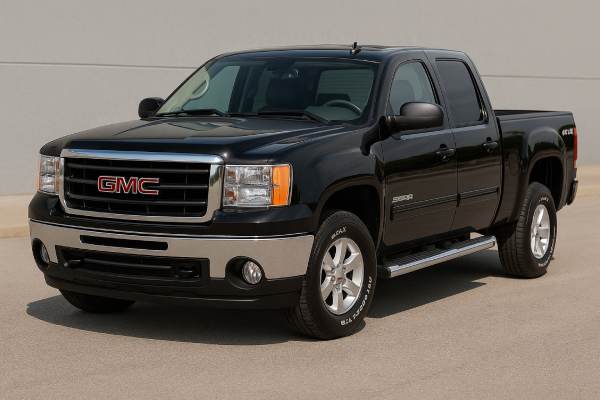
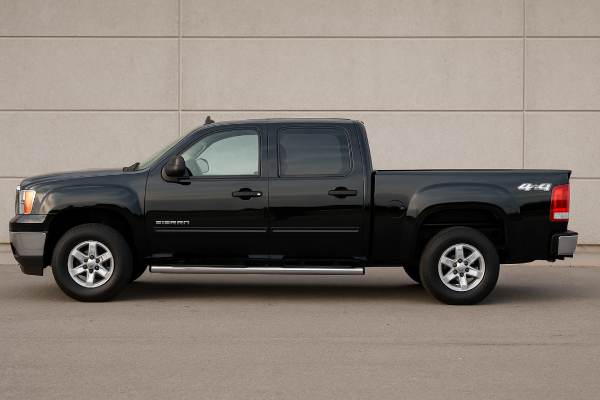
The GMT900-generation GMC Sierra 1500 with the 6.2 litre L9H Vortec V8 is the “big gun” of the half-ton lineup. Sold mainly in higher trims from 2009 to 2013, this engine delivers 403 hp and 417 lb-ft of torque, giving the Sierra 1500 4WD a noticeably stronger punch than the more common 5.3 litre trucks. It is paired with the 6L80 six-speed automatic and a two-speed Autotrac transfer case, so you get both highway refinement and low-range capability for towing or difficult surfaces.
As a used truck, the 6.2 4WD Sierra appeals to drivers who want brisk acceleration, confident towing and a well-finished cabin, without stepping into heavy-duty ride harshness. At the same time, buyers must factor in higher fuel use, known GMT900 chassis rust areas and the importance of documented maintenance on the engine, transmission and 4WD system. This guide walks through the key specs, ownership costs, reliability patterns and how the 6.2 4WD compares to rival V8 half-tons from the same era.
Quick Specs and Notes
- 6.2L L9H aluminum V8 with VVT, 403 hp and 417 lb-ft, paired to a 6L80 six-speed automatic
- Strong towing potential (around 9,000–10,000 lb when correctly optioned) and relaxed highway performance
- Higher fuel consumption than 5.3L trucks; rust and front suspension wear need close inspection on older examples
- Plan engine oil and filter changes about every 5,000–7,500 miles (8,000–12,000 km) or 12 months, whichever comes first
Section overview
- GMC Sierra 1500 6.2 context
- Sierra 1500 6.2 technical specs
- Trims options and safety tech
- Reliability issues and service actions
- Maintenance schedule and buying tips
- Driving experience and real-world economy
- Sierra 1500 6.2 versus rivals
GMC Sierra 1500 6.2 context
The 2009–2013 GMC Sierra 1500 4WD with the L9H 6.2 litre V8 sits at the top of the GMT900 half-ton hierarchy. While most Sierras of this era used 4.3 or 5.3 litre engines, the 6.2 was reserved for buyers who wanted maximum performance in a light-duty package. It was standard in Sierra Denali and available on certain SLT crew and extended cab models, where it effectively turned the truck into a bridge between regular 1500s and the 2500 HD range.
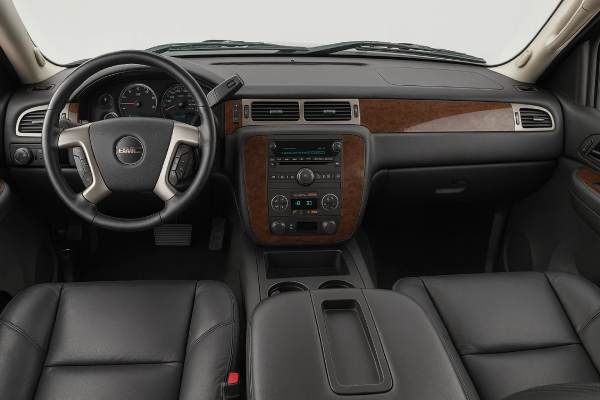
The GMT900 platform brought a stiffer frame, improved crash performance and more refined interiors compared with the previous generation. On 4WD models, the Autotrac transfer case offers rear-wheel drive, automatic four-wheel drive and true 4HI/4LO modes. That makes the truck well suited both to mixed-weather commuting and to towing or off-pavement work. Many 6.2 trucks are well equipped, with leather interiors, Bose audio, dual-zone climate control and available navigation, particularly in Denali trim.
From an ownership perspective, the 6.2 4WD Sierra combines three main traits:
- Strong performance – noticeably quicker acceleration and more confident highway passing, especially when loaded or towing.
- High comfort – quiet cabs, available heated/cooled seats and a smoother ride than heavy-duty pickups.
- Higher operating costs – more fuel consumption, more expensive tyres and brakes, and sometimes slightly higher insurance.
Most trucks are now at least a decade old, so condition varies widely. Some have lived easy lives as highway cruisers, while others have towed regularly or seen salted winters. Rust on frames and brake lines, worn front suspension components and neglected fluids are more significant than age alone. Understanding how the L9H engine behaves, what the tow ratings actually mean and which options matter will help you filter the good examples from the tired ones.
Sierra 1500 6.2 technical specs
Powertrain and efficiency
| Item | Value |
|---|---|
| Engine code | L9H Vortec 6200 V8 |
| Configuration | 90° V8, cam-in-block (OHV), variable valve timing |
| Block / heads | Aluminum block, aluminum heads |
| Displacement | 6.2 l (6,162 cc) |
| Bore × stroke | 103.25 × 92.0 mm (4.06 × 3.62 in) |
| Valvetrain | Single camshaft, 2 valves per cylinder, roller lifters |
| Induction | Naturally aspirated |
| Fuel system | Sequential multi-port fuel injection, FlexFuel capable (gasoline / E85) |
| Compression ratio | Approx. 10.5:1 |
| Max power | 403 hp (301 kW) @ ~5,700 rpm |
| Max torque | 417 lb-ft (565 Nm) @ ~4,300 rpm |
| Timing drive | Chain |
| Emissions standard | U.S. EPA Tier 2 / federal and California variants |
| Rated economy (typical 4WD 6.2) | Roughly 13–14 mpg US city / 18–19 mpg US highway (≈ 18–20 l/100 km city / 12–13 l/100 km highway) depending on cab, axle ratio and year |
| Real highway @ 120 km/h | Often 13–14 l/100 km (17–18 mpg US) when lightly loaded, stock tyres and aerodynamics |
Transmission and driveline
| Item | Value |
|---|---|
| Transmission | Hydra-Matic 6L80 six-speed automatic |
| Gear ratios (1st–6th / R) | 4.03 / 2.36 / 1.53 / 1.15 / 0.85 / 0.67 / 3.06 (reverse) |
| Final drive ratios | Commonly 3.42 or 3.73 (check axle code in glovebox/RPO sticker) |
| Transfer case | Autotrac two-speed, electronic shift, automatic 4WD mode |
| Drive type | Part-time 4WD with automatic mode (2HI, Auto 4WD, 4HI, 4LO) |
| Front differential | Open differential (traction control and ABS-based brake intervention) |
| Rear differential | Open or G80 automatic locking differential depending on options |
Chassis and dimensions (typical crew cab short box 4WD)
Dimensions vary slightly by cab and bed, but the following figures are representative for a 4WD crew cab short box:
| Item | Value (approx.) |
|---|---|
| Platform | GMT900 body-on-frame full-size pickup |
| Front suspension | Independent coil-over shock, upper and lower control arms |
| Rear suspension | Solid axle with leaf springs |
| Steering | Power-assisted rack-and-pinion |
| Front brakes | Ventilated disc, around 325–330 mm (≈ 12.8–13.0 in) |
| Rear brakes | Disc (earlier years may mix disc/drum depending on configuration) |
| Wheels and tyres | Typically 17–20 in alloy wheels; 265/70R17 to 275/55R20 tyre sizes |
| Ground clearance | ≈ 230–250 mm (9–10 in) depending on tyre and suspension package |
| Length | ≈ 5,670 mm (223 in) |
| Width (without mirrors) | ≈ 2,030 mm (80 in) |
| Height | ≈ 1,870–1,900 mm (73–75 in) |
| Wheelbase | ≈ 3,645 mm (143.5 in) crew cab short box |
| Curb weight | Roughly 2,450–2,650 kg (5,400–5,800 lb) depending on equipment |
| GVWR | Typically around 3,175–3,300 kg (7,000–7,300 lb) |
| Fuel tank | ≈ 98 l (26 US gal) |
| Cargo box volume | Short box ~1,500–1,700 l (53–60 ft³), depending on measurement method |
Performance and capability
Exact numbers depend on axle ratio, cab, bed and tow package; the figures below give realistic ranges for 6.2 4WD trucks:
| Metric | Typical value |
|---|---|
| 0–100 km/h (0–62 mph) | Around 6.5–7.0 s in lightly loaded 4WD crew cab form |
| Top speed | Limited, typically around 160–170 km/h (100–105 mph) |
| Towing capacity | Roughly 3,900–4,500 kg (8,600–10,000 lb) with the right axle and tow package; always confirm by VIN and door sticker |
| Payload | About 650–820 kg (1,400–1,800 lb), depending on configuration |
| Roof load | Modest (often ≈ 90–100 kg / 200–220 lb) – check manual for exact figure |
Fluids and service capacities (typical values)
Always verify exact capacities and specifications for your VIN and year:
| System | Specification | Approx. capacity |
|---|---|---|
| Engine oil | 5W-30 meeting GM dexos or earlier GM6094M; many owners stick with high-quality synthetic | ≈ 6.6 l (7.0 US qt) with filter |
| Engine coolant | Dex-Cool long-life coolant, usually 50/50 mix with demineralised water | ≈ 15–16 l (16–17 US qt) for full system |
| Automatic transmission | Dexron-VI ATF for 6L80 | ~10–12 l (10.5–12.7 US qt) for full service; less for pan drop |
| Transfer case | AutoTrak II or specified GM fluid | ≈ 1.9–2.0 l (2.0–2.1 US qt) |
| Front and rear differentials | 75W-90 synthetic gear oil; rear may require limited-slip additive where G80 is fitted | 1.5–2.0 l (1.6–2.1 US qt) each, depending on axle |
| A/C refrigerant | R-134a; charge quantity varies by cab and dual/single-zone HVAC | On the order of 0.8–1.0 kg (28–35 oz) |
Electrical
| Item | Value (typical) |
|---|---|
| Alternator | Often 145–160 A units, higher with towing or plough packages |
| 12 V battery | Group 48/94R or similar; ≈ 600–730 CCA depending on spec |
| Spark plugs | Iridium tipped; gap typically around 1.0 mm (0.040 in) – confirm sticker underhood |
Safety and driver assistance
The GMT900 Sierra 1500 4WD crew cab generally scored around four stars overall in U.S. NHTSA testing for these years, with strong side-impact performance and more mixed frontal and rollover scores.
Standard safety equipment typically includes:
- Front airbags, front-seat side airbags and side curtain airbags
- ABS, electronic stability control and traction control
- LATCH anchors for child seats on the rear outboard positions in most cab styles
Advanced driver assistance systems (AEB, lane keeping, adaptive cruise) were not yet offered on these trucks. Safety differences between trims mainly relate to the availability of rear parking sensors and rear-view cameras, especially on higher trims and later model years.
Trims options and safety tech
In the 2009–2013 range, the L9H 6.2 litre V8 was not available in every trim. It was targeted at well-equipped models where buyers were more likely to pay for the extra performance and fuel cost.
On the GMC side, the 6.2 4WD powertrain is most commonly found in:
- Sierra Denali – Crew cab, heavily optioned interior, unique front fascia and grille, standard 6.2 and 6L80, usually with 20 inch wheels and all-wheel-drive-like 4WD behaviour thanks to Autotrac’s automatic mode.
- Sierra SLT – Crew or extended cab trucks where the 6.2 was an option. These look more like standard Sierras, but the RPO codes will reveal the upgraded engine.
Key options that shape how the truck drives and tows include:
- Axle ratios – 3.42 is common and offers a good balance between towing and fuel economy; 3.73 ratios, where fitted, give stronger low-speed pull at the cost of higher revs on the highway.
- Z71 Off-Road package – Adds tuned shocks, skid plates, all-terrain tyres and decals. Owners who spend time on dirt appreciate the extra underbody protection.
- Max Trailering / HD Cooling packages – Upgraded engine and transmission cooling, integrated trailer brake controller on later models, and sometimes different hitch/tow hardware.
Equipment levels across Denali and SLT 6.2 trucks often include leather upholstery, dual-zone climate control, power driver and passenger seats, steering wheel audio controls and available navigation. Denali models add more chrome exterior trim, wood-like interior accents and premium audio.
From a safety and driver-assistance standpoint:
- Airbags and structure – Side curtain airbags and strengthened cab structures help deliver solid side-impact protection; these are important if you carry family or passengers frequently.
- Stability control and traction systems – Standard on this generation; they work with the Autotrac transfer case and ABS to keep the truck controllable on slippery roads.
- Parking aids – Rear parking sensors and camera systems become more common in later years and on Denali trims. On an extended or crew cab truck with a short box, a camera is a meaningful convenience and safety upgrade for towing and tight parking.
When shopping used, trim and options matter as much as the base 6.2/4WD configuration. A Denali that has never towed may be mechanically less stressed than a mid-level SLT with a max tow package that hauled a boat every weekend. Conversely, a well-spec’d tow package truck with documented fluid changes and hitch use can be a better working tool than a lightly optioned truck with a vague history.
Reliability issues and service actions
The L9H 6.2 V8 and GMT900 chassis form a robust combination when maintained, but age, mileage and use patterns all influence reliability. At this point, most 6.2 4WD Sierras have over 100,000 miles (160,000 km), so you are evaluating cumulative wear more than early production defects.
Common or notable points include:
- Engine durability – The aluminum-block 6.2 with VVT and FlexFuel capability is generally strong. It does not have the same widespread cylinder deactivation issues as some 5.3 engines of the era, because L9H is a non-AFM design. However, neglecting oil changes, running low oil levels or extended idling can still accelerate cam and lifter wear. Symptoms include ticking, misfires and rough running. The remedy is typically lifter and sometimes camshaft replacement – a major job.
- Oil consumption – Mild oil use between services is not unusual on high-mileage V8s. Excessive usage, plugs fouling or blue smoke on start-up warrants a compression test and PCV/breathing system checks.
- Cooling system – Dex-Cool coolant is long-life, but neglect can lead to sludge and internal corrosion. Radiator and heater core restrictions show up as poor heat and rising operating temperature under load. A full flush and component replacement restores performance but is not cheap if multiple parts are affected.
On the driveline:
- 6L80 transmission – When serviced regularly and not abused, this gearbox is capable of high mileages. Hard towing with old ATF can lead to torque converter shudder, delayed engagement or harsh shifts. A fluid and filter change can help if symptoms are early; long-ignored problems may require a rebuild.
- Autotrac transfer case – Low fluid levels, incorrect fluid or rarely used 4LO can cause chain stretch, noisy operation or shift motor issues. Regular fluid changes and periodic engagement of each mode keep components lubricated.
- Front suspension and steering – GMT900 trucks are known for wear in upper control arm bushings, ball joints, idler and pitman arms, and intermediate steering shafts, especially with heavy wheels or rough roads. Clunks, wandering and uneven tyre wear are typical symptoms.
Corrosion should not be underestimated. In salt-belt trucks, expect:
- Frame surface rust and, in severe cases, rot near rear spring hangers and crossmembers
- Rusty brake and fuel lines (which can burst and are a safety risk)
- Rocker panel and cab corner rot under plastic cladding
There have been multiple recalls and technical service bulletins for GMT900 trucks, covering issues like airbag wiring, fuel system problems and frame or underbody corrosion depending on region. Specific actions vary by year and VIN, so owners should run a VIN search through official recall databases and confirm completion with a dealer.
For a potential buyer, the best strategy is to treat each truck as an individual:
- Check for evidence of regular oil, ATF, transfer case and differential services
- Inspect service records for addressed recalls or TSBs on airbag or fuel system concerns
- Use a lift or at least ramps to inspect frame, lines and mounts for rust and damage
A well-documented truck can be a long-lived workhorse; a cosmetically clean but mechanically neglected example can quickly become expensive.
Maintenance schedule and buying tips
Because this is a powerful V8 4WD pickup with towing potential, following an appropriate maintenance schedule is critical. Many owners use the oil life monitor; for ageing trucks, a conservative time- and mileage-based plan is safer.
A sensible baseline schedule for mixed use (some towing, some city, some highway):
- Engine oil and filter – Every 5,000–7,500 miles (8,000–12,000 km) or 12 months, whichever comes first. Shorten to 3,000–5,000 miles (5,000–8,000 km) if you tow often or drive in dusty conditions.
- Engine air filter – Inspect every 15,000 miles (24,000 km); replace about every 30,000 miles (48,000 km), or sooner if dirty.
- Cabin filter (if fitted) – Approx. every 20,000–25,000 miles (32,000–40,000 km) or 2 years. Some trucks of this era do not have a cabin filter from the factory but can be retrofitted.
- Spark plugs – Iridium plugs often have 100,000 mile (160,000 km) intervals, but on a used truck it is wise to replace at around that age or when service history is unclear.
- Coolant – Replace roughly every 5 years or 100,000 miles (160,000 km), then more frequently as the truck ages.
- Automatic transmission fluid – For 6L80, a 50,000–60,000 mile (80,000–100,000 km) service interval is a good target if you want the transmission to last. Shorter if you tow regularly.
- Transfer case fluid – Change around every 50,000 miles (80,000 km), more often with frequent 4WD or off-road use.
- Differential fluid (front and rear) – Every 50,000–60,000 miles (80,000–100,000 km) for typical use; halve that interval if you tow heavy or off-road often.
- Brake fluid – Flush every 2–3 years; rust-prone lines make fresh fluid and inspection even more important.
- Serpentine belt and hoses – Inspect annually; expect replacement in the 7–10 year range or when cracks, noise or swelling appear.
- Tyre rotation and alignment – Rotate about every 6,000–8,000 miles (10,000–13,000 km); check alignment annually or after pothole or curb impacts.
- 12 V battery – Test annually after 4–5 years of age; many owners replace preventively at around 5–7 years.
For buying:
- History and paperwork
Look for service records, especially for regular oil changes and driveline fluid services. A truck with fewer miles but no records is often riskier than a higher-mileage truck with detailed maintenance logs. - Rust and structure
Use a flashlight to inspect frame rails, crossmembers, rear spring mounts, cab mounts, rocker panels and cab corners. Rust in these areas is expensive to address and may be a reason to walk away. - Test drive behaviour
- Engine should start quickly, idle smoothly and pull strongly without hesitation.
- Transmission shifts should be crisp but not harsh; no flare or slipping between gears.
- Transfer case should engage and disengage each mode cleanly; no binding on full-lock manoeuvres in 4HI on loose surfaces.
- Steering should be reasonably tight; excessive wander or clunks suggest worn steering or suspension components.
- Towing clues
Hitch wear, aftermarket brake controllers and marks from load-levelling hitches indicate prior towing. That is not inherently bad, but you want matching evidence of careful maintenance.
In terms of long-term outlook, a maintained L9H/6L80/4WD combination can reach very high mileages. The limiting factors tend to be rust and aggregate wear on suspension, steering and interior rather than catastrophic drivetrain failures.
Driving experience and real-world economy
On the road, the 6.2 litre Sierra 1500 4WD feels noticeably stronger than its 4.8 and 5.3 litre siblings. The L9H engine delivers a broad, confident torque curve that makes the truck surge forward with little effort. Throttle response is quick for a big V8, and the 6L80 automatic usually chooses gears intelligently, using its wide ratio spread to keep revs low in light driving and drop multiple gears when you ask for full power.
Around town, the Sierra rides comfortably for a body-on-frame pickup. The front independent suspension and long wheelbase help it settle over bumps, and Denali-trim trucks with 20 inch wheels are firm but not punishing. At highway speeds, wind and road noise are well controlled for this era; most of what you hear is the tyres and a distant V8 rumble when climbing grades.
Handling is secure rather than sporty. Steering feel is light and somewhat isolated, which works fine for long trips but does not invite fast cornering. Stability control acts quietly in the background during normal driving, yet it is ready to step in if a sudden lane change or evasive manoeuvre loads the chassis. In slippery conditions, the Autotrac automatic 4WD mode is useful: the truck stays in rear-wheel drive until slip is detected, then progressively sends torque to the front.
Under load, the 6.2 shines. Towing near the truck’s rated limits feels more relaxed than with smaller V8s. The extra torque means fewer downshifts on hills and better acceleration when merging with a trailer. Braking performance depends heavily on brake condition and trailer brake setup, but a well-maintained truck with quality pads and rotors inspires confidence.
Fuel economy is the main trade-off. In mixed real-world use:
- City driving often returns 12–14 mpg US (17–20 l/100 km).
- Highway cruising at 65–70 mph (105–115 km/h) can produce 17–19 mpg US (12–14 l/100 km) if the truck is stock and lightly loaded.
- Towing a medium-size travel trailer or boat can drop consumption into the single digits (over 25 l/100 km), especially in hilly terrain or strong headwinds.
Drivers who mostly travel short distances, idle frequently or tow large loads should budget for significantly higher fuel costs than with a 5.3 litre V8 or modern downsized turbo engines. In return, you get effortless power, particularly at altitude or in hot weather, where naturally aspirated engines with larger displacement tend to cope better.
Sierra 1500 6.2 versus rivals
When new, the 2009–2013 GMC Sierra 1500 4WD with the 6.2 V8 competed with other high-output half-ton pickups, including the Chevrolet Silverado 1500 6.2, Ford F-150 with 5.4 Triton or early 3.5 EcoBoost, and Ram 1500 with 5.7 Hemi.
Compared with the 5.3 litre Sierra/Silverado, the 6.2 offers:
- Noticeably quicker acceleration, especially when towing or climbing hills
- Higher tow ratings in some configurations, thanks to stronger engine output and cooling packages
- Higher up-front cost and fuel consumption, with similar day-to-day comfort and practicality
Against the Ford F-150 of the time, the Sierra 6.2 trades blows:
- Ford’s early EcoBoost 3.5 V6 offers strong torque at lower rpm and better rated fuel economy, but has its own complexity (turbocharging, intake condensation, additional cooling components).
- The Sierra’s 6.2 V8 is simpler, naturally aspirated and feels more traditional in sound and response. Some buyers prefer this straightforward layout, especially if they plan to keep the truck for many years.
Compared with Ram 1500 5.7 Hemi models:
- The Hemi is similarly charismatic and powerful, often with competitive or slightly better fuel economy.
- GMC counters with Denali’s more formal image, a different interior feel and the option of the 6.2 in upscale trims.
Where the Sierra 6.2 stands out is in its combination of:
- A strong, naturally aspirated V8 with a proven six-speed automatic
- Comfortable, quiet ride quality for long journeys
- A clear step up in performance from smaller V8 trims without moving to a heavy-duty chassis
On the used market, pricing depends heavily on condition and trim. Denali models command a premium but may have been treated more gently if they were used as personal luxury trucks. More basic trims with 6.2 engines may have worked harder but can represent strong value if maintenance is documented.
For buyers who want a capable, comfortable V8 4WD that feels substantial and straightforward, the GMT900 Sierra 1500 6.2 remains an appealing option. Those who prioritise fuel efficiency or the latest safety and driver-assistance tech may be better served by newer platforms or smaller engines.
References
<a href="https://www.conceptcarz.com/z19082/gmc-sierra-1500.aspx">2011 GMC Sierra 1500 Pricing, Research, & Pictures</a> 2010 (Specifications Overview)<a href="https://www.conceptcarz.com/z21708/gmc-sierra.aspx">2013 GMC Sierra Pricing, Research, & Pictures</a> 2012 (Specifications Overview)<a href="https://www.thecarconnection.com/overview/gmc_sierra-1500_2013">2013 GMC Sierra 1500 Review, Ratings, Specs, Prices, and Photos</a> 2013 (Review and Safety Summary)<a href="https://www.motortrend.com/news/2014-gmc-sierra-denali-revealed-6-2l-v-8-makes-450-lb-ft/">2014 GMC Sierra Denali Revealed, 6.2L V-8 Makes 450 Lb-Ft</a> 2013 (Engine Family Background)
Disclaimer
This article is for informational purposes only and is not a substitute for professional diagnosis, repair, or purchase advice. Specifications, torque values, service intervals, capacities, and available equipment can vary by model year, market, trim level, and individual vehicle history. Always confirm critical data against the official owner’s manual, workshop or service information, and documentation specific to your VIN, and consult a qualified technician before carrying out maintenance, repairs, modifications, or towing decisions.
If you found this guide helpful, please consider sharing it with other owners or shoppers on social media or forums. Thoughtful sharing helps support the creation of accurate, independent technical resources.