
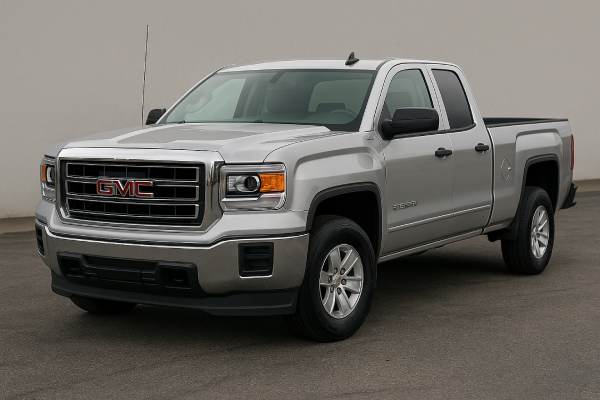
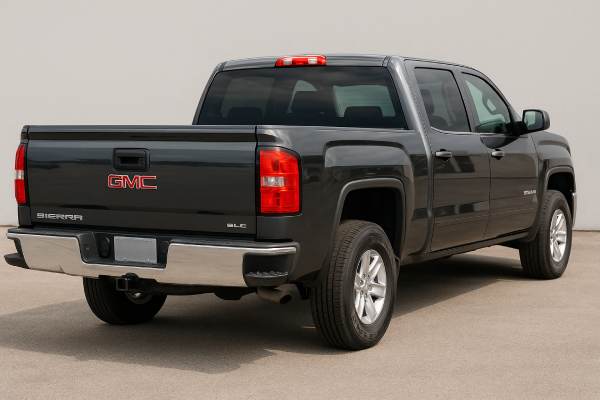
If you are considering a 2014–2018 GMC Sierra 1500 with the L83 5.3-litre V8 and four-wheel drive, you are looking at one of the most versatile half-ton trucks of its generation. Built on the GMTK2XX platform, this Sierra combines a modern EcoTec3 V8, a strong ladder frame, and an electronically controlled 4WD system that can handle year-round use and light off-roading while still feeling civilised on the road.
In these years, GMC aimed the 4WD Sierra 1500 at owners who tow regularly, drive in snow or mud, and want a quiet, comfortable cabin rather than a purely work-focused truck. The 5.3-litre V8 offers solid torque, sensible fuel use for its size, and a long track record when maintained correctly. At the same time, age, mileage, and known issues like AFM lifters and transmission shudder mean you must choose carefully. This guide walks through specifications, capability, reliability, safety, maintenance, and how the Sierra 1500 4WD compares to rivals so you can make a confident decision.
Owner Snapshot
- 5.3L L83 4WD models balance strong V8 torque with a capable AutoTrac transfer case for year-round traction.
- Comfortable, quiet cabin and solid tow ratings make the Sierra 4WD a genuine dual-purpose work and family truck.
- Common concerns include AFM lifter failure, 6-speed or 8-speed shudder, and rust in salt-belt trucks; service history is critical.
- Routine oil and filter changes every 5,000–7,500 mi (8,000–12,000 km) help protect AFM lifters and timing components.
- Transfer case and front differential fluid changes every 50,000–60,000 mi (80,000–100,000 km) are wise for long 4WD life.
Guide contents
- GMC Sierra 1500 4WD profile
- Sierra 1500 4WD technical details
- 4WD trims, options and safety
- Reliability, faults and service actions
- Ownership maintenance and buyer guide
- Driving dynamics and 4WD performance
- How Sierra 4WD compares to rivals
GMC Sierra 1500 4WD profile
The 2014–2018 GMC Sierra 1500 4WD with the L83 5.3-litre V8 is the heart of the lineup in many markets. It sits between basic V6 work trucks and higher-output 6.2-litre V8 versions, offering enough power for most towing and hauling while remaining relatively efficient. The four-wheel drive system is built around a two-speed transfer case, most often GMC’s AutoTrac unit, which adds an “Auto 4WD” mode that behaves much like all-wheel drive on wet or variable surfaces.
You could order the 5.3 4WD across a wide range of configurations: regular cab long box, double cab standard box, and crew cab with short or standard box. Wheelbases range from just under 120 inches to over 153 inches, and overall length stretches from work-truck manageable to full-size family-hauler. Most private buyers went for crew cab 4WD trucks, often in SLE, SLT, or Denali trims, because they combine family-friendly rear legroom with strong resale value.
On the chassis side, all 4WD Sierras share an independent front suspension with coil-over shocks and a robust solid rear axle on leaf springs. The 4WD hardware adds a front differential, CV axles, and the transfer case, which raises curb weight by roughly 90–140 kg (200–300 lb) versus a comparable 2WD truck. That extra mass reduces fuel economy slightly but improves traction on slippery surfaces and confidence when towing on wet grades or gravel roads.
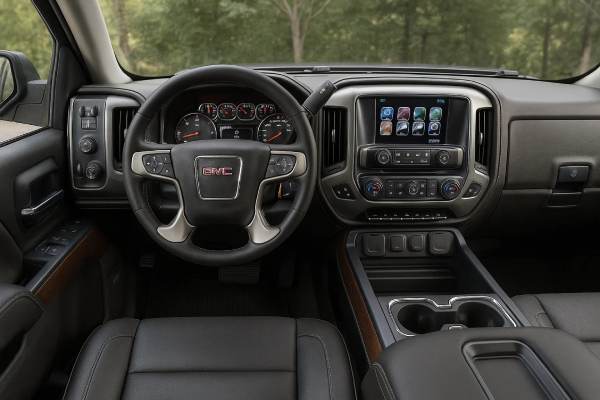
Inside, the 4WD Sierra 1500 benefits from the same big leap in refinement that defined this generation: a quiet cab, better materials than its predecessor, and much improved ergonomics. Depending on trim, you can have anything from a vinyl-floor work interior to a richly equipped Denali with heated and ventilated seats, upgraded audio, and advanced driver aids. That breadth of configuration is a major advantage on the used market: there is almost always a 5.3 4WD Sierra to suit your budget and priorities if you shop carefully.
Sierra 1500 4WD technical details
This section focuses on typical specifications for a 2014–2018 Sierra 1500 4WD with the L83 5.3-litre V8, a crew cab, and a short box. Exact numbers vary slightly by year, axle ratio, trim, and options, but these tables give a realistic technical picture.
Engine and Performance (Engine and Performance)
| Item | Specification |
|---|---|
| Engine code | L83 EcoTec3 V8 (often Flex Fuel capable) |
| Layout and valvetrain | 90° V8, OHV (cam-in-block), 2 valves per cylinder, variable valve timing |
| Displacement | 5.3 L (5,328 cc) |
| Bore × stroke | 96.0 mm × 92.0 mm (3.78 in × 3.62 in) |
| Compression ratio | 11.0:1 |
| Induction | Naturally aspirated |
| Fuel system | Direct fuel injection with Active Fuel Management cylinder deactivation |
| Maximum power | 355 hp (265 kW) @ 5,600 rpm (gasoline) |
| Maximum torque | 383 lb-ft (519 Nm) @ 4,100 rpm (gasoline) |
| Emissions / efficiency standard | Meets prevailing US light-duty truck emissions standards for 2014–2018 |
| Rated economy (4WD 5.3) | Typically around 15–16 mpg US city and 20–22 mpg US highway (roughly 15–17 L/100 km city, 11–12 L/100 km highway), depending on axle ratio and body style |
| Real-world highway @ 120 km/h | Often around 12–13 L/100 km (18–20 mpg US) if stock and driven moderately |
| Timing drive | Chain |
| Firing order | 1-8-7-2-6-5-4-3 |
Transmission and Driveline
| Item | Specification |
|---|---|
| Transmission | 6L80 6-speed automatic on most 2014–2018 5.3 4WD trucks; 8L90 8-speed automatic on some 2016+ higher trims |
| 6L80 gear ratios | 1st 4.03, 2nd 2.36, 3rd 1.53, 4th 1.15, 5th 0.85, 6th 0.67, Reverse 3.06 |
| Final drive ratios | Commonly 3.42:1 or 3.08:1; some tow-focused trucks use 3.73:1 |
| Drive type | Part-time four-wheel drive with electronic shift-on-the-fly |
| Transfer case | Two-speed AutoTrac (many models): 2HI, Auto 4WD, 4HI, 4LO, plus neutral for flat towing |
| Front differential | Independent front differential with CV half-shafts |
| Rear differential | Open or automatic locking (G80) differential depending on trim and options |
Chassis and Dimensions
| Item | Specification (typical crew cab, 4WD) |
|---|---|
| Front suspension | Independent coil-over shock with aluminium control arms and stabiliser bar |
| Rear suspension | Solid axle with semi-elliptic leaf springs |
| Steering | Electric power-assisted rack-and-pinion |
| Brakes | Four-wheel disc with ABS; front and rear rotors around 13 inches |
| Tyres (common) | 265/65R18 or 275/55R20 all-season or all-terrain, load-rated for half-ton duty |
| Ground clearance | Roughly 225–230 mm (about 8.9–9.1 in), slightly higher than 2WD |
| Approach / departure angles | Typically in the mid-teens to low twenties (degrees), depending on trim and bumper design |
| Length | Approximately 5,835 mm (229.7 in) for crew cab short box 4WD |
| Width (without mirrors) | About 2,030 mm (80.0 in) |
| Height | Around 1,880–1,900 mm (74–75 in) |
| Wheelbase | About 3,645 mm (143.5 in) for crew cab short box |
| Curb weight | Roughly 2,350–2,500 kg (5,180–5,500 lb), depending on trim and equipment |
| GVWR | Commonly around 3,175–3,266 kg (7,000–7,200 lb) for 4WD half-ton models |
| Fuel tank | Around 98 L (26 US gal, roughly 21.6 UK gal) |
| Cargo volume (short box) | Roughly 1,510 L (53.4 ft³), SAE method |
Performance and Capability
| Item | Typical value (5.3 4WD, properly equipped) |
|---|---|
| 0–100 km/h (0–62 mph) | Around 6.7–7.2 seconds, depending on cab, axle ratio, and tyres |
| Top speed (limited) | Around 175 km/h (109 mph), electronically governed |
| Braking distance 100–0 km/h | Roughly 40–44 m (130–145 ft) with healthy brakes and tyres |
| Maximum towing | Up to around 9,200–9,500 lb (4,175–4,310 kg) depending on axle ratio, cab, and tow package |
| Payload | Typically around 1,600–1,900 lb (725–860 kg) for 4WD crew cab models |
| Roof load | Generous for racks and light gear, but always follow roof rack and accessory ratings |
Fluids and Service Capacities
| System | Spec and capacity (approximate) |
|---|---|
| Engine oil | dexos1-approved 0W-20; about 8.0 L (8.5 US qt) including filter |
| Engine coolant | Dex-Cool OAT, 50/50 mix; roughly 15 L (16 qt) in most 5.3 4WD trucks |
| ATF (6L80) | Dexron-VI; pan drain about 5–6 L, full-fill around 11–12 L |
| Transfer case | GM-approved transfer case fluid; typically around 1.8–2.0 L |
| Front differential | 75W-90 synthetic gear oil; around 1.2–1.5 L depending on axle |
| Rear differential | 75W-90 synthetic gear oil; around 2–2.5 L |
Electrical and Safety Equipment
| Area | Details |
|---|---|
| Alternator output | Often around 150 A; HD tow/utility packages may increase this |
| 12 V battery | Group 48 or similar, approx. 70–80 Ah with 700+ CCA typical |
| Spark plugs | Long-life iridium; gap around 1.0 mm (0.040 in); service interval near 100,000 mi |
| ADAS suite | Availability of forward collision alert, lane departure warning, rear camera, and park assist varies by year and trim |
| Crash ratings | Crew cab 4WD variants share strong crash performance with other body styles in this generation |
4WD trims, options and safety
Four-wheel drive hardware was available across most of the Sierra 1500 range, but the way it is packaged and equipped changes significantly by trim level.
Trims and 4WD availability
- Base/“Sierra” 4WD
Typically aimed at fleets and value-conscious buyers, these trucks often feature vinyl or cloth interiors, steel wheels, and fewer cosmetic upgrades. The 5.3 V8 and 4WD hardware may be part of a package rather than standard. They are attractive as simple, durable work trucks, especially if they have the locking G80 rear differential and a tow package. - SLE 4WD
The SLE is the core mid-level trim and very common with 4WD. Expect alloy wheels, more sound insulation, an upgraded infotainment system, and often the integrated trailer brake controller and tow mirrors when spec’d for towing. Many SLE 4WD trucks are crew cabs used as dual-purpose family and work vehicles. - SLT 4WD
SLT adds leather, power seats, dual-zone climate control, and more chrome. 4WD SLT trucks frequently carry the Max Trailering package, 3.42 or 3.73 gears, and additional coolers, making them excellent tow rigs. On the downside, the extra complexity means more systems to age and more cost if items like heated seats or power mirrors fail. - Denali 4WD
Denali sits at the top, with unique exterior styling, high-end interior finishes, and the richest feature set. Many 4WD Denali trucks also offer the 6.2-litre V8, but the 5.3 remains common. Denali 4WD models can have features such as magnetic ride control, large wheels, and the most advanced driver aids available for this generation.
Quick identifiers and build codes
- Denali is easy to spot via its distinct grille, badges, and typically 20-inch wheels.
- SLT and Denali interiors feature leather, soft-touch dash panels, and more elaborate trim.
- The glovebox service parts label (RPO list) confirms important items:
- L83 for the 5.3-litre V8
- G80 for the automatic locking rear differential
- GT4/GT5 etc. for axle ratios
- NQH/NQF style codes for the transfer case type
Safety ratings and driver assistance
The 4WD versions share the same underlying structure as their 2WD siblings, so crash performance is broadly similar. Crew cab trucks generally achieve very good ratings in key tests, reflecting a strong passenger cell and effective restraint systems. Extended and regular cabs may have slightly different ratings, so if you are particularly safety-conscious, it is worth checking the exact body style and year you are considering.
Active safety and driver assistance systems evolve over this period:
- Early trucks (2014–2015) often make forward collision alert and lane departure warning optional on upper trims, with backup cameras and park sensors more widely available.
- Mid-cycle trucks (2016 onward) expand camera and sensor availability, and infotainment updates bring improved interfaces, phone mirroring, and clearer on-screen warnings.
- The availability of trailer brake controllers, hill descent control, and stability control tuned for towing helps 4WD models maintain stability under load.
Calibration and repair considerations
When replacing windscreens, front bumpers, or components around the grille, you may need to recalibrate forward collision alert cameras or radar sensors if fitted. Similarly, repairs to the steering column or rack can affect the operation of stability and lane departure systems. For 4WD models, transfer case switch faults and front axle actuator issues can trigger warning lights and deactivate 4WD modes until corrected; proper diagnosis with factory-level equipment is ideal.
Overall, a Sierra 1500 4WD in SLE or SLT trim typically offers the best balance of features, capability, and cost, while Denali adds more comfort and technology at the price of greater complexity and higher replacement costs for cosmetic and electronic parts.
Reliability, faults and service actions
The 2014–2018 GMC Sierra 1500 4WD with the L83 5.3-litre V8 is generally regarded as durable, especially when serviced on time. Nonetheless, some recurring issues are worth understanding.
Common and moderate-to-high impact issues
- AFM lifter and camshaft problems
The Active Fuel Management system uses special lifters to deactivate half the cylinders under light load. On some trucks, these lifters can collapse or wear prematurely, leading to ticking noises, misfires, and, in severe cases, camshaft damage. Symptoms include rough idle, check engine lights with cylinder-specific misfire codes, and tapping from the valley area. Repair usually involves replacing lifters and sometimes the camshaft, which is labour intensive. Many owners who plan to keep the truck long term opt for AFM-delete solutions combined with updated engine tuning, where emissions rules allow. - 6-speed and 8-speed transmission shudder
Both the 6L80 and 8L90 transmissions can suffer from fluid breakdown and torque-converter clutch shudder, particularly in higher gears under light throttle. Drivers feel this as a vibration or rumbling around 40–80 km/h (25–50 mph). The typical remedy is a full fluid exchange using the latest specified fluid, combined with software updates and, if necessary, torque-converter replacement. Trucks that have had regular fluid changes are less likely to develop severe issues. - Front-end wear and 4WD driveline noise
As mileage climbs, ball joints, tie rods, and front wheel bearings wear, sometimes accompanied by clunking noises from the intermediate steering shaft. In 4WD trucks, worn front differential bearings or CV joints can add hums or vibrations that change with speed or when 4WD is engaged. Addressing these faults early with quality replacement parts helps prevent secondary damage and improves steering precision. - Corrosion in harsh climates
In regions that use road salt, frame rails, crossmembers, brake lines, and rocker panels can develop significant rust. 4WD trucks are often exposed to more off-road mud and water, so thorough underbody inspection is vital. Severely corroded brake lines can rupture under hard braking; replacing the full set with corrosion-resistant lines is often the safest approach.
Occasional but important issues
- Electric power steering and airbag software
Some trucks were subject to recalls for brief loss of steering assist or potential non-deployment of airbags under specific self-test conditions. Ensuring that all recall work has been performed is a crucial part of a reliability strategy. - Ignition switch and key cylinder
A subset of early trucks experienced issues with the ignition switch or key mechanism, such as difficulty turning the key or unintended movement between run and accessory positions. The fixes range from lubricating and adjusting components to replacing the ignition lock housing.
Low-frequency but high-cost problems
- Rear main seal and oil cooler line leaks
Oil leaks at the rear of the engine or from cooler lines are not present on every truck but are expensive when they occur, especially rear main seal failures that require transmission removal. Catching leaks early can prevent oil saturation of rubber components and contaminants on the underbody. - Transfer case and front differential failures
When the transfer case runs low on fluid or is never serviced, its internal clutches and gears can wear or fail. Similarly, neglected front differentials can develop bearing noise or gear damage. These issues are far less common on trucks with documented fluid changes.
Recalls, TSBs, and extended coverage
General Motors has issued a variety of recalls and technical service bulletins (TSBs) for this generation of Sierra. While the exact list is long, key themes include software updates for steering and airbag modules, repairs or reinforcements for seat-belt and seat-track components, and updates for transmission calibrations. Some issues, like certain transmission concerns, have been covered under extended warranty or special policy adjustments for specific VIN ranges.
For any used truck, you should:
- Run an official VIN check on the manufacturer or national safety authority website.
- Ask for documentation of completed recall and warranty work.
- Confirm that any TSB-related fixes for symptoms you experience have been applied.
Understanding these reliability patterns allows you to focus your inspection, maintenance, and budgeting where they matter most.
Ownership maintenance and buyer guide
Owning a 2014–2018 Sierra 1500 4WD with the L83 5.3-litre V8 is straightforward if you follow a sensible maintenance plan and choose your truck carefully.
Practical maintenance schedule
For a typical mix of commuting, light towing, and occasional 4WD use:
- Engine oil and filter – Every 5,000–7,500 mi (8,000–12,000 km) or 12 months with dexos1-approved 0W-20. Shorter intervals are wise if you tow regularly, idle extensively, or drive in very dusty conditions.
- Engine air filter – Inspect every 15,000 mi (24,000 km); replace around 30,000 mi (48,000 km) or sooner if dirty.
- Cabin air filter – Replace every 20,000–25,000 mi (32,000–40,000 km) or 2 years.
- Spark plugs – Long-life iridium plugs typically at around 97,500–100,000 mi (160,000 km).
- Coolant – Dex-Cool coolant generally at 5 years/150,000 mi (240,000 km) initially, then every 5 years or 100,000 mi (160,000 km).
- Automatic transmission fluid – For both 6L80 and 8L90, aim for 50,000–60,000 mi (80,000–100,000 km) fluid service, especially if the truck tows.
- Transfer case fluid – Replace around every 50,000–60,000 mi (80,000–100,000 km); heavy off-road or tow use justifies shorter intervals.
- Front and rear differential fluids – 50,000–60,000 mi (80,000–100,000 km) under normal use; more frequent changes for heavy towing.
- Brake fluid – Flush every 3 years, regardless of mileage.
- Brake pads and rotors – Inspect annually; replace pads before they are completely worn to protect rotors and maintain stopping performance.
- Serpentine belt, hoses, and cooling hardware – Inspect from 60,000 mi (100,000 km), then yearly. Replace any components showing cracking, swelling, or leaks.
- Tyre rotation and alignment – Rotate every 6,000–8,000 mi (10,000–13,000 km); align whenever you notice pull, uneven wear, or after suspension work.
- 12 V battery – Test annually after five years; replace at the first signs of weakness.
- Timing chain – No standard replacement interval; monitor for rattle, timing correlation codes, or abnormal cam/crank variance.
Where possible, use fluids and parts that meet or exceed factory specifications. For example, sticking with dexos1 oil and high-quality filters helps reduce the risk of AFM and timing-chain wear, while proper ATF and transfer case fluid protect expensive driveline components.
Buyer checklist
When evaluating a used Sierra 1500 4WD:
- Start underneath
- Inspect the frame rails, crossmembers, and suspension mounting points for rust, particularly in salt-belt trucks.
- Look for damp or oily spots around the engine rear main area, transmission pan, transfer case, and differentials.
- Check 4WD operation
- With room to do so safely, cycle through 2HI, Auto 4WD, and 4HI on loose surfaces, listening for clunks, binding, or warning lights.
- Verify that 4LO engages and disengages correctly with the transmission in neutral and the truck at a crawl.
- Review service history
- Look for consistent oil changes, at least one or two transmission services by 100,000 mi (160,000 km), and evidence of differential and transfer case fluid changes.
- Confirm any major repairs (e.g., AFM lifters, transmission rebuilds) were done by reputable shops with quality parts.
- Test drive thoroughly
- Drive at a range of speeds, especially 40–80 km/h (25–50 mph), to feel for torque-converter shudder.
- Listen for clunks over bumps, steering play, and any humming noises that change with speed or 4WD engagement.
- Electronics and interior
- Check the operation of infotainment, cameras, parking sensors, power seats, windows, and mirrors.
- Scan for diagnostic trouble codes, even if no warning lights are illuminated.
Which 4WD Sierras to prioritise
- Best all-rounders – 2016–2018 SLE or SLT crew cab 4WD 5.3 trucks with documented maintenance offer a strong mix of updated tech and proven hardware.
- Budget workhorses – Earlier 2014–2015 4WD Sierras in Base or SLE trim can be good value if rust is controlled and recalls are completed.
- Luxury-focused – Denali 4WD models are attractive but command higher prices and bring more complex features, so factor that into ownership costs.
With the right truck and a proactive maintenance plan, a Sierra 1500 4WD L83 can deliver many more years and kilometres of reliable service.
Driving dynamics and 4WD performance
On the road, the 4WD Sierra 1500 with the L83 5.3-litre V8 feels familiar if you have driven the 2WD version, but the extra weight and 4WD hardware subtly change its character.
Ride, handling, and NVH
Ride quality is generally comfortable, especially on 17- or 18-inch wheels with standard suspension. The independent front suspension smooths out smaller imperfections, while the rear leaf springs are tuned to carry payload, so some firmness over sharp bumps is normal. Compared with 2WD, the 4WD front axle components and slightly higher ride height can make the front end feel a bit more substantial over rough surfaces, which many drivers appreciate on broken pavement and gravel.
Steering effort is light at parking speeds thanks to electric power steering and gains reassuring weight on the highway. The truck tracks straight and resists crosswinds well when properly aligned and fitted with good tyres. Road and wind noise are well controlled for a body-on-frame pickup, especially in SLT and Denali trims with extra sound insulation.
Powertrain character and transmission behaviour
The 5.3-litre V8 delivers smooth, predictable torque from low rpm, making it easy to merge, overtake, and tow without excessive revving. AFM cylinder deactivation is largely seamless in stock form, though some drivers notice a slight change in exhaust tone when the truck drops into V4 mode at light load.
The 6L80 and 8L90 automatics are tuned to reach higher gears early for fuel economy. In everyday driving, this means low revs and relaxed cruising. Under heavy throttle, both transmissions kick down decisively, though calibration differences and fluid condition can influence how crisp or smooth the shifts feel. Using tow/haul mode when pulling a trailer significantly improves downshift logic and engine braking on hills.
4WD system performance
AutoTrac 4WD is one of the Sierra’s greatest practical strengths. In 2HI, the truck behaves like a normal rear-wheel-drive pickup for efficiency. In Auto 4WD, the transfer case actively manages torque to the front axle when it senses slip, giving all-weather stability without the binding associated with locked 4HI on dry pavement. 4HI provides full-time traction for snow, mud, and loose gravel, while 4LO offers extra torque multiplication for steep climbs, descents, or extracting trailers from poor surfaces.
The system is easy to live with: a rotary dial or switch on the dash selects modes, and status indicators confirm engagement. Engaging 4LO requires the transmission to be in neutral and the truck to be nearly stationary.
Real-world efficiency and towing behaviour
In mixed driving, many owners see around:
- City: roughly 14–15 mpg US (17–19 mpg UK), or about 16–17 L/100 km.
- Highway: about 18–20 mpg US (22–24 mpg UK), or around 11–13 L/100 km, depending on speed and wind.
- Mixed: around 17–18 mpg US (20–22 mpg UK), slightly lower than equivalent 2WD trucks because of extra weight and driveline losses.
Under moderate towing, fuel economy can drop into the 8–11 mpg US (21–29 L/100 km) range depending on trailer size, speed, and terrain. 4WD improves traction when pulling away on wet ramps or gravel, and tow/haul mode, combined with a properly set trailer brake controller, helps maintain confidence on descents.
Overall, the Sierra 1500 4WD L83 delivers a reassuring, composed driving experience, with the added security of selectable four-wheel drive when conditions demand it.
How Sierra 4WD compares to rivals
When you compare a 2014–2018 Sierra 1500 4WD 5.3 to key competitors such as the Ford F-150 4×4, Ram 1500 4×4, Toyota Tundra 4×4, and Nissan Titan 4×4, several patterns emerge.
Versus Ford F-150 4×4
Ford’s aluminium-body F-150 and turbocharged EcoBoost V6 engines deliver strong performance and often slightly better fuel economy. Its wide range of configurations and clever bed features (like integrated steps and tie-down systems) appeal to many buyers. However, some owners prefer the Sierra’s naturally aspirated V8 for its simpler layout and more traditional feel. The Sierra’s AutoTrac system is also a strong point for drivers who face mixed traction and want the convenience of an automatic 4WD mode.
Versus Ram 1500 4×4
Ram’s coil-spring rear suspension (and available air suspension) generally offers the smoothest empty-bed ride among half-ton trucks of this era. The available diesel variant can provide impressive highway fuel economy, but adds complexity, and emissions-system issues can be costly. The Sierra, by contrast, focuses on a conventional V8, leaf springs, and a traditional 4WD system, which many independent shops know well. For buyers prioritising comfort above all else, a Ram may have an edge; for those valuing familiar hardware and strong parts availability, the Sierra is compelling.
Versus Toyota Tundra and Nissan Titan 4×4
The Toyota Tundra’s 5.7-litre V8 is renowned for long-term durability but consumes noticeably more fuel than the Sierra’s 5.3, and its transmission and cabin tech feel older in this age range. The Nissan Titan is less common and can be harder to support with parts and aftermarket options in some markets. The Sierra 1500 4WD usually delivers a more modern cabin experience than both and has a vast ecosystem of accessories, tuning options, and service expertise.
Strengths of the Sierra 1500 4WD L83
- Traditional, naturally aspirated V8 powertrain with modern features like direct injection and cylinder deactivation.
- Versatile AutoTrac 4WD system that provides both part-time and “automatic” modes.
- Quiet, comfortable interior suitable for long trips and daily commuting.
- Wide range of trims and configurations, from work-ready to luxury-oriented.
- Strong support from independent garages, parts suppliers, and owner communities.
Areas where rivals may lead
- Some competitors offer more advanced active safety suites and interior tech, especially in later years.
- Ram 1500’s rear suspension can ride more smoothly when unloaded.
- Ford’s EcoBoost engines and aluminium body help achieve lower fuel consumption in some use cases.
For a buyer who wants a proven small-block V8, a capable 4WD system, and a comfortable yet familiar truck that is well understood by mechanics and parts suppliers, the 2014–2018 GMC Sierra 1500 4WD L83 is a very strong choice.
References
- 2014 GMC Sierra 1500 Specifications 2014 (Specifications)
- 2015 GMC Sierra 1500 2015 (Safety Rating)
- Vehicle Detail Search – 2014 GMC Sierra 1500 | NHTSA 2014 (Safety Rating and Recalls)
- 2015 CHEVROLET SILVERADO 1500 DOUBLE CAB SPECIFICATIONS 2014 (Service Spec Tables)
- 2014 GMC Sierra 1500 Owner’s Manual PDF (522 Pages) 2014 (Owner’s Manual)
Disclaimer
This article is for informational purposes only and is not a substitute for professional diagnosis, repair, or official service literature. Specifications, torque values, maintenance intervals, and procedures can vary by VIN, production date, market, and installed equipment. Always confirm details against the official owner’s manual, factory service information, and under-hood labels for your specific vehicle before performing any work.
If you found this guide helpful, you are welcome to share it with other owners or shoppers on Facebook, X/Twitter, forums, or group chats. Sharing helps other drivers make informed choices and supports the effort that goes into detailed resources like this.