
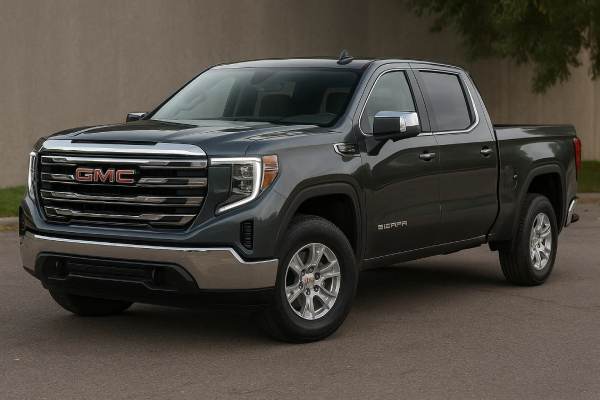
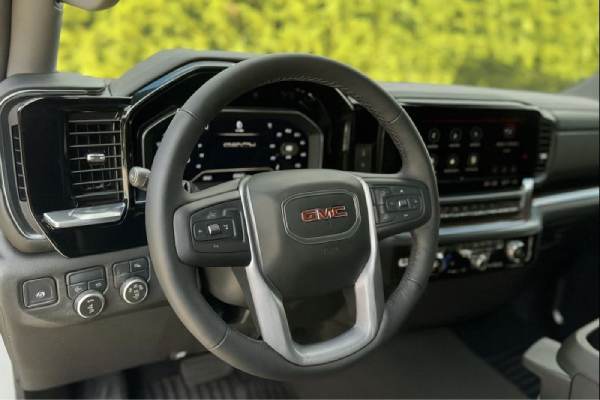
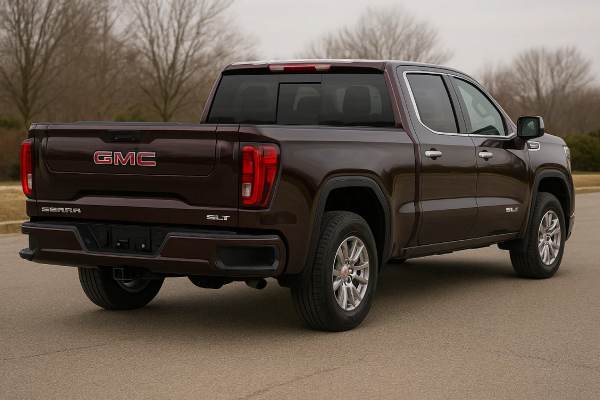
The facelifted 2022–present GMC Sierra 1500 4WD with the L3B 2.7-litre turbocharged four-cylinder is built for drivers who need real truck capability but do not want the cost or complexity of a big V8 or diesel. With the facelift, GMC paired a revised “Turbo High-Output” version of the 2.7 (often branded TurboMax) with a far more modern cabin, upgraded digital screens, and a broader suite of driver-assistance features.
In four-wheel-drive form, this Sierra combines strong low-end torque, a selectable transfer case, and meaningful tow and payload ratings with relatively modest fuel consumption for a full-size pickup. It is aimed at owners who see winter weather, unpaved access roads, or towing on variable surfaces, and who want the reassurance of 4WD without stepping into heavy-duty territory. In this guide, we walk through key specs, capability, reliability themes, maintenance planning, and how the 2.7 4WD Sierra stacks up against rivals so you can make a confident decision.
Top Highlights
- Turbo High-Output 2.7L L3B delivers about 310 hp and roughly 430 lb-ft, giving diesel-like low-end pull in a lighter gasoline package.
- Properly optioned 4WD models with the 2.7 can tow in the 9,000–9,600 lb range and offer payloads above 2,000 lb, depending on cab, bed, and axle ratio.
- Facelift trucks gained a 13.4-inch central touchscreen, an available 12.3-inch digital cluster, and enhanced camera-based trailering and ADAS features.
- Watch for carbon buildup, turbo plumbing issues, and alignment-sensitive tyre wear if you run larger wheels or off-road packages.
- Plan engine oil and filter changes every 7,500–10,000 miles (12,000–16,000 km) or 12 months, tightening that interval if you tow or run off-road often.
Navigate this guide
- GMC Sierra 4WD context
- L3B 4WD specs breakdown
- Sierra 4WD trims and safety
- Reliability trends and known faults
- Maintenance planning and purchase tips
- On-road manners and off-road use
- Rivals and alternatives to Sierra
GMC Sierra 4WD context
The 2022 facelift transformed the Sierra 1500 from a truck that was starting to feel dated inside into a thoroughly modern half-ton. The 4WD models with the L3B 2.7L turbo-four sit in a useful middle ground: they are not the very cheapest fleet-spec trucks, nor the most luxurious Denali variants, but they deliver a strong set of capabilities for the money.
The L3B Turbo High-Output engine was reworked for the 2022 model year with a reinforced block, revised crankshaft, upgraded internals, and a new calibration to deliver roughly 310 hp and around 430 lb-ft of torque. The goal was to give drivers a gasoline engine that behaves more like a small diesel in everyday use, with strong off-idle torque and confident mid-range pull when merging, climbing, or towing.
Adding 4WD changes the character of the truck. You gain:
- A two-speed transfer case with high and low range (on most 4WD trims)
- A driven front axle that can be engaged on loose or slippery surfaces
- Additional traction modes and, on some off-road trims, specific calibrations for mud, sand, or terrain
In return, you carry extra weight, add more mechanical complexity, and sacrifice a little fuel economy compared with a comparable 2WD Sierra.
Dimensionally, a typical 4WD crew cab, short-box Sierra 1500 is just over 231 in (about 5,890 mm) long, with a wheelbase in the 147 in range, around 81 in wide, and mid-70s inches tall. Those numbers are similar to rival full-size trucks, so your main real-world differences will come from cab/bed combination, wheelbase, and turning circle rather than raw footprint.
The facelift also focuses on refinement. The cabin uses better materials, tighter panel gaps, and an improved layout with a wide horizontal touchscreen and a dedicated row of physical switches for key functions. On-road, that translates to a truck that feels less like a bare workhorse and more like a large, quiet SUV with a bed attached.
If you regularly see snow, gravel, farm tracks, or steep boat ramps, the 4WD variant with this engine offers a valuable margin of security over RWD without jumping into heavy-duty pickups or very thirsty V8s.
L3B 4WD specs breakdown
This section summarises the main technical specifications for the 2.7L L3B Turbo High-Output engine and 4WD Sierra 1500 platform in the facelift era. Exact numbers vary by trim, cab, bed, and axle ratio, so always confirm for your VIN and market.
Engine and performance – L3B Turbo High-Output
| Item | Specification (approximate where noted) |
|---|---|
| Engine code | L3B Turbo High-Output (often branded TurboMax) |
| Layout | Inline-4, aluminum block and head |
| Displacement | 2.7 L (about 2,726 cc) |
| Bore × stroke | ~92.3 × 102.0 mm (3.63 × 4.01 in) |
| Valvetrain | DOHC, 4 valves/cyl, dual VVT |
| Induction | Single twin-scroll turbocharger |
| Fuel system | Direct high-pressure fuel injection |
| Compression ratio | Around 10:1 |
| Max power | 310 hp @ ~5,600 rpm |
| Max torque | About 430 lb-ft (582 Nm) @ ~3,000 rpm |
| Timing drive | Chain |
| Emissions standard | Designed to meet current US EPA / CARB light-duty rules |
The headline figure is torque. That 430 lb-ft number, on a relatively small displacement, is what allows the Sierra 1500 to tow substantial loads without needing a V8. The wide, flat torque curve also suits off-road and low-speed work in 4LO.
Transmission and 4WD driveline
Most 2.7L 4WD Sierras pair the engine with an electronically controlled automatic transmission and part-time 4WD system:
| Item | Specification (typical) |
|---|---|
| Transmission | 8-speed automatic |
| Transfer case | Two-speed, electronically controlled (2HI / 4HI / 4LO; Auto mode on some trims) |
| Drive type | 4×4, primarily rear-drive in 2HI |
| Rear differential | Open or automatic locking, depending on trim |
| Front differential | Open |
| Axle ratios | Commonly around 3.23–3.73 depending on tow packages |
With 4WD engaged, torque is split between the front and rear axles to improve traction. In low range (4LO), the transfer case multiplies torque for crawling or steep grades, which is especially helpful when towing or off-roading at low speeds.
Chassis, dimensions, and weights (crew cab, short box, 4WD – typical)
| Item | Approximate value |
|---|---|
| Overall length | ~231.9 in (5,890 mm) |
| Wheelbase | ~147.4 in (3,746 mm) |
| Width (without mirrors) | ~81.2 in (2,062 mm) |
| Height | ~75–78 in (1,905–1,980 mm), depending on suspension and tyres |
| Turning circle | Around 23–24 ft (about 7–7.3 m) kerb-to-kerb |
| Curb weight | Roughly 4,800–5,300 lb, depending on trim and equipment |
| GVWR | Typically 7,000–7,200 lb in many 4WD configurations |
| Fuel tank | Around 24 gal (approx. 91 L) gasoline |
Suspension remains independent coil-over at the front and a solid axle with leaf springs at the rear. Off-road or AT4-style trims may feature unique dampers, skid plates, and geometry changes but the basic layout is shared.
Capability and efficiency
For the 2.7 L3B 4WD, typical figures:
- Max towing: commonly around 9,000–9,300 lb for certain 4WD configurations with the correct axle ratio and tow package.
- Max payload: up to roughly 2,000–2,200 lb on select 4WD trims when lightly optioned.
- 0–60 mph: typically in the high-6 to low-7 second range in independent tests.
- Fuel economy: real-world combined figures often in the high teens in mpg (around 13–14 L/100 km), depending on load, tyre choice, and driving style.
Compared with 2WD, you lose a little efficiency and payload due to added weight and mechanical drag, but gain traction versatility and confidence on poor surfaces.
Sierra 4WD trims and safety
The 2.7L 4WD drivetrain appears across several trims, primarily in Pro, SLE, Elevation, and in some cases SLT or package-specific variants in different markets. The mix can change by model year, but the broad picture stays similar.
Trims and options with the 2.7 4WD
Typical pairings include:
- Pro 4WD
- Work-focused interior with vinyl or rugged cloth seats.
- Smaller infotainment display on early 2022 builds, with later trucks moving up to larger screens.
- Steel wheels or simple alloys, vinyl floors on many fleet-oriented examples.
- Ideal for trades, fleets, and rural users who value durability as much as comfort.
- SLE 4WD
- Cloth interior, more sound insulation, improved infotainment.
- Access to convenience options such as dual-zone climate and more advanced driver information displays.
- Often the best value balance of features and price.
- Elevation 4WD
- Sportier appearance with body-colour trim, 20-inch wheels on many builds, and black exterior accents.
- Typically crew cab, short box with the 2.7.
- Attracts buyers who want both capability and a more aggressive visual package.
- SLT 4WD (select markets)
- Higher-end interior materials, power seats, larger screens standard.
- May still offer the 2.7 Turbo High-Output as a way to get a well-equipped truck without stepping into V8 pricing.
Important option themes:
- Axle ratios and tow packages that change tow ratings and cooling hardware
- Trailering equipment (integrated brake controller, hitch guidance, trailer cameras)
- Off-road hardware (skid plates, all-terrain tyres, hill descent control)
- Interior tech (heads-up display, Bose audio, digital gauges)
Safety ratings
The Sierra 1500 crew cab shares its underlying structure with the Chevrolet Silverado 1500 crew cab. Independent crash testing has shown:
- Strong performance in moderate-overlap front and many traditional crashworthiness tests
- More mixed results in some newer small-overlap and updated side-impact assessments, depending on configuration
Government star ratings vary by cab and drivetrain. Many crew-cab configurations achieve four or five stars overall, but you should verify using VIN-specific tools for the exact truck you are considering.
Safety systems and ADAS
With the facelift, GMC Pro Safety becomes widely standard and may include:
- Forward collision alert with automatic emergency braking
- Front pedestrian braking
- Lane keep assist with lane departure warning
- Following distance indicator
- IntelliBeam automatic high beams
Higher trim levels or packages add:
- Blind-spot monitoring with rear cross-traffic alert
- Rear park assist and HD surround-view camera system
- Rear pedestrian alert
- Advanced trailering features such as trailer length indicator and jack-knife alert
On select 4WD trims, Super Cruise with trailering support is available, offering hands-free driving on compatible highways and automatic lane changes under certain conditions. It is less common on 2.7-powered trucks but worth checking if you are shopping used or ordering a high-spec configuration.
Any ADAS system may require recalibration after:
- Windscreen replacement
- Suspension height changes (lift kits or lowering)
- Front-end collision repair or major alignment work
Factor that into costs if you plan modifications.
Reliability trends and known faults
The facelift-era L3B 2.7 Turbo High-Output is still relatively young, but we can draw on early data from the engine family and from full-size GM truck ownership patterns.
Engine and turbo system
1. Carbon buildup on intake valves (direct injection)
Direct-injection petrol engines often develop carbon deposits on intake valves, particularly with short-trip or high-idle use. Symptoms include rough idle, hesitation, and a gradual loss of top-end power.
Helpful countermeasures:
- Regular oil changes using the correct spec and interval
- Occasional longer highway drives to reach full operating temperature
- Considering intake cleaning or walnut blasting around or beyond 100,000 miles if symptoms appear
2. Turbocharger and charge-air plumbing
Sustained towing, high ambient temperatures, or aggressive driving can stress the turbo hardware and plumbing. Potential issues:
- Oil seepage at turbo seals
- Boost leaks at intercooler couplers or hoses
- Underboost/overboost fault codes and reduced power
Early detection via visual inspection and attention to changes in sound or performance is important. Timely oil service helps protect the turbocharger.
3. Cooling system under load
Under sustained high-load scenarios (mountain towing, hot climates), any weakness in the cooling system stands out. Keep an eye on:
- Rising coolant or transmission temperatures on long grades
- Debris clogging radiators or coolers
- Correct coolant type and mix after any service
Address cooling concerns quickly; excess heat is one of the main threats to turbo engines and automatic transmissions.
Driveline and 4WD components
4WD hardware introduces additional service points compared with RWD:
- Transfer case fluid needs periodic replacement, especially with frequent 4LO use or off-road driving.
- Front differential fluid must be changed on schedule if the truck tows regularly or sees heavy use.
- CV joints and front axle boots should be inspected for tears, grease leakage, or clicking at full steering lock.
4WD trucks can be more sensitive to tyre diameter mismatches and alignment. Always keep tyre sizes matched, rotate regularly, and address alignment issues promptly to avoid driveline stress.
Chassis and body
Common wear points for full-size trucks that also apply to the Sierra include:
- Suspension bushings and ball joints, which wear faster on rough roads or with heavy accessories and large wheels.
- Rear leaf spring squeaks or clunks, often related to worn isolators or dry contact points.
- Corrosion hotspots in cold/salt climates, especially on frame rails, bed crossmembers, and around cab mounts.
Recalls, TSBs, and software updates
GM issues technical service bulletins (TSBs), field actions, and software updates covering:
- Transmission shift quality and adaptive learning behaviour
- Infotainment and connectivity glitches
- ADAS performance and false warning tuning
Some driveability complaints (hesitation, gear hunting, harsh shifts) are resolved with updated programming rather than hardware replacement.
Before buying or after major service, you should:
- Run your VIN through official recall and campaign databases to verify status.
- Ask the dealer which software updates have been applied and whether any are outstanding.
Overall, early indications place the L3B 2.7 Turbo High-Output in the “average to slightly better than average” range for modern turbo petrol truck engines, with no large-scale catastrophic defects widely reported at this stage.
Maintenance planning and purchase tips
A clear, realistic maintenance plan is essential if you want your 4WD 2.7 Sierra to deliver long, trouble-free service, especially when used for towing, hauling, or off-road work.
Practical maintenance schedule (generic guidance)
Always follow the official owner’s manual and Oil Life Monitoring (OLM) system, but these intervals make a solid starting point:
- Engine oil and filter
- Every 7,500–10,000 miles (12,000–16,000 km) or 12 months for mixed use
- Tighten to 5,000–7,500 miles (8,000–12,000 km) for frequent towing, idling, or dusty conditions
- Engine air filter
- Inspect at 15,000 miles (24,000 km)
- Replace around 30,000–45,000 miles (48,000–72,000 km), sooner in dusty environments
- Cabin air filter
- Replace every 15,000–24,000 miles (24,000–40,000 km) or approximately every 2 years
- Spark plugs
- Typically 60,000–100,000 miles (96,000–160,000 km) with iridium plugs; confirm exact interval for the L3B in your manual
- Coolant
- First change around 5 years / 100,000 miles (160,000 km), then as specified
- Always use the recommended long-life coolant and correct mix ratio
- Automatic transmission fluid
- 60,000–75,000 miles (96,000–120,000 km) for mixed driving
- Earlier changes are wise if towing at or near maximum ratings
- Transfer case and differentials (4WD)
- 45,000–60,000 miles (72,000–96,000 km) under tow/off-road use
- Up to 75,000–90,000 miles (120,000–145,000 km) for lighter duty, depending on the manual
- Brake fluid
- Flush every 3 years regardless of mileage
- Brake pads and rotors
- Inspect at least annually or every 12,000 miles (19,000 km)
- Tyre rotation and alignment
- Rotate every 5,000–7,500 miles (8,000–12,000 km)
- Check alignment annually or after impacts and major off-road trips
- 12V battery
- Test annually after year 3
- Plan replacement around 5–7 years depending on climate and usage
Fluids and torque considerations
Approximate planning figures (you must confirm for your specific VIN and axle/transmission):
- Engine oil capacity: about 6–7 qt (5.7–6.6 L) with filter
- Front and rear differential capacities: roughly 2–3 L each, typically synthetic 75W-90 gear oil
- Transfer case fluid: often 1–2 L of the specified transfer case fluid
- Wheel lug nuts: commonly torqued around 140–190 Nm (103–140 lb-ft)
Because 4WD hardware adds more sealed components, budget for periodic fluid replacements in the front axle and transfer case even if the truck rarely leaves paved roads.
Buyer’s guide: what to check
When shopping for a new or used Sierra 1500 4WD with the 2.7:
- Usage pattern
- Clarify whether the truck was mainly a commuter, family vehicle, or towing/work truck.
- Heavy tow use is acceptable if service records show regular fluid changes.
- Service records
- Look for consistent oil changes with the proper specification.
- Confirm driveline, brake fluid, and coolant services at sensible intervals.
- 4WD system health
- On a test drive, cycle between 2HI, 4HI, and (if fitted) 4LO at appropriate speeds and surfaces.
- Listen for binding, grinding, or clunks and watch for warning messages.
- Suspension and tyres
- Check for uneven tyre wear that could indicate alignment or shock issues.
- Inspect shocks, bushings, ball joints, and steering links, especially on trucks with lifts or heavy off-road use.
- Body and frame
- Examine frame rails, welds, bed supports, and cab mounts for corrosion or poorly repaired damage.
- Check underbody protection; missing skid plates or deformed crossmembers can hint at off-road impacts.
For long-term ownership, a powertrain-focused extended warranty can be sensible, especially if you plan frequent towing or high annual mileage.
On-road manners and off-road use
Ride and handling
The 4WD Sierra 1500 with the 2.7 engine feels planted and predictable on the road. The added mass of the front differential and transfer case introduces a slightly heavier feel at the steering wheel compared with RWD, but the electric power steering system keeps effort manageable.
On standard 18-inch wheels and tyres, the ride is firm yet controlled, with the long wheelbase helping to smooth out highway undulations. Larger 20-inch or optional wheels sharpen steering response but pass more pothole and expansion-joint harshness into the cabin.
Road and wind noise are kept in check, especially in SLE, Elevation, and SLT trims where extra insulation and better door sealing are used. The facelift interior, with its improved materials and layout, makes the cabin a much more comfortable place for long drives than earlier Sierra generations.
Powertrain character in real use
The L3B turbo-four is tuned to deliver strong low-end torque, which you notice immediately from a stop or at low speeds. Under gentle throttle, the engine stays quiet and low in the rev range, relying on torque and short early shifts. With heavier throttle, it builds boost quickly and pulls strongly through the mid-range.
Turbo lag is present but modest; once you are familiar with the engine, it is easy to keep the turbo in its sweet spot with smooth throttle inputs. The 8-speed automatic generally shifts unobtrusively, though some drivers report occasional gear hunting at light throttle—behaviour that can often be improved with the latest software updates.
Engaging Tow/Haul mode adjusts shift points, keeps lower gears longer, and adds engine braking on descents, which is noticeable and helpful when towing.
Real-world fuel economy and range
In everyday use, many owners see:
- City driving: mid-teens to high-teens mpg (roughly 13–16 L/100 km)
- Highway (65–75 mph / 105–120 km/h): high-teens to low-twenties mpg (around 11–13 L/100 km)
- Combined: around 18–20 mpg (roughly 11.8–14.1 L/100 km) in mixed conditions
Driving style, wheel and tyre choice, and accessory load (roof racks, lift kits, etc.) all have significant impacts. Compared with 2WD, expect the 4WD truck to use about 1–2 mpg more fuel in similar conditions.
Under heavy towing near the engine’s rated capacity, fuel consumption can worsen by 20–30 percent or more, which is typical for gasoline half-ton trucks.
Off-road and poor-weather performance
In 4HI, the Sierra 1500 can tackle gravel roads, muddy worksites, and snowy conditions with much more confidence than a comparable RWD truck on the same tyres. Hill descent control (where fitted), terrain modes, and skid plates on off-road packages increase capability on steeper or rougher routes.
Key points:
- Tyre choice matters as much as the presence of 4WD. All-terrain tyres improve traction but increase noise and reduce efficiency.
- 4LO is intended for low-speed work: steep climbs, rock crawling, or positioning a trailer on an incline.
- Ground clearance is adequate for light to moderate trails, but approach and departure angles are still limited compared with dedicated off-road trucks, particularly with long overhangs or side steps.
When towing on slippery ramps or in snow, the ability to engage 4HI can make launching and retrieving boats or trailers significantly easier and safer.
Rivals and alternatives to Sierra
The Sierra 1500 4WD with the 2.7L Turbo High-Output engine competes directly with other full-size trucks that use smaller-displacement turbocharged petrol engines instead of large naturally aspirated V8s.
Versus other Sierra engines
- Versus the 5.3L and 6.2L V8s
- V8 engines provide greater peak power and higher tow ratings in some configurations, plus the classic sound many owners appreciate.
- They are heavier and typically consume more fuel, especially under light or moderate loads.
- The 2.7 Turbo High-Output narrows the performance gap while using less fuel in most mixed driving and reducing front-end weight.
- Versus the 3.0L Duramax diesel
- The diesel excels for long-distance towing and highway fuel economy.
- It adds diesel exhaust fluid (DEF), more complex aftertreatment, and additional cold-weather considerations.
- The 2.7 suits owners who mainly tow moderate loads, run shorter trips, or prefer to avoid diesel emissions hardware.
Versus Ford, Ram, and others
- Ford F-150 2.7 EcoBoost / 3.5 EcoBoost
- Ford’s turbo V6 engines are very strong performers with impressive acceleration.
- They can be thirsty when worked hard; the Sierra’s 2.7 inline-four has a simpler architecture and fewer cylinders, with a similar focus on torque.
- Ram 1500 3.6 V6 with eTorque / 5.7 Hemi
- Ram emphasizes ride quality and interior refinement, with coil-spring rear suspension on many trims.
- The Sierra counters with its updated digital interior, robust towing tech, and the strong torque-per-litre of the L3B engine.
- Toyota Tundra and Nissan Titan
- Tundra now uses twin-turbo V6 powertrains; Titan continues with a naturally aspirated V8.
- Both compete on durability and reputation. The Sierra’s 2.7 offers a more efficiency-oriented alternative while still delivering meaningful capability.
Who the 2.7 4WD Sierra suits best
This configuration is particularly good for:
- Owners in mixed climates who want the security of 4WD and strong towing, but do not need the very highest capacities
- Tradespeople and small business owners who value a lower purchase price than diesel or high-output V8 models, yet still need a capable work and tow vehicle
- Families who want a dual-purpose vehicle that can serve as both daily driver and weekend adventure truck
If you frequently tow very heavy loads, run commercial-grade equipment, or expect to rack up extremely high mileage, a diesel or heavy-duty platform may still be a better fit. For many buyers, though, the GMC Sierra 1500 4WD with the L3B 2.7 Turbo High-Output offers a modern, efficient take on the full-size pickup formula with a strong blend of traction, capability, and everyday livability.
References
<a href="https://www.gmc.com/content/dam/gmc/na/us/english/index/about/download-brochures/2022-models/02-pdf/GMTR22CT100FO_MY22_GMC%20SIERRALD_080822.pdf">2022 FEATURES, SPECS AND OPTIONS</a> 2022 (Features and Specifications Guide)<a href="https://www.gmc.com/content/dam/gmc/na/us/english/index/vehicles/future-vehicles/sierra-ld-mcm/01-images/GMC_New_2022_SierraLD_CustomerOrderingGuide.pdf">NEW 2022 GMC SIERRA 1500 CUSTOMER ORDERING GUIDE</a> 2022 (Ordering and Powertrain Guide)<a href="https://www.iihs.org/ratings/vehicle/gmc/sierra-1500-crew-cab-pickup/2022">2022 GMC Sierra 1500 Crew cab pickup</a> 2022 (Safety Rating)<a href="https://www.gmc.com/support/vehicle/manuals-guides">Manuals and Guides | Vehicle Support</a> 2025 (Owner’s Manuals Portal)<a href="https://contentdelivery.ext.gm.com/content/dam/cope/en_us/public/pdf_assets/active/owners_manuals_browse/25_GMC_Sierra_Sierra_Denali_1500_OM_en_US_U_87855280B_2024OCT31_2P.pdf">2025 GMC Sierra/Sierra Denali 1500 Owner Manual</a> 2025 (Owner’s Manual)
Disclaimer
This article is intended for informational purposes only and does not replace professional diagnosis, repair, or official service information. Specifications, torque values, capacities, and maintenance intervals can vary by VIN, model year, market, and equipment package. Always verify details against your vehicle’s official owner’s manual, service documentation, and current technical bulletins, and follow manufacturer procedures and safety instructions.
If you found this guide helpful, please consider sharing it with other owners or shoppers on social platforms such as Facebook or X/Twitter. Your support helps us continue producing detailed, independent guides for enthusiasts and professionals.