
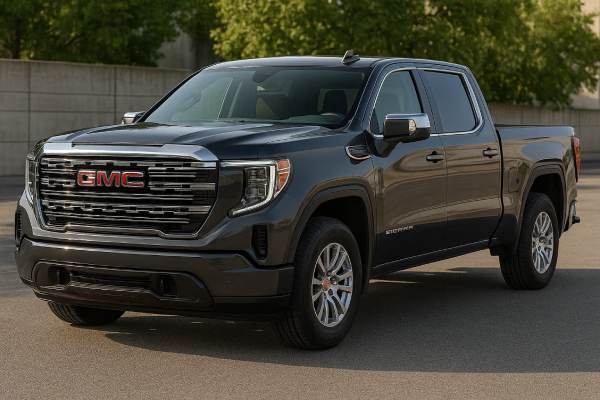
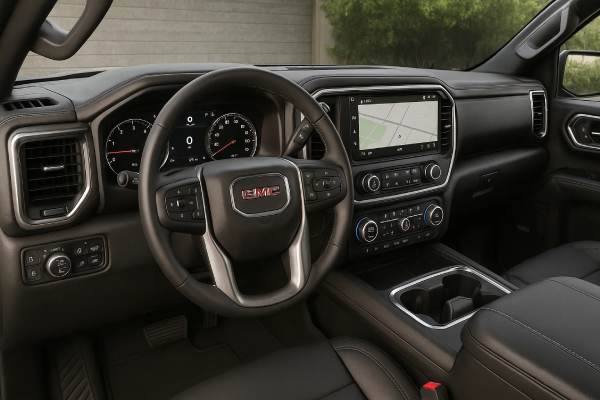
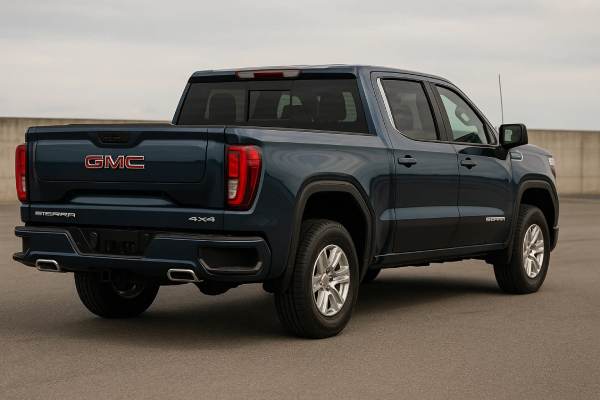
The facelifted GMC Sierra 1500 4WD with the L84 5.3 litre V8 sits in the middle of the Sierra range, but for many owners it is the sweet spot. You get a traditional pushrod V8 with modern technology, a robust 10-speed automatic, and a configurable 4WD system that can switch from confident winter grip to efficient highway running. The 2022 refresh brought a much more modern interior, a large central touchscreen, and a broader spread of driver-assist tech, which makes this truck feel newer than its basic platform age suggests.
This guide focuses on the 4WD L84 trucks from the 2022 facelift onward. It walks through the core specs, real-world performance, reliability patterns, and what to look for when buying used. You will also find practical maintenance intervals and tips on how the Sierra compares with key rivals like the F-150, Ram 1500, and Silverado.
Top Highlights
- Strong 5.3 litre V8 with 10-speed automatic and 4WD gives balanced power, towing, and efficiency.
- 2022+ facelift adds a much improved cabin, tech, and safety features compared with pre-facelift trucks.
- Known issues focus on valvetrain, lifters, and some 10-speed drivability quirks; extended warranty is wise.
- Typical engine oil change interval is 7,500 mi / 12,000 km or 1 year under normal use (shorter for heavy towing).
Navigate this guide
- GMC Sierra 5.3 4WD profile
- Engine, specs and key data
- Trims, equipment and safety tech
- Reliability and known issues
- Ownership maintenance and buying tips
- Driving experience and real-world use
- Sierra 1500 rivals comparison
GMC Sierra 5.3 4WD profile
In the 2022 facelift, GMC repositioned the Sierra 1500 as a more premium twin to the Chevrolet Silverado. The L84 5.3 litre V8 remains a core engine choice, and when paired with 4WD it is aimed at owners who tow, drive in mixed climates, or simply want the extra traction of a transfer case rather than relying on rear-wheel drive and traction control.
The facelift brought new front and rear styling, refreshed lighting, and most importantly a redesigned interior. Trucks with the 13.4-inch landscape touchscreen and new digital driver cluster feel markedly more modern than the pre-2022 models. Materials, switchgear, and seat comfort all improved, especially in higher trims such as SLT, AT4, and Denali.
Mechanically, the L84 is a 5.3 litre small-block V8 with direct injection, variable valve timing, and Dynamic Fuel Management (DFM) cylinder deactivation. It is paired with a 10-speed automatic transmission on 2022-on trucks, replacing earlier 6-speed units in many configurations. The 4WD system typically uses an electronically controlled transfer case with Auto, 2HI, 4HI, and 4LO modes, allowing you to leave the truck in Auto on mixed-grip roads, or lock in 4HI for snow, mud, and gravel.
The Sierra 1500 4WD with this V8 can be configured as a work-oriented truck with cloth seats and simple options, or as an upscale daily driver with leather, Bose audio, and advanced driver-assist tech. That spread is one of its strengths: the core frame, engine, and driveline are shared, but the experience can be tailored from basic fleet spec to near-luxury. For buyers, that means a wide used market and a lot of choice—but also the need to look carefully at trim, packages, and tow/axle codes.
Engine, specs and key data
To make sense of the Sierra 1500 4WD L84, it helps to break the technical data into clear groups. Figures below are typical for a 2022–2024 Crew Cab 4WD with the 5.3 V8; exact numbers vary slightly by cab, bed, and package.
Engine and performance
| Item | Specification (L84 5.3 V8) |
|---|---|
| Engine code | L84 |
| Layout and valvetrain | 90° V8, OHV, 2 valves/cyl |
| Displacement | 5.3 l (5,328 cc) |
| Induction | Naturally aspirated |
| Fuel system | Direct injection (DI) |
| Compression ratio | Around 11.0 : 1 |
| Max power | 355 hp ≈ 265 kW @ about 5,600 rpm |
| Max torque | About 519 Nm (383 lb-ft) @ around 4,100 rpm |
| Timing drive | Chain |
| Emissions / standards | U.S. EPA / CARB-compliant |
| Cylinder deactivation | Dynamic Fuel Management |
Official fuel economy for a typical 4WD 5.3 Sierra with the 10-speed automatic is around 15–16 mpg US city, 19–20 mpg US highway, and about 17 mpg combined (roughly 14–15 l/100 km combined), depending on cab/bed and tyre package. In real-world mixed use, owners often report high-teens mpg unloaded and low-teens when towing.
Aerodynamic drag is not usually published in detail for full-size pickups, but wide frontal area and boxy shape mean that high-speed highway fuel consumption is sensitive to lift kits, off-road tyres, and roof racks.
Transmission and driveline
| Item | Specification |
|---|---|
| Transmission | 10-speed automatic (Hydra-Matic 10L80 series) |
| Drive type | Part-time 4WD with electronic transfer case |
| Transfer case modes | 2HI, Auto, 4HI, 4LO |
| Front differential | Open (with brake-based traction control) |
| Rear differential | Open or automatic locking (G80) depending on trim |
| Typical axle ratios | Around 3.23–3.42 (varies with towing package) |
The Auto 4WD mode is useful in rain or patchy snow, as it can send torque forward when slip is detected, but still decouple when cruising.
Chassis, dimensions and capacities
Approximate figures for a Crew Cab, standard-bed 4WD 5.3:
| Item | Value |
|---|---|
| Suspension (front) | Independent coil-over struts |
| Suspension (rear) | Solid axle, leaf springs |
| Brakes (front/rear) | Ventilated discs |
| Wheelbase | ~3,744 mm (147.4 in) |
| Length | ~5,886 mm (231.8 in) |
| Width (without mirrors) | ~2,063 mm (81.2 in) |
| Height | ~1,915 mm (75.4 in) |
| Ground clearance | ~200–230 mm (≈8–9 in), trim-dependent |
| Curb weight | Roughly 2,200–2,450 kg (4,850–5,400 lb) |
| Fuel tank | About 91 l (24 US gal) |
Performance and towing
| Item | Typical value (5.3 4WD) |
|---|---|
| 0–60 mph (0–97 km/h) | ≈ 6.7–7.2 s (unloaded) |
| Top speed (governed) | ≈ 175–180 km/h (109–112 mph) |
| Braked towing capacity | Up to around 4,000+ kg (≈9,000 lb) when properly equipped |
| Payload | Typically 760–950 kg (1,675–2,100 lb), trim-dependent |
Fluids and electrical (typical)
- Engine oil: Dexos1-approved 0W-20; capacity about 7.6 l (8.0 US qt) with filter
- Coolant: Dex-Cool OAT; roughly 11–13 l system capacity
- Transmission fluid: Dexron ULV ATF; changeable volume ≈ 6–7 l in a drain-and-fill
- 4WD transfer case: GM-spec transfer case fluid; around 1.5–2.0 l
- Differentials: 75W-90 synthetic gear oil (check for locker-specific additives)
- Alternator: usually 170–220 A units, depending on towing/HD electrical package
- 12 V battery: around 70–80 Ah, often AGM on higher-spec models
Exact capacities vary, so always confirm against the under-hood labels and service literature for the specific VIN.
Trims, equipment and safety tech
For 2022-on facelift trucks, the 5.3 4WD powertrain can be found in several trims, including Pro, SLE, Elevation, SLT, AT4, AT4X (in some model years), and Denali. Higher trims increasingly bundle the 10-speed automatic, upgraded rear differential, and advanced driver-assist systems as standard.
Trim and option patterns (2022–present)
- Pro / SLE / Elevation
These are the more work-oriented or value trims. You can still option the 5.3 4WD with tow packages, but interiors lean towards durable cloth, fewer soft-touch surfaces, and simpler audio. Larger infotainment screens and digital clusters may be optional rather than standard. - SLT
Often regarded as the “sweet spot” for private owners: leather seating, the big 13.4-inch infotainment screen, and more standard safety tech, while still priced below Denali. Tow packages, integrated trailer brake controller, and trailering cameras are common. - AT4 / AT4X
Off-road-oriented, with factory lift, off-road shocks, skid plates, and all-terrain tyres. These trims take best advantage of the 4WD hardware, especially for regular dirt-road and trail use. - Denali / Denali Ultimate
Focused on luxury, with premium leather, open-pore wood, HUD on many builds, and the full suite of driver aids on most recent trucks. The 5.3 is sometimes overshadowed here by the optional 6.2, but remains a solid all-rounder.
Safety ratings
The Sierra 1500 shares its crash structure with the Silverado 1500. The crew-cab models generally test well in major crashworthiness programs, but not every combination of cab, year, and headlight package qualifies for top awards. Headlight performance and small-overlap results can vary by trim, wheel, and lighting option, so check the exact configuration if safety scores are a priority.
Government crash tests typically show strong overall ratings for late-model Sierra 1500 pickups, though—again—individual variants can differ by drivetrain, cab style, and options.
Safety systems and ADAS
Depending on year and trim, you may find:
- 6–8 airbags (front, side, curtain) and seat-belt pretensioners
- Electronic stability control, traction control, and trailer sway control
- Automatic emergency braking with forward collision warning
- Lane keep assist and lane departure warning
- Following distance indicator and forward collision alert
- Blind-spot monitoring and rear cross-traffic alert
- Rear park assist, and on many trims, 360° camera options
- Adaptive cruise control on higher trims or as part of packages
More recent trucks may also offer GM’s Super Cruise hands-free driving on select Denali-level configurations, though availability varies by year and market.
Calibration is important: after repairs involving windshields, bumpers, cameras, or alignment, ADAS sensors often need recalibration using factory procedures.
Reliability and known issues
The L84/10-speed/4WD combination is capable of high mileage, but like any modern truck it has a few patterns worth understanding. Severity and frequency depend strongly on use (towing vs light duty), maintenance, and build date.
Common to occasional issues
- Valve lifter and valvetrain problems
Some owners of late-model GM V8s, including 5.3 and 6.2 engines, have reported lifter collapse, misfires, and valvetrain noise. In more severe cases, this can lead to loss of power and expensive repairs. Over time GM has issued updated parts and software, so later production and updated trucks may fare better.
- Symptoms: Ticking, misfires, rough running, check-engine light with cylinder-specific codes.
- Remedy: Dealer diagnosis; may involve replacing lifters, pushrods, or related components, and updating engine control software.
- 10-speed automatic behaviour
Early software calibrations for the 10-speed can show harsh shifts, gear hunting, or hesitation, particularly in cold conditions or at light throttle.
- Remedy: Check for updated transmission control software and relevant technical bulletins. A fluid exchange with correct Dexron ULV and adaptive re-learn often improves behaviour.
- 4WD system and transfer case
Failures are not widespread, but fluid neglect can cause noise, shudder, or delayed engagement. Trucks that see a lot of 4LO use (off-road or heavy towing) are more sensitive.
- Remedy: Regular fluid changes, checking for leaks, and verifying that all modes (2HI/Auto/4HI/4LO) engage smoothly during a test drive.
- Electronics and infotainment
The 13.4-inch infotainment system is generally robust, but some owners report occasional freezes, black screens, or Bluetooth issues.
- Remedy: Software updates at the dealer or over-the-air when available; hardware replacement if faults persist under warranty.
Recalls and service actions
The Sierra 1500 line has seen several recalls in the 2020s, including campaigns involving braking system warnings, control modules, and certain driveline components on related models. Official recall documents detail affected VIN ranges and dealer remedies such as software updates or component replacement.
For a specific truck, always:
- Run the VIN through an official recall checker.
- Ask the seller for proof that recall work has been completed.
- Check for any service campaigns or extended warranties on engine, transmission, or electronics.
Pre-purchase checks
When evaluating a used 5.3 4WD Sierra:
- Listen for valvetrain noise on cold start and hot idle.
- Check for transmission shudder or odd shifting under light and moderate throttle.
- Verify 4WD operation in all modes, including Auto and 4LO.
- Inspect underbody and frame rails for corrosion, especially in rust-belt regions.
- Confirm regular oil changes with correct Dexos1-approved 0W-20.
- Look for evidence of heavy towing (aftermarket hitches, worn trailer plug, sagging rear springs) and adjust expectations accordingly.
Ownership maintenance and buying tips
A smart maintenance plan greatly reduces the chance of expensive failures and keeps the Sierra feeling tight and quiet as it ages. The intervals below are typical for North American schedules—always adapt to local conditions and “severe service” use such as frequent towing, extreme temperatures, or stop-start driving.
Core maintenance schedule (typical guidance)
- Engine oil and filter: Every 7,500 mi / 12,000 km or 1 year, whichever comes first; shorten to 5,000 mi / 8,000 km if towing or heavy use.
- Engine air filter: Inspect annually; replace roughly every 30,000–45,000 mi (50,000–70,000 km), sooner in dusty conditions.
- Cabin air filter: Replace every 20,000–25,000 mi (30,000–40,000 km) or 2 years.
- Spark plugs: Iridium plugs are usually specified around 97,500–100,000 mi (160,000 km), but early replacement at ~75,000 mi can help in severe service.
- Coolant: Dex-Cool is often rated for 5 years / 150,000 mi (240,000 km). A first change around 5–6 years, then every 5 years, is a sensible pattern.
- Automatic transmission fluid: Many factory schedules list “filled for life,” but a 50,000–60,000 mi (80,000–100,000 km) drain-and-fill is a good preventive step, especially if you tow.
- Transfer case and differentials: 30,000–50,000 mi (50,000–80,000 km) in heavy use; up to 75,000 mi (120,000 km) in light use.
- Brake fluid: Every 3 years regardless of mileage.
- Serpentine belt and hoses: Inspect yearly; expect replacement around 90,000–120,000 mi (145,000–190,000 km) depending on condition.
- Alignment and tyre rotation: Rotate every 5,000–7,500 mi; align whenever tyres are replaced or steering wear is noted.
- 12 V battery: Load-test yearly after year 3; many OEM batteries last 4–6 years.
Because the L84 uses a timing chain rather than a belt, there is no fixed replacement interval. Instead, listen for chain rattle on cold start, and pay attention to timing-correlation faults in the engine computer. Excessive chain stretch or worn guides should be addressed promptly.
Fluid and torque notes (selected)
- Use only Dexos1-approved 0W-20 oil and keep receipts—this matters for warranty and long-term chain/lifter health.
- When servicing wheels and suspension, follow factory torque values for lug nuts, control arm bolts, and subframe fasteners; over-tightening can distort rotors or bushings.
- For the 4WD system, the correct transfer case and differential fluids are more important than brand; avoid generic “universal” fluids with no GM approval.
Buyer’s guide and what to look for
If you are shopping used:
- Prefer full service history with documented oil changes and at least one transmission and diff service if mileage is high.
- Inspect the interior electronics: test every window, seat adjustment, camera view, and safety feature from the steering-wheel buttons and infotainment menus.
- Check for collision repairs: look at panel gaps, overspray, and mismatched paint; scan the truck for diagnostic trouble codes even if the dash shows no warning lights.
- Rust and corrosion: focus on frame rails, rear spring mounts, rocker panels, and bed supports.
- Towing use: a weight-distribution hitch, aftermarket brake controller, or worn RV plug are signs of regular towing—this is not necessarily bad, but maintenance should match.
Overall, a well-maintained 5.3 4WD Sierra can be a long-lived truck with manageable running costs, but cutting corners on fluids and ignoring early symptoms is a fast route to expensive engine or transmission work.
Driving experience and real-world use
On the road, the 5.3 V8 delivers a classic full-size truck feel with a more modern overlay. Power builds smoothly from low rpm, and the engine is happiest when allowed to rev into the mid-range under load. The 10-speed automatic keeps the engine in its torque band and can drop multiple gears quickly for passing, though some drivers notice occasional low-speed shuffle or gear hunting in early calibrations.
In city driving, the Sierra feels large but manageable. Steering is light at parking speeds and firms up on the highway. Ride quality depends heavily on wheel size and tyre choice: 18-inch wheels with more sidewall provide a more compliant ride than 20- or 22-inch wheel packages, especially on broken pavement. Off-road oriented all-terrain tyres add grip on dirt and snow but increase road noise and can slightly soften steering response.
At highway speeds, wind and road noise are competitive for the class, particularly in SLT and Denali trims with better sound insulation. The 5.3 will often run in 4-cylinder mode under light load; most drivers only notice this as a small change in exhaust tone or a bar on the info display.
Real-world efficiency
Unloaded, many owners see:
- City driving: roughly 14–16 mpg US (16–17 l/100 km)
- Highway at 65–75 mph (105–120 km/h): roughly 18–21 mpg US (11–13 l/100 km)
- Mixed use: around 17–19 mpg US (12–14 l/100 km)
With a moderate trailer (say 3,000–4,500 lb / 1,400–2,000 kg), fuel economy often drops into the low-teens mpg (18–20 l/100 km), and with near-max tow loads it can go lower. These figures typically align with official ratings once you account for real-world conditions and optional equipment.
4WD traction and control
The part-time 4WD system gives good flexibility:
- 2HI for dry pavement and best fuel economy.
- Auto for mixed or uncertain conditions.
- 4HI for consistent low-grip surfaces like deep snow or wet grass.
- 4LO for slow, technical off-road driving and heavy launches with a trailer.
Stability control and traction control are tuned to keep the truck safe rather than playful; for off-road work you can partially relax these systems, but they generally re-engage at higher speeds to maintain safety.
Towing and hauling
When configured with an appropriate tow package, the 5.3 4WD Sierra tows confidently within its rated limits. Key factors:
- Integrated trailer brake controller and tow/haul mode help maintain stability and transmission temperatures.
- The 10-speed’s closer ratios keep the engine in the fat part of its torque curve on grades.
- For heavy towing, a 3.42 or similar axle ratio is preferable to taller gearing.
As always, stick to the truck’s door-sticker payload and tow ratings, and remember that passengers, accessories, and tongue weight all count against payload.
Sierra 1500 rivals comparison
In the current half-ton market, the Sierra 1500 5.3 4WD competes most directly with:
- Chevrolet Silverado 1500 5.3 4WD – Mechanically almost identical, often with slightly lower pricing but a less “premium” interior in equivalent trims. If you like the GMC’s drivetrain but not the price, the Silverado is the obvious cross-shop.
- Ford F-150 5.0 V8 and EcoBoost V6s – The 5.0 Coyote V8 rivals the 5.3 for character and towing, while the 2.7 and 3.5 EcoBoost engines often beat it for low-rpm torque and towing performance. However, turbo complexity and different reliability patterns may concern some long-term owners.
- Ram 1500 5.7 Hemi and eTorque variants – Known for ride comfort and interior design, the Ram 1500 tends to feel more SUV-like inside. The 5.7 Hemi offers strong performance but brings its own reliability watch-points (such as cam and lifter wear). The Sierra may be preferable if you want a more traditional GM truck feel and dealer network.
- Toyota Tundra (latest generation) – Now largely hybridised and twin-turbo, with strong torque and high tech content. It moves away from the simple naturally aspirated V8 formula. For owners who like GM’s small-block character and a more straightforward towing experience, the Sierra remains attractive.
Where the Sierra 5.3 4WD stands out:
- Balanced package: a straightforward V8 with modern features, without the complexity of turbos or hybrid systems.
- 4WD versatility: the Auto mode and available off-road packages give a broad capability envelope.
- Interior and tech (2022+): the facelifted cabin and big touchscreen narrow the gap to Ram and Ford.
Where it may fall short:
- Ultimate efficiency: turbo V6 rivals or diesel options typically beat it on fuel economy, especially in highway towing.
- Cutting-edge tech: while well equipped, it does not always match the very latest driver-assist and hybrid systems of some competitors in every trim.
- Valvetrain reputation: awareness of GM V8 lifter issues can make some buyers cautious, even if many trucks run trouble-free with proper maintenance.
For buyers who value a conventional V8, strong 4WD hardware, and a more upscale feel than its Chevrolet twin, the 2022-present Sierra 1500 5.3 4WD is an appealing choice—especially if you choose a well-maintained example and keep on top of fluids and software updates.
References
- Build & Price: 2024 Sierra 1500 | Gmc-co 2024 (Specifications and options)
- 2025 GMC Sierra 1500 2024 (Safety Rating)
- Download Fuel Economy Data 2023 (Fuel Economy Database)
- Part 573 Safety Recall Report 24V-797 2024 (Recall Report)
- GMC Sierra 1500 Brake System Recall 24V-674 2024 (Recall Summary)
Disclaimer
This article is for informational purposes only and is not a substitute for professional diagnosis, repair, or legal advice. Specifications, torque values, maintenance intervals, and procedures can vary by VIN, model year, market, and installed equipment. Always verify details against the official owner’s manual, factory service information, and applicable technical bulletins for your specific vehicle. If you are unsure about any procedure or symptom, consult a qualified technician.
If you found this guide helpful, please consider sharing it with other owners and shoppers on social media (Facebook, X/Twitter, forums, and groups). It helps support the effort that goes into creating and updating detailed, model-specific information like this.