
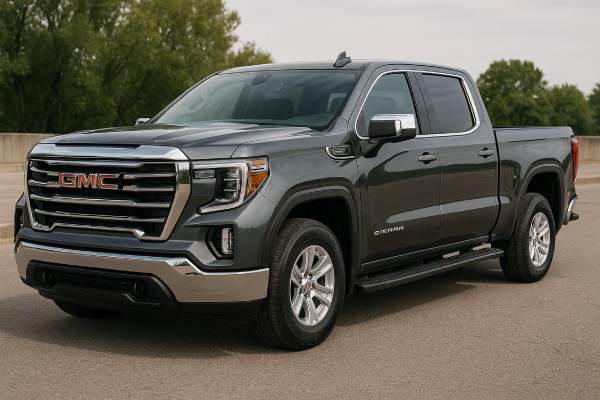
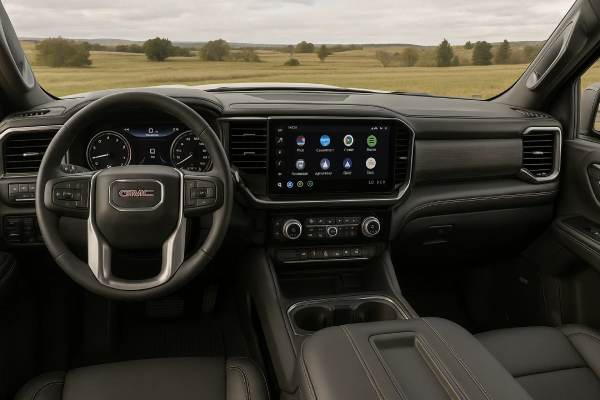
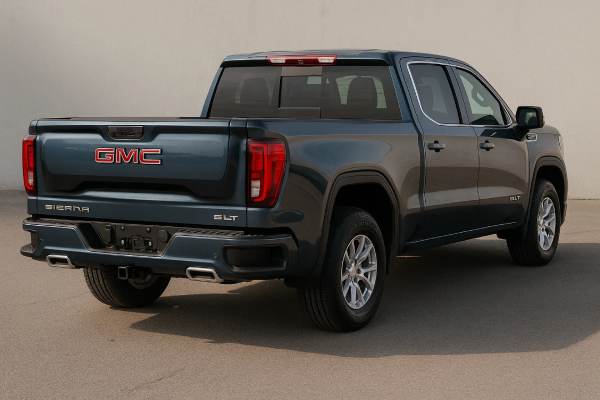
The facelifted 2022–present GMC Sierra 1500 RWD with the L3B 2.7-litre turbocharged four-cylinder is very different from early “base engine” full-size trucks. With the update, GMC paired a heavily revised TurboMax engine, higher torque output, and an overhauled interior featuring a large digital display and improved driver-assistance suite. The result is a half-ton pickup that can handle daily work, long highway commutes, and light commercial use without the weight, thirst, or purchase price of a V8 or diesel.
In rear-wheel-drive form, the L3B Sierra focuses on towing and payload efficiency with simpler driveline hardware and lower running costs than 4WD trucks. It suits buyers in mild climates or mostly paved environments who still need real capability. This guide walks through the key specifications, ownership experience, reliability patterns, maintenance planning, and how the 2.7 RWD Sierra compares to rivals, so you can decide if it fits your needs.
Fast Facts
- 2.7L L3B Turbo High-Output makes about 310 hp and 430 lb-ft, giving V8-like low-end pull with less weight and fuel use.
- Properly configured RWD models with this engine can tow up to roughly 9,300–9,400 lb and carry over 2,200 lb of payload.
- Facelift trucks gained a modern 13.4-inch touchscreen, upgraded materials, and the standard GMC Pro Safety package with automatic emergency braking and lane support.
- 2.7 TurboMax 2WD fuel economy is typically around 18 mpg city / 22 mpg highway (about 13.1 / 10.7 L/100 km).
- Plan engine oil and filter changes every 7,500–10,000 miles (12,000–16,000 km) or 12 months, sooner if towing or idling heavily.
What’s inside
- Facelift Sierra 2.7 RWD overview
- L3B turbo-four specs and data
- Trims, equipment and safety tech
- L3B longevity and common problems
- Service schedule and buyer guidance
- Driving impressions and real-world mpg
- How this Sierra compares to rivals
Facelift Sierra 2.7 RWD overview
For 2022, the Sierra 1500 received a major mid-cycle update: revised styling, a new interior, and an upgraded version of the L3B 2.7L turbocharged inline-four. Torque jumped from the earlier 348 lb-ft to about 430 lb-ft, while horsepower stayed around 310 hp. This “Turbo High-Output” (often badged TurboMax) engine is now a central powerplant in GMC’s light-duty truck line.
In rear-wheel-drive configuration, the truck uses the same ladder-frame chassis as its 4WD siblings but with a simpler driveline: no transfer case or front differential, fewer rotating components, and a bit less curb weight. That makes the 2.7 RWD a good fit for:
- Drivers in warm or dry regions who rarely need extra traction
- Fleet and trades users who value payload and lower ownership cost
- Owners stepping down from an older V8 who still want strong torque
The facelift also significantly raised cabin quality. Higher trims received a 13.4-inch central touchscreen and a 12.3-inch digital driver display, with over-the-air update capability and improved smartphone integration. Even on work-oriented Pro and SLE models, materials, noise insulation, and seat comfort improved compared with pre-2022 trucks.
On the numbers side, a typical crew-cab, short-box 2WD Sierra 1500 measures about 231.9 in (5,890 mm) long with a 147.4 in (3,746 mm) wheelbase, roughly 81 in (2,060 mm) wide, and 75–76 in (about 1,920 mm) tall. Those dimensions are in line with competitors from Ford and Ram, so day-to-day usability is driven more by wheelbase and cab/bed configuration than by outright size.
The 2.7 RWD Sierra is not a hardcore off-roader and does not offer low-range gearing. Its strengths are:
- Competitive towing in the 9,000 lb range when configured for trailering
- Stable highway manners thanks to the long wheelbase
- Better fuel efficiency than most gasoline V8 options in the same truck
If you frequently drive on loose surfaces, tow heavy trailers on steep grades, or face winter conditions, you may still prefer the 4WD variant. For everyone else, this RWD TurboMax configuration offers a sensible balance of performance, equipment, and cost.
L3B turbo-four specs and data
This section focuses on the technical side of the 2.7L L3B engine and related systems in the 2022–present Sierra 1500 RWD.
Engine and performance (L3B Turbo High-Output)
| Item | Specification |
|---|---|
| Engine code | L3B Turbo High-Output (TurboMax) |
| Layout | Inline-4, aluminum block and head |
| Displacement | 2.7 L (approx. 2,726 cc) |
| Bore × stroke | 92.3 × 102.0 mm (3.63 × 4.01 in) |
| Valvetrain | DOHC, 4 valves/cyl, continuously variable valve timing |
| Induction | Single twin-scroll turbocharger |
| Fuel system | Direct high-pressure fuel injection |
| Compression ratio | Around 10.0:1 |
| Max power | 310 hp @ 5,600 rpm |
| Max torque | Around 430 lb-ft (582 Nm) @ about 3,000 rpm |
| Timing drive | Chain-driven cams |
| Emissions/efficiency | Meets current EPA and CARB light-duty standards (US) |
The L3B is designed to behave more like a small diesel than a peaky gasoline engine: strong low-end torque, fast boost response, and a broad usable band. The strengthened block, crankshaft, and rods used for the Turbo High-Output tune are intended to handle frequent towing and high cylinder pressures.
Transmission and driveline
For RWD Sierra 1500 models with the L3B, you will typically see an 8-speed automatic:
| Item | Specification |
|---|---|
| Transmission | 8-speed automatic, electronically controlled |
| Drive type | Rear-wheel drive (RWD) |
| Final drive ratio | Around 3.42–3.73 (varies by trim and tow package) |
| Differential | Open rear diff; some trims offer automatic locking rear axle |
| Tow/Haul mode | Standard, adjusts shift points and downshifts on grades |
| Trailer equipment | Integrated trailer brake controller and hitch guidance available on many trims |
You do not get low-range gearing or front-axle drive in this configuration, which simplifies maintenance and reduces weight.
Chassis, dimensions, and weights (typical crew cab, short box, RWD)
Exact numbers vary by cab and bed, but typical figures for a 2.7L 2WD crew cab are:
| Item | Approximate value |
|---|---|
| Length | ~231.9 in (5,890 mm) |
| Width (without mirrors) | ~81.2 in (2,062 mm) |
| Height | ~75.5 in (1,918 mm) |
| Wheelbase | ~147.4 in (3,746 mm) |
| Turning circle | ~23.5 ft (7.2 m) |
| Curb weight range (2.7L RWD) | ~4,500–5,100 lb depending on trim and options |
| GVWR | Typically around 6,700–7,000 lb, depending on configuration |
| Fuel tank | Around 24 gal (approx. 91 L) for half-ton models |
Suspension is independent coil-over shocks with control arms up front and a solid rear axle with leaf springs. Brake hardware varies by wheel package but uses four-wheel discs with ABS and stability control.
Performance, efficiency, and capability
With the 2.7 Turbo High-Output in 2WD form:
- 0–60 mph: Often in the high-6 to low-7 second range in independent testing, depending on trim and load.
- Top speed: Typically electronically limited (around 110–115 mph) — not a primary truck metric.
- Max conventional towing: Up to about 9,300–9,400 lb when paired with the right cab, bed, axle ratio, and tow package.
- Max payload: Up to roughly 2,200–2,280 lb on specific 2WD trims with the 2.7 engine.
Fuel economy for the 2.7 TurboMax 2WD is generally around 18 mpg city and 22 mpg highway (approx. 13.1 / 10.7 L/100 km), with 4WD versions a little lower. Real-world results depend heavily on wheel size, load, and driving style.
Trims, equipment and safety tech
This article focuses on the engine and driveline, but trims and feature content matter just as much in day-to-day ownership. In the 2022–present facelift era, the 2.7 Turbo High-Output is typically offered on work and mid-level trims such as Pro, SLE, Elevation, and sometimes SLT, with RWD available on many of those.
Trims and options with the 2.7 RWD
Typical pairing of the 2.7 RWD engine includes:
- Pro – Fleet-friendly, vinyl or cloth interior, smaller screen on early build trucks, basic audio, steel or simple alloy wheels. Meant as a workhorse, often regular or double cab.
- SLE – Adds larger infotainment, improved cloth, more storage, and additional convenience features such as keyless entry and more advanced driver information displays.
- Elevation – Sportier cosmetic package with monochrome exterior, 20-inch wheels on many builds, and more appearance-focused options. Crew cab, short box is common.
- SLT (in some markets) – Better interior materials, more seat adjustments, and more tech, sometimes still available with the 2.7 to reduce price versus V8.
Ordering guides show which trims pair with the 2.7 High-Output and how packages (tow, off-road, protection, convenience) are bundled. For example, you may need a specific trailering package to unlock higher tow ratings even if the hardware seems similar.
Key option themes:
- Multiple wheel and tire packages (18–20 in) affecting ride and efficiency
- Choice of bench vs. bucket front seats
- MultiPro tailgate on many trims
- Bed protection (spray-in liner, tie-downs, 120V outlet)
- Trailer cameras, surround-view camera, and trailering app on higher trims
Safety ratings
The crew-cab Sierra 1500 platform has been evaluated by the Insurance Institute for Highway Safety. For 2022, the Sierra 1500 crew cab earned:
- Good ratings in moderate overlap front and most major crashworthiness categories
- Acceptable rating in updated side-impact testing
- Marginal in small-overlap passenger-side for structure on some configurations
These results apply across engine and driveline combinations, including RWD and 4WD, since the structure is shared.
Government 5-star ratings from NHTSA may vary by build and sometimes appear as “Not Rated” in early documentation, so you should always confirm the exact score for your VIN on the official site.
Safety and driver assistance systems
On facelift trucks, GMC Pro Safety is widely standard and may include (depending on market and trim):
- Automatic emergency braking with forward collision alert
- Front pedestrian braking
- Lane keep assist with lane departure warning
- Following distance indicator
- IntelliBeam auto high beams
Optional or higher-level systems can add:
- Adaptive cruise control
- Blind spot monitoring with rear cross-traffic alert
- Rear park assist and HD surround-view camera
- Rear pedestrian alert
- Trailer-specific blind-spot extensions
On premium trims (primarily 4WD), GMC also offers Super Cruise with automatic lane-keeping and hands-free driving on mapped highways; this is less common on 2.7 RWD trucks but still relevant if you are cross-shopping the engine across drivetrains.
From a service perspective, remember that many ADAS features require:
- Proper calibration after windshield replacement, collision repair, or suspension changes
- Clean sensors (radar and camera lenses) and correct ride height
- Up-to-date firmware, often delivered by over-the-air updates or dealer programming
L3B longevity and common problems
Because the L3B 2.7 Turbo High-Output in facelift Sierras is a relatively new calibration, long-term data is still building, but we can outline patterns from early trucks and similar GM turbo engines.
Overall reliability picture
So far, the 2.7 TurboMax in full-size GM trucks has not been linked to the high-profile engine recall campaigns that affect certain 6.2L V8 models with connecting-rod and crankshaft issues. Most owner reports and reviews place the Sierra 1500 around average in reliability for a modern full-size truck, with more variation by use case (towing vs. commuting) than by engine alone.
Common or emerging issues (early observations)
1. Carbon buildup on intake valves (direct injection)
- Symptoms: Rough idle, hesitation, loss of top-end power over time.
- Cause: Direct-injection engines often allow oil vapour and soot to accumulate on intake valves, especially with short-trip use.
- Mitigation: High-quality fuel, regular oil changes, occasional extended highway runs. Walnut-blast cleaning may be needed beyond 100,000 miles in severe cases.
2. Turbocharger and charge-air system wear
- Symptoms: Whining, reduced boost, or overboost/underboost codes; oil mist around turbo connections.
- Cause: High load and heat, especially with frequent towing or long idling.
- Response: Inspect charge pipes, clamps, intercooler connections, and turbo shaft play if boost codes appear. Timely oil changes help protect the turbo.
3. Cooling system stress under heavy tow
- Symptoms: Rising coolant or transmission temperatures on long grades.
- Cause: Heavy loads, high ambient temperatures, possibly clogged radiators or insufficient airflow (aftermarket grilles, light bars).
- Response: Ensure coolers and radiator fins are clean, confirm correct coolant mix, and verify fan operation. Consider conservative speed and lower gear under heavy tow.
4. Oil consumption monitoring
Some direct-injected turbo engines show modest oil consumption as they age. While heavy use is more commonly associated with V8s, it is wise to:
- Check the oil level every 1,000 miles (1,600 km), especially before long trips or towing
- Investigate any sudden drop in level, smoke, or oil smell
Driveline and chassis issues to watch
RWD Sierras avoid front-axle and transfer-case problems but can still exhibit:
- Rear axle noise or vibration – Typically due to worn bearings, incorrect fluid, or past overloading
- Rear leaf spring and bushing wear – Accelerated by frequent full payload or rough roads
- Steering rack or column play – Felt as looseness on center or clunks over bumps
Recalls, TSBs, and software updates
GMC publishes technical service bulletins (TSBs) and software updates for:
- Shifting behaviour of the 8-speed automatic
- Infotainment and connectivity issues
- ADAS feature false alerts or sensitivity tuning
Many driveability complaints (harsh shifts, hesitations) are addressed by updated transmission or engine control software rather than hardware replacement.
For any used or in-service truck, you should:
- Run a VIN check through GM or your national safety agency to verify recall completion
- Ask a dealer to confirm outstanding field actions, software updates, and TSB-related repairs
Service schedule and buyer guidance
A clear maintenance plan is essential if you want the 2.7 TurboMax to deliver long, trouble-free service.
Practical maintenance schedule (typical guidance)
Always follow your truck’s Oil Life Monitoring (OLM) system and regional manual, but the following is a sensible baseline:
- Engine oil and filter:
- Every 7,500–10,000 miles (12,000–16,000 km) or 12 months, whichever comes first
- Use dexos1-approved full synthetic in the recommended viscosity (often 0W-20 or 5W-30, depending on market)
- Engine air filter:
- Inspect at 15,000 miles (24,000 km); replace 30,000–45,000 miles (48,000–72,000 km) or sooner in dusty use
- Cabin air filter:
- Replace every 15,000–24,000 miles (24,000–40,000 km) or 2 years
- Spark plugs:
- Typically around 60,000–100,000 miles (96,000–160,000 km) with iridium plugs; inspect interval per manual
- Coolant:
- First change often around 5 years / 100,000 miles (160,000 km), then as specified
- Aux/serpentine belt and hoses:
- Inspect at least every 30,000 miles (48,000 km); replace by 90,000–120,000 miles unless earlier wear is present
- Automatic transmission fluid:
- Fluid and filter around 60,000–75,000 miles (96,000–120,000 km) for mixed use; sooner for heavy towing
- Rear axle (RWD):
- Replace gear oil at 45,000–60,000 miles if towing or hauling; otherwise 75,000+ miles
- Brake fluid:
- Flush every 3 years regardless of mileage
- Brake hardware:
- Inspect pads and rotors annually or every 12,000 miles (19,000 km)
- Alignment and tyre rotation:
- Rotate tyres every 5,000–7,500 miles; align whenever abnormal wear appears or annually on rough roads
- 12V battery:
- Test annually after year 3; expect replacement around 5–7 years depending on climate
Keep all receipts; they matter for warranty decisions and resale.
Fluids, capacities, and key torque examples
Exact capacities and torque specs vary by axle ratio and brake package, so always verify for your VIN. Typical ballpark figures:
- Engine oil capacity: around 6–7 qt (5.7–6.6 L) with filter
- Coolant capacity: often around 11–13 L, with a 50:50 premix ratio
- Rear axle oil: roughly 2–3 L, 75W-90 synthetic gear oil
- Wheel lug nuts: commonly in the 140–190 Nm (103–140 lb-ft) range
Use these values only for rough planning; torque and fluid specs must be confirmed in official documentation.
Buyer’s guide: what to look for
Whether new or used, pay attention to:
- Service history
- Evidence of regular oil changes with correct spec
- Transmission and axle services if miles are high or towing is common
- Signs of heavy use
- Hitch wear, bed damage, and sagging rear springs indicating frequent max payload
- Frame and underbody corrosion, especially in salt regions
- Electronics and ADAS
- Verify that all cameras, parking sensors, lane keep assist, and cruise control functions operate normally
- Check for warning lights or stored codes
- Test drive checks
- Cold start: listen for rattles, ticks, or extended cranking
- Acceleration: smooth boost, no misfires or flat spots
- Transmission: no harsh shifts, flares, or banging into gear
- Braking: straight stops without vibration
- Configuration fit
- Confirm cab and bed length, axle ratio, and tow package match your needs
- For regular towing near 9,000 lb, consider optional trailering mirrors, brake controller, and cooling packages
If you plan to keep the truck long term, a modest extended warranty that covers powertrain and key electronics can be worthwhile, especially if you tow frequently.
Driving impressions and real-world mpg
The 2.7 TurboMax changes the character of the Sierra compared with V6 or naturally aspirated V8 trucks.
Ride, handling, and noise
On 18-inch wheels with standard suspension, the RWD Sierra 1500 rides firmly but predictably. The long wheelbase smooths out highway undulations, and the rear leaf springs are tuned to remain controlled even with partial payload in the bed. On 20-inch Elevation-style wheels, impacts from sharp potholes are more noticeable, but overall refinement remains acceptable for a full-size pickup.
Steering is light at parking speeds and weights up reasonably on the highway. RWD trucks tend to feel slightly more agile than their 4WD equivalents because of the reduced front-end mass and fewer rotating components in the driveline.
Cabin noise is well controlled, especially in facelift trucks with improved door seals and glass. Wind noise is moderate at motorway speeds; tyre roar depends heavily on the tyre choice. Compared with pre-2022 Sierras, interior squeaks and rattles appear less frequently thanks to updated materials and assembly improvements.
Powertrain character
The L3B turbo-four delivers a strong shove from low rpm. Under gentle throttle, the engine stays quiet and low in the rev range, using its torque to move the truck without fuss. Push harder and you will hear a purposeful four-cylinder growl rather than a traditional V8 rumble, but most drivers adapt quickly.
Turbo lag is present but modest; the engine responds well in everyday driving, especially once you learn to roll into the throttle rather than stabbing it. The 8-speed automatic generally shifts smoothly, though some owners report occasional hesitation or hunting between gears at light throttle — issues that software updates often improve.
With Tow/Haul mode engaged, the transmission holds gears longer, downshifts earlier on grades, and uses engine braking to control speed when descending hills with a trailer.
Real-world efficiency and range
Owners commonly report:
- City driving: mid-to-high teens in mpg (13–15 L/100 km)
- Highway at 65–75 mph (105–120 km/h): high teens to low twenties in mpg (11–13 L/100 km)
- Mixed use: around 18–20 mpg (11.8–14.1 L/100 km)
These reports align reasonably with dealer and marketing figures of roughly 18 mpg city / 22 mpg highway for 2.7 TurboMax 2WD trucks. Expect a noticeable drop — often 20–30% — when towing near the engine’s rated capacity, especially at higher speeds or into headwinds.
RWD models benefit from:
- Lower parasitic losses vs. 4WD
- Slightly lower curb weight
- Simpler front-end alignment, which can help keep rolling resistance in check
If efficiency is your top priority and you often tow long distances, the 3.0L Duramax diesel remains more economical, but the 2.7 TurboMax offers a simpler emissions system and lower fuel cost in many markets while still providing robust torque.
Load and towing behaviour
With proper weight distribution and a correctly set up trailer brake controller, the 2.7 RWD Sierra tows confidently within its rated limits. Key observations:
- Power is adequate for highway merging and grades up to typical mountain passes, though you will use more of the rev range than with a big V8.
- Transmission temperatures remain manageable if the truck’s cooling system is maintained and the driver uses Tow/Haul mode sensibly.
- At high tongue weights or near maximum payload, rear suspension squat can become pronounced; helper springs or air-assist systems can improve stance and stability.
Always respect the published Gross Vehicle Weight Rating (GVWR), Gross Combined Weight Rating (GCWR), and axle ratings for your specific VIN.
How this Sierra compares to rivals
When comparing the 2022–present GMC Sierra 1500 RWD with the L3B 2.7L Turbo to other half-ton trucks, it helps to focus on how you will use the vehicle.
Versus other Sierra 1500 engines
- Versus 5.3L and 6.2L V8s:
- The 2.7 TurboMax is generally more fuel efficient and lighter, with similar or better low-rpm torque than some older V8 tunes.
- V8 models offer higher peak towing ratings, traditional sound, and, on some versions, more performance.
- Recent safety investigations and recalls tied to V8 engines with specific codes do not apply to the 2.7L L3B, which may comfort buyers prioritising reliability.
- Versus 3.0L Duramax diesel:
- Diesel offers superior long-haul fuel economy and very strong towing range.
- The 2.7 avoids diesel exhaust fluid (DEF), complex aftertreatment, and some cold-weather considerations, which can reduce running complexity for urban or light-use owners.
Versus Ford F-150 and Ram 1500
- Ford F-150 2.7 EcoBoost / 3.5 EcoBoost:
- Ford’s turbo V6 engines are powerful and well established, but they introduce six-cylinder complexity and can be thirstier under heavy load.
- The Sierra’s 2.7 inline-four is simpler with fewer cylinders, though it relies heavily on its turbocharger to meet performance targets.
- Ram 1500 3.6 V6 with eTorque / 5.7 Hemi:
- Ram’s V6 mild-hybrid and V8 engines are smooth and refined, with an excellent ride quality.
- The Sierra counters with a more modern interior after the facelift and a very strong torque-per-litre figure from the 2.7 TurboMax.
Where the 2.7 RWD Sierra shines
- Urban and suburban work:
- Easier manoeuvring than HD trucks; RWD simplifies snow tyre decisions in mild climates.
- Strong torque at low rpm suits stop–go traffic and frequent starts with light loads.
- Value-conscious buyers:
- Lower purchase price than many V8 or diesel trims with similar equipment.
- Fuel and maintenance costs that are more manageable for small businesses and private owners who drive moderate annual mileage.
- Tech-focused drivers:
- The facelift interior keeps up with or surpasses many rivals in screen size and connectivity, especially on mid-level trims.
Where rivals or other variants might be better
- Severe winter climates or off-road use:
- 4WD variants of Sierra, or rival trucks with advanced terrain systems, will be more suitable.
- Maximum fifth-wheel or gooseneck towing:
- For very heavy trailers, a diesel half-ton or three-quarter-ton truck is still preferable.
- Highest safety ratings:
- Some rival configurations may score better in updated side-impact or small overlap tests; always compare IIHS results for the exact body style you are considering.
In short, the GMC Sierra 1500 RWD with the 2.7L L3B Turbo High-Output engine is a compelling choice if you want a modern, strong-towing half-ton that avoids the fuel consumption and complexity of larger engines, provided your environment and use case do not demand four-wheel drive.
References
<a href="https://www.gmc.com/content/dam/gmc/na/us/english/index/about/download-brochures/2022-models/02-pdf/GMTR22CT100FO_MY22_GMC%20SIERRALD_080822.pdf">2022 FEATURES, SPECS AND OPTIONS</a> 2022 (Features and Specifications Guide)<a href="https://www.iihs.org/ratings/vehicle/gmc/sierra-1500-crew-cab-pickup/2022">2022 GMC Sierra 1500 Crew cab pickup</a> 2022 (Safety Rating)<a href="https://www.gmc.com/support/vehicle/manuals-guides">Manuals and Guides | Vehicle Support</a> 2025 (Owner’s Manuals Portal)<a href="https://gmauthority.com/blog/gm/gm-engines/l3b/">GM 2.7L L3B I-4 Turbo Engine Info, Specs, Wiki</a> 2024 (Engine Technical Reference)<a href="https://www.edmunds.com/gmc/sierra-1500/2022/">2022 GMC Sierra 1500 Review & Ratings</a> 2022 (Road Test and Reliability Overview)
Disclaimer
This article is for informational purposes only and is not a substitute for professional diagnosis, repair, or official service information. Specifications, torque values, capacities, and service intervals can vary by VIN, market, model year, and equipment level. Always confirm details against your vehicle’s official owner’s manual, service manual, and current technical bulletins, and follow manufacturer procedures and safety guidance.
If you found this guide useful, please consider sharing it with other owners or shoppers on your preferred social platforms (Facebook, X/Twitter, forums). It helps support further detailed, independent content like this.