
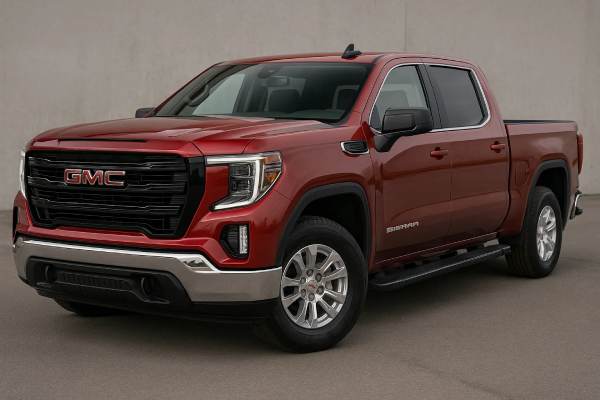
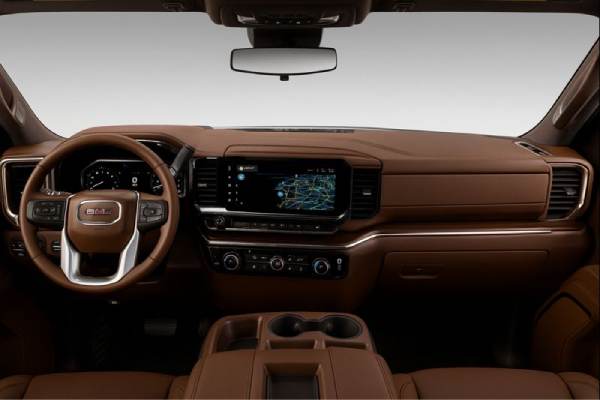
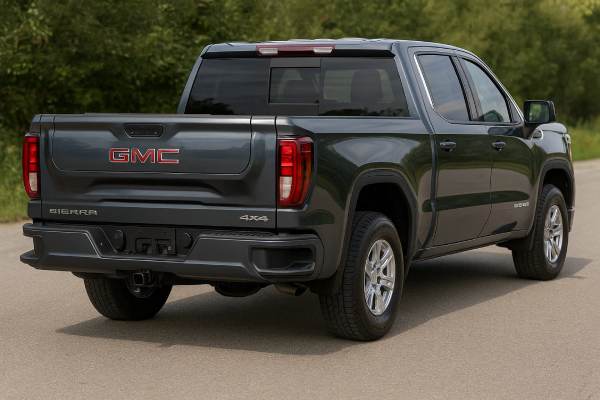
The facelifted GMC Sierra 1500 with the L84 5.3-litre V8 and rear-wheel drive sits in a sweet spot for many owners: strong towing, classic V8 character, and a much-improved cabin compared with pre-2022 trucks. With the 10-speed automatic, this configuration blends smooth power delivery with relaxed highway cruising, while the RWD layout keeps weight and complexity down for drivers who rarely need four-wheel drive.
From 2022 onward, the Sierra gained a redesigned interior on most trims, larger screens, upgraded driver assistance tech, and more refined ride and noise isolation. Underneath, though, it is still a body-on-frame work truck at heart, with a fully boxed frame, traditional leaf springs, and a naturally aspirated V8 that many buyers prefer over turbocharged alternatives.
This guide walks through the details that matter in real ownership: hard specs, capability, reliability patterns, service planning, and how the Sierra 5.3 RWD stacks up in today’s half-ton market.
Top Highlights
- 5.3 l L84 V8 delivers 355 hp and 383 lb-ft, with strong mid-range torque for towing and merging.
- RWD Sierra 1500 5.3 can tow up to around 11,000 lb when properly configured, with useful payload for work gear.
- Facelift trucks gain a more modern cabin, larger screens, improved materials, and added driver assistance systems.
- Watch for lifter/valvetrain noise and keep up with transmission and differential fluid service if towing frequently.
- Change engine oil and filter about every 7,500 miles / 12 months in normal use, or 3,000–5,000 miles under heavy towing or severe duty.
What’s inside
- Sierra 5.3 RWD facelift overview
- L84 V8 specs and data
- RWD trim levels and safety tech
- Reliability patterns and issue list
- Maintenance schedule and buying advice
- Driving experience and performance feel
- How Sierra 5.3 compares with rivals
Sierra 5.3 RWD facelift overview
From the 2022 facelift onward, the GMC Sierra 1500 5.3 RWD feels like a generation newer than the pre-refresh trucks, especially inside. The underlying T1XX platform is familiar, but the dashboard, screens, and many driver-assistance systems were significantly upgraded. If you are cross-shopping older Sierras or Silverados, this change is one of the biggest reasons to focus on 2022-present models.
In this configuration, the truck pairs the L84 5.3-litre V8 with a 10-speed automatic and rear-wheel drive. That combination is available on key trims such as Pro, SLE, Elevation, SLT and Denali, usually with crew-cab or double-cab bodies and standard or short boxes. AT4 and AT4X are four-wheel drive only, so they are outside the scope of this RWD-focused guide.
The 5.3 V8 sits in the middle of the Sierra engine range above the 2.7-litre turbo four and below the 6.2-litre V8 and 3.0-litre Duramax diesel. Many owners see it as the “balanced” choice: more power and refinement than the four-cylinder, less thirst and up-front cost than the 6.2, and simpler fueling than the diesel. With 355 hp and 383 lb-ft, it offers confident acceleration even with a full cab and bed.
The facelift also brought a cleaner exterior look depending on trim, new wheel designs, and some functional updates like the available MultiPro tailgate and 120-volt bed power outlets. Underneath, the Sierra keeps the traditional full-size formula: a fully boxed steel frame, independent front suspension and solid rear axle with leaf springs. For RWD trucks, the simpler driveline means fewer front-end wear items and slightly better efficiency compared with 4WD versions.
In everyday use, this configuration suits drivers who spend most of their time on paved roads, tow a boat or mid-size trailer a few times a month, and appreciate a smoother-revving V8. If you regularly tackle deep snow, mud or unmade roads, 4WD will still be the better choice, but for many suburban and Sun Belt owners, the RWD 5.3 makes more sense financially and mechanically.
L84 V8 specs and data
This section focuses on the key technical figures for the L84 5.3-litre V8 in facelift GMC Sierra 1500 RWD trucks, using a representative crew-cab, short-box configuration unless otherwise noted. Exact numbers vary by cab, bed, axle ratio, and equipment, so always confirm against the door-jamb label and official documentation for your VIN.
Engine and performance
| Item | Value |
|---|---|
| Engine code | L84 EcoTec3 |
| Displacement | 5.3 l (5328 cc) |
| Configuration | 90° V8, aluminum block and heads |
| Valvetrain | Pushrod (OHV), 2 valves/cyl, variable valve timing |
| Induction | Naturally aspirated |
| Fuel system | Direct injection with Dynamic Fuel Management cylinder deactivation |
| Compression ratio | Approx. 11.0 : 1 |
| Max power | 355 hp (about 265 kW) @ 5600 rpm |
| Max torque | 383 lb-ft (about 519 Nm) @ 4100 rpm |
| Recommended fuel | Regular unleaded (87 AKI); higher octane may improve performance under heavy load |
| Emissions standard | US EPA Tier 3 / LEV III equivalent |
Efficiency and aerodynamics
Typical EPA ratings for a 2WD Sierra 1500 5.3 V8 with the 10-speed automatic are:
| Cycle | mpg (US) | mpg (UK) | L/100 km (approx.) |
|---|---|---|---|
| City | 16 | 19.2 | 14.7 |
| Highway | 20 | 24.0 | 11.8 |
| Combined | 18 | 21.6 | 13.1 |
Real-world highway consumption at 75 mph (120 km/h) with light load often sits near 12–13 L/100 km (18–20 mpg US). Towing a mid-size camper or boat can push that toward 18–22 L/100 km (10–13 mpg US) depending on trailer frontal area and speed.
Transmission and driveline
| Item | Value |
|---|---|
| Transmission | 10-speed automatic, torque-converter, electronically controlled |
| Typical transmission code | 10L80 / 10L90 family (varies by GVWR and trim) |
| Drive type | Rear-wheel drive (RWD) |
| Final drive ratio | Common ratios around 3.23–3.42; max-trailering packages may use shorter ratios |
| Differential | Open rear axle; available limited-slip / automatic locking rear differential on some trims |
Chassis, dimensions and weights
(Representative crew cab, short box, RWD)
| Item | Value |
|---|---|
| Overall length | ~231.9 in (5890 mm) |
| Overall width (without mirrors) | ~81.2 in (2062 mm) |
| Overall height | ~75–76 in (1905–1930 mm) depending on suspension and tyres |
| Wheelbase | ~147.4 in (3745 mm) for crew-cab short box |
| Ground clearance | Approx. 8.0–8.3 in (203–211 mm) |
| Turning circle (kerb-to-kerb) | Around 46–47 ft (14–14.3 m) |
| Curb weight | Roughly 4800–5200 lb (2177–2359 kg) depending on trim |
| GVWR | Around 6900–7100 lb (3129–3221 kg) |
| Fuel tank | ~24.0 US gal (about 91 litres) |
| Cargo bed length (short box) | ~69.9 in (1775 mm) |
Performance and capability
(Values vary by configuration; figures below are typical ranges for RWD 5.3 trucks when properly equipped.)
| Item | Typical range |
|---|---|
| 0–60 mph (0–97 km/h) | ~6.6–7.0 seconds with light load |
| Top speed (governed) | Around 98–112 mph (158–180 km/h), depending on tyres and package |
| Towing capacity (braked) | Approximately 9500–11,000 lb (4300–4990 kg), configuration-dependent |
| Towing capacity (unbraked) | Commonly 1500–2000 lb (680–907 kg); check local regulations |
| Payload | Roughly 1800–2100 lb (816–953 kg), strongly dependent on trim and options |
| Roof load | Typically 150–200 lb (68–91 kg) with an approved rack system |
Fluids and service capacities
(Always verify for your specific year and axle/transmission.)
| System | Specification (typical) | Approx. capacity |
|---|---|---|
| Engine oil | Dexos1-approved 0W-20 full-synthetic | ~7.6 l (8.0 US qt) with filter |
| Coolant | Dex-Cool OAT coolant, ~50/50 mix | ~14–16 l (15–17 US qt) |
| Automatic transmission | Dexron-VI or later GM-specified ATF | ~9–11 l (service fill varies) |
| Rear differential | GM-spec 75W-90 gear oil, limited-slip additive if required | ~1.5–2.0 l (1.6–2.1 US qt) |
| A/C refrigerant | R-134a or R-1234yf depending on year | Charge mass printed under hood |
| Wheel lug-nut torque (typical) | Around 190 Nm (140 lb-ft) — confirm for wheel/trim |
Electrical
| Item | Value |
|---|---|
| Alternator | Typically 170–220 A, depending on trim and tow package |
| 12 V battery | Approx. 70–80 Ah, 730–800 CCA, common group sizes 48/94R |
| Spark plugs | Long-life iridium; no routine gap adjustment required; replacement interval often near 97,500 miles (157,000 km) |
RWD trim levels and safety tech
On facelift Sierra 1500s, the 5.3-litre RWD configuration is offered mainly on Pro, SLE, Elevation, SLT and Denali trims, with some regional and package-based variations. AT4 and AT4X are geared toward off-road use and generally sold as 4WD only, while the 2.7-litre turbo tends to dominate base fleets.
Trims and options
- Pro
Work-oriented with vinyl or basic cloth seats, simpler instrument cluster, and smaller touchscreen on early 2022 builds. The 5.3 often appears as an upgrade over the standard 2.7-litre, adding more tow capacity and refinement. Steel wheels are common, with simple bed features and fewer appearance options. - SLE and Elevation
These middle trims are popular for private owners and light-duty fleets. They typically include the larger 13.4-inch central touchscreen and 12.3-inch digital instrument cluster on 2022-present models, plus nicer cloth upholstery, alloy wheels, and access to popular packages such as Convenience, Trailering, and Protection. Elevation adds a sportier, monochrome exterior look. - SLT
More upscale materials, leather seating, larger wheels, and extended convenience features such as power seats with memory, higher-end audio, and more advanced trailering tech. SLT is often the sweet spot where the 5.3 RWD is paired with better sound insulation and more comfort, yet without the full luxury pricing of Denali. - Denali
Premium interior appointments, richer leather, genuine open-pore wood on many builds, available head-up display, best audio systems, and broader access to options like adaptive cruise control and Super Cruise (availability depending on year and market). The 5.3 RWD Denali suits buyers prioritising comfort and appearance over maximum off-road capability.
Year-to-year, the core changes after 2022 mainly refine software, expand package availability, and tweak colour and wheel options rather than redesign the truck. The biggest jump is between pre-2022 and 2022-present.
Safety ratings
Crew-cab Sierra 1500s with the facelift structure perform well overall in modern crash testing, with strong scores in most frontal and side-impact tests. Some evaluations note that passenger-side small-overlap performance is not quite class-leading, and headlight performance varies with trim and lighting package. Trucks with the best LED projector headlights tend to score better than those with basic reflector units.
From a regulatory perspective, the Sierra’s crash structure is closely related to the Chevrolet Silverado 1500, which shares many underlying components and receives similar ratings. When comparing trims, remember that cab style (crew vs. double cab), bed length, and optional safety packages can all influence results in specific tests.
Safety systems and ADAS
“GMC Pro Safety” is standard on most facelift Sierra 1500s and includes:
- Forward collision alert with automatic emergency braking
- Front pedestrian braking (usually low-speed)
- Lane keep assist with lane departure warning
- Following distance indicator
- IntelliBeam automatic high-beam assist
“GMC Pro Safety Plus” and higher-level packages can add:
- Rear cross-traffic alert and blind-spot monitoring
- Enhanced lane-keeping and lane-change alerts
- Adaptive cruise control (stop-and-go on some trims)
- HD surround-view camera and transparent-trailer view
- Rear pedestrian alert
The Denali and some SLT models may also offer Super Cruise on certain years and configurations, enabling supervised hands-free driving on mapped highways. After collision repair or windscreen replacement, radar and camera sensors may require recalibration, particularly on vehicles equipped with adaptive cruise or Super Cruise. This is important to plan for when budgeting repairs on higher-trim trucks.
Reliability patterns and issue list
The L84 5.3-litre V8 Sierra 1500 RWD has a generally solid reputation when maintained correctly, but there are patterns and known issues worth understanding, especially as mileage climbs past 60,000–100,000 miles.
Common or notable issues
- Lifter and valvetrain concerns (occasional, moderate to high cost)
- Symptoms: Ticking from the top end, misfires, rough idle, cylinder-deactivation codes.
- Likely cause: Problems with the dynamic fuel management (DFM) lifters or associated hardware.
- Remedy: Dealers often replace affected lifters, guides and related components, sometimes accompanied by updated parts and software. Catching early misfires and addressing them promptly helps avoid collateral damage.
- 10-speed shift quality and shudder (occasional, low to medium cost)
- Symptoms: Harsh upshifts or downshifts, flare between gears, occasional shudder at light throttle.
- Likely cause: Early transmission calibration, fluid condition, or adaptation issues.
- Remedy: Updated transmission control software and a fluid exchange, followed by a proper relearn drive cycle, often improve behaviour significantly. Trucks used for heavy towing benefit from more frequent ATF changes than the “lifetime” impression many owners have.
- Infotainment glitches and camera faults (common, low cost)
- Symptoms: Frozen or blank 13.4-inch display, intermittent Bluetooth drops, rear-camera blackouts, or distorted guidelines.
- Likely cause: Software bugs, occasional module resets, poor ground connections, or camera moisture intrusion.
- Remedy: Software updates at the dealer, hard resets, checking grounds, and replacing faulty camera modules or harnesses where needed. These are more annoying than dangerous but matter to day-to-day usability.
- Front suspension and steering wear (age/mileage-dependent, moderate cost)
- Symptoms: Clunks over bumps, vague steering on-center, knocking when turning into driveways, or uneven tyre wear.
- Likely cause: Worn control-arm bushings, ball joints, tie-rod ends, or steering-rack play.
- Remedy: Standard suspension inspection and replacement of worn components. RWD trucks have fewer front-axle components than 4WD, which simplifies diagnostics and reduces parts count.
- Corrosion hotspots in harsh climates (long-term, variable cost)
- Symptoms: Rust around bed seams, frame welds, leaf-spring mounts, brake lines, or step/tailgate hardware.
- Likely cause: Road salt and lack of underbody washing.
- Remedy: Regular under-body washes, optional rustproofing, and prompt treatment of any surface rust to prevent structural issues.
Recalls, campaigns and software updates
Like most modern trucks, the facelift Sierra 1500 has seen a series of recalls and technical service bulletins. These have covered areas such as seatbelt components, ABS/ESC control logic, and occasional powertrain updates. There have also been industry-wide investigations into GM V8 engine durability in related engines and recalls for specific issues such as diesel transmission valve concerns and, on some heavy-duty models, power tailgate behaviour. While not all of these directly affect the RWD 5.3-litre Sierra, they illustrate the importance of keeping software and recall work current.
For any used or in-service truck:
- Run the VIN through the official recall checker in your market.
- Ask the servicing dealer for a complete printout of open and completed campaigns.
- Confirm that key modules (engine, transmission, brake system, infotainment) have the latest stable calibrations.
Pre-purchase and periodic checks
When inspecting a used Sierra 1500 5.3 RWD, pay special attention to:
- Full service history, including oil changes with Dexos-approved oil at sensible intervals.
- Evidence of transmission and differential fluid service, especially if the truck has towed regularly.
- Cold-start behaviour and any ticking or misfire codes indicating potential lifter problems.
- Frame, bed and brake-line corrosion on trucks from high-salt regions.
- Proper operation of all driver-assistance features and cameras after any body or glass work.
Addressing these points early will do more for long-term reliability than any single “magic” upgrade.
Maintenance schedule and buying advice
A disciplined maintenance plan is the best way to keep a Sierra 1500 5.3 RWD reliable well past 150,000 miles. The following intervals are practical guidelines that blend typical manufacturer recommendations with real-world experience. Always adjust for severe use, such as heavy towing, extreme heat/cold, or mostly short-trip driving.
Core maintenance intervals (approximate)
- Engine oil and filter
Every 7,500 miles / 12 months in mixed driving.
Every 3,000–5,000 miles if you tow frequently, idle for long periods, or operate in dusty/hot conditions. - Engine air filter
Inspect at 15,000 miles; replace around 30,000–45,000 miles, sooner in dusty environments. - Cabin air filter
Replace every 20,000–25,000 miles, or every 2 years. - Coolant (Dex-Cool)
First change typically at 5 years / 150,000 miles, then every 5 years / 100,000–150,000 miles depending on use and condition. - Spark plugs (iridium)
Often specified near 97,500 miles (about 157,000 km). Inspect earlier if misfires or rough running appear. - Automatic transmission fluid
For light duty, consider a service around 60,000–75,000 miles.
For regular towing or heavy loads, 30,000–45,000-mile intervals are a good investment. - Rear differential fluid
Around 45,000 miles with frequent towing, 75,000–100,000 miles for lighter use. - Brake fluid
Flush every 3 years, regardless of mileage, to keep ABS and stability systems healthy. - Serpentine/auxiliary belts and hoses
Inspect every service; plan replacement around 90,000–120,000 miles or at the first sign of cracking or noise. - Tyre rotation and alignment
Rotate every 7,500 miles (often aligned with oil changes). Check alignment whenever you notice uneven wear or steering pull. - 12 V battery
Test annually from year 3 onward; many OEM batteries last 4–6 years depending on climate and use.
There is no conventional timing belt on the L84; it uses a timing chain. Instead of fixed replacement intervals, listen for chain noise, check for timing-correlation codes, and inspect guides and tensioners if symptoms appear.
Fluid choices and torque values
- Engine oil: Dexos1-Gen-3 0W-20 full synthetic is a safe default.
- Differential oil: Quality 75W-90 synthetic matching GM spec, with appropriate friction modifier if a locking/limited-slip differential is fitted.
- Key torques to know: wheel lug nuts around 190 Nm (140 lb-ft) and oil-drain plug in the region of 25–30 Nm (18–22 lb-ft). Always confirm with official documentation for your exact year.
Buyer’s guide tips
When shopping for a Sierra 1500 5.3 RWD:
- Prefer trucks with documented maintenance over low-mileage examples with unknown history.
- Check for heavy towing use by looking at hitch wear, trailer-brake controller, and owner discussions; heavy duty use is fine if fluids were serviced appropriately.
- Inspect for corrosion on frame rails, bed crossmembers, leaf-spring mounts, and brake lines.
- Test all electronics, especially the big central screen, cameras, parking sensors, and any advanced features like adaptive cruise or Super Cruise on higher trims.
- Look underneath for leaks, particularly around the rear main seal, transmission pan, differential cover, and cooler lines.
For long-term durability, a well-maintained 5.3 RWD truck should comfortably serve 10–15 years and 200,000+ miles with mainly routine wear-item replacements and occasional suspension refreshes.
Driving experience and performance feel
On the road, the facelift Sierra 1500 5.3 RWD feels more refined than its work-truck roots suggest, especially in SLT and Denali trims. The cabin is noticeably quieter than earlier generations, with better door sealing and more sound deadening. Wind noise from the mirrors and subtle tyre roar on coarse asphalt are still present, but they are in line with other modern full-size pickups.
Powertrain character
The L84 V8 has a classic, smooth build of torque. From low rpm it pulls cleanly, and the 10-speed automatic keeps the engine in its sweet spot without constant hunting. Light throttle applications see early upshifts and low revs, which helps highway economy. Under heavy throttle, the transmission drops multiple gears quickly, giving a satisfying surge without feeling frantic.
Dynamic Fuel Management can shut down cylinders under light load. Most drivers will rarely notice transitions, though a few report a faint change in exhaust note or a subtle vibration when the truck switches modes. If these transitions become rough, it can sometimes be a sign that a software update or deeper diagnosis is needed.
Ride, handling and NVH
RWD Sierras generally ride slightly more smoothly and turn more sharply than their 4WD counterparts, thanks to less weight over the front axle and simpler front-end hardware. Empty, the rear leaf springs can still feel choppy over sharp bumps or broken pavement, especially with larger wheels and low-profile tyres. With some payload in the bed, the ride settles noticeably.
Steering is light but accurate, with electric assist tuned more for ease than pure feedback. Straight-line stability at motorway speeds is good, and the truck tracks well in crosswinds. Braking feel is solid with a firm pedal; repeated hard stops with a load will still warm the system, so high-quality pads and correctly torqued wheel nuts help maintain consistency.
Real-world efficiency and range
In mixed city/highway use, many owners see fuel economy in the mid-teens mpg US (13–15 L/100 km). Pure highway cruising at 65–70 mph (105–113 km/h) can approach or slightly surpass the low-20s mpg US (around 10–11 L/100 km) in favourable conditions. Short trips in cold weather, aggressive driving, or large all-terrain tyres will drag numbers down.
When towing moderate travel trailers, expect roughly a 40–50% penalty in fuel economy, with figures near 10–13 mpg US common depending on speed and aero drag. The 24-gallon tank gives a usable towing range of around 220–260 miles between comfortable fuel stops in many scenarios.
Traction and control
On dry pavement, RWD trucks behave predictably. Traction control and stability systems step in smoothly if you accelerate too hard with an empty bed, and electronic brake distribution helps keep the truck composed in emergency stops. In rain, snow or on gravel, a good set of tyres and some ballast in the bed make a big difference. If you drive in harsh winters, pairing the truck with proper winter tyres is more important than any single electronic aid.
Under load, the Sierra feels stable when towing within its rated capacity. Temperature gauges tend to stay steady, though long mountain grades still reward drivers who manually drop a gear or two and let the engine rev a little higher for engine braking and cooling.
How Sierra 5.3 compares with rivals
The facelift GMC Sierra 1500 5.3 RWD competes directly with other full-size half-ton pickups: Chevrolet Silverado 1500, Ford F-150, Ram 1500, Toyota Tundra and, to a lesser extent, Nissan Titan in some markets. Each takes a slightly different approach.
Against Chevrolet Silverado 1500
Mechanically, the Silverado and Sierra are twins, sharing engines, transmissions, and most chassis components. Choosing between a Sierra 5.3 RWD and a similarly equipped Silverado usually comes down to styling, trim packaging and price. Sierra trims like SLT and Denali push slightly more toward premium feel, while comparable Silverados may undercut them on transaction price or offer different option bundles.
Against Ford F-150
Ford offers a broader spread of powertrains, including strong turbocharged EcoBoost V6 engines and hybrid options. An F-150 with the 3.5-litre EcoBoost will usually out-tow and out-accelerate a Sierra 5.3, especially at higher GCW, while the 5.0-litre Coyote V8 competes more directly with the L84 on character. However, Ford’s more complex turbo and hybrid systems can add long-term maintenance considerations that some buyers would rather avoid. If you value simple naturally aspirated V8 power and a quieter cabin over maximum tow ratings, the Sierra remains appealing.
Against Ram 1500
Ram 1500 is often praised for ride comfort and interior design, particularly in higher trims. Its coil-spring rear suspension and optional air suspension deliver a more car-like ride when unloaded. On the other hand, the Sierra 5.3’s traditional leaf-spring rear axle can be more robust for sustained heavy payloads and certain work scenarios. Ram’s Hemi V8 with eTorque offers smooth power but is gradually being phased out in favour of turbocharged sixes, which will shift the comparison over time.
Against Toyota Tundra and Nissan Titan
The latest Tundra uses a twin-turbo V6 and hybrid variants rather than a V8. It offers strong torque and modern tech but loses the simple, naturally aspirated V8 that some truck buyers prefer. Nissan’s Titan, where available, has a V8 but a smaller dealer and aftermarket ecosystem. Sierra’s advantages here are its broad dealer network, shared parts with Silverado, and the availability of multiple powertrains if your needs change.
Where the Sierra 5.3 RWD stands out
- Balanced spec: Sits between base engines and high-performance options in cost, power and complexity.
- Improved interior: Facelift models close the gap to the most premium rivals in cabin quality and tech.
- Simple V8 driveline: No turbos, no hybrid system, and relatively straightforward RWD layout.
Where rivals may appeal more
- Highest possible tow ratings or maximum acceleration (Ford EcoBoost, some Ram and diesel options).
- The absolute smoothest unloaded ride (coil-spring Ram 1500).
- Factory off-road packages with more extreme hardware (AT4X, Raptor, TRX, etc. – though these are almost always 4WD).
If your priority is a comfortable, well-equipped, V8-powered half-ton for mixed daily use and moderate towing, the GMC Sierra 1500 5.3 RWD remains a very compelling choice in the current market.
References
<a href="https://www.gmc.com/content/dam/gmc/na/us/english/index/vehicles/2022/trucks/sierra-1500/02-pdfs/2022-gmc-sierra-1500-features-specs-options.pdf">2022 GMC Sierra 1500 Features, Specs and Options</a> 2022 (Features and Specifications Brochure)<a href="https://www.gmc.com/content/dam/gmc/na/us/english/index/vehicles/2024/trucks/sierra-1500/02-pdfs/2024-gmc-sierra-1500-features-specs-options.pdf">2024 GMC Sierra 1500 Features, Specs and Options</a> 2024 (Features and Specifications Brochure)<a href="https://www.iihs.org/ratings/vehicle/gmc/sierra-1500-crew-cab-pickup/2025">2025 GMC Sierra 1500 Crew cab pickup</a> 2025 (Safety Rating)<a href="https://www.gmc.com/support/ownercenter/owners-manuals">Manuals and Guides | Vehicle Support</a> 2024 (Owner’s Manuals Portal)<a href="https://gmparts.com/trade-professionals/service-repair-manuals">General Motors Vehicle Service Repair Manuals</a> 2024 (Service Manual Access)
Disclaimer
This article is for informational purposes only and is not a substitute for professional diagnosis, repair, or official service information. Specifications, torque values, fluid capacities, and maintenance intervals can vary by VIN, model year, market, trim level, and installed options. Always verify all procedures and figures against your vehicle’s official owner’s manual, workshop manual, and current technical bulletins before performing any work.
If you found this guide useful, please consider sharing it with other owners or shoppers on your preferred social platforms (such as Facebook or X/Twitter). It helps support the creation of more detailed, technically grounded resources like this one.