
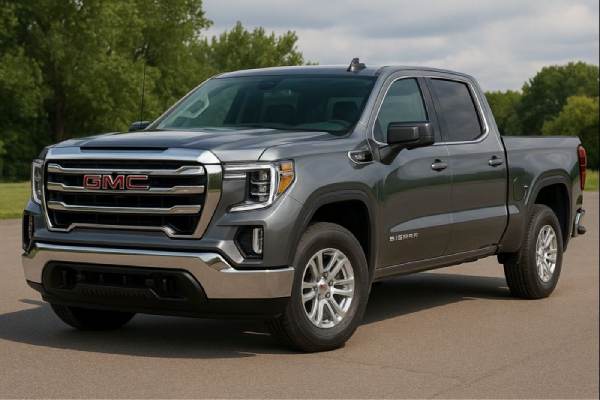
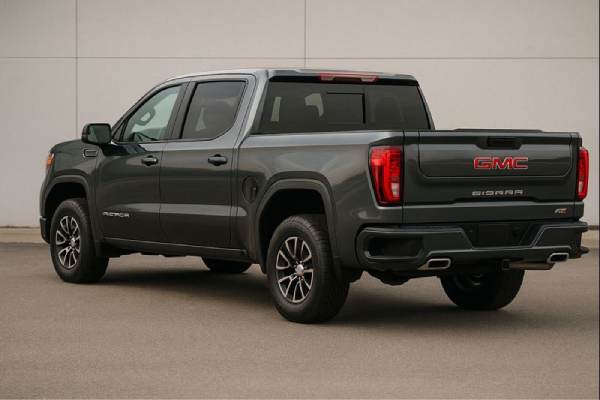
The facelifted GMC Sierra 1500 with the 6.2 litre L87 V8 in rear wheel drive form sits at the top of the half ton pickup food chain. It combines a traditional naturally aspirated small block with modern technology such as direct injection, variable valve timing, and Dynamic Fuel Management, all tied to a 10 speed automatic. For buyers, this means big power and towing capability without stepping into heavy duty territory.
From an ownership point of view, this configuration is about more than just numbers. The RWD layout keeps weight and complexity down, the 6.2 V8 gives effortless highway performance, and the T1XX chassis brings a stiffer frame, refined ride, and a much improved cabin compared with earlier generations. At the same time, the L87 engine family has come under regulatory scrutiny for bearing related failures, so it is important to go in with a clear view of both strengths and risks. This guide walks you through specs, reliability, maintenance, and how this truck stacks up against rivals.
Essential Insights
- Strong 6.2 litre L87 V8 delivers about 420 hp and 460 lb ft, giving confident towing and easy highway passing.
- RWD layout with the 10 speed automatic offers smoother cruising and slightly better efficiency than comparable 4WD versions.
- Premium fuel is recommended for best performance; expect real world consumption in the mid teens mpg (around 14–18 mpg US mixed).
- Be aware of ongoing investigations into L87 bearing failures; a clean recall history and good oil service records are essential checks.
- Typical oil change interval is 7,500–10,000 miles / 12,000–16,000 km or 12 months under normal use; shorten to 5,000 miles / 8,000 km if you tow frequently.
Contents and shortcuts
- GMC Sierra 6.2 RWD overview
- GMC Sierra 6.2 specs and data
- GMC Sierra 6.2 trims and safety
- Reliability and service actions
- Maintenance and buyer’s guide
- Driving and performance feel
- Sierra 6.2 versus rivals
GMC Sierra 6.2 RWD overview
In the current T1XX generation, the facelifted GMC Sierra 1500 (from model year 2022 onward) represents GMC’s most polished take on the light duty pickup. The 6.2 litre L87 V8 in rear wheel drive form targets buyers who want maximum power, high towing capacity, and a premium feel, but who do not necessarily need four wheel drive for off road work.
The L87 is part of the EcoTec3 small block family. It uses an aluminium block and heads, pushrod valvetrain, direct injection, variable valve timing, and Dynamic Fuel Management cylinder deactivation. In practice, the engine can run on as few as two cylinders under light load to save fuel, then switch back to all eight whenever you ask for power. Rated output is roughly 420 hp and 460 lb ft, shared with Silverado and full size SUV applications.
All 6.2 trucks pair with GM’s 10 speed automatic. In RWD form this transmission helps the Sierra feel relaxed at motorway speeds, often ticking along below 1,700 rpm. Gear spacing is close enough that the truck can stay in its power band when towing, yet still drop into tall overdrive ratios for efficiency when unloaded.
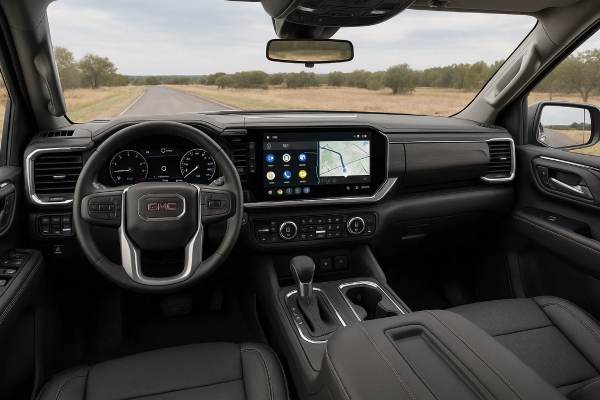
The facelift brought a much more modern interior with a large landscape infotainment screen, improved materials, and better driver assistance systems. Denali and Denali Ultimate trims push the Sierra into near luxury territory, with open pore wood, stitched dashboards, and advanced towing tech.
From a packaging viewpoint, most 6.2 RWD Sierras are sold as crew cabs with a short (5 ft 8 in) or standard (6 ft 6 in) box. This balances interior space with manoeuvrability. If you regularly tow heavier trailers, you will likely find the 6.2’s combination of horsepower, 10 speed gearing, and high tow ratings compelling, provided you are comfortable with its thirst and keep on top of maintenance.
GMC Sierra 6.2 specs and data
This section focuses on the 6.2 L87 V8, 10 speed automatic, rear wheel drive Sierra 1500 in the 2022–present facelift, primarily in North American crew cab short box form. Exact figures can vary slightly by model year, trim, and equipment, so always verify against the VIN.
Engine and performance
| Item | Specification (L87 6.2 V8) |
|---|---|
| Engine code | L87, EcoTec3 6.2 litre V8 |
| Layout and valvetrain | 90° V8, cam in block, pushrod, 2 valves per cyl |
| Block and heads | Aluminium block and heads |
| Displacement | 6.2 l (approx. 6,162 cc) |
| Bore × stroke | ~103.25 mm × 92.0 mm (4.06 in × 3.62 in) |
| Induction | Naturally aspirated |
| Fuel system | Direct injection, high pressure |
| Compression ratio | About 11.5 : 1 |
| Max power | ~420 hp (313 kW) @ 5,600 rpm |
| Max torque | ~460 lb ft (623 Nm) @ 4,100 rpm |
| Cylinder deactivation | Dynamic Fuel Management (multiple firing modes) |
| Emissions / standards | Meets current US EPA / CARB light duty standards |
Official fuel economy for similar 6.2 litre Sierra 1500s typically falls in the mid teens mpg combined, with highway figures around 19–20 mpg US in 2WD form when correctly specified. Real world results vary widely: expect low teens when towing and mid to high teens when cruising lightly loaded.
Transmission and driveline
| Item | Specification |
|---|---|
| Transmission | 10 speed automatic (10L80 family) |
| Drive type | Rear wheel drive (RWD) |
| Final drive ratios | Typically in the 3.23–3.73 range by tow pkg |
| Differential | Open or automatic locking rear (G80) by trim |
| Tow / haul mode | Yes, alters shift mapping and converter lock |
| Transfer case | Not fitted (RWD only) |
Tow packages may add a heavier duty rear axle, integrated trailer brake controller, and revised cooling.
Chassis, dimensions, and capacities
(Representative crew cab short box 2WD; check your specific configuration.)
| Item | Approximate value |
|---|---|
| Frame | Fully boxed high strength steel |
| Front suspension | Independent, coil over shock |
| Rear suspension | Solid axle, semi elliptic leaf springs |
| Steering | Electric power assist rack and pinion |
| Brakes (front / rear) | Ventilated disc / ventilated disc |
| Overall length | ~5,880 mm (231.9 in) |
| Width (without mirrors) | ~2,060 mm (81 in) |
| Height | ~1,900 mm (75–76 in) |
| Wheelbase (crew short box) | ~3,745 mm (147–148 in) |
| Ground clearance (2WD) | Around 205 mm (8.0 in) |
| Curb weight | Roughly 2,100–2,250 kg (4,630–4,960 lb) |
| GVWR | Typically ~3,175 kg (7,000 lb) by trim |
| Fuel tank | ~91 l (24 US gal) |
| Cargo box volume (short) | Around 1,780 l (62–63 ft³, SAE) |
Performance and capability
| Metric | Typical figure (properly equipped) |
|---|---|
| 0–100 km/h (0–62 mph) | Around 6.0–6.4 s |
| Top speed | Electronically limited (region specific) |
| Max conventional tow | Up to roughly 5,900–6,000 kg (13,000 lb) |
| Typical payload range | About 770–900 kg (1,700–2,000 lb) |
Figures above are indicative; the exact tow rating and payload depend heavily on cab, box, axle ratio, wheels/tyres, and package content.
Fluids and service related data (typical)
Always confirm fluid specifications in the owner’s manual or service information for your model year.
- Engine oil: Dexos1 Gen3 0W-20 full synthetic recommended; capacity about 7.6–8.0 l (8–8.5 US qt) including filter.
- Coolant: Long life silicate free OAT coolant; premix 50/50; capacity varies with cooling package.
- Automatic transmission: Dexron VI or later equivalent specified by GM; capacity depends on drain vs overhaul.
- Differential: Synthetic gear oil (typically 75W-90) to GM spec in the rear axle; locking differentials may require friction modified oils as specified.
- A/C refrigerant: R-134a or R-1234yf, depending on market and year; charge weight on under hood label.
- 12 V battery: AGM battery sized for stop start duty on many trims, with intelligent charging control.
GMC Sierra 6.2 trims and safety
The 6.2 litre L87 is not offered on every Sierra trim. It is typically reserved for higher specification models and specific packages:
- Denali and Denali Ultimate: These are the most common homes for the 6.2, especially on RWD trucks in warmer regions. Expect chrome or dark chrome exterior trim, multi function tailgate, and the most advanced infotainment and driver assistance suite.
- AT4 / AT4X: Usually 4WD only, but worth mentioning because they share the L87; they bring off road suspension, skid plates, and all terrain tyres.
- Selected SLT and other upscale trims: In some markets, the 6.2 can be optioned as an upgrade over the 5.3 V8 on well equipped SLT models.
Key mechanical and equipment differences across trims include:
- Axle ratios and tow packages: Heavy duty towing packs add numerically higher axle ratios, upgraded cooling, trailer brake controller, and extra camera views.
- Suspension tuning: Denali / Denali Ultimate often include adaptive dampers, giving a more controlled ride without sacrificing comfort.
- Wheel and tyre packages: 20 and 22 in wheels are common on 6.2 trucks. They look good but can increase unsprung mass and reduce ride compliance compared with 18 in sets.
From a safety perspective, crash protection for the crew cab Sierra is generally strong. Independent testing organisations rate the 2022+ crew cab highly in most crashworthiness categories, with solid scores for moderate and small offset frontal tests and for side protection. Headlight ratings vary with the specific lamp and trim combination; basic halogen or older projector systems often test worse than the latest LED matrix style units.
Standard and available safety / ADAS equipment typically includes:
- Multiple airbags (front, side, curtain) and a robust cab structure.
- Electronic stability control, traction control, and trailer sway control.
- Rear view camera as standard, with multi view camera systems optional.
- Lane keep assist with lane departure warning (standard or optional by trim).
- Forward collision alert with automatic emergency braking and pedestrian detection on many trims.
- Optional adaptive cruise control, which works best on clear highways.
- Blind spot monitoring and rear cross traffic alert, often upgraded to work with trailers when correctly configured.
For child transport, the crew cab provides ISOFIX / LATCH anchor points on the outboard rear seats. The rear seat base and backrest design make fitting bulky child seats relatively straightforward, though you should always verify tether routing and recline angles for your specific seat.
Because ADAS sensors (radar modules, cameras) sit behind the grille and windscreen, any collision repairs, windscreen replacements, or major suspension work may require calibration. Good body shops and dealers will be familiar with these calibration procedures; independent garages should confirm they have the right equipment before starting work.
Reliability and service actions
The 6.2 litre L87 powered Sierra has two overlapping stories: one of a proven GM small block V8 architecture, and another of more recent concerns around engine bearing reliability.
On the positive side, the basic small block layout is simple by modern standards. There are no turbochargers, the cam in block valvetrain is compact, and many components are shared with other GM trucks and SUVs. When serviced properly, these engines can cover high mileages. Common wear items such as water pumps, alternators, and sensors are widely available.
However, regulators have opened and expanded investigations into a subset of 6.2 L87 engines across pickups and SUVs, citing an unusual number of rod bearing and crankshaft related failures. These issues can lead to knocking noises, low oil pressure warnings, loss of power, or in severe cases, engine seizure. The problems are linked both to debris in oil passages and to crankshaft machining quality on certain production batches, and have already generated at least one recall, with further action under review.
For Sierra owners, practical reliability considerations include:
- Oil service discipline: Extended oil change intervals, frequent short trips, or heavy towing with inadequate maintenance can accelerate wear. Sticking to a stricter oil schedule than the absolute maximum suggested by the Oil Life Monitor is prudent.
- Listening for symptoms: Any new ticking, knocking, or rumbling noise from the lower end, especially under load, should prompt immediate inspection. Waiting for a check engine light can be risky.
- DFM lifter concerns: Like other modern GM V8s with cylinder deactivation, there is some risk of lifter or cam wear. Symptoms include misfires, ticking, and loss of performance. Updated parts and control software are often part of the remedy.
- Cooling and oil leaks: Watch for coolant seepage at hose joints and radiators, and for oil leaks around the pan, rear main seal area, and valve covers. Catching small leaks early helps prevent low fluid levels and secondary damage.
- Electronics and infotainment: The large screens and connected features can show occasional glitches such as frozen displays or slow boot times. Software updates at the dealer often resolve many of these issues.
Service actions and checks to prioritise:
- Recall status: Run the VIN through official recall databases and confirm that any L87 related campaigns, brake system recalls, or seatbelt / airbag fixes are marked as completed.
- Technical Service Bulletins (TSBs): Ask the dealer whether powertrain related TSBs (engine, transmission, DFM programming, lifter noise, shift quality) have been applied.
- Extended coverage: In some markets GM may offer goodwill repairs or extended coverage for particular issues. It is worth asking, especially if you have a full service history.
Pre purchase, arrange a full diagnostic scan, pay attention to misfire counters and stored powertrain codes, and insist on a cold start so you can listen for any abnormal noises.
Maintenance and buyer’s guide
A clear maintenance plan is the best defence against costly repairs on a 6.2 RWD Sierra. The outline below balances typical GM guidance with conservative intervals for buyers who tow or use the truck for work.
Suggested maintenance schedule (typical, may vary by market)
- Engine oil and filter: Every 7,500 miles / 12,000 km or 12 months, whichever comes first; reduce to 5,000 miles / 8,000 km if you tow frequently, idle a lot, or drive short trips. Use Dexos approved full synthetic 0W-20.
- Engine air filter: Inspect every 15,000 miles / 24,000 km; replace every 30,000–45,000 miles / 48,000–72,000 km or sooner in dusty conditions.
- Cabin air filter: Replace every 20,000–25,000 miles / 32,000–40,000 km or 2 years.
- Spark plugs: Iridium plugs often have 90,000–100,000 mile nominal intervals; for best performance and to reduce misfire risk on DFM engines, consider replacement at around 75,000 miles / 120,000 km.
- Cooling system: Replace coolant roughly every 5 years / 100,000 miles (160,000 km), or as specified in your manual.
- Automatic transmission fluid: Many “filled for life” claims are optimistic for towing use. A partial ATF change every 45,000–60,000 miles / 72,000–96,000 km can help longevity.
- Differential fluid: Replace around 45,000–60,000 miles, especially if the truck tows or operates in hot climates.
- Brake fluid: Flush every 3 years regardless of mileage.
- Brake pads and rotors: Inspect at every service; front brakes on heavy use trucks wear relatively quickly, so expect periodic pad and rotor replacement.
- Serpentine belt and hoses: Inspect from 60,000 miles / 96,000 km onward; replace at the first signs of cracking, glazing, or swelling.
- Alignment and tyre rotation: Rotate tyres every 5,000–7,500 miles with each oil change; check alignment yearly or after impacts or uneven wear.
- 12 V battery: Test annually from year 3; many AGM truck batteries last 4–6 years depending on climate and usage.
Torque specs (examples) should always be confirmed, but as a rough guide: wheel lug nuts are typically in the 170–200 Nm range, and critical suspension and steering fasteners should be tightened to factory values with a calibrated torque wrench from service documentation.
Buyer’s guide and inspection checklist
When shopping for a used 6.2 RWD Sierra:
- Service history: Look for consistent oil changes, transmission and differential services, and documentation of any engine related warranty work.
- VIN checks: Confirm recall completion and look for any history of buybacks or major accidents.
- Engine health: Listen carefully at cold start and at hot idle for any metallic ticking or knocking. A smooth startup, stable idle, and clean oil on the dipstick are good signs.
- Transmission behaviour: On a test drive, the 10 speed should shift cleanly without harshness, shudder, or hunting. In manual or low gear modes, verify that it responds promptly to commands.
- Driveline and suspension: Check for clunks when shifting from drive to reverse, and for vibrations at highway speed which may point to propshaft or tyre issues.
- Chassis corrosion: Inspect the frame rails, crossmembers, and rear leaf spring mounts, especially in salt belt regions. Surface rust is common; heavy flaking or deep pitting is more serious.
- Electrics and ADAS: Test all cameras, parking sensors, steering wheel buttons, and safety systems. Fault messages or inoperative sensors can be costly to chase, especially if accident related.
From a trim perspective, many buyers gravitate toward Denali and Denali Ultimate versions, as they combine the 6.2 with stronger resale value and more standard equipment. If you do not need the most luxurious cabin, a well optioned SLT with the 6.2 and key towing features can be an excellent value, often at a lower price point with less expensive wheels and tyres.
Long term, a well maintained 6.2 RWD Sierra can be a satisfying and capable truck. The key is to treat oil and fluid changes as non negotiable, respond early to any noise or warning light, and keep an eye on evolving guidance around L87 engine campaigns.
Driving and performance feel
On the road, the 6.2 RWD Sierra feels relaxed and confident. The large V8 delivers strong low and mid range torque, so you rarely need full throttle for normal driving. Throttle response is clean, with minimal delay between pedal input and engine reaction, especially in the more aggressive drive modes.
The 10 speed automatic is a major part of the truck’s character. In light throttle suburban driving it tries to keep revs low, often upshifting quickly into higher gears for smoothness and fuel savings. Under firm acceleration it downshifts decisively, sometimes skipping multiple gears, and keeps the engine in the 3,500–5,500 rpm range where it pulls hardest. In Tow/Haul mode, the transmission holds gears longer, locks the torque converter sooner, and uses engine braking on descents, all of which help stability when towing heavy trailers.
Ride quality in RWD 6.2 trucks depends strongly on wheel size and tyre choice. On 20 in wheels with sensible tyre sidewalls, the Sierra strikes a good balance: firm enough to control the body, soft enough to keep passengers comfortable on broken pavement. Denali models with adaptive dampers do the best job of smoothing out expansion joints and patchwork surfaces. Large 22 in wheels look sharp but can introduce more impact harshness and susceptibility to rim damage.
Handling is predictable for a full size pickup. The steering is light at parking speeds, weighting up as you go faster. Straight line stability is good, and the truck tracks confidently on motorways. Body roll is noticeable in tight bends, but grip is adequate with quality tyres, and electronic stability control steps in gently if you overdo it.
In terms of efficiency, realistic figures for a 6.2 RWD Sierra might be:
- Around 13–15 mpg US (18–20 l/100 km) in mixed city driving.
- Around 17–20 mpg US (12–14 l/100 km) on steady highway runs at legal speeds with light load.
- Single digit mpg when towing large box trailers or driving aggressively.
Cold weather, short trips, roof loads, aggressive tyres, and heavy accessories can all push consumption higher. Using premium fuel as recommended helps maintain both power and efficiency by allowing the engine to run its intended ignition timing maps.
When towing within its rated limits, the 6.2 has a clear advantage over smaller turbo engines. It pulls grades with authority, holds speed with fewer downshifts, and feels less strained. Transmission fluid and oil temperatures should still be watched on long climbs, but the standard cooling package on tow equipped 6.2 trucks is robust.
Overall, the 6.2 RWD Sierra feels like a traditional big V8 pickup updated with modern control systems: powerful, smooth, and easy to live with if you accept its fuel appetite.
Sierra 6.2 versus rivals
Against other full size trucks, the 6.2 RWD Sierra plays the role of the high power, premium option rather than the fleet workhorse.
- Ford F 150: Key competitors include the 5.0 litre V8 and the 3.5 litre EcoBoost V6. The Ford’s turbo V6 often beats the Sierra on towing torque at low rpm and can be more efficient when driven gently, but some owners prefer the linear, naturally aspirated feel of the 6.2 and its simpler exhaust layout. The F 150 also offers hybrid variants that can dramatically lower fuel consumption for mixed use.
- Ram 1500: The 5.7 litre Hemi, especially with eTorque, is the closest match. Ram’s coil spring or air sprung rear suspension gives a very refined ride, but the 6.2 Sierra generally has the edge in peak power and tow ratings in top configurations. Ram’s interior design is widely praised; Sierra Denali and Denali Ultimate close much of that gap with the facelift.
- Toyota Tundra: The latest Tundra largely moves to twin turbo V6 and hybrid powertrains. These can offer strong torque and respectable economy, but they add complexity. Buyers who value a big displacement, naturally aspirated V8 often see the Sierra 6.2 as one of the last straightforward options in this class.
- Chevrolet Silverado 1500: Mechanically, the Silverado 6.2 and Sierra 6.2 are close siblings. Choosing between them often comes down to styling, interior trim preferences, equipment packaging, and local pricing. The Sierra usually positions itself as the more upscale, “professional grade” choice.
Where the 6.2 RWD Sierra stands out:
- Power and refinement: Few half ton trucks match its combination of high horsepower, smoothness, and a wide ratio 10 speed automatic.
- Premium feel: Denali and Denali Ultimate trims deliver materials and tech that compete with well optioned SUVs.
- Traditional V8 ownership: For drivers who value the sound, throttle feel, and simplicity of a large naturally aspirated V8, the Sierra offers something many rivals are phasing out.
Where it trails:
- Fuel economy: It will almost always cost more to fuel than a well driven turbo V6 or hybrid rival.
- Ongoing engine investigations: The L87 bearing issue is a real concern; potential buyers should follow updates on recalls and investigations and treat maintenance as critical, not optional.
- Price and complexity at the top end: Highly optioned trucks can be expensive to repair, especially if advanced suspensions, large wheels, or complex electronics are damaged.
If you value power, comfort, and a traditional V8 experience, and you are prepared to budget for fuel and diligent maintenance, the GMC Sierra 1500 RWD with the L87 6.2 can be a very rewarding choice.
References
- Manuals and Guides | Vehicle Support | GMC 2024 (Owner’s Manual)
- Gas Mileage of 2023 GMC Sierra 2023 (Fuel Economy Data)
- 2022 GMC Sierra 1500 2022 (Safety Rating)
- Vehicle Detail Search – 2022 GMC SIERRA 1500 PU/CC 2WD | NHTSA 2022 (Recall Database)
- Feds Widening Investigation Into GM Trucks and SUVs Powered by 6.2-Liter L87 V-8s 2025 (Investigation Overview)
Disclaimer
This article is for informational purposes only and does not replace professional diagnosis, repair advice, or official service information. Specifications, torque values, service intervals, and procedures can vary by VIN, model year, market, trim level, and installed equipment. Always confirm details using your vehicle’s owner’s manual, official workshop documentation, and local regulations, and consult a qualified technician before carrying out any work.
If you found this guide useful, you are welcome to share it on social platforms such as Facebook or X/Twitter. It helps other owners find accurate information and supports the effort that goes into producing detailed technical content.