
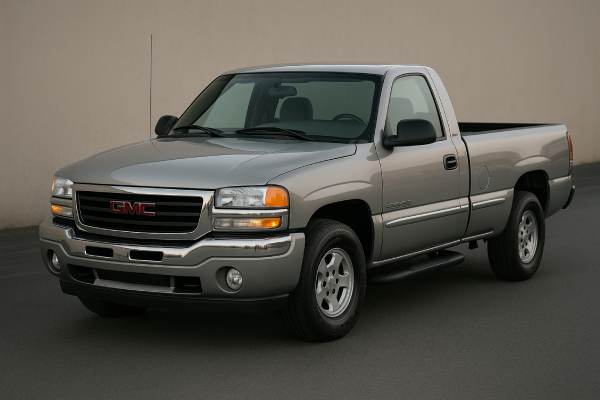
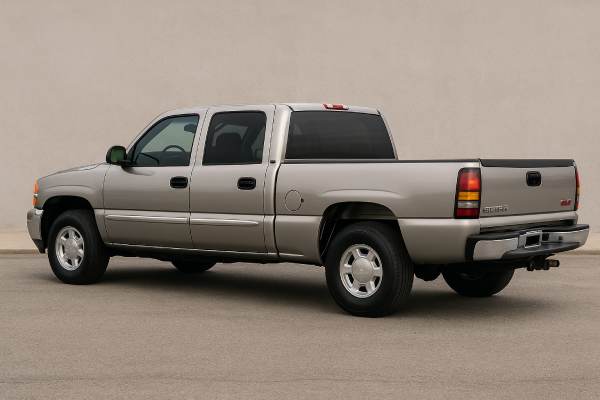
The 2000–2006 GMC Sierra 1500 RWD with the LM7 5.3 litre V8 sits in a sweet spot of the GMT800 generation: more power and refinement than the base 4.3 V6, without the thirst of the big 6.0 workhorse. It combines a robust body-on-frame layout with one of General Motors’ most durable small-block V8 engines. For owners, that means a truck that can tow, commute, and rack up mileage with relatively simple maintenance, provided rust and age-related wear are kept under control.
This guide focuses specifically on rear wheel drive 1500 models with the 5.3 litre LM7, cutting through the wide Sierra lineup to cover the specs, service needs, and real-world behaviour of this configuration. You will find key dimensions and capacities, typical performance numbers, common faults to watch for, and how it stacks up against rival half-ton trucks of the same era, all with a practical, ownership-focused angle.
Quick Specs and Notes
- Strong LM7 5.3 litre V8 (285 hp) with good low rpm torque and long service life when serviced on time.
- RWD layout gives lighter weight and slightly better fuel economy than 4WD, while still towing up to roughly 3,500–4,000 kg when correctly equipped.
- Simple, proven 4L60-E automatic; affordable to service but sensitive to neglected fluid and heavy towing.
- Watch for frame and brake line corrosion on trucks from rust-belt regions and intake gasket or rocker cover leaks with age.
- Aim for engine oil and filter changes every 8,000–10,000 km or 6 months under mixed use, more often if towing or ploughing.
Navigate this guide
- GMC Sierra 5.3 RWD profile
- LM7 5.3 specs and data
- Trim choices and safety tech
- Reliability patterns and fixes
- Service schedule and buying tips
- On-road character and capability
- Sierra 5.3 rivals comparison
GMC Sierra 5.3 RWD profile
The GMT800-generation GMC Sierra 1500 is a classic early-2000s full-size pickup: boxed frame, torsion-bar or coil-over front suspension depending on year, and leaf springs at the rear. In 1500 rear wheel drive form with the LM7 5.3 litre V8, it is positioned as the “step-up” engine for buyers who needed more pull than the base V6 but did not require 2500-series payload or the 6.0 V8.
The LM7 is an iron-block member of the LS-based small-block family. It uses aluminium cylinder heads, sequential fuel injection, and a relatively modest 9.5:1 compression ratio, which allows it to run happily on regular unleaded fuel. Power output is around 285 hp with approximately 325 lb-ft of torque, depending on model year and calibration. In a rear wheel drive Sierra 1500, that translates to relaxed highway cruising and enough torque for trailers, boats, and light equipment.
RWD trucks are a little lighter than their 4WD counterparts and have fewer driveline components. That gives them a small but noticeable edge in fuel consumption and reduces long-term complexity. For owners who mainly drive on paved roads or only occasionally tow, the RWD 5.3 litre configuration is often the most sensible choice.
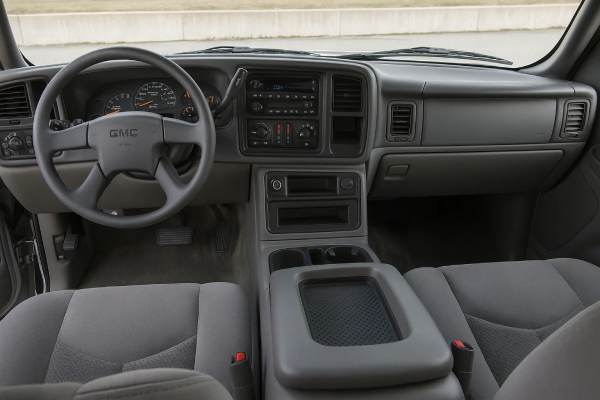
Cab and bed configurations include regular cab short or long bed, extended cab (with rear half doors in most years), and crew cab with a shorter bed. Interior quality is simple by modern standards but well laid out, with easy access to controls and robust cloth or leather upholstery depending on trim. The Sierra shares much with the Chevrolet Silverado of the same years, but typically carries slightly more upscale trim options and styling details.
For today’s buyer, the key attraction is a relatively simple, well-supported platform with abundant parts availability, strong aftermarket support, and an engine family that is widely known by independent shops. The main downsides are age-related: rust, wear, and the absence of modern driver-assistance systems.
LM7 5.3 specs and data
This section focuses on typical values for a 2000–2006 GMC Sierra 1500 RWD with the LM7 5.3 litre V8. Exact figures can vary slightly by year, cab, bed, and axle ratio, so treat these as representative.
Engine and performance
| Item | Value / Description |
|---|---|
| Engine code | LM7 |
| Displacement | 5.3 l (5,327 cc) |
| Layout and cylinders | 90° V8, iron block, aluminium heads |
| Valvetrain | OHV, 2 valves per cylinder, hydraulic lifters |
| Bore × stroke | 96.0 mm × 92.0 mm (3.78 in × 3.62 in) |
| Induction | Naturally aspirated |
| Fuel system | Sequential multi-port fuel injection |
| Compression ratio | Approx. 9.5:1 |
| Max power | ~285 hp (213 kW) @ 5,200 rpm |
| Max torque | ~441 Nm (325 lb-ft) @ 4,000 rpm |
| Timing drive | Chain, internal wet |
| Recommended fuel | Unleaded, typically 87 AKI (regular) |
| Typical combined economy | Approx. 13–15 l/100 km (15–18 mpg US) |
Transmission and driveline
Most 5.3 RWD Sierras use the 4L60-E four-speed automatic, with a smaller number equipped with a manual in early years.
| Item | Value / Description |
|---|---|
| Transmission | 4L60-E 4-speed automatic (most common) |
| Optional manual (early yrs) | 5-speed manual (NV3500 in some configurations) |
| Drive type | Rear wheel drive |
| Typical axle ratios | 3.23, 3.42, 3.73 (varies by tow package and trim) |
| Differential | Open, with optional automatic locking rear (G80) |
Chassis and dimensions (typical extended cab, standard bed)
Values vary; always verify against the door jamb label and manual for the exact truck.
| Item | Value / Description |
|---|---|
| Frame | Ladder-type, boxed/channeled |
| Front suspension | Independent (torsion bar or coil-over by year) |
| Rear suspension | Solid axle with leaf springs |
| Steering | Power-assisted recirculating ball |
| Brakes | Front disc, rear drum (most years) |
| Length | ~5,780 mm (227.6 in) |
| Width (without mirrors) | ~1,990 mm (78.5 in) |
| Height | ~1,870 mm (73.6–74 in) |
| Wheelbase (Std cab/Ext cab) | ~3,023–3,645 mm (119–143.5 in) |
| Curb weight (RWD 5.3) | ~2,050–2,200 kg (4,500–4,850 lb) |
| GVWR | Typically 2,900–3,040 kg (6,400–6,700 lb) |
| Fuel tank capacity | About 98 l (26 US gal) |
Performance and capability
Again, these are typical ranges for a well-maintained truck with standard gearing.
| Item | Value / Description |
|---|---|
| 0–100 km/h (0–62 mph) | ~8.5–9.5 s |
| Top speed (governed) | ~170 km/h (105–110 mph) |
| Typical towing capacity | ~2,900–3,900 kg (6,400–8,500 lb), properly equipped |
| Typical payload | ~680–860 kg (1,500–1,900 lb), depending on trim |
Fluids and service capacities (approximate)
Always confirm exact specs in the owner’s manual or service information.
| System | Spec / Type (example) | Approx. Capacity |
|---|---|---|
| Engine oil | 5W-30 meeting GM specification (later dexos1) | ~5.7 l (6.0 US qt) |
| Engine coolant | Long-life ethylene glycol (Dex-Cool type) | ~15–16 l (15–17 US qt) |
| 4L60-E ATF | Dexron III / VI (check year/updates) | ~8–10 l (incl. converter) |
| Rear differential | 75W-90 GL-5; add friction modifier if required | ~2–2.5 l (2.1–2.6 US qt) |
| Power steering | Power steering fluid / ATF per manual | ~1 l (1.1 US qt) |
| A/C refrigerant | R-134a | ~0.8–1.0 kg (28–35 oz) |
Electrical highlights
| Item | Value / Description |
|---|---|
| Alternator output | Typically 105–145 A (higher with tow/HD packages) |
| 12 V battery | ~600–700 CCA, Group 78 or similar |
| Spark plugs | Platinum or iridium, 0.99 mm (0.039 in) gap typical |
Safety equipment focuses on dual front airbags and ABS. Stability control and advanced driver-assistance systems were not widely available in the early 2000s Sierra, so buyers should calibrate expectations accordingly.
Trim choices and safety tech
Across 2000–2006, the Sierra 1500 RWD with the LM7 engine was offered in several trims, with equipment varying by year and region. Naming and exact content can shift, but typical grades include a base or “Work Truck” style model, mid-level SLE, and higher-spec SLT. In some markets, special editions and appearance packages added chrome, wheels, or interior upgrades without changing the mechanical fundamentals.
Base and work-oriented trims usually pair the 5.3 litre V8 with vinyl or basic cloth seats, manual climate controls, and simpler audio systems. These trucks are often regular cabs or extended cabs and may have rubber floor coverings. Mechanically they can still be well equipped, especially if ordered with a towing or trailering package, which often brings a higher axle ratio, transmission cooler, and sometimes the G80 locking rear differential.
SLE and SLT trims add more comfort and convenience: power windows and locks, keyless entry, upgraded cloth or leather upholstery, steering wheel audio controls in later years, and more sound insulation. SLT trucks are frequently found as extended or crew cabs with nicer interior materials, alloy wheels, and additional chrome trim. Mechanically, they may carry the same core hardware as lower trims, but are more likely to have options like heavy-duty cooling, fog lights, and higher-capacity alternators.
Identifying trims can be done through:
- Exterior badging (SLE/SLT emblems on doors or tailgate).
- Interior cues such as split-bench versus bucket seats, leather, and steering wheel controls.
- The RPO (Regular Production Option) code label in the glovebox; decoding this will reveal LM7, axle ratios, G80 differential, Z82 trailering package, and more.
On safety, early GMT800 Sierras generally offer:
- Dual front airbags (driver and passenger).
- Four-wheel ABS.
- Three-point belts for most seating positions.
- Child-seat anchors (LATCH) on later model years, especially in rear seats.
Side airbags, curtain airbags, and electronic stability control were limited or unavailable for much of this generation, depending on market and year. Structurally, frontal crash performance for these trucks is acceptable for their era, but side impact and rollover protection do not match modern designs.
Driver-assistance systems in the modern sense (autonomous emergency braking, adaptive cruise control, lane keeping) are absent. Parking aids may extend only to rear parking sensors on some higher trims or aftermarket fitments. This is important to factor in if you’re coming from a newer vehicle.
From a service standpoint, the simplicity of the safety electronics is helpful. There are fewer sensors and modules to reprogram or recalibrate after repairs, though airbag and ABS systems still require correct diagnostic procedures. After collision repair, checking sensor mounting, wiring, and fault codes is essential, but you will not be dealing with radar calibration or camera aiming.
Reliability patterns and fixes
The LM7-powered Sierra 1500 RWD is generally considered durable, but by now every example is old enough that age and mileage matter more than the original design. It helps to think in terms of common issues, when they tend to appear, and what the typical fixes are.
Engine and fuel system
- Oil leaks (common, low–medium cost): Rocker cover gaskets and rear main seals can seep with age. Symptoms include oil spots under the truck and oily residue on the bellhousing or exhaust. Replacement gaskets and, in the case of the rear main, more involved labour are the remedies.
- Intake manifold and throttle body deposits (common, low cost): Rough idle or stalling can result from carbon build-up. Cleaning the throttle body and, if needed, the intake, along with re-adapting the idle, usually resolves this.
- Fuel pump wear (common at higher mileage, medium cost): In-tank electric fuel pumps can fail, often after 200,000 km or more, especially if run low on fuel frequently. Symptoms include hard starting, hesitation, or complete no-start. Replacement of the pump module and strainer is the cure.
Cooling and gaskets
- Coolant leaks from hoses and radiators (common, low cost): Original rubber hoses and radiators can crack with age. Look for dried coolant residue at joints and the radiator tanks. Renew hoses, clamps, and radiator as needed.
- Heater core or intake gasket issues (occasional, medium cost): Sweet-smelling vapour in the cabin or unexplained coolant loss can indicate heater core seepage. A milky appearance in oil or coolant can suggest gasket problems and requires immediate diagnosis.
Transmission and driveline
- 4L60-E wear (common on hard-used trucks, medium–high cost): Symptoms include flare on 1–2 shifts, slipping under load, or harsh engagement. Heat and towing with old fluid accelerate wear. Regular fluid and filter changes help; rebuilds or replacements are common beyond high mileage if neglected.
- Driveshaft and U-joints (common with age, low–medium cost): Vibration under acceleration or a clunk when shifting into gear often traces back to worn U-joints or slip-yoke issues. Replacement parts are widely available.
Suspension, steering, and brakes
- Front suspension wear (common, low–medium cost): Ball joints, tie rod ends, idler arm, and pitman arm wear show up as vague steering, uneven tyre wear, and clunks over bumps. Parts are not expensive, but alignment is crucial after replacement.
- Rear leaf spring and shackle corrosion (common in rust regions, medium cost): Check for rusted or cracked leaves and weakened shackles. Replacement kits and upgraded hardware are available.
- Brake line corrosion (common in salty climates, medium cost): Steel lines above the frame and fuel tank are known corrosion spots. Soft brake pedal or visible wet spots need immediate attention; replacement with coated or copper-nickel lines is a preferred long-term fix.
Body and frame
- Frame and crossmember rust (region-dependent, high impact): Pay close attention to the rear frame rails, around the spare tyre, and at cab and bed mounts. Surface rust can be cleaned and treated; deep flaking or perforation can be a structural concern.
- Cab corners and rockers (common, cosmetic–structural): Rust bubbling under paint or through holes is typical. Repair ranges from patching to full panel replacement.
Electrics
- Instrument cluster stepper motors (common on GMT800 trucks): Erratic fuel, speed, or RPM gauges are often due to failing stepper motors. Rebuild services and DIY kits exist.
- Ground issues (occasional, low cost): Poor grounds can cause intermittent electrical symptoms; cleaning frame and body ground points often helps.
Recalls and service campaigns
Various recalls may apply by year (for example, brake line corrosion and tailgate or seatbelt issues in some markets). For any specific truck, use the VIN with an official dealer or the manufacturer’s recall portal, and ask for a printout showing completed and outstanding campaigns. This is an essential step before purchase.
Service schedule and buying tips
Because these trucks are now older, you are often dealing with a mix of historical servicing and catch-up maintenance. A sensible baseline schedule, assuming normal mixed use, looks like this:
Routine service intervals (approximate)
- Engine oil and filter: Every 8,000–10,000 km or 6 months; reduce to 5,000–7,000 km for frequent towing, idling, or dusty use.
- Engine air filter: Inspect every 15,000 km; replace every 30,000–40,000 km or as needed.
- Cabin air filter: Many trucks of this era may not have one from the factory; if fitted or retrofitted, replace every 20,000–25,000 km or annually.
- Spark plugs: Platinum or iridium plugs can often run 160,000 km, but on high-mileage or unknown service history trucks, replacing them proactively is wise.
- Fuel filter: Where a serviceable filter is fitted in-line, replace roughly every 50,000–60,000 km; many later trucks integrate it in the tank module.
- Coolant: Replace every 5 years or 160,000 km with the correct extended-life coolant, unless contamination or component failure forces earlier change.
- Transmission fluid (4L60-E): Drain and refill with filter every 50,000–60,000 km for mixed use or sooner for heavy towing. Avoid “flush-only” services on neglected gearboxes.
- Differential oil: Renew every 80,000–100,000 km, more often if towing or off-roading.
- Brake fluid: Replace every 2–3 years, regardless of mileage.
- Serpentine belt and hoses: Inspect annually; replace at the first signs of cracking, glazing, or bulging, typically by 150,000 km at the latest.
- 12 V battery: Test yearly after four years of age; expect replacement roughly every 5–7 years.
Inspection checklist for buyers
When evaluating a used Sierra 1500 RWD with the LM7:
- Frame and underbody: Look for flaking rust, especially near the rear frame, spare tyre area, and brake/fuel lines. Structural corrosion is more important than cosmetic body rust.
- Suspension and steering: Check for play in the steering wheel, clunks when rocking the steering left–right, and uneven tyre wear. Budget for front-end refresh on trucks with vague steering.
- Engine behaviour: Cold start, listening for knocking, ticking, or excessive valve train noise. Brief lifter tick is common on some small-blocks but should clear quickly. Check for smoke and stable idle.
- Transmission: Ensure smooth shifts under light and moderate throttle, with no flare, harsh engagement, or slipping. A test drive with a warm gearbox is essential.
- Fluids: Inspect engine oil, coolant, ATF, and differential oil for correct levels and signs of contamination or neglect.
- Electronics: Verify all gauges, lights, windows, and climate controls. Cluster issues and window regulators are not uncommon but are fixable.
- Service documentation: Look for proof of regular oil changes, coolant and transmission services, and completed recall work.
Which years and trims to favour
- Trucks with documented maintenance and minimal rust matter more than specific year differences.
- SLE/SLT trims often have better equipment and may have been more lightly worked than basic fleet trucks, but condition still varies widely.
- A tow package with auxiliary coolers and locking rear differential is desirable if you plan to tow, provided the transmission has been serviced regularly.
For long-term durability, the LM7 engine is capable of very high mileage, but the surrounding systems—frame, suspension, and transmission—set the real lifespan. A rust-free truck with a refreshed suspension and documented fluid changes is a strong candidate for another decade of use.
On-road character and capability
The Sierra 1500 RWD with the LM7 5.3 has a distinctly “old-school” truck feel, but in a way many owners appreciate. Steering is relatively slow by modern standards but stable at highway speeds. The suspension tune leans more toward comfort with a load or trailer than toward sharp empty-bed handling, so an unladen truck can feel a little bouncy over broken surfaces, especially with stiffer leaf packs.
Noise, vibration, and harshness are well controlled for the era. The V8 produces a subdued rumble at idle and a purposeful growl under acceleration without being intrusive. Wind and road noise are more noticeable than in modern half-ton pickups but acceptable for long drives, particularly in crew cab and higher trims with better sound insulation.
The LM7 engine itself feels flexible and willing. It delivers strong torque from low rpm, making light work of urban traffic and highway merging. There is no turbo lag to manage; throttle response is linear, and the power band feels broad. With the common 4L60-E automatic, shifts are smooth when the gearbox is healthy and fluid is fresh. Under heavy throttle, the transmission will kick down decisively, though it may occasionally “hunt” between gears when towing in rolling terrain if overdrive is left engaged.
In real-world fuel economy, expect near the mid-teens in mpg US (around 13–15 l/100 km) for mixed driving. Steady highway cruising can dip below that, particularly with conservative speeds and an empty bed. Heavy city use, oversized tyres, lift kits, and constant towing will push consumption upward.
Traction in dry conditions is good, but as with any powerful RWD pickup with an unladen bed, grip on wet or icy surfaces is limited. Quality tyres and, in winter climates, proper winter rubber make a significant difference. Some owners add modest ballast over the rear axle during winter. Without 4WD, you must drive with more care in snow and off-road settings, but on paved roads the simpler driveline and lower weight pay off.
Towing behaviour is solid within rated limits when the hitch, brakes, and cooling system are in good condition. The LM7 provides enough torque to maintain highway speeds with moderate loads, although long, steep grades will require patience and might prompt higher revs. Transmission temperature management is key under these conditions; a factory or aftermarket transmission cooler is advisable if you tow frequently.
Overall, the driving experience is defined by a dependable V8, predictable handling, and a straightforward interface, making the Sierra 1500 RWD LM7 a comfortable daily driver and weekend hauler if you accept its age and lack of modern driver aids.
Sierra 5.3 rivals comparison
When cross-shopping the 2000–2006 Sierra 1500 RWD 5.3 with other half-ton pickups of the same era, you are usually looking at:
- Chevrolet Silverado 1500 with similar 5.3 litre V8.
- Ford F-150 (late ninth/early tenth generation and then the 2004-up redesign).
- Dodge Ram 1500 with the 4.7 or 5.7 Hemi V8.
- Toyota Tundra (first generation).
Versus Chevrolet Silverado 1500
Mechanically, the Silverado 1500 of this era is nearly identical to the Sierra. The choice often comes down to styling, interior trim, and regional availability. Parts interchange and service knowledge are essentially the same. In some markets, Silverados may be more common, which can improve selection when buying used.
Versus Ford F-150
The F-150 offers a broad engine range, including modular V8s, and often slightly higher payload ratings in certain configurations. Interior design and ride comfort improved with the 2004–2008 generation, and frame and suspension updates boosted refinement. However, some Ford engines of the era have their own quirks (such as spark plug and timing chain issues on specific variants), and rust is an issue here as well.
The Sierra’s LM7 engine is widely regarded as robust, with strong aftermarket support. If you prioritise engine longevity and easy parts availability, the Sierra scores well. If you need a specific F-150 configuration (for example, certain bed and cab combinations or factory options), Ford may still be the better fit.
Versus Dodge Ram 1500
The Ram 1500 of this era stands out for ride comfort and interior design, particularly with the 5.7 Hemi. It can feel more modern inside than a GMT800 truck. However, some owners report higher rates of front suspension and steering wear, and certain engine and transmission combinations can be more sensitive to neglect.
The Sierra may not feel as plush, but the LM7/4L60-E combination and GM’s frame and suspension design are familiar to many independent shops, keeping ownership simpler.
Versus Toyota Tundra
The first-generation Tundra is praised for reliability and build quality, but in many regions it is less common and can command a price premium on the used market. Payload and towing ratings can be lower in some configurations. If ultimate long-term reliability is your only priority and budget allows, a Tundra is a strong candidate, but you may sacrifice some capacity or pay more upfront compared with a Sierra.
Where the Sierra 5.3 RWD stands out
- Well-known, durable LM7 engine with huge parts and tuning support.
- Simple RWD driveline for owners who do not need off-road capability.
- Good towing and payload ratings for its era without stepping up to 2500-series trucks.
- Strong availability of used examples and affordable replacement parts.
For buyers seeking a capable, mechanically straightforward V8 truck for work and everyday use, a clean GMT800 Sierra 1500 RWD with the LM7 engine remains a compelling choice, especially if you can find one with minimal rust and strong maintenance records.
References
<a href="https://www.gmc.com/support/vehicle/manuals-guides">Manuals and Guides | Vehicle Support</a> 2024 (Owner’s Manual Portal)<a href="https://experience.gm.com/support/vehicle/manuals-guides">Manuals and Guides | Vehicle Support - Experience GM</a> 2024 (Owner’s Manual Portal)<a href="https://contentdelivery.ext.gm.com/bypass/gma-content-api/resources/sites/GMA/content/staging/MANUALS/1000/MA1130/en_US/2.0/2k04sierra1248945727944380338.pdf">2004 GMC Sierra Owner Manual M</a> 2003 (Owner’s Manual)<a href="https://www.iihs.org/vehicle-safety/rankings/small-pickups-vans-suvs/2003-2006-gmc-sierra-1500-extended-cab-pickup">2003–2006 GMC Sierra 1500 extended cab pickup</a> 2017 (Safety Rating)<a href="https://www.gmccanada.ca/en/support/vehicle/manuals-guides">Owner's Manuals and Guides</a> 2024 (Owner’s Manual Portal)
Disclaimer
This article is for informational purposes only and is not a substitute for professional diagnosis, repair, or safety inspection. Specifications, torque values, fluid types, and service intervals can vary by VIN, model year, market, equipment level, and previous repairs or modifications. Always confirm critical data against your official owner’s manual and factory service information, and consult a qualified technician before carrying out any maintenance or repair work.
If you found this guide useful, please consider sharing it with other owners or enthusiasts on social platforms such as Facebook or X/Twitter. Your support helps keep detailed, practical content like this available.