
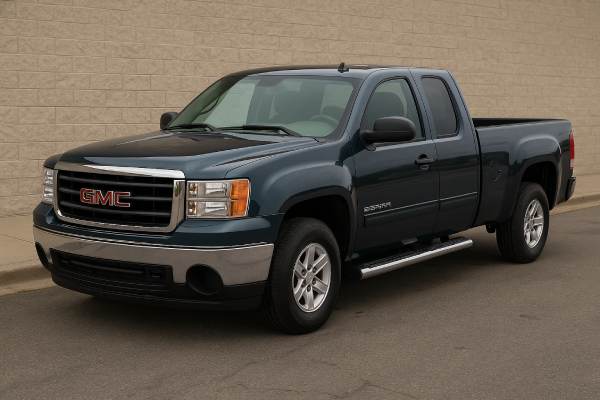
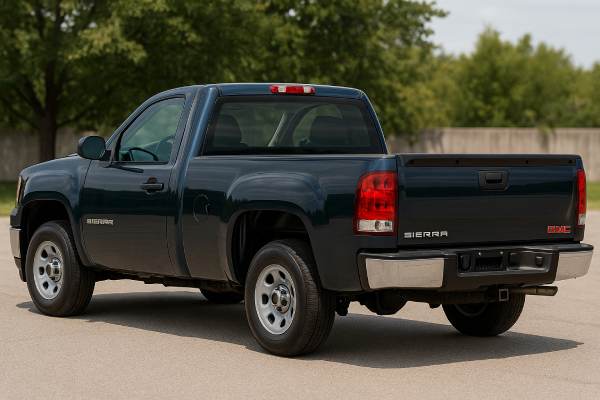
The 2007–2013 GMC Sierra 1500 with the LU3 4.3 litre V6 sits at the practical end of the GMT900 lineup. It was aimed at fleets, tradespeople, and owners who needed a dependable half-ton truck more than they needed big power numbers. With its cast-iron pushrod V6, conventional rear wheel drive layout, and straightforward cabin, this version trades outright speed and luxury for durability, low running costs, and easy servicing.
Most examples are regular cab, rear wheel drive trucks with simple equipment and a 4-speed automatic. The engine’s modest 195 hp rating can feel slow when the truck is heavily loaded, but the low-rpm torque and proven design are valuable in long-term ownership. At the same time, safety and comfort features vary a lot by trim and model year, and many trucks have led hard lives. This guide focuses specifically on the 4.3 V6 RWD GMT900 Sierra and what current and future owners should know.
Fast Facts
- Simple LU3 4.3 litre V6 with around 195 hp and 260 lb-ft is durable, cheap to repair, and widely supported for parts.
- Rear wheel drive regular-cab layout offers strong payload and easy manoeuvring in cities and job sites.
- Real-world fuel economy typically sits around 15–17 mpg US combined, slightly better than comparable V8 Sierras in light use.
- Watch closely for frame and brake-line corrosion on older, northern trucks plus front suspension wear.
- Plan on engine oil and filter changes every 5,000–7,500 miles (8,000–12,000 km) or 6–12 months, depending on usage and oil type.
Explore the sections
- GMC Sierra 4.3 V6 overview
- Sierra 4.3L technical specs
- Trims, equipment and safety tech
- Reliability and common problems
- Maintenance planning and buying tips
- Real-world driving and performance
- Sierra 4.3 vs rival trucks
GMC Sierra 4.3 V6 overview
The GMT900-generation GMC Sierra 1500 launched for the 2007 model year and ran through 2013, overlapping slightly with the outgoing “Classic” range. Within this generation, the LU3 4.3 litre V6 served as the base engine on many rear wheel drive standard-cab trucks and some extended cabs in lower trims. It is a 90-degree V6 derived from General Motors’ long-running small-block architecture, using a cast-iron block and heads with a single camshaft in the block and pushrods.
In practice, that design brings three main benefits: mechanical simplicity, strong low-end torque, and excellent parts support. The 4.3 V6 will not win any drag races, but it is tolerant of high mileage and uneven maintenance compared with more complex, high-specific-output engines. Many of these trucks have exceeded 200,000 miles with only routine service and occasional wear-item repairs.
This configuration is most often found as:
- Regular cab with 6.5 ft box, 2WD
- Regular cab with 8 ft box, 2WD
- Selected extended cab 2WD trucks in lower trims
Crew cabs, luxury trims and off-road packages usually came with V8 engines instead.
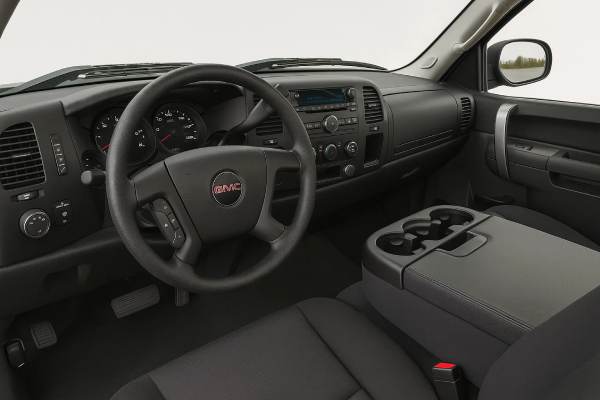
Inside, the GMT900 platform improved on the older Sierra with a more modern dash, better materials, and improved ergonomics. However, most 4.3 V6 trucks still have basic, work-oriented interiors: cloth or vinyl seats, manual or simple power windows, and straightforward audio systems. For an owner today, that is often a plus. There are fewer complex features to fail with age, and repairs tend to be inexpensive.
The key to understanding the 4.3 Sierra is to see it as a dependable, light-duty work truck. It excels at city deliveries, light hauling, and general utility tasks. It is less ideal if you regularly tow at the upper end of half-ton ratings or want premium ride, cabin tech, and refinement.
Sierra 4.3L technical specs
This section summarises common specifications for a typical 2007–2013 GMC Sierra 1500 RWD with the LU3 4.3 litre V6 and 4-speed automatic. Values can vary slightly with year, axle ratio, cab, and box length, so treat them as representative.
Engine and performance
| Item | Specification |
|---|---|
| Engine code | LU3, Vortec 4300 |
| Displacement | 4.3 L (4,300 cc) |
| Layout | 90° V6, cast-iron block and heads, OHV, 2 valves per cylinder |
| Bore × stroke | Approx. 101.6 × 88.4 mm (4.00 × 3.48 in) |
| Induction | Naturally aspirated |
| Fuel system | Multi-point fuel injection (MPFI) |
| Compression ratio | Around 9.2:1 |
| Maximum power | About 195 hp (145 kW) @ ~4,600 rpm |
| Maximum torque | Around 260 lb-ft (approx. 350 Nm) @ ~2,800 rpm |
| Firing order | 1–6–5–4–3–2 |
| Recommended fuel | Regular unleaded (87 AKI) |
Approximate fuel economy for a 2WD regular cab automatic:
| Usage | Typical economy (US) |
|---|---|
| City | 15–16 mpg (about 14.7–17 L/100 km) |
| Highway | 20–21 mpg (about 11–12 L/100 km) |
| Combined | 16–17 mpg (around 13–15 L/100 km) |
Transmission and driveline
| Item | Specification |
|---|---|
| Transmission | 4L60E 4-speed automatic (most common) |
| 1st / 2nd / 3rd / 4th | 3.06 / 1.63 / 1.00 / 0.70 |
| Reverse | 2.29 |
| Final drive ratios | Frequently 3.23, 3.42 or 3.73 depending on axle option |
| Drive type | Rear wheel drive (RWD) |
| Rear axle | Live axle with leaf springs; open differential common, limited-slip optional |
Chassis and dimensions (typical 2WD regular cab, 6.5 ft box)
| Item | Specification |
|---|---|
| Front suspension | Independent, coil-over shock, control arms |
| Rear suspension | Solid axle, semi-elliptic leaf springs |
| Steering | Hydraulic power-assisted rack and pinion |
| Brakes (front/rear) | Ventilated disc / drum |
| Wheelbase | About 119 in (3,023 mm) short box; ~133 in (3,378 mm) long box |
| Overall length | Roughly 206–225 in (5,230–5,720 mm) depending on box |
| Width (without mirrors) | Around 80 in (2,030 mm) |
| Height | Approximately 73–74 in (1,850–1,880 mm) |
| Turning circle | Around 39–40 ft curb-to-curb (short wheelbase) |
| Curb weight | Typically 4,500–4,700 lb (2,040–2,130 kg) |
| GVWR | Commonly 6,400–6,700 lb (2,900–3,050 kg) |
| Fuel tank | About 26 US gal (98 L) |
The fuel tank and typical highway economy produce a real-world cruising range in the 450–520 mile (725–835 km) range for steady, moderate-speed highway driving.
Performance and capability
| Metric | Typical value |
|---|---|
| 0–60 mph (0–97 km/h) | Roughly 9.5–11.0 s unloaded |
| Top speed | Around 95–99 mph (153–160 km/h), often limited |
| Braking 60–0 mph | Around 140–150 ft (43–46 m) on healthy brakes and tyres |
| Max towing | Commonly in the 5,000–5,500 lb (2,270–2,500 kg) range depending on axle ratio and configuration |
| Payload | Often 1,500–2,000 lb (680–910 kg), depending on GVWR and curb weight |
Fluids, capacities, and key torques (typical)
Always confirm against the specific owner’s or service manual, but rough working figures are:
- Engine oil: about 4.0–4.7 L (4.2–5.0 US qt) with filter, often 5W-30 or 5W-20 meeting GM specifications
- Coolant: approximately 15–16 L (16–17 qt) Dex-Cool type long-life coolant
- Automatic transmission: around 11–12 L (11.5–12.5 qt) total; 4–5 L on typical pan drain
- Rear axle: roughly 1.6–2.0 L (1.7–2.1 qt) of 75W-90 gear oil
Typical torque values (always confirm for your year):
- Wheel nuts: around 140 ft-lb (190 Nm)
- Spark plugs: roughly 15–18 ft-lb (20–25 Nm)
- Engine oil drain plug: around 18–22 ft-lb (25–30 Nm)
Electrical and basic safety equipment
- Alternator outputs commonly around 140–150 A, with higher capacities in tow or heavy-duty packages
- Truck-size 12 V battery, often 600–700 CCA range
- Standard fitment includes ABS and, across the run, stability control, front airbags, and (in many models) side curtain airbags and tyre pressure monitoring
Trims, equipment and safety tech
The LU3 4.3 V6 typically appears in value-focused trims. Understanding which packages could be paired with the base engine helps when shopping or decoding a used truck.
Trims and options with the 4.3 V6
Work Truck (WT) and base trims
These are the most common home of the 4.3:
- Vinyl or simple cloth seats
- Rubber or easy-clean flooring
- Basic audio (AM/FM, often with simple CD or aux input in later years)
- Manual windows and locks on early trucks; power equipment optional or standard on some later versions
- Steel wheels and relatively narrow tyre sizes
SL / SLE with 4.3
In some markets and years, the 4.3 could also be ordered on lower SLE or equivalent trims:
- Cloth seats with more padding and better sound insulation
- More equipment packages: power windows, keyless entry, cruise control
- Alloy wheels in many cases
- Better audio systems and optional steering-wheel controls
Higher trims such as SLT and Denali almost always used V8 engines and are not typically found with the 4.3.
Mechanical and functional option packages that matter for owners include:
- Trailering package – Adds hitch receiver, wiring harness, sometimes upgraded cooling and a different axle ratio
- Handling/Trailering suspension (Z85 or similar) – Slightly firmer tuning and sometimes larger anti-roll bars
- Locking or limited-slip differential (often code G80) – A desirable option for loose-surface traction and light off-roading
Year-to-year, infotainment and minor interior features improved: later trucks gained better integration for phones and media, while early trucks stayed basic. The 4.3 trucks usually sit at the simpler end of that spectrum.
Safety ratings in context
Crash ratings for the GMT900 platform vary by body style and test. Crew cab models generally rate better in some tests than extended cabs, and the presence of side airbags significantly affects side-impact performance. In broad terms:
- Moderate-overlap front crash performance is generally good for half-ton trucks of this era.
- Side-impact results improve on trucks equipped with head curtain and torso airbags.
- Roof strength and head restraint performance are often rated in the acceptable to marginal range for some variants.
NHTSA star ratings for 2007–2013 Sierra 1500 models commonly fall between four and five stars for frontal impact and rollover, depending on configuration. Exact scores depend on the specific year, cab type, and drive configuration.
Safety systems and driver assistance
Safety and driver assistance technology on these trucks is relatively straightforward by modern standards:
- Dual front airbags standard across the range
- Head curtain side airbags optional early and increasingly standard on later models and higher trims
- Seat-mounted side airbags on many later crew and extended cabs
- ABS and electronic stability control (StabiliTrak) present across most of the generation
- Tyre pressure monitoring system standard
Advanced driver assistance features such as autonomous emergency braking, lane keeping assistance, blind spot monitoring, and adaptive cruise control were not offered. Some trucks gained factory or dealer-installed parking sensors and rear cameras, but many 4.3 work trucks lack them. After major collision repair, proper calibration of steering angle sensors and checks of airbag modules and wiring are important to keep ABS and stability systems functioning correctly.
Reliability and common problems
The Sierra 1500 LU3 4.3 V6 is known for above-average durability, especially if it avoided severe rust and has seen reasonable maintenance. Still, after more than a decade, patterns of common issues are well established.
Engine-related issues
Common, usually low-to-medium cost
- Intake manifold gasket leaks
- Symptoms: subtle coolant loss, external seepage, occasional misfire on cold start, sweet smell.
- Likely cause: aged intake manifold gaskets shrinking or hardening.
- Remedy: replace gaskets, inspect mating surfaces, flush and refill coolant.
- Ignition components (cap, rotor, wires, plugs)
- Symptoms: misfires, rough idle, poor fuel economy, occasional no-start in damp conditions.
- Cause: worn distributor cap and rotor, aged wires, or spark plugs at or beyond service life.
- Remedy: refresh ignition components with quality parts and verify timing and coil function.
- Oxygen sensors and EVAP faults
- Symptoms: check engine light, fuel trim codes, or evap leak codes.
- Cause: ageing O2 sensors, cracked hoses, leaking purge or vent valves.
- Remedy: diagnose with scan tool and smoke test; repair or replace faulty components.
Timing chain wear on the 4.3 is generally not a frequent failure point. Noisy chains or timing correlation codes at very high mileage warrant attention, but chain replacement is not a standard maintenance item as it might be on some belt-driven engines.
Transmission and driveline
The widely used 4L60E automatic brings its own set of known behaviours:
- Shift flare, slipping, or loss of gears
- Symptoms: delayed or harsh shifts, slipping into higher gears, or complete loss of 3rd/4th.
- Cause: worn clutch packs, weakened 3–4 clutch, valve body wear, or neglected fluid.
- Remedy: proper rebuild with updated components and a clean cooler; fluid and filter changes earlier in life can help delay issues.
- Driveline clunks
- Symptoms: noticeable clunk when shifting from park to drive or reverse, or when taking up slack.
- Cause: normal lash, dry slip yoke, worn U-joints, or differential play.
- Remedy: inspect joints and mounts, grease slip yoke where applicable, and address worn components.
Rear differentials usually last well if fluid is changed periodically and the truck isn’t consistently overloaded.
Chassis, brakes, and steering
Common ageing-related problems include:
- Front suspension wear
- Worn ball joints, tie-rod ends, and control-arm bushings are normal at higher mileages.
- Symptoms include wandering steering, uneven tyre wear, and clunks over bumps.
- Budget for a front-end refresh on high-mileage trucks, followed by proper wheel alignment.
- Steering intermediate shaft clunk
- A light clunk through the steering column over bumps is a common GM trait.
- Greasing the shaft or installing an updated design can reduce or eliminate it.
- Brakes and corrosion
- In rust-prone areas, steel brake lines and fuel lines along the frame can corrode.
- Caliper sliders and backing plates also rust, leading to dragging brakes or uneven wear.
- Regular inspection and preventive replacement of rusty lines can prevent sudden failures.
Corrosion and body issues
Rust is often the limiting factor on older Sierras, especially in regions with heavy road salt:
- Frame rails near the rear axle, spare tyre area, and trailer hitch mounts
- Brake and fuel line brackets along the frame
- Cab corners, rocker panels, and rear wheel arches
Severe frame corrosion is difficult and costly to fix. Many otherwise sound trucks are retired because of frame or brake-line rust, so a thorough inspection is essential.
Electrical and interior
Electrical issues are usually nuisance-level but can add up:
- Instrument cluster gauge failures due to stepper motor issues
- Power window regulators and door lock actuators wearing out
- HVAC blend door actuators failing, causing loss of temperature or airflow control
These problems are usually repairable with moderate labour and parts costs and rarely immobilise the truck.
Maintenance planning and buying tips
A well-maintained Sierra 1500 4.3 can deliver a long service life. A neglected one can become an expensive project. A clear maintenance plan and careful pre-purchase inspection go a long way.
Practical maintenance schedule (typical guidance)
Always refine intervals with the specific owner’s manual and your usage pattern, but these ranges work well as a starting point:
- Engine oil and filter – Every 5,000 miles/8,000 km for severe use (short trips, towing, dusty driving) or up to 7,500 miles/12,000 km for lighter use with quality oil. Change at least annually.
- Engine air filter – Inspect annually; replace around 30,000–45,000 miles (48,000–72,000 km), more often in dusty conditions.
- Cabin air filter – Where fitted, change every 15,000–25,000 miles (24,000–40,000 km) or every second year.
- Spark plugs – Iridium plugs often last 90,000–100,000 miles (145,000–160,000 km). Check around 60,000 miles and replace if worn.
- Fuel filter – On trucks with serviceable filters, replace around 50,000–60,000 miles (80,000–100,000 km); some later setups have in-tank filters.
- Coolant – Replace Dex-Cool-type coolant every 5–7 years or 100,000 miles (160,000 km), whichever comes first, or sooner if contaminated.
- Automatic transmission fluid and filter – Drain and refill with filter change every 50,000–60,000 miles (80,000–100,000 km), more frequently for heavy towing, high temperatures, or repeated stop-start driving.
- Differential oil – Replace every 60,000–75,000 miles (96,000–120,000 km); halve the interval for frequent heavy towing or hauling.
- Brake fluid – Flush every 3–4 years regardless of mileage to control moisture content.
- Serpentine belt and coolant hoses – Inspect annually from year 8 onward; replace at the first sign of cracking, fraying, swelling, or glazing.
- Tyre rotation and alignment – Rotate every 6,000–8,000 miles (10,000–13,000 km) and check alignment when tyres wear unevenly or suspension work is done.
- 12 V battery – Load test annually after year 4; many original batteries last about 4–6 years in real-world use.
Use fluids that meet GM specifications for gasoline engines of this era, including the correct Dexron-VI ATF and Dex-Cool-compatible coolant. Using the right fluid type matters as much as the interval.
Buyer’s guide checklist
When shopping for a used 4.3 Sierra 1500:
- Rust and structural integrity
- Inspect frame rails, especially near the rear axle, hitch mounts, and along brake and fuel lines.
- Check rocker panels, cab corners, and wheel arches for bubbling paint or visible holes.
- Engine condition
- Listen on cold start for knocking, loud ticking, or heavy valve noise.
- Look for coolant or oil seepage around the intake manifold, oil pan, and rear of the engine.
- Confirm there are no active misfire, EVAP, or catalyst codes via scan tool.
- Transmission and driveline
- On a test drive, look for smooth shifts without slipping or flaring.
- Note any vibrations or humming that change with vehicle speed or throttle.
- Suspension, steering, and brakes
- Check steering play and response; a vague or wandering feel suggests front-end wear.
- Inspect tyres for cupping or uneven wear patterns that hint at suspension or alignment issues.
- Verify that the parking brake holds properly and that braking is straight and consistent.
- Interior and electrical
- Confirm all gauges, lights, windows, locks, HVAC settings, and radio functions work correctly.
- Check for water leaks or damp carpets, which can accelerate corrosion.
- History and documentation
- Look for service records covering oil changes, coolant, transmission, and differential services.
- Verify recall completion via official databases.
- Recent investment in tyres, brakes, shocks, and steering components is a positive sign.
Well-cared-for trucks that lived in dry climates and did modest towing are usually better long-term bets than lower-mile trucks with heavy rust or unclear histories.
Real-world driving and performance
Behind the wheel, the GMC Sierra 1500 4.3 V6 RWD feels like a traditional full-size pickup with a slightly more relaxed personality than its V8 siblings.
Powertrain character
The 4.3 V6 delivers its strongest torque at modest revs, which suits stop-start city driving and low-speed work. Around town, the truck pulls away confidently if you are not in a hurry. On the highway, acceleration is acceptable but not brisk; merging and overtaking require more planning than in a V8-equipped Sierra.
The 4L60E transmission is tuned for smooth shifts and fuel economy:
- It upshifts early at light throttle, keeping revs low and saving fuel.
- Kickdown is adequate but not instant; pressing the throttle firmly is often needed to get a timely downshift.
- On long grades, the truck may shift between 3rd and 4th if loaded, especially with shorter axle ratios.
Owners who drive with a measured right foot and avoid constant full-throttle acceleration tend to be happiest with the 4.3’s performance.
Ride, handling, and noise
The GMT900 platform offers a comfortable ride for a body-on-frame truck:
- Ride quality – Unladen, the rear leaf springs can feel firm, especially on short-wheelbase regular cabs. Adding several hundred pounds of payload smooths out the ride.
- Handling – Steering effort is light, with predictable, if not sporty, responses. Body roll is present but controlled, and grip strongly depends on tyre type and condition.
- Noise – At highway speeds, wind and road noise dominate more than the engine, which settles into a quiet cruise. The V6’s sound is slightly coarser than the V8s when revved but usually unobtrusive in normal use.
Real-world efficiency and towing behaviour
In mixed use, many owners see:
- City: around 14–16 mpg US (roughly 16–17 L/100 km)
- Highway: around 18–21 mpg US (roughly 11–13 L/100 km)
- Combined: around 15–17 mpg US (roughly 14–16 L/100 km)
Cold weather, short trips, and heavy loads reduce those numbers, while steady, moderate-speed highway driving often meets or slightly exceeds them.
When towing within its rated range, the Sierra 4.3 remains stable if the trailer is correctly set up. However:
- Acceleration is slower, and the truck will spend more time in lower gears, particularly on inclines.
- Transmission and coolant temperatures rise more quickly, making clean cooling systems and fresh ATF more important.
- Fuel consumption can worsen by 30–50% with heavier trailers, which is typical for half-ton trucks of this era.
Everyday usability
For daily driving and light work, owners usually appreciate:
- Good visibility from the upright seating position
- Simple, robust controls that age better than complex touchscreens
- A relatively tight turning circle for a full-size truck, especially in short-wheelbase form
The main compromises are the modest acceleration, basic cabin on many 4.3 trucks, and the absence of modern driver-assistance technology. If you accept those limitations, the driving experience is honest, predictable, and easy to live with.
Sierra 4.3 vs rival trucks
When comparing the GMT900 Sierra 1500 4.3 V6 RWD to other used full-size pickups, it helps to focus on what matters in long-term ownership: reliability, running costs, capability, and comfort.
Versus V8 Sierra and Silverado models
Advantages of the 4.3 V6 version:
- Typically cheaper to buy on the used market than similar-condition V8 trucks
- Slightly better fuel economy in light-duty use, especially in city driving and unloaded operation
- No cylinder-deactivation hardware, fewer complex systems, and a long production history of the basic V6 design
- Often paired with simpler trims that bring lower repair costs for interior electronics and luxury features
Disadvantages:
- Noticeably weaker acceleration when loaded or towing compared with 5.3 or 6.0 V8 models
- Lower maximum tow ratings; not the best choice for large travel trailers or heavy equipment
- Some buyers strongly prefer the sound and feel of a V8, which supports higher resale demand for those configurations
Versus other manufacturers’ base-engine half-tons
Against similar-era Ford F-150 and Ram 1500 trucks with base V6 engines:
- Power and refinement – The Sierra’s 4.3 is competitive in torque but less refined than some later overhead-cam or multi-valve V6s. It wins on simplicity, not sophistication.
- Ride and comfort – Ride quality is generally good, especially with some weight in the bed. Some rivals may offer quieter cabins or more advanced seat and noise-isolation options in higher trims.
- Reliability and costs – The 4.3 V6 is widely regarded as durable, with excellent parts availability and a large base of mechanics familiar with it. Rust and 4L60E wear are often bigger issues than engine failures.
- Safety and technology – By today’s standards, all trucks of this era lack modern active safety features. Some competitors introduced advanced features slightly earlier, but the gap is limited; expectations should be calibrated accordingly.
Who should choose a Sierra 4.3 V6 RWD
This configuration makes the most sense if you:
- Primarily need a reliable, affordable work or utility truck
- Tow moderately sized loads only occasionally and stay well within rated tow limits
- Prefer mechanical simplicity and lower potential repair bills over high performance and luxury features
- Are comfortable with a more traditional driving experience and limited driver-assistance technology
Drivers who tow heavy trailers frequently, demand strong acceleration, or prioritise advanced safety and infotainment features may be better served by a V8-powered Sierra or a newer generation of half-ton truck. For many owners, however, the 4.3 V6 RWD Sierra strikes a very attractive balance between cost, durability, and everyday capability.
References
- Manuals and Guides | Vehicle Support 2024 (Owner’s Manual portal)
- 2007 GMC SIERRA 1500 4-DR RWD/AWD 2007 (Recall Database)
- 2011 GMC Sierra 1500 Crew cab pickup – Vehicle ratings 2011 (Safety Rating)
- 2011 GMC SIERRA 2011 (Brochure / Specifications)
- GMC | Auto Catalog Archive – Brochure pdf download 2023 (Brochure Archive)
Disclaimer
This article is intended for informational purposes only and does not replace professional diagnosis, repair, or manufacturer service information. Specifications, torque values, fluid types, and maintenance intervals can vary by VIN, model year, market, and installed equipment. Always confirm critical data and procedures with the official owner’s manual, workshop manual, or manufacturer service documentation for your specific vehicle, and follow all safety precautions when working on a vehicle.
If you found this guide useful, please consider sharing it with other owners and enthusiasts on platforms such as Facebook or X/Twitter to help support our work.