
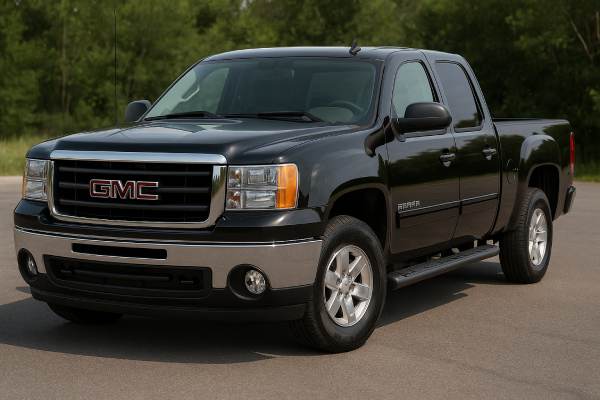
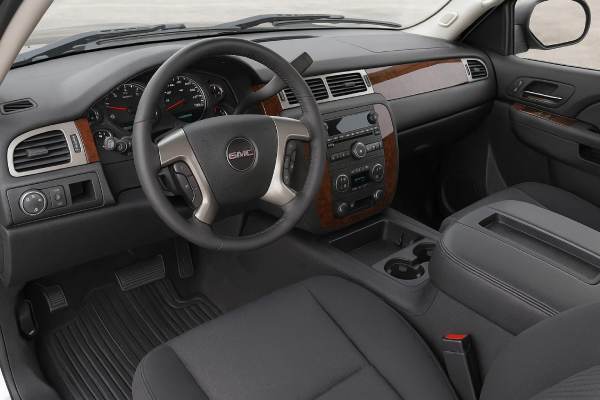
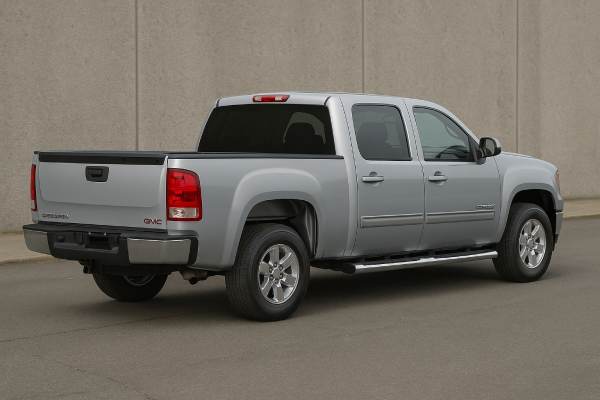
The 2009–2013 GMC Sierra 1500 with the L9H 6.2-litre V8 in rear-wheel drive form is the “sleeper” of the GMT900 generation. Underneath the conservative styling sits one of GM’s most desirable small-block truck engines: an all-aluminium, flex-fuel 6.2 that delivers 403 hp, strong mid-range torque, and a surprisingly refined character. Paired with the 6L80 six-speed automatic and a stout half-ton chassis, this Sierra can tow, haul, and cover long highway distances with ease while still feeling genuinely quick when you lean on it.
For buyers today, the appeal is a mix of classic truck simplicity and modern powertrain hardware. You get a hydraulically assisted steering system, body-on-frame construction, and leaf-spring rear axle, but also variable valve timing, six forward ratios, and a fairly plush cabin in higher trims. This guide walks through specs, reliability patterns, maintenance strategy, and how the 6.2 RWD Sierra stacks up against rivals so you can decide if it fits your needs and budget.
Top Highlights
- Strong 403 hp L9H V8 gives brisk acceleration and relaxed highway towing.
- RWD layout, 6L80 six-speed, and available locking rear differential make a capable light-duty tow rig.
- Interior comfort and options rival many SUVs when you choose SLT or Denali-equipped trucks.
- Watch for frame corrosion and neglected transmission or differential fluid on higher-mileage work trucks.
- Plan engine oil and filter changes every 8,000–10,000 km or 6–12 months, sooner if towing or hauling frequently.
On this page
- GMC Sierra 6.2 RWD overview
- Sierra 6.2 specifications and data
- Sierra 6.2 trims and safety
- Reliability issues and service actions
- Maintenance schedule and buying guide
- Driving character and real-world economy
- Sierra 6.2 RWD versus rivals
GMC Sierra 6.2 RWD overview
The 2009–2013 GMC Sierra 1500 RWD with the L9H 6.2-litre V8 sits at the top of the half-ton gasoline range for this generation. While most Sierras of the era used 4.3, 4.8, or 5.3-litre engines, the 6.2 was the premium option, often tied to well-equipped trims and crew cab configurations. In rear-wheel-drive form it combines a high-output engine with slightly lower curb weight and reduced drivetrain losses compared with four-wheel drive, making it one of the quickest factory GMT900 trucks.
The L9H engine itself is an all-aluminium, 90-degree V8 derived from GM’s Generation IV small-block family. It uses variable valve timing, a high 10.5:1 compression ratio for a truck engine, and flex-fuel capability so it can run on E85 as well as regular gasoline. Unlike some later 6.2-litre truck engines, the L9H is not equipped with cylinder deactivation, which many enthusiasts consider an advantage for long-term durability and simplicity.
Chassis-wise, these trucks ride on the GMT900 platform with a fully boxed front frame section and hydroformed rails for improved stiffness and crash performance. Up front there is an independent short/long arm suspension with coil-over shocks and a stabiliser bar; at the rear, a solid axle with leaf springs handles payload and tow loads. Four-wheel disc brakes with ABS are standard, and most 6.2-equipped RWD trucks leave the factory with 17- or 20-inch wheels and all-season or all-terrain tyres.
In terms of usage, the 6.2 RWD Sierra works well as a tow vehicle for moderate-size boats, enclosed trailers, or campers, especially in warmer climates where 4WD is less critical. The powertrain’s relaxed torque output makes highway merges and mountain grades much easier than in 4.8 or 5.3 trucks, and the six-speed automatic keeps rpm in the sweet spot. At the same time, it retains traditional pickup virtues: a practical bed, relatively simple mechanicals, and broad availability of parts and aftermarket support.
For shoppers today, the main trade-offs are predictable: higher fuel consumption than smaller V8s, greater purchase prices on the used market, and the need to be fussy about rust and maintenance history. A well-kept truck, however, can offer a compelling mix of performance, comfort, and work capability that is hard to find in newer half-tons without spending significantly more.
Sierra 6.2 specifications and data
Engine and performance
| Item | Value |
|---|---|
| Engine code | L9H (Vortec 6200 VVT, flex-fuel) |
| Layout and cylinders | 90° V8, cam-in-block (OHV), 2 valves per cylinder |
| Displacement | 6.2 l (6,162 cc) |
| Bore × stroke | 103.25 × 92.0 mm (4.06 × 3.62 in) |
| Induction | Naturally aspirated |
| Fuel system | Sequential multi-port fuel injection |
| Compression ratio | 10.5:1 |
| Max power | 403 hp (301 kW) @ ~5,700 rpm |
| Max torque | 565 Nm (417 lb-ft) @ ~4,300 rpm |
| Timing drive | Chain |
| Emissions / efficiency class | US EPA Tier 2 / LEV II equivalent (market and state dependent) |
| Rated economy (typical 2WD) | Approx. 18 L/100 km city / 13 L/100 km highway (13 / 18 mpg US; 16 / 21 mpg UK) |
| Real highway at 120 km/h | ~12–13 L/100 km (18–20 mpg US; 22–24 mpg UK) |
| Aerodynamic drag coefficient | Around Cd 0.43–0.45 depending on cab and bed |
Real-world fuel use varies strongly with axle ratio, cab/bed configuration, tyre type, and how often you tow. E85 use increases consumption by roughly 20–30% but can improve power slightly.
Transmission and driveline
| Item | Value |
|---|---|
| Transmission | 6-speed automatic, 6L80, electronically controlled |
| Gear ratios | 1st 4.03 · 2nd 2.36 · 3rd 1.53 · 4th 1.15 · 5th 0.85 · 6th 0.67 · R 3.06 |
| Typical axle ratios | 3.42:1 or 3.73:1 (varies by tow package and trim) |
| Drive type | Rear-wheel drive (4×2) |
| Differential | Open rear standard; optional automatic locking rear (G80) |
| Stability systems | StabiliTrak stability control with traction control (most trims) |
| Tow/haul mode | Standard button on shifter, alters shift schedule and torque converter behaviour |
For towing or heavy hauling, trucks with 3.73 gearing and the G80 locking differential are especially desirable, as they improve launch feel and traction on slippery surfaces.
Chassis and dimensions
Typical figures below are for a 2011–2013 Sierra 1500 Crew Cab Short Box 2WD; other cab and bed combinations vary slightly.
| Item | Value |
|---|---|
| Platform | GMT900 body-on-frame full-size pickup |
| Front suspension | Independent SLA with coil-over shocks, stabiliser bar |
| Rear suspension | Solid axle with semi-elliptic leaf springs |
| Steering | Hydraulic rack-and-pinion |
| Front brakes | Ventilated disc, ~325–330 mm (≈12.8–13.0 in) |
| Rear brakes | Solid or ventilated disc, ~330–336 mm |
| Wheels/tyres (common) | 17–20 in alloys or steel; e.g. 265/70 R17 |
| Length | ~5,705 mm (224.7 in) |
| Width (without mirrors) | ~2,029 mm (79.9 in) |
| Height | ~1,875 mm (73.8 in) |
| Wheelbase (crew cab) | 3,645 mm (143.5 in) |
| Ground clearance (2WD) | Around 208–230 mm (8.2–9.1 in) |
| Turning circle | ~13.4–13.7 m (44–45 ft) |
| Curb weight (typical) | ~2,350–2,450 kg (5,180–5,400 lb) |
| GVWR (most 6.2 RWD) | ~3,130–3,220 kg (6,900–7,100 lb) |
| Fuel tank capacity | ~98 l (26 US gal; 21.6 UK gal) |
| Bed length (short box) | ~1,702 mm (67 in) |
Performance and capability
| Item | Value |
|---|---|
| 0–100 km/h (0–62 mph) | Roughly 6.5–6.8 s (unladen, 2WD crew cab) |
| 0–60 mph | Roughly low- to mid-6 s |
| Top speed (limited) | Around 170–180 km/h (105–112 mph) |
| Braking 100–0 km/h | Approx. 40–43 m (conditions and tyres dependent) |
| Max conventional towing | Around 4,350 kg (≈9,600 lb) in ideal 2WD crew cab setups |
| Typical payload rating | ~640–780 kg (1,400–1,700 lb) depending on trim |
| Roof load | Modest; roof racks generally rated around 75–100 kg (165–220 lb) |
Always verify tow and payload numbers against the specific truck’s door-jamb label and trailering guide; they vary with axle ratio, cab/bed, and equipment.
Fluids and service capacities
Values can vary slightly by year; always cross-check with your owner’s manual or service data.
| System | Specification / type | Capacity (approx.) |
|---|---|---|
| Engine oil | 5W-30 meeting GM6094M / dexos1 (where specified) | ~5.7–6.6 l (6–7 US qt) |
| Engine coolant | Long-life ethylene glycol, pre-mix 50:50 | ~13–15 l (13.7–15.9 US qt) |
| Transmission (6L80) | Dexron-VI ATF | ~9–11 l (9.5–11.6 US qt) total; less for drain/refill |
| Rear axle | 75W-90 synthetic gear oil (GL-5) | ~2.0–2.5 l (2.1–2.6 US qt) |
| Power steering | GM-spec power steering fluid | ~1.0–1.2 l (1.1–1.3 US qt) |
| Brake fluid | DOT 3 or DOT 4 | As required for system |
| A/C refrigerant | R-134a | ~700–900 g (24.7–31.7 oz) |
| A/C compressor oil | PAG oil (GM-specified viscosity) | ~120–180 ml (4–6 fl oz) |
| Wheel nut torque | Typically around 190–190+ Nm (140–145 lb-ft) | |
| Oil drain plug torque | Often around 25–30 Nm (18–22 lb-ft) |
Electrical and safety data
| Item | Value / notes |
|---|---|
| Alternator output | Commonly 145–160 A units on 6.2-equipped trucks |
| 12 V battery | ~600–730 CCA, group 48/94R or similar depending on year |
| Spark plugs | Iridium, heat range for L9H; gap around 1.0 mm (0.040 in) |
| Crash ratings (NHTSA) | Many 2009–2013 crew cab trucks score 4-star overall, 5-star side, 3–4-star rollover |
| Airbags | Dual front, front side, and curtain airbags on most 6.2 trims |
| Stability and ABS | Four-channel ABS and StabiliTrak stability control standard on later years |
Sierra 6.2 trims and safety
The 6.2-litre L9H V8 was not offered in every Sierra 1500 trim. In the 2009–2013 model years it was typically tied to well-equipped SLT and Denali packages, especially in crew cab configurations. In rear-wheel-drive form, these trucks often feature leather interiors, dual-zone climate control, upgraded audio, and power seats, with cosmetic touches such as body-colour bumpers, chrome grilles, and 18- or 20-inch wheels.
On SLT models, the 6.2 option usually brought a tow package with a hitch receiver, wiring harness, and sometimes an integrated trailer-brake controller in later years. Denali-branded trucks added a unique grille, specific interior trim, more sound insulation, and often 20-inch chrome wheels. Some regional or special-order trucks may pair the 6.2 with SLE-level equipment, but these are less common; VIN decoding or a build sheet is the best way to confirm.
Quick identifiers for a 6.2-equipped RWD GMT900 Sierra include the “6.2L V8” badge on the front doors or tailgate (where fitted), an “L9H” or equivalent engine code in the glovebox RPO sticker, and a tachometer redline in the 6,000 rpm range. The RPO code G80 identifies the automatic locking rear differential, highly desirable for traction when launching on loose surfaces or towing.
Safety equipment evolved slightly over the production run. Dual front airbags are standard throughout, with head-curtain airbags covering front and rear outboard occupants on most crew cabs and many extended cabs. Front seat-mounted side airbags are common in later years. Four-wheel ABS is standard, and StabiliTrak electronic stability control with traction control is fitted on most 2010-on trucks; early 2009 base models are the ones most likely to be sparsely equipped.
Crash-test coverage for this generation is not as comprehensive as for modern trucks, but NHTSA testing of comparable 2WD crew cab models typically shows four stars overall, with strong side-impact performance and rollover ratings that reflect the high centre of gravity common to full-size pickups. The Sierra’s fully boxed front frame and hydroformed rails help manage frontal impacts, while the high seating position offers good forward visibility.
Advanced driver-assistance systems such as automatic emergency braking, lane-keeping assist, or adaptive cruise control were not offered on these trucks. Instead, the focus is on robust basic systems: big disc brakes, ABS, stability control, and optional rear parking sensors. For families, ISOFIX/LATCH anchors are fitted in rear outboard seating positions on crew cabs, but access and tether routing can be more awkward than in a modern SUV.
When shopping, it is worth confirming the presence and operation of key safety items: check airbag warning lights, ensure ABS and StabiliTrak lamps extinguish after start-up, and verify that any parking assist or rear camera systems added later work correctly. Trucks that have had airbag or seat repairs should be inspected carefully to ensure proper reinstallation and, where relevant, sensor recalibration.
Reliability issues and service actions
Overall, the L9H-powered Sierra 1500 has a solid reputation when maintained correctly, but age, mileage, and usage patterns now matter more than the original engineering. Many examples are over a decade old and may have spent their lives towing, hauling, or operating in harsh climates.
On the engine side, the L9H avoids some of the high-profile problems associated with active fuel management lifters because it does not use cylinder deactivation. However, it still shares common small-block concerns. Occasional owners report oil consumption, especially on higher-mileage engines that have seen extended drain intervals or heavy towing without adequate cooling. Symptoms include low oil levels between services and blue smoke on cold start; remedies range from more frequent oil changes and PCV checks to, in severe cases, ring and valve-stem seal work.
Another recurring theme is intake and throttle body carbon build-up, particularly on trucks that see lots of short-trip city driving. This can lead to rough idle, throttle lag, or occasional stalling. Cleaning the throttle body and intake, checking for vacuum leaks, and updating engine control software where applicable usually cures these issues. Coil-on-plug ignition generally holds up well, but misfires under load can result from ageing spark plugs or coil packs; a full ignition service at sensible intervals is cheaper than diagnosing intermittent misfires later.
The 6L80 automatic transmission is robust in concept but sensitive to heat, fluid condition, and towing habits. Common complaints on poorly maintained trucks include harsh shifts, shuddering around the 1–2 or 2–3 shift, or a “slipping” sensation in higher gears. Often, these are linked to old or contaminated Dexron-VI fluid, a clogged filter, or torque converter clutch wear. A proper fluid and filter service using the correct specification, and in some cases a software update, can significantly improve behaviour. High-mileage trucks that have towed near their limits for years may require torque converter or internal repairs, which are not cheap.
On the chassis, you can expect the usual full-size truck wear items: front upper and lower control arm bushings, ball joints, sway-bar links, and tie-rod ends. Symptoms include vague steering, clonks over bumps, and uneven tyre wear. Rear leaf-spring shackle bushings and shock absorbers also age, particularly on trucks that frequently carry loads. Replacing these parts with quality components restores much of the truck’s original ride and stability.
Frame and body corrosion is a bigger issue in rust-belt regions. Look closely at the rear frame rails, crossmembers near the spare tyre, cab mounts, and the junction between bed and frame. Surface rust is manageable; heavy scaling, flaking metal, or holes are red flags that may require extensive repair. Rocker panels, cab corners, and wheel arches are also common rust zones.
Electrical problems tend to be low- to medium-cost but annoying. Door-mounted wiring harnesses can fatigue, causing intermittent window, lock, or speaker issues. Faded stepper motors in the instrument cluster can lead to erratic gauge readings. Blower motor resistors and HVAC actuators sometimes fail, causing loss of fan speeds or uneven temperature control. In most cases, these faults are fixable with relatively inexpensive parts if you catch them early.
GM has issued various recalls and service bulletins for GMT900 trucks covering issues such as seatbelt anchor strength, corrosion at brake line junctions, and potential fuel system leaks. The exact campaigns depend on model year and VIN, so running a VIN check through official national databases and confirming completion with a dealer is important. For pre-purchase inspections, ask for proof of recall work and any major warranty repairs.
Maintenance schedule and buying guide
A clear maintenance plan is essential to keeping a 6.2-litre Sierra RWD reliable. Below is a practical baseline for a mixed-use truck that tows occasionally; if you tow frequently, run heavily loaded, or operate in extreme climates, shorten intervals accordingly.
Suggested maintenance intervals
- Engine oil and filter: Every 8,000–10,000 km or 6–12 months, whichever comes first; reduce to 5,000–7,000 km for frequent towing or severe use.
- Engine air filter: Inspect at 20,000 km; replace around 40,000 km or sooner in dusty conditions.
- Cabin air filter (if equipped): Replace every 20,000–25,000 km or 2 years.
- Spark plugs: Iridium plugs can often run 160,000 km, but replacing around 120,000 km is prudent on older trucks.
- Fuel filter: Many GMT900 Sierras with returnless systems have the filter integrated with the pump; follow service information or replace with the pump if pressures are low.
- Coolant: Replace at 5 years / 160,000 km for long-life coolant, then every 3–5 years.
- Transmission (6L80) fluid and filter: Every 60,000–80,000 km (40,000–50,000 miles) in real-world towing or mixed use, even if the original schedule is looser.
- Rear differential oil: Every 60,000 km; halve that if towing regularly or using a locking differential off-road.
- Brake fluid: Flush every 2–3 years regardless of mileage.
- Brake pads and rotors: Inspect at every service; heavy towing can eat pads quickly.
- Power steering fluid: Replace every 100,000 km or when dark/contaminated.
- Serpentine/auxiliary belt and hoses: Inspect from 80,000 km; replace by 150,000 km or if cracked or glazed.
- Wheel alignment and tyre rotation: Rotate every 10,000–12,000 km; align at least every 2 years or after suspension work.
- 12 V battery: Test annually from year 4; expect replacement around years 5–7.
Timing on the L9H is chain-driven, so there is no scheduled belt replacement. Instead, listen for chain rattle at cold start and watch for timing-related fault codes; these usually indicate oil issues or high mileage.
Fluid and torque notes
Stick with quality 5W-30 oil that meets GM’s specifications for the era; newer dexos1-approved oils are often suitable. Dexron-VI is mandatory for the 6L80; mixing with older Dexron formulations can cause shift issues. For the rear axle, use synthetic 75W-90 GL-5 gear oil and add friction modifier only when specified for limited-slip units.
Wheel nuts are typically tightened to roughly 140–145 lb-ft, but always confirm for your wheel type. Over-tightening with an impact gun is a common cause of warped rotors and stretched studs, so insist on proper torque wrench use.
Buyer’s checklist
When evaluating a used 6.2 RWD Sierra:
- Frame and body: Inspect frame rails, crossmembers, bed supports, rocker panels, cab corners, and wheel arches for corrosion and repairs.
- Drivetrain: On a test drive, ensure smooth, decisive shifts from the 6L80, no shudder under light acceleration, and no clunks when shifting from Park to Drive/Reverse. Under full throttle, the engine should pull cleanly without misfires.
- Fluids: Check oil, coolant, transmission fluid, and differential oil for correct level and signs of neglect (burnt smell, heavy contamination).
- Suspension and steering: Listen for knocks over bumps and feel for wander or excessive play at highway speeds. Uneven tyre wear can signal alignment or bushing problems.
- Electrics: Test all windows, locks, mirrors, gauges, HVAC modes, and lighting. Look for aftermarket wiring hacks, which can create future electrical gremlins.
- History and paperwork: Prefer trucks with documented regular servicing, evidence of transmission and differential fluid changes, and completed recalls.
Long-term, a well-maintained L9H Sierra can comfortably exceed 300,000 km, and many do, provided rust is controlled and fluids and wear items are not ignored. The strongest candidates are usually privately owned, lightly modified trucks that have done more highway than heavy commercial work.
Driving character and real-world economy
Behind the wheel, the 6.2-litre RWD Sierra feels more muscular and responsive than most half-tons of its era. Throttle response is brisk, especially once you are off idle, and the L9H’s torque plateau from the mid-2,000s to around 4,500 rpm makes the truck feel eager in everyday driving. Unlike some modern turbocharged engines, power delivery is linear and predictable, with a classic V8 soundtrack that becomes more pronounced as revs climb.
The 6L80 six-speed automatic does a good job of balancing performance and economy when healthy. In normal driving it upshifts early to keep revs low, but a firm throttle input or tow/haul mode calls up lower gears quickly. Tow/haul also adjusts torque-converter lock-up and downshift logic to hold gears on grades and reduce hunting. Kickdown from 6th or 5th to 3rd for passing is decisive, and combined with the 6.2’s torque it lets the truck overtake confidently even when loaded.
Ride quality depends heavily on configuration. Crew cab short-box RWD trucks with 17-inch wheels and taller sidewalls ride more smoothly than those on 20-inch wheels. Unladen, the rear leaf springs can feel busy over sharp expansion joints or broken pavement, but body control is generally good and improves further with fresh shocks. On the highway the truck tracks straight and feels stable, aided by the long wheelbase and relatively soft spring rates.
Noise, vibration, and harshness are respectable for a body-on-frame pickup of this age. Wind noise around the mirrors is noticeable at motorway speeds, and tyre roar varies with pattern and size, but the cabin is quiet enough for long trips, especially in SLT and Denali trims with more sound insulation. At idle and low load the V8 is subdued; under heavy throttle it produces a deep, refined growl rather than a coarse roar.
In terms of handling, the RWD layout gives slightly sharper steering feel than a comparable 4WD truck thanks to fewer front-end components and less weight over the nose. The front end turns in better than you might expect from a large pickup, though body roll is still present in tight corners. Stability control intervenes smoothly if you over-step grip, and the G80 locking differential can be felt engaging on loose surfaces, improving traction out of junctions or when launching a boat on a ramp.
Real-world fuel economy reflects the engine size and vehicle mass. Many owners see roughly 14–16 L/100 km (15–17 mpg US) in mixed driving, with highway-only runs at steady speeds settling in the 12–13 L/100 km (18–20 mpg US) range. Urban stop-and-go with short trips can easily drop into the high-teens L/100 km. Towing a mid-size camper or enclosed trailer often adds 30–50% to consumption, depending on speed and terrain.
For long-distance touring, the combination of a 26-gallon tank, strong passing performance, and comfortable seats makes the 6.2 RWD Sierra a good road-trip partner. With a light foot it is possible to cover 550–650 km between fills on the highway. The main compromise is that you pay more at the pump than with a 5.3-litre truck, but in return you get more relaxed performance and less need to downshift and rev the engine hard on grades.
Sierra 6.2 RWD versus rivals
When new, the 6.2-litre RWD Sierra 1500 competed against other high-output half-tons such as the Chevrolet Silverado 1500 6.2, Ford F-150 with 5.4 Triton and later 6.2 V8s, and the Ram 1500 with the 5.7 HEMI. Today, buyers often cross-shop it with similar-age trucks and sometimes with newer, smaller-displacement turbo or cylinder-deactivation engines.
Compared with a same-generation 5.3-litre Sierra, the 6.2 RWD version delivers noticeably stronger acceleration and towing performance. On steep motorway grades or when passing with a trailer, the 6.2 is less strained, spends less time at high rpm, and makes the truck feel more relaxed overall. Fuel economy is typically one or two mpg worse in like-for-like use, so the trade-off is extra power in exchange for a modest running-cost penalty.
Against comparable-year Ford F-150s, the Sierra 6.2 holds its own in straight-line performance and may be simpler to live with long-term thanks to the proven small-block architecture and absence of turbochargers. The Ford 6.2 V8 is robust but rarer and often tied to specific trims, while earlier 5.4 engines have known timing and cam-phaser issues. On the other hand, F-150 interiors of the same era can feel more modern and offer different cab and bed combinations.
The Ram 1500 HEMI offers a charismatic engine and often a slightly smoother ride thanks to rear coil springs in later generations, but in the GMT900 years many Rams still used leaf springs, similar to the Sierra. HEMI trucks have their own typical quirks (such as exhaust manifold bolt issues), and some owners find GM’s steering and braking feel more confidence-inspiring. Resale values vary regionally, but 6.2-equipped Sierras often command a premium among enthusiasts and tow-focused buyers.
Newer half-tons with smaller turbocharged engines or more aggressive cylinder-deactivation strategies can beat the GMT900 Sierra on fuel economy and technology. However, they bring added complexity and, in some cases, less predictable long-term reliability. The 6.2 RWD Sierra sits at an appealing intersection for buyers who prefer a larger-displacement, naturally aspirated V8 with fewer moving parts and a track record now extending well beyond a decade.
If you value outright towing numbers above all, a modern half-ton or three-quarter-ton truck will tow more and may offer better integrated towing aids. If you prioritise a balance of classic V8 character, strong but not extreme tow ratings, and a relatively straightforward mechanical layout, the 6.2-litre RWD Sierra 1500 remains a compelling choice. It is especially attractive in regions where snow and off-road demands are limited, letting you take advantage of RWD’s lower complexity and weight without sacrificing the utility you need.
References
- Vehicle Support: 2013 GMC Sierra 2013 (Owner’s Manual and Specifications)
- Fuel Economy of the 2013 GMC Sierra 1500 2013 (Fuel Economy Data)
- 2013 GMC SIERRA 1500 2 WD CREW CAB 2013 (Safety Rating)
- GM Trailering Guide 2013 (Trailering and Tow Ratings)
Disclaimer
This article is for informational purposes only and is not a substitute for professional diagnosis, repair, or purchase advice. Specifications, capacities, torque values, and maintenance intervals can vary by model year, market, trim level, optional equipment, and individual vehicle history. Always confirm critical information against the official owner’s manual, workshop or service documentation, and data specific to your VIN, and consult a qualified technician before carrying out maintenance, repairs, or modifications.
If you found this guide useful, consider sharing it with other owners or enthusiasts on platforms such as Facebook or X/Twitter. Thoughtful sharing helps support the creation of accurate, independent technical resources.