
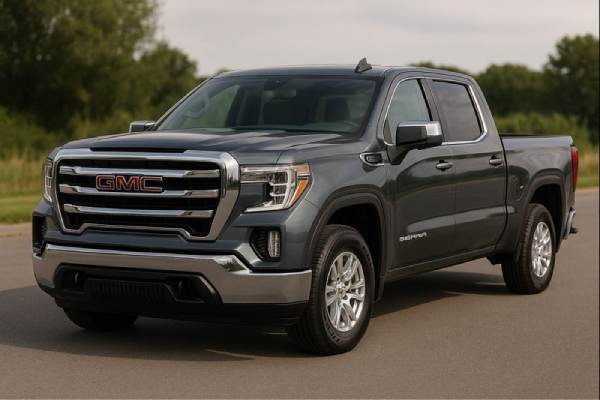
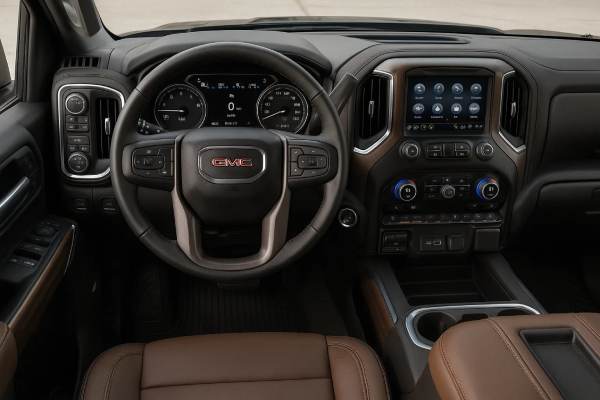
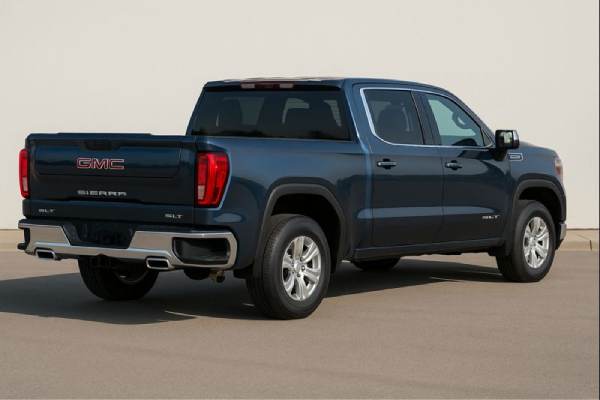
The 2020–2021 GMC Sierra 1500 RWD with the LM2 3.0 litre Duramax turbo-diesel is aimed squarely at drivers who want full-size truck capability without full-size fuel bills. Its all-aluminium inline-six diesel produces 277 hp and a stout 460 lb-ft of torque, paired with a 10-speed automatic and rear-wheel drive for smooth, relaxed cruising and confident towing.
Compared with the gas V8 options, this diesel Sierra feels quieter and more laid-back in day-to-day use while delivering excellent highway economy and long tank range. EPA ratings up to 23 mpg city and 30 mpg highway for 2WD models make it one of the most efficient full-size pickups of its era. In mixed real-world driving, owners commonly see fuel economy in the low 20s mpg, with mid to high 20s on steady highway runs.
Available across popular trims like SLE, Elevation, SLT, AT4 and Denali, the LM2 powertrain fits everything from work-ready fleets to premium daily drivers. This guide walks through specs, dimensions, safety, reliability, maintenance and how the diesel Sierra 1500 compares to rivals so you can decide if it fits your needs and budget.
Fast Facts
- Strong 277 hp / 460 lb-ft LM2 diesel and 10-speed automatic deliver smooth torque, especially at low rpm.
- Excellent efficiency for a full-size truck: 2WD diesel models are rated around 23 mpg city / 30 mpg highway / 26 mpg combined.
- Max towing is roughly 9,100–9,200 lb for properly equipped 2WD LM2 trucks, with payload typically in the low-2,000 lb range.
- Ownership caveat: diesel emissions hardware (DPF, DEF system, EGR) can be sensitive to frequent short-trip use and poor fuel quality.
- Typical oil change interval is about 7,500 miles / 12,000 km under normal use, or as indicated by the oil life monitor using Dexos D 0W-20 oil.
Navigate this guide
- GMC Sierra 1500 LM2 profile
- Sierra 1500 LM2 specs summary
- Sierra 1500 trims and safety tech
- Duramax LM2 reliability notes
- Ownership maintenance and buying tips
- Driving performance and real use
- Sierra 1500 diesel versus rivals
GMC Sierra 1500 LM2 profile
The LM2 3.0 litre Duramax diesel arrived in the T1XX-generation GMC Sierra 1500 for 2020 as a refined, torque-rich alternative to the familiar gas V8s. It is an all-aluminium, inline-six turbo-diesel designed for smoothness, quiet operation and strong low-rpm pull. Output is 277 hp and 460 lb-ft of torque, delivered through a 10-speed automatic (10L80) to the rear wheels in the RWD models covered here.
Where this truck stands out is in its blend of efficiency and capability. A 2WD diesel Sierra 1500 is EPA-rated around 23 mpg city, 30 mpg highway and 26 mpg combined, figures that rival many midsize pickups and beat most gas V8 half-tons. In mixed real-world driving, testers report averages in the low-20s mpg, with 26–30 mpg achievable on gentle highway runs at legal speeds.
Despite the focus on efficiency, the diesel Sierra remains a serious work tool. Properly configured 2WD models with the LM2 and trailering-focused packages can tow roughly 9,100–9,200 lb, with payload capacities in the 2,000–2,200 lb range depending on cab, bed and trim. That comfortably covers a mid-size travel trailer, boat or car trailer while still leaving room for passengers and gear.
The LM2 engine is available on key trims rather than being restricted to a single “fuel-saver” model. It appears on SLE, Elevation, SLT, AT4 and Denali in many markets, typically in crew-cab and some double-cab configurations. This lets you pair the diesel with anything from cloth-seat work trucks to fully loaded Denali luxury models.
In day-to-day ownership, the RWD diesel Sierra 1500 best suits:
- High-mileage drivers who spend a lot of time on the highway.
- Owners regularly towing moderate loads where torque and range matter more than headline tow ratings.
- Buyers who prefer traditional truck packaging but want lower fuel spend than a gas V8 can offer.
The main trade-offs are higher upfront cost for the diesel engine, higher price for diesel fuel in some regions, and the added complexity of modern emissions systems. For many owners who tow or drive long distances, the comfort and efficiency benefits more than offset those drawbacks.
Sierra 1500 LM2 specs summary
Engine and performance (LM2 3.0L Duramax I6)
| Item | Specification |
|---|---|
| Engine code | LM2 Duramax |
| Layout and valvetrain | Inline-6, aluminium block and head, DOHC, 4 valves per cylinder |
| Displacement | 3.0 L (2,992 cc) |
| Bore × stroke | 84.0 × 90.0 mm (3.31 × 3.54 in) |
| Induction | Single variable-geometry turbocharger |
| Fuel system | Common-rail direct injection, high-pressure |
| Compression ratio | About 15.0:1 (market-dependent) |
| Max power | 277 hp (≈207 kW) @ 3,750 rpm |
| Max torque | 460 lb-ft (≈623 Nm) @ 1,500 rpm |
| Timing drive | Chain-driven camshafts |
| Emissions systems | EGR, DPF, SCR/DEF aftertreatment |
Efficiency (2020 2WD diesel, representative):
| Cycle | Official rating | Notes |
|---|---|---|
| City | 23 mpg US (≈10.2 L/100 km) | Varies slightly by cab/bed |
| Highway | 30 mpg US (≈7.8 L/100 km) | Best-case rating |
| Combined | 26 mpg US (≈9.0 L/100 km) | Typical EPA combined |
| Real-world mixed | ~21–23 mpg US | Driver and load dependent |
Later 2021 2WD diesels are broadly similar, with minor variations by cab, bed and equipment.
Transmission and driveline
| Item | Specification |
|---|---|
| Transmission | Hydra-Matic 10L80 10-speed automatic |
| Drive type | Rear-wheel drive (RWD) |
| Final drive ratio | Typically in the low-3.xx range (3.23 or 3.42, depending on axle code and tow package) |
| Differential | Open rear differential; automatic or electronic locker available with some packages |
| Tow/Haul mode | Standard, with trailer-focused shift logic |
Chassis and dimensions (typical crew cab, short bed RWD)
Exact numbers vary slightly by trim and market; the values below are representative of a 147-inch wheelbase crew-cab short-box truck.
| Item | Approximate value |
|---|---|
| Platform | T1XX body-on-frame full-size pickup |
| Front suspension | Independent coil-over struts with aluminium lower control arms |
| Rear suspension | Solid axle with leaf springs |
| Steering | Electric power-assisted rack-and-pinion |
| Brakes | 4-wheel discs with ABS and stability control |
| Wheelbase | ≈3,740 mm (147.4 in) |
| Overall length | ≈5,885 mm (231.7 in) |
| Overall width (without mirrors) | ≈2,030–2,060 mm (80–81 in) |
| Overall height | ≈1,880–1,900 mm (74–75 in), trim-dependent |
| Ground clearance | Around 210–225 mm (8.3–8.9 in), slightly lower than AT4 4×4 models |
| Curb weight | Roughly 4,700–4,900 lb for RWD crew cabs, depending on trim |
| GVWR | Commonly around 7,000–7,200 lb on LM2 half-tons |
| Fuel tank | About 91 L (24 US gal) – confirm in the owner’s manual for your VIN |
Performance and capability (RWD LM2, properly equipped)
| Metric | Typical figure |
|---|---|
| 0–60 mph | Low-7-second range (varies by trim, load and tyres) |
| Top speed | ~112 mph (electronically limited; varies by tyre rating) |
| Max towing (2WD LM2) | Up to ~9,200 lb braked, configuration-dependent |
| Payload | Typically ~2,000–2,200 lb on 2WD crew cabs |
Fluids and service capacities (guide values)
Always verify exact specs and capacities in the owner’s manual or service information for your VIN.
| System | Specification and capacity (approximate) |
|---|---|
| Engine oil | Dexos D–approved 0W-20 synthetic; ≈6.6 L (7.0 US qt) with filter |
| Coolant | Dex-Cool OAT coolant; capacity varies by cab/bed (roughly mid-teens in litres) |
| Automatic transmission | Dexron ULV fluid; capacity varies (service refill much lower than dry fill) |
| DEF (diesel exhaust fluid) | Tank size ≈19–22 L; consumption typically 1–3% of fuel use depending on duty cycle |
| A/C refrigerant | R-1234yf on most 2020+ Sierras; charge quantity depends on cab configuration |
Electrical and safety tech
| Item | Notes |
|---|---|
| 12 V battery | Group 94R (or similar) AGM or flooded lead-acid, capacity varies by trim |
| Alternator | High-output units available (often 170–220 A), especially with trailering and upfit packages |
| ADAS availability | Automatic emergency braking, forward collision alert, lane keep assist, blind-spot monitoring, rear cross-traffic alert, rear camera mirror and head-up display available on higher trims and option packages |
Sierra 1500 trims and safety tech
For 2020–2021, the 3.0L Duramax LM2 is not tied to a single “eco” trim. Instead, it appears as an available engine on SLE, Elevation, SLT, AT4 and Denali, and in some markets on the base Sierra in certain cab/bed combinations. That means you can choose the level of equipment and styling that suits you while keeping the same core powertrain.
Trim-level character (with LM2 available):
- SLE and Elevation: Work-friendly yet comfortable, with cloth seats, useful towing options and simpler interiors. Elevation adds blacked-out styling, body-colour trim and larger wheels for a sportier look.
- SLT: More comfort (leather, power seats, dual-zone climate), GMC MultiPro tailgate and upgraded trailering tech. A good “do-everything” spec for owners who use the truck heavily but also commute.
- AT4 (4×4 only, but worth noting): Off-road-oriented suspension with 2 inch factory lift, skid plates and aggressive tyres. The LM2 pairs well here if you spend time off-pavement but still drive long distances.
- Denali: The luxury flagship with adaptive ride control on some years, premium audio, advanced cameras and the most comprehensive driver-assistance options.
Visually, LM2 trucks can often be identified by a “Duramax” badge on the hood or fender and, on many listings, by a 3.0L Duramax notation in the spec sheet or window sticker. VIN decoding or a build sheet is the most reliable way to confirm.
Safety ratings
The Sierra 1500 shares its structure with the Chevrolet Silverado 1500. Crash testing on crew-cab models (which applies across engine types) shows:
- Crashworthiness:
- Small overlap front, driver side: generally Good.
- Small overlap front, passenger side: more mixed, often Marginal overall with weaker structure performance.
- Moderate overlap front: Good.
- Original side test: Good; updated side: often Acceptable.
- Roof strength and head restraints: Good.
- Crash avoidance:
- Optional front crash prevention (vehicle-to-vehicle): rated well when equipped.
- Headlights: many trims score Marginal or Poor due to limited curve illumination and glare on some setups.
NHTSA ratings for 2020 Sierra 1500 configurations commonly show a 4-star overall rating, with strong side-impact protection and typical rollover risk for a tall pickup. Ratings may vary slightly by cab and drivetrain.
Safety systems and ADAS
Standard equipment includes multiple front, side-impact and side-curtain airbags, electronic stability control, traction control and trailer sway control, plus a rear-view camera and tire-pressure monitoring. Child-seat anchors (LATCH/ISOFIX) are present in the rear outboard seating positions on crew cabs; usability is sometimes rated as only average because anchors can be recessed and crowded by seatbelt hardware.
Advanced safety and driver-assistance systems are heavily trim- and package-dependent. On 2020–2021 trucks, expect:
- Driver Alert / Driver Alert II packages (mostly SLT, AT4, Denali): forward collision alert, automatic emergency braking, lane keep assist with lane departure warning, blind-spot monitoring, rear cross-traffic alert, rear park assist and a safety alert seat.
- Trailering tech: hitch-guidance camera views, in-vehicle trailering app and integrated trailer brake controller on many tow-focused builds.
- Denali-specific options: head-up display, rear camera mirror and more extensive camera coverage.
After collision repairs or windshield replacement, radar and camera sensors may require calibration with factory scan tools and targets. Any work affecting bumper covers, grilles, camera brackets or ride height should be followed by an ADAS calibration check to keep these features functioning correctly.
Duramax LM2 reliability notes
The LM2 3.0L Duramax has a good reputation for refinement and economy, and early data suggests solid reliability when maintained correctly. Being a modern emissions-equipped diesel, it does have a few patterns prospective owners should understand.
Overall reliability picture
Owner surveys and reliability trackers tend to place the 2020–2021 Sierra 1500 in the “average to above average” band among full-size trucks, with no widespread systemic failures specific to the LM2 engine. Most issues are isolated or tied to emissions hardware and electronics rather than catastrophic engine failures.
Common or notable issues (by rough prevalence)
Common to occasional (low–medium cost):
- DEF and emissions components: Some owners report warning messages or limp-home behaviour from failing DEF heaters, level sensors or NOx sensors. Symptoms include repeated “Service Emissions System” messages, reduced power and countdown to speed limitation. The fix is typically sensor or heater replacement and clearing codes.
- EGR/DPF-related drivability issues: Trucks used mostly for short trips may see more frequent active regenerations, fuel dilution of the oil and possible soot-related EGR valve issues. Regular highway runs and following oil-change guidance reduce risk.
- 10L80 transmission behaviour: Some owners note occasional harsh shifts or shudder under light throttle. Updated transmission control software and, in some cases, fluid changes can improve this; ongoing issues should be diagnosed promptly.
Occasional (medium–high cost, watch closely):
- Oil or coolant leaks: A minority of trucks develop oil consumption or coolant loss traced to leaks or gasket issues. Persistent fluid loss should be investigated early to avoid secondary damage.
- Glow plug faults: Failed glow plugs or control modules can lead to cold-start difficulty and stored codes. Replacement is relatively straightforward but should be handled carefully to avoid breaking plugs in the head.
Rare but serious:
- Internal engine damage: There are far fewer reports of bottom-end failures on LM2 than on some gas engines of similar years, but any knocking noises, metal in oil, or sudden loss of oil pressure are red-flag conditions requiring immediate shutdown and diagnosis. Even rare events can be expensive on a modern diesel.
Recalls, TSBs and software updates
Recalls and Technical Service Bulletins (TSBs) change over time and are highly VIN-specific. Manufacturer recall portals and government databases are the best ways to see what applies to a given truck. Examples of the types of actions you may encounter include:
- Campaigns to update engine or transmission control software for drivability, emissions robustness or diagnostic improvements.
- TSBs covering shift-quality refinements for the 10L80 automatic.
- Service procedures for emissions-related faults (DEF components, sensors and wiring).
When shopping used, ask for printouts showing:
- All recalls completed.
- Any open field service actions or extended warranty programs.
- A record of control-module software updates, especially for the engine and transmission.
Pre-purchase checks specific to the LM2
For a 2020–2021 Sierra 1500 LM2, it is wise to:
- Review full service history with proof of diesel-rated Dexos D 0W-20 oil changes at appropriate intervals.
- Inspect for oil, coolant or DEF leaks around the engine, underbody and DEF tank.
- Ask if any emissions components (DPF, DEF pump, EGR) have been replaced and why.
- Scan the truck with a capable diagnostic tool for stored or pending codes, including emissions, transmission and ADAS modules.
- Check underbody and frame rails for corrosion, especially in rust-belt regions.
Overall, when maintained with quality fluids and allowed regular highway use, the LM2 diesel appears to age gracefully, but the cost of out-of-warranty emissions repairs is a key ownership consideration.
Ownership maintenance and buying tips
A disciplined maintenance routine is essential for long life on any modern diesel. GM uses an oil-life monitor and condition-based recommendations in the manual, but you can think in terms of approximate mileage/time intervals for planning.
Practical maintenance schedule (guide only)
Always confirm intervals and specs in the owner’s manual for your specific truck.
- Engine oil and filter: Follow the oil-life monitor; typically around 7,500 miles / 12,000 km or once a year under normal use, shorter for heavy towing or lots of idling. Use Dexos D-approved 0W-20.
- Fuel filter: Around every 22,500 miles / 36,000 km in severe use, or as specified; more often if you suspect poor fuel quality.
- Engine air filter: Inspect every 15,000 miles / 24,000 km; replace as needed or at least every 45,000 miles / 72,000 km.
- Cabin air filter: Typically every 22,500–30,000 miles (36,000–48,000 km).
- Coolant: Dex-Cool long-life coolant; first change often around 150,000 miles / 10 years, then at shorter intervals.
- Transmission fluid (10L80): Under heavy towing, consider 45,000–60,000 mile (72,000–96,000 km) drain-and-fill intervals, especially if shifts feel harsh.
- Differential fluid: 45,000–60,000 miles for frequent towing, otherwise less often.
- Brake fluid: Every 5 years regardless of mileage.
- Tyre rotation and alignment: Rotate every 5,000–7,500 miles (8,000–12,000 km), check alignment annually or after impacts.
- 12 V battery: Load-test annually after year 4; many factory batteries last 4–6 years depending on climate.
For emissions components, follow the truck’s messages about DPF regeneration and DEF levels. Never ignore DEF warnings; running the tank dry can trigger power limitations and may require dealer resets.
Key specs and torque values (decision-making level)
- Engine oil capacity: ≈6.6 L / 7.0 US qt.
- Oil spec: Dexos D 0W-20 only for the LM2 diesel.
- GVWR: commonly around 7,000–7,200 lb on LM2 half-tons.
- Representative tow rating: up to ~9,200 lb for 2WD LM2 trucks, depending on configuration.
When doing your own work, always refer to factory torque specs for wheel lugs, drain plugs and critical fasteners. Over-tightening on aluminium components is a common source of problems.
Buyer’s guide: what to look for
Inspection checklist:
- Corrosion: Inspect frame rails, crossmembers, bed mounts and rear bumper brackets for rust, particularly on trucks from northern climates.
- Leaks: Check under the engine, transmission and DEF tank for wetness or crusted residue.
- Driveline feel: During a test drive, feel for clunks during gear changes, driveline lash when going from on-throttle to off-throttle, and vibration under steady cruise.
- Cooling system: Watch temperatures on long hills; cooling performance should be stable even when towing.
- Electronics: Test all cameras, parking sensors, ADAS alerts and trailer-related functions; intermittent faults here can be time-consuming to chase.
Trims and years to consider:
- 2020 vs 2021: Both years use the same first-generation LM2; later trucks may benefit from running changes and software refinements.
- Value picks: SLE or Elevation with towing packages and the LM2 diesel often give the best balance of price, equipment and capability.
- Premium choice: Denali LM2 offers maximum comfort and tech, but you pay for the badge and features.
Avoid heavily tuned or deleted trucks unless you fully understand local emissions laws and the costs of returning them to stock; such modifications can mask issues and void warranty.
Long-term, a well-maintained LM2 Sierra 1500 RWD should comfortably cover high mileages while retaining strong drivability. Fuel savings and long range add up over time, particularly for owners who tow moderate loads or drive many highway miles each year.
Driving performance and real use
On the road, the LM2 diesel changes the character of the Sierra 1500 compared with its gas siblings. The inline-six layout naturally balances out vibrations, and GM’s noise-control work makes the engine surprisingly quiet from inside the cabin. At idle you hear a muted diesel clatter outside; underway it mostly fades into a low hum.
Powertrain behaviour
With 460 lb-ft of torque available from just 1,500 rpm, the truck steps off smartly and holds gears confidently on grades. The 10-speed automatic spreads ratios closely, so the engine rarely feels strained; it usually hovers in the 1,500–2,500 rpm band in normal driving. Kickdown for passing is quick, and the gearbox is smart enough to drop multiple gears when needed.
Turbo lag is modest. There is a brief pause off the line if you stab the throttle, but the torque arrives smoothly and progressively. In town, this gives the truck an easygoing feel; on the highway, it feels like a much larger-displacement gas engine that simply does not rev as high.
Ride, handling and NVH
On RWD models with standard suspension, the Sierra rides firmly but not harshly. Unladen, you will feel sharp expansion joints, but body control is good and the truck settles quickly after bumps. Crew-cab models with longer wheelbases feel particularly stable at highway speeds. Steering is light with consistent weighting, though not especially communicative—typical for full-size pickups.
Cabin noise at 70–75 mph is low for the class, helped by the diesel’s relaxed rpm and decent aero refinement. Wind noise around the mirrors and mild road noise from all-terrain tyres (if fitted) are more noticeable than engine sound.
Real-world fuel economy and range
In mixed driving, many owners and testers report around 21–23 mpg US (11–13 L/100 km), matching or slightly beating the combined rating. On long highway cruises at moderate speeds, 26–30 mpg (7.8–9.0 L/100 km) is realistic, giving effective ranges of 600+ miles (965+ km) on the highway-sized fuel tank when conditions are favourable.
Towing a mid-size travel trailer or car hauler in the 5,000–7,000 lb range typically cuts economy by roughly 30–40%, into the mid-teens mpg. That still compares well to gas V8s, which often drop into single-digit mpg under the same load.
Towing and load behaviour
The diesel’s low-rpm torque and the 10-speed’s close ratios help the truck hold gears on grades and minimise hunting. Exhaust braking is available and adds confidence on descents, especially when combined with Tow/Haul mode.
With a properly balanced trailer and functioning brake controller, RWD LM2 trucks feel composed when towing within their rating. In wet or loose conditions, traction-control interventions may happen earlier than in 4×4 models, so tyre choice (and using appropriate trailer tongue weight) matters.
Overall, the RWD LM2 Sierra 1500 is more about effortless torque, low noise and excellent range than brute-force acceleration—but in day-to-day use, that is exactly what most owners want.
Sierra 1500 diesel versus rivals
When it launched, the LM2 3.0L Duramax entered a small but competitive segment of light-duty diesel pickups. The closest rivals were the Ford F-150 3.0L Power Stroke V6 and Ram 1500 3.0L EcoDiesel V6, alongside the Sierra’s own gas V8 options.
Versus Ford F-150 3.0 Power Stroke
Ford’s 3.0L Power Stroke diesel makes slightly less power and torque than the LM2 in many model years, and its EPA ratings are similar or a little lower depending on configuration. The Ford’s aluminium body structure holds down curb weight, but the GM inline-six is often praised for smoother, quieter operation and a more relaxed feel, particularly when paired with the 10-speed automatic.
Ford’s diesel was available for fewer model years and in fewer trims, which can make used examples harder to find. Parts and dealer familiarity with the LM2 may be stronger long-term as GM continues to develop Duramax diesels across its lineup.
Versus Ram 1500 EcoDiesel
Ram’s 3.0L EcoDiesel V6 is known for strong torque and excellent efficiency, and the Ram 1500 often rides more smoothly and quietly than competitors thanks to its rear coil-spring or air-suspension setups. The Sierra counters with a simpler rear suspension design, a very refined diesel that still feels distinctly “truck-like,” and a reputation for straightforward service access on the inline-six.
If you prioritise cabin plushness and ride quality above all else, a Ram EcoDiesel may edge out the Sierra. If you prefer a more traditional frame-leaf layout and value GM’s wide dealer network and shared components with other Duramax models, the LM2 Sierra is appealing.
Versus gas Sierra 1500 engines
Compared with the 5.3L and 6.2L gas V8s in the same truck, the LM2:
- Uses substantially less fuel in mixed and highway driving.
- Delivers a very strong low-rpm shove but does not rev or sound like a performance V8.
- Has lower maximum tow ratings than the top-spec gas configurations but more than enough for most personal-use towing.
- Requires attention to DEF, emissions hardware and diesel-specific maintenance.
For many buyers, especially high-mileage drivers and frequent towers, the diesel’s fuel savings, range and relaxed character outweigh the added complexity. If you tow at the very upper end of half-ton capacity or prefer a simpler emissions package, a gas V8 may still make more sense.
Who the LM2 Sierra 1500 RWD suits best
The 2020–2021 GMC Sierra 1500 RWD with the LM2 diesel is an excellent match if you:
- Drive long distances or commute by highway.
- Tow or haul moderate but not extreme loads.
- Want a full-size truck that feels calm, quiet and effortless rather than overtly sporty.
- Are comfortable following a diesel-specific maintenance schedule and keeping DEF topped up.
For buyers in that usage band, the LM2 Sierra offers a compelling blend of modern tech, capability and long-legged efficiency that is hard to match in the full-size truck market.
References
<a href="https://my.gmc.com/content/dam/gmownercenter/gmna/dynamic/manuals/2020/GMC/Sierra/2020-GMC-Sierra-Owners-Manual.pdf">2020 GMC Sierra Owners Manual</a> 2020 (Owner’s Manual)<a href="https://www.gmccanada.ca/content/dam/gmc/na/ca/en/index/download-a-brochure/02-pdfs/GCTR20CT000_2020_GMC_Sierra_LD_Catalog_CDN_ENG_6C_AODA_V2.pdf">2020 GMC Sierra</a> 2020 (Brochure/Specifications)<a href="https://www.fueleconomy.gov/feg/bymodel/2020_GMC_Sierra_1500.shtml">Fuel Economy of the 2020 GMC Sierra 2WD</a> 2020 (Fuel Economy Data)<a href="https://www.iihs.org/ratings/vehicle/gmc/sierra-1500-crew-cab-pickup/2020">2020 GMC Sierra 1500</a> 2020 (Safety Rating)<a href="https://www.nhtsa.gov/vehicle/2020/GMC/SIERRA%201500/PU/RC/2WD">Vehicle Detail Search - 2020 GMC SIERRA 1500 PU RC</a> 2020 (Recall Database)
Disclaimer
This article is for informational purposes only and is not a substitute for professional diagnosis, repair or safety advice. Specifications, torque values, capacities, maintenance intervals and procedures can vary by VIN, model year, market, trim level and installed equipment. Always confirm details with the official owner’s manual, factory service information and current technical bulletins for your specific vehicle before performing any work or making purchase decisions.
If you found this guide useful, consider sharing it with other owners or shoppers on social platforms such as Facebook or X/Twitter. It helps support the effort that goes into creating detailed, independent technical content like this.