
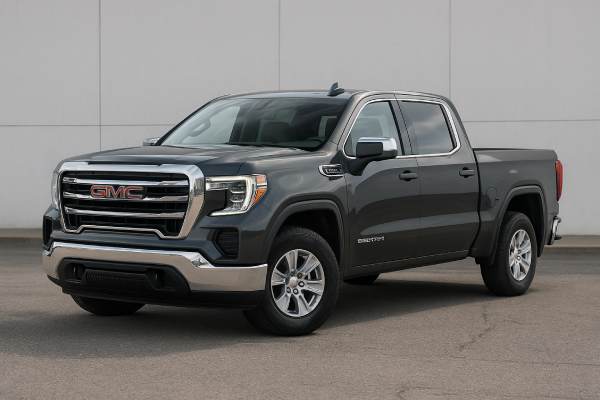
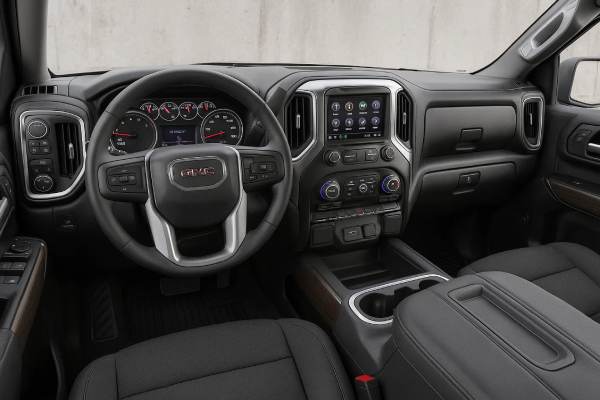
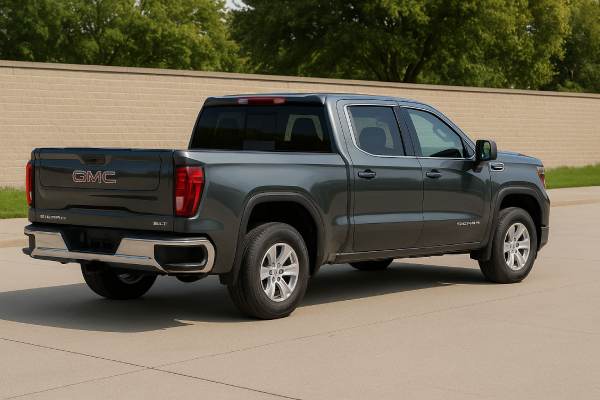
The rear-wheel-drive GMC Sierra 1500 with the L84 5.3 litre V8 sits in a sweet spot of the T1XX generation: enough power for real towing and payload, modern fuel-saving tech, and a more refined cabin than earlier trucks. The L84 is an all-aluminium, direct-injected small-block with Dynamic Fuel Management (DFM), rated at 355 hp and 383 lb-ft, and paired to 8- or 10-speed automatics depending on year and trim.
In 2WD form, the Sierra is lighter and more efficient than the 4WD variants and can still tow up to around 11,200 lb when correctly equipped, making it a good match for contractors, light commercial users, and owners who tow on paved roads more than they off-road. Across 2019–2021, GM refined shift logic, added more active safety tech, and expanded trim choices, while keeping the core chassis and powertrain package stable. That means buyers today can shop based on equipment and price, knowing the fundamentals stayed largely the same.
Fast Facts
- 5.3 L L84 V8 makes 355 hp and 383 lb-ft, with 8- or 10-speed automatics depending on year and trim.
- Properly optioned 2WD trucks can tow up to about 11,200 lb with payloads around 2,000–2,200 lb.
- Watch for DFM lifter concerns, frame-wax coating rust, and driveline or transmission shudder; many fixes are documented in GM technical bulletins.
- Plan engine oil and filter changes roughly every 7,500 miles or 12 months, following the Oil Life System and severe-service guidance where applicable.
What’s inside
- GMC Sierra 1500 L84 overview
- Specifications and technical data
- Trims, options and safety tech
- Reliability and known issues
- Maintenance and buyer’s guide
- Driving and performance
- How the Sierra compares to rivals
GMC Sierra 1500 L84 overview
For 2019, GMC moved the Sierra 1500 onto the T1XX platform, with a stiffer frame, aluminium body panels, and a more upright, premium-leaning design than its Chevrolet Silverado cousin. The L84 5.3 litre EcoTec3 V8 became the volume engine, using direct injection, variable valve timing and Dynamic Fuel Management (which can run anywhere from two to eight cylinders) to balance power and efficiency.
In rear-wheel-drive form, the truck sheds some weight and complexity versus 4×4 versions. A typical 2019 regular-cab long-bed 2WD Sierra 1500 with gas V8 weighs about 4,250–4,350 lb curb, with a GVWR around 6,800–7,000 lb and payload in the 2,000–2,250 lb range depending on trim and options. That lightness shows up in decent acceleration and braking figures for a full-size pickup.
This guide focuses on 2019–2021 rear-drive trucks with the L84 5.3 V8, paired mostly to the 8-speed automatic in 2019–2020 and increasingly to the 10-speed in 2020–2021, especially in higher trims. Axle ratios commonly range from 3.23 to 3.42; max-tow packages add a 9.76-inch rear axle, heavier cooling, and an uprated alternator, which is important if you plan to tow close to the limit.
From an ownership angle, the Sierra 1500 RWD L84 is attractive if you:
- Tow moderate-to-heavy trailers on paved roads rather than deep mud or heavy snow.
- Prefer a slightly more upscale look and cabin than a similarly equipped Silverado.
- Value the compromise of strong V8 power without the thirst of the big 6.2 L87 or the complexity of the 3.0-litre diesel.
However, you should budget for potential lifter/valvetrain repairs on higher-mileage trucks, proactive frame rust protection in salt regions, and strict fluid maintenance to protect the automatic transmission and rear axle.
Sierra 5.3 L84 specs and data
Below are representative specs for a 2019–2021 GMC Sierra 1500 2WD with the L84 5.3L V8, focusing on regular-cab long-bed and Double Cab RWD variants. Figures vary slightly by year, cab, and options; always check the door-jamb labels and owner’s manual for a specific truck.
Engine and performance (L84 5.3L V8)
The L84 is an aluminium pushrod V8 with advanced fuel-saving tech:
| Item | Specification |
|---|---|
| Engine code | L84 EcoTec3 V8 |
| Layout | 90° V8, OHV (pushrod), 2 valves/cyl |
| Displacement | 5.3 L (5,328 cc) |
| Bore × stroke | 3.78 × 3.62 in (96.0 × 92.0 mm) |
| Compression ratio | 11.0:1 |
| Induction | Naturally aspirated |
| Fuel system | Direct injection with high-pressure pump |
| Cylinder deactivation | Dynamic Fuel Management (up to 17 firing patterns) |
| Max power | 355 hp (265 kW) @ 5,600 rpm |
| Max torque | 383 lb-ft (519 Nm) @ 4,100 rpm |
| Timing drive | Chain |
| Recommended oil | SAE 0W-20 meeting GM dexos1 for L84 |
| Engine oil capacity | 7.6 L (8.0 US qt) with filter |
EPA-rated economy for 2WD L84 trucks typically comes in around 15–17 mpg city and 21–23 mpg highway, depending on cab, bed, axle ratio, and model year. Converted, that’s roughly:
- City: ~15.7 L/100 km (15 mpg US / ~18 mpg UK)
- Highway: ~11.2 L/100 km (21 mpg US / ~25 mpg UK)
- Combined: ~13.8 L/100 km (17 mpg US / ~20 mpg UK)
Real-world reports show that steady highway cruising at 70–75 mph in a lightly loaded 2WD truck often returns 19–21 mpg US when driven gently.
Transmission and driveline
| Item | Specification |
|---|---|
| Transmission | 8-speed automatic (8L90) in most 2019–early 2020 L84 2WD trucks; 10-speed automatic (10L80/10L90) increasingly available in 2020–2021 trims |
| Drive type | Rear-wheel drive (2WD) |
| Typical axle ratios | 3.23:1 standard; 3.42:1 with max-tow / some packages |
| Rear axle | 9.5 or 9.76 in ring gear depending on tow package; locking diff available in many trims |
Chassis, dimensions and capacities (representative 2WD regular cab / Double Cab)
| Item | Specification |
|---|---|
| Front suspension | Independent coil-over shock with aluminium control arms |
| Rear suspension | Solid axle with semi-elliptic leaf springs |
| Steering | Electric power rack-and-pinion |
| Brakes | 4-wheel disc with ABS (front/rear vented discs) |
| Wheelbase | ~139.5–140.0 in (approx. 3,545 mm) |
| Overall length | ~229.6 in (~5,832 mm) |
| Width (w/o mirrors) | ~81.1–81.2 in (~2,061 mm) |
| Height | ~75.6 in (~1,920 mm) |
| Ground clearance | ~8.1 in (205 mm) for 2WD regular cab |
| Turning circle | ~44.7 ft (13.6 m) |
| Curb weight | ~4,250–4,530 lb depending on cab and equipment |
| GVWR | Around 6,800–7,000 lb (varies by build) |
| Payload | Roughly 2,000–2,240 lb for 2WD regular cab and some Double Cab models |
| Fuel tank | ~24–26 US gal (90–98 L) depending on configuration |
Performance and capability
Independent testing of 5.3L 2WD/4WD Sierras and Silverados with similar specs shows:
| Metric | Typical value |
|---|---|
| 0–60 mph | ~6.2–7.0 s depending on cab, weight and gearing |
| 60–0 mph braking | ~127–128 ft on all-season tyres |
| Max towing (L84 2WD) | Up to about 11,200 lb in specific Double Cab / Standard bed / 2WD configurations with proper package |
| Typical towing range (L84) | ~6,500–11,200 lb across 2019–2021 by engine, axle ratio, cab and tow package |
Fluids, service capacities and key torque values
| System | Spec |
|---|---|
| Engine oil type | SAE 0W-20, GM dexos1-approved, for L84 gasoline V8 |
| Engine oil capacity | 7.6 L (8.0 US qt) with filter |
| Cooling system capacity (approx.) | ~15–16 L (~16.6 qt) for 5.3-litre V8 trucks of this generation; always verify for the exact VIN |
| Wheel lug nut torque | ~190 Nm (140 ft-lb); follow the value in the vehicle documentation or label |
| Oil drain plug torque | Around 18 ft-lb (24 Nm) |
Electrical basics for these trucks typically include a 170–220 A alternator (depending on tow/cooling package) and a 12 V battery around 70–80 Ah, often rated near 730 CCA.
Sierra 1500 trims and safety tech
Between 2019 and 2021, rear-drive L84-equipped Sierra 1500s could be had in several trims depending on market: generally Base/Pro, SLE, Elevation, and SLT, with Denali more often specced with 4WD or the 6.2-litre but sometimes ordered as 2WD in warmer climates.
Trims and options (RWD-relevant highlights)
- Base/Pro: Vinyl or cloth seats, basic infotainment with 7-inch touchscreen, manual or simple power seats. Steel wheels on work-truck variants. The 5.3 L84 is usually optional versus the base V6 or 2.7T.
- SLE/Elevation: Popular mid-trims for 2WD buyers. Add alloy wheels, better cloth interiors, more sound insulation, and extended feature content (larger touchscreen, smartphone integration, upgraded lighting). Elevation packages bring monochrome/exterior styling tweaks. Axle options and trailering packages (including integrated brake controller and hitch guidance) are common here.
- SLT: Moves into leather, more power seat adjustment, advanced driver aids and often the 10-speed automatic when paired with the L84. Max-tow configurations (Double Cab, Standard bed, 2WD, 3.42 axle) are common in this tier.
Quick identifiers:
- Elevation: body-colour bumpers and grille surround, blacked-out trim, unique badging.
- SLE vs SLT: SLT usually has chrome trim, leather seats, and more extensive steering-wheel and seat controls.
- Trailering packages: Look for the integrated trailer brake controller, additional camera views, and the trailering app in the infotainment system, plus a higher GVWR on the door label.
Safety ratings (2019–2021)
Crash testing of crew-cab and extended-cab Silverado/Sierra twins (which share structure and safety performance) shows:
- Moderate-overlap front and side tests: typically Good overall.
- Driver-side small-overlap front: Good overall on crew cab; structure sometimes rated Acceptable in certain combinations.
- Passenger-side small-overlap front: generally Marginal to Acceptable in early years, limiting top safety awards.
- Head restraints and seats: Good.
- Headlights: many trims, especially with halogen/LED reflector setups, scored Marginal or Poor for headlight performance, mainly due to limited curve lighting and some glare.
Government crash ratings are generally four to five stars overall for comparable configurations, but the exact score depends on cab, drivetrain, and equipment; always verify by VIN.
Airbags and ADAS
Typical equipment by 2019–2021 includes:
- Front, side, and side-curtain airbags, with rollover sensing.
- Electronic stability control, traction control, and four-channel ABS.
- Tire pressure monitoring with individual tyre readout on most trims.
Advanced driver-assistance systems (ADAS) vary by year and trim:
- Available systems include forward collision alert with automatic emergency braking, lane keep assist with lane departure warning, following-distance indicator, automatic high beams, rear cross-traffic alert, blind-spot monitoring, and front/rear park assist.
- Some features are bundled in Driver Alert Packages, often optional on SLE/Elevation/SLT and more commonly standard on Denali.
- After collision repairs or windshield replacement, ADAS cameras and radar sensors may require calibration using GM’s service procedures, which adds labour to those jobs.
For child seats, the Sierra offers LATCH/ISOFIX anchors in the rear outboard positions of crew and Double Cabs; regular cabs rely on seat-belt routing and top tether anchors behind the seat back.
Reliability and common Sierra issues
Overall, the 2019–2021 Sierra 1500 with the L84 V8 scores mid-pack in owner-reported reliability. Engine durability is generally good if serviced on time, but there are some important patterns to understand.
Engine and valvetrain
1. Lifter and DFM issues (occasional to common, medium–high cost)
- Symptoms: Ticking at idle, misfires, cylinder deactivation codes, or rough running.
- Cause: Collapsed valve lifters or related components in the AFM/DFM systems.
- Remedy: Dealer diagnosis, often lifter and pushrod replacement on the affected bank, plus updated components where specified. This is usually a multi-thousand-dollar repair out of warranty.
2. Oil consumption and long intervals (occasional, medium cost)
- Running the Oil Life System to very low percentages repeatedly, especially in heavy towing or short-trip use, can lead to varnish and deposits in direct-injection engines. Preventive 5–7,500-mile oil changes with 0W-20 dexos1 synthetic and good filters are advisable, particularly once past warranty.
Transmission and driveline
3. 8-speed automatic shudder (occasional, medium cost)
- Symptoms: Light-throttle shudder or vibration around 40–70 mph; feels like driving over rumble strips.
- Cause: Torque converter clutch behaviour and fluid breakdown in some 8-speed units.
- Remedy: Updated fluid and software calibrations; in persistent cases, torque converter or transmission replacement.
4. Rear diff and driveline noises (occasional, low–medium cost)
- Light clunks when shifting from Park into gear, or slight whine on overrun, are common in full-size pickups and not always a defect. However, with heavy towing or poorly serviced fluid, bearings can wear. Regular axle oil changes are cheap insurance.
Brakes and frame corrosion
5. Brake system warnings and recall-related concerns (rare but high severity)
- Certain 2019 trucks were subject to recalls and service campaigns involving brake system electronic control modules and caliper components.
- Some owners have reported warning messages or reduced brake assist; it is critical to confirm recall status and correct completion on any truck you are considering.
6. Frame wax-coat peeling and rust (regional but important)
- Owners in rust-belt regions have widely discussed peeling wax coating and early surface rust on frame rails and crossmembers on late-model GM trucks.
- GM has published guidance for inspection and re-treatment of peeling coating. Proactive cleaning and application of quality rustproofing products can help extend frame life.
Recalls, TSBs and extended coverage
Representative campaigns affecting 2019–2021 Sierra 1500s include:
- Seat belt fastener issues.
- Electrical system and battery cable recalls.
- Stability-control and driveshaft-related campaigns.
- Tyre/wheel compatibility issues where certain combinations affected ABS and speedometer calibration.
Steps for any owner or buyer:
- Run the VIN through the official recall checker on your local safety agency’s website and GM’s own recall lookup.
- Ask the dealer to print the warranty and campaign history showing completed recalls and special coverage adjustments.
- Check for under-body corrosion and frame-coat condition, especially in high-salt regions.
- Listen for valvetrain tick and road-test for transmission shudder.
Maintenance and buyer guide tips
Practical maintenance schedule (L84 Sierra 1500 RWD)
Always confirm intervals with the official owner’s manual, but the following pattern aligns with typical GM guidance and dealer schedules for this generation.
Every 7,500 miles or 12 months (or when Oil Life System indicates):
- Engine oil and filter (0W-20 dexos1 synthetic for L84).
- Tyre rotation and pressure check.
- Brake inspection (pads, rotors, hoses).
- Visual inspection of belts, hoses, steering, suspension, driveline, fluid levels and leaks.
Every 22,500 miles (~36,000 km):
- Replace cabin air filter.
- Inspect brake pads more closely; replace if thin.
Every 45,000 miles (~72,000 km):
- Replace engine air filter.
- Inspect automatic transmission fluid; many owners choose a drain-and-fill at 45–60k miles, particularly if towing.
- Inspect brake fluid; consider flush if discoloured.
- Inspect evaporative emissions components.
Every 90,000 miles (~145,000 km):
- Replace spark plugs (iridium plugs can last longer, but many technicians favour ~90k intervals in real use).
- Replace transmission fluid and filter (especially for trucks that tow or see heavy city use).
- Service rear differential oil; if extensively used for towing, consider 45–60k mile changes instead.
Around 150,000 miles (~240,000 km):
- Drain and refill engine coolant following GM’s coolant type guidance.
- Inspect accessory (serpentine) belt and idlers; replace if cracked or noisy.
Other periodic tasks:
- Brake fluid: Flush every 3–5 years regardless of mileage.
- Alignment: Check when tyres are replaced, or if you notice uneven wear or pulling.
- 12 V battery: Load-test every 3–4 years; replacement around 5–7 years is typical in hot or cold climates.
Key fluid specs (summary)
- Engine oil: SAE 0W-20, GM dexos1 (L84); 7.6 L/8 qt with filter.
- Coolant: Dex-Cool-type long-life coolant; capacity around mid-teens in litres; mix to 50/50 unless climate or manual suggests otherwise.
- ATF: GM-specified low-viscosity synthetic ATF (check the label for 8-speed or 10-speed family).
- Differential: GM-approved gear oil; some locking diffs may require specific friction modifiers.
Buyer’s checklist
When inspecting a used 2019–2021 Sierra 1500 RWD L84:
- Service history:
- Look for regular oil changes (≤7,500-mile intervals) and documented transmission/diff services.
- Recalls/TSBs:
- Confirm all safety recalls done; ask specifically about brake and seat-belt campaigns, and any valvetrain/lifter-related bulletins.
- Under-body and frame:
- Inspect frame rails, crossmembers, and bed mounts for wax-coat peeling and rust. Mild surface rust is common; heavy scaling or perforation is a red flag.
- Engine behaviour:
- From cold, listen for persistent ticking that doesn’t fade as the engine warms. Check for misfire codes and rough idle.
- Road test:
- Check for transmission shudder during light acceleration in higher gears, or harsh downshifts.
- Verify straight tracking and stable braking with no steering shimmy.
- Electronics and ADAS:
- Test all cameras, parking sensors, automatic braking alerts and lane-keeping features on a safe route.
Recommended configurations to seek:
- 2WD Double Cab or Crew Cab with L84, 3.42 axle, tow package and 10-speed automatic (2020+), if you tow frequently but don’t need 4×4.
- SLE/Elevation trims for a good balance of features, price and weight.
Configurations to approach with extra care:
- High-mileage early-build 2019 trucks with incomplete service records and heavy towing use.
- Trucks showing significant frame rust, especially at rear crossmembers and bed mounts.
If you find a clean, well-maintained example with documented fluid changes and minimal corrosion, the L84 Sierra 1500 RWD is capable of long service life with relatively predictable running costs.
Driving impressions and performance
Powertrain character
In everyday use, the 5.3 L L84 feels flexible rather than aggressive. Throttle response is crisp off idle, and the engine pulls smoothly through the mid-range, where the 383 lb-ft torque peak lives. Cylinder deactivation is mostly unobtrusive; you may hear a faint change in exhaust tone as the engine transitions between firing patterns, but vibration is well managed when everything is healthy.
With the 8-speed automatic, some trucks exhibit occasional hesitation or gear hunting around town; later calibrations and the 10-speed box generally feel smoother and keep the engine in its sweet spot more effectively.
Independent testing shows 0–60 mph in the low-to-mid-6-second range for many 5.3-litre Sierras, which is brisk for a half-ton pickup. Passing performance from 50–80 mph is confident, particularly with axle ratios such as 3.42 that keep the engine higher in its power band.
Ride, handling and NVH
The T1XX chassis is noticeably more refined than the previous generation:
- Ride: RWD trucks with standard suspension ride firmly but not harshly when unladen; they settle nicely with a few hundred kilos or several hundred pounds in the bed.
- Steering: Electric power steering offers light effort at parking speeds and firmer weighting on the highway. On-centre feel is generally good, though big-tyre packages can dull feedback.
- Noise: At 70 mph, wind and road noise are moderate and competitive; the 5.3 is quiet when cruising, with more of a subdued growl under hard throttle.
Braking performance is strong but pedal feel is sometimes described as wooden or lacking initial bite. Stopping distances around 128 ft from 60 mph place the Sierra among the better full-size pickups, even if subjective feel trails some rivals.
Real-world efficiency
Owners typically report:
- Light commuting / mixed use: around 16–18 mpg US (13–14.7 L/100 km).
- Highway at 65–70 mph, unladen: 19–21 mpg US (11.2–12.4 L/100 km), assuming flat terrain and gentle driving.
- Towing 5,000–7,000 lb: often 9–13 mpg US (18–26 L/100 km) depending on speed, terrain and aero of the trailer.
These figures line up reasonably well with official estimates of 15–17 mpg city and 20–23 mpg highway depending on configuration.
Load and towing behaviour
With proper tongue weight and a correctly set brake controller, the RWD Sierra 1500 L84 tows confidently within its rated limits:
- The long wheelbase of regular-cab long-bed and Double Cab trucks helps straight-line stability.
- Transmission temperatures generally stay controlled when using Tow/Haul mode and downshifting on grades; max-tow packages add enhanced cooling, uprated rear suspension and a higher-output alternator.
Under heavy loads:
- Expect braking distances to grow noticeably; consider higher-quality pads and fresh fluid if you tow often.
- Fuel consumption can effectively double compared with solo highway driving, especially with tall box trailers or high frontal-area campers.
For occasional gravel or wet-grass use, RWD plus a locking rear diff and good tyres is usually adequate, but if you regularly tow on dirt or snow-covered roads, a 4×4 model may be the safer choice.
How Sierra 1500 compares rivals
In the 2019–2021 full-size pickup market, a RWD GMC Sierra 1500 with the L84 V8 tends to sit between work-truck simplicity and near-luxury comfort.
Versus Chevrolet Silverado 1500 (same generation)
Mechanically, the Silverado 1500 shares the T1XX platform and L84/automatic combinations. Key differences:
- Styling and cabin: Sierra aims for a more upscale look with distinctive front-end design and interior trim, especially on Elevation, SLT and Denali.
- Feature packaging: GMC often bundles more standard comfort features on equivalent trims, but pricing can be slightly higher.
- Driving feel: On equivalent tyres and suspension, they drive nearly identically.
If price is the priority, a similarly equipped Silverado might be more affordable used; if you want a bit more visual distinction and upscale branding, the Sierra has the edge.
Versus Ford F-150 (5.0 V8 / EcoBoost V6)
The F-150 of this era is lighter thanks to its aluminium-intensive body and has a wide engine range including 2.7 and 3.5 EcoBoost V6s and a 5.0 V8.
- Power and towing: Turbo V6 F-150s often out-tow and out-accelerate the L84 Sierra, especially at altitude, but can be thirstier when heavily loaded.
- Ride and handling: Both are comfortable; many test drivers find the Sierra’s steering and body control competitive, but Ford’s higher-trim interiors often feel slightly more modern.
- Complexity: The naturally aspirated L84 is mechanically simpler than a twin-turbo V6, which may appeal to long-term owners who prioritise straightforward maintenance.
Versus Ram 1500 (5.7 HEMI)
Ram’s 2019–2021 trucks earned praise for ride comfort thanks to coil-spring or air-suspension rear ends.
- Ride and cabin: Ram 1500 usually wins on ride plushness and interior design.
- Engine feel: The HEMI V8 feels strong and sounds great; fuel economy is similar to the L84 when unloaded, but cylinder-deactivation strategies differ.
- Chassis: Sierra’s more traditional leaf-spring rear axle can be more robust for continuous heavy loads and rough job-site use, though Ram’s hardware is also stout.
Where the Sierra 1500 RWD L84 shines
- Strong, proven V8 power with modern fuel-saving tech.
- Competitive towing and payload ratings in properly specced 2WD trucks.
- Clear trim walk from work-truck to near-luxury, with relatively simple option structures.
- Shared parts and service knowledge with the high-volume Silverado, which helps with long-term parts availability.
Its main weaknesses are the potential for DFM-related lifter issues, occasional transmission behaviour complaints, and headlight performance that lags some rivals in certain trims.
For buyers who want a comfortable, capable, rear-drive half-ton with a naturally aspirated V8 and plan to keep it long-term, a carefully chosen 2019–2021 GMC Sierra 1500 L84 remains a strong candidate—provided you pay close attention to maintenance history, corrosion, and outstanding campaigns.
References
- 5.3L V-8 L84 Small-Block Engine 2023 (Technical Overview)
- 2019 GMC Trailering Guide 2019 (Towing Guide)
- 2019 GMC Sierra/Sierra Denali 1500 Owner’s Manual 2019 (Owner’s Manual)
- 2019 GMC Sierra 1500 Crew cab pickup 2019 (Safety Rating)
- Check for Recalls: Vehicle, Car Seat, Tire, Equipment 2025 (Recall Database)
Disclaimer
This article is for informational purposes only and is not a substitute for professional diagnosis, repair, or official service information. Specifications, fluid types and capacities, torque values, safety ratings, and maintenance intervals can vary by VIN, market, model year, build date, and installed equipment. Always verify details against your vehicle’s owner’s manual, official service literature, and current manufacturer or regulatory data before performing work or making purchase decisions.
If you found this guide useful, you are welcome to share it with other owners or shoppers on social media platforms such as Facebook or X (Twitter) to support our work and help others find the information more easily.