
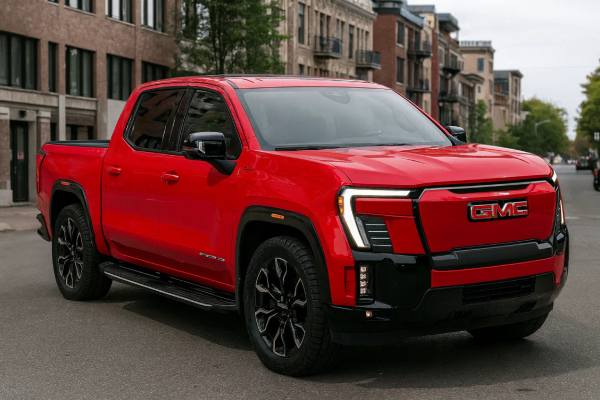
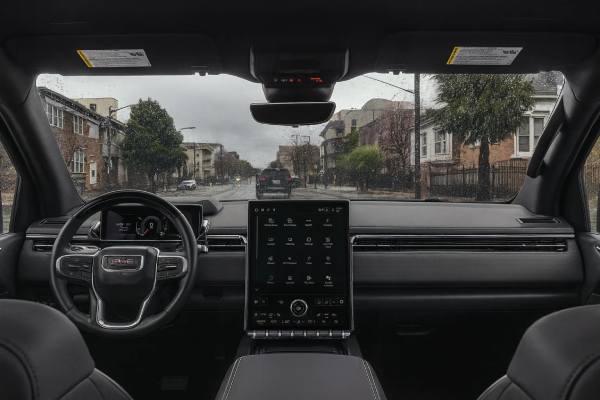
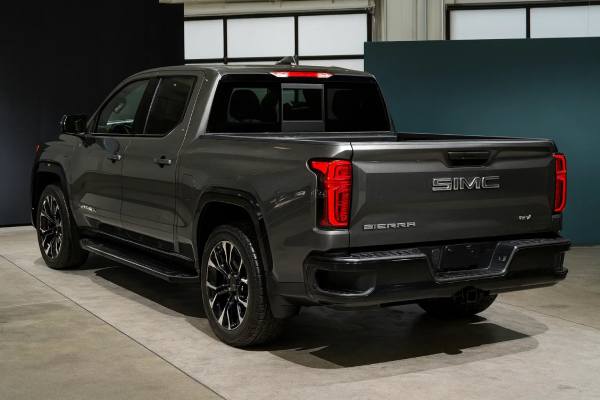
The Sierra EV AT4 Extended Range is the “work-truck meets off-road” take on GM’s large Ultium-based electric pickup. It pairs a dual-motor e4WD layout with AT4-specific hardware—most notably a factory lift and 35-inch all-terrain tires—so it’s aimed at buyers who want trail-ready stance without giving up daily drivability. That same hardware also changes the ownership math: bigger tires and added ride height tend to increase energy use at highway speeds, and they can accelerate tire wear if alignment and rotations aren’t kept on schedule. The upside is a truck that feels unusually stable for its size thanks to the low-mounted battery mass, plus strong towing capability and modern charging that can take advantage of high-power DC fast chargers on road trips. If you want a single vehicle for commuting, towing, and real off-pavement traction, this trim’s engineering choices make sense—so long as you plan around efficiency.
Quick Specs and Notes
- Strong all-round capability: 625 hp dual-motor AWD with serious towing headroom for an EV pickup.
- AT4 hardware adds real trail utility (lift and 35-inch all-terrains) and improves rough-road confidence.
- Expect higher highway energy use than non-AT4 Sierra EV trims because tires and ride height increase drag and rolling resistance.
- Rotate tires about every 12,000 km (7,500 mi) to keep the 35-inch set wearing evenly.
- Before long DC-fast-charge trips, precondition the battery via navigation when possible to improve charge speed consistency.
Explore the sections
- AT4 Extended Range deep dive
- Specs and technical tables
- Trims, options, and ADAS
- Reliability issues and actions
- Maintenance and buying advice
- Driving, range, and charging
- Rivals and alternatives
AT4 Extended Range deep dive
“Extended Range” in the Sierra EV lineup refers to the mid pack option—positioned between the lower-cost Standard Range and the longest-leg Max Range configuration. In real use, the AT4 Extended Range is best understood as a capability-first truck that still aims to be road-trip viable. The dual-motor e4WD system places one drive unit at the front and one at the rear, giving the truck consistent AWD traction without a mechanical transfer case. Torque response is immediate compared with combustion pickups, and the traction system can modulate output quickly for wet pavement, loose gravel, or sand.
What makes the AT4 distinct is the hardware package. GMC pairs the trim with a lifted suspension and 35-inch all-terrain tires. That changes three practical things:
- Efficiency and range planning. Larger, heavier all-terrains raise rolling resistance, and extra ride height increases aerodynamic drag. At city speeds, the penalty is often modest; at 110–120 km/h (70–75 mph), it becomes more noticeable.
- Ride and NVH. The truck benefits from the battery’s low center of gravity, which helps body control. But the tire choice can add low-frequency road noise on coarse pavement and a slightly busier feel over sharp edges.
- Running costs. 35-inch tires are expensive and can wear quickly if rotations are skipped. Keeping pressures correct and rotating on schedule matters more than it does on a street-focused trim.
One confusion worth clearing up: the AT4 trim has been marketed most prominently as a 2026 model-year expansion, yet it may appear in shopping contexts during calendar-year 2025 depending on production timing and region. So “2025–present” is a reasonable ownership window label, even though the primary model-year branding you’ll see is 2026.
Finally, the truck’s appeal is not only power. The Sierra EV platform also focuses on usability: a modern cabin, high towing ratings for a full-size EV pickup, and fast-charging capability designed to take advantage of today’s high-power DC stations—provided you manage battery temperature and arrive at chargers with a sensible state of charge.
Specs and technical tables
Below are the most relevant specifications for the Sierra EV AT4 Extended Range (BT1CG), dual-motor e4WD, 625 hp. Where manufacturers or testing bodies have not published a figure yet, it is labeled accordingly.
Powertrain, Battery, and Efficiency
| Item | Spec |
|---|---|
| Code | BT1CG |
| Motor | Dual motor e4WD (front + rear drive units); motor type not consistently published for this trim |
| Battery chemistry | Lithium-ion (Ultium-based pack; chemistry not always disclosed publicly by trim) |
| System voltage | 800 V class architecture (marketed as an 800V system) |
| Traction battery (gross / usable) | Not officially published by trim; widely reported pack sizing varies by configuration—verify by VIN/label data where available |
| Max power | 625 hp (466 kW) (AT4 Extended Range) |
| Max torque | Not consistently published for AT4 Extended Range (some AT4 marketing highlights quote 775 lb-ft, but not always tied to the Extended Range output) |
| Thermal management | Liquid-cooled battery and power electronics (typical for this platform); heat-pump availability varies by equipment/market |
| Efficiency / test standard | EPA figures for this specific trim may lag early production; verify on the Monroney label |
| Rated efficiency | Not yet consistently published for AT4 Extended Range in all markets |
| Rated range | GM-estimated range varies by configuration; AT4 marketing commonly highlights up to 390 mi for the previously quoted Extended Range setup, while Max Range claims can reach 478 mi on certain builds |
| Real-world highway @ 120 km/h | Treat as planning range: expect a noticeable drop versus the best-case estimate; tire choice and temperature are major drivers |
| Aerodynamics | Cd / frontal area not consistently published for Sierra EV trims |
Driveline and Charging
| Item | Spec |
|---|---|
| Transmission / drive unit | Single-speed reduction gearing (typical EV layout) |
| Drive type | e4WD / AWD (dual-motor) |
| Differential / torque distribution | Electronically controlled torque delivery front-to-rear; brake-based traction control for side-to-side management |
| Charging connector (AC) | J1772 (North America typical) on many builds; confirm by market/year changes |
| Charging connector (DC) | CCS (North America typical); market transitions may occur—confirm by VIN and model year |
| Charging port location | Not consistent across press materials; verify on vehicle |
| Onboard charger (AC) | Up to 19.2 kW reported for Sierra EV configurations |
| DC fast-charge peak | Up to 350 kW (claimed capability on supported stations) |
| Typical DC charging curve | Not officially graphed by GMC in a public curve; expect taper as SOC rises, with best power at lower SOC |
| Replenishment time | Often communicated as “about 100 miles in ~10 minutes” under ideal conditions on a 350 kW station |
| Battery preconditioning | Available via route planning/navigation on many modern GM EVs; verify in infotainment settings and OTA status |
| Bidirectional capability | Availability depends on equipment and market; confirm V2L/V2H claims by VIN and installed hardware |
Performance and Capability
| Item | Spec |
|---|---|
| Acceleration | Published testing estimates vary by configuration; early reporting suggests roughly 4.3–4.8 s (0–60 mph) depending on battery/power mode and conditions |
| 0–100 km/h (0–62 mph) | If you only have 0–60 mph data, treat 0–100 km/h as slightly slower; confirm with instrumented tests |
| Top speed | Reported around 112 mph (180 km/h) for the platform in some early coverage; confirm by tire rating, limiter, and build |
| Braking distance | Not consistently published for AT4-specific tire package |
| Towing capacity | 12,300 lb (5,579 kg) (AT4 rating cited in early spec coverage) |
| Payload | Varies significantly by configuration; confirm on door-jamb label |
Chassis and Dimensions
| Item | Spec |
|---|---|
| Suspension (front/rear) | Independent layouts typical of this EV truck platform; AT4 includes a lift and off-road-oriented tuning |
| Steering | Electric power steering; ratio not consistently published |
| Brakes | Four-wheel disc; sizes not consistently published publicly by trim |
| Wheels/Tires | 35-inch all-terrain tires (AT4 hallmark) |
| Ground clearance | AT4 is marketed as having about 2 inches more clearance than other Sierra EV trims |
| Length/width/height | Varies by configuration; verify by VIN/spec sheet |
| Wheelbase | Not consistently published by trim in consumer spec tables |
| Turning circle | Tightened by rear steer/crab-walk features where equipped; exact kerb-to-kerb numbers vary |
Safety and Driver Assistance
| Item | Spec |
|---|---|
| Crash ratings | Large-pickup EV crash-test ratings may not be published early in the model cycle; verify NHTSA/IIHS listings by model year |
| ADAS suite | Availability varies: AEB, adaptive cruise, lane support, blind-spot features, and trailer-aware aids depending on package |
Electrical
| Item | Spec |
|---|---|
| HV architecture | 800 V class system (marketed) |
| DC–DC converter | Output not typically disclosed in consumer specs |
| 12 V battery | Type/location vary; expect periodic testing/replacement like any modern vehicle |
| OTA updates | Supported for many vehicle modules; keep software current for charging/ADAS refinements |
Fluids and Service Capacities
Consumer-facing spec sheets rarely publish exact coolant liters or drive-unit oil capacities. Treat any published capacities as VIN-specific and confirm with official service information before ordering fluids.
Trims, options, and ADAS
Even within “Sierra EV,” equipment can change dramatically by trim and battery configuration. The key for buyers is to separate three layers: battery (Standard/Extended/Max), trim (Elevation/AT4/Denali), and driver-assistance packages.
AT4 Extended Range position in the lineup. AT4 is the capability-oriented trim. It targets buyers who want trail-ready hardware without moving up to the most luxury-focused Denali equipment set. In early published breakdowns, the AT4 Extended Range sits below AT4 Max Range in output and headline range, while maintaining the same core identity: dual-motor e4WD, lifted stance, and 35-inch all-terrain tires.
Options that change the truck mechanically. When you’re evaluating listings, prioritize options that alter how the truck behaves and what it costs to own:
- Battery configuration (the biggest lever): more range usually means more weight and higher purchase price, but it can also reduce charging stops on long trips.
- Tire and wheel spec (already aggressive on AT4): some wheel choices can change ride noise and winter performance.
- Trailering packages: look for integrated trailer brake controller, trailer camera views, and trailer-aware blind-spot tuning if you tow often.
- Rear-steer / maneuvering features: depending on equipment, rear-wheel steering and diagonal “crab” maneuvers can shrink the “big truck” feel at low speed—especially helpful with tight parking and trail switchbacks.
How to identify what you’re actually buying. For used or incoming stock, rely on hard identifiers:
- The window sticker (Monroney) for EPA range/MPGe (when available), battery designation, and standard-vs-optional ADAS.
- The door-jamb tire and load label for tire size, pressures, payload, and GAWR—critical on lifted trims.
- The build codes on dealer paperwork for battery and package content.
Safety systems and ADAS. The Sierra EV platform generally follows today’s full-size truck norm: multiple airbags, stability control, traction control, and a suite of driver aids that can include automatic emergency braking (AEB), lane keeping or lane centering assistance (depending on package), adaptive cruise control, blind-spot monitoring, and rear cross-traffic alert. Two practical notes for owners:
- Calibration after service matters. Windshield replacement, bumper repair, or suspension changes can require camera/radar recalibration. On an AT4, alignment work after hard impacts is common—budget time to verify ADAS behavior after repairs.
- Tires influence ADAS feel. Aggressive all-terrains can change braking distances and steering response, which may subtly change how “confident” some driver aids feel on wet pavement.
If you are shopping specifically for the best safety tech, don’t assume “AT4” automatically equals “fully loaded.” The highest-level ADAS features are often tied to an additional package, not just the trim badge.
Reliability issues and actions
Because the Sierra EV AT4 is still early in its lifecycle, reliability should be approached like a systems checklist rather than a long history of failures. Focus on what tends to matter on modern EV trucks: software maturity, charging hardware consistency, and high-load use cases (towing, repeated fast charging, rough-road vibration).
Likely issue patterns by prevalence and cost tier
Common (low to medium cost):
- Tire wear and alignment drift: Symptoms include steering pull, uneven shoulder wear, and vibration at speed. Likely root causes are toe/camber changes from impacts or lifted/off-road geometry. Remedy: alignment to spec, rotate frequently, inspect suspension bushings and steering links.
- Brake noise/corrosion from heavy regen use: Symptoms include grinding after rain or washing, or a “first stop” squeal. Root cause: friction brakes used less often, allowing surface corrosion. Remedy: periodic firm stops to clean rotors; inspect pads and slide pins.
Occasional (medium cost):
- Charge-port latch or communication glitches: Symptoms include failed session starts, repeated “plug in again” messages, or DC fast charge handshake delays. Root causes can include latch misalignment, moisture intrusion, or software-related negotiation faults. Remedy: inspect/clean, verify seals, update software; replace latch/port hardware if needed.
- 12 V battery sensitivity: Symptoms include odd warning cascades, module offline messages, or intermittent infotainment resets. Root cause: low 12 V voltage or aging battery. Remedy: load test, replace if weak, ensure DC–DC charging behavior is normal.
Rare but higher stakes (high cost):
- High-voltage isolation faults (moisture-related): Symptoms include reduced power, “service high voltage system,” or limp-home behavior. Root causes can include moisture intrusion at connectors or junction points, or damage to underbody protection after off-road contact. Remedy: isolation test, inspect HV connectors and underbody, repair seals/replace affected components.
Software and calibration actions
For new EV platforms, software updates can materially change ownership. Updates may address:
- Charging behavior (preconditioning triggers, plug-and-charge compatibility, reduced taper severity in some temperature windows),
- Battery management (state-of-charge estimation accuracy, thermal control strategies),
- ADAS stability (sensor fault handling, lane-keeping smoothness),
- Infotainment reliability (connectivity and camera system stability).
A practical ownership rule: if the truck shows new warning messages after an update—or charging behavior changes—document the before/after and ask the dealer to verify calibration status, not just clear codes.
Recalls, TSBs, and how to verify
EV trucks can see campaigns that are software-only (reflash) or hardware-related. The correct approach is always VIN-based:
- Use an official VIN recall lookup and dealer service history to confirm completion.
- Ask for printouts showing “closed” campaigns and the software calibration IDs when relevant.
Because the model is evolving, do not treat a clean early recall history as proof of long-term reliability. Treat it as a signal that the software and supplier pipeline are still maturing—as they do with most first-wave EV trims.
Maintenance and buying advice
EV pickups reduce some traditional maintenance (no engine oil, no spark plugs), but they add new priorities: tire management, brake health under regen, thermal-system monitoring, and software currency. For the AT4, the tire package and off-road intent raise the importance of inspections.
Practical maintenance schedule (distance and time)
Use this as a baseline planning schedule and confirm the exact intervals for your VIN and market:
- Tire rotation: every 12,000 km (7,500 mi) or 12 months (sooner if you see uneven wear).
- Alignment check: at least every 20,000–25,000 km or annually, and immediately after hard pothole/off-road impacts.
- Brake inspection (pads/rotors): every 20,000 km or 12 months; include caliper slide lubrication checks where service procedures allow.
- Brake fluid: inspect moisture content annually; replace around every 3–5 years depending on climate and official guidance.
- Cabin air filter: typically every 24,000–36,000 km or 24 months (dusty areas may need more frequent changes).
- Coolant loops (battery/power electronics): follow the official service schedule; EV coolants are critical for battery longevity, so avoid mixing types.
- 12 V battery test: annually after year 2; expect replacement in the 3–6 year window depending on use and heat exposure.
- Underbody inspection: every 12 months if you drive off-road—look for damage to shields, fasteners, and seals.
Fluids, specs, and key torque values (decision-useful)
Because EV service data can be VIN-specific and often sits behind official service information, treat consumer numbers cautiously. Still, you can shop smarter by insisting on:
- Correct coolant type (do not accept “universal” coolant without proof of compatibility),
- Documented brake fluid spec (DOT rating as required),
- Wheel fastener torque verified at service (critical on large wheel/tire packages).
Buyer’s guide: inspection checklist for AT4 Extended Range
Battery and charging
- Request a battery health report (state-of-health where available) and confirm there were no pack/module replacements without documentation.
- Test DC fast charging if possible: verify stable session start, reasonable early charge power, and expected tapering.
- Inspect the charge port for seal integrity, latch smoothness, and signs of water ingress.
Chassis and body
- Inspect for underbody impacts: shield deformation, missing fasteners, and battery housing scrapes.
- Check tire wear patterns closely. Uneven wear can signal alignment issues or suspension damage—costly with 35-inch tires.
Electronics and ADAS
- Confirm camera clarity and sensor operation (front camera, surround view, parking sensors if equipped).
- Ask about OTA update history and ensure no persistent warning messages remain unresolved.
Which builds to seek or avoid
- Seek builds with the trailering aids you actually need (brake controller, camera views, trailer-aware blind spot).
- If your priority is maximum highway range, be realistic: the AT4 tire/lift package is a trade for capability. Consider a non-AT4 trim if range is your primary KPI.
Long-term durability outlook: expect the core electric drive units and battery to hold up well if charging is managed and cooling systems are maintained, but budget for tires and occasional software-related dealer visits early in the lifecycle.
Driving, range, and charging
Ride, handling, and NVH
The Sierra EV platform’s low-mounted battery gives it a planted feel that can surprise drivers used to tall, heavy combustion pickups. The AT4 adds lift and a more aggressive tire, so you should expect a slightly softer initial response to steering inputs and more tread noise on certain road surfaces. Still, the mass distribution helps straight-line stability, especially in crosswinds.
On broken pavement, the large sidewalls can be an advantage, absorbing sharp edges that would thump through lower-profile street tires. Off-road, the immediate torque and AWD control help with controlled climbs and loose surfaces, but smooth throttle technique matters: EV torque arrives instantly, and abrupt inputs can trigger traction control aggressively.
Powertrain character and regen behavior
With dual motors, the truck delivers confident step-off response. In normal driving it feels smooth and quiet, but full-throttle launches can feel surprisingly forceful—enough that stability control may intervene if the surface is imperfect. Regenerative braking usually offers multiple levels and a one-pedal mode. The key comfort factor is the handoff between regen and friction braking: most drivers adapt quickly, but the feel can vary by software version and brake temperature.
Real-world efficiency and range planning
Because published EPA data for specific new trim/battery combinations may lag, plan range like an owner, not like a brochure reader:
- City driving: Expect better efficiency than highway because regen recovers energy and aero drag is lower.
- Highway at 110–120 km/h (70–75 mph): Expect the largest drop versus the headline range, especially with AT4 tires and lift.
- Cold weather: Range can drop substantially due to cabin heat load, battery heating, and higher rolling resistance.
A practical planning method:
- Use the truck’s trip energy graph after 2–3 weeks of your typical driving.
- Build your own “safe range” number at 70% of the best-case estimate for highway winter trips and 80–85% for mild-weather highway trips.
- Leave DC fast chargers with enough buffer to reach the next stop even if speeds rise or weather turns.
Charging behavior: what to expect
On home AC charging, the onboard charger rating matters—many owners will effectively charge overnight. On road trips, the headline is DC fast charging capability up to high peak power on compatible stations. The real-world limiter is usually battery temperature and starting state of charge:
- Arrive with a low SOC (for example, 10–20%) for the best chance at high initial power.
- Use navigation-based preconditioning when available to warm/cool the pack before you plug in.
- Expect tapering after the pack passes mid SOC; the last 20% often takes disproportionately longer.
For owners who tow, the biggest lifestyle difference is charging logistics. Trailers can complicate pull-through access, so mapping trailer-friendly chargers matters as much as peak kW.
Rivals and alternatives
The Sierra EV AT4 Extended Range sits in a fast-growing set of large electric pickups where each competitor emphasizes a different “superpower.” The best choice depends on whether you value off-road traction, long-distance efficiency, charging convenience, or price.
Chevrolet Silverado EV (related platform). The Silverado EV is the closest technical cousin. If you prioritize range-per-dollar and don’t need the AT4’s off-road stance, a Silverado EV configuration can deliver similar underlying tech with different trim logic and styling. The Sierra EV typically positions itself as the more premium-feeling sibling, depending on equipment.
Ford F-150 Lightning. Lightning tends to feel more like a traditional pickup in packaging and size, and it has a strong ownership ecosystem. However, if your priority is maximizing range in a very large EV pickup format, compare battery sizes, tow-range behavior, and DC fast charge performance in your region. Lightning’s real-world towing range management is a major deciding point for frequent haulers.
Rivian R1T. Rivian’s R1T is smaller and more performance-oriented, with excellent off-road capability and clever storage, but it’s not a direct full-size competitor in bed and cabin scale. If you want trail talent with a more maneuverable footprint, it’s worth cross-shopping.
GMC Hummer EV (pickup). The Hummer leans hard into extreme off-road features and styling. It can be shockingly quick, but it also tends to be heavier and less efficiency-focused. If you want a more conventional pickup identity with serious towing capacity, the Sierra EV AT4 is the more practical daily tool.
What to pick based on your use
- Choose Sierra EV AT4 Extended Range if you want factory off-road hardware plus strong towing while keeping the EV benefits (quiet, torque, modern charging).
- Choose a non-AT4 Sierra EV / Silverado EV build if maximum highway range and tire cost are top priorities.
- Choose Lightning if you want a more traditional pickup footprint and strong community support.
- Choose R1T if you want a smaller, highly capable adventure truck and don’t need full-size towing/bed priorities.
The best “spec” is the one that matches your daily constraints: charging access, towing frequency, winter temperatures, and tire budget.
References
- 2026 Sierra EV AT4 | Off-Road Electric Pickup Truck | GMC 2026 (Manufacturer page)
- 2026 GMC Sierra EV Review, Pricing, and Specs 2026 (Specs and pricing)
- Check for Recalls: Vehicle, Car Seat, Tire, Equipment | NHTSA 2025 (Recall Database)
Disclaimer
This article is for informational purposes only and is not a substitute for professional diagnosis, inspection, or repair. Specifications, torque values, service intervals, charging performance, and procedures can vary by VIN, market, software version, and installed equipment—always verify details using official owner’s and service documentation for your exact vehicle.
If you found this guide useful, please consider sharing it on Facebook, X (Twitter), or your favorite forum to help others find it.