
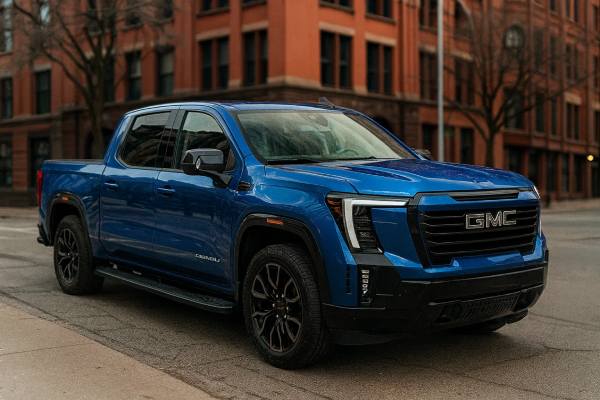
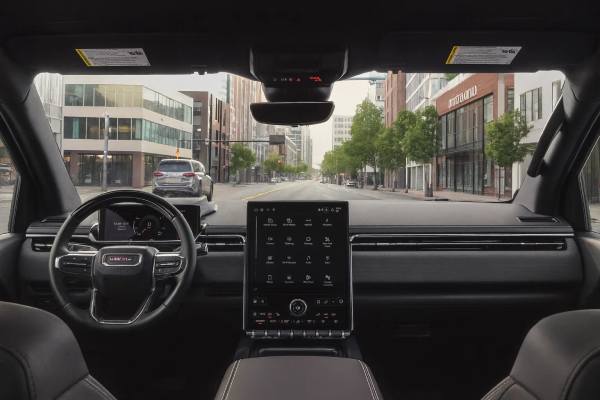
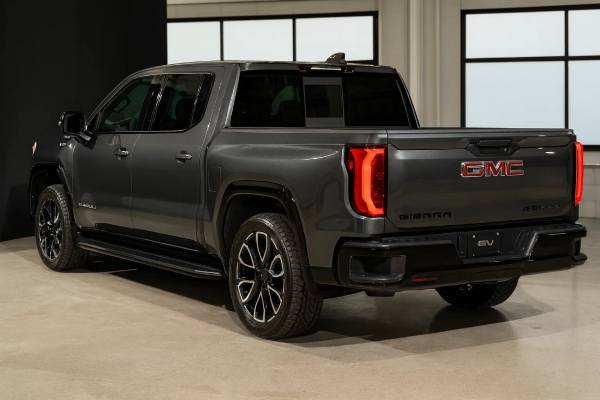
The Sierra EV AT4 Max Range is the “do-everything” end of GMC’s electric pickup strategy: big power, big battery, and a chassis tuned for rougher roads than the Denali buyer typically seeks. In real ownership terms, it’s less about peak numbers and more about how well the truck holds its composure when you add speed, weight, weather, and charging stops to the equation.
One frustration you’re right to call out is that some “must-have” specs—especially acceleration, sustained charging power, and usable battery capacity—are not always published cleanly in one official spec table. Automakers often share ranges, power, towing, and headline charging claims first, while deeper engineering numbers live in internal order guides, homologation docs, or later EPA/label releases. In this guide, I’ll clearly separate published values from expected/typical real-world ranges where official data is still thin.
Fast Facts
- Very quick for a full-size truck: GMC quotes 0–60 mph in 4.43 s for the AT4 Max Range.
- “Max Range” is the point: GMC quotes up to 478 miles (769 km) on a full charge (configuration-dependent).
- Strong work rating: GMC quotes up to 12,300 lb (5,579 kg) towing when properly equipped.
- Ownership caveat: early-life experience is often software and charging-behavior dependent, so update history matters.
- Practical routine: rotate tires about every 12,000 km (7,500 mi) or 12 months (more often if you tow or run aggressive all-terrains).
Guide contents
- Sierra EV AT4 Max Range explained
- Full technical specifications
- Trims, options, and safety tech
- Reliability picture and service bulletins
- Maintenance plan and buyer advice
- Real range and performance feel
- AT4 Max Range versus rivals
Sierra EV AT4 Max Range explained
“AT4” has always meant the same thing at GMC: the more rugged flavor of a model line, with hardware and calibration choices that make sense for dirt roads, winter travel, and job-site driving. In Sierra EV form, the AT4 Max Range pairing aims to keep the truck’s “luxury-fast” character while improving its tolerance for uneven surfaces, debris, and the kind of repeated high-load use that can expose weak points in cooling, brakes, or software logic.
The headline output—725 hp (about 541 kW)—doesn’t tell you the whole story. What matters in daily use is how the dual-motor e4WD system meters torque to keep the truck stable when you’re accelerating on wet pavement, climbing a grade with a trailer, or creeping down a loose surface with regen active. The best EV pickups feel calm because they’re always “in gear,” and the motors can respond instantly—but they also need conservative thermal and traction control strategies to avoid power fade, wheelspin, or sudden traction-control intervention.
You also asked whether it’s “really on sale” and why basic items like acceleration are sometimes missing. On GMC’s own model page for the Sierra EV AT4, GMC publishes pricing, range, 0–60 mph time, towing, and charging claims, and it presents the truck like a retail product (not just a concept). That’s a strong indicator the trim is intended for consumer ordering and dealer inventory workflows. The messy part is that “deep specs” (battery usable kWh, charging curve, some dimensions) often lag because they can change with supplier updates, wheel/tire packages, or EPA certification timing.
If you’re shopping seriously, treat this truck as a configuration-driven product: wheel/tire choice, underbody protection, accessories, and payload/tow options can move range and charging performance more than most people expect.
Full technical specifications
Below are tables organized the way owners and buyers actually use them: what makes it move, how it charges, what it can do under load, and what you need to know for service planning. Where GMC has not published a value in a stable spec table, I mark it as Not published and give the best practical way to verify it (window label, VIN build sheet, or official service documentation).
Powertrain, battery, and efficiency
| Item | Specification |
|---|---|
| Code | BT1CG (platform/program code often associated with Sierra EV) |
| Motor | Dual-motor e4WD (front + rear electric drive units); motor type not published |
| System voltage | 800V architecture (published as “800V DC fast charging capability”) |
| Battery chemistry | Not published (Ultium cell chemistry varies by application and supplier) |
| Traction battery (gross / usable) | Not published as a single kWh figure on the retail page; verify via window label/build docs |
| Max power | 725 hp (≈541 kW) |
| Max torque | 775 lb-ft (≈1,051 Nm) |
| Thermal management | Not published in detail; expect liquid-cooled battery and power electronics typical of this class |
| Efficiency / test standard | EPA values for AT4 Max Range not published on the model page; verify via EPA label when available |
| Rated efficiency | Not published for AT4 Max Range on the model page |
| Rated range | Up to 478 mi (769 km) (configuration-dependent) |
| Real-world highway @ 120 km/h | Expect a large swing with speed, tires, wind, and temperature; see Driving section for realistic bands |
| Aerodynamics | Cd / frontal area not published on the retail page |
Driveline and charging
| Item | Specification |
|---|---|
| Transmission / drive unit | Single-speed reduction gear(s), typical for EV; ratios not published |
| Drive type | e4WD (electric AWD via front + rear drive units) |
| Differential / torque distribution | Not published; EV torque blending with brake-based traction control is expected |
| Charging connector (AC) | Not published on the retail page; verify by market and model year |
| Charging connector (DC) | Not published on the retail page; verify by market and model year |
| Charging port location | Not published on the retail page |
| Onboard charger (AC) | Not published on the retail page |
| DC fast-charge peak | Not published as a kW number on the retail page |
| Published “quick add” claim | Up to 120 miles in 10 minutes (ideal conditions, high-power charger, warm pack) |
| Typical 10–80% DC time | Not published; depends heavily on charger power, pack temperature, and starting SOC |
| Battery preconditioning | Not published on the retail page; in practice, many modern EVs precondition via navigation to a DC charger |
| Bidirectional capability | Up to 10.2 kW offboarding power with available equipment (plus a 7.2 kW figure is commonly cited for lighter setups); outlet formats vary by option set |
Performance and capability
| Item | Specification |
|---|---|
| Acceleration | 0–60 mph: 4.43 s (published) |
| 0–100 km/h | Not published; typically slightly slower than 0–60 mph due to extra 2 mph |
| Top speed | Not published on the retail page |
| Braking distance | Not published on the retail page |
| Towing capacity | Up to 12,300 lb (5,579 kg) (properly equipped) |
| Payload | Not published on the retail page; verify by VIN/label |
| Roof load | Not published |
Chassis and dimensions
GMC’s consumer page emphasizes capability, but it does not provide a full engineering dimension sheet. For a truck this size, the missing items matter because they impact garage fit, turning circle, tire cost, and real payload.
| Item | Specification |
|---|---|
| Suspension layout | Not published on the retail page |
| Steering | Not published; some GM EV trucks offer rear steering on certain trims/options—verify by VIN |
| Brakes | Not published (diameters and caliper type not listed) |
| Wheels/tires | Package-dependent; AT4 commonly implies more aggressive tire intent—verify by VIN/build |
| Ground clearance / angles | Not published on the retail page |
| Length / width / height | Not published on the retail page |
| Wheelbase | Not published on the retail page |
| Turning circle | Not published on the retail page |
| Curb weight / GVWR | Not published on the retail page |
| Cargo volume / additional storage | Not published on the retail page |
Safety and driver assistance
At the time of writing, the most reliable approach is to verify your exact VIN for safety campaigns and to treat driver assistance as “feature + calibration + sensor cleanliness.”
| Item | Specification |
|---|---|
| Crash ratings | NHTSA/IIHS listings may lag new EV trims; verify using official lookup tools |
| Headlight rating (IIHS) | Not published here; IIHS data depends on trim and headlight configuration |
| ADAS suite | GMC typically offers AEB, lane support, blind-spot monitoring, and ACC depending on trim and packages; verify standard vs optional per build |
Electrical
| Item | Specification |
|---|---|
| Traction battery | kWh not published on the retail page; architecture is published as 800V |
| High-voltage layout | Not published |
| DC–DC converter | Not published |
| Inverter/power electronics | Not published |
| 12V battery | Not published (chemistry, Ah, location vary) |
| OTA updates | Modern GM EVs support software updates; scope varies by module and region |
Fluids and service capacities
EVs still have fluids—coolant, brake fluid, gear oil in drive units, and A/C refrigerant—but manufacturers often publish exact quantities in the service manual rather than marketing pages.
| Item | Specification |
|---|---|
| Drive unit / reduction gear oil | Specification and capacity not published on retail page; verify in service documentation |
| Battery/power electronics coolant | Type and capacity not published on retail page |
| Brake fluid | Type/interval varies; commonly time-based |
| A/C refrigerant | Type/charge not published on retail page |
| Key torque specs | Wheel fastener torque and other critical values are in service docs; do not guess |
Bottom line: the big numbers (range, power, tow rating, 0–60 mph, and quick-add charging claim) are published, but you should expect to verify the rest by VIN once you’re looking at a specific truck.
Trims, options, and safety tech
Think of the Sierra EV lineup as three overlapping decisions: (1) range/battery, (2) luxury vs rugged intent, and (3) towing/payload configuration. “AT4 Max Range” is the combination for buyers who want the tougher aesthetic and surface tolerance without giving up the longest-distance mission.
Trims and options that matter on AT4 Max Range
Even within a single trim name, the real-world truck you get can feel very different depending on equipment. These are the option categories that change ownership more than people expect:
- Wheel/tire package: Aggressive all-terrain tires can reduce highway range and increase road noise, but they improve cold traction and puncture tolerance. They also change braking distances and stability-control behavior.
- Tow equipment: Properly equipped tow packages can change cooling strategy, rear-axle loading, and the truck’s long-grade behavior. They can also alter how conservative the truck is about limiting power to protect the pack.
- Offboarding power hardware: GMC publishes up to 10.2 kW offboarding power capability with available equipment. If you plan to run tools, a camper, or backup power use cases, confirm the exact hardware package and outlet setup.
- ADAS package level: Many safety and driver assistance features are “available” rather than standard across every build. Calibration quality and sensor robustness matter as much as feature count.
Quick identifiers (how to avoid ordering the wrong truck)
When you’re trying to confirm you’re looking at the correct “Max Range” configuration:
- Use the window label/Monroney to confirm official range, tire size, and option groups.
- Check the battery/range wording—manufacturers often use consistent language like “Max Range” vs “Extended Range.”
- Verify towing rating on the label (don’t rely on a generic trim brochure).
- Confirm charging claims vs hardware—the “best case” DC charging behavior assumes a warm battery and a high-power charger.
Safety ratings and what “not rated yet” really means
New EV trims and new model years sometimes appear in public crash databases later than buyers expect. That does not imply the vehicle is unsafe; it usually means the test body hasn’t completed (or published) that exact configuration’s results. The practical move is:
- Check VIN-specific safety campaigns and recalls first.
- Confirm the truck has the driver assistance features you personally rely on (AEB, blind-spot monitoring, lane support).
- For a heavy EV truck, prioritize tire condition and brake health—they influence real stopping distance more than a brochure.
If you’re buying early in the model cycle, pay attention to software release notes and dealership update history. In EVs, the difference between “annoying” and “excellent” can be a charging/thermal-control update.
Reliability picture and service bulletins
For a brand-new EV trim, the honest reliability story is “early and evolving.” That doesn’t mean “bad”—it means the data is still forming, and the highest-value reliability move is to track software updates, campaigns, and charging-related complaints. Below is a practical map of what tends to appear first in big, high-power EV trucks, with prevalence and cost severity tiers.
Common (low to medium cost): software, sensors, and 12V support
- Infotainment glitches or resets → often tied to software versions, corrupted profiles, or module updates → remedy is usually an OTA update or dealer reflash.
- Driver-assistance warnings (camera/radar blocked, calibration drift) → weather, road grime, or windshield sensor alignment → remedy is cleaning, recalibration, or addressing mounting/aim.
- 12V battery issues (slow wake-up, random warnings) → EVs still depend on 12V stability for control modules → remedy can be testing, software updates to charging strategy, or 12V replacement.
Why it happens: EVs have more software-defined behavior than ICE trucks. Early builds may receive frequent improvements to charging logic, thermal control thresholds, and sensor fault handling.
Occasional (medium to high cost): charging hardware and thermal management
- DC fast charging slower than expected → pack too cold/hot, charger limits, or conservative thermal strategy → remedy is preconditioning habits, software updates, or diagnosing coolant/fan performance.
- Charge port latch/communication faults → connector wear, debris, water intrusion, or module faults → remedy ranges from cleaning and seal replacement to port/module service.
- Coolant-level or thermal warnings → leak, trapped air after service, sensor faults → remedy is correct coolant service procedure and leak checks.
Best owner habit: treat fast charging as a tool, not the default. Frequent high-power DC charging plus towing heat loads is a “severe use” scenario for any EV.
Rare (high cost): drive unit noises and HV isolation faults
- Whine/grind/clunk under load → could be bearing wear, mount issues, or gearset noise → remedy can range from mounts to drive unit service.
- HV isolation warnings → moisture intrusion, damaged harness, connector sealing problems → remedy is a professional diagnostic and repair; do not ignore.
Recalls, TSBs, and extended coverage
Because published campaigns can change, the correct process is:
- Run the VIN in an official tool (recalls and investigations).
- Ask the dealer for a printout of completed campaigns and software version history.
- Confirm whether any actions are software-only (fast) vs parts replacement (potential delays).
If you’re purchasing used, request a battery health report (state of health, balance, and any recorded thermal events if available) and confirm the truck has been updated to the latest stable software branch.
Maintenance plan and buyer advice
EV trucks cut out oil changes and many engine-related services, but they replace those chores with a different set: tires, brakes (often under-used), cooling systems, and software/diagnostics. Here’s a practical schedule you can actually follow, with “normal use” and “severe use” notes.
Practical maintenance schedule (distance and time)
- Tire rotation: every 12,000 km (7,500 mi) or 12 months. Severe use: every 8,000–10,000 km (towing, aggressive tires, rough roads).
- Alignment check: at least every 24,000 km (15,000 mi) or when tire wear looks uneven; immediately after major pothole/off-road impacts.
- Brake inspection (pads, rotors, sliders): every 20,000 km or 12 months. EV regen can hide corrosion until you need friction braking.
- Brake fluid: commonly every 2 years (time-based moisture absorption). Confirm the exact interval in official documentation for your VIN.
- Cabin air filter: every 20,000–30,000 km or 12 months, sooner in dusty areas.
- Cooling system inspection: annually for leaks, radiator blockage, and fan operation; coolant replacement interval varies by manufacturer and coolant type.
- 12V battery test: every 12 months; replacement window often 3–5 years depending on climate and usage.
- Drive unit fluid (if serviceable): interval is model-specific; confirm in service documentation rather than guessing.
Fluids, torque values, and “don’t guess” items
For EVs, incorrect fluid type or improper bleeding can create expensive problems. The highest-risk DIY mistakes are coolant service and any HV-related work. Practical guidance:
- Only use manufacturer-specified coolant and procedures (air pockets can trigger thermal faults).
- Wheel fastener torque and lift/jack points should be taken from official sources—especially on a heavy EV with a battery pack.
Buyer’s guide: what to check before you commit
Battery and range reality
- Do a mixed route test: city + highway at 110–120 km/h.
- Watch the truck’s predicted arrival SOC; check whether HVAC use swings range heavily.
- If possible, observe a DC fast-charge session from ~15% to ~70% to see taper behavior.
Charging hardware
- Inspect the charge port for smooth latch action and seal condition.
- Confirm included cables/adapters and that the truck recognizes AC charging reliably.
Thermal management
- Listen for fan operation after charging or spirited driving (normal, but should be consistent).
- Check for warning history in service records.
Chassis and body
- Underbody inspection matters more on AT4 use cases: look for damaged shields, exposed harnesses, and dents near battery protection areas.
Electronics and updates
- Confirm all cameras/sensors function in bad weather conditions if possible.
- Ask for evidence of recent software updates and any unresolved warning codes.
Purchase strategy
- If you want the best long-term experience, prioritize a truck with documented updates, clean charging behavior, and tires that match your real driving (range vs grip tradeoff).
Real range and performance feel
Straight-line performance and drivability
GMC’s published 0–60 mph time of 4.43 seconds is fast enough that traction and stability systems are doing real work behind the scenes. In daily driving, the most noticeable trait won’t be “peak acceleration,” but effortless mid-range pull—merging at highway speed or passing with a trailer feels less strained than most ICE trucks because the motors don’t need to downshift.
Expect driving modes to change pedal mapping and regen feel. The best setup for smooth towing usually isn’t the most aggressive throttle mode; it’s a calmer map that reduces sudden torque spikes that can provoke trailer sway on poor surfaces.
Ride, handling, and NVH (noise, vibration, harshness)
A heavy floor-mounted battery typically improves body control because the center of gravity sits lower than an ICE truck’s. The tradeoff is mass: bumps carry more energy, so suspension tuning matters. AT4 intent usually pushes toward:
- more impact tolerance over rough roads
- more tire noise if all-terrains are fitted
- slightly less “plush” isolation than a luxury-focused trim on perfect pavement
Real-world efficiency and range (what to expect)
GMC’s headline up to 478 miles (769 km) is best treated as a best-case configuration under the official cycle. Real highway driving at European-style speeds can reduce range dramatically, especially with aggressive tires or cold temperatures.
Reasonable expectation bands for a large, powerful EV truck:
- City/urban: often closer to the official number because regen helps.
- Mixed driving: commonly 70–85% of the headline figure depending on speed and temperature.
- Highway at 120 km/h (75 mph): commonly 55–75% of the headline figure, depending on tire choice, wind, and HVAC.
If we translate that into practical planning for long trips, a realistic “don’t-stress” highway planning range is often 350–500 km between charging stops if you want to arrive with buffer—less in deep winter, more in mild weather with conservative speed.
Charging performance: what matters more than peak kW
GMC publishes a simple claim—up to 120 miles added in 10 minutes—which is useful but incomplete. For road trips, the key is the average power between roughly 10% and 70–80% SOC. Many EVs charge very quickly early, then taper hard.
What you can do to get the best result:
- Start DC charging at a low SOC (roughly 10–20%) rather than arriving at 50%.
- Use navigation that triggers battery preconditioning if available.
- Prefer chargers with reliable power delivery; “350 kW” hardware doesn’t guarantee you’ll see it.
Load and towing reality
Towing is where EV trucks separate. High aerodynamic drag can cut range sharply—often by 30–50% depending on trailer size, speed, and terrain. The Sierra EV’s advantage is strong torque and likely robust cooling design, but you still need to plan charging stops earlier and keep speed reasonable on long grades.
AT4 Max Range versus rivals
The Sierra EV AT4 Max Range sits in a competitive space where rivals specialize in different strengths. The right comparison depends on your real mission: towing, off-road surfaces, charging network access, or cabin luxury.
Where the Sierra EV AT4 Max Range is likely strongest
- High-power, long-range positioning: A 725 hp dual-motor setup plus a “Max Range” focus targets buyers who want one truck for commuting, travel, and occasional heavy use.
- Work + lifestyle blend: Published towing capability plus meaningful offboarding power options can make it a strong “truck-first” EV rather than a sporty lifestyle pickup.
- 800V fast-charging capability: In theory, 800V systems can maintain higher charging power under the right conditions (the charging curve still matters).
Where rivals may beat it
- Charging ecosystem simplicity: Some brands win on network integration and payment reliability. If you road-trip constantly, frictionless charging can matter as much as battery size.
- Efficiency at speed: Aerodynamics and tire choices can let some rivals deliver more real highway miles per kWh, even if their headline range is lower.
- Off-road specialization: If you truly do technical off-road (not just rough roads), a purpose-built off-road platform can outperform a full-size EV in approach angles, visibility, and trail packaging.
Quick matchup guide
- If you want maximum straight-line pace and tech-heavy features, some rivals will feel more “sport truck.”
- If you want a traditional full-size pickup feel with strong towing focus and a rugged trim identity, the AT4 Max Range is positioned well.
- If your use is mostly city + occasional towing, a smaller battery variant may be the smarter cost/weight choice—if you can live with fewer miles.
The practical advice: shop the AT4 Max Range by the numbers that affect you weekly: tire package, real payload on the door sticker, tow rating on the label, and a test drive that includes a highway segment at your normal speed.
References
- Sierra EV AT4 2025 (Manufacturer model page)
- 2025 GMC Sierra EV 2025 (Fuel economy database)
- SaferTruck | NHTSA 2025 (Recall and safety lookup)
Disclaimer
This article is for informational purposes only and is not a substitute for professional diagnosis, inspection, or repair. Specifications, torque values, service intervals, and procedures can vary by VIN, market, build date, and installed equipment—always verify details using official owner and service documentation for the exact vehicle you are working on or buying.
If you found this guide useful, please consider sharing it on Facebook, X/Twitter, or in an owners’ group to help others research their next truck.