
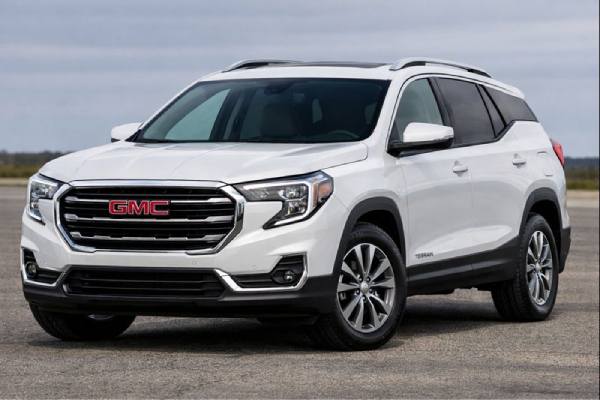
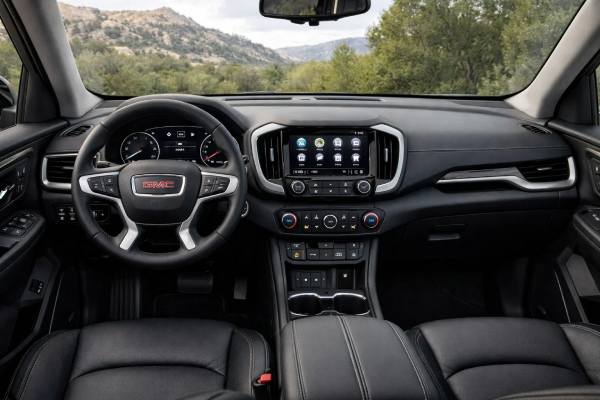
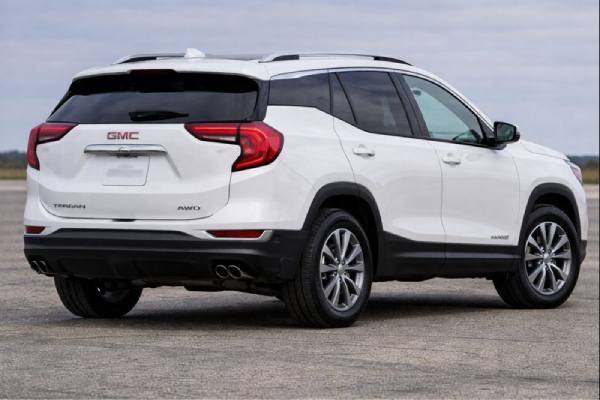
The facelifted 2022 GMC Terrain AWD with the 1.5L turbo (RPO LYX) is the “everyday-does-everything” version of this platform: light enough to be efficient, but strong on low-end torque and traction when weather or road conditions get messy. The AWD system is designed for normal roads first—think rain, slush, gravel driveways, and occasional mild trails—rather than rock-crawling. For owners, the key engineering story is how many systems work together: the direct-injected turbo engine, a multi-ratio automatic, and on-demand AWD with stability and traction controls that constantly balance grip and fuel use.
If you’re shopping one used or maintaining one long-term, focus on two things: clean oil-change habits (turbo health depends on it) and keeping up with software updates and open recalls. Get those right, and the Terrain can be a very practical compact SUV to live with.
Quick Specs and Notes
- Strong low-rpm pull for a small turbo SUV, and AWD helps it put torque down cleanly on wet pavement.
- Practical packaging: easy daily visibility, usable cargo space, and a comfortable ride on most trims.
- Engine oil capacity is higher on AWD models, so DIY oil changes need the correct fill amount.
- Check for open fuel-system and seat-related recalls before purchase, even on low-mileage examples.
- Rotate tires every 12,000 km (7,500 mi) to reduce uneven wear and AWD driveline stress.
Contents and shortcuts
- 2022 Terrain AWD explained
- LYX 1.5L AWD technical specs
- Trims, packages, and ADAS
- Problem spots and recalls
- Service plan and buying tips
- How it drives day to day
- AWD Terrain vs competitors
2022 Terrain AWD explained
This specific Terrain—the facelifted 2022 model year, AWD, and the 1.5L turbo LYX—sits at the core of the lineup because it matches what many compact-SUV buyers actually do: commuting, school runs, winter driving, and weekend errands. The powertrain aims for usable torque rather than big peak output. With a small turbocharger, the engine can build boost early, so the vehicle feels more responsive at city speeds than the horsepower number suggests.
The AWD system on Terrain is best understood as on-demand traction management. Most of the time, it behaves like a front-drive crossover for efficiency. When wheel-slip is detected (or predicted, based on steering angle, throttle input, and stability-control logic), the system can send torque rearward to help the vehicle track straight and pull away cleanly. In practice, this means you get better stability in heavy rain and far better mobility in snow than the equivalent FWD vehicle—especially when combined with proper winter tires.
The facelift matters, too. Beyond exterior styling, 2022 brought meaningful cabin and tech changes that affect ownership: updated infotainment, different option packaging, and (depending on trim) more driver-assistance availability. Those changes can alter how easy the vehicle is to live with and how expensive a particular example is to repair if a camera, radar sensor, or module is damaged.
Who is this Terrain for?
- All-weather commuters who want simple, predictable traction without stepping up to a larger SUV.
- Families who prioritize ride comfort, a higher seating position, and easy child-seat usability.
- Used-car shoppers who want modern safety tech but need a clear checklist to avoid neglected maintenance or open recalls.
Who should think twice?
- Drivers who routinely tow heavy loads, or live in mountainous areas and expect strong passing power at speed. The 1.5T can do highway work, but it’s not the “effortless” engine in the range.
- Owners who dislike staying on top of maintenance. A small turbo engine rewards consistent oil service; skipping it tends to show up later in turbo, PCV, or cooling-system wear.
Treat the 2022 Terrain AWD as a comfort-first compact SUV with smart traction and decent efficiency—and you’ll judge it by the right yardstick.
LYX 1.5L AWD technical specs
Below are specs that matter for the exact configuration: 2022 Terrain AWD (D2XX) with the 1.5L turbo LYX. Some figures can vary by trim, wheel size, and market equipment, so use these as a baseline and confirm with the door-jamb label, build sheet, and service information for your VIN.
Engine and performance
| Item | Specification |
|---|---|
| Engine code | LYX |
| Layout | Inline-4, turbocharged, direct-injection (DI) |
| Displacement | 1.5 L (approx. 1,490 cc) |
| Valvetrain | DOHC, 4 valves/cyl (16 valves total) |
| Max power | 170 hp (127 kW) @ rpm (varies by calibration) |
| Max torque | ~275 Nm (203 lb-ft) @ low rpm band |
| Timing drive | Chain |
| Fuel | Unleaded gasoline (follow octane guidance for your market) |
| Rated efficiency | Approx. 9.4 L/100 km (25 mpg US) combined in AWD form factor |
Transmission and driveline
| Item | Specification |
|---|---|
| Drive type | AWD (on-demand) |
| Transmission | Multi-speed automatic (exact code varies by build) |
| Shift behavior | Calibrated for early torque and low-rpm cruising |
Chassis and dimensions
| Item | Specification |
|---|---|
| Platform | D2XX |
| Class | Compact (small) SUV |
| Brakes | 4-wheel disc with ABS, stability control |
| Cargo | Compact-SUV typical; verify exact SAE volumes by trim |
Performance and capability (real-world oriented)
| Metric | What to expect |
|---|---|
| 0–60 mph (0–97 km/h) | Usually in the ~9-second range depending on wheels, tires, and conditions |
| Highway passing | Adequate, but downshifts are common on grades |
| Towing | Often limited to light utility towing on the 1.5T; confirm your rating before hitching |
Fluids and service capacities (high-value items)
| System | Specification |
|---|---|
| Engine oil (AWD LYX) | 5.0 L (5.3 qt) with filter, dexos1 0W-20; ACDelco PF64 oil filter |
| Coolant | GM DEX-COOL type coolant (typically 50/50 mix); capacity varies by equipment |
| A/C refrigerant | Modern builds commonly use R-1234yf; verify under-hood label |
| Key note | AWD models can have different service capacities than FWD—don’t assume they match |
Safety and driver assistance (headline)
| Category | Notes |
|---|---|
| IIHS crashworthiness | Good ratings across major crash tests for this design generation |
| Driver assistance | Availability varies widely by trim and package—confirm by VIN and window sticker |
If you plan to DIY service, the most important “spec” is the correct oil fill amount for AWD. Overfilling can cause aeration and drivability issues; underfilling reduces turbo lubrication margin. Use the correct quantity, then verify with the dipstick procedure for your engine.
Trims, packages, and ADAS
The 2022 facelift year is where shopping gets tricky: the Terrain family can look similar on the outside, but equipment levels differ sharply by trim and option package. For the AWD 1.5T specifically, your day-to-day experience is shaped less by the engine (most are the same) and more by the driver-assistance suite, lighting, wheels and tires, and cabin tech.
Trims and quick identifiers (practical approach)
Instead of memorizing every trim name, use these quick checks:
- Wheels and tire size: Larger wheels can sharpen steering response but often add road noise and raise tire cost. They also change 0–60 feel more than people expect.
- Headlights: If a Terrain has the “higher-end” lighting package, night driving comfort improves and replacement cost increases. This matters for used ownership.
- Seat controls: Power seats and memory settings aren’t just comfort features—some recalls and service actions apply only to certain seat-frame builds.
- Cameras and sensors: Front camera, rear camera, and (on higher trims) additional sensors or radar modules can affect repair bills after a minor bump.
Option packages that change the experience
- Tire and wheel packages: These change ride compliance, pothole resistance, and winter traction potential. If you live in snow country, a smaller wheel with a taller tire sidewall is often a long-term win.
- Trailering prep (when available): Even if towing capacity is modest, the presence of a factory hitch, wiring, and proper cooling provisions can affect reliability under load.
- Driver-assistance bundles: Adding active safety features can be a major value add—but only if you maintain sensors correctly and repair them with proper calibration after windshield or bumper work.
Safety ratings and what they mean for 2022
The Terrain’s design generation performs well in several modern crash tests. That’s good news, but two practical points matter in ownership:
- Headlights and crash prevention scores can vary by trim. A vehicle can be structurally strong but still score differently depending on lighting performance or whether automatic emergency braking is fitted.
- Test coverage can span multiple model years of the same body structure, while equipment changes (headlights, ADAS availability) can shift sub-scores.
ADAS and service implications
If your Terrain has lane support, forward collision alert, or AEB, treat windshield and bumper repairs as calibration events. After replacing a windshield, aligning a camera, or removing a bumper, many systems require a scan-tool procedure to restore correct operation. When shopping used, confirm:
- No warning lights for camera or radar
- Clean windshield area around the camera
- Even tire wear (important for stability-control assumptions)
- Documentation for any collision repair, with calibration receipts if sensors were involved
A well-optioned Terrain can feel “newer” for longer—but only if the tech is healthy and correctly calibrated.
Problem spots and recalls
The 1.5T AWD Terrain can be a dependable compact SUV, but reliability is rarely about one “fatal flaw.” It’s about a few predictable weak spots and whether the previous owner addressed them early. Below is a practical map of what to watch for, organized by how often it shows up and how expensive it tends to be.
Common (watch closely)
- Turbo and PCV system sensitivity (low to medium cost): Small turbo engines rely on clean oil and healthy crankcase ventilation. Symptoms include oily residue near the intake plumbing, intermittent rough idle, or higher-than-expected oil consumption. Remedy is diagnosis of PCV routing (often integrated with the valve cover), ensuring the correct oil spec, and fixing any boost leaks before replacing major parts.
- Cooling-system “small leaks” (medium cost): Many modern turbo engines run hot under boost, so even minor coolant seepage matters. Look for dried coolant residue near hose connections or plastic housings, and pay attention to any sweet smell after shutdown. Remedy is early replacement of suspect hoses or housings before overheating becomes an event.
Occasional (depends on use and climate)
- 9-speed shift quality complaints (medium cost if ignored): Some owners report harsh low-speed shifts, hesitation, or hunting between gears at low speed. Often the fix is a software update and correct fluid level; severe cases can involve internal wear. Use a long test drive with gentle throttle and stop-and-go conditions to feel for repeatable flare or shudder.
- AWD mismatch stress (low to medium cost): AWD systems dislike uneven tire circumference. If one tire was replaced alone (or two new tires paired with two worn tires), the driveline may work harder and run hotter. Remedy is simple: keep tires matched, rotate regularly, and replace as a set when wear is significant.
Rare but high-impact (verify before purchase)
- Fuel delivery faults that can lead to stalling: Certain 2022 Terrain vehicles were recalled for an issue where the fuel pump module may not provide adequate fuel flow, which can cause a stall. The remedy is dealer replacement of the fuel pump module.
- Driver seat frame pivot bolt recall: Certain builds with power driver seats may have a seat-frame issue that reduces occupant restraint capability in a crash. Dealers inspect and repair as needed.
- Emissions recall related to the catalytic converter: Certain 2022 LYX-equipped vehicles may require inspection and replacement of the catalytic converter.
Pre-purchase checks to request
- A full recall completion printout from the dealer (or official documentation)
- Scan for stored powertrain codes, not just dash lights
- Evidence of consistent oil service (receipts, not guesses)
- Tires with even wear and matching brand/model across an axle (ideally all four)
A 2022 Terrain AWD that is up to date on recalls and maintained on schedule is usually a safe bet. The risky ones are the “looks clean but has no records” examples—especially if you can’t confirm fuel-system and seat-related campaigns were completed.
Service plan and buying tips
A solid maintenance plan for the 2022 Terrain AWD 1.5T is less about exotic procedures and more about doing the basics consistently—because the turbo and AWD driveline don’t tolerate neglect as gracefully as older, simpler powertrains.
Practical maintenance schedule (distance and time)
Use this as a conservative, owner-friendly schedule. If your driving is mostly short trips, stop-and-go, extreme heat/cold, or frequent idling, shorten intervals.
- Engine oil and filter: Follow the oil-life monitor, but treat 12 months as a hard cap even with low mileage. Use dexos1 0W-20 and the correct AWD fill amount (5.0 L with filter).
- Tire rotation: Every 12,000 km (7,500 mi). This is especially important on AWD to keep tire circumference matched.
- Cabin air filter: Inspect every 12 months; replace when airflow drops or odors appear.
- Engine air filter: Inspect at least annually; replace earlier in dusty environments.
- Brake inspection: At every tire rotation—pads, rotors, and slide pins.
- Brake fluid: Every 2 years, regardless of mileage (moisture absorption is time-based).
- Coolant: Follow the official interval, but inspect annually for level stability and seepage.
- Transmission fluid: If you keep the vehicle long-term, consider a preventive drain-and-fill around 70,000–100,000 km (45,000–60,000 mi), sooner for severe use.
- AWD service: In heavy snow, gravel, or repeated hill work, ask your shop about drivetrain fluid service intervals instead of assuming “lifetime.”
Buyer’s guide: what to inspect in 30 minutes
- Cold start: Listen for persistent rattles, rough idle, or belt squeal beyond normal warm-up.
- Boost plumbing: Check clamps and hoses for oil misting and loose connections.
- Coolant level and residue: Look for dried trails around plastic housings and hose joints.
- Transmission behavior: Drive slowly, then moderate throttle—avoid vehicles with repeatable hesitation or shudder.
- Tire match: Same tire model and similar tread depth on all four is ideal.
- Seat function and movement: Test for looseness or rattles under body shifts.
- Recall proof: Confirm fuel pump and seat-related campaigns are completed.
Long-term durability outlook
Maintained examples age well, especially if you keep tires matched, change oil by time as well as mileage, and treat coolant loss as a problem to solve—not something to top off. Most expensive repairs come from ignoring small symptoms until they create secondary damage.
How it drives day to day
In real driving, the 2022 Terrain AWD 1.5T feels tuned for comfort and calm control rather than sport. The ride is usually composed over broken pavement, and the cabin is quiet enough for long commutes—though tire choice matters a lot. If a used Terrain feels noisy, don’t assume it’s “just the model.” Cheap tires or uneven wear can add a surprising amount of hum and vibration.
Ride, handling, and NVH
- Ride quality: Soft-to-moderate damping that filters small impacts well. Bigger wheels can make potholes sharper.
- Steering feel: Light and easy in town, with a guided feel rather than deep feedback. It tracks straight on the highway when alignment is correct.
- Braking feel: Predictable and confidence-inspiring, especially around town. Fresh brake fluid helps consistency on long descents.
Powertrain character
The 1.5T’s strength is low-speed torque. Around 30–70 km/h (20–45 mph), it feels eager enough for normal traffic gaps. The tradeoff is that at higher speeds—especially uphill—the transmission will downshift to keep the turbo in its effective range. That’s normal. What you don’t want is repeated gear hunting on flat roads at steady throttle, or a shudder sensation under light acceleration.
AWD behavior is generally unobtrusive. In rain, you’ll notice fewer front-tire scrabbles on hard launches. In snow, the benefit is bigger: the vehicle moves away from stops with less wheelspin and stays more stable when you add throttle mid-corner. Tires still matter more than AWD; good winter tires transform the vehicle.
Real-world efficiency
Expect mileage to swing with temperature and tire choice. Turbo engines and AWD both take a bigger winter hit than many drivers expect. To improve efficiency:
- Keep tire pressures correct and rotate regularly
- Avoid hard throttle until the engine warms up
- Fix alignment drift early
- Keep oil service consistent and time-based for short-trip use
Towing and load behavior
The 1.5T Terrain is best for light towing. Even within rated limits, sustained climbs can raise temperatures and trigger frequent downshifts. Keep loads conservative, especially in hot weather or at high elevations.
Overall, the 2022 Terrain AWD drives like a well-mannered compact SUV with smart traction. It’s not built to feel fast; it’s built to feel easy—and for most owners, that’s exactly the point.
AWD Terrain vs competitors
The Terrain AWD 1.5T competes in one of the toughest segments in the market. The best rivals are excellent at one thing (efficiency, space, driving feel, or resale), while the Terrain tries to balance comfort, styling, and everyday usability. Here’s a practical comparison to help you decide whether this specific configuration is your best fit.
Versus Honda CR-V AWD
The CR-V often wins on rear-seat space and cargo usability. The Terrain can feel more planted on the highway and may offer a more premium interior vibe in certain trims. If you regularly carry adults in the second row, the CR-V’s packaging advantage can matter more than small differences in power delivery.
Versus Toyota RAV4 AWD
The RAV4’s strengths are resale and a broad reputation for durability. The Terrain can be more comfort-focused and quieter at speed, depending on tires and trim. If you value a calm ride and you find a Terrain with strong records and completed recalls, it can be a smart buy.
Versus Mazda CX-5 AWD
The CX-5 is often the driver’s choice, with sharper steering feel and more engaging handling. The Terrain counters with a softer comfort tune and a more relaxed daily-driving personality. Choose based on whether you want engagement or ease.
Versus Ford Escape AWD
The Escape can feel lighter and more responsive in some setups. The Terrain often feels more stable and planted at highway pace. Compare specific examples by test drive—equipment and tire condition can change impressions dramatically.
Why pick the Terrain AWD 1.5T
Choose the 2022 Terrain AWD if you want on-demand traction for real winter usability without moving to a larger SUV, and you’re willing to maintain it like a modern turbo vehicle. Skip it if your top priority is maximum cargo space, maximum passing power, or the strongest resale curve.
References
- 2022 GMC Terrain 4-door SUV 2022 (Safety Rating)
- Gas Mileage of 2022 GMC Terrain 2022 (Efficiency Data)
- TechLink-engine-oil-capacities-B-2022.pdf 2022 (Service Data)
- Product Safety Recall N222372310 Inadequate Fuel Pump Flow 2023 (Recall Document)
- Part 573 Safety Recall Report 22V-724 2022 (Recall Report)
Disclaimer
This article is for informational purposes only and is not a substitute for professional diagnosis, inspection, or repair. Specifications, torque values, service intervals, and procedures can vary by VIN, market, and installed equipment. Always verify details against your official owner’s manual and factory service information for your exact vehicle.
If you found this guide useful, please consider sharing it on Facebook, X (Twitter), or your favorite forum to help others and support our work.