
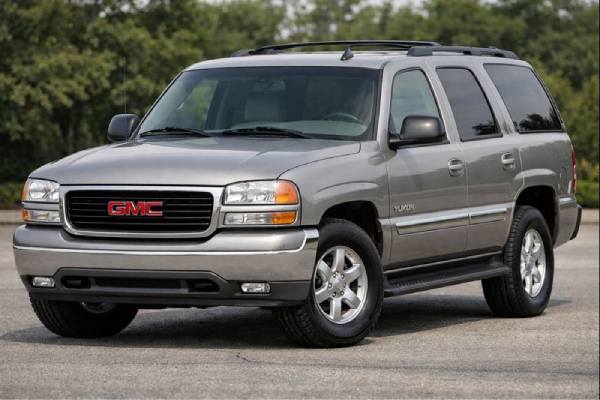
A 2000–2006 GMC Yukon 4WD on the GMT800 platform is a traditional body-on-frame SUV built around GM’s proven truck hardware. In LR4 4.8L form (275 hp), the Gen III Vortec V8 favors simplicity and serviceability: iron-block durability, port fuel injection, and a timing chain rather than a belt. The 4WD system adds real all-weather capability, but it also adds maintenance points—front axle components, a transfer case, and an extra driveshaft—so condition matters as much as mileage. This Yukon’s ownership story is usually decided by a few systems: transmission heat management, front-end steering and suspension wear, cooling-system health, and keeping 4WD fluids clean and correct. Buy the best-maintained example you can, baseline it with fluids and inspections, and you get a comfortable highway cruiser that can tow confidently and handle snow or muddy access roads with far less drama than most crossovers.
Quick Specs and Notes
- True truck-based 4WD with low range available on many builds, useful for snow, ramps, and slow-speed pulling
- LR4 4.8L V8 is straightforward to maintain, with wide parts availability and strong diagnostic support
- Stable towing manners when equipped with the factory tow package and the right axle ratio
- Budget for front driveline and transfer-case upkeep as the truck ages (fluids and seals matter)
- Service transfer case fluid about every 80,000–100,000 km (50,000–60,000 mi) or sooner with heavy use
Contents and shortcuts
- Yukon 4WD design and layout
- Technical tables for LR4 4.8
- Trims, packages, and safety tech
- Failure points, recalls, and fixes
- Service schedule and buyer checklist
- Driving feel, towing, and economy
- Rivals: Expedition, Sequoia, and more
Yukon 4WD design and layout
The GMT800 Yukon is a full-size SUV built like a truck: a body-on-frame chassis, independent front suspension, and a solid rear axle. That structure is a big reason owners like these trucks. The Yukon feels planted on the highway, it tolerates rough pavement and gravel well, and it carries passengers and cargo without the “saggy” feel some car-based SUVs develop with age.
The 4WD version adds a front differential, CV axles, a front driveshaft, and a transfer case. Most trucks use a selectable system with 2HI, 4HI, and 4LO, and many include an “Auto 4WD” mode that can send torque forward when rear wheel slip is detected. In practical terms, that means you can run in 2WD for dry roads, switch to Auto for mixed winter conditions, and use 4HI for deep snow or dirt. Low range (4LO) is not about speed—it’s about control. It multiplies torque at low speeds for slippery ramps, boat launches, crawling through ruts, or pulling a trailer slowly up a grade.
The trade-off is that the added driveline requires attention. A 4WD Yukon has more U-joints, more seals, and more fluid-filled housings than the 2WD version. If those fluids are ignored, the truck can develop binding, whining, or vibration that owners sometimes mistake for “normal truck behavior.” It’s not. A healthy 4WD GMT800 should shift, steer, and track straight without shakes or clunks.
The LR4 4.8L V8 sits at the sensible end of the power spectrum for this platform. It moves the Yukon well, but it will downshift more often than a 5.3L when loaded, especially with taller axle ratios. For reliability, that’s not automatically a negative—what matters is heat management. If the cooling system and transmission are kept in good condition, the drivetrain can live a long time. If the truck has been towing hard with old fluid, oversized tires, or weak cooling, it tends to “age quickly” in the transmission and front end.
Technical tables for LR4 4.8
The tables below focus on a 2000–2006 GMC Yukon 4WD with the LR4 4.8L V8. Exact numbers vary by model year, axle ratio, tire size, and option content, so treat this as a baseline and verify with your VIN and RPO codes.
Engine and performance
| Item | Spec |
|---|---|
| Code | LR4 (Vortec 4800, Gen III) |
| Engine layout and cylinders | V8, OHV pushrod, 2 valves/cyl |
| Displacement | 4.8 L (4,807 cc) |
| Bore × stroke | 96.0 × 83.0 mm (3.78 × 3.27 in) |
| Induction | Naturally aspirated |
| Fuel system | Sequential MPFI (port injection) |
| Compression ratio | ~9.5:1 (varies slightly by year/calibration) |
| Max power | 275 hp (205 kW) @ ~5,200 rpm |
| Max torque | ~393 Nm (290 lb-ft) @ ~4,000 rpm |
| Timing drive | Chain |
| Emissions / efficiency standard | EPA (North America) |
| Rated efficiency (example) | 2005 Yukon 1500 4WD 4.8: 14/19/16 mpg (US) city/hwy/comb (~16.8 / 12.4 / 14.7 L/100 km) |
| Real-world highway @ 120 km/h (75 mph) | Often ~14–17 L/100 km (14–17 mpg US), depending on tires, load, wind, and gearing |
Transmission and 4WD driveline
| Item | Spec |
|---|---|
| Transmission | 4-speed automatic (4L60-E family) |
| Gear ratios | 1st 3.06 / 2nd 1.63 / 3rd 1.00 / 4th 0.70 / Rev 2.29 |
| Final drive ratio | Commonly 3.42 or 3.73 (verify RPO) |
| Drive type | 4×4 (part-time with Auto mode on many trucks) |
| Transfer case | Commonly Autotrac 2-speed (model varies by year/trim) |
| Low range ratio | Typically ~2.7:1 on 2-speed cases (verify by tag/RPO) |
| Differentials | Usually open; G80 locker depends on build content |
Chassis and dimensions
| Item | Spec |
|---|---|
| Suspension (front/rear) | Independent torsion-bar front / solid axle rear with coil springs and links |
| Steering | Power steering, recirculating ball; ratio varies |
| Brakes | 4-wheel disc ABS (sizes vary by year/package) |
| Wheels/tyres | 16–17 in common; check door placard for OEM size |
| Ground clearance | Around ~200 mm (~8 in), tire- and suspension-dependent |
| Length / width / height | ~5,050 / 2,010 / 1,880 mm (~198.9 / 79.1 / 74.0 in) |
| Wheelbase | ~2,946 mm (~116.0 in) |
| Turning circle | ~12.3 m (~40 ft), varies |
| Curb weight | Often ~2,350–2,550 kg (~5,180–5,620 lb), build-dependent |
| Fuel tank | ~98 L (26 US gal / 21.6 UK gal) |
Fluids and service capacities
| Item | What matters | Notes |
|---|---|---|
| Engine oil | Correct viscosity and quality filter | Typical fill ~5.7 L (6.0 US qt) with filter |
| Coolant | Correct long-life coolant type and mix | Capacity varies; verify service info |
| ATF | Correct spec fluid and temperature control | Pan service is less than total fill |
| Front and rear diff oil | Correct gear oil for axle | Shorten interval if towing or water exposure |
| Transfer case fluid | Correct transfer-case-specific fluid | Important for Auto 4WD clutch performance |
Key torque specs
| Fastener | Torque |
|---|---|
| Wheel lug nuts (common GMT800 spec) | ~190 Nm (140 lb-ft) |
| Spark plugs (Gen III LS-family typical) | ~15 Nm (11 lb-ft), confirm plug spec and head type |
Trims, packages, and safety tech
With GMT800 Yukons, the badge on the liftgate matters less than the equipment underneath. A 4WD LR4 truck can be a mild family hauler or a genuinely capable tow-and-snow machine depending on axle ratio, cooling hardware, and the specific 4WD system. When you shop, prioritize the options that change capability and long-term costs.
Trims and options that change the driving experience
- Axle ratio selection: This is the quiet “performance package” on the 4.8L. A 3.73 truck generally feels more eager off the line and holds gears better on grades than a 3.42. That can reduce transmission hunting under load.
- Tow package content: A factory tow package typically adds a receiver hitch, proper wiring, and (often) extra cooling. For a 4.8L Yukon, cooling is not a luxury—heat is what shortens transmission life.
- G80 locking differential (when equipped): Even with 4WD, a locking rear differential can help you move cleanly when one rear wheel is on ice or a wet patch. It can also reduce the need to use 4HI on marginal surfaces.
- Wheel and tire packages: Oversized wheels and aggressive all-terrains can look right on a Yukon, but they can also increase steering effort, raise tire costs, and reduce fuel economy. On older GMT800 front ends, heavy tires accelerate wear in idler and pitman arms and wheel hubs.
Seating and interior equipment checks
Many trucks are 7–9 passenger configurations. Make sure:
- Third-row mounts and latches are intact
- Seatbelts retract smoothly and lock properly
- HVAC works in all zones (rear HVAC repairs can become time-consuming)
Safety ratings and what to verify
Early-2000s SUVs don’t always have clean, consistent public crash-test coverage by exact body and driveline configuration. The smart approach is to check your exact year using official sources and treat “no rating shown” as “not tested or not available,” not as a good or bad result.
Safety systems and driver assistance
Expect conventional safety equipment rather than modern ADAS:
- Front airbags and seatbelt pretensioning strategies typical of the era
- ABS standard; traction control and stability control depend on year/trim and should be verified by VIN/build content
- Child-seat anchoring provisions improved through the early 2000s; confirm tether anchors and lower anchors are present and undamaged
For family duty, prioritize a truck with a clean SRS history (no airbag light), unmodified seats and belts, and no evidence of flood damage or wiring hacks.
Failure points, recalls, and fixes
A GMT800 Yukon 4WD can be very dependable, but it has predictable wear patterns. The key is to separate “common, manageable fixes” from “neglect that turns expensive.” Below is a practical way to think about issues by prevalence and cost tier, with 4WD-specific notes.
Common issues (medium cost, high impact)
- 4L60-E wear and heat stress:
Symptoms: delayed engagement, flare on upshifts, shudder on light throttle, slipping 3–4, harsh downshifts.
Root causes: old fluid, heat from towing or city driving, valve body wear, tired converter, worn clutches.
Fix strategy: check fluid condition and cooling first; if it’s already slipping, a quality rebuild (not just a quick flush) is usually the correct path. - Front-end steering and suspension wear:
Symptoms: wander at speed, clunks over bumps, uneven tire wear, brake shimmy, vague on-center feel.
Root causes: idler and pitman arms, tie rods, ball joints, wheel hubs/bearings, worn shocks.
Fix strategy: inspect with the vehicle loaded on its wheels; align after parts replacement; avoid oversized tires if durability is the goal.
4WD-specific problems (common to occasional)
- Transfer case wear and fluid sensitivity: Auto 4WD systems rely on clean, correct fluid for clutch operation. Dirty or incorrect fluid can lead to chatter, binding, or inconsistent engagement.
- Front driveshaft and CV axle wear: Clicking on turns (CV joints), vibration under load (U-joints), or leaks at seals can appear as mileage climbs.
- Encoder motor or switch issues: If 4WD selection becomes intermittent, confirm the basics (battery voltage, grounds, connectors) before replacing major components.
Occasional problems (low to medium cost)
- Knock sensor harness water intrusion (Gen III trait): can trigger fault codes and reduce performance.
- Fuel pump module fatigue: long crank, loss of power under load, or pump noise.
- Instrument cluster gauge errors: misleading speed, fuel level, or charging readings.
Recalls and service actions
Recall coverage depends on VIN and model year. The best practice is simple:
- Run an official VIN recall lookup.
- Ask for paperwork showing completion.
- Confirm that ABS and airbag lights behave correctly at key-on and do not remain on.
A Yukon with completed recall work, consistent fluid services, and a tight front end is typically a much safer long-term bet than a “low-mile” truck with no records.
Service schedule and buyer checklist
A 4WD Yukon rewards “boring maintenance.” The goal is to keep fluids fresh, stop small leaks before they become big leaks, and prevent heat-related failures—especially in the transmission and transfer case.
Practical maintenance schedule
- Engine oil and filter: every 8,000–12,000 km (5,000–7,500 mi) or 6 months. Use the shorter interval for short trips, heavy city use, hot climates, or towing.
- Engine air filter: inspect at every oil change; replace about every 24,000–48,000 km (15,000–30,000 mi) depending on dust.
- Cabin air filter (if equipped): every 24,000–32,000 km (15,000–20,000 mi) or annually.
- Coolant: if history is unknown, treat it as due; then follow the long-life interval only once the system is clean and stable.
- Spark plugs: if you don’t have proof of service, baseline them and inspect coils and wires/boots at the same time.
- Transmission fluid: prioritize condition. For towing or frequent city driving, plan more frequent service than “lifetime.” A common real-world interval is 40,000–80,000 km (25,000–50,000 mi) depending on use and temperature control.
- Transfer case fluid: about every 80,000–100,000 km (50,000–60,000 mi), sooner if you use Auto 4WD often or the truck sees water crossings.
- Front and rear differential fluid: every 80,000–120,000 km (50,000–75,000 mi), sooner with towing or water exposure.
- Brake fluid: every 2–3 years, regardless of mileage.
- Tire rotation and alignment check: rotate every 8,000–12,000 km (5,000–7,500 mi); align if wear is uneven or after steering work.
Buyer’s inspection checklist
- 4WD operation: verify 2HI, Auto (if equipped), 4HI, and 4LO engagement. Listen for grinding, binding, or repeated clunks.
- Transmission health: smooth engagement in Drive and Reverse, no flare on 2–3 or 3–4, and no burnt ATF smell.
- Cooling performance: stable temperature at idle and during a longer hill climb; heater output consistent.
- Front driveline: check CV boots for tears, front hubs for play/noise, and driveshaft U-joints for slop.
- Rust and corrosion: brake and fuel lines, frame rails, rear suspension mounts, and rocker seams (region-dependent).
- Electrical sanity: gauges credible, charging stable, no signs of parasitic drain, and no hacked wiring for trailer or audio.
Smart “first month” baseline
If you buy a truck with unknown history, a smart baseline usually includes: all driveline fluids, engine oil and filter, a careful inspection of belts and hoses, brake fluid, a full front-end check, and tire alignment. It’s the most cost-effective way to make the Yukon feel tight and predictable.
Driving feel, towing, and economy
On the road, a GMT800 Yukon 4WD drives like a well-damped truck: calm at speed, comfortable over broken pavement, and predictable when you ask it to work. When everything is in good condition, it tracks straight with a relaxed steering feel. When it isn’t, it can feel “loose,” and that looseness is usually fixable—shocks, steering linkages, and wheel hubs make a bigger difference here than people expect.
Powertrain character
The LR4 4.8L is smooth and willing, but it’s moving a heavy SUV plus the extra mass and rotating components of 4WD. In day-to-day driving, it’s responsive at light throttle and happy to cruise, but it will downshift on grades and during passes more readily than a 5.3L or 6.0L. The transmission’s behavior is a good diagnostic tool: a healthy 4L60-E should shift cleanly without flare, and it should not “hunt” constantly on flat roads. If it does, look at tire size, axle ratio, and transmission condition before assuming it’s normal.
Ride, handling, and NVH
- Ride: Generally comfortable, especially on OEM tire sizes and fresh shocks.
- Handling: Not sporty, but stable. Body roll is present and should feel controlled, not “wallowy.”
- Braking: Adequate when pads, rotors, and fluid are fresh. The Yukon’s weight means brake maintenance is not optional.
- Noise: Tire choice matters. Aggressive all-terrains add noticeable hum and can reduce fuel economy.
4WD behavior in the real world
Auto 4WD (when equipped) is especially useful in mixed conditions—wet roads, patchy snow, or gravel—because it can add front torque without forcing you to run 4HI all the time. 4HI is better for deeper snow or consistent low-traction surfaces. 4LO is for slow-speed control and torque multiplication, not for driving fast.
Real-world efficiency
For a reference point, official EPA estimates for a 2005 Yukon 1500 4WD with the 4.8L and 4-speed automatic are 14 mpg city / 19 mpg highway / 16 mpg combined (US), which is about 16.8 / 12.4 / 14.7 L/100 km. In practice, expect:
- City-heavy use: often ~16–20 L/100 km (12–15 mpg US)
- Steady highway: often ~14–17 L/100 km (14–17 mpg US) at 120 km/h (75 mph), depending on wind, load, and tires
- Towing: a meaningful penalty; plan fuel stops conservatively and monitor transmission temperature if equipped
Rivals: Expedition, Sequoia, and more
Shopping a GMT800 Yukon 4WD usually means cross-shopping other early-2000s full-size SUVs: Ford Expedition, Toyota Sequoia, and later Nissan Armada, plus niche picks like the Land Cruiser 100-series if budget allows. The “best” choice is often the best-maintained example, but each platform has distinct strengths.
Ford Expedition (4×4, 4.6/5.4 era)
- Where the Yukon wins: broad GM truck parts ecosystem, huge shop familiarity, and a very well-understood chassis. The Yukon’s drivetrain support is excellent in most regions.
- Where the Expedition can win: ride comfort and interior packaging can suit some families better.
- What decides it: maintenance records and driveline feel on a test drive. A sloppy front end or tired transmission is expensive on any platform.
Toyota Sequoia (4WD, 4.7 V8)
- Where the Yukon wins: usually lower purchase price and often lower parts costs, plus very accessible DIY support.
- Where the Sequoia wins: strong long-term durability reputation and consistent build quality when cared for.
- What decides it: budget and condition. If the Sequoia is priced high, insist on excellent maintenance proof; the Yukon can be the better value if you’re willing to baseline and refresh wear items.
Nissan Armada (4WD, early 5.6 era)
- Where the Yukon wins: predictable service ecosystem and plentiful interchangeable parts across GM trucks and SUVs.
- Where the Armada wins: strong power and towing feel, depending on year and configuration.
- What decides it: how confident you are in local parts supply and specialist knowledge.
How the Yukon 4WD fits today
The Yukon’s advantage is not that it’s perfect; it’s that it’s straightforward. The systems that fail are known, the fixes are widely documented, and you can keep the truck reliable by staying ahead of fluids, heat, and front-end wear. If your use case includes winter roads, unpaved access, or towing on mixed surfaces, the 4WD Yukon is often a better “real life” tool than a 2WD truck—provided you maintain the extra driveline properly.
References
- GM Owner Manuals 2006 (Owner’s Manual)
- Gas Mileage of 2005 GMC Yukon 2005 (Fuel Economy)
- Check for Recalls: Vehicle, Car Seat, Tire, Equipment | NHTSA 2025 (Recall Database)
- Car Safety Ratings | Vehicles, Car Seats, Tires | NHTSA 2025 (Safety Rating)
Disclaimer
This article is for informational purposes only and is not a substitute for professional inspection, diagnosis, or repair. Specifications, torque values, fluid types, capacities, and service intervals can vary by VIN, market, model year, and installed equipment—verify details using your vehicle’s official owner information and service documentation.
If this guide helped you, please consider sharing it on Facebook, X (Twitter), or your preferred community to support our work.