
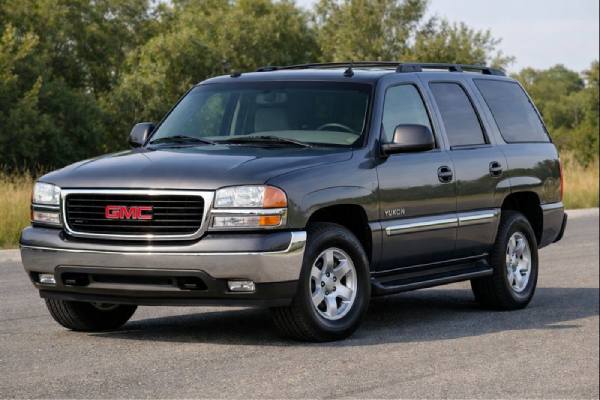
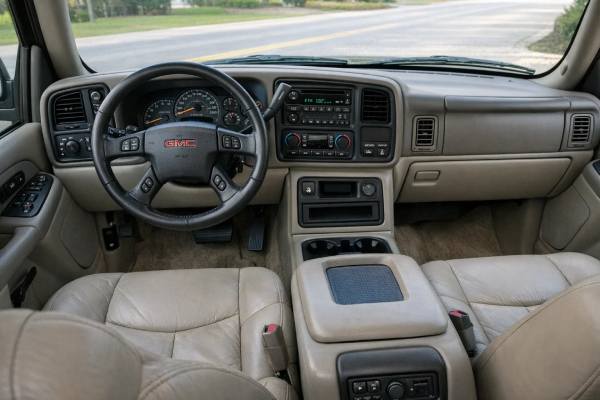
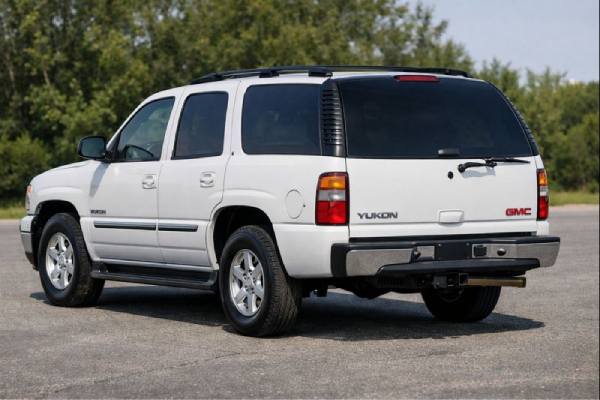
The 2000–2006 GMC Yukon 4WD on the GMT800 platform is a classic body-on-frame SUV built around simple, durable hardware: an iron-block 5.3L LM7 V8, a conventional 4-speed automatic, and a truck-grade 4WD system meant for real weather and real work. Its strengths are easy to understand—strong parts availability, straightforward service access, and towing capability that still fits modern needs.
Ownership is mostly about staying ahead of age-related wear. These trucks can run for a long time, but they do not forgive neglected fluids, rusty brake lines, or a transfer case that never gets serviced. Buy the cleanest example you can, confirm the exact axle ratio and 4WD setup from the RPO codes, and budget for baseline “catch-up” maintenance. Do that, and a GMT800 Yukon can still be a practical, confident winter and towing tool.
Owner Snapshot
- Truck-frame stability and strong towing manners for a full-size SUV.
- Simple, widely supported 5.3L V8 and driveline parts almost everywhere.
- 4WD systems range from basic and tough to more complex Auto 4WD—know which you have.
- Transfer case service matters; ignored fluid can shorten encoder motor and case life.
- Plan on engine oil changes at least every 12 months or when the oil life monitor calls for service.
What’s inside
- LM7 4WD Yukon in context
- LM7 5.3 technical sheet
- VIN options and safety features
- Trouble spots and official fixes
- Upkeep plan and purchase checklist
- Snow traction, towing, and fuel use
- How it stacks up today
LM7 4WD Yukon in context
GMT800 Yukon 4WD models sit on a fully boxed (front) truck frame with a separate body shell, which is the key reason they tow and track so confidently compared with car-based crossovers. The suspension is also fundamentally truck-like: independent front suspension with torsion bars up front and a solid rear axle on coil springs out back. That layout is not about sharp cornering. It is about controlling mass, keeping alignment stable under load, and surviving rough roads, snow, and dirt without delicate subframes.
The LM7 5.3L V8 is a core part of the appeal. It is a traditional pushrod (OHV) V8 with two valves per cylinder—simple by modern standards, but proven. It delivers easy low- and mid-range torque that suits a heavy SUV, especially in slippery conditions where smooth throttle control matters more than peak horsepower. The 4-speed automatic (most commonly 4L60-E) is also familiar to almost every transmission shop, which keeps ownership practical.
Where buyers need to slow down is in the details of the 4WD system. Many Yukons of this era use a two-speed transfer case with a low range for deep snow, steep grades, or careful maneuvering. Some include Auto 4WD (sometimes called “AutoTrac”), which can automatically send torque to the front when rear slip is detected. Auto 4WD is convenient, but it adds more electronics and wear points than a basic 2HI/4HI/4LO setup. Neither is “bad”—you just maintain them differently and diagnose them differently.
Year-to-year differences matter less than condition, but there are still useful patterns. Later trucks often have more refined interior trim, more mature stability and traction control calibrations, and small running changes that help long-term use. Earlier trucks can be excellent value, but they are now old enough that corrosion and wiring condition become the deciding factor. A clean, dry, well-documented Yukon is almost always a better buy than a newer but rusty or poorly maintained example—especially for a 4WD vehicle where brake lines, front differential seals, and transfer case operation are critical.
LM7 5.3 technical sheet
Below are practical, ownership-focused specifications for a GMT800 Yukon 4WD with the 5.3L LM7. Exact values vary by model year, calibration, axle ratio, and equipment, so treat numbers as “typical,” then verify by VIN and RPO codes.
Engine and performance (LM7 5.3)
| Item | Spec |
|---|---|
| Code | LM7 |
| Layout | 90° V8, OHV |
| Valvetrain | 2 valves/cyl (16 valves total) |
| Bore × stroke | 96.0 × 92.0 mm (3.78 × 3.62 in) |
| Displacement | 5.3 L (5,328 cc) |
| Induction | Naturally aspirated |
| Fuel system | Sequential port fuel injection (PFI) |
| Compression ratio | ~9.5:1 (varies by year) |
| Max power | 285 hp (213 kW) @ ~5,200 rpm (varies by calibration) |
| Max torque | ~441 Nm (325 lb-ft) @ ~4,000 rpm (typical) |
| Timing drive | Chain |
| Fuel | Regular gasoline (typical) |
Transmission and driveline
| Item | Spec |
|---|---|
| Transmission | 4-speed automatic (commonly 4L60-E) |
| Gear ratios | 1st 3.06 / 2nd 1.62 / 3rd 1.00 / 4th 0.70 / Rev 2.29 |
| Drive type | Part-time 4WD or Auto 4WD (equipment-dependent) |
| Transfer case | 2-speed, low range available on many trims (varies) |
| Differential | Open or optional locking (RPO-dependent) |
Rated efficiency (example EPA listing)
Fuel economy depends heavily on 4WD type, tire size, and axle ratio. As a reference point, FuelEconomy.gov listings for a 2005 Yukon 1500 4WD 5.3L 4-speed show ratings such as:
- 13 mpg city / 18 mpg highway (about 18.1 / 13.1 L/100 km)
- Some configurations list 13 / 17 mpg (about 18.1 / 13.8 L/100 km)
Chassis and dimensions (short wheelbase Yukon)
| Item | Typical spec (ranges across years and trims) |
|---|---|
| Suspension (front/rear) | IFS torsion bars / solid axle with coils |
| Brakes | 4-wheel discs (typical) |
| Length | ~5,050 mm (~199 in) |
| Width | ~2,000 mm (~79 in) |
| Wheelbase | ~2,946 mm (~116 in) |
| Turning circle | ~11.8–12.2 m (~39–40 ft), equipment dependent |
| Curb weight | ~2,400–2,600 kg (~5,300–5,700 lb), equipment dependent |
Capacities and key torques (useful owner numbers)
| Item | Spec |
|---|---|
| Fuel tank (short wheelbase) | 98 L (26 US gal / 22 UK gal) |
| Transfer case fluid (4WD) | ~1.9 L (2.0 US qt) |
| Wheel nut torque | 190 Nm (140 lb-ft) |
Safety and driver assistance (era-appropriate)
| Item | Notes |
|---|---|
| Airbags | Front airbags standard; side curtain availability varies by year and trim |
| ABS | Standard on most configurations |
| Stability and traction control | Available; standardization and names vary by year/trim |
| Crash ratings | Check by model year on NHTSA vehicle pages; test protocols vary by year |
VIN options and safety features
On GMT800 trucks, “trim level” tells you less than the option content. Two 2004 Yukons can look identical but drive and tow very differently depending on axle ratio, transfer case type, cooling package, and stability system. The fastest way to stop guessing is the RPO (Regular Production Option) code label—usually in the glovebox. That label is your equipment truth.
Start with driveline and towing identifiers. Axle ratio codes are the difference between “fine around town” and “confident with a trailer.” A 3.73 axle generally feels more relaxed under load than a taller ratio, and it can reduce gear hunting on grades. If the Yukon has the factory trailering package, you may also see heavier-duty cooling hardware and wiring provisions that make ownership easier. For winter use, check whether the truck has a locking rear differential (often marketed as a limited-slip or locking feature depending on label language). It can be a real advantage on icy driveways, snowed-in parking lots, and wet boat ramps.
Now focus on the 4WD system itself. Some trucks use a simple selector for 2HI/4HI/4LO; others add Auto 4WD. Auto mode can be excellent for mixed winter driving—dry pavement alternating with patches of ice—because it can reduce driveline bind while still reacting to slip. The trade-off is complexity: encoder motors, sensors, and control modules become part of your maintenance world. When shopping, confirm that every range engages cleanly, the indicator lights behave correctly, and there is no grinding, delay, or repeated clicking from the dash area during shifts.
Safety equipment also evolved during this era, but it is not uniform across all trims and years. Expect front airbags and ABS as the baseline. Side airbags and side curtain airbags—when present—improve real-world protection in side impacts, but availability varies. Stability control can also vary by year and trim; some trucks have only traction control, while others add yaw control (stability) that can help keep the vehicle pointed straight during abrupt maneuvers, especially on snow. If you plan to tow, stability and trailer wiring integration are worth prioritizing.
Because these vehicles predate modern ADAS, you should set expectations correctly. There is no factory automatic emergency braking or lane centering here. Your best “driver assistance” is correct tires, healthy brakes, functioning ABS and stability systems, and clear headlights. A well-maintained GMT800 can be safe in the real world, but you must respect its age: crash-test protocols, airbag coverage, and structural design are not the same as a 2020s SUV. The practical approach is to verify equipment, keep the fundamentals strong, and drive it like the heavy, high-center-of-gravity vehicle it is.
Trouble spots and official fixes
Reliability on a GMT800 Yukon 4WD is less about one “fatal flaw” and more about predictable wear points that show up as the vehicle ages. Think in three buckets: common low-cost annoyances, occasional medium-cost repairs, and rarer high-cost events.
Common (low to medium cost):
- Instrument cluster stepper motors and gauges: Symptoms include dead speedometer, erratic fuel gauge, or backlight issues. Remedy is cluster rebuild or replacement.
- HVAC blend door and actuator failures: Clicking behind the dash, stuck temperature, or weak defrost control. Remedy is actuator replacement and recalibration.
- Steering clunk and loose-feeling front end: Often the intermediate steering shaft, plus wear in idler and pitman arms. Remedy is updated shaft or lubrication (if applicable) and worn link replacement.
Occasional (medium cost):
- Fuel pump wear: Long crank, stumble under load, or no-start. Remedy is pump module replacement; inspect wiring and ground points at the same time.
- Knock sensor water intrusion: Can trigger a check-engine light and reduced performance. Remedy often involves resealing and replacing sensors and addressing water paths under the intake.
- Cooling system aging: Water pumps, radiators, and plastic fittings can seep or fail after many heat cycles. Remedy is proactive replacement and correct coolant choice.
4WD-specific (medium to high cost depending on damage):
- Transfer case encoder motor or range shift issues: Delayed engagement, flashing mode lights, or stuck in one range. Remedy can be motor replacement, switch repair, wiring cleanup, or module diagnosis.
- Transfer case internal wear from neglected fluid: Whine, binding, or metal in fluid. Remedy ranges from fluid service to rebuild; early attention is cheaper.
- Front differential and CV joint wear: Leaks at seals, vibration under load, clicking on turns. Remedy is seal service and CV replacement as needed.
Less common (high cost):
- Automatic transmission failures due to heat and neglected fluid: Slipping, harsh shifts, or delayed engagement. Heavy towing, oversized tires, and old fluid raise risk. Remedy is rebuild or replacement; an auxiliary cooler and proper service intervals help.
For official actions, do not rely on memory—use the VIN. A 2002 Yukon and a 2002 Yukon can have different recall completion histories. Your best process is:
- Run the VIN through the official recall database.
- Ask the seller for dealer printouts or service invoices showing recall completion.
- If anything is unclear, confirm with a GMC dealer using the VIN.
Also remember that many “recall-like” issues were handled through technical service bulletins (TSBs) rather than safety recalls. TSBs can still matter because they often point to updated parts, revised diagnostic steps, or known failure patterns. If you are paying for a pre-purchase inspection, ask the shop to scan all modules for stored codes, test the 4WD range engagement, and check for hidden rust at brake and fuel lines. Those findings often matter more than the engine’s idle quality in the driveway.
Upkeep plan and purchase checklist
A GMT800 Yukon stays reliable when you treat it like the truck it is: fluids, steering joints, brakes, and tires first—cosmetics second. The goal is to prevent small problems (heat, leaks, rust) from becoming expensive failures.
Practical maintenance schedule (baseline)
Use this as a starting point, then match it to your exact service manual and driving conditions.
| Service item | Normal use | Severe use (short trips, heavy city, towing, deep dust, frequent 4WD) |
|---|---|---|
| Engine oil and filter (5W-30 typical) | Oil life monitor or at least 12 months | Shorter intervals; do not stretch |
| Engine air filter | Inspect regularly; replace around 50,000 mi (83,000 km) rhythm | Inspect every oil change in dusty use |
| Cabin air filter (if equipped) | 12 months | 6–12 months |
| Automatic transmission fluid and filter | Around 100,000 mi (166,000 km) | About every 50,000 mi (83,000 km) |
| Transfer case fluid (4WD) | About every 50,000 mi (83,000 km) | More often if used hard or in water/snow |
| Spark plugs and wire inspection | Around 100,000 mi (166,000 km) | Sooner if misfires occur |
| Engine coolant | Follow long-life interval; also respect time (about 5 years) | Shorter if contaminated or mixed coolant used |
| Brake fluid | Every 2–3 years | Every 2 years |
| Differential fluid | Condition-based; sooner if towing or water intrusion | Regular intervals; inspect for contamination |
| Tire rotation and alignment check | Every 8,000–12,000 km (5,000–7,500 mi) | Same, plus more frequent pressure checks |
Fluids and key torque you should know
- Wheel nuts: 190 Nm (140 lb-ft)
- Transfer case fluid capacity: ~1.9 L (2.0 US qt)
- Fuel tank: 98 L (26 US gal / 22 UK gal)
Even if you do not do your own work, knowing these helps you spot bad shop habits (under-torqued wheels, “universal” fluid choices, skipped transfer case service).
Buyer checklist (what actually matters)
Rust and structure
- Inspect brake lines, fuel lines, and frame rails—especially around brackets and rear sections.
- Check rocker panels and lower door seams for bubbling paint.
Driveline
- Cold start the truck and test 2HI → 4HI → 4LO engagement (on a proper surface and following the owner’s manual procedure).
- Listen for clunks on takeoff and on/off throttle transitions (U-joints, mounts, driveline play).
Front end and steering
- Drive over small bumps and apply gentle steering inputs—wandering or clunking often signals worn idler/pitman arms or ball joints.
- Check for uneven tire wear, which can indicate alignment or component wear.
Cooling and transmission
- Look for pink crust at radiator end tanks, seepage at water pump, and coolant condition.
- During a test drive, verify smooth 1–2 and 2–3 shifts and stable converter lockup at cruise.
Electronics
- Verify gauge operation, HVAC temperature control, window regulators, and 4WD mode lights.
Finally, choose the configuration that fits your use. If you tow often, prioritize a verified tow package, a healthy transmission, and the axle ratio that matches your load. If you drive mostly in winter mixed conditions, Auto 4WD can be genuinely helpful—just commit to maintaining the transfer case and diagnosing it correctly when it acts up.
Snow traction, towing, and fuel use
A GMT800 Yukon 4WD feels like a large, stable platform—because it is. The steering is typically light-to-moderate with a slower ratio than modern crossovers, and the suspension is tuned for load control more than sporty response. On the highway, that translates to good straight-line calm, especially with proper tires and tight front-end components. If the front end is worn, you will feel it immediately as wander, shimmy, or a “loose” response to small steering corrections.
The LM7 5.3L V8 suits the vehicle’s mission. Throttle response is usually clean at low rpm, and the engine’s torque curve makes it easy to roll away smoothly in slippery conditions. The 4-speed automatic is not fast by modern standards, but it is predictable. Under load, it will downshift early and hold gears longer—normal behavior when the vehicle is working. If you feel repeated hunting between 3rd and 4th on mild grades, that can be a sign of tall axle gearing, oversized tires, or a transmission that is not as healthy as it should be.
In snow, the biggest performance variable is not the engine—it is tires and the 4WD system mode. With good winter tires, 4HI provides confident traction for steady-speed roads. Auto 4WD (if equipped) is especially useful when roads alternate between dry and icy, because it can reduce binding while still reacting to slip. A locking rear differential (if equipped) also matters at low speeds, such as climbing a snowy driveway, crossing rutted parking lots, or pulling a trailer on a slick ramp.
Towing is where the Yukon’s fundamentals pay off. The frame, wheelbase, and mass help it feel composed with a properly set up trailer. The driver’s job is temperature management and braking margin. Keep the cooling system healthy, use the correct transmission service interval for your usage, and do not underestimate how quickly speed builds on long descents with a heavy load. A weight-distributing hitch and trailer brakes are not “nice to have” on bigger trailers—they are part of towing safely.
Fuel use is the trade-off. Expect real-world consumption to vary widely by speed, tires, and load:
- Mixed driving: often around 15–18 L/100 km (13–16 mpg US)
- Highway at 120 km/h (75 mph): commonly around 14–17 L/100 km (14–17 mpg US)
- Towing: plan on a significant penalty; 30–60% more fuel is a reasonable mental model depending on trailer size and speed
If you want the best ownership experience, treat “tight front end + good tires + fresh fluids” as performance upgrades. On these trucks, that combination improves safety, confidence, and comfort more than almost any bolt-on part.
How it stacks up today
When you compare a 2000–2006 Yukon 4WD with the 5.3L to its era rivals, it helps to separate three questions: durability, capability, and daily livability. On durability and serviceability, the GMT800 platform still scores well. Parts availability is excellent, most driveline shops know the mechanical layout, and the engine bay is relatively straightforward to work in compared with many newer SUVs packed with turbo plumbing and tightly packaged cooling modules.
Against a Ford Expedition of the same era, the Yukon typically feels more “truck-like” in steering and front-end wear sensitivity, but it often wins on drivetrain familiarity and the breadth of aftermarket support. Expeditions can be great tow vehicles too, yet the ownership experience can be more dependent on how a specific truck was maintained and which engine and transmission combination it has.
Against a Toyota Sequoia (early 2000s), the Sequoia has a strong reputation for long-term durability, especially in engine smoothness and interior longevity. The trade-off is often cost and parts pricing, and the Toyota may not match the GM ecosystem for inexpensive used components in some markets. If you value “set-and-forget” refinement, the Sequoia can be compelling. If you value easy local repairs and plentiful parts, the Yukon stays attractive.
Against a Nissan Armada (mid-2000s), the Armada offers strong power and a roomy cabin, but fuel use is not meaningfully better, and long-term ownership can depend more on model-specific issues and parts access. The Yukon’s advantage is the sheer volume of GMT800 trucks on the road and the knowledge base around keeping them going.
The Yukon’s biggest “today” disadvantage is safety modernization. Even a well-maintained GMT800 does not offer modern crash structures, headlight performance, or ADAS. That does not make it unsafe by default—but it does mean you should be honest about the vehicle’s era. The best way to offset that is to keep braking, tires, and lighting in top condition and to drive with more margin than you would in a newer SUV.
If your priorities are winter traction, towing stability, and a platform you can maintain without specialized tools, the 2000–2006 Yukon 4WD with the LM7 is still a valid choice. Buy for condition and documentation, verify the exact options by RPO codes, and assume you will do baseline catch-up service right away. Do those things, and this truck can still earn its keep.
References
- 2006 GMC Yukon, Yukon XL Owner Manual M 2006 (Owner’s Manual)
- Gas Mileage of 2005 GMC Yukon 2025 (Fuel Economy Database)
- Vehicle Detail Search – 2005 GMC YUKON 4-DR | NHTSA 2025 (Safety Ratings and Recalls)
- Check for Recalls: Vehicle, Car Seat, Tire, Equipment 2025 (Recall Database)
Disclaimer
This article is for informational purposes only and is not a substitute for professional diagnosis, inspection, or repair. Specifications, torque values, service intervals, and procedures vary by VIN, market, and equipment—always verify details using official owner information and service documentation for your exact vehicle.
If you found this guide helpful, please consider sharing it on Facebook, X (Twitter), or your favorite forum to support our work.