
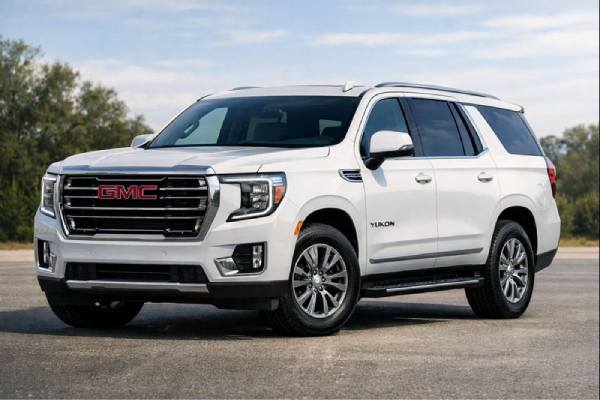
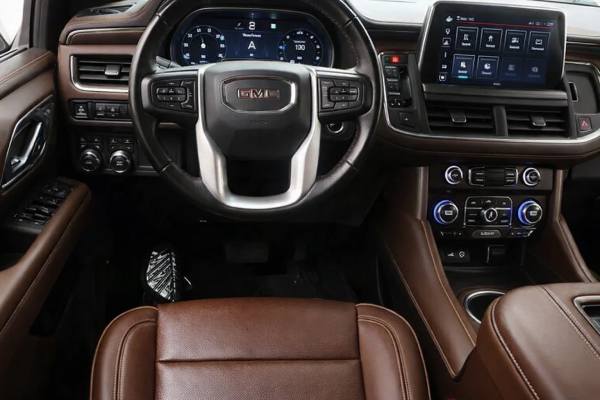
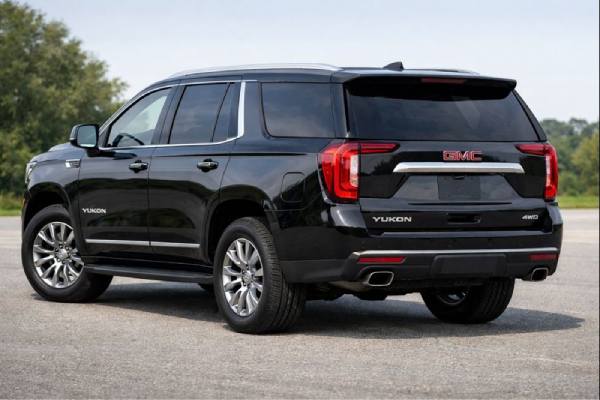
The 2021–2024 GMC Yukon Denali 4WD (T1UG) with the 6.2L L87 V8 is built for buyers who want full-size comfort without giving up real capability. The Denali-specific chassis tuning, available air suspension, and the 2-speed 4WD system make it a strong all-season family hauler that can still tow a meaningful load. The L87’s 420 hp output gives the Yukon effortless passing power, especially at highway speeds and when carrying passengers and cargo.
Ownership comes down to three realities: it’s a large, heavy SUV that rewards careful maintenance; it’s packed with electronics and driver-assistance systems that benefit from correct calibration after repairs; and it uses modern V8 tech (like cylinder deactivation) that can be sensitive to oil quality and service habits. If you plan to tow or keep it long term, the best Denali is the one with documented service and completed recall work.
Top Highlights
- Strong 6.2L V8 output and calm 10-speed behavior make it feel “unstressed” at highway speeds and under load.
- 2-speed 4WD and available eLSD-based system add real traction benefits on snow, ramps, and wet launches.
- Denali comfort hardware (ride control and available air suspension) can noticeably reduce head toss in a big SUV.
- Reliability caveat: confirm L87-related recall and service history before purchase, especially on 2021–2024 builds.
- Typical interval: change engine oil and filter at 12 months / 7,500 miles (12,000 km) or sooner for severe use.
Contents and shortcuts
- Denali 4WD in real life
- L87 6.2 and 4WD specs
- Packages, safety, and ADAS
- Reliability patterns and campaigns
- Maintenance and buyer strategy
- Driving, towing, and economy
- Denali 4WD vs full-size rivals
Denali 4WD in real life
A Yukon Denali 4WD is easiest to understand as a luxury SUV built on a truck foundation. That sounds obvious, but it explains why it does some things exceptionally well (long-distance comfort, towing stability, winter traction) while still carrying the compromises of a tall, heavy body-on-frame platform (fuel use, tire and brake wear, and a lot of mass in emergency maneuvers).
The 4WD system matters because it changes how you can use the Denali year-round. With a 2-speed transfer case, you get a true low range for slow-speed control—useful for steep driveways, boat ramps, deep snow, and controlled descents. In normal driving, the system’s “Auto” behavior (when equipped) can send torque forward when rear traction drops, which is especially helpful with the Denali’s strong low- and mid-range V8 torque.
Denali is also the “comfort-and-control” trim of the Yukon lineup. When the suspension is in good shape and aligned correctly, the truck can feel surprisingly composed for its size. The optional air suspension adds two ownership benefits beyond ride: it can help keep the vehicle level with passengers and cargo, and it can manage height for easier entry, loading, and hitching. The tradeoff is complexity—air springs, compressors, and height sensors are not cheap when they age.
From an ownership standpoint, the best Denali experience is the one you set up correctly:
- Choose tires that match your real driving (touring tires for highway comfort, all-terrain only if you truly need them).
- Keep up with fluids that many owners ignore (transfer case and differential services if you tow or drive in harsh conditions).
- Treat driver-assistance systems like part of the chassis: a wheel alignment, windshield replacement, or bumper repair can require sensor calibration to keep ADAS working as designed.
If you plan to keep the vehicle past warranty, think in systems: powertrain heat management, driveline fluids, and suspension wear all move faster in a 6,000+ lb SUV, especially with towing or heavy city use.
L87 6.2 and 4WD specs
Below are practical, model-relevant specifications for the 2021–2024 Yukon Denali 4WD with the L87 6.2L V8 and 10-speed automatic. Some values vary by equipment (wheel size, suspension, towing package, and Yukon vs Yukon XL), so use them as a decision baseline and verify against your door-jamb label and build sheet.
Engine and performance
| Item | Specification |
|---|---|
| Engine code | L87 |
| Layout and cylinders | V8, overhead valve (OHV), 2 valves/cyl, variable valve timing |
| Bore × stroke | 103.25 × 92 mm (4.06 × 3.62 in) |
| Displacement | 6.2 L (6,162 cc) |
| Induction | Naturally aspirated |
| Fuel system | Direct injection with Dynamic Fuel Management |
| Compression ratio | 11.5:1 |
| Max power | 420 hp (313 kW) @ 5,600 rpm |
| Max torque | 624 Nm (460 lb-ft) @ 4,100 rpm |
| Timing drive | Chain (typical for this engine family) |
| Rated efficiency (example: 2024 4WD 6.2) | 14/18/16 mpg US (city/hwy/comb) ≈ 16.8/13.1/14.7 L/100 km |
Real-world highway at 120 km/h (75 mph) is usually worse than the official highway number because of mass, tire width, and aero. A realistic expectation for steady cruising is often ~14–17 L/100 km (14–17 mpg US) depending on wind, temperature, tires, and speed discipline.
Transmission and driveline
| Item | Specification |
|---|---|
| Transmission | 10-speed automatic (10L80) |
| Gear ratios (1–10) | 4.70 / 2.99 / 2.16 / 1.78 / 1.53 / 1.28 / 1.00 / 0.85 / 0.69 / 0.64 |
| Reverse | 4.87 |
| Final drive ratio | 3.23 |
| Drive type | 4WD |
| Transfer case | AutoTrac 2-speed transfer case (4WD) |
| Traction hardware (availability) | Active Response 4WD system with electronic limited-slip differential available; Max Trailering Package available |
Dimensions and capacities
(Values below reflect the standard-length Yukon unless noted; Yukon XL differs mainly in length, cargo room, and fuel tank size.)
| Item | Specification |
|---|---|
| Length | 210.0 in (5,334 mm) |
| Height | 76.5 in (1,943 mm) |
| Seating | Up to 9 (configuration-dependent) |
| Fuel tank (Yukon) | Approx. 24.0 US gal (≈ 90.8 L) |
| Fuel tank (Yukon XL) | Approx. 28.0 US gal (≈ 106.0 L) |
| Max cargo (behind 1st/2nd/3rd row) | 122.9 / 72.6 / 25.5 cu ft |
| Max cargo Yukon XL (behind 1st/2nd/3rd row) | 144.7 / 93.8 / 41.5 cu ft |
Towing and payload (comparison baseline)
These are comparison ratings; your actual limit depends on passengers, cargo, hitch, and options.
| Model and powertrain | Max GVWR | Max trailer rating | Max payload | With Max Trailering Package |
|---|---|---|---|---|
| Yukon 4WD 6.2L | 7,500 lb | 7,500 lb | 1,616 lb | 8,000 lb |
Fluids, service capacities, and key torque
| Item | Specification |
|---|---|
| Engine oil | 0W-20 dexos (verify exact spec by year); capacity 7.6 L (8.0 US qt) with filter |
| Cooling system | 14.3 L (15.1 US qt) (use correct long-life coolant per manual) |
| Transfer case fluid | 1.5 L (1.6 US qt) |
| Wheel nut torque | 190 Nm (140 lb-ft) |
| Spark plug gap | 1.1 mm (0.043 in) |
Packages, safety, and ADAS
Denali is a trim, but it’s also a collection of “systems choices.” When you’re shopping used, those choices matter as much as mileage because they change ride quality, towing behavior, and long-term repair costs.
Trim and configuration reality
For 2021–2024, Denali sits near the top of the Yukon line and typically includes the 6.2L V8 and a high equipment baseline. Still, two Denalis can feel very different depending on packages:
- Suspension and ride packages
- Magnetic ride control (availability varies) can reduce float and sharpen control on uneven pavement.
- Air Ride Adaptive Suspension (when equipped) improves leveling with loads and can change ride height, but adds components that need attention as the vehicle ages.
- Capability packages
- Max Trailering Package increases the comparison tow rating and typically adds towing-focused hardware and guidance features.
- Active Response 4WD with eLSD (when equipped) can noticeably improve traction when pulling away on slick surfaces or when one rear wheel unloads.
- Cabin and tech packages
Denali buyers often tick boxes for premium audio, upgraded seats, rear entertainment, and trailering camera systems. Those options improve daily life, but they also add modules and sensors that should be checked carefully during a pre-purchase inspection.
Quick identifiers that help when you’re viewing listings:
- Look for Denali badging, the unique grille treatment, and the typical Denali wheel designs.
- Verify 4WD on the dashboard selector and confirm the presence of low range operation during a test drive (in a safe, appropriate location).
- Ask for the window sticker/build sheet or a dealer printout to confirm packages, especially air suspension and trailering tech.
Safety ratings and what they mean here
Full-size SUVs are sometimes rated using tests performed on close platform relatives. In the GM family, the Chevrolet Tahoe is the most commonly published point of reference for the shared structure. The important ownership lesson is not the badge—it’s that headlights, front crash prevention performance, and the newest front-impact tests can vary significantly by model year and equipment level.
Safety systems and driver assistance
Most 2021–2024 Denalis come with a robust set of standard safety tech, then layer more advanced driver assistance as options:
- Common standard features: automatic emergency braking, forward collision alert, pedestrian detection, lane departure warning or lane keep support (equipment varies), stability control, and rear camera systems.
- Common optional/upper-tier features: adaptive cruise control, surround-view cameras, rear pedestrian alert, lane change assistance, and trailering-specific camera and guidance features.
One practical note: after windshield replacement, front bumper repairs, alignment changes, or suspension work, many ADAS features require calibration. If a seller can prove calibrations were performed after collision repairs, that’s a meaningful plus.
Reliability patterns and campaigns
Reliability on a Yukon Denali 4WD is rarely “one thing.” It’s a combination of powertrain durability, the complexity of luxury suspension and electronics, and how the vehicle was used (short trips vs highway, towing vs commuting, salt exposure, and idle time). The L87 6.2L and 10-speed pairing can be excellent, but it rewards disciplined maintenance.
Common vs occasional vs rare issues
Common (ownership-likelihood high)
- Tire wear and alignment sensitivity (low to medium cost): Large wheels and heavy curb weight make alignment and rotation discipline important. Expect faster wear if you skip rotations or run under-inflated tires.
- Brake wear (medium cost): The mass of the vehicle means pads and rotors may not last like they do on lighter SUVs, especially in stop-and-go driving or hilly areas.
- Infotainment and camera glitches (low to medium cost): Software updates often resolve issues, but intermittent camera faults or sensor errors should be treated seriously because they affect safety features.
Occasional (depends on build, mileage, and climate)
- Air suspension component aging (medium to high cost): Leaks, compressor fatigue, or height sensor issues often show up as uneven stance, slow height changes, or warning messages.
- Magnetic ride damper wear (medium to high cost): Ride becomes harsher or less controlled; fluid leaks may appear at higher mileage.
- 4WD system service neglect (medium cost): Transfer case and differential fluids are frequently ignored; contamination or breakdown is more likely if the vehicle tows or sees water/snow use.
Rare but high impact
- L87 internal engine damage/failure risk (high cost): A subset of 2021–2024 L87 engines falls under a safety recall related to internal engine components and potential loss of propulsion. This is not a “maybe later” maintenance item—verify status by VIN and confirm remedy completion.
Symptoms → likely cause → what to do
- Knocking noise, misfire-like shake, or sudden warning lights under load → possible internal engine issue or valvetrain concern → stop towing, check oil level/condition, and get a professional diagnosis immediately.
- Hard shifts, shudder, or inconsistent downshifts → transmission calibration or fluid condition issue → confirm software updates and service history; a road test with a technician can identify torque converter or shift strategy problems.
- 4WD warning message or binding in tight turns → transfer case fluid condition or actuator issue → service the correct fluid and verify operating modes; avoid forcing engagement on dry pavement.
Recalls, TSBs, and how to verify
For a Denali 4WD, verification is straightforward and worth doing every time:
- Run the VIN through the official recall database and print the results.
- Ask the dealer (or a GM service department) for repair history showing completion.
- During inspection, confirm there are no unresolved drivability symptoms that suggest incomplete work.
If you’re buying private-party, treat “it’s fine” as a placeholder until you see documentation.
Maintenance and buyer strategy
A Yukon Denali 4WD will tolerate occasional missed services, but it won’t reward them. The combination of high oil temperatures (big V8), drivetrain load (4WD), and vehicle mass means fluids and wear items do real work every mile. The goal is not over-maintenance—it’s targeted maintenance in the places that prevent expensive failures.
Practical maintenance schedule
Use this as a conservative baseline for long-term ownership; adjust earlier for towing, lots of idling, extreme heat/cold, or frequent short trips.
- Engine oil and filter: every 7,500 miles (12,000 km) or 12 months; consider 5,000 miles (8,000 km) if you tow often, idle heavily, or do mostly short trips.
- Tire rotation and pressure check: every 5,000–7,500 miles (8,000–12,000 km); align at least annually or at any sign of uneven wear.
- Cabin air filter: inspect every 12 months, replace as needed (often yearly).
- Engine air filter: inspect at least yearly; replace earlier in dusty areas or if towing off paved roads.
- Brake fluid: every 2–3 years regardless of mileage (moisture control matters).
- Coolant: follow the vehicle’s official interval; many long-life coolants target 5 years / 150,000 miles, but verify by year and market.
- Transfer case fluid (4WD): often overlooked—consider every 30,000–60,000 miles (48,000–96,000 km) depending on towing and weather exposure.
- Differential fluids: consider every 45,000–60,000 miles (72,000–96,000 km) if towing or driving in harsh conditions.
- Spark plugs: commonly around 97,500 miles (156,000 km) on modern GM V8s, but verify for your exact year.
- 12V battery: test annually after year 3; replacement is common in the 3–5 year window depending on climate.
Fluids and specs that help you make decisions
- Engine oil capacity: 7.6 L (8.0 qt) with filter is useful when pricing a DIY service or checking if a shop quote is reasonable.
- Wheel lug torque: 190 Nm (140 lb-ft) matters if you rotate tires at home or use independent shops; over-torque can warp rotors and damage studs.
Buyer’s checklist (the short version)
When inspecting a used Denali 4WD:
- VIN recall status and service proof (non-negotiable on L87 years).
- Cold start behavior: listen for abnormal knock/tick, observe idle stability, and confirm no warning lights.
- 4WD operation: verify mode changes, listen for clunks, and check for binding.
- Suspension function (if equipped): confirm level stance after sitting overnight and consistent ride height changes.
- Electronics and cameras: test every camera view, parking sensors, and ADAS alerts.
- Tire wear pattern: uneven wear can signal alignment or suspension bushing issues.
Long-term durability outlook is strongest when the vehicle has documented oil services, driveline fluid services, and properly handled repairs (including calibrations).
Driving, towing, and economy
The Denali 4WD driving experience is defined by easy torque, a stable long-wheelbase feel, and a “quiet strength” character—especially when the suspension is healthy. It’s not a sporty SUV, but it can feel surprisingly controlled for its size when equipped with the right ride hardware.
Ride, handling, and NVH
- Ride quality: Denali tuning prioritizes isolation. On good pavement it’s calm and settled; on broken pavement, air suspension and adaptive damping (when equipped) can reduce sharp impacts that a standard coil setup may transmit.
- Handling balance: Expect secure, predictable cornering rather than agility. The key is stability—this is a vehicle that likes smooth inputs.
- Braking feel: Pedal feel is typically confidence-inspiring, but repeated hard stops (mountain descents, towing) can reveal how much work the brakes are doing. Fresh fluid and quality pads matter.
Powertrain character
The L87’s 420 hp output gives the Denali strong midrange pull. The 10-speed generally keeps revs low in normal driving, which helps noise and comfort. In tow/haul mode it holds gears longer and uses engine braking more aggressively, which can reduce brake heat on grades.
A practical tip: if you tow, pay attention to coolant and oil temperatures on long climbs and keep the drivetrain in a mode that avoids hunting between gears.
Real-world economy expectations
Official figures for a 2024 Yukon 4WD with the 6.2L are 14 mpg city / 18 mpg highway / 16 mpg combined (US). In daily use:
- City and short trips can land closer to the low teens (mpg US), especially in winter.
- Highway cruising can approach the high teens at moderate speeds, then drops as speed climbs.
- Towing typically adds a significant penalty—often 20–40% worse fuel economy, depending on trailer size, speed, and terrain.
Towing behavior and confidence
With the 4WD system, the Denali is less likely to struggle on slippery ramps or when pulling away on wet pavement with a trailer. The best towing setup combines:
- Correct hitch and weight distribution
- Proper tire pressure and load-rated tires if needed
- Trailer brake controller setup (if equipped)
- Conservative speed and following distance
If you can, prioritize a vehicle with trailering technology options—camera views and guidelines reduce stress and help prevent expensive mistakes when backing and hitching.
Denali 4WD vs full-size rivals
The Yukon Denali 4WD sits in a competitive part of the market: buyers want three-row space, luxury features, and towing capability—often all at once. Here’s how it tends to compare in the real world.
Against Ford Expedition and Lincoln Navigator
- Strengths for Denali: the L87 V8’s power delivery feels effortless, and the Denali’s ride hardware can be very composed on long highway drives.
- Where Ford can win: some buyers prefer the turbocharged torque feel, and packaging differences may favor Ford depending on third-row usage and cargo needs.
- Buying angle: choose based on drivetrain preference and which vehicle’s seat comfort and tech interface you prefer after a long test drive.
Against Jeep Wagoneer and Grand Wagoneer
- Strengths for Denali: proven platform maturity since 2021, and a strong combination of towing tech and comfort.
- Where Jeep can win: interior presentation and feature packaging may appeal more to some buyers.
- Buying angle: compare warranty coverage and long-term complexity tolerance; both can be expensive when heavily optioned.
Against Toyota Sequoia (hybrid) and Nissan Armada
- Strengths for Denali: classic V8 response, towing confidence, and a broad network for service.
- Where Toyota can win: hybrid efficiency benefits in some use patterns and Toyota’s long-run reputation for powertrain durability.
- Where Nissan can win: value pricing in some markets, with simpler feature stacks depending on trim.
Who should pick the Denali 4WD?
Choose the Denali 4WD if you:
- Regularly drive in winter conditions and want true low-range capability.
- Tow enough that stability, braking confidence, and 4WD traction matter.
- Want luxury comfort but still prefer a traditional V8 feel.
You may prefer a rival if:
- Fuel costs are a top concern and you don’t tow often.
- You want the newest crash-avoidance performance and lighting ratings above all else.
- You prefer a simpler suspension setup for long-term ownership.
References
- YUKON MODELS 2024 FEATURES, SPECS AND OPTIONS 2024 (Manufacturer Specs)
- Gas Mileage of 2024 GMC Yukon 2024 (Fuel Economy)
- 2024 Chevrolet Tahoe 4-door SUV 2024 (Safety Rating)
- Yukon/Yukon XL/Denali Owner’s Manual 2023 (Owner’s Manual)
- Part 573 Safety Recall Report 25V-274 2025 (Recall Database)
Disclaimer
This article is for informational purposes only and is not a substitute for professional diagnosis, inspection, or repair. Specifications, torque values, service intervals, and procedures can vary by VIN, market, and equipment. Always verify details using your official owner’s manual, service information, and labeling on the vehicle.
If this guide helped, please consider sharing it on Facebook, X (Twitter), or your favorite forum to support our work.