

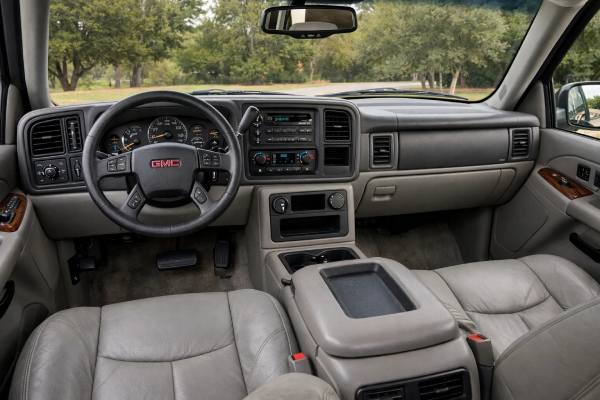
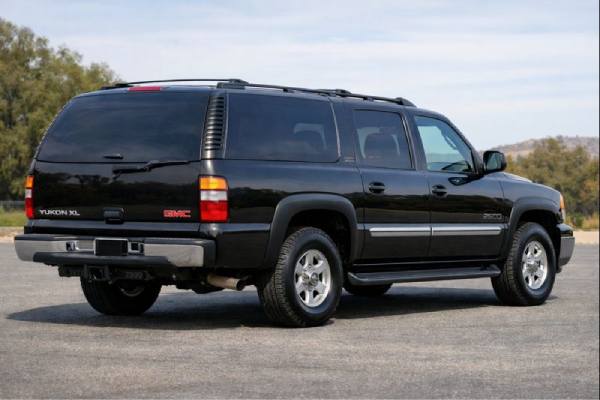
The GMT800 Yukon XL Denali is the “do-it-all” luxury says-yes SUV from GM’s early-2000s truck era: full-size, body-on-frame, and built around the LQ4 6.0-liter V8. Where standard Yukon XL models often split into 2WD or part-time 4WD, the Denali leans on full-time AWD for confident traction in rain and snow without any driver input. It also pairs the big cabin and long wheelbase with a more premium suspension tune and higher-end interior, which is why many of these became long-distance family rigs.
What makes it worth owning today is the balance of simple, serviceable truck hardware with real comfort. What can bite you is age-related wear in the AWD driveline, suspension components, and the electronics that control comfort features. Buy on condition and service history, not mileage alone.
Key Takeaways
- Full-time AWD adds year-round grip and stability, especially on wet highways and snow-packed streets
- LQ4 6.0-liter V8 delivers strong midrange pull for a loaded XL without feeling strained
- Denali ride and cabin materials are a step up, but air-leveling and luxury electronics add repair points
- Watch for transfer case fluid neglect and mismatched tires, which can accelerate AWD driveline wear
- Plan engine oil changes every 8,000 km (5,000 mi) or 6 months, sooner with short trips or towing
Quick navigation
- Denali AWD in real life
- LQ4 Denali specs and measurements
- Denali equipment and safety
- Reliability issues to expect
- Maintenance and buying strategy
- Driving feel and fuel use
- Comparisons with similar SUVs
Denali AWD in real life
The Yukon XL Denali AWD (2001–2006) is best understood as a premium 1500-series XL with a drivetrain designed for continuous traction. Unlike part-time 4WD systems that you engage only when conditions demand, Denali’s AWD is meant to stay on all the time. That matters in real ownership because it simplifies the driving experience: you do not have to anticipate a slick on-ramp, a sudden rainstorm, or mixed traction on mountain roads. The system is always managing front-to-rear torque through the transfer case, which improves stability during lane changes, downhill braking, and steady-speed cruising in poor weather.
The engineering trade-off is that AWD adds rotating mass and driveline drag. You usually give up some fuel economy compared with a 2WD Yukon XL, and you add maintenance items that do not exist on simpler drivetrains. On a 20+ year-old truck, that “extra” is mostly about fluid quality and wear surfaces: transfer case fluid condition, CV joints and boots, front hub bearings, and differential seals. AWD systems also react badly to neglected tires. If one tire is significantly different in circumference (different brand, different wear, or a mismatched size), it can load the driveline continuously and shorten the life of transfer case and differential components.
The Denali identity is not only drivetrain. It typically includes more sound insulation, upgraded seating and audio, and a suspension setup that aims for a smoother ride than work-focused trims. Many trucks were equipped with rear load leveling or an upgraded damping package, which helps keep the XL composed when you have six people and luggage. Over time, those comfort systems can become a “hidden cost” if they have been ignored, so it’s smart to verify function rather than assume “it’s fine.”
The LQ4 6.0-liter V8 complements the XL Denali’s mission. It is not a high-revving performance engine. It is a torque-first truck V8 that moves mass with less effort than smaller engines. In daily use, that means fewer full-throttle moments and calmer highway merges. In ownership, it means heat management is often easier—provided the cooling system is healthy and the transmission is not pushed beyond its comfort zone.
LQ4 Denali specs and measurements
The tables below focus on the Yukon XL Denali AWD (GMT800) with the LQ4 6.0-liter V8 rated at 325 hp (common for Denali calibration in this era). Exact figures can vary by model year, axle ratio, tire package, and option codes, so confirm VIN-specific details when ordering parts or fluids.
Engine and performance
| Item | Specification |
|---|---|
| Code | LQ4 (6.0 l V8) |
| Engine layout and cylinders | V8, OHV pushrod, 2 valves/cyl (16 valves total) |
| Bore × stroke | 101.6 × 92.0 mm (4.00 × 3.62 in) |
| Displacement | 6.0 l (5,967 cc) |
| Induction | Naturally aspirated |
| Fuel system | Sequential MPFI (port injection) |
| Compression ratio | ~9.4:1 (varies by calibration/year) |
| Max power | 325 hp (242 kW) @ ~5,200 rpm |
| Max torque | ~510 Nm (375 lb-ft) @ ~4,000 rpm |
| Timing drive | Chain |
| Rated efficiency (typical real-world) | Mixed driving often ~15–18 L/100 km (16–13 mpg US) depending on speed and tires |
| Real-world highway @ 120 km/h (75 mph) | Often ~13–16 L/100 km (18–15 mpg US) when lightly loaded |
Transmission and AWD driveline
| Item | Specification |
|---|---|
| Transmission | 4L65E or late 4L60E-family 4-speed automatic (year and calibration dependent) |
| Gear ratios | 1st 3.06 / 2nd 1.62 / 3rd 1.00 / 4th 0.70 / Rev 2.29 |
| Drive type | Full-time AWD |
| Transfer case (common Denali type) | NV149 single-speed AWD (typical for Denali/Escalade AWD of the era) |
| Transfer case fluid (common) | AutoTrak II type fluid (confirm by transfer case model and service label) |
| Differentials | Typically open front; rear may have a locking differential depending on option codes |
Chassis and dimensions (Yukon XL body)
| Item | Typical figure (approx.) |
|---|---|
| Platform | GMT800, body-on-frame |
| Suspension (front/rear) | Independent front torsion bar / rear multi-link or leaf setup depending on exact build and package |
| Steering | Hydraulic power steering (recirculating ball) |
| Brakes | 4-wheel disc |
| Length / width / height | ~5,570 mm / 2,000 mm / 1,900 mm (approx. 219 in / 79 in / 75 in) |
| Wheelbase | ~3,302 mm (130.0 in) |
| Turning circle | ~12.8–13.2 m (42–43 ft), tire-dependent |
| Curb weight | Often ~2,600–2,800 kg (5,700–6,200 lb), equipment-dependent |
| GVWR | Often ~3,300 kg (7,200 lb), package-dependent |
| Fuel tank | Commonly ~117 L (31 US gal / 26 UK gal) |
| Cargo volume (approx., SAE) | ~1,300 L (46 ft³) behind 3rd row / ~2,550 L (90 ft³) behind 2nd / ~3,700 L (131 ft³) max |
Capability (useful owner ranges)
| Item | Typical range |
|---|---|
| 0–100 km/h (0–62 mph) | ~8.5–10.0 s (tires, load, and conditions matter) |
| Braked towing | Commonly ~3,200–3,800 kg (7,000–8,400 lb), equipment-dependent |
| Payload | Often ~550–750 kg (1,200–1,650 lb), configuration-dependent |
Fluids and service capacities (typical references)
| Item | Typical specification |
|---|---|
| Engine oil | 5W-30; capacity often ~5.7 L (6.0 US qt) with filter |
| Coolant | Dex-Cool type 50/50 mix; total capacity varies by radiator and heater configuration |
| Transmission fluid | Dexron-type ATF; pan service vs full service volumes differ |
| Transfer case | AutoTrak II type fluid for many Denali AWD units (confirm model before filling) |
| Brake fluid | DOT 3 (DOT 4 acceptable where specified) |
Key torque specs (common decision points)
| Fastener | Typical torque |
|---|---|
| Wheel lug nuts | ~190 Nm (140 lb-ft) |
| Spark plugs | ~20 Nm (15 lb-ft) |
| Engine oil drain plug | ~25 Nm (18 lb-ft) |
These torque values are common for this platform, but always verify against your exact service documentation because hardware can differ by year and axle package.
Denali equipment and safety
Denali is a trim, but on a GMT800 Yukon XL it behaves like a complete “configuration.” You get the XL body’s third-row practicality and long wheelbase, paired with a more upscale cabin and a driveline that emphasizes smooth, always-on traction rather than off-road low-range capability. When shopping or maintaining one, it helps to group Denali features into three buckets: comfort equipment, chassis behavior, and safety.
Trims, options, and how to spot them
Most Yukon XL Denalis of this era share a similar baseline, but two trucks can still feel very different because of packages and condition.
- Suspension and leveling: Many Denalis were equipped with upgraded damping and rear load-leveling. When it’s healthy, it keeps the XL from sagging with passengers and cargo and improves stability at highway speed. When it’s worn, you’ll see rear-end squat, bouncy rebound over bumps, or compressor noise with no height change.
- Wheels and tires: Denali wheels are often larger and paired with lower-profile tires compared with base models. That can sharpen steering response but makes tire quality and alignment more important. The wrong tire load rating or mismatched wear matters more on AWD.
- Interior and electronics: Power seats, heated seating, premium audio, and automatic climate control are common. These are not “deal breakers,” but they are where age shows first: dead pixels, intermittent HVAC behavior, and worn seat motors are frequent.
Quick identifiers that help ownership:
- The RPO/SPID label (often in the glovebox) lists axle, differential, and chassis codes.
- Denali-specific badging and interior trim are helpful, but RPO codes are more reliable than badges.
Safety ratings: what to check and how
For 2001–2006 vehicles, safety ratings depend on the model year and the test protocol used at the time. The practical approach is to look up the exact model year in the official database and read both crash and rollover information.
Even without a modern driver-assist suite, these trucks can be safe when properly maintained because the basics are strong:
- A stable, heavy platform with predictable highway informing
- ABS braking (common)
- Traction control (common)
- Airbags (front standard; additional airbags vary by year and equipment)
Safety systems and service implications
Two ownership realities matter:
- Tires are a safety system. A Denali on worn or mismatched tires can feel nervous in rain and can stress the AWD driveline. The best “safety upgrade” is a matched set of quality tires with correct load index and a proper alignment.
- Brakes and steering determine confidence. Many Yukon XL Denalis on the used market need steering linkage refresh, front hub/bearing attention, and a brake system service (pads, rotors, fluid). If the steering has play or braking is inconsistent, address it early—these are heavy vehicles, and small defects scale up quickly in emergency maneuvers.
Child-seat provisions (LATCH/ISOFIX) were present in this era, but exact anchor locations and limits vary. If you use child seats regularly, confirm anchor placement and belt condition before purchase.
Reliability issues to expect
The Yukon XL Denali AWD has a good reputation when it’s maintained like a truck, but reliability at this age is less about “what breaks” and more about whether the previous owners stayed ahead of wear. The issues below are mapped by prevalence and cost tier, with typical symptoms and the most sensible fixes.
Common (high prevalence)
- Front hub bearings and ABS sensor faults (medium cost)
- Symptoms: humming that rises with road speed, ABS light, vibration, uneven tire wear.
- Root cause: bearing wear accelerated by tire and wheel choices.
- Remedy: replace hub assembly, inspect wiring, then align.
- Steering play and clunks (low to medium cost)
- Symptoms: wandering at highway speed, clunk over bumps, loose on-center feel.
- Root cause: idler arm, pitman arm, center link wear; sometimes steering intermediate shaft clunk.
- Remedy: inspect systematically and replace worn parts as a matched set.
- LQ4 knock sensor and harness moisture issues (low to medium cost)
- Symptoms: intermittent knock sensor codes, reduced power strategy, poor fuel economy.
- Root cause: water intrusion in the sensor valley area under the intake.
- Remedy: reseal properly during service, use correct torque and sealing practices.
- HVAC blend door actuators and control glitches (low to medium cost)
- Symptoms: clicking behind dash, inconsistent temperature control, stuck vent modes.
- Root cause: actuator gear wear and aging electronics.
- Remedy: replace actuators and confirm calibration steps after install.
Occasional (vehicle-dependent)
- Fuel pump module wear (medium cost)
- Symptoms: long crank, loss of power at high load, lean codes.
- Remedy: test fuel pressure under load; do not diagnose by “it runs fine at idle.”
- Cooling system aging (medium cost if ignored)
- Symptoms: slow coolant loss, rising temps while towing, weak heater output.
- Root cause: radiator flow decline, water pump seepage, hose deterioration, fan clutch wear.
- Remedy: pressure test and refresh proactively if history is unknown.
- Rear load-leveling or upgraded suspension issues (medium to high cost)
- Symptoms: sagging rear, harsh ride, compressor running frequently.
- Remedy: inspect shocks, lines, compressor, and ride-height behavior; avoid “delete” solutions that ruin balance unless you intentionally reconfigure.
Rare but expensive (watch closely)
- AWD transfer case wear from fluid neglect or tire mismatch (high cost)
- Symptoms: binding sensation, driveline shudder, whining under steady throttle, leaks.
- Root cause: wrong fluid, very old fluid, or constant stress from uneven tires.
- Remedy: verify correct fluid, service on schedule, and keep tires matched.
- 4L60E/4L65E family transmission fatigue under heavy towing (high cost)
- Symptoms: flare on shifts, slipping in 3rd/4th, shudder, burnt ATF smell.
- Root cause: heat and load beyond what the setup tolerates, delayed fluid service.
- Remedy: prioritize cooling, correct shift behavior, and sane tow practices; shop carefully if you tow heavy.
Recalls and service actions
Because these trucks have often changed hands, it’s common to find open recalls or incomplete service actions. The safest approach is procedural: run the VIN through the official recall lookup, confirm completion with dealer records when possible, and treat any missing proof as “not done” until verified.
Maintenance and buying strategy
A Yukon XL Denali AWD rewards owners who maintain it like a truck and inspect it like a used aircraft: you’re not hunting perfection, you’re looking for predictable function and proof of care. Use the schedule below as a practical baseline and tighten it if your driving includes short trips, winter salt, or towing.
Maintenance schedule (distance and time)
Every 8,000 km (5,000 mi) or 6 months
- Engine oil and filter (5W-30 is typical for this era)
- Inspect leaks: oil pan, valve covers, transmission lines, transfer case seams, front diff seals
- Check tire pressure, tread depth, and confirm all four tires match closely in size and wear
Every 16,000 km (10,000 mi)
- Rotate tires and inspect brakes (pads, rotor condition, caliper slides)
- Inspect steering and front suspension for play
- Check AWD driveline boots (CV joints) and listen for new humming from hubs
Every 48,000 km (30,000 mi)
- Engine air filter replacement; cabin air filter if equipped
- Transfer case fluid service (especially if history is unknown)
- Front and rear differential fluid service if the truck sees snow, water, or heavy loads
Every 80,000–100,000 km (50,000–60,000 mi)
- Transmission service approach based on history: a pan drop, filter, and refill is often a sensible step when fluid is not burnt and shifts are healthy
- Coolant service if age is unknown, plus inspection of radiator and fan clutch operation
Every 160,000 km (100,000 mi)
- Spark plugs (verify exact interval and part by year/VIN)
- Inspect ignition components and address any misfire early (misfires under load are hard on catalysts)
Every 2 years
- Brake fluid exchange (a heavy SUV benefits from fresh fluid for consistent pedal feel)
Every 4–6 years
- Battery test and replacement planning before winter
Fluid specs (typical) and why they matter
- Engine oil: 5W-30 is a common baseline; consistent changes reduce lifter and valvetrain wear and keep oil pressure stable.
- Transmission fluid: Dexron-type ATF; heat is the enemy, so cooling and cleanliness matter more than “magic additives.”
- Transfer case fluid: many Denali AWD units use AutoTrak II type fluid; incorrect fluid can cause chatter or poor coupling behavior.
- Differentials: 75W-90 gear oil is common; confirm if your rear differential requires any special additive.
Buyer’s guide: what to check before money changes hands
AWD and tires
- All four tires same brand, model, size, and similar tread depth
- No binding, shudder, or unusual noises at steady speed
- Transfer case area dry or only lightly damp (active wetness needs explanation)
Engine
- Smooth cold start, no persistent ticking, stable idle
- No coolant smell or evidence of chronic overheating
- No major oil leaks that drip onto exhaust
Transmission
- Shifts consistent when cold and fully warmed
- No burnt ATF odor
- Test drive on a mild grade to see if it hunts or flares into 3rd/4th
Suspension and electronics
- Rear ride height correct; no excessive bounce
- HVAC delivers consistent temperature without clicking noises
- Instrument cluster and warning lights behave normally
A clean Denali with strong records often costs more up front, but it’s usually cheaper than buying a “deal” and paying for someone else’s skipped maintenance.
Driving feel and fuel use
The Yukon XL Denali AWD is at its best on the kinds of trips it was built for: steady highway miles, full cabins, and mixed weather. The long wheelbase smooths freeway expansion joints and gives the truck a calm, planted feel when you’re cruising at speed. Compared with more work-oriented trims, Denali typically feels quieter and more composed, but it’s still a body-on-frame SUV—there is real mass and real suspension travel under you.
See-through driving impressions
- Ride: generally soft to medium-firm, depending on tire choice and the condition of the dampers. A healthy Denali doesn’t wallow, but it also won’t feel “sporty.” If it bounces repeatedly after a bump, suspect worn shocks or a failing leveling setup.
- Handling: predictable and stable, with modest body roll. The biggest handling improvement often comes from correcting worn steering parts and aligning it properly.
- Steering: light to moderate effort, more “truck” than “crossover.” A tight front end tracks straight. A worn one feels vague and needs constant correction.
- Braking: capable when the system is fresh, but sensitive to pad quality, rotor condition, and brake fluid age. With heavy SUVs, brake fluid condition is a real performance variable.
LQ4 powertrain character
The LQ4 6.0 is built to pull smoothly through the midrange. In normal driving, you’ll notice that it does not need high rpm to move the XL. Throttle response is clean and predictable, and highway merges are easy even with passengers and cargo. The 4-speed automatic is not modern-fast, but a healthy unit shifts consistently and keeps the engine in its torque band. If your truck “hunts” between gears on small grades, it can be a sign of transmission wear, incorrect tire size, or simply a setup that would benefit from different driving technique (holding a gear rather than letting it shuffle).
Real-world fuel economy expectations
Fuel use is driven mostly by speed, tires, and weather. Typical owner-observed ranges:
- City-heavy: ~16–20 L/100 km (15–12 mpg US)
- Mixed driving: ~15–18 L/100 km (16–13 mpg US)
- Highway at 100–110 km/h (60–70 mph): ~13–15 L/100 km (18–16 mpg US)
- Highway at 120 km/h (75 mph): ~14–16 L/100 km (17–15 mpg US)
Cold weather, short trips, roof boxes, and aggressive tires can push those numbers noticeably higher. If economy is far worse than expected, common culprits include underinflated tires, dragging brakes, aging oxygen sensors, or knock sensor issues that keep timing conservative.
Load and towing notes
The Denali can tow, but the AWD Denali setup and transmission family generally prefer moderate, well-controlled towing rather than maximum-weight, long-grade work. If towing is frequent, prioritize:
- A properly adjusted trailer brake controller
- Transmission temperature management (cooling and shift stability)
- Conservative driving on grades (avoid constant overdrive hunting)
For owners who tow heavy often, a 2500-series GM SUV is usually the better tool. For occasional towing and daily family use in bad weather, Denali AWD is the more refined compromise.
Comparisons with similar SUVs
To judge the Yukon XL Denali AWD fairly, compare it to other large, early-2000s premium SUVs on the same three axes: traction strategy, towing comfort, and long-term repair complexity.
Versus Cadillac Escalade and Escalade ESV (same era)
The closest mechanical cousin is the Escalade family. In many cases, you’re choosing between styling, interior feel, and what you find on the used market in the best condition. Denali often offers a more understated look and can be less expensive to buy while sharing a similar drivetrain concept. Your real differentiator should be maintenance history and drivetrain condition, not the badge.
Versus Ford Expedition and Lincoln Navigator (early 2000s)
Ford’s main advantage is a different ride and steering feel that some owners prefer, and certain configurations can have strong towing manners. The Denali’s strengths are the simplicity of the GM truck platform and the predictable behavior of its V8 under load. In ownership terms, both brands will have age-related suspension and electronics issues; condition matters more than brand loyalty at this age.
Versus Toyota Sequoia (first generation)
The Sequoia’s reputation often centers on long-term reliability and a smooth V8, and it can be a strong choice if you find a clean one. The Denali counters with the XL’s extra interior length and a heavier-duty feel at highway speed. Parts costs and repair approaches differ: Toyota often feels “tight” when maintained, while GM can be easier to source and service in many regions. Your use case should decide: cargo volume and road-trip space favor the XL Denali; a slightly smaller footprint and Toyota’s ownership profile can favor the Sequoia.
Versus GM Yukon XL 1500 4WD (part-time)
This is the comparison most shoppers should make. A part-time 4WD Yukon XL can return slightly better fuel economy in 2WD and may have fewer AWD-specific wear concerns. Denali’s advantage is the seamless traction and the trim’s premium equipment. If your weather is mixed for months at a time, Denali AWD’s “always ready” nature is meaningful. If you mostly drive dry highways and want the simplest drivetrain, a 2WD or part-time 4WD configuration can be the smarter long-term bet.
Bottom line
Choose the Yukon XL Denali AWD if you want a premium, long-wheelbase family SUV with confident all-weather traction and truck-simple serviceability. Pass if you need maximum tow capacity every weekend, or if you want modern safety tech as standard. As a used buy, a fully sorted Denali is far more satisfying than a cheaper one that needs an AWD refresh, suspension work, and deferred fluids.
References
- Manuals and Guides 2025 (Owner’s Manual Portal)
- Recalls 2025 (Recall Database)
- Vehicle 2025 (Vehicle Safety Information)
- Find a Car 2025 (Fuel Economy Database)
Disclaimer
This article is for informational purposes only and is not a substitute for professional diagnosis, inspection, or repair. Specifications, torque values, service intervals, and procedures vary by VIN, market, and installed equipment, so verify details using official owner and service documentation for your exact vehicle.
If this guide helped, please consider sharing it on Facebook, X, or your favorite community to support our work.