


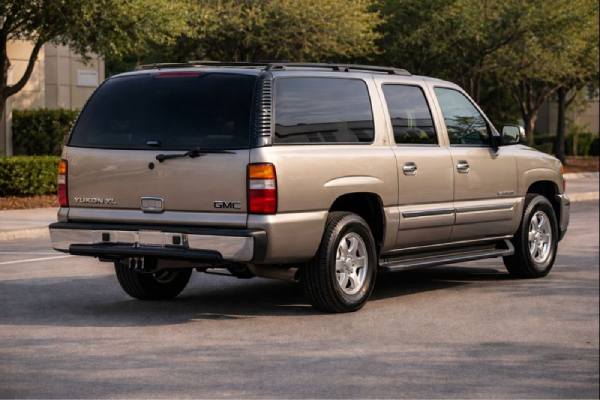
The 2000–2006 GMC Yukon XL RWD on the GMT800 platform is a classic full-size SUV recipe: a simple body-on-frame chassis, a torquey small-block V8, and parts availability that’s still excellent. In LM7 5.3-liter form, it focuses on low-end pull and durability over high-strung power, which is exactly what you want in a long-wheelbase family hauler or light tow rig. The upside is straightforward ownership—conventional suspension, a proven 4-speed automatic, and a drivetrain that most shops know inside-out. The tradeoff is that age, rust exposure, and deferred maintenance matter more than the badge on the grille. Buy the right one and it can feel “honest” and dependable for years; buy the wrong one and you’ll be chasing old-truck problems in several systems at once.
Owner Snapshot
- Strong low-rpm torque and simple V8 layout make it well-suited to hauling and everyday towing.
- Easy parts sourcing and wide shop familiarity keep most repairs practical and predictable.
- Big fuel tank and long wheelbase work well for highway travel and family road trips.
- Budget for age-related electrical and drivetrain wear—especially gauges, HVAC, and transmission shift quality.
- Plan on engine oil changes when the oil-life monitor calls for it (and at least once every 12 months).
Guide contents
- Yukon XL RWD platform and feel
- LM7 Yukon XL technical specs
- Trims, packages, and safety tech
- Reliability patterns and common faults
- Maintenance plan and buying tips
- On-road performance and economy
- Yukon XL versus key rivals
Yukon XL RWD platform and feel
The GMT800 Yukon XL is the long-body sibling of the Yukon, built to prioritize space, stability, and mechanical simplicity. In rear-wheel drive form, it keeps the driveline straightforward: a front differential and transfer case are off the menu, and that tends to reduce complexity, service cost, and “mystery noises” compared with 4×4 trucks of the same era. For many owners, the RWD version is also the sweet spot for highway comfort—less driveline drag and fewer rotating parts up front.
Engineering-wise, this is a body-on-frame SUV with truck DNA. That matters because it rides differently than modern unibody crossovers. You get a solid, planted feel over broken pavement, good straight-line composure at speed, and predictable behavior when loaded with passengers and cargo. The long wheelbase helps it track smoothly on interstates, and it also makes trailer behavior calmer than shorter SUVs—especially with the right hitch setup and a properly loaded trailer.
The LM7 5.3-liter V8 (rated around 295 hp in later calibrations) isn’t about drama; it’s about usable torque and low stress. The engine’s priorities show up in daily driving: easy launches, relaxed highway cruising, and the ability to pull moderate loads without constantly hunting gears. The 4-speed automatic is dated by modern standards, but it’s part of why these trucks are so widely serviceable. When maintained, the combination is capable of very high mileage.
Ownership traits you’ll notice quickly:
- Cabin packaging is genuinely useful. The XL’s extra length translates to real third-row comfort and a cargo area that can swallow family-trip gear without playing Tetris.
- Towing confidence is strong for the class, but it depends heavily on cooling condition, axle ratio, hitch hardware, and brake health.
- Age sensitivity is the big theme. Rubber bushings, brake lines, electrical connectors, and interior plastics don’t improve with time—so condition and history matter more than the odometer alone.
If you want a full-size SUV that feels “truck honest,” the Yukon XL RWD is exactly that—provided you shop carefully and maintain it like the heavy-duty family machine it is.
LM7 Yukon XL technical specs
Below are practical, ownership-focused specifications for the GMC Yukon XL 1500 RWD (GMT800) with the 5.3L LM7 family. Some items vary by VIN code, axle ratio, options (rear heat, tow package), and year—so treat this as a strong baseline, then verify against your door sticker and service documentation.
Engine and performance
| Item | Spec |
|---|---|
| Code | LM7 family 5.3 L V8 (Vortec) |
| Layout and valvetrain | V8, OHV (pushrod), 2 valves/cyl (16-valve total) |
| Bore × stroke | 96.0 × 92.0 mm (3.78 × 3.62 in) |
| Displacement | 5.3 L (5328 cc) |
| Induction | Naturally aspirated |
| Fuel system | Port fuel injection (PFI/MPFI) |
| Compression ratio | ~9.5:1 (typical for LM7-era calibrations) |
| Max power | 295 hp (220 kW) @ ~5200 rpm |
| Max torque | typically ~325–335 lb-ft (441–454 Nm) @ ~4000 rpm (varies by year/VIN code) |
| Timing drive | Chain |
| Spark plug gap | 0.040 in (1.01 mm) |
Transmission and driveline
| Item | Spec |
|---|---|
| Transmission | 4-speed automatic (commonly 4L60-E family on 1500 series) |
| Gear ratios | 1st 3.06 / 2nd 1.63 / 3rd 1.00 / 4th 0.70 / Rev 2.29 |
| Drive type | RWD |
| Common axle ratios | Often 3.42 or 3.73 (verify RPO code/axle tag) |
| Differential | Typically open; locking diff often available with tow/off-road packages (market/trim dependent) |
Chassis and dimensions
| Item | Spec |
|---|---|
| Platform | GMT800 body-on-frame |
| Suspension (front/rear) | Independent front; solid rear axle with coil springs (typical) |
| Length | ~5570 mm (219.3 in) |
| Width | ~2004 mm (78.9 in) |
| Height | ~1890 mm (74.4 in) |
| Wheelbase | ~3299 mm (129.9 in) |
| Ground clearance | ~203 mm (8.0 in) (varies by tires/suspension) |
| Turning circle | ~13.4 m (44 ft) (approx.) |
| Curb weight | commonly ~2400–2550 kg (5300–5600 lb), depending on equipment |
| Cargo volume (typical) | ~1255 L (44.3 ft³) seats up / ~3726 L (131.6 ft³) seats down (configuration dependent) |
Efficiency and range
For a representative late-model-year listing, EPA data for a 2006 Yukon XL 1500 2WD, 5.3 L, automatic shows 13 mpg city / 17 mpg highway / 14 mpg combined (about 18.1 / 13.8 / 16.8 L/100 km). Real-world results vary heavily with tires, speed, and load—and these trucks are sensitive to headwinds and towing.
Fluids and service capacities
| Item | Spec |
|---|---|
| Cooling system (5.3 V8 with electric fan) | 16.7 qt (15.8 L); add 2.0 L (2.1 qt) if equipped with rear heat |
| Engine oil with filter | 6.0 qt (5.7 L) |
| Fuel tank (Yukon XL 1500) | 31.0 gal (117.3 L) |
| Wheel nut torque | 140 lb-ft (190 Nm) |
These capacities are intentionally “decision-grade”: enough to plan service correctly without guessing.
Trims, packages, and safety tech
For the 2000–2006 Yukon XL 1500 RWD with the 5.3-liter, trims tend to cluster around SLE and SLT in most markets, with Denali models typically pairing different drivetrains and equipment. Rather than focusing on badges, it’s smarter to shop by option content—because two “SLT” trucks can drive and tow very differently.
Trims and functional options that matter
Key equipment differences that change the ownership experience:
- Seating layouts: These trucks can appear as 7-, 8-, or 9-passenger configurations depending on second-row setup (captain’s chairs vs bench) and front seating. If you need a true 8/9, confirm the seat hardware is original and that the third-row mounts are intact.
- Tow package and cooling: Look for a factory tow package if towing is even an occasional need. You’re shopping for the whole system—hitch class, wiring, transmission cooler, and (ideally) the correct axle ratio for your trailer weight.
- Rear HVAC (rear heat/AC): A major comfort option in the XL body. It also slightly increases coolant capacity and adds more hoses and connections—great for passengers, but it’s another place age-related leaks can happen.
- Suspension upgrades: Some trucks have load-leveling or premium dampers. Great when working properly, more expensive if neglected.
- Axle ratio and differential type: The same 5.3 can feel lively or lazy depending on gearing. If you want better pull with a trailer, a shorter axle ratio is usually your friend. If you drive in snow but stay RWD, a locking differential can be a meaningful traction upgrade.
Quick identifiers to check when shopping:
- VIN engine code: Owner documentation often distinguishes 5.3 variants by VIN code; verify you’re looking at the correct fuel capability (some 5.3 trucks are flex-fuel capable).
- RPO codes: The glovebox sticker (or build sheet) is the fastest way to confirm tow package, axle ratio, and differential equipment without guessing.
Safety systems and driver assistance
This era predates modern ADAS (automatic emergency braking, lane centering, etc.). Expect the safety toolkit to be mostly “foundational”:
- Front airbags and three-point belts.
- ABS (anti-lock braking) and traction control on many configurations.
- Stability control availability varies by year and package, so don’t assume it’s present—verify via dashboard indicators and build codes.
- Child-seat provisions are typically present (LATCH/ISOFIX), but check for damaged anchors or missing tether points, especially if the truck has lived a hard life.
Safety ratings reality check
Crash-test coverage and rating methods differ by year, body style, and test protocol. The most reliable way to confirm the exact truck you’re considering is to check official databases by model year and then confirm by VIN where possible. Treat any third-party “rating summaries” as a pointer—not a final answer—because the Yukon and Yukon XL can be listed separately, and drivetrain/body configurations can affect what’s published.
Reliability patterns and common faults
A well-kept GMT800 Yukon XL can be genuinely long-lived, but reliability depends on whether it has been maintained like the heavy vehicle it is. The LM7 5.3 itself is usually not the limiting factor—supporting systems, corrosion exposure, and deferred fluids are.
Below is a practical issue map. “Prevalence” assumes a typical aging fleet; your local climate and previous owner behavior can shift the odds.
| System | Prevalence | Cost tier | Symptoms | Likely cause | Practical remedy |
|---|---|---|---|---|---|
| Instrument cluster / gauges | Common | Medium | Dead or inaccurate speedo/tach/fuel, warning lights | Stepper motor or cluster electronics aging | Cluster rebuild or replacement |
| HVAC temperature blend | Common | Low–Medium | Stuck hot/cold, clicking behind dash | Blend door actuator wear | Replace actuator; calibrate if required |
| Knock sensor faults | Common | Medium | Check-engine light, reduced performance | Moisture intrusion in valley area, harness issues | Replace sensors/harness; improve sealing and drainage |
| Fuel pump wear | Occasional | Medium | Long crank/no-start, loss of power | Pump aging, heat cycles, tank contamination | Replace pump module; consider tank cleaning |
| Cooling system leaks | Occasional | Medium | Low coolant, sweet smell, overheating risk | Aged hoses, radiator seams, water pump seep | Replace weak components; correct coolant mix |
| 4-speed automatic shift issues | Occasional–Common | High | Slips, harsh shifts, delayed engagement | Wear, overheating, old fluid, towing stress | Diagnose early; service fluid; rebuild if slipping persists |
| Front-end wear | Common | Medium | Clunks, wandering, uneven tire wear | Ball joints, bushings, tie rods aging | Replace worn parts; align |
| Brake line corrosion | Climate-dependent | High | Soft pedal, visible rust, leaks | Road salt exposure | Replace lines; inspect calipers and hoses |
| Oil leaks | Occasional | Low–Medium | Drips, burning oil smell | Gaskets/seals aging | Reseal as needed; prioritize active leaks |
Age and usage bands that matter
- Short-trip, cold-climate trucks tend to show more condensation-related sensor issues, quicker exhaust corrosion, and sludge risk if oil changes were stretched.
- Tow-used trucks are more likely to have transmission heat stress, cooling system fatigue, and rear suspension wear.
- Salt-belt trucks are the wild card: rust can turn a “cheap fix” into a project if fasteners, brake lines, and frame sections are compromised.
Recalls, TSBs, and service actions
Because recall coverage can be VIN-specific—and some older campaigns may not appear in a simple year/make/model search—the best practice is:
- Run a VIN-based recall lookup using official tools.
- Ask the seller for proof of completion (dealer invoice or printout).
- Treat open recalls as part of the purchase negotiation, not a surprise later.
If you want one guiding principle for GMT800 reliability: buy condition and documentation first, miles second.
Maintenance plan and buying tips
A Yukon XL that gets consistent fluids and inspections is usually far cheaper to own than one that “seems fine” but hasn’t been serviced on schedule. Use this section as a practical baseline, then refine it to your climate and workload.
Core maintenance schedule you can live with
- Engine oil and filter: Follow the oil-life monitor when equipped, and still treat 12 months as a hard time limit if mileage is low. Use the correct viscosity (commonly 5W-30) and keep the level right—these engines don’t like running low.
- Engine air filter: Inspect at oil changes; replace when dirty or restricted (dusty regions may need earlier service).
- Cabin air filter: If equipped, replace when airflow drops or odors appear (often annually for family use).
- Coolant: Use the specified long-life coolant type and correct mix ratio. Refresh on the manufacturer time/mileage schedule, and don’t ignore small leaks—overheating events are what shorten engine life.
- Automatic transmission fluid: If the truck tows, sees city heat, or shifts feel “off,” service earlier rather than later. Fresh fluid won’t fix hard wear, but it can prevent it.
- Rear differential fluid (RWD): Service periodically, and sooner if towing. If equipped with a locking differential, use the correct fluid and additive guidance.
- Brake fluid: Replace at a reasonable interval (commonly every 2–3 years) to manage moisture and corrosion.
- Spark plugs: The 5.3 is typically a long-interval plug engine—plan for replacement around the six-figure mileage range if not already done, and verify correct gap on install.
- Accessory belt and hoses: Inspect for cracks, glazing, and coolant seep. Preventive replacement is often cheaper than a roadside failure.
- Tires and alignment: Rotate regularly, keep pressures correct, and align if you see uneven wear or steering pull.
- Battery and charging system: Test yearly, especially before winter. A weak battery can mimic other electrical problems.
Fluids, capacities, and one torque value you should memorize
- Engine oil with filter: 6.0 qt (5.7 L)
- Cooling system (5.3 V8, electric fan): 16.7 qt (15.8 L), plus 2.0 L (2.1 qt) if rear heat is fitted
- Fuel tank (XL 1500): 31.0 gal (117.3 L)
- Wheel nut torque: 140 lb-ft (190 Nm)
That wheel torque matters because under-torqued or over-torqued lugs can warp brake rotors and damage studs over time.
Buyer’s guide: what to check before money changes hands
Bring a flashlight and take your time:
- Rust hotspots: Frame rails, brake lines, fuel lines, rocker panels, and body mounts.
- Transmission behavior: Cold start engagement, 1–2 and 2–3 shifts, and any shudder under light throttle.
- Cooling health: Look for dried coolant residue, soft hoses, and stable operating temperature in traffic.
- Front end and steering: Clunks over bumps and vague tracking often mean worn suspension parts.
- Electrical function sweep: Gauges, HVAC modes, window regulators, seat motors, rear HVAC, and trailer wiring if equipped.
The best buys are usually trucks with boring paperwork: regular fluid services, cooling system care, and timely repairs.
On-road performance and economy
Driven back-to-back with newer SUVs, a GMT800 Yukon XL feels unmistakably “truck-based,” but not in a bad way. It’s stable, predictable, and comfortable at speed—especially in the long-wheelbase XL form.
Ride, handling, and NVH
- Ride quality: The Yukon XL tends to smooth highway expansion joints well, and the longer wheelbase helps it feel less busy than shorter SUVs. On rough city streets, you’ll still feel the mass working—good shocks and healthy bushings make a huge difference.
- Steering and control: Steering is typically light and not especially chatty. If it feels vague or wanders, suspect alignment or worn front-end components rather than “that’s just how they are.”
- Braking feel: In good condition, braking is confident for a large SUV. In neglected condition, you’ll notice long pedal travel, pulsation (warped rotors), or uneven stopping—often tied to caliper wear, rusty slide pins, or old brake fluid.
Powertrain character
The 5.3’s personality is about low- to mid-range torque. It pulls cleanly from low rpm, which suits city driving and loaded highway merges. The 4-speed automatic is the limiting factor for “modern” feel: it has wider steps between gears, so you’ll see more rpm swing on hills and kickdowns than you would in a 6–10 speed truck.
If your truck has taller gearing, it will cruise quietly but may downshift more on grades. Shorter gearing tends to feel stronger around town and can be better for towing—at the cost of a bit more engine speed on the highway.
Real-world efficiency
EPA figures for a representative 2006 Yukon XL 1500 2WD 5.3L automatic listing are 13 mpg city / 17 mpg highway / 14 mpg combined (about 18.1 / 13.8 / 16.8 L/100 km). In practice:
- Around-town fuel use worsens quickly with short trips and heavy stop-and-go.
- At 60–75 mph, tires, alignment, roof racks, and headwinds can swing economy by several mpg.
- Towing adds a meaningful penalty; even a well-sorted truck will drink more under load.
Load and towing confidence
The Yukon XL’s long wheelbase helps trailer stability, but don’t confuse wheelbase with unlimited capacity. For safe towing, the deciding factors are:
- Cooling system health and correct fluids
- Brake condition and correct trailer brake setup where applicable
- Proper hitch hardware (weight distribution when needed)
- Realistic payload management (people + cargo + tongue weight)
Set the truck up correctly and it’s a calm, capable tow platform. Ignore the fundamentals and it becomes a stressed, heat-soaked drivetrain in a hurry.
Yukon XL versus key rivals
To compare fairly, focus on other early- to mid-2000s full-size SUVs that were built for the same mission: three rows, real cargo room, and towing that’s more than a marketing claim.
Chevrolet Suburban 1500 (GMT800)
This is the closest rival because it’s the mechanical twin. Advantages and disadvantages usually come down to:
- Condition and equipment more than brand differences.
- Interior materials and feature packaging that can vary by trim.
If you find a cleaner Suburban than Yukon XL (or vice versa), buy the better truck—parts and service knowledge overlap heavily.
Ford Expedition and Expedition EL
Ford’s full-size SUVs offer strong capability, and some buyers prefer Ford’s interior ergonomics of the era. Key differences:
- Drivetrain and transmission designs differ, so a “good one” is just as dependent on maintenance history.
- Some owners find Ford’s chassis feel different on broken pavement—test drive matters.
Toyota Sequoia (first generation)
If your priority is long-term powertrain durability with fewer domestic-truck electrical quirks, the Sequoia is often cross-shopped. Tradeoffs:
- Typically higher purchase price for comparable condition.
- Different towing feel and feature availability depending on year/trim.
Nissan Armada (early models)
A strong-size alternative with good space, but as with all aging full-size SUVs, the deciding factors are history and how it was used (towing, short trips, rust exposure).
Why the Yukon XL RWD still makes sense
The GMT800 Yukon XL’s enduring advantage is ownership practicality:
- Huge parts supply
- Straightforward mechanical layout
- Familiarity in independent shops
- Real interior volume without pretending to be “efficient”
Where rivals can beat it is usually refinement and transmission count. Where it can beat rivals is the combination of space, simplicity, and repairability—especially if you buy a clean, well-documented example.
References
- 2006 GMC Yukon, Yukon XL Owner Manual M 2006 (Owner’s Manual)
- Gas Mileage of 2006 GMC Yukon 2006 (Fuel Economy)
- 2006 GMC YUKON XL – Vehicle Detail Search 2006 (Recall Database and Safety Information)
- Check for Recalls: Vehicle, Car Seat, Tire, Equipment 2025 (Recall Lookup)
- NHTSA Datasets and APIs 2025 (Safety Ratings and Data Overview)
Disclaimer
This article is for informational purposes only and is not a substitute for professional diagnosis, inspection, or repair. Specifications, torque values, service intervals, and procedures can vary by VIN, market, model year, and installed equipment. Always verify details using your official owner’s manual, factory service information, and the labels on your specific vehicle.
If this guide helped, please consider sharing it on Facebook, X/Twitter, or your favorite forum to support our work.