

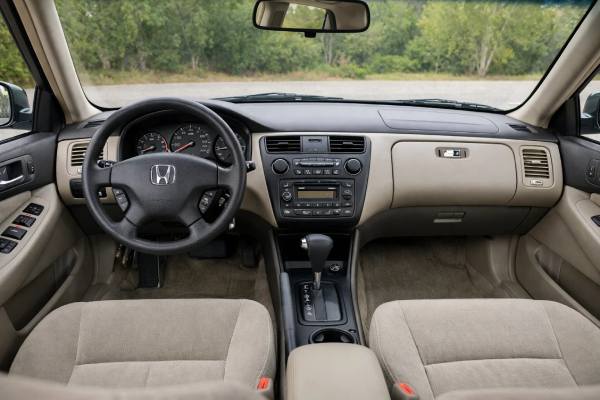

The 1998–2002 Honda Accord (CG1) with the J30A1 3.0-liter V6 is the “grown-up quick” version of the sixth-generation Accord: smooth power, a calm chassis, and simple mechanicals that reward steady maintenance. The SOHC VTEC V6 is not a high-strung engine, but it delivers its best work in the midrange, making highway passing and merging feel effortless compared with the 4-cylinder cars. The platform’s double-wishbone suspension (front and rear) is a key engineering highlight, helping the Accord ride comfortably without feeling loose or floaty.
Ownership, however, depends heavily on service history. This era’s V6 automatic can be sensitive to neglected fluid, and overdue timing-belt service is the single biggest “walk away” risk. Get those two items right, and the CG1 can still be a dependable daily driver.
What to Know
- Smooth, strong midrange power that suits commuting and highway travel.
- Double-wishbone suspension gives a balanced ride and predictable handling.
- Cabin controls and visibility tend to age well for a late-1990s design.
- V6 automatic transmission longevity often depends on frequent fluid service.
- Replace the timing belt about every 105,000 miles (168,000 km) or 7 years.
Jump to sections
- CG1 V6 model character
- J30A1 V6 specs and data
- Equipment, trims, and crash safety
- Known weak points and recalls
- Service schedule and buying strategy
- How the V6 drives
- CG1 V6 against competitors
CG1 V6 model character
The CG1 Accord V6 is best understood as a comfort-first midsize car with an engine that makes it feel “bigger” than it is. The J30A1 is a 60-degree V6 with SOHC VTEC valvetrain (Variable Valve Timing and Lift Electronic Control), designed to deliver smooth torque and low noise rather than razor-sharp top-end power. In everyday driving, that means it pulls cleanly from low rpm, climbs grades without drama, and feels relaxed at highway speed.
A major engineering advantage of this generation is its suspension layout. Unlike many rivals that used front struts and rear multi-link variants, the Accord relied on double wishbones at both ends. Practically, this helps the car track straight on rough pavement and keeps camber change under control during cornering, which can reduce “tire scrub” and keep steering behavior consistent. The result is a car that feels planted in normal driving, even if it is not tuned as a sport sedan.
The CG1 V6 was commonly paired with an automatic transmission and front-wheel drive. That combination is quiet, simple, and generally efficient for the performance level, but it also shapes the car’s personality: traction is good in dry conditions, yet full-throttle launches can provoke wheelspin on worn tires, and the traction limit arrives earlier than on rear-drive rivals. Still, for most owners, the trade-off is worth it because it keeps running costs reasonable and parts availability strong.
From an ownership perspective, the CG1’s “good years” are the ones with clear records: timing-belt history, cooling-system health, and transmission-fluid service matter more than small cosmetic wear. If you are shopping, prioritize condition and documentation over trim level. A clean, well-serviced V6 Accord is usually a better bet than a higher-trim example that has unknown maintenance gaps.
J30A1 V6 specs and data
Below are key specifications for the 1998–2002 Accord V6 (CG1) with the J30A1. Some values vary by market, emissions label, and exact equipment, so treat these as a decision-making baseline and verify against your door-jamb label and official documentation.
Engine and performance
| Item | Specification |
|---|---|
| Code | J30A1 |
| Engine layout and cylinders | 60° V6, 6 cylinders, SOHC VTEC, 4 valves/cyl |
| Bore × stroke | 86.0 × 86.0 mm (3.39 × 3.39 in) |
| Displacement | 3.0 L (2,997 cc) |
| Induction | Naturally aspirated |
| Fuel system | PGM-FI / MPFI |
| Compression ratio | 9.4:1 |
| Max power | 200 hp (149 kW) @ ~5,500 rpm |
| Max torque | ~264 Nm (195 lb-ft) @ ~4,700 rpm (typical published value) |
| Timing drive | Belt |
| Rated efficiency (EPA, typical V6 automatic) | 11.2 L/100 km (21 mpg US) combined; 9.0 L/100 km (26 mpg US) highway; 13.1 L/100 km (18 mpg US) city |
| Real-world highway @ 120 km/h (75 mph) | Often ~8.5–9.8 L/100 km (24–28 mpg US), strongly affected by speed, tires, and A/C use |
Transmission and driveline
| Item | Specification |
|---|---|
| Transmission | 4-speed automatic (common pairing for V6) |
| Gear ratios | Not listed in owner-spec pages; verify by transmission code/VIN if needed |
| Final drive ratio | Not listed in owner-spec pages; verify by transmission code/VIN |
| Drive type | FWD |
| Differential | Open (typical) |
Chassis and dimensions
| Item | Specification |
|---|---|
| Suspension (front/rear) | Double wishbone / double wishbone |
| Length / width / height | 4,767 / 1,785 / 1,405 mm (187.7 / 70.3 / 55.3 in) |
| Wheelbase | 2,670 mm (105.1 in) |
| Track (front/rear) | 1,555 / 1,535 mm (61.2 / 60.4 in) |
| Wheels/tires (common) | P205/60R16 91V (some trims: P205/65R15 92V) |
| Curb weight | Varies by trim and equipment; typically mid-1,500 kg range (check label/spec sheet for your car) |
| Fuel tank | 64.8 L (17.12 US gal / 14.26 Imp gal) |
Fluids and service capacities
| Item | Specification |
|---|---|
| Engine coolant (approx. total) | 5.6 L (1.48 US gal) change; 7.5 L (1.98 US gal) total |
| Engine oil (change, incl. filter) | 4.4 L (4.6 US qt) |
| Engine oil (change, without filter) | 4.0 L (4.2 US qt) |
| Automatic transmission fluid | 2.9 L (3.1 US qt) drain/fill; 7.2 L (7.6 US qt) total |
| A/C refrigerant | HFC-134a (R-134a), 450–500 g (15.8–17.5 oz) |
| A/C compressor oil | ND-OIL8 |
Safety and driver assistance
This generation predates modern ADAS (automatic emergency braking, lane centering, and adaptive cruise control). Safety equipment is mainly structural design, airbags, seatbelt systems, and ABS/traction-control availability by trim/year.
Equipment, trims, and crash safety
Trim structure varies by market, but most CG1 V6 cars were positioned above the base models and sold with “comfort plus” equipment rather than performance upgrades. The practical way to shop is to focus on functional differences (brakes, ABS, wheels, and airbags) and to confirm what is actually installed, because 20+ years of repairs and parts swaps can blur original spec.
Common trims and option themes (typical North American pattern)
- LX / value-oriented trims: often cloth interiors, simpler audio, and fewer convenience features. ABS could be optional depending on year/market.
- EX / higher trims: more likely to include alloy wheels, upgraded audio, power seat features, sunroof, and (in many cases) ABS as standard. Leather packages were common in this tier.
- Special editions (SE and similar): usually appearance and convenience bundles (wheels, interior upgrades, and audio), with mechanicals largely unchanged.
Because the V6 powertrain is the main differentiator, you should treat trim as a “comfort choice” rather than a reliability choice. A well-serviced lower-trim V6 is often the smarter purchase than a higher-trim car with missing timing-belt records.
Quick identifiers when inspecting
- Engine bay: a V6 Accord has a wider intake layout and different accessory placement than the inline-4 cars.
- Wheels and tires: many V6 cars use 16-inch tires (commonly P205/60R16), while some lower trims use 15-inch.
- Door-jamb label: confirms GVWR, tire specification, and manufacturing details (critical for parts accuracy).
- Cluster and dash switches: ABS indicators and traction-control switches (if equipped) can hint at the braking package, but always confirm by inspecting hardware.
Crash safety and ratings
For 1998–2002 Accord sedan models, IIHS moderate overlap front testing for the platform is rated Acceptable overall, with good results in many injury measures but weaker performance in specific lower-extremity metrics in the original test configuration. Ratings are platform-based and useful context even if your exact body style differs, but remember that airbags and seat design can vary by year and trim.
Airbags, child seats, and braking systems
- Airbags: dual front airbags are standard; some models offered additional airbags depending on year/trim.
- Child-seat provisions: later years are more likely to have standardized lower anchors (LATCH), while earlier vehicles may rely more on tether anchors and seatbelt routing. Always verify anchor presence and condition before installing a child seat.
- Brakes and stability aids: ABS availability depends on trim/year; stability control is generally not part of this era’s Accord lineup. If ABS matters to you, confirm the ABS unit and wheel-speed sensors are present and functional, not just the dash light.
Known weak points and recalls
A well-kept J30A1 Accord can be durable, but the failure pattern tends to cluster around a few expensive systems. The goal is to separate “age normal” wear from problems that can quickly exceed the value of the car.
High-impact, commonly reported issues
- Automatic transmission wear (high severity, common):
Symptoms: delayed engagement into Drive/Reverse, harsh 2–3 shifts, slipping under throttle, shudder, burnt-smelling fluid.
Likely causes: heat, varnish buildup, and wear accelerated by long fluid intervals; some units are simply more failure-prone with age.
Remedy: immediate drain-and-fill service (with correct Honda-spec fluid) if symptoms are mild; professional diagnosis if slipping persists. When buying, prioritize cars with documented, frequent ATF changes. - Timing belt overdue (high severity, common on neglected cars):
Symptoms: no warning until failure; sometimes chirps/ticking from tensioner area.
Likely causes: belt age, tensioner wear, water-pump bearing play.
Remedy: timing-belt service with water pump and related seals at the interval. If history is unknown, treat it as due.
Medium-cost issues to expect with age
- Oil leaks (medium severity, common): valve-cover gaskets, cam seals, crank seals, and oil-pan seepage are typical at this age.
Rule of thumb: small seepage is normal; active dripping onto the exhaust or alternator is not. - Cooling-system fatigue (medium severity, occasional): radiators and hoses can age out; coolant neglect increases risk.
What to look for: crusty residue at hose joints, sweet smell after shutdown, and inconsistent cabin heat. - EGR and intake deposits (low-to-medium severity, occasional): some Hondas of this era can develop EGR passage restrictions.
Symptoms: rough idle, hesitation, or recurring emissions codes.
Fix: cleaning passages and confirming the valve and control system function. - Ignition and sensor aging (low-to-medium severity, common): O2 sensors, ECT sensors, and coil/plug wear can trigger check-engine lights.
Best practice: scan for codes and confirm readiness monitors before purchase.
Recalls and service campaigns
The safest approach is to assume nothing has been completed until proven. This era of vehicles can have safety-related recalls (including airbag-related campaigns in many Hondas across late 1990s and early 2000s production). Use an official VIN check and keep copies of dealer completion records.
Pre-purchase checks worth paying for
- Full scan tool check (stored and pending codes, readiness status).
- Transmission fluid condition and shift behavior during a long test drive (hot and cold).
- Cooling system pressure test and radiator cap evaluation.
- Evidence of timing-belt service (invoice with mileage/date, not just verbal assurance).
- Brake inspection including ABS function (if equipped), and a road test for pulsation or pull.
Service schedule and buying strategy
A CG1 V6 can be a solid buy if you treat maintenance as a system, not a set of isolated tasks. The best strategy is to bring the car to a known baseline quickly, then keep intervals conservative—especially for fluids that control heat and wear.
Practical maintenance schedule (good “real life” baseline)
| Item | Normal use baseline | Notes |
|---|---|---|
| Engine oil and filter | Every 7,500 miles (12,000 km) or 12 months | Short trips or extreme temps justify shorter intervals |
| Tire rotation | Every 7,500 miles (12,000 km) | Align if you see uneven wear or steering pull |
| Engine air filter | Inspect regularly; replace by condition | Dusty areas shorten life significantly |
| Cabin (dust and pollen) filter | Replace on schedule/condition | Helps HVAC performance and reduces blower strain |
| Coolant | About 120,000 miles (192,000 km) or 10 years, then every 60,000 miles (96,000 km) or 5 years | Use Honda Type 2 or verified equivalent |
| Spark plugs | At the scheduled interval | Use correct plug type and gap spec for your engine |
| Timing belt (and water pump inspection) | About 105,000 miles (168,000 km) or 7 years | If unknown history, assume due |
| Automatic transmission fluid | Follow schedule, but consider earlier drain/fills for longevity | Drain-and-fill is often safer than aggressive flushing on old units |
| Brake fluid | Every 3 years (independent of mileage) | Moisture absorption lowers boiling point |
| Brake inspection | At each oil service | Check pads, rotors, hoses, and caliper slide pins |
| Drive belts | Inspect each service; replace if cracked/glazed | Belt condition affects charging and cooling |
Fluids and specs you should keep consistent
- Engine oil capacity (change, incl. filter): 4.4 L (4.6 US qt).
- ATF drain/refill (approx.): 2.9 L (3.1 US qt).
- Fuel tank: 64.8 L (17.12 US gal).
- A/C refrigerant: R-134a, 450–500 g.
If you maintain the car yourself, keep two “decision torque” values handy and confirm them in service literature for your exact VIN:
- Wheel lug nuts: commonly around 108 Nm (80 lb-ft) on many Hondas of this era.
- Engine oil drain bolt: commonly around 39 Nm (29 lb-ft).
Buyer’s guide: what to seek and what to avoid
Seek:
- Proof of timing-belt service with a date and mileage.
- Clean, consistent transmission behavior and fluid that is not burnt.
- Cooling system that holds pressure and shows stable operating temperature.
- A seller who can describe maintenance with receipts, not just claims.
Avoid (unless priced for repairs):
- Any V6 automatic that slips when hot, bangs into gear, or hesitates to engage.
- Cars with unknown timing-belt history and high mileage if you cannot budget for immediate service.
- Overheated engines (warped heads and gasket issues can follow).
Long-term durability is realistic if you treat the powertrain as “maintenance-sensitive.” The engine itself is generally forgiving; neglected belts, coolant, and ATF are what turn a good car into a money pit.
How the V6 drives
In real use, the J30A1 Accord feels like it has more power than the numbers suggest because the torque arrives where people actually drive—low to mid rpm. Around town, it pulls smoothly from light throttle without needing aggressive downshifts. On the highway, passing is confident, and the car tends to stay quiet at speed, which is one reason these cars still make sense as budget commuters.
Ride, handling, and NVH (noise, vibration, harshness)
- Ride comfort: the chassis is tuned for compliance. It absorbs broken pavement well for its era, especially on stock-size tires with adequate sidewall. Low-profile aftermarket tires can make it feel harsher and noisier.
- Handling balance: the double-wishbone setup helps the car feel stable through long sweepers. It is not a sports coupe, but it is predictable and easy to place.
- Steering feel: steering effort is typically light to moderate. With age, worn tie-rod ends or bushings can add play; a tight front end is a good sign.
- Braking feel: braking performance depends heavily on rotor condition and tire quality. ABS operation (if equipped) should be smooth and consistent, not intrusive or erratic.
Powertrain character and transmission behavior
The V6 is generally refined, but the automatic transmission’s logic is “old school”: fewer gears, wider spacing, and more noticeable kickdown than modern units. A healthy transmission will:
- shift cleanly under light throttle,
- downshift promptly for passing,
- avoid flare (rpm rise without speed increase) during 2–3 changes.
If the transmission hunts, slips, or clunks, treat it as a major negotiation point.
Real-world efficiency
EPA ratings for a typical V6 automatic setup land around 18 mpg city / 26 mpg highway / 21 mpg combined (about 13.1 / 9.0 / 11.2 L/100 km). Many owners see their best results on steady-speed highway trips, while short-trip urban driving can drop economy quickly because the engine spends more time warming up and the transmission shifts more often.
CG1 V6 against competitors
To judge the CG1 V6 fairly, compare it to other late-1990s/early-2000s midsize cars with optional V6 power. The Accord’s strongest argument is balance: it rarely leads on one headline metric, but it combines refinement, predictable handling, and long-term parts support in a way that still works today.
Versus Toyota Camry V6 (same era)
- Accord advantage: more “connected” chassis feel and a suspension design that often feels composed on imperfect roads.
- Camry advantage: reputation for softer, simpler ownership in some years, and a generally calm drivetrain character.
- Buyer takeaway: choose the Accord if you care about steering/handling feel; choose condition first in either case.
Versus Nissan Maxima (often sportier, sometimes pricier)
- Accord advantage: typically lower parts and service complexity, plus a more conservative overall design.
- Maxima advantage: stronger performance identity and often quicker acceleration in comparable trims.
- Buyer takeaway: the Accord is usually the safer “daily driver bet,” while the Maxima can be more rewarding if it is exceptionally well maintained.
Versus Ford Taurus V6 and GM midsize sedans
- Accord advantage: interior ergonomics, suspension sophistication for the class, and broad aftermarket/OE support.
- Domestic rivals’ advantage: sometimes cheaper purchase prices and easier-to-find local used inventory.
- Buyer takeaway: the Accord often holds up better long-term, but only if timing-belt and transmission care are documented.
Versus European alternatives (Passat V6, etc.)
- Accord advantage: typically lower risk for electronics and parts pricing, and simpler routine service access.
- European rivals’ advantage: cabin feel and highway composure in some configurations.
- Buyer takeaway: if you want predictable ownership costs, the Accord remains a sensible choice.
Overall, the CG1 V6 is best for buyers who want an affordable, comfortable car with real passing power—provided they are willing to be strict about maintenance records. If you can verify timing-belt work and you can confirm healthy transmission behavior, it remains one of the more rational “older V6 coupe” purchases.
References
- Specifications (6-cylinder Models) 2002 (Owner’s Manual)
- Maintenance Schedule 2002 (Owner’s Manual)
- Gas Mileage of 2002 Honda Accord 2002 (Fuel Economy Data)
- 2002 Honda Accord 2002 (Safety Rating)
- Vehicle Detail Search – 2002 HONDA ACCORD 4-DR | NHTSA 2002 (Recall Database)
Disclaimer
This article is for informational purposes only and is not a substitute for professional diagnosis, inspection, or repair. Specifications, torque values, maintenance intervals, fluids, and procedures can vary by VIN, market, model year, and installed equipment, so always verify details against your official Honda service documentation and labels on the vehicle.
If this guide helped you, please consider sharing it on Facebook, X/Twitter, or your favorite forum to support our work.