
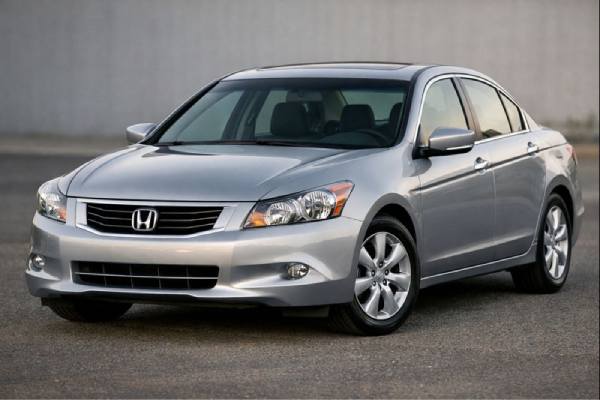
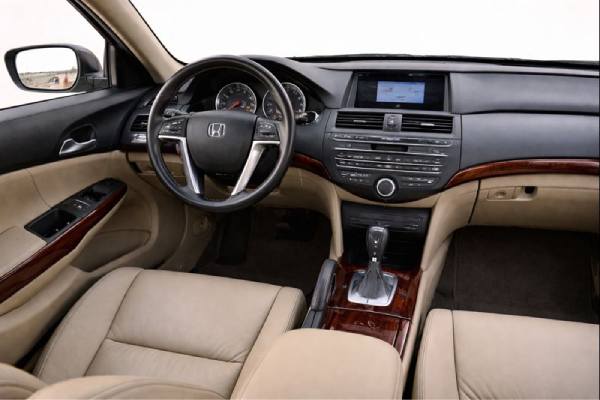
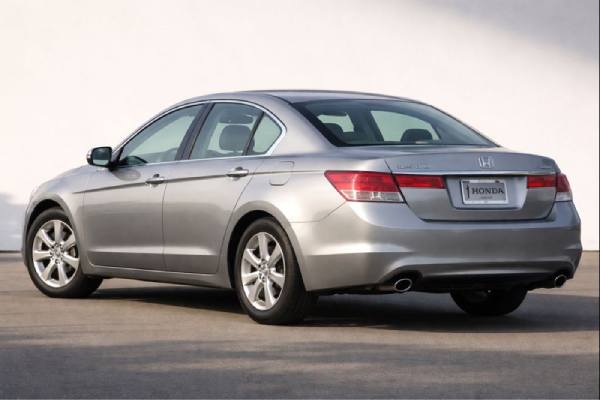
The Honda Accord CP3 with the J35Z2 3.5-liter V6 is the “effortless” version of the eighth-generation Accord: strong, quiet torque paired with a relaxed highway demeanor. With 268 hp on tap, it delivers confident passing without needing high rpm, yet it still keeps the everyday Accord strengths—predictable handling, good ergonomics, and broad parts availability. The J35 family is also well understood by independent shops, which matters as these cars age.
Ownership today is mainly about choosing the right example and staying ahead of wear. The V6 adds complexity versus the four-cylinder: a timing belt service, higher under-hood heat, and (on many versions) cylinder deactivation hardware that can create vibration or oil-use complaints if maintenance was neglected. Get a clean service history and the CP3 V6 can still be a comfortable, capable long-term daily.
Owner Snapshot
- Strong low-rpm torque makes city driving and highway passing feel effortless.
- Refined cruising: stable at speed, quiet cabin, and a smooth V6 character.
- Parts and service knowledge are widely available due to high production volume.
- Budget for timing belt and water pump service if it is not documented.
- Plan automatic transmission fluid drain-and-fill about every 40,000–60,000 km.
Quick navigation
- CP3 J35Z2 V6 overview
- J35Z2 specs, dimensions, and capacities
- Trims, options, and safety features
- Reliability issues and service actions
- Maintenance schedule and buyer’s guide
- Driving, performance, and real efficiency
- How the CP3 V6 stacks up
CP3 J35Z2 V6 overview
“CP3” is commonly used to identify the V6-equipped Accord sedan configuration within the eighth-generation Accord family in several markets. In real-world terms, this is the Accord you choose when you want the same day-to-day friendliness as the four-cylinder cars, but with a noticeably stronger power reserve and a calmer, more premium cruising feel.
The centerpiece is Honda’s J35Z2: a 3.5-liter SOHC V6 with i-VTEC. It’s tuned for smooth, linear power rather than a peaky surge, so it feels strong with partial throttle—exactly what you want for merging, overtaking, or climbing grades with passengers. The V6 also changes the car’s character: throttle response feels more “lazy-fast,” and you can keep rpm lower in normal traffic while still moving briskly.
Compared with the four-cylinder, the trade-offs are mostly about ownership complexity. Many versions of this V6 were paired with cylinder deactivation hardware (often referred to as VCM, or Variable Cylinder Management). When it is working properly, it can improve steady-speed fuel consumption. When maintenance history is poor or parts are aging, it can contribute to a few repeat complaints: vibration during transitions, uneven engine mount wear, and in some cases higher oil consumption that shows up as low oil level between services. None of that is guaranteed, but it’s the main reason buyers should prioritize condition and service records on the V6.
On the chassis side, the CP3 typically feels planted and confident. It’s not a sports sedan, but it tracks straight at highway speed, absorbs rough pavement well for the segment, and remains predictable when pushed. As these cars reach higher ages and mileages, their “feel” depends heavily on suspension health—worn control arm bushings, tired dampers, or old engine mounts can make a good car feel mediocre.
The big advantage of a well-kept CP3 V6 is that it still delivers an upscale daily experience for sensible running costs. If you approach the purchase like a long-term owner—verifying belt service, keeping fluids fresh, and refreshing worn rubber parts—you can get many more reliable years out of the platform.
J35Z2 specs, dimensions, and capacities
Specs vary by market, model year, and equipment. The tables below reflect typical CP3 Accord sedan specifications for the J35Z2 3.5-liter V6 rated at 268 hp.
Engine and performance
| Item | Spec |
|---|---|
| Code | J35Z2 |
| Engine layout and cylinders | V6, SOHC, i-VTEC, 4 valves/cyl |
| Displacement | 3.5 L (3,471 cc) |
| Bore × stroke | 89.0 × 93.0 mm (3.50 × 3.66 in) |
| Induction | Naturally aspirated |
| Fuel system | Multi-point fuel injection (MPFI) |
| Compression ratio | ~10.5:1 |
| Max power | 268 hp (200 kW) @ ~6,200 rpm |
| Max torque | ~339 Nm (250 lb-ft) @ ~5,000 rpm |
| Timing drive | Belt |
| Emissions / efficiency standard | Market-dependent (EPA / Euro variants) |
| Rated efficiency (typ., EPA combined) | ~10.5–11.5 L/100 km (20–22 mpg US) |
| Real-world highway @ 120 km/h | ~8.5–9.8 L/100 km (24–28 mpg US), tires and wind matter |
Transmission and driveline
| Item | Spec |
|---|---|
| Drive type | FWD |
| Transmission (common) | 5-speed automatic |
| Differential | Open |
Typical 5-speed automatic ratios (varies slightly by year):
| Gear | Ratio |
|---|---|
| 1st | 2.697 |
| 2nd | 1.606 |
| 3rd | 1.071 |
| 4th | 0.766 |
| 5th | 0.566 |
| Reverse | 1.888 |
| Final drive | ~4.31–4.44 |
Chassis and dimensions
| Item | Typical spec (approx.) |
|---|---|
| Suspension (front/rear) | MacPherson strut / multi-link independent |
| Steering | Rack-and-pinion (assist type varies by market/year) |
| Brakes (front/rear) | Disc/disc; sizes vary by trim |
| Wheels/tires (common) | 225/50 R17 or similar |
| Length / width / height | ~4,725 / 1,840 / 1,440 mm (~186.0 / 72.4 / 56.7 in) |
| Wheelbase | ~2,800 mm (~110.2 in) |
| Turning circle (kerb-to-kerb) | ~11.8–12.0 m (~38.7–39.4 ft) |
| Curb weight | ~1,600–1,680 kg (~3,530–3,700 lb), equipment dependent |
| Fuel tank | ~70 L (18.5 US gal / 15.4 UK gal) |
| Cargo volume | ~420–460 L (~14.8–16.2 ft³), method varies |
Performance and capability
| Item | Typical range (healthy stock car) |
|---|---|
| 0–100 km/h (0–62 mph) | ~6.5–7.5 s |
| 80–120 km/h passing | ~4.5–6.0 s depending on kickdown |
| Top speed | ~210–230 km/h (130–143 mph), often limited by market |
| Braking 100–0 km/h | Highly tire-dependent; commonly ~37–41 m |
| Towing capacity | Often not emphasized; verify by market approval |
Fluids and service capacities
| Fluid | Typical spec |
|---|---|
| Engine oil | 5W-20 (common) or market-specified equivalent; ~4.3 L (4.5 US qt) with filter |
| Coolant | Honda long-life type; total system capacity often ~7.5–8.5 L |
| Automatic transmission | Honda ATF (DW-1 commonly used); drain/fill often ~3.0 L (total higher) |
| Brake fluid | DOT 3 (or DOT 4 where specified) |
| Power steering | Depends on system; use specified Honda fluid where applicable |
Key torque specs (common references; verify by VIN):
| Fastener | Torque |
|---|---|
| Engine oil drain bolt | 39 Nm (29 lb-ft) |
| Wheel lug nuts | ~108 Nm (~80 lb-ft) |
Electrical (typical)
| Item | Typical spec |
|---|---|
| Alternator output | ~110–130 A (varies) |
| 12V battery | Often 60–70 Ah range (market-dependent) |
| Spark plugs | Iridium long-life; gap commonly ~1.1 mm (0.043 in) |
Safety and driver assistance (era-typical)
| Item | Notes |
|---|---|
| Airbags | Front, side, and curtain airbags common; verify trim/market |
| Stability systems | ABS and stability control commonly fitted |
| ADAS | Generally limited compared with modern cars; mostly passive safety + stability systems |
Trims, options, and safety features
Most CP3 V6 Accords were positioned as “near-top” trims in their markets. That means you often get strong comfort equipment—leather, power seats, upgraded audio, and sometimes navigation—without stepping into a true luxury brand. The downside is that higher trims also bring more aging electronics to test during a pre-purchase inspection.
Trims and options: what changed ownership experience
- Comfort upgrades (common on V6): Leather seating, heated front seats in many markets, dual-zone climate control, and a premium audio system. These features improve daily satisfaction, but each adds potential repair points: seat heaters, seat motors, and climate blend door actuators.
- Wheel packages: V6 trims often came with larger wheels and wider tires. The upside is better grip and more stable turn-in. The downside can be higher road noise and faster wear of suspension bushings if roads are rough.
- Infotainment generations: Factory navigation units from this era work, but they feel dated and can be expensive to replace. If audio modernization matters, prioritize cars with clean wiring and avoid poorly installed aftermarket units.
Quick identifiers when badges lie
Used cars frequently have swapped wheels, debadged trunks, or replacement bumpers. Practical tells include:
- Full leather vs cloth (and whether the driver seat shows typical bolster wear).
- Sunroof presence and operation.
- Factory head unit type (navigation screen vs standard audio display).
- Tire size on the door jamb sticker matching what is fitted.
Safety ratings: what to verify
Safety scores depend on the exact body style, model year, and test version. In many regions, this generation of Accord performed well in its class, but you should still verify the exact results for your year using official sources. This is especially important if you are comparing a V6 sedan to a four-cylinder sedan or a coupe, because ratings and tested equipment can differ.
Safety equipment and real-world usefulness
For this era, “safety tech” is mainly about solid basics:
- Structural protection: A strong occupant cell design and well-developed crumple zones were core engineering priorities for mainstream Hondas of this period.
- Restraints: Multiple airbags are common. Confirm the SRS light behaves correctly (illuminates at key-on, then turns off).
- Child-seat provisions: ISOFIX/LATCH anchors are typically present. Check that the anchors are accessible and that rear seat belts retract smoothly.
- Stability and braking systems: ABS and stability control reduce loss-of-control risk in emergency maneuvers, but only if tires, alignment, and brakes are kept in good condition.
Driver assistance reality check
Most CP3-era V6 Accords predate widespread automatic emergency braking, lane centering, and radar cruise control in this segment. If those features are a priority, a newer vehicle is a more meaningful upgrade than trimming differences inside this generation. For CP3 buyers, the best “active safety” strategy is mechanical: fit quality tires, keep brake fluid fresh, ensure calipers slide freely, and correct any worn suspension components that compromise stability.
Reliability issues and service actions
A well-maintained J35Z2 is generally durable, but the V6 adds a few “must monitor” areas that don’t apply to the four-cylinder cars. To keep this section actionable, issues are grouped by prevalence and cost tier, with clear symptoms and typical remedies.
Common (high prevalence), usually medium cost
- Engine mount wear and vibration: If the car shudders at idle or during light cruising, mounts are a prime suspect—especially on cylinder-deactivation versions where torque pulses can change during transitions.
Symptoms → cause → remedy: vibration in cabin → aged hydraulic/active mounts → replace mounts and verify correct idle and no misfire codes. - Suspension bushings and links: Clunks over bumps and vague steering are often worn control arm bushings, sway links, or rear multi-link bushings.
Symptoms → cause → remedy: knocks and uneven tire wear → worn rubber joints → replace worn arms/bushings and align. - Brake hardware sticking: Slide pins that seize lead to uneven pads and rotor overheating.
Symptoms → cause → remedy: pulling or hot wheel → stuck slide pins/caliper → service pins, replace damaged hardware.
Occasional, can become expensive if ignored
- Oil consumption and plug fouling (some VCM-equipped cars): Not every car does this, but it’s the V6 Accord’s most discussed long-term risk.
Symptoms → cause → remedy: dropping oil level, misfire on specific cylinders → oil control issues + extended intervals → shorten oil interval, verify PCV system health, inspect plugs, and address root cause before catalyst damage. - Timing belt service neglect: The belt itself is not usually “troublesome,” but skipping the interval can be catastrophic.
Symptoms → cause → remedy: no symptoms until failure → overdue belt/tensioner → replace belt, tensioner, and usually water pump as a set. - Cooling system aging: Plastic tanks, hoses, and thermostats age; overheating is the enemy of any aluminum engine.
Symptoms → cause → remedy: rising temps under load → weak radiator/thermostat/hoses → pressure-test, replace worn parts, refill with correct coolant.
Rare, higher cost
- Automatic transmission abuse or neglect: The 5-speed automatic usually holds up well if serviced, but neglected fluid can cause harsh shifts or delayed engagement.
Symptoms → cause → remedy: flare or harsh shifting → degraded ATF and clutch wear → correct fluid service, diagnose with scan data, avoid guessing. - Catalyst efficiency failures: Often secondary to misfires or oil burning.
Symptoms → cause → remedy: check-engine catalyst code → upstream cause + aging catalyst → fix engine issue first, then confirm catalyst need.
Recalls, TSBs, and verification
This model era overlaps with major industry-wide safety campaigns (most notably airbag-related recalls in many markets). The correct process is simple:
- Run an official VIN recall check.
- Confirm completion with dealer records or invoices.
- Avoid cars where warning lights were recently “cleared” without paperwork.
Pre-purchase checks that reduce risk
- Cold start and warm idle: listen for abnormal noises and confirm smooth idle.
- Scan for stored history codes: not just current codes.
- Inspect oil level and condition: a low level tells you more than a shiny detail job.
- Drive at steady speed: feel for vibration changes that could indicate mount or cylinder-deactivation transition issues.
- Confirm timing belt history: if undocumented, assume it’s due and price accordingly.
Maintenance schedule and buyer’s guide
A CP3 V6 that is “maintained like a commuter” tends to last. A CP3 V6 that is “maintained like a cheap used car” becomes expensive. The goal is to keep fluids fresh, protect the timing belt system, and refresh wear parts before they degrade drivability.
Practical maintenance schedule (distance/time)
- Engine oil and filter: Every 8,000–10,000 km or 12 months (shorter if many cold starts or short trips). Keep the oil level checked between changes; don’t rely on long intervals.
- Engine air filter: Inspect every 15,000 km; replace every 30,000–45,000 km based on conditions.
- Cabin filter: Every 15,000–30,000 km, or sooner if airflow drops.
- Brake fluid: Every 2 years, regardless of mileage.
- Coolant (long-life): Follow market guidance; a practical used-car approach is to replace if history is unknown and then keep a consistent interval thereafter.
- Automatic transmission fluid: Drain-and-fill every 40,000–60,000 km for longevity, especially in city driving or hot climates.
- Spark plugs (iridium): Commonly around 160,000 km (100,000 mi), sooner if there are misfires, poor economy, or rough running.
- Timing belt, tensioner, and water pump: If undocumented, treat as due. Many owners plan it around 160,000 km (100,000 mi) or roughly 7 years, whichever comes first.
- Accessory belt, hoses, and coolant seals: Inspect at every oil service; replace at early signs of cracking or seepage.
- Tires and alignment: Rotate every 8,000–10,000 km; align annually or with any uneven wear.
Fluids and specs for decision-making
- Use the correct Honda-spec ATF (and don’t mix random fluids).
- Use the correct long-life coolant type; mixing coolants can reduce corrosion protection.
- Use the specified oil viscosity for your market and climate, and focus on oil quality and level.
Buyer’s guide: what to inspect first
Service history (highest priority)
- Proof of timing belt service (parts list matters: belt + tensioner + water pump is ideal).
- Regular oil services with reasonable intervals.
- Documented ATF services rather than “never touched.”
Mechanical condition
- Smooth idle and stable cruising without vibration surges.
- No harsh or delayed engagement from Park to Drive.
- No overheating signs: stable temperature gauge, clean coolant, no sweet smell.
Chassis
- Listen for clunks at low speed over bumps.
- Check tire wear for alignment or bushing issues.
- Verify brake feel and ensure no wheel is noticeably hotter after a test drive.
Electrical and comfort
- Test every window, lock, HVAC mode, and audio function.
- Confirm all warning lights self-test and then turn off properly.
Which versions tend to age best
- Best long-term bets: Cars with complete records, stock intake/exhaust, and conservative wheel sizes.
- Potential troublemakers: Modified cars with unknown tuning, missing service history, or “freshly cleared” dash lights.
- Best value strategy: Pay more for condition, then spend wisely on baseline fluids, mounts, and suspension refresh. A sorted CP3 V6 feels dramatically newer than a neglected one.
Driving, performance, and real efficiency
The CP3 V6 is defined by ease. The powertrain makes the car feel lighter than its curb weight suggests, and the chassis is tuned to be stable rather than playful. If you want a sedan that quietly covers distance with minimal effort, this is the appeal.
Ride, handling, and NVH
On the road, the CP3 V6 is typically smooth and composed. The suspension absorbs broken pavement without constant bouncing, and the body stays settled over long highway undulations. Steering is usually light to moderate, with more emphasis on accuracy than feedback. When parts are fresh—dampers, bushings, mounts—the car feels tight and refined. When those parts are worn, the same car can feel floaty, noisy, and slightly “disconnected,” which is why condition matters so much.
Braking feel is generally consistent, but older cars often suffer from basic issues: moisture-contaminated brake fluid, stuck slide pins, or cheap pads that fade early. Fixing the basics can restore confidence quickly.
Powertrain character
The J35Z2 provides strong midrange pull. In everyday driving, you don’t need to rev it; it moves briskly at low rpm and responds well to moderate throttle. For passing, the automatic kickdown is usually decisive enough, though it will never feel like a modern 8–10 speed transmission. Instead, it trades rapid ratio changes for smoothness.
If the car uses cylinder deactivation, you may notice subtle transitions at steady cruise. In a healthy example, the transition is mild. In an aging example with worn mounts or uneven combustion, it can feel like a gentle drone or vibration. That is not something you should ignore during a test drive.
Real-world efficiency (what owners often see)
- City driving: roughly 11–13 L/100 km (18–21 mpg US), with short trips pushing higher.
- Highway 100–120 km/h: roughly 8.5–9.8 L/100 km (24–28 mpg US).
- Mixed use: commonly around 10–11.5 L/100 km (20–23 mpg US).
Tires, alignment, and brake drag can swing these numbers more than people expect. So can driving style: the V6 makes it easy to accelerate harder because it feels effortless, and that can quietly raise consumption.
Performance metrics that matter day-to-day
The headline acceleration is strong for the class:
- 0–100 km/h (0–62 mph): commonly in the mid-6 to mid-7 second range when healthy.
- Passing power: feels immediate because torque is available without high revs.
What matters more than the stopwatch is consistency. A healthy CP3 V6 should feel smooth, strong, and calm. If it feels hesitant, rough, or “busy” at steady speed, treat that as diagnostic information—often mounts, ignition maintenance, or transmission fluid condition are involved.
How the CP3 V6 stacks up
The CP3 V6 competes best on “complete daily-driver quality”: it blends power, comfort, and long-term serviceability. When comparing rivals, focus on what you actually value—straight-line speed, cabin comfort, running costs, or long-term durability.
Toyota Camry V6 (same era)
Why it’s a rival: Similar mission—comfortable mid-size sedan with strong V6 power.
Typical difference: The Camry often leans softer in ride and steering feel, while the Accord tends to feel more composed and confidence-inspiring at speed.
Ownership angle: Both are durable; condition and service history matter more than badge at this age.
Nissan Altima 3.5
Why it’s a rival: Strong V6 power and often a lighter feel.
Typical difference: The Accord generally feels more “finished” in control feel and cabin ergonomics.
Ownership angle: Pay close attention to drivetrain type and service history on any Altima variant you consider.
Mazda6 (V6 where available)
Why it’s a rival: Often more driver-focused steering and cornering balance.
Typical difference: The Accord V6 usually wins on quiet cruising and powertrain smoothness.
Ownership angle: Parts availability and market support can be easier for the Accord, depending on region.
Ford Fusion V6 and similar domestic V6 sedans
Why it’s a rival: Good value and sometimes strong features for the money.
Typical difference: The Accord’s long-term parts ecosystem and well-known service pathways are often an advantage.
Ownership angle: A well-kept Fusion can be great; a neglected one can become “death by small repairs.”
The practical verdict
- Choose the CP3 J35Z2 if you want a refined, strong sedan with simple day-to-day drivability and wide service support.
- Choose a four-cylinder Accord if you want lower fuel use and fewer V6-specific maintenance items.
- Choose a newer car if modern driver assistance and up-to-date infotainment are must-haves.
At this age, the best competitor to a CP3 V6 is often a better-maintained CP3 V6. Buy the cleanest example you can find, budget for baseline service, and you’ll get the smooth, capable experience this model is known for.
References
- Recalls 2025 (Recall Database)
- Honda Accord 4-door sedan 2010 (Safety Rating)
- 2010 Honda Accord 2010 (Fuel Economy Data)
- Owner’s Manuals 2025 (Owner’s Manual)
Disclaimer
This article is for informational purposes only and is not a substitute for professional diagnosis, repair, or safety inspection. Specifications, torque values, service intervals, and procedures vary by VIN, market, model year, and equipment. Always verify details using official Honda service documentation and the information specific to your vehicle.
If you found this guide useful, please consider sharing it on Facebook, X (Twitter), or your preferred community to support our work.