
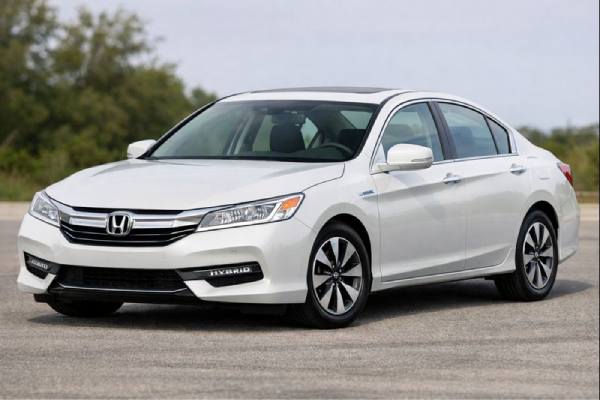
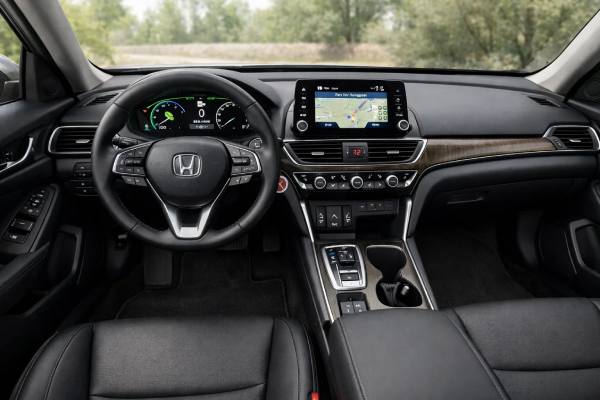
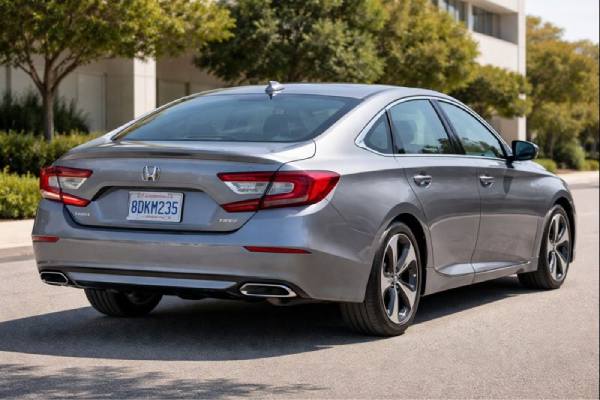
The CV3 Honda Accord Hybrid is the “quietly clever” version of the 10th-gen Accord: it looks like a normal midsize sedan, but its engineering priorities are very different. Instead of leaning on a multi-gear automatic, Honda’s two-motor hybrid system blends electric drive with a simple, mostly fixed-ratio driveline. Around town, it can behave like an EV for short stretches, then smoothly bring the engine online to generate power. On the highway, it can couple the engine more directly for efficiency. The result is strong everyday response, excellent fuel economy, and lower brake wear thanks to regenerative braking.
For owners, the upside is a roomy, long-legged car that feels modern even years later. The main tradeoff is that hybrids reward correct maintenance (especially fluids and cooling) and careful diagnosis when something does go wrong.
Top Highlights
- Strong real-world efficiency without giving up midsize-sedan space and comfort
- Smooth, “single-speed” feel in traffic with quick torque off the line
- Regenerative braking reduces pad wear in mixed driving, especially city use
- Plan for a 12 V battery test every 3–4 years, even if the hybrid battery is healthy
- Typical tyre rotation interval: every 10,000–12,000 km (6,000–7,500 miles)
What’s inside
- CV3 Accord Hybrid at a glance
- Specs and measurements CV3
- Trims, equipment, and safety tech
- Reliability trends and known fixes
- Maintenance plan and buying checks
- Real-world driving and efficiency
- Accord Hybrid versus main rivals
CV3 Accord Hybrid at a glance
Think of the CV3 Accord Hybrid as a conventional midsize sedan body wrapped around a powertrain that behaves more like an EV most of the time. Honda’s two-motor hybrid layout uses an electric traction motor for the majority of low-speed driving, while the gasoline engine often runs as a generator (making electricity) rather than directly turning the wheels. At higher speeds and lighter loads, the system can transition to a more direct mechanical coupling for efficiency. You don’t need to understand the control logic to enjoy it, but that architecture explains a few ownership traits.
First, response is typically strong at city speeds. Electric torque arrives instantly, and because there are no traditional gear changes, the car feels smooth in stop-and-go traffic. Second, brake feel and brake wear differ from a non-hybrid. Regenerative braking (regen) slows the car by turning the traction motor into a generator. That “recaptures” energy into the battery and reduces friction-brake use, so pads can last longer in mixed driving. The flip side is that cars driven mostly on regen can see more rotor surface rust if they sit frequently or live in wet climates, because the friction brakes get used less.
On packaging, the Accord Hybrid remains a true family sedan: a low seating position, wide rear bench, and a trunk that stays practical for daily life. Some years and trims vary in wheels, tyres, and features, but the core experience is consistent: quiet cruising, confident stability, and fuel economy that makes long commutes feel cheaper and less stressful.
The main ownership “hybrid reality” is diagnosis and service access. A typical independent shop can maintain one, but not every shop has hybrid-specific scan tools, experience with high-voltage safety procedures, or familiarity with Honda’s hybrid system cooling and electronics. If you buy one used, prioritize service records and a clean electrical history over cosmetic perfection.
Specs and measurements CV3
Specifications for the CV3 Accord Hybrid can vary slightly by model year, market, and trim, but the core hardware stays consistent: a 2.0-liter Atkinson-cycle engine paired with a two-motor hybrid drive unit powering the front wheels. Where exact values differ by region (EPA vs WLTP vs Canadian ratings), the tables below focus on the most commonly published figures and practical ownership information.
Powertrain and efficiency (typical CV3 Accord Hybrid)
| Item | Specification |
|---|---|
| Powertrain codes | LFA1 (2.0L engine) + LFB1 (hybrid drive) |
| Engine layout | Inline-4, DOHC, i-VTEC, 4 valves/cyl |
| Displacement | 2.0 L (≈ 1,993 cc class) |
| Bore × stroke | ≈ 81.0 × 96.7 mm (≈ 3.19 × 3.81 in) |
| Induction | Naturally aspirated |
| Fuel system | Direct injection (market-dependent labeling) |
| Compression ratio | High (Atkinson-cycle tuning; market varies) |
| System max power | 212 hp (158 kW) combined |
| Traction motor output | Often published around 181 hp (135 kW) and strong low-rpm torque (market listings vary) |
| Hybrid battery | Lithium-ion; capacity and voltage are not always listed in consumer brochures (commonly ~1.3 kWh, ~260-V class) |
| Rated efficiency (typical) | Around 5.0–5.5 L/100 km combined (varies by year/trim/market) |
| Real-world highway @ 120 km/h | Often ~5.8–6.5 L/100 km depending on temperature, tyres, and wind |
| Aerodynamics | Cd and frontal area vary by trim; not consistently published |
Transmission and driveline
| Item | Specification |
|---|---|
| Transmission type | e-CVT style hybrid drive (two-motor system with fixed gearing) |
| Drive type | FWD |
| Differential | Open (traction and stability systems manage slip) |
Chassis and dimensions (sedan)
| Item | Specification |
|---|---|
| Front suspension | MacPherson strut |
| Rear suspension | Multi-link |
| Steering | Electric power steering (rack-and-pinion) |
| Brakes | 4-wheel discs (sizes vary by trim/wheel package) |
| Wheels/tyres | Commonly 225/50R17 or 235/40R19 depending on trim |
| Length | ≈ 4,882 mm (≈ 192.2 in) |
| Wheelbase | ≈ 2,830 mm (≈ 111.4 in) |
| Width | Market reporting varies (with mirrors folded often ~1,906 mm / 75.0 in) |
| Height | ≈ 1,450 mm (≈ 57.1 in) |
| Turning circle | ≈ 11.6 m (≈ 38.1 ft) class (market-dependent measurement method) |
| Curb weight | Typically ~1,520–1,560 kg (≈ 3,350–3,440 lb), trim dependent |
| Fuel tank | ≈ 48.5 L (≈ 12.8 US gal / 10.7 UK gal) |
| Cargo volume | ≈ 470 L (≈ 16.6 ft³) class (method varies by market) |
Performance and capability (typical)
| Item | Specification |
|---|---|
| 0–100 km/h (0–62 mph) | ~6.9–7.5 s (test method and tyres matter) |
| Top speed | Typically governed around ~180–190 km/h (112–118 mph) |
| Towing | Generally not rated for heavy towing in many markets; verify for your VIN/market |
| Payload | Check the door-jamb tyre/loading label; varies by trim and equipment |
A helpful way to interpret these numbers is to focus less on “peak horsepower” and more on how the hybrid system delivers torque. The CV3 tends to feel quick from low speeds because the traction motor does the heavy lifting early. The engine’s job is often to keep the battery state-of-charge stable while meeting power demand, which is why the engine may rev differently than a conventional automatic under hard acceleration.
Trims, equipment, and safety tech
Because trim names differ by country, it’s easiest to think of the CV3 Accord Hybrid lineup in three buckets: value-focused trims, sport-appearance trims, and comfort/luxury trims. Mechanically, most Hybrids share the same core powertrain and front-wheel-drive layout. The meaningful differences are typically wheel size (which affects ride and real-world efficiency), interior comfort features, audio/infotainment level, and the exact configuration of driver-assistance equipment.
Trims and options that matter most
- Wheel and tyre packages: Smaller wheels with taller sidewalls (often 17-inch) usually deliver the best ride comfort and the best real-world economy. Larger wheels (often 19-inch on upper or sport-appearance trims) can sharpen turn-in, but they typically add road noise and can cost fuel economy on rough pavement.
- Lighting packages: Headlight design and performance can vary by trim and model year. This matters for night driving and also because some safety-rating organizations score headlights separately.
- Infotainment and audio tiers: Base systems are functional, but higher trims often add better speakers, navigation availability (market dependent), and more connectivity features. If you keep cars for a long time, prioritize the newest infotainment hardware you can get within budget, because it tends to age better.
- Comfort and winter features: Heated seats and steering wheel (market dependent), better seat upholstery, and more cabin insulation can materially change daily satisfaction in cold climates or long commutes.
Safety ratings and what to watch
Safety results for the Accord family are generally strong, but the details matter because rating protocols change over time. In many years, the Accord earns high crashworthiness scores in core crash tests, while headlight ratings and front-crash-prevention performance can vary by trim and by the exact test version used.
Practical guidance:
- Treat “top rating” headlines as a starting point, then confirm your exact trim’s lighting and crash-prevention evaluation where possible.
- If you’re shopping used, verify that the car has the expected forward-collision and lane-support features active and calibrated correctly. After windshield replacement, front bumper repairs, or suspension alignment work, some systems may require calibration.
Safety systems and driver assistance (typical availability)
Most CV3 Accord Hybrids are associated with Honda Sensing features that commonly include:
- Forward collision warning and automatic emergency braking (AEB)
- Lane departure warning and lane keeping assistance
- Adaptive cruise control (ACC)
- Road departure mitigation
- Stability control and traction control
- Multiple airbags and reinforced body structure designs
Child-seat hardware is typically straightforward for this class, with LATCH/ISOFIX anchors and tether points. The key ownership note is that advanced driver-assistance systems depend on camera and radar alignment. If the car has been in a front-end collision, insist on documentation showing the correct repair procedures and calibrations were performed, not just that the bumper looks good.
Reliability trends and known fixes
The CV3 Accord Hybrid’s reputation is generally positive, but “hybrid reliable” means a different mix of risks than a purely gasoline sedan. The good news is that the core hybrid design avoids some traditional wear points (no multi-gear automatic shift packs, less brake wear in many use cases). The important part is knowing which issues are most common, how they present, and what a sensible repair path looks like.
Common (higher prevalence)
- 12 V battery weakness (low to medium cost):
Symptoms: Slow starts (even though it’s a hybrid), warning messages, random infotainment resets, intermittent sensor errors.
Likely cause: Small 12 V battery aging; hybrids still rely on it to boot the car’s systems.
Remedy: Load test, replace with correct capacity, and check charging behavior. Many “mystery” errors disappear after a proper 12 V replacement. - Infotainment glitches (low to medium cost):
Symptoms: Screen freezes, Bluetooth dropouts, intermittent camera behavior.
Likely cause: Software bugs, aging connections, or low 12 V voltage events.
Remedy: Software updates where available, battery/ground checks, and a reset procedure before replacing expensive modules. - Brake feel and rotor corrosion (low to medium cost):
Symptoms: Pulsation after sitting, light grinding in wet weather, uneven braking feel.
Likely cause: Regen-heavy driving reduces friction-brake use; surface rust can build up.
Remedy: Periodic firm stops to “clean” rotors, correct pad bedding, and rotor resurfacing/replacement if needed.
Occasional (moderate prevalence)
- A/C performance problems (medium to high cost):
Symptoms: Weak cooling, intermittent cold air, or refrigerant leaks.
Likely cause: Leaks at condenser or lines, or compressor issues. Hybrids use electric A/C compressors, which can be costly.
Remedy: Proper leak test and correct oil/refrigerant handling; avoid “top-off” shortcuts. - Fuel system and DI deposits (medium cost over time):
Symptoms: Rough cold starts, mild hesitation, reduced efficiency at high mileage.
Likely cause: Direct injection can promote intake-valve deposits over long mileage, especially with short trips.
Remedy: Use quality fuel, keep up with air filtration, and consider professional cleaning if symptoms develop.
Rare (lower prevalence but higher consequence)
- Hybrid electronics cooling or inverter-related faults (high cost):
Symptoms: Reduced power, warnings, limp mode, or charging/regen anomalies.
Likely cause: Cooling flow issues, connector corrosion, sensor faults, or module failure.
Remedy: Diagnose with hybrid-capable scan tools; confirm cooling pump operation and coolant condition before replacing modules.
Recalls, service bulletins, and how to verify
Rather than relying on generic lists, use your VIN to confirm open recalls and completed remedies. Ask the seller for dealer service history printouts, and check completion status through official recall tools. If you see evidence of front-end damage, prioritize documentation showing correct sensor calibration and repair procedures.
Maintenance plan and buying checks
A CV3 Accord Hybrid rewards “boring, consistent” maintenance. The hybrid system itself is usually low-drama when fluids, filters, and cooling are kept in shape, and when the 12 V electrical system is treated as a normal wear item.
Practical maintenance schedule (distance/time)
Use your car’s Maintenance Minder or service prompts where equipped, but a simple baseline plan looks like this:
- Engine oil and filter: every 10,000–12,000 km (6,000–7,500 miles) or 12 months, whichever comes first (short trips may shorten this). Use the correct low-viscosity oil grade listed for your market, commonly 0W-20.
- Tyre rotation: every 10,000–12,000 km; check alignment annually or whenever tyres show uneven wear.
- Cabin air filter: every 20,000–25,000 km (or yearly in dusty/pollen-heavy regions).
- Engine air filter: every 30,000–40,000 km (inspect sooner in dust).
- Brake fluid: every 3 years is a conservative interval, regardless of mileage.
- Coolant: often around 5 years/100,000 km for first change, then shorter intervals thereafter (verify for your market).
- Spark plugs: commonly around 160,000 km (100,000 miles) on modern Hondas, but verify by VIN and engine family.
- Hybrid transmission/drive unit fluid: treat as a real service item, especially if you do lots of high-speed commuting, mountain driving, or heavy city use. A practical interval is often in the 60,000–100,000 km range depending on use and official guidance.
Fluids, capacities, and “decision-making” numbers
Exact capacities vary by year and equipment, but the following are helpful planning anchors:
- Engine oil: typically ~3.7–4.0 L including filter on Honda 2.0-class fours (confirm for your exact engine and filter).
- Brake fluid: DOT 3 or DOT 4 as specified for your market; do not mix random “universal” fluids.
- Coolant: use Honda-type coolant compatible with aluminum engines; do not top off with generic green coolant unless it matches the required standard.
- A/C refrigerant: hybrids often use electric compressors and specific oils; correct service procedures matter.
Essential torque values (verify by model year)
These are commonly used planning references for Hondas in this class, but always confirm for your exact vehicle:
- Wheel lug nuts: ~108 Nm (80 lb-ft)
- Engine oil drain bolt: commonly ~39 Nm (29 lb-ft) class
- Spark plugs: often around ~18–25 Nm depending on plug design (do not guess—verify)
Buyer’s guide: what to inspect before purchase
Bring a checklist and treat it like a short audit:
- Service history: oil changes at sensible intervals, coolant and brake fluid not ignored, and evidence of correct tyre care.
- 12 V battery condition: ask how old it is; test it. A weak 12 V can mimic bigger problems.
- Hybrid behavior on a test drive: smooth transitions, no warning lights, consistent regen feel, and normal engine behavior under load.
- HV cooling and underhood condition: look for dried coolant residue, hacked wiring, or missing clips near the front radar/camera areas.
- Brakes and tyres: uneven tyre wear suggests alignment or suspension wear; rusty rotors are common but should clean up after normal braking.
- Accident repairs: insist on documentation for ADAS calibrations if the windshield or front bumper has been replaced.
Long-term outlook is strong when the car is maintained and driven regularly. The biggest “avoid” scenario is a car with unclear electrical history, recurring warning lights, or evidence of improper crash repairs.
Real-world driving and efficiency
In daily driving, the CV3 Accord Hybrid feels different from both a conventional automatic and many “CVT” hybrids, even though people often use the same shorthand. The key sensation is smooth, immediate torque paired with engine behavior that doesn’t always match road speed, because the engine can operate as a generator rather than a direct drive source.
Ride, handling, and NVH
- Ride: The Accord’s chassis is mature—stable at speed, composed over bigger bumps, and generally comfortable for long commutes. Wheel size matters a lot: 17-inch setups typically ride more softly and quietly than 19-inch setups.
- Handling: You get predictable front-wheel-drive balance with good mid-corner stability. It won’t feel like a sports sedan, but it’s confident on a twisty road, especially on good tyres.
- NVH (noise and vibration): Around town, it can be remarkably quiet because the car often moves on electric power at low loads. Under hard acceleration, you may hear the engine rise to a steady, higher rpm—normal behavior for this hybrid style.
Powertrain character
Off the line, the traction motor gives the car a “quick step.” Passing power is usually strong in the 40–110 km/h range because the system can blend engine generation with battery output. When the battery is low or the car is hot/cold, you may notice the engine running more often to manage thermal needs and state-of-charge. None of that is a fault; it’s system management.
Regenerative braking is one of the biggest ownership differences. Many drivers adapt quickly: light pedal pressure gives smooth deceleration with energy recovery, and the friction brakes blend in when you need more stopping power. If your car has steering-wheel regen paddles (trim dependent), they are useful for controlling speed on descents without riding the brakes.
Real-world efficiency
In mixed driving, many owners see fuel economy near official combined ratings when tyres are correctly inflated and trips are longer than a few kilometers. The biggest swings come from:
- Short trips in winter: the engine runs more for cabin heat and warm-up.
- High-speed cruising: aerodynamic drag rises sharply above 110–120 km/h.
- Wheel and tyre choice: wider, stickier tyres and larger wheels cost efficiency.
A realistic expectation is excellent city economy, strong mixed economy, and highway numbers that remain good for a midsize sedan—just not “magic” at very high speeds or in deep winter.
Accord Hybrid versus main rivals
The Accord Hybrid competes in a crowded field, but it stands out because it blends efficiency with a genuinely “big sedan” feel. Here’s how it typically compares to the alternatives people cross-shop.
Toyota Camry Hybrid
- Why choose the Accord: More EV-like smoothness around town, a spacious cabin feel, and an engaging chassis balance for the class. Many drivers prefer the Accord’s steering and overall road manners.
- Why choose the Camry: A long-standing hybrid reputation, very broad service familiarity, and a powertrain character that some find more predictable because engine behavior often feels more directly tied to acceleration.
- Bottom line: Camry Hybrid is the conservative pick; Accord Hybrid is the “still practical, but a bit more refined to drive” pick.
Hyundai Sonata Hybrid and Kia K5 (where applicable)
- Why choose the Accord: A more traditional midsize-sedan driving position and a hybrid system that tends to feel robust and smooth when maintained. Strong resale in many regions.
- Why choose the Korean rivals: Often more features for the money, longer warranty coverage in many markets, and a modern tech presentation.
- Bottom line: If you prioritize warranty and features, the Sonata Hybrid can be tempting. If you prioritize long-term familiarity and a proven platform, the Accord is often the safer bet.
Honda Insight and Toyota Prius (efficiency-focused alternatives)
- Why choose the Accord: More rear-seat space, a larger trunk feel, and better high-speed comfort for long highway commutes.
- Why choose the smaller hybrids: Lower running costs and sometimes better city fuel economy due to lighter weight.
- Bottom line: If you want one car that does commuting, family duty, and road trips with minimal compromise, the Accord Hybrid makes more sense than a smaller efficiency-first model.
The simple decision rule
- Choose the Accord Hybrid if you want a midsize sedan that feels quiet and confident at speed, delivers strong day-to-day response, and still returns excellent fuel economy.
- Choose a rival if your priority is maximum feature-per-dollar, the most conservative hybrid reputation in your local market, or a smaller car optimized purely for economy.
References
- Specifications – 2022 Honda Accord Hybrid 2022 (Manufacturer Specifications)
- Fuel Economy of the 2020 Honda Accord Hybrid 2020 (Official Fuel Economy Data)
- 2019 Honda Accord 2019 (Safety Rating)
- Check for Recalls: Vehicle, Car Seat, Tire, Equipment | NHTSA 2025 (Recall Database)
- Maintenance Schedule Download for Your Honda Vehicle | Honda Canada 2025 (Maintenance Schedule)
Disclaimer
This article is for informational purposes only and is not a substitute for professional diagnosis, inspection, or repair. Specifications, torque values, service intervals, and procedures can vary by VIN, model year, market, and equipment. Always verify details against your vehicle’s official owner’s documentation and service information, and follow appropriate high-voltage safety procedures for hybrid components.
If this guide helped you, please consider sharing it on Facebook, X (Twitter), or your favorite forum to support our work.