
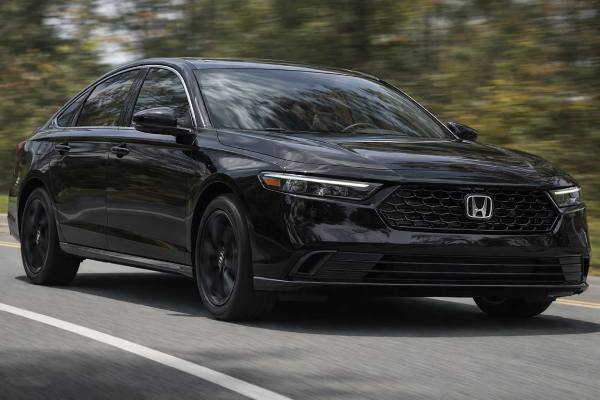
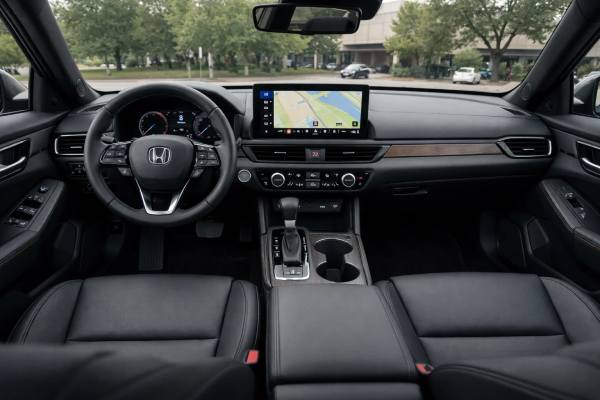
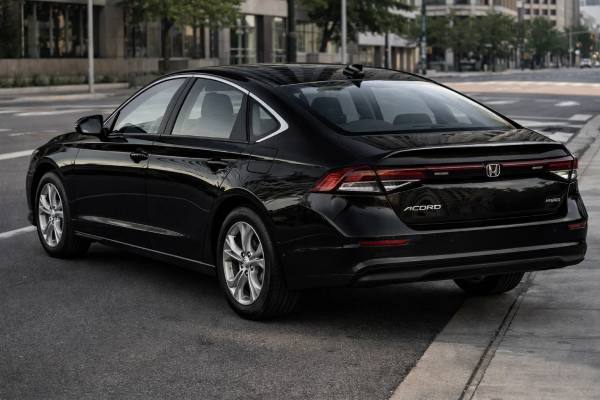
The 2023–present Accord (CY1) with the L15BE 1.5-liter turbo is the “everyday engineer’s” Accord: a modern midsize sedan that prioritizes predictable behavior, low running stress, and high usability over headline power. The engine’s direct injection and small turbocharger deliver strong midrange torque for normal traffic, while the CVT keeps the powertrain relaxed at highway speeds. Honda also tuned this generation for a quieter cabin and steadier ride, so it feels more grown-up than older Accords without turning numb.
For owners, the sweet spot is the simple formula: efficient fuel use, sensible tire sizes, straightforward servicing, and a deep safety-technology baseline. The main ownership key is staying disciplined with fluids—especially oil and CVT fluid—because turbo heat and a belt CVT are both happiest with clean, correct-spec fluids.
Quick Specs and Notes
- Strong real-world torque for daily driving, with smooth power delivery once the turbo is on boost.
- Efficient highway cruising for a midsize sedan, helped by tall effective gearing from the CVT.
- Practical packaging: a big rear seat and a genuinely usable trunk for family and travel duty.
- Keep up with CVT fluid services; skipping them is one of the fastest ways to shorten transmission life.
- Typical oil service cadence is about 12 months / 10,000 miles (16,000 km), but follow the car’s Maintenance Minder prompts.
Jump to sections
- CY1 Accord 1.5T profile
- L15BE specs and capacities
- Trims, options, and safety tech
- Reliability watchlist and actions
- Service schedule and buying tips
- Road feel and efficiency
- Rivals and real alternatives
CY1 Accord 1.5T profile
The CY1 Accord with the L15BE 1.5T is the entry point to the 11th-generation Accord lineup, but it isn’t “cheap” in the ways older base trims sometimes were. The body structure is designed around modern crash standards, the interior is laid out for low distraction, and most markets package key driver-assistance features broadly across the range. From an engineering perspective, this Accord is all about consistent, repeatable behavior: stable highway tracking, predictable braking, and a powertrain that stays within its comfort zone during normal use.
The L15BE itself is a small-displacement, direct-injected turbo four-cylinder. In practice, it behaves like a larger naturally aspirated engine when you’re already rolling: you get useful torque without needing high rpm, and the CVT can “hold” the engine near its torque plateau when you ask for passing power. The trade-off is that it’s not a charismatic engine—its best work is quiet, low-effort commuting and steady cruising rather than dramatic top-end pull.
The CY1 platform also puts a strong focus on daily usability. The cabin is sized for adult rear passengers, and the trunk is large enough to matter (not just “midsize sedan adequate”). Controls are generally simple and logically placed, which matters when you live with a car for years. The suspension tuning is biased toward composure: it filters the sharp edges of broken pavement without feeling floaty, and it keeps the car settled in long sweepers.
Ownership-wise, the main “turbo reality” still applies. Turbo engines run hotter, and direct injection can be less forgiving of poor fuel or overly long oil intervals. The Accord’s design mitigates that with good cooling and conservative factory calibration, but the owner’s role is to follow the maintenance system and use the correct fluids. If you do that, the Accord 1.5T tends to deliver what buyers expect from an Accord: low drama, high practicality, and strong day-to-day safety.
L15BE specs and capacities
Below are the core technical details for the CY1 Accord 1.5T (commonly LX/EX-type trims in many markets). Exact equipment and some measurements can vary by trim, wheels/tires, and region, so treat these as a practical baseline and verify against your VIN-specific documentation.
Powertrain and efficiency
| Item | Specification |
|---|---|
| Code | L15BE |
| Engine layout and cylinders | Inline-4, DOHC, 4 valves/cyl |
| Bore × stroke | 73.0 × 89.4 mm (2.87 × 3.52 in) |
| Displacement | 1.5 L (1,498 cc) |
| Induction | Turbocharged |
| Fuel system | Direct injection |
| Compression ratio | 10.3:1 |
| Max power | 192 hp (143 kW) @ 6,000 rpm |
| Max torque | 260 Nm (192 lb-ft) @ 1,700–5,000 rpm |
| Timing drive | Chain |
| Rated efficiency (typical EPA) | 7.4 L/100 km combined (32 mpg US) |
| Real-world highway @ 120 km/h (75 mph) | ~7.0–7.6 L/100 km (31–34 mpg US), conditions dependent |
Transmission and driveline
| Item | Specification |
|---|---|
| Transmission | CVT |
| Transmission ratios | 2.645–0.405 |
| Final drive ratio | 5.047 |
| Drive type | FWD |
| Differential | Open (torque vectoring via braking where equipped) |
Chassis and dimensions
| Item | Specification |
|---|---|
| Suspension (front / rear) | MacPherson strut / multi-link |
| Steering | Electric rack-and-pinion; 13.9:1 ratio; ~2.7 turns lock-to-lock |
| Brakes (front / rear) | 292 mm (11.5 in) vented disc / 282 mm (11.1 in) solid disc |
| Wheels/tires (common) | 225/50 R17 on 17×7.5 in wheels |
| Ground clearance | 135 mm (5.3 in) |
| Length / width / height | 4,962 / 1,862 / 1,450 mm (195.4 / 73.3 / 57.1 in) |
| Wheelbase | 2,830 mm (111.4 in) |
| Turning circle (curb-to-curb) | 11.7 m (38.4 ft) |
| Curb weight (typical) | 1,470–1,488 kg (3,239–3,280 lb), trim dependent |
| GVWR (typical) | 2,010 kg (4,431 lb), trim dependent |
| Fuel tank | 56 L (14.8 US gal / 12.3 UK gal) |
| Cargo volume (trunk) | 473 L (16.7 ft³) |
Performance and capability (typical, varies by test and tires)
| Item | Typical result |
|---|---|
| 0–100 km/h (0–62 mph) | ~7.8–8.5 s |
| Top speed | ~200–210 km/h (125–130 mph), often limited |
| Braking 100–0 km/h (62–0 mph) | ~36–39 m (~118–128 ft) |
| Towing capacity | Not commonly rated for this powertrain; verify local handbook |
| Payload | Typically ~500–540 kg (~1,100–1,190 lb), equipment dependent |
| Roof load | Not consistently specified; verify local handbook |
Fluids and service capacities (common service-fill values)
| Item | Specification |
|---|---|
| Engine oil | 0W-20; ~3.5 L (3.7 US qt) with filter |
| Coolant | Honda Type 2 (50/50); ~6.08 L (6.42 US qt) |
| CVT fluid | Honda HCF-2; ~3.7 L (3.9 US qt) for a drain-and-fill service |
| Brake fluid | DOT 3 (Honda Heavy Duty DOT 3) |
| A/C refrigerant | R-1234yf; ~450 ± 15 g (15.9 ± 0.5 oz) |
| Key torque specs | Oil drain bolt: 40 Nm (29 lb-ft); wheel nut torque varies by wheel—verify label and manual |
Safety and driver assistance (availability varies by trim/market)
| Item | Notes |
|---|---|
| Core active safety | ABS, stability control, brake assist, traction control |
| ADAS baseline | AEB, adaptive cruise, lane-keeping support are commonly standard in many regions |
| Blind-spot and rear cross-traffic | Often standard above base trims; sometimes optional on entry trims |
| Crash ratings | IIHS results for 2023–2025 models show strong performance in key crash tests; equipment like headlights can change ratings |
Trims, options, and safety tech
For the CY1 Accord 1.5T, trims usually separate into two practical buckets: the “value and simplicity” versions and the “daily comfort” versions. The biggest point for buyers is not the badge on the trunk; it’s which safety and convenience systems are truly included in your exact market and model year.
Trims and options that matter
- Base-oriented trims (often LX-type): These tend to prioritize cost control with smaller wheel packages and fewer luxury features. That’s not a bad thing for long-term ownership: the 17-inch tire sizes are typically cheaper, more resistant to pothole damage than low-profile options, and can ride better on broken pavement.
- Comfort-oriented trims (often EX-type): Expect upgrades like a better infotainment experience, additional USB/charging convenience, and commonly expanded driver-assistance content (especially blind-spot monitoring). This trim level is often the “sweet spot” if you do long highway miles.
- Wheel and tire packages: Larger wheels can sharpen initial steering response but often increase impact harshness and tire replacement cost. If your roads are rough, a 17-inch package is usually the smart long-term choice.
- Tech packages (market dependent): Parking sensors, upgraded headlights, and premium audio tend to appear as option bundles. For safety ratings and night driving confidence, headlight performance can be the most meaningful “option” you can buy.
Safety ratings (how to read them)
Most shoppers want a simple answer, but crash testing is layered:
- IIHS (U.S.): They score individual crash modes (small overlap, moderate overlap, side) and also rate headlights and crash prevention. A common pattern across many cars is that crash structure can score “Good” while headlights vary by trim—so the same car can be safer at night depending on which lights it has.
- NHTSA (U.S.): They publish star ratings when tested, but coverage and test timing can vary. Even when a star rating isn’t front-and-center, NHTSA is still essential for recall tracking and complaint patterns.
Safety systems and ADAS (what owners should know)
- AEB (automatic emergency braking): Usually camera-and-radar based. Windshield replacement, front-end repairs, and some alignments can require recalibration. Budget time and money for that if you have collision work done.
- Adaptive cruise and lane support: These systems reduce fatigue on long drives, but they depend on clean sensors and clear lane markings. In winter, a dirty radar cover or icy windshield area can disable functions.
- Blind-spot monitoring (if equipped): Great for daily safety, but bumper repairs can affect sensor alignment. Make sure body shops follow the calibration procedure.
- Child-seat provisions: Look for LATCH/ISOFIX anchors and confirm ease-of-use in your own car. The Accord’s rear seat space generally makes child-seat fitment less stressful than smaller sedans.
If safety is the primary buying reason, prioritize the best headlights available for your trim and confirm which ADAS features are standard versus optional for your build date.
Reliability watchlist and actions
Because the CY1 generation is still relatively new, “reliability” is best approached as a combination of (1) known patterns from Honda’s 1.5T turbo family and (2) early data specific to this model. The good news: the engineering is conservative, and most long-term risk comes from neglected maintenance or repeated short-trip use that never fully warms the oil.
Below is a practical map of issues by prevalence and cost tier, with symptoms and what to do.
Common (low to medium cost)
- Direct-injection deposits (intake side):
- Symptoms: Rough idle, uneven cold start, reduced fuel economy over time.
- Root cause: DI fuel doesn’t wash intake valves; deposits accumulate depending on driving and oil vapor control.
- Remedy: Use quality fuel, keep oil changes on time, and consider an intake cleaning if symptoms develop (don’t “pre-clean” a perfectly running engine).
- CVT fluid aging:
- Symptoms: Shudder, delayed engagement, “rubber band” flare that gets worse with time.
- Root cause: Old fluid and heat cycling reduce belt-to-pulley friction control.
- Remedy: Regular drain-and-fill services with the correct HCF-2 fluid; avoid universal fluids.
Occasional (medium cost)
- High-pressure fuel system concerns (campaign/TSB/recall activity can exist by year):
- Symptoms: Fuel smell, hard start, check-engine light, reduced power.
- Root cause: Component tolerance issues in high-pressure fuel delivery parts.
- Remedy: Verify recall completion by VIN and address immediately—fuel leaks are not “monitor it later” problems.
- Turbo plumbing or wastegate noise:
- Symptoms: Rattles on light throttle, inconsistent boost feel, occasional underboost codes.
- Root cause: Actuator wear, exhaust-side vibration, or boost control leaks.
- Remedy: Pressure-test intake tract, inspect vacuum/boost control, and follow OEM diagnostic steps.
Rare but higher impact
- Cooling-system weakness leading to overheating events:
- Symptoms: Rising temperature under load, coolant loss, heater performance changes.
- Root cause: Leak points, cap issues, or neglected coolant.
- Remedy: Fix leaks early; overheating a turbo engine is one of the fastest paths to expensive repairs.
- Head gasket failure patterns (seen on some small turbo engines industry-wide):
- Symptoms: Coolant loss with no visible leak, misfires on cold start, exhaust steam, contamination signs.
- Root cause: Combination of heat, pressure, and repeated high-load/low-coolant events.
- Remedy: Treat any recurring coolant loss as urgent; pressure-test and check for combustion gases.
Software and calibrations (quietly important)
Modern Hondas can fix drivability quirks through ECU/TCU updates. If you experience odd shift logic, repeated sensor warnings, or inconsistent idle stop behavior (where equipped), ask the dealer to check for updates. Calibration is also critical after windshield replacement or front-end repairs because camera/radar alignment can trigger false warnings or system shutdowns.
Recalls, TSBs, and how to verify
Instead of relying on internet lists, verify by VIN through official databases and dealer records. When shopping used, ask for printed proof of completion. A “should have been done” recall that wasn’t completed becomes your time and safety risk.
Service schedule and buying tips
The Accord 1.5T rewards owners who keep maintenance simple and consistent. Your car’s Maintenance Minder is the final authority for oil-life timing, but you still need a plan for items the minder may not emphasize often (like brake fluid) and for “severe use” conditions (short trips, high heat, heavy traffic, mountain driving).
Practical maintenance schedule (typical best practice)
- Engine oil and filter (0W-20): Usually around 10,000 miles / 16,000 km or 12 months, sooner if you do frequent short trips or very hot/cold operation. Turbo engines prefer clean oil.
- Tire rotation and inspection: Every 5,000–7,500 miles (8,000–12,000 km); check inner shoulder wear and keep alignment in spec.
- Cabin air filter: Every 15,000–30,000 miles (24,000–48,000 km), sooner in dusty or urban pollution-heavy areas.
- Engine air filter: Every 20,000–40,000 miles (32,000–64,000 km) depending on environment.
- Brake fluid (DOT 3): Common guidance is every 3 years, regardless of mileage, because fluid absorbs moisture.
- CVT fluid (HCF-2):
- Normal use: consider ~50,000–60,000 miles (80,000–96,000 km).
- Severe use: ~25,000–30,000 miles (40,000–48,000 km) is a smart interval.
A drain-and-fill service is often the safest approach. - Coolant (Type 2, 50/50): Many Hondas run long-life coolant intervals (often around 10 years initially, then shorter). For ownership planning, treat ~5 years / 60,000 miles as a conservative “keep it healthy” interval unless your official handbook says otherwise.
- Spark plugs: Often ~100,000 miles (160,000 km) for modern iridium plugs, but turbo heat and driving style can justify earlier replacement if misfires appear.
Essential service details that prevent mistakes
- Use the correct CVT fluid. “Universal CVT fluid” can create shudder or accelerated wear.
- Don’t overfill oil. Turbo engines can be sensitive to aeration and PCV load.
- After windshield replacement or front-end repairs, verify ADAS recalibration was completed if required.
Buyer’s guide (used or nearly-new)
- Service history: Look for documented oil changes and at least one CVT fluid service if mileage is high enough to justify it.
- Recall completion proof: Request printouts or dealer records; don’t rely on verbal confirmation.
- Cold-start behavior: Listen for extended cranking, rough idle, or fuel smell—those are clues for fuel-system attention.
- Transmission feel: During a gentle pull from 20–50 mph (30–80 km/h), the acceleration should feel linear without repeated shuddering.
- Tires and alignment: Uneven wear hints at prior impacts or neglected alignment; it also affects braking and lane-keeping performance.
- Electronics scan: Make sure warning lights are off and that driver-assistance features initialize normally after startup.
Long-term durability outlook is strong when the Accord is maintained like a modern turbo car: correct fluids, timely services, and prompt attention to leaks or warning lights.
Road feel and efficiency
From the driver’s seat, the Accord 1.5T feels designed to remove effort from routine miles. The steering is quick enough to place the car confidently but tuned for stability rather than sporty chatter. On the highway it tracks cleanly with fewer small corrections than many older midsize sedans. Over rough pavement, the suspension aims for composure: it softens sharp edges without letting the body float or oscillate.
Ride, handling, and NVH (noise, vibration, harshness)
- Ride quality: The Accord’s longer wheelbase helps it bridge broken pavement. With 17-inch tires, it typically feels more forgiving than trims with bigger wheels.
- Cornering balance: Predictable and mild understeer when pushed; stability control tuning is conservative, which is appropriate for the car’s mission.
- Braking feel: Strong initial bite and easy modulation, with good straight-line stability. Brake feel is often a “quiet advantage” on the Accord—easy to drive smoothly.
- Cabin noise: Wind and tire noise are well controlled for the class, especially at steady speeds. Tire choice makes a big difference; aggressive all-seasons can raise road roar noticeably.
Powertrain character
The L15BE’s torque peak arrives early, so the car feels responsive in real traffic. The CVT keeps the engine in its efficient zone at light throttle, then raises rpm under heavier acceleration. If you’re coming from a traditional automatic, the biggest adjustment is accepting the CVT’s “steady rpm” behavior during full-throttle runs. In everyday driving, it’s smooth and unobtrusive.
Real-world efficiency
Expect fuel economy to depend heavily on speed, temperature, and trip length:
- City-heavy, short trips: Often the least efficient scenario for turbo DI engines; cold start enrichment and stop-and-go add up.
- Highway cruising (100–120 km/h): Usually the Accord’s best case, especially on flatter routes.
- Mixed commuting: Many owners land near the official combined rating if traffic is moderate and trips are long enough for full warm-up.
Cold weather can reduce efficiency meaningfully because the engine spends more time warming up and the cabin heater load is higher. If your use is mostly short trips, shortening oil intervals is often more important than chasing a perfect mpg number.
Performance metrics that matter in the real world
This powertrain isn’t about drag-strip numbers; it’s about passing confidence. The broad torque band means the car doesn’t need dramatic downshifts to overtake, and the chassis stays composed at speed. If you want stronger step-off acceleration and smoother “electric” response, the Accord Hybrid is the upgrade path. If you want a simpler long-term mechanical package, the 1.5T’s relative simplicity can be appealing—provided you respect turbo and CVT maintenance needs.
Rivals and real alternatives
The Accord 1.5T competes in a segment where almost every rival is competent, so the “best” choice depends on your priorities: efficiency, price, comfort, or long-term simplicity.
Toyota Camry
- Why it might beat the Accord: Camry has a strong reputation for long-term durability and often feels slightly more isolated on rough roads. Newer Camry lineups are increasingly hybrid-focused, which can deliver excellent city efficiency.
- Why the Accord can be better: The Accord typically offers a roomier-feeling cabin and a more natural driving position. If you value steering precision and a lighter feel, many drivers prefer the Accord.
Hyundai Sonata and Kia K5
- Strengths: Strong feature content for the money, often with long warranties and impressive infotainment. Turbo options can be lively.
- Trade-offs: Long-term ownership confidence depends heavily on maintenance history and exact engine/transmission pairing. If you keep cars past 150,000 miles (240,000 km), the Accord’s conservative feel can be a comfort.
Nissan Altima
- Strengths: Comfortable highway demeanor, often good value on the used market.
- Trade-offs: Some buyers remain cautious about long-term CVT durability across the industry. If you choose one, service history matters as much as mileage.
Mazda (where available) and “near rivals”
Mazda’s sedans (where still offered) tend to emphasize driving feel and interior design. They can be more engaging, but may sacrifice rear-seat and trunk practicality compared with the Accord.
When the best rival is another Accord
- If your commute is heavy stop-and-go or you want the smoothest low-speed response, the Accord Hybrid is often the smarter daily driver.
- If you drive mostly highway, prefer a familiar gas-only feel, and want lower complexity than a hybrid system, the Accord 1.5T remains a strong match.
Bottom line
Choose the Accord 1.5T if you want a balanced sedan that’s easy to live with, has modern safety tech, and doesn’t punish you at the pump. Choose a hybrid if city efficiency and smooth low-speed response are top priorities. Choose a feature-heavy rival if you prioritize technology per dollar and plan to change cars sooner rather than later.
References
- 2025 Accord Sedan Specifications and Features 2025 (Manufacturer Specs)
- Specifications | 2023 Accord 2023 (Owner’s Manual)
- To Use Maintenance Minder™ | 2023 Accord 2023 (Owner’s Manual)
- 2023 Honda Accord 2023 (Safety Rating)
- Fuel Economy of 2025 Honda Accord 2025 (Fuel Economy Database)
Disclaimer
This article is for informational purposes only and is not a substitute for professional diagnosis or repair. Specifications, torque values, service intervals, and procedures can vary by VIN, market, model year, and equipment. Always verify details using your vehicle’s official service information and owner’s documentation before performing maintenance or repairs.
If you found this guide helpful, please consider sharing it on Facebook, X (Twitter), or your favorite forum to support our work.