
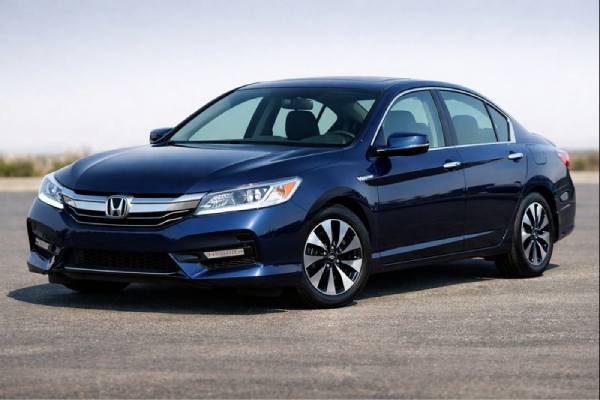
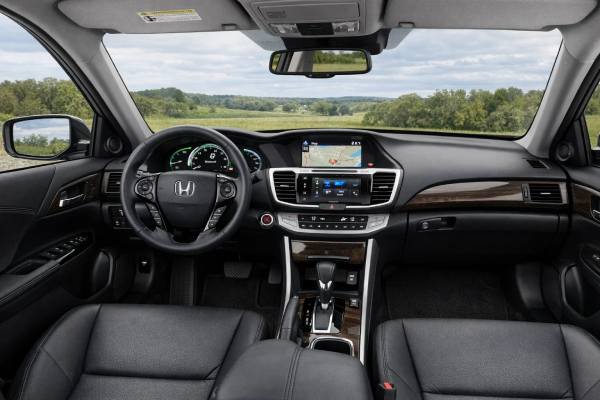
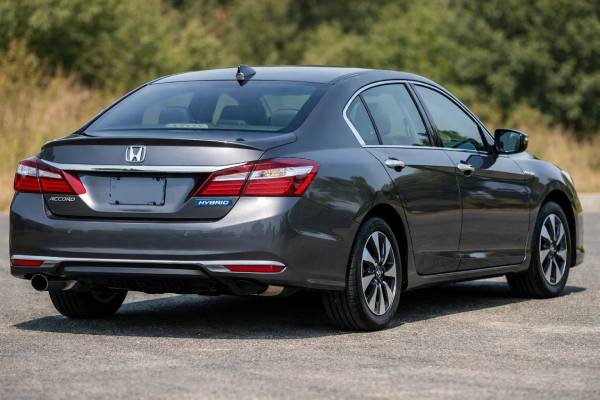
The 2017 Honda Accord Hybrid (CR6) is a “no-drama” hybrid done right: it feels like a normal midsize sedan, but it quietly saves fuel without asking you to change habits. Under the hood, Honda’s two-motor system pairs the LFA1 2.0-liter Atkinson-cycle engine with an electric drive unit (MF8) that often powers the car directly at low and moderate speeds. In real traffic that translates into smooth takeoff, strong midrange response, and less engine noise than many older hybrids. On the highway, a clutch allows more direct engine contribution, keeping cruising efficient and stable.
Ownership is mostly conventional Accord logic—tires, brakes, suspension, and fluids—plus a few hybrid priorities: keep the cooling systems healthy, confirm recall and software actions are completed, and don’t ignore 12 V battery weakness. Buy a well-documented example and the CR6 can be a calm, efficient long-term daily.
Quick Specs and Notes
- EV-like smoothness in city traffic thanks to the two-motor hybrid layout.
- Excellent real-world economy for a midsize sedan when driven normally.
- Strong safety structure and predictable handling, especially on long trips.
- Verify hybrid control software recall completion and check for stored hybrid-system fault codes.
- Plan oil service every 10,000–12,000 km (6,000–7,500 mi) or 12 months, guided by the maintenance minder.
Navigate this guide
- 2017 CR6 hybrid overview
- 212 hp specs, dimensions, and capacities
- 2017 trims, options, and safety tech
- Reliability issues and service actions
- Maintenance plan and buyer’s guide
- Driving, performance, and real economy
- How it stacks up against rivals
2017 CR6 hybrid overview
The 2017 Accord Hybrid (CR6) is built around a simple idea: make the car feel like an Accord first, and let the hybrid system work in the background. Unlike hybrids that behave like a conventional automatic with extra help, Honda’s two-motor design often drives the wheels electrically at lower speeds. The gasoline engine can run to generate power, support acceleration, or—at cruising speeds—connect more directly through a clutch. You don’t need to manage modes to benefit; the car’s control strategy is designed to handle the switching.
For owners, that layout delivers three practical advantages:
- Smoothness in stop-and-go: Electric propulsion masks the “start/stop” sensation that some drivers dislike. Takeoff is immediate and quiet, which reduces fatigue in traffic.
- Efficiency without plugging in: The battery is relatively small and meant for frequent charge/discharge cycles, capturing braking energy and assisting acceleration rather than enabling long EV range. You get the benefit without a charging routine.
- Low-stress long-distance behavior: The Accord chassis is stable and predictable. On long motorway drives it settles down like a standard sedan, and the hybrid system focuses on keeping engine operation efficient and calm.
There are also real compromises to understand before you buy. The hybrid components add weight compared with a non-hybrid Accord, and trunk volume can be slightly reduced depending on packaging and market. If you spend most of your time at high sustained speeds (for example, fast motorway cruising), the fuel-economy advantage shrinks compared with urban use. Hybrids typically shine most when the car can recover energy during braking and operate the engine in efficient zones.
The smart way to evaluate a CR6 is to treat it like a normal used sedan plus a “systems check.” Confirm routine maintenance is consistent, then focus on hybrid-specific health: recall completion, stored diagnostic codes, cooling system condition, and 12 V battery stability. If those boxes are ticked, the 2017 Accord Hybrid is one of the easiest hybrids to own because it doesn’t demand special behavior to work well.
212 hp specs, dimensions, and capacities
This section focuses on the 2017 Accord Hybrid (CR6) with the LFA1 engine and MF8 hybrid drive. Equipment and published values can vary slightly by market and trim, so use these tables as a practical baseline and verify VIN-specific items (fluids, brake sizes, and battery service info) before ordering parts.
Powertrain and efficiency
| Item | Specification |
|---|---|
| Code | LFA1 + MF8 |
| Engine layout and cylinders | Inline-4, transverse, DOHC, 16-valve |
| Displacement | 2.0 L (1,993 cc) |
| Induction | Naturally aspirated |
| Fuel system | PFI (port fuel injection) |
| Compression ratio | Typically around 13:1 (Atkinson-cycle tuning) |
| Timing drive | Chain |
| System max power | 212 hp (158 kW) |
| Traction motor (front) | PMSM-type; commonly listed around 124 kW |
| Hybrid battery | Lithium-ion; ~1.3 kWh; ~260 V class |
| Emissions standard | Market dependent (U.S. emissions certification varies by state) |
| Rated efficiency (typical) | About 5.0 L/100 km combined (around 47–48 mpg US / 56–58 mpg UK) |
| Real-world highway @ 120 km/h | Commonly ~5.8–6.6 L/100 km (36–41 mpg US / 43–49 mpg UK), weather and tyres dependent |
Transmission and driveline
| Item | Specification |
|---|---|
| Transmission | e-CVT style hybrid drive with clutch (single-speed behavior) |
| Drive type | FWD |
| Differential | Open |
Chassis and dimensions
| Item | Typical value |
|---|---|
| Suspension (front / rear) | MacPherson strut / multi-link |
| Length | ~4,890 mm (192.5 in) |
| Width | ~1,850 mm (72.8 in) |
| Height | ~1,466 mm (57.7 in) |
| Wheelbase | ~2,776 mm (109.3 in) |
| Turning circle (kerb-to-kerb) | ~11.6 m (38.1 ft) |
| Kerb (curb) weight | ~1,620–1,700 kg (3,570–3,750 lb), trim dependent |
| Fuel tank | ~50 L (13.2 US gal / 11.0 UK gal), market dependent |
| Cargo volume | Typically ~388 L (13.7 ft³), configuration dependent |
| Common wheels/tyres | 215/55 R17 or 235/45 R18 (trim dependent) |
Performance and capability
| Item | Typical value |
|---|---|
| 0–100 km/h (0–62 mph) | ~7.0–7.6 s (conditions and tyres matter) |
| Top speed | Often limited around ~185 km/h (115 mph) |
| Towing | Frequently not recommended or not rated; verify in your market documentation |
Fluids and service capacities
| System | What to use | Typical notes |
|---|---|---|
| Engine oil | 0W-20 | Capacity commonly around 4.0–4.5 L (4.2–4.8 US qt) with filter; verify by VIN. |
| Engine coolant | Honda long-life premix type | First change is often time-based; treat correct bleeding as essential. |
| Power electronics coolant | Honda long-life premix type | Separate loop on many hybrids; confirm layout in service info. |
| Hybrid drive fluid | Honda-specified hybrid/e-CVT fluid | Drain-and-fill quantities vary; do not substitute generic ATF. |
| Brake fluid | DOT 3 or DOT 4 (market dependent) | Refresh on time; regen does not protect fluid from moisture. |
Key torque specs (common planning values)
| Fastener | Typical torque |
|---|---|
| Wheel nuts | ~108 Nm (80 lb-ft) (verify for your wheels) |
| Engine oil drain plug | Verify by service documentation for your engine oil pan |
2017 trims, options, and safety tech
The 2017 Accord Hybrid was generally sold in a simplified grade walk compared with non-hybrid Accords, but equipment still matters because it affects comfort, running costs, and safety outcomes. Most markets group the hybrid into a few well-equipped trims rather than a long list. Mechanically, all 2017 CR6 hybrids share the same core powertrain; what changes is wheel size, lighting, interior features, and the availability of driver-assistance functions.
Trims and options that change ownership
When comparing listings, these are the “high impact” items:
- Wheel size (17 vs 18): 18-inch tyres cost more and can add road noise on coarse asphalt. They can also make worn suspension bushes feel worse. If you value quiet comfort and low tyre spend, the smaller wheel package usually suits the hybrid best.
- Headlights: Some trims offer higher-performance headlamp units. This matters for night safety and, in some rating systems, can influence award status. Confirm beam pattern and lens condition on used cars.
- Infotainment and camera features: Honda’s LaneWatch (right-side camera display when signaling) can be a genuine daily benefit. Check that the camera image is clear, the screen responds normally, and the wiring has not been disturbed after body repairs.
- Seating and HVAC: Leather, heated seats, and dual-zone climate are common, but condition matters more than the feature list. A tired seat base or weak blower motor can make a “fully loaded” car feel worn out quickly.
Safety ratings and what to look for
The Accord sedan platform is known for strong crashworthiness, and it performs well in U.S.-style front, side, and roof-strength testing regimes for its era. However, modern safety is not only structure; it is also crash avoidance. For 2017, some safety and driver-assistance features can be trim-dependent, so you should verify actual equipment on the specific vehicle:
- Core safety: multiple airbags, ABS, stability control, traction control, and strong seatbelt restraint design are typical.
- Driver assistance (varies by trim/market): forward collision warning, lane departure warning, and in some configurations adaptive cruise control or lane-keeping support. Don’t assume the presence of full automatic emergency braking unless the documentation for that vehicle confirms it.
ADAS service implications
If the car has camera-based warning systems, treat windscreen replacement and front-end repairs as calibration-sensitive work. A cheap windscreen or improper mounting can cause nuisance warnings or reduced system reliability. During a pre-purchase drive, watch for stable lane markings detection and confirm that any warning icons behave normally (no persistent faults, no repeated “system unavailable” messages).
In short: buy the trim that matches your priorities. For most owners, the best hybrid choice is the grade that combines the smaller wheels (if available) with the safety and lighting you want, because those two areas usually drive the long-term “cost per year” experience.
Reliability issues and service actions
The 2017 Accord Hybrid (CR6) is usually a dependable car when it has proper maintenance and completed service actions, but it has a few reliability patterns worth understanding. The good news is that many “hybrid problems” on used cars turn out to be 12 V battery issues, missed software updates, or cooling-system neglect rather than catastrophic high-voltage failures.
Issue map by prevalence and cost
- Common, low to medium cost
- Weak 12 V battery causing intermittent warnings or odd electrical behavior
- Brake rotor surface corrosion and noise in wet climates (regen reduces friction-brake use)
- Infotainment glitches or camera issues (often repairable without major parts)
- Occasional, medium cost
- Cooling system service errors after repairs (air pockets, wrong coolant, improper bleeding)
- Suspension bush wear (influenced by wheel size, potholes, and alignment)
- Hybrid drive fluid never serviced (can affect smoothness and long-term bearing life)
- Rare, high cost
- High-voltage isolation faults or inverter/control module failures (usually accompanied by persistent warnings and stored codes)
Symptoms → likely causes → recommended remedies
- Random “check system” warnings, weird start behavior, multiple unrelated alerts
- Likely cause: weak 12 V battery, poor terminal connections, or low voltage during startup.
- Remedy: load-test the 12 V battery, clean terminals and grounds, and confirm the correct battery spec is installed.
- Inconsistent braking feel at low speed, squeal after rain, or vibration
- Likely cause: rotor surface rust, sticking caliper slide pins, or old brake fluid.
- Remedy: service slide pins, inspect pad wear, refresh brake fluid on time, and include occasional firm stops when safe to keep rotors clean.
- Hybrid warnings after coolant service or component replacement
- Likely cause: air trapped in coolant loops, incorrect coolant type, or an underperforming pump.
- Remedy: follow the correct bleeding procedure, verify the cooling loop layout (engine vs electronics), and re-check levels after a full heat cycle.
- Reduced power, persistent “hybrid system” messages, or charging/assist limitations
- Likely cause: stored high-voltage faults, temperature protection behavior, or software needing an update.
- Remedy: scan the car with a capable diagnostic tool and confirm all updates and campaigns are completed before replacing parts.
Recalls, TSBs, and software updates
For 2017, it is especially important to confirm hybrid system software-related service actions have been performed. Hybrids rely heavily on control logic, and updates can address driveability, warning-light nuisance conditions, and in some cases fail-safe behaviors. Verification should be done through official VIN checks and dealer records, not assumption. If the seller cannot provide proof, factor a dealer verification visit into the buying process.
The most buyer-friendly approach is simple: treat “completed campaigns” as part of the value of the car, the same way you treat a full service history. A CR6 with documented updates and clean diagnostic results is the kind of hybrid that can feel boring—in the best way—for years.
Maintenance plan and buyer’s guide
A solid maintenance plan for the 2017 Accord Hybrid should be time-aware, not only mileage-aware. Many hybrids rack up fewer engine miles because the system shuts the engine off frequently, yet fluids still age, moisture still accumulates in brake fluid, and coolant still degrades. Your best strategy is to follow the maintenance minder and keep a conservative baseline schedule for key fluids.
Practical maintenance schedule
| Item | Distance | Time | Notes |
|---|---|---|---|
| Engine oil and filter | 10,000–12,000 km (6,000–7,500 mi) | 12 months | Use 0W-20; shorten interval for short trips and cold climate. |
| Cabin air filter | 15,000–30,000 km (10,000–20,000 mi) | 12–24 months | Helps HVAC performance; replace sooner in dusty areas. |
| Engine air filter | Inspect 20,000–30,000 km | 12–24 months | Replace based on condition, not only time. |
| Brake fluid | — | 24 months | Moisture control matters even with regen braking. |
| Coolant (engine) | — | Often 5 years first interval | Verify exact interval by market and service info. |
| Coolant (power electronics) | — | Often similar to engine | Treat as critical; use correct premix coolant only. |
| Hybrid drive fluid | 50,000–80,000 km (30,000–50,000 mi) | 4–6 years | Conservative drain-and-fill can improve long-term smoothness. |
| Tyre rotation | 10,000–12,000 km | — | Maintains efficiency and reduces noise. |
| Alignment check | — | 12 months | Especially important with 18-inch tyres. |
| 12 V battery test | — | Yearly after year 4 | Replace proactively if it tests weak. |
| Spark plugs | Up to ~160,000 km (100,000 mi) | — | Earlier if misfire symptoms occur. |
Buyer’s checklist (hybrid-specific)
- Confirm recall completion by VIN and request dealer printout or official verification.
- Scan for stored codes (not just active warnings). A clean cluster does not guarantee a clean history.
- Test the 12 V system: stable starts, no flickering displays, no repeated warning clusters.
- Check coolant condition and level for both loops if applicable; look for signs of improper service (low level, wrong color, residue).
- Assess braking hardware: rotor edges, pad thickness, and slider condition—regen can hide wear patterns.
- Inspect tyres carefully: uneven wear can indicate alignment issues that hurt efficiency and noise.
What to budget for after purchase
Even a good car typically needs “baseline maintenance” within the first year of used ownership: fresh brake fluid, new filters, an oil service, and tyres if the current set is mismatched or worn. That money is usually better spent than chasing performance upgrades, because efficiency and refinement on this hybrid depend heavily on tyres, alignment, and clean fluids.
Driving, performance, and real economy
The 2017 Accord Hybrid’s driving character is defined by smooth response rather than sporty drama. In town, it often feels like an electric car with a gasoline backup: it moves promptly with light throttle, and the engine can fade into the background. If you come from a conventional automatic, the biggest “adjustment” is that engine sound does not always match road speed in a linear way during hard acceleration—because the system chooses efficient engine operating points rather than stepping through gears.
Ride, handling, and NVH
- Ride comfort: generally balanced and mature. Smaller wheels (if fitted) tend to give the best blend of comfort and quietness.
- Handling: predictable and stable. It’s not a sports sedan, but it feels planted and trustworthy at speed.
- Cabin noise: low in urban use, especially when electric drive dominates. On coarse surfaces, tyre choice is the biggest noise factor.
Powertrain feel and performance
In everyday use, the hybrid torque makes the car feel strong off the line. Passing performance is typically confident because the motor can provide immediate push while the engine contributes power as needed. Full-throttle acceleration can produce a steady engine note rather than gear changes, which is normal for this architecture.
Useful real-world metrics to understand:
- 0–100 km/h (0–62 mph): typically in the low-to-mid 7-second range.
- Midrange passing: feels strong because electric torque fills in quickly.
- Braking feel: mostly natural, but low-speed transitions from regen to friction can feel slightly different than a non-hybrid until you get used to it.
Real-world fuel economy
The Accord Hybrid can deliver excellent consumption numbers in mixed and city driving because it recovers braking energy and minimizes engine idling. Typical owner patterns look like this:
- City-heavy driving: often the best-case scenario for a hybrid; consumption can stay close to the official combined figure when traffic is moderate.
- Highway cruising: still efficient, but the advantage narrows at higher speeds (especially above 120 km/h) and in cold weather.
- Winter penalty: expect higher fuel use because cabin heat and battery temperature management increase engine runtime.
Two practical tips that consistently help:
- Prioritize tyres and alignment: low rolling resistance tyres in the correct size and a proper alignment can be worth more than you’d expect.
- Brake smoothly but decisively: smooth deceleration increases regen recovery, yet you still want occasional firm braking to keep friction brakes clean and effective.
If you want a hybrid that doesn’t feel like a compromise, the 2017 CR6 is one of the better examples: it stays calm, saves fuel, and remains a comfortable long-distance sedan.
How it stacks up against rivals
Cross-shopping the 2017 Accord Hybrid works best when you compare it against other midsize hybrids and one “wild card” choice: the newer-generation hybrid that arrived later. Your decision usually comes down to driving feel, safety-tech availability, and how much you value proven simplicity.
Versus Toyota Camry Hybrid (same era)
- Accord Hybrid strengths: EV-like smoothness in low-speed driving and a very cohesive “electric-first” feel in traffic. Many drivers prefer the steering and chassis balance.
- Camry Hybrid strengths: a long-standing reputation for conservative hybrid durability and broad parts familiarity.
- Best for: Accord if you value refinement and response; Camry if you prioritize the most conservative hybrid ownership bet.
Versus Ford Fusion Hybrid
- Accord Hybrid strengths: typically stronger efficiency and a more modern hybrid driving character (less “CVT rubber band” sensation in normal use).
- Fusion Hybrid strengths: often strong value on the used market and comfortable ride tuning.
- Best for: Accord for a more complete package; Fusion if budget is the leading factor and you find a well-kept example.
Versus Hyundai Sonata Hybrid (similar years)
- Accord Hybrid strengths: smoother low-speed behavior and a highly integrated hybrid feel.
- Sonata Hybrid strengths: can offer good equipment value and comfort features for the money.
- Best for: choose based on service history quality and local specialist support.
Versus the next-generation Accord Hybrid (2018+) as an alternative
If price allows, the newer generation typically adds efficiency improvements, more modern infotainment, and updated driver-assistance availability. If the 2017 CR6 is significantly cheaper and has documented recall completion, it can be the smarter buy. If prices are close, the newer car’s tech and packaging often justify stepping up.
Bottom line
The 2017 Accord Hybrid is strongest as a “daily efficiency sedan” that still feels like a conventional car. It’s most compelling for drivers who want excellent fuel economy in mixed use, a calm commute, and a chassis that remains stable and comfortable on long trips. Buy on condition and documentation, and it’s a hybrid you can live with easily for the long haul.
References
- Fuel Economy of the 2017 Honda Accord Hybrid 2017 (Official Fuel Economy Data)
- 2017 Honda Accord 4-door sedan 2017 (Safety Rating)
- Recalls 2025 (Recall Database)
- 2017 Accord Hybrid Owner’s Manual 2017 (Owner’s Manual)
Disclaimer
This article is for informational purposes only and is not a substitute for professional diagnosis, inspection, or repair. Specifications, torque values, fluid types, service intervals, and procedures vary by VIN, market, software level, and equipment. Always confirm details using official Honda service documentation for your exact vehicle.
If you found this guide helpful, please share it on Facebook, X (Twitter), or your preferred community to support our work.