
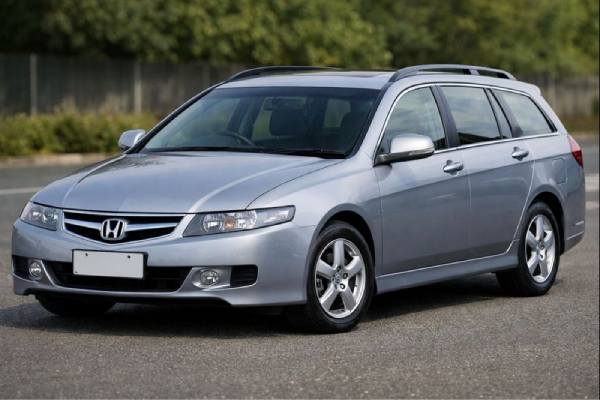
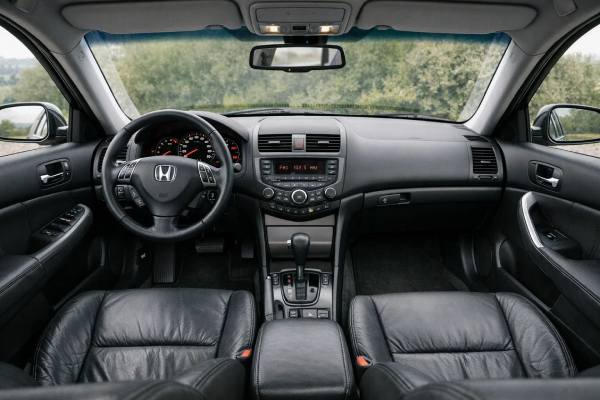

The 2003–2008 Honda Accord Tourer with the K20A6 2.0-litre i-VTEC is a rare kind of family estate: engineered like a driver’s car, packaged like a practical one, and built with Honda’s typical “do it properly” mindset. In day-to-day use, the 155 hp K-series engine feels clean and predictable, with a smooth pull that rewards revs without punishing you at cruise. The Tourer body adds genuine load space and smart folding-seat design, yet it still rides and steers with a composed, confident feel for its era. What matters for ownership today is less about headline performance and more about condition, service history, and a few age-related weak points—most of which are manageable if you know where to look and maintain it on schedule.
Owner Snapshot
- Strong balance of handling, comfort, and long-distance stability for an estate
- Useful cargo space and clever rear-seat folding without feeling “van-like”
- K20A6 i-VTEC is generally durable if oil level and cooling health are watched
- Budget for suspension bushings and brake servicing as the car ages
- Plan oil and filter changes about every 10,000–15,000 km (6,000–9,000 mi) or 12 months
Navigate this guide
- Accord Tourer engineering focus
- K20A6 specs and dimensions
- Tourer trims options and safety
- Reliability issues and service bulletins
- Maintenance plan and buying checklist
- Real-world driving and economy
- Accord Tourer vs estate rivals
Accord Tourer engineering focus
Honda developed the seventh-generation Accord Tourer to feel more “car” than “estate,” and it shows in the fundamentals: a stiff body shell, well-controlled suspension geometry, and steering that stays calm at motorway speeds. The Tourer also uses a rear suspension layout designed to keep the load floor low while preserving ride quality, which is why it can carry bulky items without needing SUV height or truck-like compromises.
The K20A6 2.0 i-VTEC is the sensible heart of the range. It’s naturally aspirated, smooth, and happiest when you let it rev. Peak outputs sit at 155 hp (114 kW) and 190 Nm, which is enough for confident merging and steady passing—especially with the manual gearbox. In factory form, the car leans toward refinement and predictability rather than “hot estate” urgency, and that’s part of its long-term charm.
Where this model tends to win owners is in the combined package:
- Practicality that’s actually usable: wide opening, smart seat folding, and a big, square load area rather than a narrow “wagon slot.” Honda quotes 626 L with the rear seats up (VDA method), which is genuinely competitive for the class.
- Comfort with control: it’s not floaty, but it isn’t harsh either—important if you do long distances or carry family loads regularly.
- Simple, durable powertrain philosophy: no turbo hardware, no high-pressure direct injection system, and a timing chain rather than a belt (reducing big scheduled timing jobs).
The ownership reality today is that these cars are now firmly “condition-dependent.” A well-kept example can still feel tight and modern enough to live with daily, but neglected ones often show the same pattern: tired suspension bushings, uneven braking, and small electrical annoyances. If you approach it as a maintained, older premium family estate—rather than a cheap runabout—it’s one of the more rewarding wagons of its era.
K20A6 specs and dimensions
Below are core technical figures for the Accord Tourer (CM1) with the 2.0 i-VTEC K20A6. Specs can vary slightly by market, model year, and trim, so treat this as a solid baseline and verify against your VIN documentation.
Engine and efficiency
| Item | Specification |
|---|---|
| Code | K20A6 |
| Layout | Front, transverse-mounted |
| Configuration | I-4, all-aluminum DOHC i-VTEC |
| Valvetrain | DOHC, 4 valves/cyl (typical for K-series) |
| Bore × stroke | 86 × 86 mm (3.39 × 3.39 in) |
| Displacement | 2.0 L (1998 cc) |
| Induction | Naturally aspirated |
| Fuel system | PGM-FI multi-point injection |
| Compression ratio | 9.8:1 |
| Max power | 155 hp (114 kW) @ 6000 rpm |
| Max torque | 190 Nm (140 lb-ft) @ 4500 rpm |
| Timing drive | Chain (typical K-series design) |
| Fuel | 95 RON |
| Rated combined economy (manual) | 8.3 L/100 km (34.0 mpg UK / ~28.3 mpg US) |
| Rated combined economy (automatic) | 8.8 L/100 km (32.1 mpg UK / ~26.7 mpg US) |
| Aerodynamics | Cd 0.32 |
Real-world note: at steady motorway speeds, many owners see economy worsen if the car is loaded, on short trips, or running tired tyres/alignment. The upside is consistency: the K20A6 tends to deliver predictable consumption rather than “spiky” turbo behavior.
Transmission and driveline
| Item | Manual | Automatic |
|---|---|---|
| Drive type | FWD | FWD |
| Transmission | 5-speed manual | 5-speed automatic (sequential shift) |
| 1st | 3.266 | 2.652 |
| 2nd | 1.769 | 1.516 |
| 3rd | 1.212 | 1.082 |
| 4th | 0.921 | 0.773 |
| 5th | 0.738 | 0.566 |
| Reverse | 3.583 | 2.000 |
| Final drive | 4.764 | 4.563 |
Chassis, dimensions, and capacities
| Item | Value |
|---|---|
| Front suspension | Double wishbone, coil springs, anti-roll bar |
| Rear suspension (Tourer) | 5-link double wishbone with trailing arm |
| Steering | Hydraulic rack and pinion |
| Turning radius (at body) | 5.8 m (19.0 ft) |
| Brakes (front/rear) | 300 mm ventilated disc / 282 mm solid disc |
| Length / width / height | 4750 / 1760 / 1470 mm (187.0 / 69.3 / 57.9 in) |
| Wheelbase | 2720 mm (107.1 in) |
| Ground clearance | 140 mm (5.5 in) |
| Fuel tank | 65 L (17.2 US gal / 14.3 UK gal) |
| Cargo volume (VDA) | 626 L seats up; 971 L seats down to window; 1707 L seats down to roof |
| Kerb weight (typical) | ~1477–1560 kg (3256–3439 lb), by trim and gearbox |
Performance and capability
| Metric | Manual | Automatic |
|---|---|---|
| 0–100 km/h (0–62 mph) | 9.9 s | 11.5 s |
| Top speed | 128 mph (206 km/h) | 125 mph (201 km/h) |
| Towing capacity | 1500 kg (3307 lb) braked; ~505 kg (1113 lb) unbraked | |
| Roof load | 80 kg (176 lb) |
Fluids and service capacities
These are common reference values used in service planning; always verify for your exact VIN and market.
| Fluid | Typical spec | Typical capacity (approx.) |
|---|---|---|
| Engine oil | 5W-30 (quality API/ACEA equivalent) | ~4.2 L (~4.4 US qt) |
| Coolant | Long-life ethylene glycol (often Honda Type 2 50/50) | ~6.0 L (~6.3 US qt) |
| Manual trans fluid | Honda MTF equivalent | ~2.2 L (~2.3 US qt) |
| Automatic trans fluid | Honda ATF-Z1 / later DW-1 equivalent | drain-refill often ~3.0 L (~3.2 US qt) |
| A/C refrigerant | R134a | varies by equipment; confirm under-hood label |
Tourer trims options and safety
Trim naming varies by country, but the Tourer range commonly revolved around SE and Executive (with higher-spec audio, comfort, and cosmetic upgrades). The key point for buyers is not the badge itself, but what it implies about equipment that affects long-term ownership cost—wheels, brakes, and safety features.
Trims and options that matter
- Wheel and tyre packages: 2.0 models often start on 195/65 R15 with 15×6J alloys, while larger wheels (including 17-inch options) bring sharper response but can increase road noise and accelerate bushing wear on rough roads.
- Tailgate features: some cars have powered tailgate hardware; when it’s healthy, it’s convenient—when it’s not, it adds diagnostic time.
- Infotainment tiers: early factory navigation and premium audio exist, but modern ownership often benefits more from a clean electrical system than from chasing original tech features.
Quick identifiers you can use on inspection:
- Tyre size on the sidewall is the fastest “reality check” for suspension tuning expectations (15-inch comfort setup vs larger wheels).
- Curtain airbag tags (often on the A/B pillar trim) help confirm whether the car has head-protecting airbags, which were not always standard in every market.
Crash ratings and what they mean today
This generation earned a 4-star overall result in an earlier Euro NCAP-era style assessment, with an adult occupant score of 27.72 out of 37 (about 75% of the maximum points) and a pedestrian score of 15.87 out of 36 (about 44%).
Two practical takeaways:
- Structure and restraint systems were strong for the time, with solid side-impact results and available head protection.
- It is not a modern crash-test design. Newer small-overlap tests, advanced pedestrian protocols, and modern crash-avoidance expectations weren’t part of its original target.
Safety systems and driver assistance
Expect solid “baseline” safety equipment for the era:
- ABS with electronic brake distribution and brake assist is a common baseline expectation.
- ISOFIX child-seat anchors (with top tether points) are called out for the Accord range.
- ADAS reality check: features like AEB, lane-keep assist, and adaptive cruise are generally not part of this generation’s equipment. If you see aftermarket sensors or cameras, treat them as add-ons, not integrated safety systems.
Reliability issues and service bulletins
The K20A6 Accord Tourer is usually a reliable long-term platform, but age, mileage, and maintenance gaps create predictable problem clusters. Below is a practical way to think about issues by prevalence and cost tier, plus the usual symptoms and fixes.
Common and usually low to medium cost
- Front and rear suspension bushings and drop links
- Symptoms: clunks over bumps, vague steering on-center, uneven tyre wear
- Root cause: rubber aging and load cycles, especially on bigger wheels
- Remedy: replace worn arms/bushings; align afterward
- Brake caliper slide pins and rear caliper sticking
- Symptoms: one wheel runs hot, uneven pad wear, sluggish handbrake feel
- Root cause: corrosion and dried grease in sliders; infrequent fluid changes
- Remedy: service sliders, rebuild/replace calipers if needed; refresh brake fluid
- Air conditioning performance decline
- Symptoms: weak cooling, compressor cycling, oily residue at lines
- Root cause: seal aging, condenser corrosion from road debris
- Remedy: proper leak test and repair before re-gas
Occasional but can become high cost if ignored
- Oil level neglect leading to timing and valvetrain wear
- Symptoms: noisy top end, rough idle, VTEC/VTC-related codes
- Root cause: low oil volume harms chain tensioning and cam phasing behavior
- Remedy: correct oil level discipline; diagnose leaks/consumption early
- Cooling system weak points (radiator, thermostat, hoses)
- Symptoms: temperature creep in traffic, heater fluctuation, coolant smell
- Root cause: age-related plastic tank cracks and tired thermostats
- Remedy: pressure test; replace components proactively if history is unknown
Software, calibrations, and recall reality
On a car of this age, “software updates” are less about new features and more about drivability fixes and fault-resolution procedures. The bigger safety-related topic is recall completion status, particularly around airbags in many markets. Use an official recall check and dealer records to confirm whether campaigns were completed for your VIN.
Pre-purchase documents worth requesting:
- Proof of regular oil servicing (dates, mileage, oil grade)
- Brake fluid and coolant change evidence
- Any recall completion paperwork or dealer printout matching the VIN
Maintenance plan and buying checklist
A simple, consistent maintenance rhythm is what keeps the Accord Tourer feeling “Honda tight” rather than “old car tired.” The schedule below is practical for mixed driving; shorten intervals for frequent short trips, heavy city use, or hot climates.
Maintenance schedule
- Engine oil and filter: every 10,000–15,000 km (6,000–9,000 mi) or 12 months
- Air filter (engine): inspect every service; replace every 30,000–40,000 km (19,000–25,000 mi)
- Cabin filter: every 15,000–30,000 km (9,000–19,000 mi) (or annually if you’re sensitive to HVAC odors)
- Spark plugs: typically 100,000 km (60,000+ mi) interval depending on plug type; inspect earlier if misfires appear
- Coolant: every 5 years (or per the coolant type and service documentation)
- Brake fluid: every 2 years regardless of mileage
- Manual gearbox fluid: every 60,000–100,000 km (37,000–62,000 mi) depending on shift feel and usage
- Automatic ATF: drain-and-fill on a similar cadence; more often if shifts feel “lazy” or the fluid is dark
- Serpentine belt and tensioner: inspect at each service; replace if cracked/noisy
- Valve clearance: if adjustable on your variant, consider inspection around 100,000–160,000 km (60,000–100,000 mi) or if noisy
Buyer’s inspection checklist
- Cold start behavior: listen for abnormal rattles, rough idle, or warning lights.
- Cooling health: look for clean coolant, stable temperature, and no oily film in the expansion tank.
- Suspension test drive: low-speed bumps and tight turns reveal worn bushings and top mounts.
- Brake feel: confirm straight, smooth braking; check for a hot wheel after the drive (sticking caliper clue).
- Tailgate and interior electrics: Tourer-specific convenience features should work consistently.
- Underside and corrosion hotspots: check rear arches, subframe edges, brake lines, and underbody seams (especially in salted-road regions).
- Service history quality: a stack of “oil only” receipts is not the same as a maintained car—look for fluids, brakes, and cooling items.
Long-term durability outlook
If you buy on condition and keep up with fluids, the K20A6 drivetrain is typically capable of high mileage without dramatic failures. The more common “end of life” triggers are neglected cooling issues, persistent brake/suspension wear that the owner stops fixing, or unresolved recall work.
Real-world driving and economy
The 2.0 i-VTEC Tourer is best understood as a refined, rev-friendly estate rather than a torque-heavy hauler. Throttle response is clean and linear, and the engine has a smooth “build” as revs rise. Around town, it’s easy to drive, but you’ll feel the difference between calm cruising and committed acceleration: the car prefers to downshift and use rpm rather than surge on low-end torque.
Ride, handling, and NVH
- Ride quality: generally composed, with the Tourer’s chassis keeping body motions tidy over long undulations. Bigger wheel packages can sharpen impacts and bring more road noise.
- Steering: hydraulic rack-and-pinion steering tends to deliver a more natural weight and feedback than later electric systems, especially at motorway speeds.
- Brakes: the hardware is credible for the class (front ventilated discs), and pedal confidence depends heavily on caliper condition and fresh fluid.
Powertrain character: manual vs automatic
- Manual: best matches the engine’s personality. It helps the car feel lighter on its feet and trims the 0–62 mph time to 9.9 seconds.
- Automatic: smoother in traffic but noticeably slower to 62 mph (11.5 seconds) and usually slightly thirstier in mixed use.
Efficiency in the real world
Official combined figures are 34.0 mpg UK (8.3 L/100 km) for the manual and 32.1 mpg UK (8.8 L/100 km) for the automatic.
In practice, what changes economy most is not the engine—it’s usage:
- Short trips and cold running: biggest penalty; oil and coolant take time to reach stable temp.
- High-speed cruising with load: aerodynamics are decent for an estate (Cd 0.32), but speed still dominates fuel use.
- Alignment and tyre choice: worn bushings can put the alignment out, quietly raising fuel use and tyre wear together.
For many owners, the “win” is that the car remains stable, quiet enough, and comfortable enough on long drives that you don’t feel punished for using it as a real estate—exactly what it was designed to do.
Accord Tourer vs estate rivals
In the mid-size estate class, the Accord Tourer competed against cars that each had a strong angle: the Volkswagen Passat Variant for interior packaging and brand pull, the Ford Mondeo Estate for chassis balance and running costs, the Mazda 6 for lightness and steering feel, and the Toyota Avensis for low-drama ownership. The Accord Tourer’s advantage is how consistently it blends these priorities without leaning too far into any single compromise.
Where the Accord Tourer tends to beat rivals
- Engineering cohesion: steering, ride, and drivetrain feel like they were tuned as a complete package, not assembled from parts-bin targets.
- Naturally aspirated durability mindset: compared to some turbo-era alternatives, the K20A6 avoids a lot of modern complexity, which can lower long-term risk if you maintain it well.
- Practical load space with good manners: 626 L (VDA) seats-up cargo volume is strong, and the car still behaves like a well-sorted saloon on the road.
Where rivals may do better
- Low-end torque: diesel rivals (including Honda’s own i-CTDi variants) feel easier when fully loaded or towing frequently.
- Cabin tech and modern safety: newer generations of Passat/Mondeo/Mazda 6 introduced more advanced driver assistance systems sooner. This Accord generation largely lives in the ABS/airbags/VSA era rather than the AEB/ACC era.
- Parts pricing in some regions: depending on market, certain Honda suspension and electrical components can cost more than mainstream European alternatives.
Verdict for most buyers
Choose the Accord Tourer 2.0 if you want a mid-size estate that still feels engineered, not merely packaged—and you’re willing to buy based on condition and keep up with fluid and suspension/brake maintenance. Choose a rival if your priority is maximum low-rpm shove, the newest safety tech, or the cheapest possible parts availability in your local market.
References
- Accord Tourer Brochure.pdf 2003 (Brochure)
- Accord i-CTDi | Specifications 2003 (Press Kit)
- accord03e.doc 2003 (Safety Rating)
- Honda Owners | Recalls and Updates | Honda UK 2025 (Recall Database)
- SRS Airbag Recall | Recall Safety Campaign | Honda UK Cars 2025 (Recall Database)
Disclaimer
This article is for informational purposes only and is not a substitute for professional inspection, diagnosis, or repair. Specifications, torque values, fluid capacities, service intervals, and procedures can vary by VIN, market, model year, and equipment; always confirm details using your official Honda service documentation and labels on your vehicle.
If you found this guide useful, please consider sharing it on Facebook, X (Twitter), or your favorite forum to support our work.