


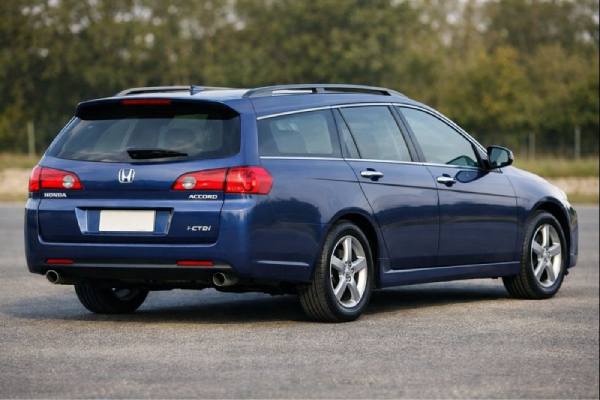
Honda’s seventh-generation Accord Tourer in CM2 form pairs the practical estate body with the K24A3 2.4-litre i-VTEC engine, a naturally aspirated four-cylinder known for smooth power delivery and strong mid-range pull. In everyday use, this version tends to feel more relaxed than the 2.0, especially when loaded with passengers or luggage, because you rely less on revs to make progress. The platform’s long wheelbase and multi-link rear suspension also give the Tourer a mature balance: stable at highway speeds, yet controlled on broken roads when the suspension is in good condition.
Ownership is mostly straightforward if you stay ahead of fluids and wear items. The biggest “make or break” factor for a used example is condition: suspension bushings, brake hardware, and the quality of prior servicing matter more than the odometer alone.
What to Know
- Strong mid-range torque makes it an easy long-distance estate, especially with a manual gearbox.
- K-series i-VTEC is generally durable when oil changes are kept consistent and correct oil is used.
- Age-related suspension bush and brake-caliper wear is common; budget for a refresh on higher-mile cars.
- Change engine oil every 10,000–12,000 km (6,000–7,500 mi) or 12 months, whichever comes first.
- If equipped with the 5-speed automatic, fresh ATF at 40,000–60,000 km (25,000–37,000 mi) helps shift quality and longevity.
Contents and shortcuts
- CM2 Tourer character and layout
- K24A3 specs and measurements
- Equipment lines and safety features
- Reliability patterns and known faults
- Maintenance plan and buying advice
- Real driving performance and economy
- CM2 Tourer versus key estate rivals
CM2 Tourer character and layout
The Accord Tourer (CM2) was engineered as an estate first, not a saloon with a box added on. You feel that in the way it carries speed with luggage on board: the body stays composed, the steering remains predictable, and the car tracks straight at motorway pace. Compared with many mid-2000s wagons, the Honda’s strengths are its consistency and its “no surprises” balance rather than outright softness or sporty sharpness.
With the K24A3, the Tourer’s personality changes in a useful way. The 2.4’s extra displacement gives you stronger pull from the mid-range, so overtakes and hills need fewer downshifts. That matters in real life because estates often run heavier: roof boxes, child seats, tools, or simply a full load of passengers. The 2.4 also suits relaxed cruising because the engine does not feel strained when you hold 110–130 km/h for long stretches.
Inside, the cabin design is typical Honda of the era: functional controls, good driving position, and clear instrumentation. A well-kept example still feels solid, but it is not immune to age. Door seals, seat bolsters, and switchgear can show wear, and some cars develop minor rattles if trims have been removed for audio or alarm work. The Tourer body adds practical details—flat load floor, wide tailgate opening, and rear-seat folding that genuinely changes what the car can carry.
From an engineering perspective, it’s worth remembering what this car is not: it is not an off-road wagon, it is not a tow-heavy workhorse like a large SUV, and it is not a modern ADAS-equipped commuter. It is a dependable, well-mannered mid-size estate that rewards owners who keep suspension, brakes, and fluids in good order. If you want a “set and forget” daily, the CM2 can do it—provided you buy on condition and service history, not on optimism.
K24A3 specs and measurements
Specs for CM2 Tourer variants vary by market, trim, and gearbox. The tables below reflect typical European-spec K24A3 Tourer configurations (and common Honda service specs), so treat them as a decision-making baseline and verify against your VIN-specific documentation.
Engine and performance (K24A3)
| Item | Specification |
|---|---|
| Code | K24A3 |
| Engine layout and cylinders | Inline-4, DOHC i-VTEC, 4 valves/cyl (16-valve) |
| Bore × stroke | 87 × 99 mm (3.43 × 3.90 in) |
| Displacement | 2.4 L (2354 cc) |
| Induction | Naturally aspirated |
| Fuel system | Honda PGM-FI (port injection) |
| Compression ratio | ~10.5:1 |
| Max power | 190 hp (140 kW) @ ~6800 rpm (market-dependent) |
| Max torque | 223 Nm (165 lb-ft) @ ~4500 rpm |
| Timing drive | Chain |
| Rated efficiency (typical) | ~9.0–9.6 L/100 km (26–25 mpg US / 31–29 mpg UK) |
| Real-world highway @ 120 km/h | ~8.5–10.0 L/100 km (28–24 mpg US / 33–28 mpg UK), depending on load and tyres |
Transmission and driveline (typical offerings)
| Item | Specification |
|---|---|
| Drive type | FWD |
| Manual | 6-speed manual (common on 2.4) |
| Automatic | 5-speed automatic (market/trim-dependent) |
| Differential | Open |
Typical 6-speed manual gear ratios (K24A3 applications)
(These can vary slightly by market/trim.)
| Gear | Ratio |
|---|---|
| 1st | 3.533 |
| 2nd | 1.880 |
| 3rd | 1.354 |
| 4th | 1.027 |
| 5th | 0.825 |
| 6th | 0.659 |
| Reverse | 3.583 |
| Final drive | ~4.39 |
Chassis and dimensions (Tourer body)
| Item | Measurement |
|---|---|
| Suspension (front) | Double wishbone (typical for this generation) |
| Suspension (rear) | Multi-link |
| Steering | Rack-and-pinion with power assist |
| Turning circle (kerb-to-kerb) | ~11.4 m (37.4 ft), market/tyre dependent |
| Brakes | 4-wheel discs, ABS, EBD; Brake Assist on many trims |
| Wheels and tyres (common) | 16–17 in; e.g., 205/55 R16 or 225/45 R17 |
Exterior dimensions (typical CM Tourer)
| Item | Measurement |
|---|---|
| Length | ~4750 mm (187.0 in) |
| Width | ~1760 mm (69.3 in) |
| Height | ~1495 mm (58.9 in) |
| Wheelbase | ~2720 mm (107.1 in) |
| Fuel tank | ~65 L (17.2 US gal / 14.3 UK gal) |
Weights and capacities (ranges are normal)
| Item | Typical range |
|---|---|
| Kerb (curb) weight | ~1500–1650 kg (3307–3638 lb) |
| Cargo volume | ~460 L (16.2 ft³) seats up; ~1600–1660 L (56–58.6 ft³) seats folded (method varies) |
| Roof load | commonly ~60 kg (132 lb), market dependent |
| Towing capacity | varies widely by market/approval; check VIN plate and handbook |
Performance and capability (typical K24 Tourer)
| Metric | Typical result |
|---|---|
| 0–100 km/h (0–62 mph) | ~8.3–9.9 s (gearbox and trim dependent) |
| Top speed | ~210–225 km/h (131–140 mph), gearbox dependent |
Fluids and service capacities (common service values)
| Item | Specification (typical) |
|---|---|
| Engine oil | 5W-30 (many markets); capacity ~4.0–4.5 L (4.2–4.8 US qt) |
| Coolant | Honda Type 2 (or equivalent long-life); 50/50 mix typical |
| Manual gearbox fluid | Honda MTF (or equivalent) |
| Automatic transmission fluid | Honda ATF (DW-1 commonly used as the service replacement fluid) |
| Brake fluid | DOT 4 |
| Power steering fluid | Honda PSF (avoid generic ATF unless explicitly approved) |
| A/C refrigerant | R134a (charge varies by system and market) |
Key torque specs (common workshop values)
| Fastener | Torque |
|---|---|
| Wheel nuts | ~108 Nm (80 lb-ft) |
| Spark plugs | ~18 Nm (13 lb-ft) |
| Engine oil drain plug | commonly ~30–40 Nm (22–30 lb-ft), confirm for your sump and washer type |
Safety and driver assistance (era-correct)
| Item | Notes |
|---|---|
| Airbags | Front and side airbags common; curtain airbags vary by market/trim/year |
| Stability control | VSA often standard on 2.4/high trims, but verify by build/market |
| ADAS (AEB, ACC, lane support) | Generally not available on this generation in most markets |
Equipment lines and safety features
Trim naming varies by region, but most CM2 Tourers fall into a familiar pattern: a comfort-focused mid trim, a higher “Executive” style trim, and a sport-oriented trim (often called Type S in many European markets). The mechanical core—engine, driveline layout, and basic suspension architecture—stays consistent, while equipment and wheel packages change the day-to-day experience.
Common trim differences you will actually feel
- Wheels and tyres: Moving from 16-inch to 17-inch wheels usually sharpens steering response but can add impact harshness and road noise. If you prioritise comfort, a Tourer on 16s often feels calmer on rough roads.
- Stability and braking features: Many higher trims bundle Vehicle Stability Assist (VSA) and traction control as standard. On a wet motorway or a greasy roundabout, VSA is a genuine safety advantage rather than a gimmick.
- Lighting: Higher trims may add better headlamps (often projector-style) and fog lights. This matters on unlit roads more than most buyers expect.
- Cabin and convenience: Dual-zone climate control, upgraded audio, cruise control, heated seats, and leather/half-leather are common “step-up” items.
Quick identifiers when viewing a used car
- Badging and wheel design: Type S and higher trims often have distinct wheel styles and subtle body details. Don’t rely on badges alone—many cars have had parts swapped.
- Interior cues: Leather/Alcantara-style inserts, steering wheel controls, and factory navigation (where fitted) can help confirm a trim level, but retrofits exist.
- Stability control confirmation: Look for a VSA button, a matching dash light during ignition-on self-test, and a consistent ABS/VSA module setup with no warning lights.
Safety ratings and what they mean
For this era, crash-test ratings are best used as a comparative guide rather than an absolute modern benchmark. Many 2003–2008 cars can perform well in their period tests but lack later advances like modern small-overlap structures, widespread curtain-airbag standardisation, or today’s automatic emergency braking.
A key point for the Accord Euro/European Accord family in the early 2000s is that safety performance depended on equipment level in some markets—especially the availability of curtain airbags. If you are shopping, prioritise examples with side and curtain airbags and confirm the airbag system is healthy (no SRS light, no stored faults).
Driver assistance and “ADAS” reality check
Most CM2 Tourers will not have modern assistance systems like AEB or lane centring. What they do have is the more “mechanical” safety foundation:
- ABS with electronic brake distribution (EBD)
- Brake Assist on many trims
- Stability control (VSA) on many 2.4/high-spec cars
- ISOFIX/LATCH provisions (market dependent) and sensible rear belt geometry
If your priority is active crash avoidance in dense traffic, a newer wagon with AEB will be a meaningful upgrade. If your priority is a strong passive-safety structure for its era and predictable handling, a well-specified CM2 can still make sense.
Reliability patterns and known faults
The K24A3 drivetrain has a strong reputation, but “reliable” does not mean “maintenance-free,” especially at 15–22 years old. The most common ownership frustrations on CM2 Tourers are age-related chassis and accessory issues rather than internal engine failures.
Below is a practical way to think about common problems—by prevalence and cost severity—so you can prioritise inspections.
Common (expect to see on higher-mile cars)
1) Suspension bush wear (low to medium cost, but affects feel a lot)
- Symptoms: clunks over sharp bumps, vague steering on centre, uneven tyre wear, instability under braking.
- Likely causes: front lower control arm bushes, drop links, rear multi-link bushes, worn dampers.
- Remedy: replace worn bushes/arms and stabiliser links; align the car after work. A refreshed Accord often drives like a different vehicle.
2) Brake caliper slider and rear caliper issues (low to medium cost)
- Symptoms: pulling to one side, hot wheel after short drive, uneven pad wear, weak handbrake.
- Likely causes: seized slider pins, corroded caliper mechanisms, old brake fluid.
- Remedy: rebuild or replace affected calipers, service sliders properly, renew brake fluid.
3) Power steering pump seep or noise (medium cost if ignored)
- Symptoms: whining when turning, fluid smell, dampness around pump or lines.
- Likely causes: aging seals, incorrect fluid, neglected leaks.
- Remedy: reseal/replace as needed, flush with correct Honda PS fluid, check rack gaiters for contamination.
Occasional (varies by climate and service history)
4) VTC actuator rattle on cold start (usually low to medium cost)
- Symptoms: brief rattling noise at startup that fades quickly.
- Likely causes: variable timing control mechanism wear, oil drain-back, extended oil intervals.
- Remedy: verify oil grade and interval first; if persistent, replace the VTC actuator during a timing-service-style job (chain typically remains unless out of spec).
5) Oil leaks from valve cover or seals (low cost)
- Symptoms: oil smell, small drips, oily spark plug tubes.
- Likely causes: valve cover gasket aging, tube seals, crank seal seep.
- Remedy: gasket set replacement and a careful clean-up to spot future leaks.
6) Air conditioning performance decline (medium cost)
- Symptoms: weak cooling, intermittent compressor engagement.
- Likely causes: low refrigerant from slow leaks, compressor clutch wear, condenser corrosion.
- Remedy: proper leak test and repair, correct recharge by weight.
Rare but expensive (screen carefully)
7) Automatic transmission neglect (medium to high cost)
- Symptoms: flare on shifts, shudder on light throttle lock-up, delayed engagement.
- Likely causes: old ATF, overheating history, valve body issues.
- Remedy: correct fluid service (not aggressive flushing unless the unit is healthy), diagnose solenoids and pressure. Buy the best-shifting example you can find.
8) Corrosion in underbody or structural areas (high severity)
- Symptoms: flaking subframe, perforation near jacking points, rusty brake/fuel lines.
- Likely causes: winter road salt and poor underbody care.
- Remedy: walk away from structural corrosion; treat and protect early-stage rust promptly.
Recalls, service actions, and how to verify
Because campaigns can be VIN-specific, the correct approach is always:
- Run the car through the official Honda recall and update checker.
- Confirm completion with dealer records where possible.
- Pay special attention to airbag-related campaigns on this era of vehicles.
A clean bill of health here is worth real money, because it reduces both safety risk and resale headaches.
Maintenance plan and buying advice
If you maintain a CM2 Tourer proactively, it tends to reward you with long engine life and predictable running costs. The trick is to treat it like an older, well-engineered car: frequent fluid changes and timely wear-item replacement beat “wait until it breaks.”
Practical maintenance schedule (distance or time)
| Item | Interval (typical) | Notes |
|---|---|---|
| Engine oil and filter | 10,000–12,000 km (6,000–7,500 mi) or 12 months | Short-trip cars benefit from the shorter end. |
| Cabin air filter | 15,000–30,000 km (10,000–20,000 mi) or 12 months | Helps HVAC performance and window misting control. |
| Engine air filter | 30,000–40,000 km (20,000–25,000 mi) | More often in dusty areas. |
| Brake fluid | Every 2 years | Improves pedal feel and reduces corrosion risk. |
| Coolant | 5 years, then every 3–5 years | Use correct long-life coolant type. |
| Spark plugs | 90,000–120,000 km (55,000–75,000 mi) | Use the specified plug type and correct torque. |
| Valve clearance check | 80,000–120,000 km (50,000–75,000 mi) or if noisy | Adjustment can restore smooth idle and efficiency. |
| Manual gearbox fluid | 60,000–100,000 km (37,000–62,000 mi) | Helps shift feel, especially in cold climates. |
| Automatic transmission fluid | 40,000–60,000 km (25,000–37,000 mi) | Use correct Honda-spec ATF; avoid “universal” fluids. |
| Serpentine belt and inspect pulleys | 80,000–120,000 km (50,000–75,000 mi) | Replace earlier if cracked or noisy. |
| Suspension and alignment check | Every tyre change or annually | Saves tyres and keeps stability predictable. |
| 12 V battery test | Annually after year 4 | Replace preventively if weak before winter. |
Fluids and parts choices that matter
- Engine oil: The K24A3 responds well to consistent oil changes. Use a quality oil meeting the correct spec for your market and climate, and avoid stretching intervals “because it still feels fine.”
- Power steering fluid: Use the correct Honda PS fluid. Incorrect fluid can accelerate seal wear and pump noise.
- Automatic transmission: If the car has a 5-speed automatic, shifting quality often improves noticeably after correct ATF service. If it shifts poorly, diagnose first and do not expect miracles from fluid alone.
Buyer’s guide: what to inspect before purchase
Body and rust checks
- Rear wheel arches, tailgate edges, underbody seams
- Front and rear subframe condition, especially around mounting points
- Brake and fuel line corrosion (country and climate dependent)
Engine bay
- Oil leaks around the valve cover and timing cover area
- Power steering pump seep and reservoir level/condition
- Cooling system health: clean coolant, stable temperature, no “sweet” smell
Test drive
- Smooth idle and clean throttle response (no hunting or stumbling)
- Straight tracking and stable braking (no pulling, no vibration)
- Suspension noise over broken surfaces (bushings, links, dampers)
- Gearbox behaviour: crisp manual engagement; automatic should shift without flare or harshness
Paperwork
- Evidence of regular oil services
- Proof of brake fluid and coolant changes (often skipped)
- Recall completion evidence, especially airbag-related campaigns
Long-term durability outlook
A cared-for CM2 with the K24A3 can remain a dependable family estate well past 250,000 km (155,000 mi). The engine is rarely the limiting factor; suspension wear, corrosion exposure, and prior neglect typically decide whether the car becomes a bargain or a burden. Buy the cleanest, most honestly maintained example you can, even if it costs more upfront.
Real driving performance and economy
The K24A3 Accord Tourer is not about drama; it is about usable speed and calm competence. Around town, the 2.4’s torque makes the car feel lighter than its size suggests. You can short-shift and still keep pace, which suits urban driving and reduces noise. On open roads, the engine’s character changes: it stays smooth as revs rise, and it pulls with a steady, linear build rather than a turbo-style surge.
Ride, handling, and NVH
- Ride: When suspension components are fresh, the Tourer rides with a mature firmness—controlled rather than floaty. On tired dampers or cracked bushes, it can feel busy and less settled.
- Handling: The chassis likes clean inputs. It turns in predictably, holds a stable line, and remains composed under braking. Worn rear bushes can make it feel slightly “rear-steery” mid-corner, which is a fixable condition issue, not a design flaw.
- NVH (noise, vibration, harshness): Road noise depends heavily on tyres and wheel size. 17-inch setups often add more tyre roar on rough asphalt. Wind noise is generally reasonable for the era, but worn door seals can change that.
Powertrain character by gearbox
6-speed manual (common enthusiast pick)
You get a direct feel, better control of the torque band, and typically slightly better fuel economy. The clutch should engage smoothly without judder. Notchy shifting often improves with correct manual gearbox fluid and sound mounts.
5-speed automatic (comfort-biased choice)
A healthy unit shifts smoothly and suits relaxed touring. However, it is less tolerant of neglect than the manual. If you feel shudder on light throttle at steady speed, consider that a warning sign to investigate ATF condition and lock-up behaviour.
Real-world economy expectations
Owners often see results shaped by speed and load more than by gentle around-town driving:
- City driving: typically ~10–12.5 L/100 km (24–19 mpg US / 28–23 mpg UK), especially with short trips.
- Highway at 100–120 km/h: typically ~8.5–10.0 L/100 km (28–24 mpg US / 33–28 mpg UK).
- Mixed use: typically ~9.0–10.5 L/100 km (26–22 mpg US / 31–27 mpg UK).
Cold weather, winter tyres, roof boxes, and heavy cargo can easily add 0.5–1.5 L/100 km.
Performance metrics that matter day to day
The headline 0–100 km/h time is only part of the story. The K24A3’s advantage is the way it accelerates from typical road speeds:
- Overtaking: strong mid-range reduces downshifts compared with the 2.0.
- Loaded driving: less strain on long grades, especially with passengers and luggage.
- Braking feel: usually consistent with good fluid and healthy calipers; neglected sliders and old fluid are the main causes of weak feel.
If you want a Tourer that feels genuinely brisk without sacrificing refinement, the 2.4 is the sweet spot in the petrol lineup—provided you accept the fuel consumption trade versus the 2.0.
CM2 Tourer versus key estate rivals
To judge the CM2 Tourer fairly, compare it to mid-2000s estates with similar size and mission: family transport, long-distance comfort, and real cargo usefulness. In that group, the Accord’s calling card is reliability balance and consistent road manners rather than the cheapest parts prices or the plushest ride.
Versus Volkswagen Passat Variant (B5.5/B6 era)
- Accord advantages: typically fewer chronic electrical quirks, strong naturally aspirated drivability, and a “tight” chassis feel when maintained.
- Passat advantages: often more low-end torque if diesel, and a wide parts ecosystem in many markets.
- Verdict: If you want petrol smoothness and predictable ownership, the Honda often wins. If you do huge mileage and want diesel economy, the Passat can make more sense—provided you buy carefully.
Versus Ford Mondeo Estate (Mk3/Mk4 transition)
- Accord advantages: engine refinement and long-term durability when serviced, plus a high-quality interior feel for the era.
- Mondeo advantages: often sharper steering and chassis playfulness, sometimes lower purchase prices.
- Verdict: The Mondeo can feel more “driver-focused,” but the Accord is often the calmer long-haul companion.
Versus Mazda6 Wagon (first generation)
- Accord advantages: generally stronger corrosion resistance than the worst Mazda6 years (market dependent), and a robust drivetrain reputation.
- Mazda advantages: lighter feel and responsive handling; some trims are very engaging.
- Verdict: Choose Mazda for agility, Honda for a more grown-up touring character and often better long-term mechanical confidence.
Versus Toyota Avensis Wagon (T25 era)
- Accord advantages: the 2.4 i-VTEC’s performance and a more involving chassis.
- Avensis advantages: typically conservative ownership profile, often softer ride and straightforward servicing.
- Verdict: The Avensis is the comfort-and-caution pick; the Accord 2.4 is the “practical but still enjoyable” option.
Who the CM2 Tourer suits best
Pick the Accord Tourer 2.4 if you want:
- A practical estate that feels stable and confident at speed
- A naturally aspirated petrol engine with smooth, linear response
- A car that rewards proper maintenance with long service life
Skip it (or shop newer) if you want:
- Modern crash-avoidance tech like AEB
- Diesel-like fuel economy from a petrol drivetrain
- A car you can ignore between services without consequence
Done right, the CM2 Tourer is an honest, capable family wagon that still makes sense for drivers who value mechanical simplicity, predictable handling, and real-world practicality.
References
- Honda Owners | Recalls and Updates | Honda UK 2025 (Recall Database)
- SRS Airbag Recall | Recall Safety Campaign | Honda UK Cars 2025 (Recall Database)
- Honda Accord Euro | Safety Rating & Report | ANCAP 2003 (Safety Rating)
- accord03e.doc 2003 (Safety Report PDF)
- Honda Accord Achieves Highest Overall Rating in EuroNCAP Crash Tests for Large Family Cars 2008 (Safety Rating)
Disclaimer
This article is for informational purposes only and is not a substitute for professional diagnosis, inspection, or repair. Specifications, torque values, service intervals, and procedures can vary by VIN, market, model year, and equipment. Always verify details using your vehicle’s official service documentation and follow manufacturer-approved methods and fluids.
If you found this guide helpful, please consider sharing it on Facebook, X (Twitter), or your favourite forum to support our work.