
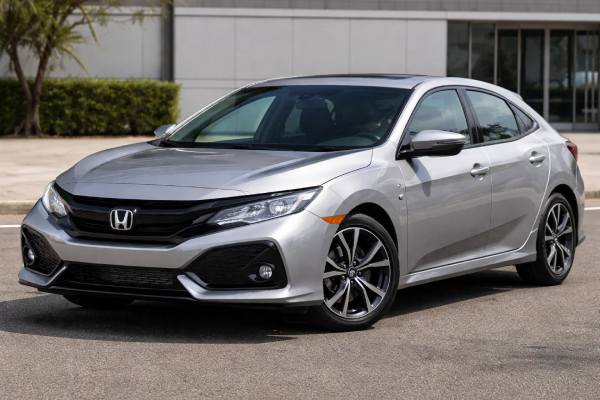
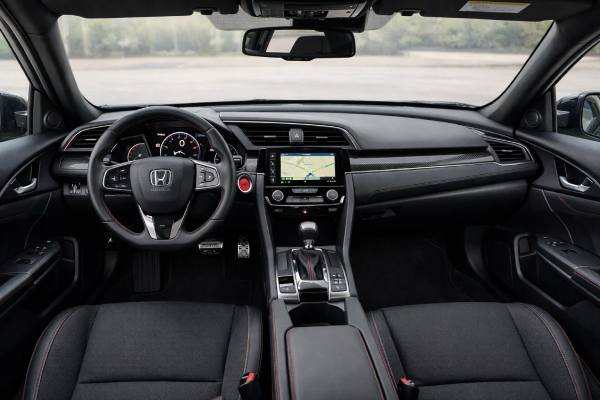
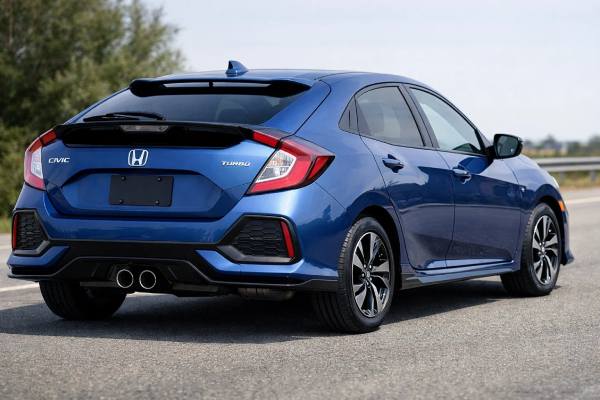
The 10th-gen Honda Civic hatchback (FK7) with the L15BA 1.5-liter turbo is the “sweet spot” Civic for many owners: quick enough to feel special, efficient enough to daily, and practical enough to replace a small wagon. The direct-injected turbo engine delivers strong mid-range torque, so the car feels effortless in real traffic—especially on hills and when passing—without needing high revs. Underneath, the FK7’s rigid body, multi-link rear suspension, and confident braking give it a planted, grown-up character compared to many compact rivals.
Ownership is mostly straightforward, but the L15 turbo family rewards good habits: correct oil, sensible warm-up, and attention to service intervals. If you’re shopping used, condition and maintenance history matter more than trim badges—because the best FK7 is the one that’s been serviced on time and driven regularly.
Owner Snapshot
- Strong real-world pull from low rpm; easy overtakes without downshifts.
- Practical hatch packaging with a genuinely usable cargo area for the class.
- Stable chassis with confident high-speed control and predictable braking.
- Turbo direct-injection needs disciplined oil changes; short-trip use is harder on it.
- Plan on engine oil service about every 10,000–12,000 km (6,000–7,500 mi) or 12 months (whichever comes first).
Navigate this guide
- FK7 1.5 turbo in context
- L15BA technical specifications
- Equipment grades and safety tech
- Reliability patterns and fixes
- Service schedule and purchase checks
- Driving character and efficiency
- FK7 rivals and alternatives
FK7 1.5 turbo in context
The FK7 Civic hatchback is the practical branch of the 10th-generation Civic family: lower and sportier than many compact hatches, but with everyday ground clearance and a wide-opening tailgate. In 1.5 turbo form, it’s also the most “complete” non-Type-R Civic of the era, because the extra torque suits the hatch’s slightly heavier body and real-world usage (passengers, luggage, motorway cruising).
The L15BA is a modern small turbo gasoline engine: aluminum block and head, DOHC valvetrain, direct injection, an intercooler, and variable valve timing. In simple terms, it makes its power efficiently by forcing more air into a smaller engine, then controlling combustion precisely with high-pressure fuel injection. The payoff is a flat, usable torque curve—so you don’t have to rev it like older naturally aspirated Civics to make progress.
Most FK7s are front-wheel drive with either a 6-speed manual or a CVT (continuously variable transmission). The manual suits drivers who like involvement and predictable engine braking. The CVT suits commuters who value smoothness and easy acceleration in traffic, but it demands fresh fluid and gentle heat management if you keep the car long-term. Either way, the chassis is a strength: the car tracks straight at speed, resists crosswinds well for its size, and feels more stable than many “tall-roof” hatchbacks.
From an ownership standpoint, this is a car that likes being used. Regular longer drives help keep fluids warm and evaporate moisture in the oil. A FK7 that’s only done short cold trips can still be fine, but it should have very consistent oil servicing and a clean service record. If you treat the 1.5 turbo like a small performance engine—warm it up, cool it down after hard driving, and service it on time—it’s typically a durable daily.
L15BA technical specifications
Specs vary by model year, market, emissions equipment, wheels, and transmission. The tables below reflect common FK7 1.5 turbo configurations and are intended for ownership decisions—always verify against the car’s VIN-specific documentation.
Powertrain and efficiency
| Item | Specification |
|---|---|
| Engine code | L15BA |
| Layout | Inline-4, aluminum block/head, DOHC |
| Valvetrain | 16 valves (4/cyl), variable timing (market-dependent details) |
| Bore × stroke | ~73.0 × 89.4 mm (2.87 × 3.52 in) |
| Displacement | 1.5 L (1,498 cc) |
| Induction | Turbocharged, intercooled |
| Fuel system | Direct injection |
| Compression ratio | ~10.3:1 (varies by calibration) |
| Max power | 182 hp (134 kW) @ ~5,500 rpm |
| Max torque | 220–240 Nm (162–177 lb-ft) @ ~1,900–5,000 rpm (varies by transmission/market) |
| Timing drive | Chain |
| Rated efficiency (typical) | ~6.0–7.0 L/100 km (39–47 mpg US / 48–56 mpg UK) depending on cycle and trim |
| Real-world highway @ 120 km/h | ~6.3–7.2 L/100 km (33–37 mpg US / 39–45 mpg UK) |
| Aerodynamics (typical) | Cd ~0.30–0.32, frontal area ~2.1–2.2 m² (varies by wheels/body details) |
Transmission and driveline
| Item | Specification |
|---|---|
| Drive type | FWD |
| Manual | 6-speed (market availability varies) |
| Automatic | CVT (with stepped “shift logic” under load) |
| Differential | Open (traction managed by brake-based stability control) |
Chassis and dimensions
| Item | Specification |
|---|---|
| Suspension (front/rear) | MacPherson strut / Multi-link |
| Steering | Electric power steering (EPS) |
| Brakes (typical) | Ventilated front discs / rear discs (size varies by trim) |
| Wheels/tyres (common) | 215/50 R17 or 235/45 R18 |
| Ground clearance (typical) | ~130 mm (5.1 in) |
| Length / width / height (typical) | ~4,518 / 1,799 / 1,434 mm (177.9 / 70.8 / 56.5 in) |
| Wheelbase | ~2,697 mm (106.2 in) |
| Turning circle (kerb-to-kerb) | ~11.0 m (36.1 ft) |
| Kerb weight (typical) | ~1,300–1,420 kg (2,866–3,131 lb) depending on transmission/trim |
| Fuel tank | ~46 L (12.2 US gal / 10.1 UK gal) |
| Cargo volume (typical) | ~420 L (14.8 ft³) seats up; ~1,200 L (42.4 ft³) seats down (method varies by market) |
Performance and capability (typical)
| Item | Specification |
|---|---|
| 0–100 km/h (0–62 mph) | ~8.0–8.6 s (trim and transmission dependent) |
| Top speed | ~210–220 km/h (131–137 mph) |
| Braking 100–0 km/h (typical test range) | ~36–39 m (118–128 ft) with good tyres |
| Towing / payload | Market- and approval-dependent; verify the VIN plate and handbook |
Fluids, service capacities, and key torques (common ranges)
| Item | Typical spec (verify by VIN/market) |
|---|---|
| Engine oil | 0W-20 (API/ACEA per market); capacity typically ~3.7–4.0 L (3.9–4.2 US qt) with filter |
| Coolant | Honda-type long-life coolant; capacity typically ~5–6 L (5.3–6.3 US qt) |
| CVT fluid | Honda CVT fluid (market spec varies); capacity varies by service method |
| Manual gearbox oil | MTF-type fluid; capacity varies by gearbox code |
| A/C refrigerant | R-134a or R-1234yf depending on year/market; charge is label-specific |
| Wheel lug nuts | Typically ~108 Nm (80 lb-ft) |
| Oil drain plug | Typically ~39 Nm (29 lb-ft) |
Electrical and ignition (typical)
| Item | Specification |
|---|---|
| 12 V battery | Size and CCA vary by market |
| Spark plugs | Iridium type; gap and part number are VIN-specific (commonly ~0.7–0.8 mm) |
| Alternator output | Market-dependent |
Safety and driver assistance
| Item | Specification |
|---|---|
| Euro NCAP | 5 stars (example listing shows Adult 92% / Child 75% / VRU 75% / Safety Assist 88%, depending on assessment configuration) |
| IIHS | Ratings vary by year and headlight fitment; verify the exact test year and trim |
| ADAS suite | Honda Sensing availability varies by market/year: AEB, ACC, lane support, sign recognition, and more (see next section) |
Equipment grades and safety tech
FK7 trim names differ by country, but the “shape” of the lineup is consistent: a value-focused base, one or two mid trims with the best comfort-per-dollar, and a higher trim that adds wheels, lighting upgrades, and driver-assistance features. When you’re shopping used, it’s smarter to focus on the equipment that affects ownership (lights, tyres, ADAS sensors, seating durability) rather than badge prestige.
Trims and options that matter for owners
- Wheels and tyres: 17-inch setups usually ride better and cost less to replace; 18-inch setups can sharpen turn-in but increase tyre cost and pothole risk.
- Headlights: LED headlights (if fitted) can improve night driving and reduce bulb changes, but assemblies are expensive if damaged.
- Infotainment: some model years have smoother software and better phone compatibility; check boot time, Bluetooth stability, and camera response.
- Comfort hardware: heated seats, dual-zone climate control, parking sensors, and a better audio system are common “live with it every day” upgrades.
- Suspension tuning: some markets offer sport-tuned suspension or adaptive damping on certain grades. If fitted, test for knocks and confirm dampers are dry (no leaks).
Quick identifiers for the 1.5 turbo hatch
- The engine code is the most reliable identifier; check the registration documents and the engine stamping/label.
- Many markets badge the car as 1.5 VTEC TURBO or similar.
- Road test feel is a clue: the 1.5 turbo pulls strongly from ~2,000 rpm with less need to rev than a small naturally aspirated engine.
Safety systems and ADAS (what to verify)
Most FK7s include the basics: stability control, traction control, ABS, brake assist, and multiple airbags. The bigger variation is driver assistance:
- AEB (automatic emergency braking): often radar + camera based; verify it has no warning lights and that the front radar area isn’t cracked or poorly repaired.
- ACC (adaptive cruise control): test smoothness at low speeds and confirm it tracks vehicles consistently.
- Lane support (LKAS/LKA/LPA): should recognize lane markings without constant dropouts in normal conditions.
- Traffic sign recognition and speed limiter: market dependent; confirm it reads signs accurately after windshield replacements.
A practical note: windscreen replacement, wheel alignment, or front-end repairs can require ADAS calibration. When shopping used, ask for invoices that show calibration was performed—not just that a windshield was installed.
Reliability patterns and fixes
The FK7 platform is generally robust, but the L15 turbo family and modern electronics bring a few repeat themes. Below is a prevalence-and-severity view that helps prioritize what to inspect and budget for.
Common (check every car)
- Air conditioning performance issues (medium cost):
Symptoms: weak cooling, oily residue near condenser, frequent top-ups.
Likely cause: condenser or seal leakage (varies by year/market).
Remedy: leak test, replace leaking component, evacuate and recharge to the under-hood label spec. - Brake wear tied to driving style (low to medium):
Symptoms: vibration under braking, squeal, uneven pad wear.
Likely cause: city driving, cheap pads, seized slide pins.
Remedy: clean and lubricate slide pins, use quality pads, flush brake fluid on schedule. - Front suspension knocks on rough roads (low to medium):
Symptoms: clunks over potholes, vague steering over broken surfaces.
Likely cause: wear in drop links, bushings, or top mounts (mileage dependent).
Remedy: targeted replacement after a proper inspection—not guesswork.
Occasional (more likely with short trips or poor service)
- Fuel dilution in engine oil (medium to high if ignored):
Symptoms: rising oil level, fuel smell on dipstick, rough cold running.
Likely cause: repeated short cold trips prevent evaporation; some calibrations are more sensitive.
Remedy: shorten oil-change intervals, ensure regular fully-warm drives, confirm the latest ECU updates applicable to the VIN, and investigate misfires or injector issues if drivability is poor. - Direct-injection deposit build-up (medium):
Symptoms: hesitation, rough idle, reduced economy at higher mileage.
Likely cause: DI engines don’t wash intake valves with fuel; deposits can accumulate.
Remedy: diagnose first (don’t “parts cannon”); intake cleaning methods vary—use reputable procedures. - CVT behavior complaints (medium):
Symptoms: shudder, flare, or odd rpm behavior under load.
Likely cause: aged fluid, overheating, or poor prior service practices.
Remedy: correct fluid service at sensible intervals; confirm no stored transmission codes; avoid repeated full-throttle starts on hot days.
Rare but expensive (worth screening)
- Turbo hardware faults (high):
Symptoms: persistent smoke, whistling, underboost codes, limp mode.
Likely cause: boost leaks, wastegate/control issues, or oiling problems.
Remedy: smoke test intake plumbing, verify boost control operation, and confirm oil quality and history before condemning the turbo.
Recalls, TSBs, and how to verify
Because campaigns vary by market and build date, treat verification as a process:
- Run an official VIN check (local Honda site or official recall portals where available).
- Ask the seller for dealer service printouts showing campaign completion.
- Match the car’s behavior to paperwork: if a car has known service actions but no records, assume you’ll need to confirm (and possibly pay for) updates.
For buyers, the big takeaway is simple: a well-maintained FK7 is usually a dependable long-term hatch, but neglect shows up faster on turbo DI engines than it did on older naturally aspirated Civics.
Service schedule and purchase checks
A strong maintenance routine is the difference between a “just runs” FK7 and one that becomes fussy with warning lights and drivability issues. The schedule below is conservative and owner-friendly; always follow the VIN-specific handbook and local service bulletins.
Practical maintenance schedule (street-driven car)
| Item | Interval (distance/time) | Notes |
|---|---|---|
| Engine oil and filter | 10,000–12,000 km (6,000–7,500 mi) or 12 months | Short trips/cold climate: shorten interval. Use correct 0W-20 spec for your market. |
| Tyre rotation and inspection | 10,000–12,000 km | Helps avoid uneven wear, especially on 18-inch tyres. |
| Cabin air filter | 15,000–20,000 km or yearly | Replace sooner in dusty cities. |
| Engine air filter | 30,000–40,000 km | Inspect more often if you drive dirt roads. |
| Brake fluid | Every 3 years | Moisture is the enemy; flush on time. |
| Spark plugs | ~100,000 km (60,000+ mi) | Use the correct iridium plugs and torque properly. |
| Coolant | Often 10 years/200,000 km first, then 5 years/100,000 km | Verify the exact coolant type and interval for your market. |
| CVT fluid (if equipped) | 50,000–60,000 km (rule-of-thumb) | Earlier if driven hard, hot, or in heavy traffic. Use only approved fluid. |
| Manual gearbox oil (if equipped) | 60,000–80,000 km | Fresh oil helps shift quality and synchro life. |
| 12 V battery test | Yearly after 3–4 years | Modern cars are sensitive to low voltage. |
Buyer’s checklist (what to inspect and test-drive)
- Cold start: listen for abnormal rattles; idle should settle quickly without hunting.
- Oil level and smell: check for overfull oil or strong fuel odor; confirm the seller’s oil-change cadence.
- Cooling system: look for dried coolant traces, damp hose ends, or inconsistent heater output.
- Turbo plumbing: inspect rubber couplers and clamps for oil misting and looseness; minor mist is common, heavy wetness is not.
- Transmission behavior:
- CVT: smooth pull-away, no shudder, consistent acceleration.
- Manual: clutch engagement should be clean; check for high bite point or slipping in a high-gear pull.
- ADAS and cameras: confirm no warning lights; ensure the windshield area around the camera looks professionally fitted.
- Underbody and hatch area: check for impact damage, corrosion on exposed fasteners, and signs of poor repairs.
What years and setups to favor
- Facelift-era cars (market-dependent timing) often have improved infotainment behavior and equipment packaging.
- If you value long-term running costs, 17-inch wheel cars are usually the sweet spot.
- For heavy commuting, a well-serviced CVT can be excellent; for long ownership and simplicity, the 6-speed manual is often easier to keep happy.
Driving character and efficiency
On the road, the FK7 1.5 turbo feels like a larger car than its class suggests. The chassis is stable at motorway speeds, the steering is quick enough to place the car confidently, and the rear multi-link suspension helps it stay composed on imperfect surfaces. Ride quality depends heavily on wheel size: 17-inch setups usually round off harsh edges better, while 18-inch packages can feel busier on broken pavement.
Powertrain feel (manual vs CVT)
- Low-rpm response: the turbo brings meaningful pull from around 2,000 rpm, which is where you live in real commuting.
- Turbo lag: present but modest; you’ll notice it most when you demand full torque suddenly at very low rpm.
- Manual: more engaging, clearer control on descents, and generally less “rubber band” sensation.
- CVT: smooth and efficient when driven progressively; under hard throttle it can hold rpm high, which some drivers interpret as noise rather than speed.
Real-world efficiency
Expect fuel economy to vary widely with speed and temperature:
- City: ~7.8–9.0 L/100 km (26–30 mpg US / 31–36 mpg UK)
- Highway (100–120 km/h): ~6.3–7.2 L/100 km (33–37 mpg US / 39–45 mpg UK)
- Mixed: ~6.8–8.0 L/100 km (29–35 mpg US / 35–42 mpg UK)
Cold weather and repeated short trips typically raise consumption and can also increase oil contamination risk on small turbo DI engines, which is why “getting it fully warm” is more than a comfort issue—it’s a longevity habit.
Selective performance metrics (typical)
- 0–100 km/h: ~8.0–8.6 s depending on tyres and transmission
- 80–120 km/h passing: strong for class; the engine’s torque makes it feel effortless
- Braking feel: generally consistent; pedal confidence depends on pad quality and fluid freshness
- Traction: front-wheel drive is predictable; good tyres matter more than power on wet roads
For most owners, the key performance story is not lap times—it’s how easily the FK7 maintains speed on grades, merges without drama, and stays calm at higher cruising speeds.
FK7 rivals and alternatives
The FK7 Civic 1.5 turbo competes in a crowded “do-everything” hatchback class. Its strongest angle is breadth: it’s roomy, stable, and brisk, without demanding premium running costs if it’s maintained properly.
How it stacks up against common rivals
- Volkswagen Golf 1.5 TSI: typically more understated inside and often feels more refined at low speeds; the Civic usually offers more dramatic styling and a lively chassis feel. Golf parts availability is strong, but ownership costs can rise with option-heavy cars.
- Ford Focus 1.5 EcoBoost: often excellent steering and balance; depending on generation and transmission, long-term reliability perception varies. The Civic’s cabin packaging and highway stability are frequent advantages.
- Mazda3 (2.0/2.5 NA): usually quieter and more “premium” in cabin presentation, with simpler naturally aspirated powertrains in many markets. The Civic’s turbo torque makes passing easier, while the Mazda often wins for interior polish.
- Hyundai i30 / Kia Ceed turbo models: often strong value and straightforward usability, sometimes with longer warranties depending on market. The Civic counters with sharp dynamics and strong real-world performance.
- Toyota Corolla (including hybrid): hybrid variants can win for urban fuel economy and smoothness. The Civic tends to feel more eager and engaging, especially at higher speeds and during passing.
Which one is best for which driver?
- Choose the FK7 1.5 turbo if you want a fast-feeling daily that can do long motorway days, carry real cargo, and still be enjoyable on a back road.
- Consider a hybrid Corolla if your use is mostly city traffic and you prioritize low fuel spend over passing performance.
- Consider a Mazda3 if you prioritize cabin feel and a simpler non-turbo powertrain (market dependent).
- Consider a Golf if you want a more conservative design and a strong ecosystem of parts and specialists.
The Civic’s big advantage is that it rarely forces a compromise: it’s quick enough, practical enough, and composed enough that it can be your only car—provided you keep the turbo DI maintenance disciplined.
References
- Euro NCAP | Latest Safety Ratings 2025 (Safety Rating)
- Owners manuals | Honda Canada 2025 (Owner’s Manual Portal)
- Honda CIVIC Owner’s Guide 2019 (Owner’s Guide)
Disclaimer
This article is for informational purposes only and is not a substitute for professional diagnosis, repair, or model-specific service instructions. Specifications, torque values, service intervals, and procedures can vary by VIN, market, model year, and equipment—verify all details in your official owner’s literature and service documentation before performing work.
If this guide helped, please consider sharing it on Facebook, X (Twitter), or your favorite forum to support our work.