
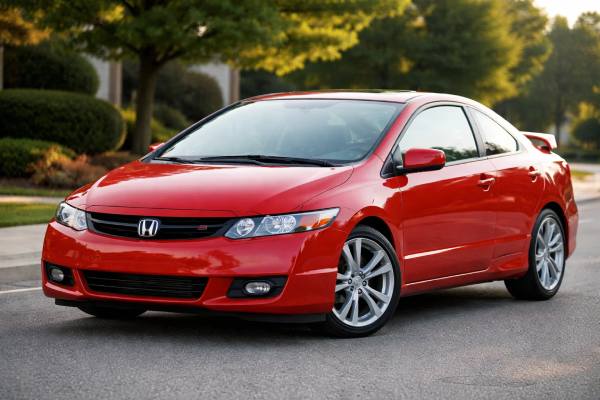
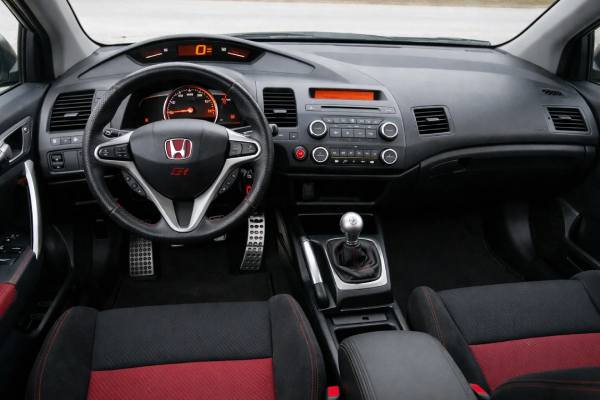
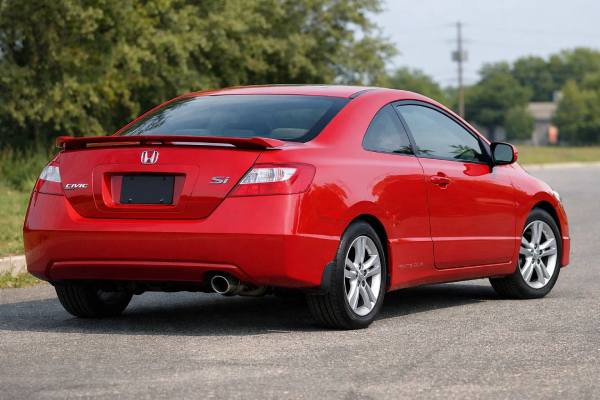
The 2006–2011 Honda Civic Si coupe (FG2) is the “high-rev” Civic many enthusiasts still recommend because its engineering priorities are clear: a strong K-series four-cylinder, a close-ratio 6-speed manual, and a chassis tuned to stay composed when driven hard. The K20Z3’s character is the headline—smooth at low load, then eager as cam profiles and intake flow come alive at higher rpm. Unlike many modern sport compacts, the FG2 is also relatively simple to own: naturally aspirated, timing chain, and widely supported with parts and service knowledge.
That said, it rewards owners who treat it like a performance car, not just a commuter. Gearbox health depends on shifting habits and fluid condition, and the suspension and mounts wear faster on rough roads or modified setups. Buy well, maintain it on schedule, and it can be both fun and durable.
What to Know
- A high-rpm powerband and close-ratio 6-speed make it engaging, especially above 5,500 rpm.
- The factory limited-slip differential (where equipped/marketed) improves corner-exit traction in real driving.
- Strong aftermarket and parts availability keep long-term ownership manageable.
- Watch for 2nd/3rd gear synchro wear and clutch hydraulics if the car was driven aggressively.
- Change engine oil about every 8,000 km (5,000 mi) or 6 months under spirited use.
Quick navigation
- FG2 Civic Si in context
- K20Z3 specs and dimensions
- FG2 trims, safety, and tech
- Common problems and recalls
- Maintenance plan and buying tips
- How it drives daily
- Rivals and best alternatives
FG2 Civic Si in context
The eighth-generation Civic platform marked a big change for Honda: stiffer structure, more modern electronics, and a more “grown-up” cabin layout, while the Si kept the old-school recipe of a naturally aspirated engine and a manual gearbox that wants to be used. In coupe form (FG2), the Civic Si sits in a sweet spot for size and weight—large enough to feel stable on the highway, still compact enough to place accurately on a back road.
Engineering-wise, the FG2’s appeal is balance. The K20Z3 is not a torque-heavy engine at low rpm, so the car relies on gearing and driver intent. Honda leaned into that with a close-ratio 6-speed. This shapes the whole experience: you don’t “surf” torque; you choose gears, keep it in the powerband, and the car responds cleanly. That also means the FG2 can feel ordinary if you short-shift and stay below the midrange. Owners who love it usually enjoy the process—precision inputs, a clear reward when driven properly, and a chassis that doesn’t punish you for using all of it.
From an ownership standpoint, the FG2 has a practical advantage over many turbo rivals of the era: fewer heat-related complications and simpler intake/exhaust packaging. It is also well supported by independent shops because K-series service procedures are common and parts supply remains strong. However, the same strengths that make it fun can tempt hard use. Many cars were modified, tracked, or simply driven with aggressive shifting. A good FG2 is less about chasing the lowest mileage and more about finding one with clean fluid history, stock-ish calibration, and evidence the gearbox and clutch were treated with respect.
In short: the FG2 is for drivers who value consistency and feel over outright straight-line punch. Kept close to factory spec and maintained on time, it remains one of the more “honest” sport compacts of its generation.
K20Z3 specs and dimensions
Below are the core specifications typically associated with the 2006–2011 Civic Si coupe (FG2). Exact figures can vary slightly by market, emissions configuration, and wheel/tire fitment.
Powertrain and efficiency
| Item | Specification |
|---|---|
| Engine code | K20Z3 |
| Layout and valvetrain | I-4, DOHC, i-VTEC, 4 valves/cyl |
| Bore × stroke | 86.0 × 86.0 mm (3.39 × 3.39 in) |
| Displacement | 2.0 L (1,998 cc) |
| Induction | Naturally aspirated |
| Fuel system | Port injection (PGM-FI / MPFI) |
| Compression ratio | ~11.0:1 |
| Max power | 197 hp (147 kW) @ ~7,800 rpm |
| Max torque | 188 Nm (139 lb-ft) @ ~6,200 rpm |
| Timing drive | Chain |
| Rated efficiency (EPA typical) | ~9.8 L/100 km combined (24 mpg US / 29 mpg UK) |
| Real-world highway @ 120 km/h (75 mph) | ~8.5–9.5 L/100 km (25–28 mpg US / 30–34 mpg UK) |
| Aerodynamics | Cd not consistently published; typical ~0.31–0.33 for this class |
Transmission and driveline
| Item | Specification |
|---|---|
| Transmission | 6-speed manual |
| Drive type | FWD |
| Differential | Limited-slip differential commonly equipped on Si; verify by VIN/market |
Chassis and dimensions
| Item | Specification |
|---|---|
| Suspension (front/rear) | MacPherson strut / independent multi-link |
| Steering | Electric power steering (EPS) |
| Brakes (front/rear) | Ventilated disc / disc (sizes vary by market) |
| Typical wheels/tires | 215/45 R17 (17-in rim) |
| Length / width / height | ~4,438 / 1,752 / 1,394 mm (~174.7 / 69.0 / 54.9 in) |
| Wheelbase | ~2,700 mm (~106.3 in) |
| Turning circle | ~10.9 m (~35.8 ft) |
| Curb weight | ~1,320–1,360 kg (~2,910–3,000 lb) |
| Fuel tank | ~50 L (13.2 US gal / 11.0 UK gal) |
| Cargo volume | Coupe trunk size varies by measurement method; verify by market |
Performance and capability
| Metric | Typical real-world result |
|---|---|
| 0–100 km/h (0–62 mph) | ~6.8–7.3 s |
| 0–60 mph | ~6.5–7.0 s |
| Top speed | ~210–220 km/h (~130–137 mph), market dependent |
| Braking 100–0 km/h | ~37–40 m (approx. 121–131 ft from 60–0 mph) |
| Towing and roof load | Generally not rated for towing in many markets; check owner documentation |
Fluids and service capacities (decision-useful)
| Fluid | Specification (typical) | Capacity (approx.) |
|---|---|---|
| Engine oil | 5W-20 meeting Honda spec/API standards | ~4.2 L (~4.4 US qt) with filter |
| Coolant | Honda Type 2 premix or equivalent | ~5.0–5.5 L (~5.3–5.8 US qt) |
| Manual trans | Honda MTF or approved equivalent | ~1.8–2.0 L (~1.9–2.1 US qt) |
| A/C refrigerant | R-134a | label varies; verify under-hood sticker |
Key torque specs (critical fasteners only)
| Fastener | Torque |
|---|---|
| Wheel lug nuts | ~108 Nm (80 lb-ft) |
| Engine oil drain plug | ~39 Nm (29 lb-ft) |
| Spark plugs | ~18 Nm (13 lb-ft) |
Safety and driver assistance (era-correct)
| Item | Notes |
|---|---|
| Airbags | Front, front side, and side curtains (typical for this generation) |
| Stability control | Electronic stability control commonly standard on Si (market dependent) |
| IIHS (2006–2011 applicability) | Moderate overlap front: Good; Side: Acceptable; Head restraints and seats: Good (seat design notes apply—verify Si seat specifics) |
FG2 trims, safety, and tech
Most buyers encounter the FG2 in a fairly straightforward configuration: “Si” typically means the K20Z3 engine, 6-speed manual, sport seats, and the sport-tuned suspension baseline. Where the details change is in market packaging and year-to-year equipment updates.
Trims and options you will actually see
Common identifiers for an FG2 Si include the redline-focused tach, sport seats with heavier bolstering, a factory rear spoiler on many cars, and 17-inch wheels. Options often show up as comfort and appearance items rather than mechanical changes—think upgraded audio, satellite capability, navigation in some years/markets, and interior trim variations. Practical advice: treat “options” as value items, not performance upgrades. The mechanical condition of the engine mounts, gearbox, and suspension matters more than whether the head unit is factory.
If you are shopping across years, pay attention to small revisions that affect ownership:
- Audio and infotainment revisions can change how easily you integrate modern phone features.
- Wheel finishes and tire brands can subtly change ride harshness and road noise.
- Previous-owner modifications (intakes, headers, tunes) have a bigger impact than minor factory equipment changes.
Safety ratings: what applies and what doesn’t
For North American shoppers, the most useful data point is IIHS testing for the 2006–2011 generation. The Civic coupe’s moderate overlap front rating is strong for the era, and side performance is typically “acceptable” in the original side test, assuming curtain and torso airbags are present and functional. That “assuming” is important: verify the car has not had airbag-related recalls ignored, and check that the SRS light proves out correctly at startup.
NHTSA ratings for 2011 are complicated by a major testing overhaul that year. You may see lower star scores for some 2011 Civics—especially in side impact—because the revised protocol was tougher and added new injury criteria. Treat star ratings as configuration-specific: body style, equipment, and test version matter.
Euro NCAP ratings are generally not directly transferable to the FG2 because Euro NCAP tests a specific European-market configuration and test year. Use Euro NCAP only as broad context for Honda’s general safety engineering, not as a direct FG2 scorecard.
Driver assistance and active safety reality check
This generation predates modern ADAS features such as automatic emergency braking (AEB), adaptive cruise control (ACC), and lane centering. Your “assist systems” are mostly fundamentals:
- ABS with electronic brake distribution
- Stability control and traction control
- Tire quality and alignment (often overlooked, but decisive)
If you want an FG2 as a daily driver, the best “upgrade” for real-world safety is maintenance: fresh tires, correct brake fluid intervals, and ensuring all recall work is complete.
Common problems and recalls
A well-kept FG2 can be reliable, but it has predictable weak points—especially as mileage, age, and enthusiastic driving accumulate. The most useful way to think about issues is by prevalence and by cost tier.
Common (plan for it)
- 2nd/3rd gear synchro wear or gear grind (medium cost).
Symptoms: crunch or resistance on fast 2–3 upshifts, worse when cold; occasional pop-out under load.
Likely cause: synchro wear from aggressive shifting, old fluid, or clutch drag.
Remedy: start with correct manual-trans fluid service and a clutch hydraulic inspection; persistent issues may require gearbox repair. - Engine mounts (low to medium cost).
Symptoms: wheel hop, clunk on throttle transitions, vibration at idle.
Likely cause: mount rubber fatigue accelerated by hard launches or stiffer aftermarket inserts.
Remedy: replace worn mounts; avoid mixing very stiff inserts with old mounts. - Suspension consumables (low to medium cost).
Symptoms: front-end clunks, vague steering on-center, uneven tire wear.
Likely cause: struts, end links, bushings, and ball joints aging.
Remedy: refresh in sets; align after any suspension work.
Occasional (inspect carefully)
- Clutch master/slave cylinder issues (low to medium cost).
Symptoms: inconsistent engagement point, difficulty selecting gears, pedal feel changes.
Cause: seal wear and moisture-contaminated brake fluid.
Remedy: bleed/flush, then replace hydraulics if symptoms return. - VTEC solenoid and gasket seepage (low cost).
Symptoms: oil film near the solenoid area, occasional oil smell.
Remedy: replace gasket and clean mating surfaces; confirm no oil level neglect. - A/C system repairs (medium cost).
Symptoms: weak cooling, intermittent compressor cycling.
Remedy: leak test and repair correctly; avoid repeated “top-offs.”
Rare but expensive (don’t ignore)
- Heavily modified or poorly tuned cars (high cost).
Symptoms: knock, overheating, persistent check-engine lights, emissions failures.
Cause: aggressive ignition timing, lean fuel targets, cheap components, or heat management issues.
Remedy: return to a known-good calibration and inspect engine health before spending on upgrades.
Recalls, TSBs, and how to verify
For 2006–2011 Hondas, airbag recalls are a major theme across the industry. Even if the car seems fine, outstanding recall work is a deal-breaker. Verification steps:
- Run the VIN through the official recall database for your country.
- Ask for dealer documentation showing completion dates.
- Confirm the SRS indicator behaves normally at key-on.
Also watch for service bulletins related to drivability, updated parts, and known noise/vibration fixes. These are not always “recalls,” but they can change how the car feels and how much you spend after purchase.
Maintenance plan and buying tips
The FG2 responds best to maintenance that matches how the car is used. If it’s a weekend car that sees high rpm, shorten intervals. If it’s a commuter, focus on fluids, rubber parts, and corrosion prevention.
Practical maintenance schedule (distance or time)
- Engine oil and filter: every 8,000–10,000 km (5,000–6,000 mi) or 6 months if driven hard; up to the manufacturer schedule for gentle use.
- Engine air filter: inspect every oil change; replace about 24,000–40,000 km (15,000–25,000 mi) depending on dust.
- Cabin air filter: about 20,000–30,000 km (12,000–18,000 mi) or yearly for air quality.
- Manual transmission fluid: every 48,000–80,000 km (30,000–50,000 mi); shorten if you track the car or shift aggressively.
- Brake fluid: every 3 years (moisture control matters more than mileage).
- Coolant: follow the Honda schedule; many owners plan around 5 years for the first service, then shorter thereafter.
- Spark plugs: typically 160,000 km (100,000 mi) for iridium, but inspect earlier if modified or misfiring.
- Valve clearance: inspect/adjust around 160,000–180,000 km (100,000–110,000 mi) or sooner if you hear ticking, lose power, or see misfire codes.
- Serpentine belt and hoses: inspect yearly; replace at first cracking or coolant seepage.
- 12 V battery: test annually after year 3; many last 4–6 years depending on climate.
Fluids and parts: keep it simple
Use the correct oil viscosity and a quality filter, and do not “experiment” with transmission fluid. For the FG2, the gearbox feel is sensitive to fluid type and condition; the correct MTF is a low-cost way to protect synchros.
Buyer’s guide: inspection checklist
- Gearbox behavior cold and hot: perform multiple 2–3 shifts at moderate load; note any crunch, notch, or pop-out.
- Clutch engagement consistency: check for high engagement point, slipping under full throttle, or difficulty selecting reverse.
- Mounts and wheel hop signs: look for torn rubber, clunks, and evidence of hard launches.
- Cooling system health: steady operating temperature, clean coolant, no crust at hose joints.
- Oil leaks: valve cover area, VTEC solenoid region, and oil pan edges.
- Electrical sanity: all warning lights prove out; no lingering SRS or ABS lights.
- Body and underbody corrosion: check rear arches, rocker seams, and suspension mounting points in salted climates.
- Modification quality: prefer stock or lightly modified with documentation; avoid unknown tunes.
Long-term durability outlook
A stock-ish FG2 with clean fluids, completed recalls, and a healthy gearbox can age well. The biggest “unknown” is prior abuse. Buy the best-maintained example you can—even if it costs more—because gearbox and suspension reconditioning can erase any upfront savings.
How it drives daily
The FG2’s on-road personality is defined more by its calibration choices than by raw numbers. It is stable at highway speed, direct in steering response, and predictable under braking—traits that make it easy to trust when you drive it with intent.
Ride, handling, and NVH
On smooth roads, the car feels tight and cohesive, with a chassis that resists sloppy weight transfer. On broken pavement, the sport suspension and shorter tire sidewalls can transmit sharp impacts. That does not make it uncomfortable, but it does mean the FG2 is happier on decent asphalt than on pothole-heavy commutes. Cabin noise is typical for a sporty compact of the era: some road roar on coarse surfaces, with mechanical sound becoming more prominent as rpm rises.
Braking feel is usually firm and consistent when the system is maintained. If pedal travel is long or the bite is inconsistent, it is often fluid condition, pad choice, or sliding hardware—not an inherent design flaw.
Powertrain character and shift quality
At low rpm, the K20Z3 feels competent rather than forceful. The “point” of the engine arrives as airflow and cam control do their work higher in the rev range. That creates a distinctive rhythm: you plan passes with a downshift, and you carry gears longer than you would in a turbo car. When healthy, the 6-speed is precise; when worn or poorly serviced, it becomes notchy—especially in the 2–3 shift.
If the car has an LSD, traction on corner exit improves noticeably in everyday driving. You feel less inside-wheel spin and more ability to apply throttle earlier. With open differential behavior, tire quality becomes even more important for usable grip.
Real-world efficiency
Fuel economy depends heavily on how often you chase the upper rev range. In mixed driving, many owners see economy around the mid-20s mpg (US). Highway cruising can be efficient for a 2.0-liter performance coupe, but sustained high speed and frequent downshifts reduce economy quickly. Cold weather typically adds a noticeable penalty due to warm-up time and denser air.
Selective performance metrics that matter
The FG2’s acceleration is “quick” rather than “fast” by modern standards, but the car feels responsive because the gearing keeps the engine in its useful band. Passing performance is strong when you downshift correctly. In other words, it rewards skilled, deliberate driving more than it flatters lazy throttle inputs.
For a daily driver who wants involvement without constant drama, that is an advantage: you can commute calmly, then enjoy the full character of the car when the road opens up.
Rivals and best alternatives
The FG2 competes best against other sport compacts that were built around driver engagement rather than outright torque. Your ideal alternative depends on what you want more of: power, refinement, traction, or practicality.
Volkswagen GTI (Mk5/Mk6 era)
A GTI is the natural “different flavor” choice: more low-rpm torque (especially in turbo form), a more insulated cabin, and a more mature ride. The tradeoff is complexity—turbo heat management, more involved intake and emissions hardware, and potentially higher long-term repair costs. Choose GTI if you want effortless midrange and a quieter daily experience.
Mazda Mazdaspeed3
The Mazdaspeed3 delivers strong straight-line speed and punchy torque, but it is front-wheel drive with a more aggressive torque-steer personality and a different refinement level. It can feel faster with less effort than the FG2, but it may require more attention to traction, tire selection, and drivetrain condition. Choose it if you want the “hit” of boost and accept the added stress on components.
Subaru WRX (same era)
The WRX brings all-wheel drive traction and year-round confidence, which can be a decisive advantage in wet or snowy climates. The cost is more drivetrain complexity and a different maintenance profile. Choose WRX if you prioritize traction and tuneability over simplicity.
Chevrolet Cobalt SS (turbo era)
The Cobalt SS (turbo) is quick and surprisingly capable, with strong torque and good performance value. Ownership can be more variable depending on prior modifications and regional parts support. Choose it if you want peak performance-per-dollar and you can verify condition carefully.
Acura RSX Type S and Civic Si sedan (FA5)
If you like Honda’s approach but want a different body shape, the RSX Type S offers a similar high-rev philosophy in an older package, while the Civic Si sedan (FA5) shares much of the FG2’s mechanical character with more rear-seat practicality. Choose FA5 if you want the same core experience with a more useful cabin.
Bottom line
Pick the FG2 if you value a naturally aspirated response, a manual gearbox-focused driving style, and long-term serviceability. Choose a turbo rival if you want effortless speed and midrange torque. Choose AWD if traction is your priority. In today’s market, condition matters more than brand: a clean, stock-ish FG2 is often a better purchase than a more powerful alternative with unknown tuning history.
References
- 2011 CIVIC COUPE Owner’s Manual (Unlinked) 2010 (Owner’s Manual)
- 2011 Honda Civic 2025 (Safety Rating)
- Vehicle Detail Search – 2011 HONDA CIVIC 2 DR FWD 2025 (Recall Database)
- Gas Mileage of 2011 Honda Civic 2025 (Official Fuel Economy Data)
Disclaimer
This article is for informational purposes only and is not a substitute for professional inspection, diagnosis, or repair. Specifications, torque values, fluid capacities, service intervals, and procedures can vary by VIN, market, model year, and installed equipment; always confirm details using the official owner’s manual, service information for your exact vehicle, and qualified technicians.
If you found this guide helpful, please consider sharing it on Facebook, X (Twitter), or your favorite forum to support our work.